REVIEW 3 major objections 5 minor 2 references
Heterogeneous Earnings Effects of the Job Corps by Gender Earnings: A Translated Quantile Approach
T0 review · 3 major / 5 minor · reviewed 2026-08-14 · deepseek-v4-flash
Pith's one-line read The paper claims that existing gender earnings inequality, not Job Corps trainability differences, accounts for 82% of the program's male-favouring effect gap.
desk verdict A fair, clearly written application of translated quantile methods to the Job Corps gender puzzle, whose headline 82% structural share is real but normalization-dependent and statistically fragile; worth a serious referee, not a desk reject. read the letter →
The pith
A machine-rendered reading of the paper's core claim, the machinery that carries it, and where it could break.
The reading
What carries the argument
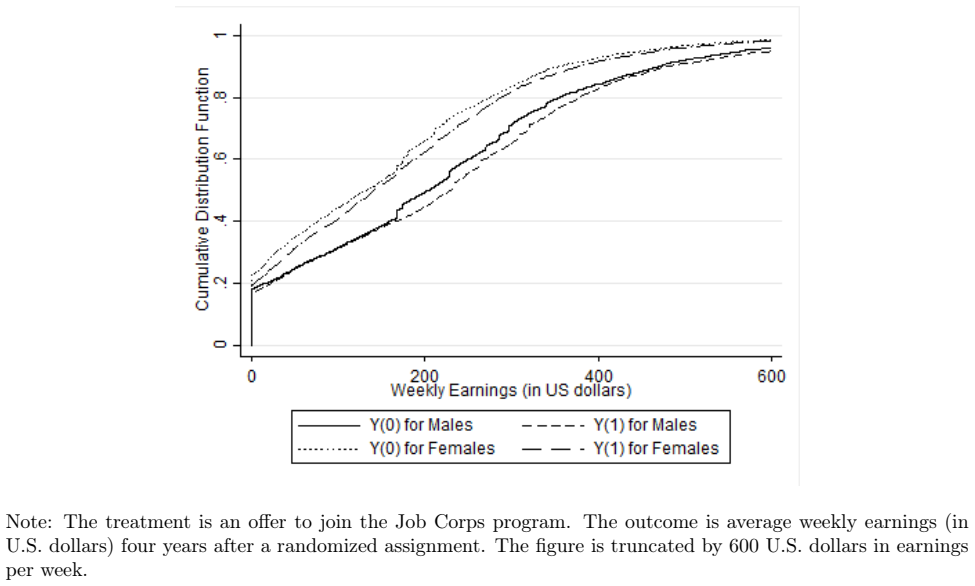
The central object is the translated quantile treatment effect (TQTE), a treatment effect measured not at a group's own quantile rank but at the rank that a given earnings level occupies in a common reference distribution, here the pooled potential earnings distribution of all eligible candidates under non-treatment. Each group's relative rank $\tau_g^r = F_{Y(0)|G}(Q_{Y(0)}(\tau)|g)$ maps conditional ranks onto this reference scale, and the TQTE is the horizontal distance between the conditional potential outcome distributions at that translated rank. Because the same reference earnings level is compared across genders, heterogeneity in TQTEs isolates the 'direct' gender channel, while the gap between the conditional quantile treatment effect and the TQTE, the structural component SQTE, captures the contribution of the gender earnings gap itself. The paper proves two anchor properties that give the split its meaning: TQTE equals CQTE when there is no structural earnings inequality, and TQTE equals the unconditional quantile treatment effect when structural inequality fully accounts for the heterogeneity. The average analogues, TATE and SATE, extend the decomposition to mean effects and produce the headline 82% share.
What would settle it
A direct check is to recompute the decomposition with participants ranked by predicted non-treatment earnings from baseline covariates instead of by observed earnings ranks, the paper itself sketches such a Tobit prediction, and see whether the 82/18 split survives; a split that swings with the choice of reference yardstick would show the structural share is a normalization artifact. A sharper external test applies the same TQTE machinery to a training program with known female-favouring effects: the structural mechanism predicts a mirror-image split, with most of the female advantage explained by the earnings structure, and a null gender gap for programs whose returns do not increase with earnings rank.
Extended reading notes
Core claim
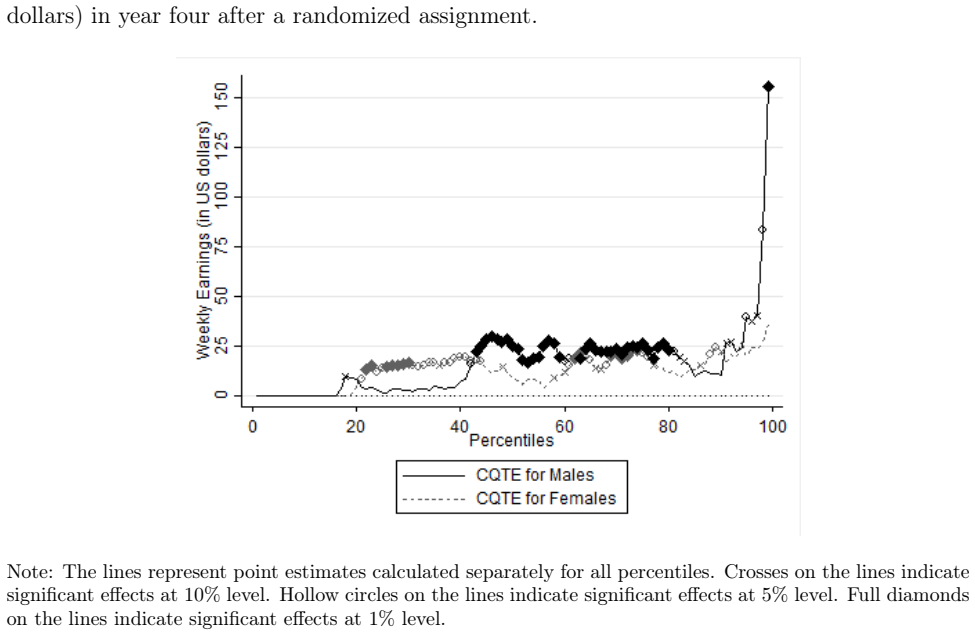
The paper's central claim is that the Job Corps' male-favouring effect heterogeneity operates through the pre-existing gender earnings structure, not through gender differences in trainability. In the experimental data of the National Job Corps Study, an offer to participate raises average weekly earnings four years later by about $15 (8%) overall, about $12 for females versus $18 for males, so the offer widens the average gender earnings gap within the eligible group by about 8%. Applying the translated quantile treatment effect (TQTE), which re-anchors each gender's conditional quantile effects to the pooled non-treatment earnings distribution, the paper attributes 82% of this average effect gap to the structural component (the SATE), leaving only 18% to the direct gender effect that a fair reader would call trainability. Consistent with this, the translated quantile differences between females and males oscillate around zero and are never statistically significant, whereas the untranslated conditional quantile differences are significant at some percentiles. The same decomposition applied by gender and parenthood attributes 71% of the heterogeneity between these groups to differences in their earnings structures.
Load-bearing premise
The decomposition treats rank in the pooled non-treatment earnings distribution as the correct yardstick for labour-market opportunities, and its strict monotonicity assumptions must hold on the support used: if the true mechanism operates through some other scale than potential earnings ranks, the 82% structural share is an artifact of that normalization rather than a measured mechanism.
Editorial extensions
If this is right
- The male advantage of the Job Corps is mostly structural: 82% of the average gender effect gap is attributed to existing earnings inequality and only 18% to trainability differences, and the translated quantile effects for females and males oscillate around zero with no statistically significant differences.
- Randomly offering Job Corps participation raises average weekly earnings by about $15 (8%) and widens the average gender earnings gap within the eligible group by about 8% ($5 out of the $63 non-treatment gap).
- Awarding offers so that the unconditional non-treatment earnings distributions of the selected males and females are balanced would preserve average gains, since the female TATE exceeds the female CATE, while limiting the increase in gender earnings inequality to about 2% instead of 8%.
- The structural channel also dominates the gender-by-parenthood pattern: mothers gain more than fathers and childless men more than childless women, with earnings structure accounting for 71% of that between-group heterogeneity, implying assignment rules should account for within-group earnings structure.
Reading between the lines
- The 82% share is a ratio of statistically insignificant estimates, and the paper does not report uncertainty around the ratio itself; a bootstrap or Bayesian version of the split is the natural next step before the number is used in policy design.
- The mechanism is portable: any program whose returns rise with earnings rank will appear to favour whichever gender sits higher in the earnings distribution, so the same decomposition applied to a female-favouring program should produce a mirror-image structural share.
- Because the reference scale is the pooled non-treatment earnings distribution, the split is only as good as the claim that earnings rank captures labour-market opportunities; re-running the decomposition with participants ranked by predicted earnings from baseline covariates (a version the paper sketches) would test whether the 82% is mechanism or normalization.
- The assignment-rule corollary can be tested without a new experiment: simulate on the existing randomized data alternative offer rules that balance non-treatment earnings ranks by gender and compare average gains and gender-gap impacts with the random assignment benchmark.
Signed reviews
Editorial analysis
A structured set of objections, weighed in public.
Referee Report
Summary. This paper studies gender heterogeneity in the earnings effects of the Job Corps using the National Job Corps Study randomized experiment. Applying the translated quantile treatment effect (TQTE) approach of Bitler, Hoynes, and Domina (2014), the author proposes to decompose the female-male difference in conditional quantile treatment effects into a 'structural' component, arising from differences in the earnings distributions of men and women under non-treatment, and a 'direct' component attributed to gender differences in trainability. The paper extends the TQTE framework to average effects (TATE and SATE) and reports that structural gender earnings inequality accounts for about 82% of the average gender gap in Job Corps effects, while direct trainability differences play a small role. Additional results examine heterogeneity by gender and parenthood. The abstract and conclusions are carefully worded as 'suggestive evidence' and emphasize the statistically insignificant average effects.
Significance. If the central claim is accepted, the paper provides a novel mechanism for the well-documented but puzzling finding that the Job Corps raises male earnings more than female earnings, in contrast to most other active labor market programs. The analytical results showing that TQTE collapses to CQTE when there is no structural inequality and to QTE when structural inequality fully explains heterogeneity are clean and parameter-free. The empirical analysis uses a large-scale randomized experiment, transparent nonparametric estimation, and a battery of robustness checks in the online appendix. The main quantitative conclusion, however, rests on a statistically imprecise and normalization-dependent decomposition, so the significance of the 82% figure is currently more suggestive than conclusive.
major comments (3)
- [Section 5.3, Table 5] The headline claim that structural earnings inequality accounts for 82% of the average gender effect heterogeneity is computed as (SATE_f − SATE_m)/(CATE_f − CATE_m) = −4.28/−5.22. The denominator is the CATE difference of −5.22 with a bootstrap standard error of 7.55, and the TATE difference is −0.95 with standard error 9.22; neither component is statistically significant. No confidence interval or standard error is reported for the ratio itself. The paper should report a bootstrap confidence interval for the ratio and for the implied share (and preferably for the difference SATE_f − SATE_m relative to CATE_f − CATE_m), and should interpret the 82% accordingly. As it stands, the main quantitative claim in the abstract and conclusions is a point estimate whose components are statistically indistinguishable from zero.
- [Section 4.3 and Section 5.4] The decomposition into structural (SQTE/SATE) and direct (TQTE/TATE) components is defined relative to the pooled non-treatment earnings distribution, and the paper itself states in Section 4.3 that 'the choice of reference distribution is obviously crucial, generally, there is no best choice.' Section 5.4 and Appendix C report that alternative reference distributions and relative ranks do not alter results 'qualitatively,' but the quantitative 82% share is not reported for any alternative reference distribution (e.g., male non-treatment, female non-treatment, treatment, or observed outcome distributions). Because the decomposition is by construction a function of the chosen reference distribution, the 82% figure and the associated conclusion that trainability differences play a minor role are normalization-dependent. The paper should report the SATE/TATE decomposition and the implied share under each alternative reference distribution considered in Appendix C, or provide a formal argument for why the pooled non-treatment distribution is the uniquely appropriate reference.
- [Section 4.4 and Appendix B] The estimation excludes all ranks below the 21st percentile because of the mass point at zero earnings, and also truncates relative ranks to [0.01, 0.99]. The definitions of TATE and SATE in Section 4.3 integrate over the full [0,1] interval, but the reported TATE and SATE averages are computed over the truncated support. It is not stated how the integrals are normalized over the truncated range, nor how sensitive the 82% share is to the choice of truncation points (e.g., 10th or 30th percentile). Because the zero-earnings mass is substantial for this population, the paper should clarify the exact support used for the average effects and provide a sensitivity analysis of the decomposition to the truncation rule.
minor comments (5)
- [Section 4.4] The sentence 'This could The standard deviations of all parameters are estimated...' appears to be an incomplete editing artifact and should be corrected.
- [Online Appendix C] Multiple figures in Appendix C share the same numbers (C.1, C.2, C.3, C.4) across different subsections, which makes cross-referencing and replication needlessly confusing; the figures should be renumbered sequentially.
- [Various] There are several typographical and formatting errors, including 'Heteroskedastie robust standard errors' in Table A.2, 'v an den Berg' in the references, and inconsistent use of commas and periods in Tables D.1 and D.2. These do not affect the substance but should be cleaned up.
- [Section 2] The institutional description cites 'Job Corps Annual Report (2008)' without a full reference entry; please complete the bibliographic information.
- [Section 4.1] The claim that TQTE equals the unconditional QTE when structural inequality is solely responsible for heterogeneity is proven in Section 4.3, but the proof relies on a quantile-quantile stability condition that is only briefly discussed in footnote 16; a more explicit statement of this condition in the main text would improve readability.
Circularity Check
No significant circularity: all quantities are estimated from experimental data; the 82% share is a decomposition output, not a fitted prediction or imported self-citation.
full rationale
The paper's core quantities (CATE, TATE, SATE) are nonparametric functions of the randomized Job Corps experiment, and no parameter is fitted to a subset of data and then renamed a prediction. The decomposition δSQTE = δCQTE − δTQTE is definitional in the same sense that all decompositions are, but the numerical conclusion that the structural component accounts for 82% of the gender gap in average effects is an empirical estimate, not a tautology: the share would have been very different if the TATE gap had been large. The paper explicitly acknowledges that the choice of reference distribution is crucial and reports robustness checks under alternative reference distributions and relative ranks, finding that results do not change qualitatively. The method is attributed to Bitler, Hoynes, and Domina (2014), not to a self-citation chain, and the estimation follows Athey and Imbens (2006). The main caveat is interpretive rather than circular: labeling the residual component 'structural gender earnings inequality' depends on the chosen normalization, but this is an identification and interpretation limitation, not a case where the derivation reduces to its own inputs.
Assumptions & free parameters
assumptions (5)
- domain assumption Randomized assignment of the Job Corps offer to eligible applicants.
- domain assumption Stable unit treatment value assumption (SUTVA).
- domain assumption Strict monotonicity and continuity of conditional potential outcome distributions under non-treatment over the analyzed support.
- ad hoc to paper The pooled non-treatment potential earnings distribution is the appropriate reference distribution for defining structural versus direct effects.
- domain assumption No attrition bias after weighting with non-response adjusted weights.
Cite this review
Pith. "Pith review of Heterogeneous Earnings Effects of the Job Corps by Gender Earnings: A Translated Quantile Approach." pith.science (2026). https://pith.science/paper/33ZP3USO
@misc{pith2026190808721,
  author       = {Pith},
  title        = {Pith review of: Heterogeneous Earnings Effects of the Job Corps by Gender Earnings: A Translated Quantile Approach},
  year         = {2026},
  howpublished = {\url{https://pith.science/paper/33ZP3USO}},
  note         = {Machine review of arXiv:1908.08721}
}
read the original abstract
Several studies of the Job Corps tend to nd more positive earnings effects for males than for females. This effect heterogeneity favouring males contrasts with the results of the majority of other training programmes' evaluations. Applying the translated quantile approach of Bitler, Hoynes, and Domina (2014), I investigate a potential mechanism behind the surprising findings for the Job Corps. My results provide suggestive evidence that the effect of heterogeneity by gender operates through existing gender earnings inequality rather than Job Corps trainability differences.
Figures


Figures from the paper (7 more)






Reference graph
Works this paper leans on
-
[1]
Abadie, A., J. D. Angrist, and G. W. Imbens (2002): “Instrumental Variables Estimates of the Effect of Subsidized Training on the Quantiles of Trainee Earnings,”Econometrica, 22To illustrate the approach, I predict earnings in the NJCS subsample without an offer to participate in Job Corps with a Tobit model for each gender separately. Table A.2 in Online A...
work page 2002
-
[611]
EfficientSemiparametric Estimation of Quantile Treatment Effects,
Firpo, S. (2007): “EfficientSemiparametric Estimation of Quantile Treatment Effects,”Econo- metrica, 75(1), 259–276. Flores, C. A., A. Flores-Lagunes, A. Gonzalez, and T. C. Neuman (2012): “Esti- mating the Effects of Length of Exposure to Instruction in a Training Program: The Case of Job Corps,”Review of Economics and Statistics , 94(1), 153–171. Fortin, N....
work page 2007
Reviewed August 14, 2026 · model on record in the stance chip above.
Discussion (0). Continue with ORCID to comment.