REVIEW 4 major objections 5 minor 53 references
Early Prediction of Current Quench Events in the ADITYA Tokamak using Transformer based Data Driven Models
T0 review · 4 major / 5 minor · reviewed 2026-08-06 · deepseek-v4-flash
Pith's one-line read A transformer model predicts tokamak current quenches 8–10 ms ahead with recall above 0.9, outperforming LSTM on ADITYA data.
desk verdict The transformer-vs-LSTM comparison is plausible on the filtered subset, but the headline 8–10 ms recall claim doesn't survive contact with the excluded half of the data. read the letter →
The pith
A machine-rendered reading of the paper's core claim, the machinery that carries it, and where it could break.
The reading
What carries the argument
The load-bearing object is the transformer encoder with self-attention, which lets each time step in the 600-step, six-channel diagnostic sequence weigh its dependence on every other step. The model is trained with binary cross-entropy to output a disruption probability for a time 80 steps (16 ms) ahead, and an alarm triggers when the probability exceeds 0.5. The comparison is made against an LSTM with the same input structure, alarm rule, and training procedure.
What would settle it
Apply the same trained models to the original 1407 shots without excluding slow-quench shots and compare recall at an 8–10 ms threshold; a drop below the reported level or below LSTM's would show the result depends on the filtering, while matching performance would support the generalization claim.
Extended reading notes
Core claim
The central claim is that transformer-based models are better than LSTM models at early current-quench prediction on ADITYA tokamak data. Using six diagnostic signals (plasma current, soft and hard X-rays, bolometer, H-alpha, and C-III), the transformer achieves recall above 0.9 up to a prediction threshold of 8–10 ms, whereas LSTM recall degrades faster with threshold. The transformer also maintains higher accuracy and more balanced precision–recall performance across naturally balanced and bias-adjusted training datasets, which the authors take as evidence of reliable generalization.
Load-bearing premise
The results rely on treating shots whose current quench times fall outside the median by more than 25% as outliers and removing them, but real ADITYA operation includes slow decays and controlled shutdowns, so performance on the filtered set may not carry over to unfiltered operation.
Editorial extensions
If this is right
- A practical real-time current-quench warning on ADITYA is feasible with a lead time of about 8–10 ms, which the paper argues is enough to trigger mitigation on a 120 ms discharge.
- Because the transformer keeps recall above 0.9 while LSTM recall declines, fewer actual disruptions would be missed at longer warning windows.
- The model's stability across biased training sets suggests it can be deployed when operational conditions make disruptive and non-disruptive shots imbalanced.
- The same architecture could be a starting point for real-time disruption-avoidance systems on other short-pulse tokamaks, though the paper flags that confirmation on long-duration tokamaks is still needed.
Reading between the lines
- If attention weights are examined, the six selected diagnostics may reveal which signals carry the earliest precursor information, but the paper leaves that interpretability step to future work.
- The 8–10 ms recall result was obtained after removing shots with quench times outside ±25% of the median; on an unfiltered operational dataset that includes slow decays and controlled shutdowns, recall and precision may differ.
- The paper's suggested 5–10 ms mitigation window is based on an electromagnetic particle injector study; if faster actuators become available, the model's useful threshold could extend further.
Editorial analysis
A structured set of objections, weighed in public.
Referee Report
Summary. The paper develops a transformer-encoder model for early prediction of current-quench events in the ADITYA tokamak, using six diagnostic time series from 725 selected shots, and compares its performance against an LSTM baseline. The authors report that the transformer maintains recall above 0.9 for prediction thresholds up to 8–10 ms, with greater stability than LSTM as the threshold increases, and they also study the effect of biasing the training set toward disruptive shots. The claimed contribution is the first transformer-based disruption predictor for ADITYA, with practical feasibility for short-pulse tokamaks.
Significance. If the central claims hold, the paper is a useful incremental contribution to tokamak disruption prediction: it applies a modern transformer architecture to ADITYA data, makes a direct quantitative comparison with LSTM, and explicitly addresses dataset diversity and class-imbalance sensitivity. The use of a larger ADITYA dataset than prior work and the attention to evaluation at multiple prediction thresholds are strengths, as is the clear statement that recall, not just accuracy, is the key operational metric. The main significance depends on whether the filtered dataset and the evaluation protocol support the strong practical-feasibility claim for real ADITYA operations.
major comments (4)
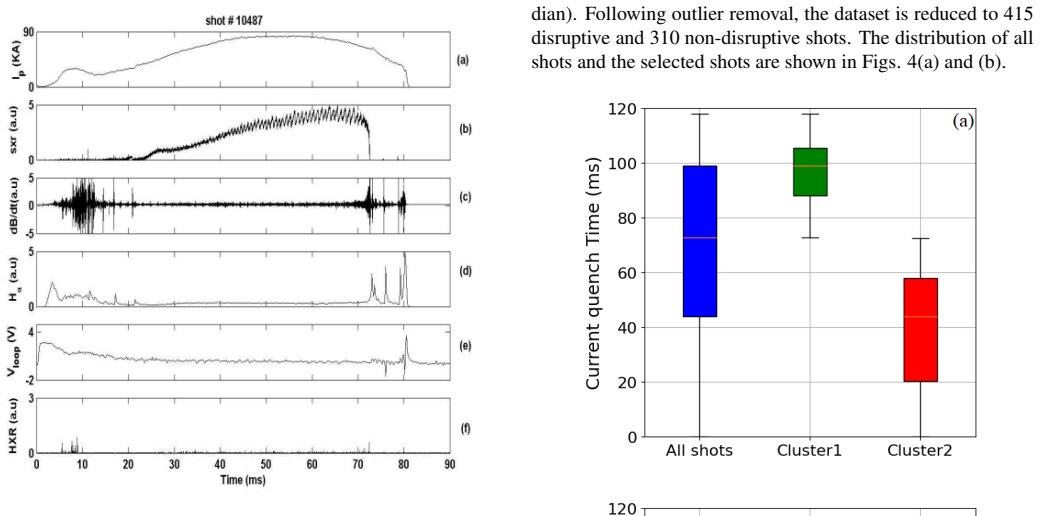
- [§2.1.3, §3.1] The data filtering step removes all shots with current-quench times outside ±25% of the median (~54–90 ms), reducing the dataset from 1407 to 725 shots. The paper itself notes in §2.1.2 that shots with quench times below 65 ms are often disruptive, and §2.1.3 states that high-quench-time events are often non-disruptive terminations or controlled shutdowns. Thus the evaluation in §3.1, which uses only the filtered 725-shot set, excludes both the early disruptive shots and the slow shutdowns that a deployed predictor on ADITYA would encounter. The abstract's claim of recall above 0.9 up to 8–10 ms and the claim of 'practical feasibility' are therefore established only for an artificially separated two-cluster distribution, not for the full distribution of ADITYA discharges. The authors should either report performance on the excluded shots as a separate class or distribution, or substantially qualify the practical-feasibility claim.
- [§2.1.3, §2.2.3] The exact label-encoding rule is never specified. Section 2.2.1 states that the target value 'encodes the proximity to a disruption event,' with values near 0 for normal operation and near 1 for imminent disruption, but no formula or algorithm is given for assigning y_t ∈ {0,1} to each time step, nor how the 80-step alignment and the 0.5 alarm threshold interact across shots of different lengths. Without a precise definition of the labeling rule, the reported precision/recall/accuracy numbers are not reproducible, and the TP/TN/FP/FN definitions in §2.2.4 are ambiguous for shots where quench occurs at intermediate times. The authors should provide the exact labeling procedure, including how the prediction horizon and the alarm threshold are applied in time.
- [§3.1] The test set for the threshold study consists of a single 30% random split (123 disruptive and 93 non-disruptive shots), and no confidence intervals, standard deviations, or repeated-seed results are reported. The observed differences between transformer and LSTM, particularly the claimed recall advantage of 8–10 ms, could be sensitive to the particular split and to the small number of non-disruptive test shots. The authors should report error bars or multiple-seed statistics, or at minimum state the number of runs over which the reported curves are averaged.
- [Abstract and §3.1] The abstract states that the transformer maintains recall 'above 0.9 even up to a prediction threshold of 8-10 ms,' but the results section does not report the actual numerical recall values; Figure 10 is the only evidence, and its values are hard to read from the figure as described. The authors should state the exact recall, precision, and accuracy values at thresholds of, say, 5, 8, 10, and 16 ms, so that the quantitative claim in the abstract is directly verifiable.
minor comments (5)
- [§2.1.3] The text says 'This removal is purely mathematical' but also argues that it 'improves the reliability of identifying truly non-disruptive cases'; these two statements sit in tension and should be clarified, since the removal is not neutral with respect to the physical interpretation.
- [§2.2.1] The notation in Equation (3) uses y_{t+80} both as the hidden state and as part of the input-output alignment; this is confusing and should be redefined, for example as h_{t+80} for the hidden state.
- [§2.1.4] The number 600 time steps is derived from 120 ms at 5 kHz, but the text says 'negative plasma current values are replaced with zero'; if this is a physical correction, it should be justified, and if it is an artifact removal, the fraction of affected shots/time steps should be reported.
- [§1, §2.1.1] There are several typographical errors and inconsistencies: 'Covolution' in the introduction, 'ADITY A' with a space throughout, and the diagnostic name 'C-111' versus 'C-III' in different places. These should be corrected.
- [§2.1.5] The diversity analysis computes Euclidean distance only on plasma current signals, but the models use six features; the claim that this measures diversity for the full feature space should be softened or supported with a comparison using the full feature set.
Circularity Check
No significant circularity: the transformer-vs-LSTM comparison is an internal benchmark on held-out shots, and no prediction reduces to its training labels by construction.
full rationale
The central claim—transformer recall above 0.9 at 8–10 ms lead time on the filtered ADITYA dataset—is supported by a held-out test split (30% of 725 shots) that is disjoint from the training data. Labels are defined by measured current-quench times, not by model outputs, and the LSTM baseline is evaluated under the same input/output alignment and alarm threshold of 0.5, so the reported superiority is not forced by construction. The ±25% median trim in Section 2.1.3 removes slow terminations and very early quenches, narrowing the evaluation distribution; this is a data-representativeness and generalization limitation, not a circular derivation, because the model must still learn to emit an alarm before the quench from pre-quench diagnostic signals. The selection of the 8 ms threshold after inspecting Figure 10 is a post hoc choice that inflates the statistical strength of the claim, but it does not make the prediction equal to the label by definition. The overlapping-author citation [52] is used for input-feature correlation analysis and is ancillary to the transformer-versus-LSTM comparison; it is not a load-bearing self-citation chain. Overall, the derivation is self-contained with respect to the empirical benchmark performed.
Assumptions & free parameters
free parameters (7)
- Alarm threshold =
0.5
- Outlier trim range =
±25% of median quench time (~72 ms)
- Prediction horizon =
80 time steps (16 ms)
- Diagnostic feature subset =
plasma current, SXR, HXR, Bolo, H-alpha, C-III
- Operating warning threshold =
8 ms
- Transformer hyperparameters =
not reported
- Soft-label encoding rule =
not specified
assumptions (5)
- domain assumption Current quench time is a valid label for disruption versus non-disruption.
- domain assumption The six selected diagnostics contain sufficient information to predict current quench.
- domain assumption The post-outlier-removal dataset (725 shots) is representative of ADITYA operations.
- domain assumption Transformer and LSTM are trained under comparable conditions.
- standard math Standard transformer attention mathematics and stochastic training are valid.
Cite this review
Pith. "Pith review of Early Prediction of Current Quench Events in the ADITYA Tokamak using Transformer based Data Driven Models." pith.science (2026). https://pith.science/paper/34BHQ6UN
@misc{pith2026250712797,
  author       = {Pith},
  title        = {Pith review of: Early Prediction of Current Quench Events in the ADITYA Tokamak using Transformer based Data Driven Models},
  year         = {2026},
  howpublished = {\url{https://pith.science/paper/34BHQ6UN}},
  note         = {Machine review of arXiv:2507.12797}
}
read the original abstract
Disruptions in tokamak plasmas, marked by sudden thermal and current quenches, pose serious threats to plasma-facing components and system integrity. Accurate early prediction, with sufficient lead time before disruption onset, is vital to enable effective mitigation strategies. This study presents a novel data-driven approach for predicting early current quench, a key precursor to disruptions, using transformer-based deep learning models, applied to ADITYA tokamak diagnostic data. Using multivariate time series data, the transformer model outperforms LSTM baselines across various data distributions and prediction thresholds. The transformer model achieves better recall, maintaining values above 0.9 even up to a prediction threshold of 8-10 ms, significantly outperforming LSTM in this critical metric. The proposed approach remains robust up to an 8 ms lead time, offering practical feasibility for disruption mitigation in ADITYA tokamak. In addition, a comprehensive data diversity analysis and bias sensitivity study underscore the generalization of the model. This work marks the first application of transformer architectures to ADITYA tokamak data for early current-quench prediction, establishing a promising foundation for real time disruption avoidance in short-pulse tokamaks.
Figures


Figures from the paper (6 more)


Reference graph
Works this paper leans on
-
[1]
L. A. Artsimovich, Tokamak devices, Nuclear Fusion 12 (2) (1972) 215
work page 1972
-
[2]
S. T. Paruchuri, I. Ward, N. Rist, V . Graber, H. Al Khawaldeh, Z. Wang, E. Schuster, A. Pajares, J.- W. Juhn, Density regulation with disruption avoidance in next-generation tokamaks using a safe reinforcement learning-based controller, Fusion Engineering and Design 216 (2025) 115064
work page 2025
-
[3]
L. E. Zakharov, S. A. Galkin, S. N. Gerasimov, et al., Un- derstanding disruptions in tokamaks, Physics of Plasmas 19 (5) (2012)
work page 2012
-
[4]
A. H. Boozer, Theory of tokamak disruptions, Physics of Plasmas 19 (5) (2012) 058101
work page 2012
-
[5]
A. Hassanein, T. Sizyuk, V . Sizyuk, G. Miloshevsky, Im- pact of various plasma instabilities on reliability and per- formance of tokamak fusion devices, Fusion engineering and design 85 (7-9) (2010) 1331–1335
work page 2010
-
[6]
R. Yoshino, D. J. Campbell, E. Frederickson, Characteri- zation of disruption phenomenology in ITER, Tech. Rep. IAEA-CSP–8/C, IAEA (2001)
work page 2001
-
[7]
F. C. Schuller, Disruptions in tokamaks, Plasma Physics and Controlled Fusion 37 (11A) (1995) A135
work page 1995
- [8]
Show all 53 references
-
[9]
A. V . Nedospasov, Thermal quench in tokamaks, Nuclear Fusion 48 (3) (2008) 032002
2008
-
[10]
Raman, W
R. Raman, W. S. Lay, T. R. Jarboe, J. E. Menard, M. Ono, Electromagnetic particle injector for fast time response disruption mitigation in tokamaks, Nuclear Fusion 59 (1) (2018) 016021
2018
-
[11]
K. H. Finken, M. Lehnen, S. A. Bozhenkov, Gas flow analysis of a disruption mitigation valve (DMV), Nuclear Fusion 48 (11) (2008) 115001
2008
-
[12]
Dhyani, et al., A novel approach for mitigating disrup- tions using biased electrode in ADITY A tokamak, Nuclear Fusion 54 (8) (2014) 083023
P. Dhyani, et al., A novel approach for mitigating disrup- tions using biased electrode in ADITY A tokamak, Nuclear Fusion 54 (8) (2014) 083023
2014
-
[13]
A. H. Boozer, Plasma steering to avoid disruptions in ITER and tokamak power plants, Nuclear Fusion 61 (5) (2021) 054004
2021
-
[14]
V . D. Pustovitov, Models and scalings for the disruption forces in tokamaks, Nuclear Fusion 62 (2) (2022) 026036
2022
-
[15]
E. J. Strait, J. L. Barr, M. Baruzzo, J. W. Berkery, R. J. Buttery, P. C. de Vries, et al., Progress in disruption pre- vention for ITER, Nuclear Fusion 59 (11) (2019) 112012
2019
-
[16]
Lehnen, K
M. Lehnen, K. Aleynikova, P. B. Aleynikov, D. J. Camp- bell, P. Drewelow, N. W. Eidietis, et al., Disruptions in ITER and strategies for their control and mitigation, Jour- nal of Nuclear Materials 463 (2015) 39–48
2015
-
[17]
Rea, et al., A real-time machine learning-based dis- ruption predictor in DIII-D, Nuclear Fusion 59 (9) (2019) 096016
C. Rea, et al., A real-time machine learning-based dis- ruption predictor in DIII-D, Nuclear Fusion 59 (9) (2019) 096016
2019
-
[18]
B. H. Guo, et al., Disruption prediction using a full con- volutional neural network on EAST, Plasma Physics and Controlled Fusion 63 (2) (2021) 025010
2021
-
[19]
Zheng, et al., Disruption predictor based on neural net- work and anomaly detection on J-TEXT, Plasma Physics and Controlled Fusion 62 (4) (2020) 045008
W. Zheng, et al., Disruption predictor based on neural net- work and anomaly detection on J-TEXT, Plasma Physics and Controlled Fusion 62 (4) (2020) 045008. 11
2020
-
[20]
B. Dave, S. Patel, R. Shivani, S. Purohit, B. Chaudhury, Synthetic data generation using generative adversarial net- work for tokamak plasma current quench experiments, Contributions to Plasma Physics 63 (12 2022)
2022
-
[21]
Vega, et al., Disruption prediction with artificial intel- ligence techniques in tokamak plasmas, Nuclear Fusion 60 (6) (2020) 066013
J. Vega, et al., Disruption prediction with artificial intel- ligence techniques in tokamak plasmas, Nuclear Fusion 60 (6) (2020) 066013
2020
-
[22]
Aymerich, et al., Disruption prediction at JET through deep convolutional neural networks using spatiotemporal information from plasma profiles, Nuclear Fusion 62 (7) (2022) 076027
E. Aymerich, et al., Disruption prediction at JET through deep convolutional neural networks using spatiotemporal information from plasma profiles, Nuclear Fusion 62 (7) (2022) 076027
2022
-
[23]
Aymerich, et al., Performance comparison of machine learning disruption predictors at JET, Applied Sciences 13 (3) (2023) 1749
E. Aymerich, et al., Performance comparison of machine learning disruption predictors at JET, Applied Sciences 13 (3) (2023) 1749
2023
-
[24]
Kates-Harbeck, et al., Predicting disruptive instabilities in controlled fusion plasmas through deep learning, Na- ture 568 (7753) (2019) 526–531
J. Kates-Harbeck, et al., Predicting disruptive instabilities in controlled fusion plasmas through deep learning, Na- ture 568 (7753) (2019) 526–531
2019
-
[25]
R. M. Churchill, et al., Deep convolutional neural net- works for multi-scale time-series classification and appli- cation to tokamak disruption prediction using raw, high temporal resolution diagnostic data, Physics of Plasmas 27 (6) (2020) 062510
2020
-
[26]
J. X. Zhu, et al., Scenario adaptive disruption prediction study for next generation burning-plasma tokamaks, Nu- clear Fusion 61 (6) (2021) 064006
2021
-
[27]
J. X. Zhu, et al., Hybrid deep-learning architecture for general disruption prediction across multiple tokamaks, Nuclear Fusion 61 (10) (2021) 106022
2021
-
[28]
Croonen, et al., Investigation of machine learning tech- niques for disruption prediction using JET data, Plasma 6 (2) (2023) 351–366
J. Croonen, et al., Investigation of machine learning tech- niques for disruption prediction using JET data, Plasma 6 (2) (2023) 351–366
2023
-
[29]
Priyanka, J
M. Priyanka, J. Sangeetha, C. Jayakumar, A review of tra- ditional and data-driven approaches for disruption predic- tion in different tokamaks, E3S Web of Conferences 477 (2024) 00039
2024
-
[30]
Wang, et al., Robust control of q-profile and beta us- ing data-driven models on EAST, Fusion Engineering and Design 162 (2021) 112097
S. Wang, et al., Robust control of q-profile and beta us- ing data-driven models on EAST, Fusion Engineering and Design 162 (2021) 112097
2021
-
[31]
Dalsania, Z
N. Dalsania, Z. Patel, S. Purohit, B. Chaudhury, An ap- plication of machine learning for plasma current quench studies via synthetic data generation, Fusion Engineering and Design 171 (2021) 112578
2021
-
[32]
S. A. Sabbagh, J. W. Berkery, Y . S. Park, J. H. Ahn, Y . Jiang, J. D. Riquezes, et al., Disruption event charac- terization ex/p6-26 and forecasting in tokamaks, in: IAEA Fusion Energy Conference, IAEA, 2018
2018
-
[33]
S. A. Sabbagh, J. W. Berkery, Y . S. Park, J. H. Ahn, Y . Jiang, J. D. Riquezes, et al., Tokamak disruption event characterization and forecasting research and expansion to real-time application, in: Proc. 28th Int. Conf. on Fusion Energy, IAEA, 2021
2021
-
[34]
R. L. Tanna, et al., Overview of recent experimental re- sults from the ADITY A tokamak, Nuclear Fusion 57 (10) (2017) 102008
2017
-
[35]
Dhyani, Biased electrode experiments in ADITY A toka- mak, Ph.D
P. Dhyani, Biased electrode experiments in ADITY A toka- mak, Ph.D. thesis, Institute for Plasma Research (2014)
2014
-
[36]
Purohit, et al., Characterization of the plasma current quench during disruptions in ADITY A tokamak, Nuclear Fusion 60 (7) (2020) 076018
S. Purohit, et al., Characterization of the plasma current quench during disruptions in ADITY A tokamak, Nuclear Fusion 60 (7) (2020) 076018
2020
-
[37]
Chattopadhyay, et al., Analysis of disruptive instabil- ities in ADITY A tokamak discharge, Indian Journal of Pure and Applied Physics 44 (12) (2006) 897–904
A. Chattopadhyay, et al., Analysis of disruptive instabil- ities in ADITY A tokamak discharge, Indian Journal of Pure and Applied Physics 44 (12) (2006) 897–904
2006
-
[38]
A. K. Chattopadhyay, et al., Instability analysis in ADITY A tokamak discharges with the help of soft x-ray, Journal of Plasma and Fusion Research Series 8 (2009) 685–690
2009
-
[39]
R. L. Tanna, et al., Novel approaches for mitigating run- away electrons and plasma disruptions in ADITY A toka- mak, Nuclear Fusion 55 (6) (2015) 063010
2015
-
[40]
Ghosh, et al., Disruption mitigation using ion cyclotron wave in ADITY A tokamak, Physics of Plasmas 28 (2) (2021) 022505
J. Ghosh, et al., Disruption mitigation using ion cyclotron wave in ADITY A tokamak, Physics of Plasmas 28 (2) (2021) 022505
2021
-
[41]
Sengupta, et al., Forecasting disruptions in the ADITY A tokamak using neural networks, Nuclear Fusion 40 (12) (2000) 1993
A. Sengupta, et al., Forecasting disruptions in the ADITY A tokamak using neural networks, Nuclear Fusion 40 (12) (2000) 1993
2000
-
[42]
Agarwal, et al., Deep sequence to sequence learning- based prediction of major disruptions in ADITY A toka- mak, Plasma Physics and Controlled Fusion 63 (7) (2021) 075006
A. Agarwal, et al., Deep sequence to sequence learning- based prediction of major disruptions in ADITY A toka- mak, Plasma Physics and Controlled Fusion 63 (7) (2021) 075006
2021
-
[43]
Joshi, J
R. Joshi, J. Ghosh, N. Kalani, R. L. Tanna, Assessment of stacked LSTM, bidirectional LSTM, ConvLSTM2D, and auto encoders LSTM time series regression analysis at ADITY A-U tokamak, IEEE Transactions on Plasma Sci- ence 52 (9) (2024) 2776–2784
2024
-
[44]
Joshi, J
R. Joshi, J. Ghosh, N. Kalani, R. L. Tanna, Conceptual design and preliminary data analysis for classification of plasma disruption event at ADITY A-U tokamak, Tech. rep. (2022)
2022
-
[45]
Muruganandham, S
P. Muruganandham, S. Jayaraman, K. Tahiliani, R. Tanna, J. Ghosh, S. K. Pathak, N. Ramaiya, An advanced double-phase stacking ensemble technique with active learning classifier: Toward reliable disruption prediction in ADITY A tokamak, Review of Scientific Instruments 95 (9) (...
2024
-
[46]
Zeyer, P
A. Zeyer, P. Bahar, K. Irie, R. Schlüter, H. Ney, A com- parison of transformer and LSTM encoder decoder mod- els for ASR, in: IEEE Automatic Speech Recognition and Understanding Workshop (ASRU), IEEE, 2019, pp. 8–15. doi:10.1109/ASRU46091.2019.9004025
2019
-
[47]
Spangher, M
L. Spangher, M. Bonotto, W. Arnold, D. Chayapathy, T. Gallingani, A. Spangher, F. Cannarile, D. Bigoni, E. de Marchi, C. Rea, Disruptionbench and Complimen- tary new models: Two Advancements in Machine Learn- ing Driven Disruption Prediction, Journal of Fusion En- ergy 44 (1) ...
2025
-
[48]
S. B. Bhatt, D. Bora, B. N. Buch, ADITY A: The first in- dian tokamak, Indian Journal of Pure and Applied Physics 27 (9-10) (1989) 710–742
1989
-
[49]
D. Raju, R. Jha, P. Kaw, S. Mattoo, Y . Saxena, A. Team, Mirnov coil data analysis for tokamak ADITY A, Pramana 55 (2000) 727–732
2000
-
[50]
Atrey, D
P. Atrey, D. Pujara, S. Mukherjee, Mhd mode bispectral analysis from density fluctuations in ADITY A discharges, Fusion Engineering and Design 130 (2018) 89–93
2018
-
[51]
Bora, SST and ADITY A tokamak research in india, Brazilian journal of physics 32 (2002) 193–216
D. Bora, SST and ADITY A tokamak research in india, Brazilian journal of physics 32 (2002) 193–216
2002
-
[52]
Agarwal, B
J. Agarwal, B. Chaudhury, S. Jakhar, N. Shah, S. Arora, D. Katrodia, M. Sharma, Automated labelling and corre- lation analysis of diagnostic signals from ADITY A toka- mak for developing ai-based disruption mitigation sys- tems, Radiation Effects and Defects in Solids 179 (7-8...
2024
-
[53]
Vaswani, N
A. Vaswani, N. Shazeer, N. Parmar, J. Uszkoreit, L. Jones, A. N. Gomez, Ł. Kaiser, I. Polosukhin, Attention is all you need, Advances in neural information processing systems 30 (2017). 13
2017
Reviewed August 6, 2026 · model on record in the stance chip above.
Discussion (0). Continue with ORCID to comment.