REVIEW 2 major objections 5 minor 43 references
Towards Microgrid Resilience Enhancement via Mobile Power Sources and Repair Crews: A Multi-Agent Reinforcement Learning Approach
T0 review · 2 major / 5 minor · reviewed 2026-08-06 · deepseek-v4-flash
Pith's one-line read H2MAPPO coordinates mobile power sources and repair crews via hierarchical hybrid multi-agent reinforcement learning, achieving near-optimal load restoration within 3.53% of the perfect-information MILP benchmark.
desk verdict A solid MARL contribution to microgrid restoration, but the decentralization claim is overstated because the MGCC still solves a central AC-OPF at every step. read the letter →
The pith
A machine-rendered reading of the paper's core claim, the machinery that carries it, and where it could break.
The reading
What carries the argument
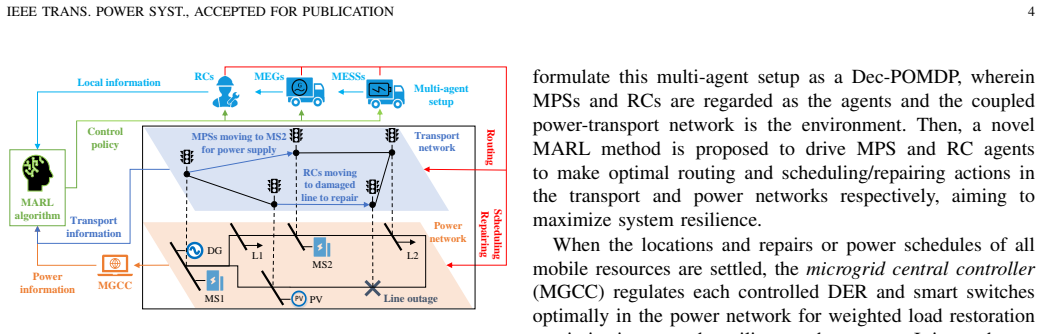
The load-bearing mechanism is the two-level hierarchical hybrid policy. A high-level softmax policy $x_i = \mu_{\psi_i}(x|o)$ chooses whether agent $i$ acts in the transport network (routing) or the power network (scheduling/repairing) at each time step. Then a low-level hybrid policy combines a categorical softmax policy $\pi_{\phi^d_i}(k|o)$ for discrete routing/repair actions and a Gaussian policy $\pi_{\phi^c_i}(c|o)$ for continuous power setpoints (MEG generation, MESS charging/discharging as fractions of capacity). Training uses MAPPO clipped surrogate objectives with generalized advantage estimation, and each agent's critic takes its local observation, high-level action, and an embedded function $\xi_i$ that quantifies the agent's contribution to total load restoration, enabling centralized training without sharing raw observations. The environment includes detailed transport routing with congestion-dependent travel times and a linearized AC-OPF solved by the MGCC to compute restored loads and rewards.
What would settle it
Run the H2MAPPO test process with the MGCC's AC-OPF step disabled or delayed (simulating damaged communication), for instance by using an hour-old OPF solution or by computing rewards from local measurements only; if the resilience index drops to near the no-coordination level or training diverges, the decentralized-operation claim is falsified.
Extended reading notes
Core claim
On the paper's own terms, the central discovery is that a two-level hierarchical hybrid multi-agent reinforcement learning architecture (H2MAPPO) can solve the coordinated routing and scheduling/repairing problem of mobile power sources and repair crews in a decentralized fashion with near-optimal load restoration. The method learns a high-level policy that switches each agent between transport routing and power scheduling/repairing, and a low-level hybrid policy that separates discrete routing from continuous scheduling actions, removing the invalid simultaneous-action problem. An embedded function, $\xi_i$, defined as the agent's power contribution divided by total restored load, is fed into each agent's critic network during training to abstract other agents' information and preserve privacy. The paper reports an average resilience index of 21.34 on the 33-bus system, 3.53% lower than the MILP upper bound and 5.91–9.10% higher than MAPPO, IPPO, and MPC, with per-step computation around 0.5 seconds. The same method scales to a modified 69-bus network with four MESSs, four MEGs, and four RCs, preserving the pattern where repair crews contribute most to load restoration, followed by MEGs and MESSs.
Load-bearing premise
The framework assumes that a functioning microgrid central controller (MGCC) exists at every time step to collect all agents' dispatch actions and solve a central linearized AC-OPF, which computes restored loads, rewards, and the embedded function.
Editorial extensions
If this is right
- Trained policies deploy in about 0.5 seconds per decision step, compared with roughly 76 seconds for MILP and 1029 seconds for MPC, enabling real-time restoration control after an event.
- The hierarchical switch removes the invalid simultaneous routing-and-scheduling actions that destabilize MAPPO and IPPO, and the embedded function cuts training episodes to convergence from about 4,000 to 3,200.
- The learned policy generalizes from a 33-bus network with one of each mobile resource to a 69-bus network with four of each, suggesting the approach scales with microgrid size.
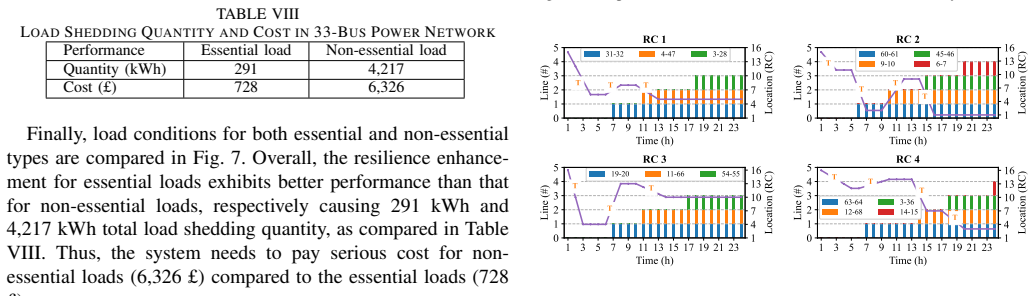
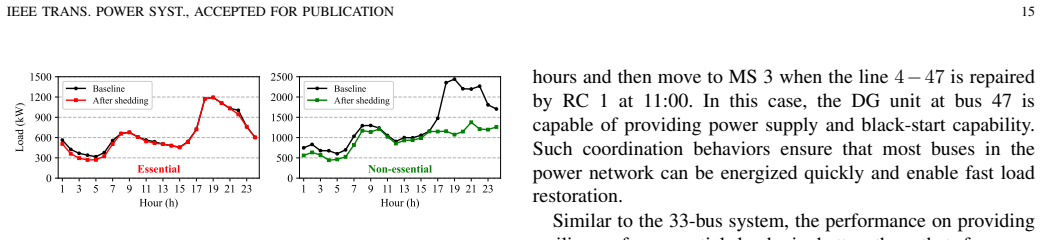
- The method learns sensible coordination behaviors: MESS charges at PV-rich stations at midday and discharges at essential-load stations in the morning and evening, MEG provides black-start power, RCs repair lines that unlock essential loads first, and smart switches are reconfigured as repairs proceed.
Reading between the lines
- The claimed decentralization is partial: at every time step a microgrid central controller must still collect all agents' actions and solve a central AC-OPF to compute restored loads, rewards, and the embedded function, so the method has not been tested in the fully communication-degraded setting that motivates it.
- A testable extension is to replace the central AC-OPF with an intermittent or locally estimated power-flow update; one would predict that the resilience gap to the MILP upper bound grows as the OPF update interval increases.
- The embedded function $\xi$ is only available after the central OPF is solved, so a fully decentralized deployment would need to estimate $\xi$ from local measurements; comparing that variant against H2MAPPO would isolate how much of the performance comes from the central OPF rather than the hierarchical policy.
- The framework could be extended to multi-day outages by adding fuel and resource re-filling actions, which the authors list as future work; the episodic horizon would then need longer trajectories and more efficient sampling.
Editorial analysis
A structured set of objections, weighed in public.
Referee Report
Summary. The paper addresses the coordinated dispatch of mobile power sources (MEGs, MESSs) and repair crews in a microgrid with a coupled power–transport network, aiming at load restoration after extreme events. It formulates the problem as a Dec-POMDP and proposes H2MAPPO, a hierarchical hybrid multi-agent reinforcement learning method in which a high-level policy switches between transport routing and power scheduling/repairing, and a low-level hybrid policy produces discrete routing and continuous scheduling actions. An embedded function is used to condense global system dynamics into the critic. Case studies on IEEE 33-bus and 69-bus feeders compare H2MAPPO against IPPO, MAPPO, MPC, and a perfect-information MILP, reporting an average resilience index of 21.34 on the 33-bus network, 3.53% below the MILP bound and 5.91–9.10% above the other learning/MPC baselines, with computation times around 0.5 s.
Significance. If the decentralization claim were fully supported, the work would be of clear value to resilience-constrained microgrid operation, offering a learning-based alternative to centralized optimization that can act in real time while handling nonlinearities in transport congestion and power-network constraints. The paper provides a well-specified algorithm (Algorithms 1 and 2), detailed network and parameter tables, training curves, and a comparative evaluation with several strong baselines; these elements support the internal validity of the relative performance ranking on the 33-bus feeder. The hierarchical/hybrid action design and the embedded-function critic are interesting and potentially reusable ideas. However, the central claim that the framework operates in a decentralized manner and avoids single-point failure is undermined by the requirement for a central MGCC to solve an AC-OPF at every time step, and the scalability demonstration on the 69-bus feeder lacks a quantitative comparison against baselines.
major comments (2)
- [II-A, Algorithms 1 and 2, IV-C] The paper's headline contribution is a decentralized framework for MPS/RC dispatch that 'does not depend on the central commands' and 'avoids single-point failure' (Section I-C, contribution 1). Yet Section II-A states that 'the microgrid central controller (MGCC) regulates each controlled DER and smart switches optimally', and Algorithm 1 (line 14) and Algorithm 2 (line 11) both require 'MGCC runs the AC-OPF algorithm once collecting all agents’ dispatches'. This central OPF (13)–(32) determines the restored loads, the switch operations, and the reward (39); it is not merely a physics simulator. The footnote in Section IV-C even concedes that the embedded function ξi 'can be only accessible once MGCC has solved the AC-OPF algorithm, which requires all agents’ actions'. Consequently, the decision loop is not decentralized and the motivating scenario of damaged communication is not modelled: no communication failure or MGCC unavailability is considered, and the observation discussion in Section III-C only mentions incomplete local information. To make the claim defensible, the authors should either rephrase the contribution to 'decentralized MPS/RC dispatch given a functioning MGCC performing network-level OPF', or explicitly model and evaluate operation under communication degradation and MGCC failure (e.g., with local OPF approximations or a degraded-communication test case).
- [V-D] The abstract and contribution 4 claim that the method is validated on both IEEE 33-bus and 69-bus networks and that its 'superior performance' over state-of-the-art methods is demonstrated. However, Section V-D on the 69-bus network only presents dispatch behaviors, load shedding quantities, and agent contributions; it contains no comparison of H2MAPPO against IPPO, MAPPO, MPC, or MILP, and no resilience-index or computation-time table for that feeder. Thus the superiority claim is supported only for the 33-bus case, and the scalability claim is only a qualitative demonstration. The authors should add a comparison table (and ideally statistical significance measures) for the 69-bus network, or explicitly limit the superiority claim to the 33-bus case.
minor comments (5)
- [II-B2, Eq. (3)] Constraint (3) appears ill-formed: the left-hand side sums u_{i,m,τ} over τ from t to min(t+T^rd_{mn,t}, T), while the right-hand side multiplies (1-u_{i,n,t}) by min(T^rd_{mn,t}, T-t), which is dimensionally inconsistent (the right side is a time duration, the left side is a count). Please rewrite this routing restriction so that the intended travel-time constraint is unambiguous.
- [IV-C, Eq. (50)] Equation (50) uses P_ls_d in the denominator, but P_ls_d is not defined in the nomenclature or in the text. Please define this quantity explicitly (if it denotes load shedding) and reconcile its notation with the load-shedding constraints (23)–(24).
- [IV-D, Eqs. (55)–(58)] The sentence introducing the learning rates reads 'where αψ, αϕd, αϕd, αθ indicate the learning rates', which duplicates αϕd and omits αϕc. The correct set is αψ, αϕd, αϕc, αθ (as used in Algorithm 1).
- [Algorithm 1, line 18] The update condition 'while time step t % J = 0' with J=24 and T=24 triggers the parameter update only at t=24, which may not capture the intended mini-batch training procedure. Please clarify how the buffer F accumulates trajectories across episodes and how multiple gradient updates are performed.
- [Table V] Table V reports only point estimates of the resilience index over 31 test days and does not report standard deviations, confidence intervals, or the number of seeds used. Given that the MARL methods were trained with 10 random seeds, the authors should report mean ± std over seeds and test days to allow statistical assessment of the claimed performance gaps.
Circularity Check
No significant circularity: the reward equals the normalized restoration objective by design, the benchmarks are external, and the self-citations are provenance rather than proof.
full rationale
The paper's main derivation chain is Dec-POMDP formulation plus H2MAPPO policy optimization, followed by simulation on IEEE 33-bus and 69-bus networks. The reward function in Eq. (39) is deliberately the same weighted load restoration objective as Eq. (13), normalized by the baseline; this is a standard RL reward design, not a circular prediction, because the learned policies are not fitted to the MILP or MPC results and the test data is a separate one-month period. The embedded function xi in Eq. (50) is computed from the AC-OPF solution and used only in the centralized critic during training, as the paper's footnote explicitly states; it is auxiliary state information for learning stability and does not enter test-time action selection, so it does not make the reported resilience indices equivalent to the inputs. The self-citations ([27], [39], [40]) provide the hierarchical and hybrid MARL building blocks, but they are cited as method provenance, not as uniqueness theorems or as proof of the present experimental outcomes; the paper's own comparisons against IPPO, MAPPO, MPC, and a perfect-information MILP are independent and meaningful. One non-circular weakness is that Algorithms 1 and 2 require a functioning MGCC to solve the AC-OPF at every step, which undermines the rhetorical claim of fully decentralized operation with no single-point failure; this is a correctness/consistency issue, not a circular derivation, and does not change the fact that the reported performance numbers are produced by an external simulation rather than by construction from the paper's assumptions.
Assumptions & free parameters
free parameters (5)
- HL switch probability threshold =
0.5
- Learning rates and PPO hyperparameters =
alpha_psi=1e-4, alpha_phi=1e-4, alpha_theta=1e-3, gamma=0.99, epsilon=0.2, batch J=24
- Load shedding costs =
2.5 GBP/kWh essential, 1.5 GBP/kWh non-essential
- Traffic impedance coefficients =
not specified
- RC repair parameters =
RT_rc in [1,4] h, RS_rc in [2,3] units
assumptions (6)
- domain assumption MESSs and MEGs have black-start capability during restoration.
- domain assumption A functioning MGCC exists that can collect all agents' actions and solve the LinDistFlow AC-OPF at every hour.
- domain assumption Adequate fuel is available for MPS routing and operation.
- standard math The LinDistFlow linearized power flow and radiality constraints (29)-(32) accurately model the distribution network.
- ad hoc to paper The RL environment satisfies routing constraints (2)-(3) automatically.
- domain assumption Local observations in the Dec-POMDP are sufficient for near-optimal coordination.
invented entities (1)
-
Embedded function xi_i
Cite this review
Pith. "Pith review of Towards Microgrid Resilience Enhancement via Mobile Power Sources and Repair Crews: A Multi-Agent Reinforcement Learning Approach." pith.science (2026). https://pith.science/paper/34CG77JO
@misc{pith2026250718095,
  author       = {Pith},
  title        = {Pith review of: Towards Microgrid Resilience Enhancement via Mobile Power Sources and Repair Crews: A Multi-Agent Reinforcement Learning Approach},
  year         = {2026},
  howpublished = {\url{https://pith.science/paper/34CG77JO}},
  note         = {Machine review of arXiv:2507.18095}
}
read the original abstract
Mobile power sources (MPSs) have been gradually deployed in microgrids as critical resources to coordinate with repair crews (RCs) towards resilience enhancement owing to their flexibility and mobility in handling the complex coupled power-transport systems. However, previous work solves the coordinated dispatch problem of MPSs and RCs in a centralized manner with the assumption that the communication network is still fully functioning after the event. However, there is growing evidence that certain extreme events will damage or degrade communication infrastructure, which makes centralized decision making impractical. To fill this gap, this paper formulates the resilience-driven dispatch problem of MPSs and RCs in a decentralized framework. To solve this problem, a hierarchical multi-agent reinforcement learning method featuring a two-level framework is proposed, where the high-level action is used to switch decision-making between power and transport networks, and the low-level action constructed via a hybrid policy is used to compute continuous scheduling and discrete routing decisions in power and transport networks, respectively. The proposed method also uses an embedded function encapsulating system dynamics to enhance learning stability and scalability. Case studies based on IEEE 33-bus and 69-bus power networks are conducted to validate the effectiveness of the proposed method in load restoration.
Figures


Figures from the paper (8 more)


Reference graph
Works this paper leans on
-
[1]
Battling the extreme: A study on the power system resilience,
Z. Bie, Y . Lin, G. Li, and F. Li, “Battling the extreme: A study on the power system resilience,” Proc. IEEE, vol. 105, no. 7, pp. 1253–1266, Jul. 2017
work page 2017
-
[2]
Power system resilience enhancement in typhoons using a three-stage day-ahead unit commitment,
T. Ding, M. Qu, Z. Wang, B. Chen, C. Chen, and M. Shahidehpour, “Power system resilience enhancement in typhoons using a three-stage day-ahead unit commitment,” IEEE Trans. Smart Grid , vol. 12, no. 3, pp. 2153–2164, May 2021
work page 2021
-
[3]
Seismic-resilient electric power distribution systems: Harnessing the mobility of power sources,
Z. Yang, P. Dehghanian, and M. Nazemi, “Seismic-resilient electric power distribution systems: Harnessing the mobility of power sources,” IEEE Trans. Ind. Appl. , vol. 56, no. 3, pp. 2304–2313, May-Jun. 2020
work page 2020
-
[4]
On microgrids and resilience: A comprehensive review on modeling and operational strategies,
Y . Wang, A. O. Rousis, and G. Strbac, “On microgrids and resilience: A comprehensive review on modeling and operational strategies,” Renew. Sust. Energ. Rev., vol. 134, p. 110313, Dec. 2020
work page 2020
-
[5]
Optimizing service restoration in distribution systems with uncertain repair time and demand,
A. Arif, S. Ma, Z. Wang, J. Wang, S. M. Ryan, and C. Chen, “Optimizing service restoration in distribution systems with uncertain repair time and demand,” IEEE Trans. Power Syst., vol. 33, no. 6, pp. 6828–6838, Nov. 2018
work page 2018
-
[6]
J. Li, M. E. Khodayar, and M. R. Feizi, “Hybrid modeling based co-optimization of crew dispatch and distribution system restoration considering multiple uncertainties,” IEEE Syst. J. , vol. 16, no. 1, pp. 1278–1288, Mar. 2022
work page 2022
-
[7]
S. Lei, J. Wang, C. Chen, and Y . Hou, “Mobile emergency generator pre-positioning and real-time allocation for resilient response to natural disasters,” IEEE Trans. Smart Grid , vol. 9, no. 3, pp. 2030–2041, May 2018
work page 2018
-
[8]
G. Zhang, F. Zhang, X. Zhang, Z. Wang, K. Meng, and Z. Y . Dong, “Mobile emergency generator planning in resilient distribution systems: A three-stage stochastic model with nonanticipativity constraints,” IEEE Trans. Smart Grid , vol. 11, no. 6, pp. 4847–4859, Nov. 2020
work page 2020
Show all 43 references
-
[9]
Resilience-driven optimal sizing and pre-positioning of mobile energy storage systems in decentralized networked microgrids,
Y . Wang, A. O. Rousis, and G. Strbac, “Resilience-driven optimal sizing and pre-positioning of mobile energy storage systems in decentralized networked microgrids,” Appl. Energy, vol. 305, p. 117921, 2022
2022
-
[10]
Routing and scheduling of mobile power sources for distribution system resilience enhancement,
S. Lei, C. Chen, H. Zhou, and Y . Hou, “Routing and scheduling of mobile power sources for distribution system resilience enhancement,” IEEE Trans. Smart Grid , vol. 10, no. 5, pp. 5650–5662, Sept. 2019
2019
-
[11]
Resilient disaster recovery logistics of distribution systems: Co-optimize service restoration with repair crew and mobile power source dispatch,
S. Lei, C. Chen, Y . Li, and Y . Hou, “Resilient disaster recovery logistics of distribution systems: Co-optimize service restoration with repair crew and mobile power source dispatch,” IEEE Trans. Smart Grid , vol. 10, no. 6, pp. 6187–6202, Nov. 2019
2019
-
[12]
Resilient service restoration for unbalanced distribution systems with distributed energy resources by leveraging mobile generators,
Z. Ye, C. Chen, B. Chen, and K. Wu, “Resilient service restoration for unbalanced distribution systems with distributed energy resources by leveraging mobile generators,” IEEE Trans. Industr. Inform., vol. 17, no. 2, pp. 1386–1396, Feb. 2021
2021
-
[13]
Multiperiod distribution system restoration with routing repair crews, mobile electric vehicles, and soft-open-point networked microgrids,
T. Ding, Z. Wang, W. Jia, B. Chen, C. Chen, and M. Shahidehpour, “Multiperiod distribution system restoration with routing repair crews, mobile electric vehicles, and soft-open-point networked microgrids,” IEEE Trans. Smart Grid , vol. 11, no. 6, pp. 4795–4808, Nov. 2020
2020
-
[14]
Stochastic pre-event prepa- ration for enhancing resilience of distribution systems,
Q. Zhang, Z. Wang, S. Ma, and A. Arif, “Stochastic pre-event prepa- ration for enhancing resilience of distribution systems,” Renew. Sust. Energ. Rev., vol. 152, p. 111636, Dec. 2021
2021
-
[15]
Multi-period restoration model for integrated power-hydrogen systems considering transportation states,
Z. Wang, T. Ding, W. Jia, C. Mu, C. Huang, and J. P. Catalão, “Multi-period restoration model for integrated power-hydrogen systems considering transportation states,” IEEE Trans. Ind. Appl., vol. 58, no. 2, pp. 2694–2706, Mar.-Apr. 2021
2021
-
[16]
A sequential black-start restoration model for resilient active distribution networks,
T. Ding, Z. Wang, M. Qu, Z. Wang, and M. Shahidehpour, “A sequential black-start restoration model for resilient active distribution networks,” IEEE Trans. Power Syst. , vol. 37, no. 4, pp. 3133–3136, Jul. 2022
2022
-
[17]
A new model for resilient distribution systems by microgrids formation,
T. Ding, Y . Lin, G. Li, and Z. Bie, “A new model for resilient distribution systems by microgrids formation,” IEEE Trans. Power Syst. , vol. 32, no. 5, pp. 4145–4147, Sept. 2017
2017
-
[18]
A resilient microgrid formation strategy for load restoration considering master-slave distributed genera- tors and topology reconfiguration,
T. Ding, Y . Lin, Z. Bie, and C. Chen, “A resilient microgrid formation strategy for load restoration considering master-slave distributed genera- tors and topology reconfiguration,” Appl. Energy, vol. 199, pp. 205–216, Aug. 2017
2017
-
[19]
A full decentralized multi-agent service restoration for distribution network with dgs,
W. Li, Y . Li, C. Chen, Y . Tan, Y . Cao, M. Zhang, Y . Peng, and S. Chen, “A full decentralized multi-agent service restoration for distribution network with dgs,” IEEE Trans. Smart Grid , vol. 11, no. 2, pp. 1100– 1111, Mar. 2019
2019
-
[20]
A resilience-oriented centralised-to-decentralised framework for networked microgrids man- agement,
P. Ge, F. Teng, C. Konstantinou, and S. Hu, “A resilience-oriented centralised-to-decentralised framework for networked microgrids man- agement,” Appl. Energy, vol. 308, p. 118234, Feb. 2022
2022
-
[21]
R. S. Sutton and A. G. Barto, Reinforcement learning: An introduction . MIT press, 2018
2018
-
[22]
Distribution system resilience under asynchronous information using deep reinforcement learning,
J. C. Bedoya, Y . Wang, and C.-C. Liu, “Distribution system resilience under asynchronous information using deep reinforcement learning,” IEEE Trans. Power Syst. , vol. 36, no. 5, pp. 4235–4245, Sept. 2021
2021
-
[23]
Deep reinforcement learning based model-free on-line dynamic multi-microgrid formation to enhance resilience,
J. Zhao, F. Li, S. Mukherjee, and C. Sticht, “Deep reinforcement learning based model-free on-line dynamic multi-microgrid formation to enhance resilience,” IEEE Trans. Smart Grid, vol. 13, no. 4, pp. 2557–2567, Jul. 2022
2022
-
[24]
A deep reinforce- ment learning-based multi-agent framework to enhance power system resilience using shunt resources,
M. Kamruzzaman, J. Duan, D. Shi, and M. Benidris, “A deep reinforce- ment learning-based multi-agent framework to enhance power system resilience using shunt resources,”IEEE Trans. Power Syst., vol. 36, no. 6, pp. 5525–5536, Nov. 2021
2021
-
[25]
Resilient load restoration in microgrids considering mobile energy storage fleets: A deep reinforcement learning approach,
S. Yao, J. Gu, H. Zhang, P. Wang, X. Liu, and T. Zhao, “Resilient load restoration in microgrids considering mobile energy storage fleets: A deep reinforcement learning approach,” in 2020 IEEE Power & Energy Society General Meeting (PESGM) . IEEE, 2020, pp. 1–5
2020
-
[26]
Multi-agent safe policy learning for power management of networked microgrids,
Q. Zhang, K. Dehghanpour, Z. Wang, F. Qiu, and D. Zhao, “Multi-agent safe policy learning for power management of networked microgrids,” IEEE Trans. Smart Grid , vol. 12, no. 2, pp. 1048–1062, Mar. 2020
2020
-
[27]
Multi-agent deep reinforcement learning for resilience-driven routing and scheduling of mobile energy storage systems,
Y . Wang, D. Qiu, and G. Strbac, “Multi-agent deep reinforcement learning for resilience-driven routing and scheduling of mobile energy storage systems,” Appl. Energy, vol. 310, p. 118575, Mar. 2022
2022
-
[28]
A three-level planning model for optimal sizing of networked microgrids considering a trade-off between resilience and cost,
Y . Wang, A. O. Rousis, and G. Strbac, “A three-level planning model for optimal sizing of networked microgrids considering a trade-off between resilience and cost,” IEEE Trans. Power Syst., vol. 36, no. 6, pp. 5657– 5669, Apr. 2021
2021
-
[29]
Research on resilience of power systems under natural disasters—a review,
Y . Wang, C. Chen, J. Wang, and R. Baldick, “Research on resilience of power systems under natural disasters—a review,” IEEE Trans. Power Syst., vol. 31, no. 2, pp. 1604–1613, Feb. 2016
2016
-
[30]
Theory and application study of the road traffic impedance function,
W. Yuanqing, Z. Wei, and L. Lianen, “Theory and application study of the road traffic impedance function,” J. Highway Transp. Res. Dev. , vol. 21, no. 9, pp. 82–85, Nov. 2004
2004
-
[31]
Network reconfiguration in distribution systems for loss reduction and load balancing,
M. E. Baran and F. F. Wu, “Network reconfiguration in distribution systems for loss reduction and load balancing,” IEEE Power Energy Mag., vol. 9, no. 4, pp. 101–102, Apr. 1989
1989
-
[32]
A two-level simulation- assisted sequential distribution system restoration model with frequency dynamics constraints,
Q. Zhang, Z. Ma, Y . Zhu, and Z. Wang, “A two-level simulation- assisted sequential distribution system restoration model with frequency dynamics constraints,” IEEE Trans. Smart Grid, vol. 12, no. 5, pp. 3835– 3846, Sept. 2021
2021
-
[33]
F. A. Oliehoek and C. Amato, A concise introduction to decentralized POMDPs. Springer, 2016
2016
-
[34]
A learning-based power management method for networked microgrids under incomplete information,
Q. Zhang, K. Dehghanpour, Z. Wang, and Q. Huang, “A learning-based power management method for networked microgrids under incomplete information,” IEEE Trans. Smart Grid , vol. 11, no. 2, pp. 1193–1204, Mar. 2019
2019
-
[35]
Estimating demand flexibility using siamese lstm neural networks,
G. Ruan, D. S. Kirschen, H. Zhong, Q. Xia, and C. Kang, “Estimating demand flexibility using siamese lstm neural networks,” IEEE Trans. Power Syst., vol. 37, no. 3, pp. 2360–2370, May 2022
2022
-
[36]
A hybrid of deep reinforcement learning and local search for the vehicle routing problems,
J. Zhao, M. Mao, X. Zhao, and J. Zou, “A hybrid of deep reinforcement learning and local search for the vehicle routing problems,” IEEE Trans. Intell. Transp. Syst. , vol. 22, no. 11, pp. 7208–7218, Nov. 2021
2021
-
[37]
Real-time operation management for battery swapping-charging system via multi-agent deep reinforcement learning,
Y . Liang, Z. Ding, T. Zhao, and W.-J. Lee, “Real-time operation management for battery swapping-charging system via multi-agent deep reinforcement learning,” IEEE Trans. Smart Grid , 2022
2022
-
[38]
Charging cost aware fleet manage- ment for shared on-demand green logistic system,
Y . Huang, Z. Ding, and W.-J. Lee, “Charging cost aware fleet manage- ment for shared on-demand green logistic system,” IEEE Internet Things J., 2022
2022
-
[39]
D. Qiu, Y . Wang, M. Sun, and G. Strbac, “Multi-service provision for electric vehicles in power-transportation networks towards a low-carbon transition: A hierarchical and hybrid multi-agent reinforcement learning approach,” Appl. Energy, vol. 313, p. 118790, May 2022. IEEE T...
2022
-
[40]
Hybrid multi-agent reinforcement learning for electric vehicle resilience control towards a low-carbon transition,
D. Qiu, Y . Wang, T. Zhang, M. Sun, and G. Strbac, “Hybrid multi-agent reinforcement learning for electric vehicle resilience control towards a low-carbon transition,” IEEE Trans. Industr. Inform., 2022
2022
-
[41]
The surprising effectiveness of mappo in cooperative, multi-agent games,
C. Yu, A. Velu, E. Vinitsky, Y . Wang, A. Bayen, and Y . Wu, “The surprising effectiveness of mappo in cooperative, multi-agent games,” arXiv preprint arXiv:2103.01955 , 2021
2021 arXiv
-
[42]
Between mdps and semi-mdps: A framework for temporal abstraction in reinforcement learning,
R. S. Sutton, D. Precup, and S. Singh, “Between mdps and semi-mdps: A framework for temporal abstraction in reinforcement learning,” Artif. Intell., vol. 112, no. 1-2, pp. 181–211, Aug. 1999
1999
-
[43]
Residential load and rooftop pv generation: an australian distribution network dataset,
E. L. Ratnam, S. R. Weller, C. M. Kellett, and A. T. Murray, “Residential load and rooftop pv generation: an australian distribution network dataset,” Int. J. Sustain. Energy , vol. 36, no. 8, pp. 787–806, Oct. 2017. Yi Wang received the Ph.D. degree from the De- partment of E...
2017
Reviewed August 6, 2026 · model on record in the stance chip above.
Discussion (0). Sign in to comment.