REVIEW 4 major objections 3 minor 2 cited by
Tilings of the sphere by congruent pentagons IV: Edge combination $a^4b$ with general angles
T0 review · 4 major / 3 minor · reviewed 2026-08-11 · deepseek-v4-flash
Pith's one-line read This paper proves that every edge-to-edge tiling of the sphere by congruent $a^4b$ pentagons with an irrational angle appears in a short explicit list.
desk verdict A genuinely shorter route to a known classification, with real gaps in the case-completeness argument; worth refereeing but needs the skipped branches filled. read the letter →
The pith
A machine-rendered reading of the paper's core claim, the machinery that carries it, and where it could break.
The reading
What carries the argument
The engine of the proof is the Irrational Angle Lemma: given three distinct vertex types whose exponent vectors, together with the angle-sum vector $(1,1,1,1,1)$, are linearly independent, every other vertex must lie in the same three-dimensional affine subspace, because otherwise the angle system would force a rational solution for an irrational angle. That lemma turns a continuous angle problem into finite lists of candidate vertex combinations. These candidates are then pruned by the Balance Lemma, the Parity Lemma, and adjacent-angle deduction (AAD), the local rule that propagates tile labels and angles around a vertex until the whole tiling is forced; the pentagonal subdivision and the three-layer earth map construction provide the geometric templates for the tilings that survive.
What would settle it
A concrete check would be an exhaustive enumeration, for small sphere sizes such as $f=28$, $36$, and $60$, of all angle-wise vertex combinations consistent with the irrational-angle, balance, and parity lemmas and with the geometric equations (2.3)--(2.5); any resulting edge-to-edge tiling whose vertex set is not among those in Theorem 1 or Theorem 2 would be a counterexample, and the skipped 'similar' branches are the natural place to begin.
Extended reading notes
Core claim
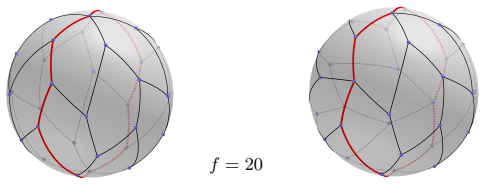
The paper's central discovery is Theorem 2: for a non-symmetric $a^4b$-tiling with general angles, the only possible tilings are the pentagonal subdivisions of the octahedron $T(24\alpha\delta\epsilon,8\gamma^3,6\beta^4)$ and of the icosahedron $T(60\alpha\delta\epsilon,20\gamma^3,12\beta^5)$, and a sequence of one-parameter families admitting the non-symmetric 3-layer earth map tiling $T(4m\, \alpha\delta\epsilon,2m\,\beta^2\gamma,2\gamma^m)$ for every $m\ge4$. Each odd $m=2k+1$ family also admits a standard flip modification, and when $f=8k+4$ with $\alpha=\beta=(1-4/f)\pi$ there are many further tilings formed by rearranging UFO blocks, all counted in Table 3. The proof reaches this list by showing that every alternative combination of degree-3 vertex types either violates the irrational-angle lemma, the balance lemma, or the parity lemma, or dies in an adjacent-angle deduction, and that the surviving combinations propagate uniquely to the listed tilings.
Load-bearing premise
The classification is complete only if the case trees in Sections 3–6 are exhaustive, including the branches dismissed as 'similar' without written deduction, and only if the UFO multiplicities counted visually from 3D computer models in Table 3 are correct.
Editorial extensions
If this is right
- A fixed $a^4b$ pentagon with an irrational angle can have only the tilings listed in Theorem 2 (or the symmetric ones in Theorem 1), and the paper gives an explicit count of how many distinct tilings each prototile admits.
- The completion of the $a^4b$ case closes the last edge combination in the decomposition of pentagonal tilings, so with the sequel all edge-to-edge tilings of the sphere by congruent pentagons will be classified.
- The listed families come with exact angle and side-length formulas, so each tiling can be constructed and checked directly rather than only abstractly.
- Letting one of the pentagon's angles become $\pi$ turns these tilings into new non-edge-to-edge quadrilateral tilings, extending the known quadrilateral tiling landscape.
Reading between the lines
- The handwritten case trees are exactly the kind of finite enumeration that could be machine-verified; replacing the 'similar' dismissals and the visual UFO counts with a formal check would put the completeness claim on fully checkable ground.
- The UFO-flip mechanism suggests that all the $f=8k+4$ variations are generated from one earth-map tiling by a small set of local moves, which would explain the polynomial counting formulas in Table 3 and might generalize to other tiling classifications.
- The degenerate-pentagon quadrilateral tilings may offer test cases for extending the known edge-to-edge quadrilateral classification to non-edge-to-edge settings, since they are produced from explicit pentagon families rather than by ad hoc construction.
Signed reviews
Editorial analysis
A structured set of objections, weighed in public.
Referee Report
Summary. This paper studies edge-to-edge tilings of the sphere by congruent pentagons with edge combination a^4b, under the assumption that at least one angle is irrational in degrees. The main result, Theorem 2, states that the only non-symmetric tilings are two 1-parameter pentagonal subdivisions of the octahedron and icosahedron, and a sequence of 1-parameter families whose generic member supports a non-symmetric 3-layer earth map tiling with 4m tiles, together with flip modifications and additional rearrangements when f=8k+4. Theorem 1 records the symmetric cases from previous work. The proof uses the Irrational Angle Lemma, the parity and balance lemmas, and extensive adjacent-angle-deduction (AAD) case analysis organized in tables. Exact and numerical geometric data, tile counts, and some induced non-edge-to-edge quadrilateral tilings are also given.
Significance. If the classification is correct and complete, it provides a valuable independent verification of the a^4b case previously treated in [3], and it contributes a concise source of explicit prototile data, 3D pictures, and tiling counts for all listed families. The Irrational Angle Lemma gives a transparent way to reduce the rational-linear-algebra constraints to finite combinatorial cases. The paper is explicit about its main strengths: exact parameter ranges and geometric data are provided for every family, and the total number of tilings for a fixed prototile is stated. The main limitation is that the proof is not fully checkable as written because several exclusion branches are asserted rather than derived; those branches are exactly where completeness of the classification must be verified.
major comments (4)
- [Section 5, Proposition 4] The exclusion of the seven rows of Table 12 other than {γ3} and {αγ2} is not proved. The sentence 'The other cases lead to contradictions in a similar and much easier way' follows only the worked rows {γ3} and {αγ2}, but each row has its own angle system, its own Irrational Angle Lemma relation, and its own AAD chain. Since Theorem 2 asserts completeness, a surviving row would change the classification. Please either display the reductions for all rows or give a precise reduction to the displayed cases.
- [Section 3, Proposition 1] After the worked example for {αδ2,γϵ2,βγ2}, the proof states 'All other pairs are discussed similarly by Table 5 and 6.' The tables record input data and final contradictions but not the individual AAD deductions for the remaining ten pairs of Lemma 15. Because the AAD deductions are the actual argument that closes each branch, 'similarly' is not checkable from the manuscript. At minimum, the tables should be expanded to make each contradiction reproducible, or each pair should be referred to a specific published case.
- [Sections 5-6, Propositions 5-7 and 10] Several propositions defer to large tables with the phrase 'similar to Proposition 1' or say the proof is completed by the table. For example, Proposition 5 refers to Tables 14-20, Proposition 6 to Tables 21-22, Proposition 7 to Tables 23-27, and Proposition 10 to Tables 28-29. These tables state vertex types, angle values, and the irrational-angle relations, but the AAD derivation is omitted for whole blocks. This is a load-bearing completeness gap, not a presentation issue.
- [Section 3, Table 3] The multiplicity counts in Table 3 are support for the claim that the total number of different tilings is counted explicitly. The text says these counts were obtained 'by playing with the 3D pictures in GeoGebra,' and no independent counting rule is supplied. Since the number of tilings for a fixed prototile is one of the stated new results, please provide a reproducible enumeration or a rigorous combinatorial derivation of the counts in the last column of Table 3.
minor comments (3)
- [Section 4, first paragraph] The text refers to 'a special tile from Lemma 2', but the special-tile lemma is Lemma 4; please correct the reference.
- [Throughout] The two-dimensional tables are often hard to read because the 'Contradiction' column abbreviates a multi-step AAD argument to a phrase such as 'No β2···'. Please add a short legend describing the columns and the convention for reading angle words.
- [Section 1, Introduction] The statement that the sequel shows 'there are no more new prototiles, nor new tilings' is only an announcement; please label it explicitly as a claim proved in [5].
Circularity Check
No significant circularity: the a4b classification is derived by case analysis plus the external geometric lemma [3]; self-cited lemmas are routine prior results, not the target theorem.
full rationale
The central claim of Theorem 2 is not obtained by defining its output as its input. The exclusion branches are argued from Lemma 13 (Irrational Angle Lemma), which uses only the angle-sum Lemma 3 and linear algebra, together with adjacent-angle-deduction (AAD) reasoning, and the geometric feasibility checks use Lemma 11, explicitly imported from the external 174-page classification [3] by Cheung, Luk, and Yan. The same-series citations ([7], [9], [10], [11]) supply prior published lemmas (parity, balance, special-tile, Lemma 8, Lemma 9, Lemma 10) that are parameter-free results about spherical pentagon tilings in general; none is defined in terms of the a4b classification being proved, and none is used to assert the target theorem itself. The pentagonal subdivision families are constructed directly by subdividing Platonic faces, and their parameter ranges are given explicitly in Table 1 rather than being fitted from the tiling data. There are, however, many genuinely omitted case analyses: Proposition 1 dismisses 'All other pairs are discussed similarly by Table 5 and 6', Proposition 4 dismisses seven Table 12 rows as 'similar and much easier', Proposition 3 appeals to Table 11 'similar to Proposition 1', and Table 3's UFO counts are said to come from 'playing with the 3D pictures in GeoGebra'. These are completeness and verification gaps (correctness risk), not circularity: they do not define the conclusion into the premises, and they do not rename a known result as a new one. The self-citations are load-bearing only as routine foundational lemmas, which are published, checkable, and not equivalent to the a4b completeness claim, so the derivation is self-contained in the sense relevant to circularity.
Assumptions & free parameters
assumptions (9)
- standard math Euler-type counting identities f = 12 + 2Σ(k-3)v_k and v_3 = 20 + Σ(3k-10)v_k for pentagonal tilings of the sphere
- standard math The angle sum of the tile is 3 + 4/f and no vertex contains all five angles
- domain assumption Every tiling has a special tile with at most one vertex of degree greater than 3
- domain assumption Parity lemma: the number of δ and ε angles at any vertex is even
- domain assumption Balance lemma constraints on δ and ε occurrences at vertices
- domain assumption The three equations (2.3)-(2.5) are necessary and sufficient for angles plus edge a to define an almost equilateral pentagon
- domain assumption The AAD (adjacent angle deduction) technique is a complete local constraint: the displayed arrangements exhaust all possible edge and angle configurations around a given vertex
- domain assumption At least one of the five angles is irrational in degrees
- ad hoc to paper The rational-angle case introduces no new prototiles or tilings
Cite this review
Pith. "Pith review of Tilings of the sphere by congruent pentagons IV: Edge combination $a^4b$ with general angles." pith.science (2026). https://pith.science/paper/34EFBH7P
@misc{pith2026241208492,
  author       = {Pith},
  title        = {Pith review of: Tilings of the sphere by congruent pentagons IV: Edge combination $a^4b$ with general angles},
  year         = {2026},
  howpublished = {\url{https://pith.science/paper/34EFBH7P}},
  note         = {Machine review of arXiv:2412.08492}
}
abstract
We classify edge-to-edge tilings of the sphere by congruent pentagons with the edge combination $a^4b$ and with any irrational angle in degree: they are three $1$-parameter families of pentagonal subdivisions of the Platonic solids, with $12, 24$ and $60$ tiles; and a sequence of $1$-parameter families of pentagons admitting non-symmetric $3$-layer earth map tilings together with their various rearrangements under extra conditions. Their parameter moduli and geometric data are all computed in both exact and numerical form. The total numbers of different tilings for any fixed such pentagon are counted explicitly. As a byproduct, the degenerate pentagons produce naturally many new non-edge-to-edge quadrilateral tilings. A sequel of this paper will handle $a^4b$-pentagons with all angles being rational in degree by solving some trigonometric Diophantine equations, to complete our full classification of edge-to-edge tilings of the sphere by congruent pentagons.
Figures


Figures from the paper (34 more)






Forward citations
Cited by 2 Pith papers
-
Non-side-to-side tilings of the sphere by congruent triangles with any irrational angle
Any non-side-to-side spherical tiling by congruent triangles with an irrational angle is either a 2-layer earth map tiling, an 8-tile family, or the unique 16-tile sporadic tiling.
-
Tilings of the sphere by congruent pentagons V: Edge combination $a^{4}b$ with rational angles
Rational-angle a^4b pentagonal sphere tilings are exactly three families: a 12-tile tetrahedral subdivision, a 4m-tile symmetric family with flips, and a 20-tile non-symmetric case.
Reference graph
Works this paper leans on
-
[3]
H. M. Cheung, H. P. Luk, M. Yan. Tilings of the sphere by congruent pentagons IV: edge combination a4b. preprint, arXiv:2307.11453
-
[5]
W.C. Hu, J. Liang, Y. Liao, E. Wang. Tilings of the sphere by congruent pentagons V: edge combination a4b with rational angles. preprint
-
[1]
C. Adams. The Tiling Book: An Introduction to the Mathematical Theory of Tilings. American Mathematical Society, Providence, RI, 2022. 44 f = 24 f = 60 Figure 35: The pentagonal subdivisions of the platonic solids with δ = π. α = π ϵ = π Figure 36: The degenerate non-symmetric 3-layer earth map tilings with 20 tiles and their standard flips
work page 2022
- [2]
-
[4]
B. Gr¨ unbaum, G. C. Shephard. Tilings and Patterns. W. H. Freeman and Dover, 1987 and 2016
work page 1987
- [6]
-
[7]
Y. Liao, E. Wang, P. Qian, Y. Xu. Tilings of the Sphere by Congruent Quadrilaterals I: Edge Combination a2bc. Chin. Ann. Math. Ser. B , 45(5), 2024, 733–766
work page 2024
-
[8]
Y. Liao, E. Wang. Tilings of the sphere by congruent quadrilaterals II: edge Combination a3b with rational angles. Nagoya Math. J. , 253 (2024), 128–163
work page 2024
Show all 11 references
-
[9]
Y. Liao, E. Wang, P. Qian, Y. Xu. Tilings of the sphere by congruent quadrilaterals III: Edge Combination a3b with general angles. Forum Math. 2024; 36(5): 1159–1186
2024
-
[10]
E. Wang, M. Yan. Tilings of the sphere by congruent pentagons I: edge combinations a2b2c and a3bc. Adv. Math., 394 (2022), 107866. 45
2022
-
[11]
E. Wang, M. Yan. Tilings of the sphere by congruent pentagons II: edge combination a3b2. Adv. Math., 394 (2022), 107867. 46
2022
Reviewed August 11, 2026 · model on record in the stance chip above.
Discussion (0). Continue with ORCID to comment.