REVIEW 3 major objections 6 minor 1 cited by
The First Day of a Type Ia Supernova from a Double-Degenerate Binary
T0 review · 3 major / 6 minor · reviewed 2026-08-06 · deepseek-v4-flash
Pith's one-line read A white-dwarf collision in a Type Ia supernova creates a hot wake: half the sky brightens early, then dims by 15% at day one.
desk verdict First-day light curves for double-degenerate SN Ia: testable predictions, but the wake's homology mapping from 1000 s to 2 hr needs stiffer justification. read the letter →
The pith
A machine-rendered reading of the paper's core claim, the machinery that carries it, and where it could break.
The reading
What carries the argument
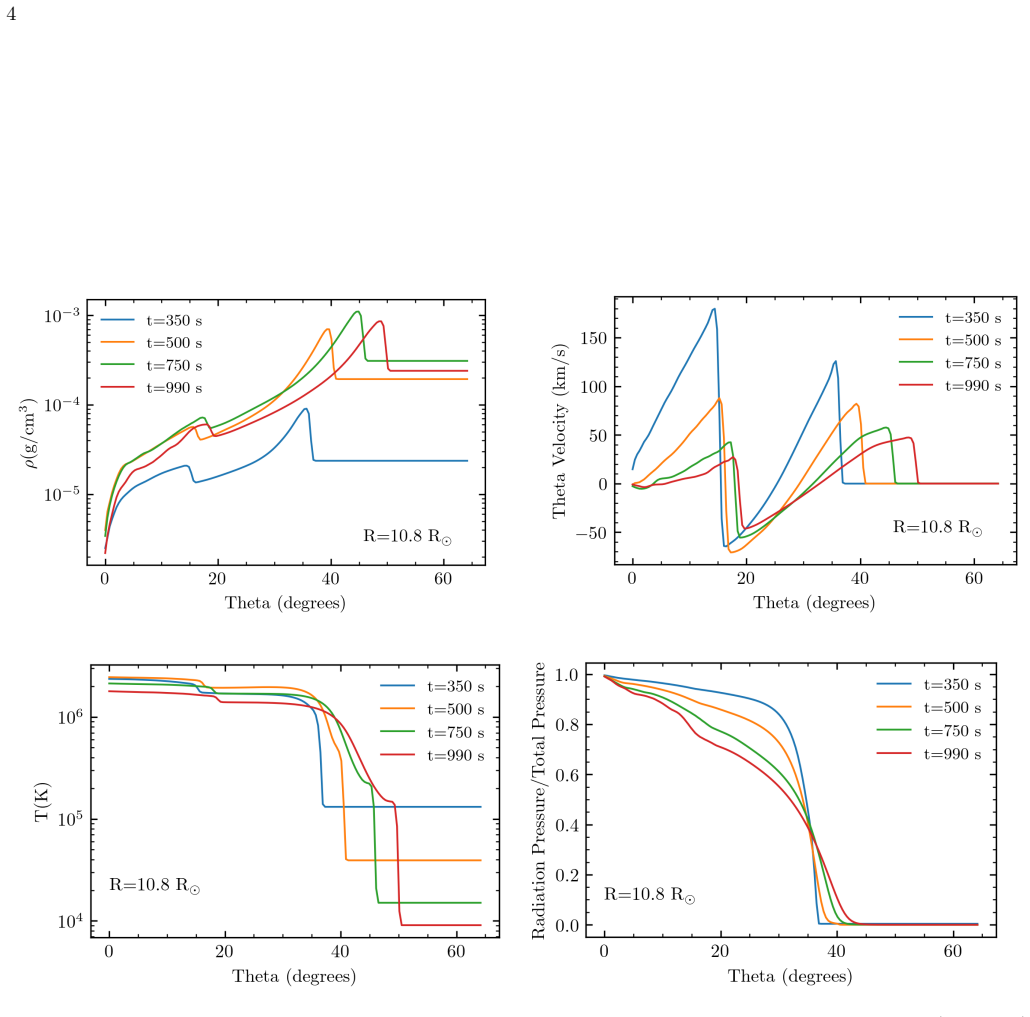
The central object is the conical wake: a low-density, high-temperature channel in the ejecta downstream of the donor, bounded by a bow shock and a recompression shock, in which the radial velocity is increased by as much as about 50 percent. The argument is carried by two coupled stages: first, a hydrodynamical simulation of the ejecta–donor collision that maps the wake's density, temperature, and velocity structure at $t=1000$ s; second, a homologous evolution of each ejected parcel with $\rho\propto t^{-3}$ and $^{56}$Ni heating, followed by an implicit radiation-hydrodynamics calculation that produces the angle-dependent light curves. The wake's protrusion is what makes the shocked emission visible over more than half the sky, and its low density is what makes the photosphere recede and the wake direction dim at one day.
What would settle it
A full three-dimensional radiation-hydrodynamical run that evolves the ejecta continuously from $t=1000$ s without the homologous-expansion approximation would either preserve or erase the wake's high-velocity protrusion and one-day density deficit; the claim fails if the protrusion or the 15 percent dip disappears. Observationally, a nearby Type Ia caught within hours with dense multi-band coverage that shows no angle-dependent excess and no one-day dip in any orientation would also contradict the prediction.
Extended reading notes
Core claim
The paper's central claim is that the collision between Type Ia ejecta and a Roche-lobe-filling white dwarf donor leaves a permanent conical imprint on the ejecta: a low-density, radiation-pressure-dominated wake bounded by a bow shock and a weaker recompression shock, with ejecta accelerated by up to about 50 percent so that the shocked material protrudes ahead of the unperturbed ejecta. Evolving this structure homologously with $^{56}$Ni heating and computing angle-dependent radiation transport, the authors find that the hot shocked gas yields $L>10^{40}$ erg s$^{-1}$ over more than half the sky in the first few hours. At later times the photosphere within the wake cools and recedes in velocity space, so that by about 12 hours nickel heating dominates the luminosity and, by one day, observers looking directly into the wake see about 15 percent less light than observers on the back side: 86 percent of the back-side value at $\theta=18^\circ$ and 93 percent at $\theta=38^\circ$ for their fiducial nickel mass fraction $X_{56}=0.04$.
Load-bearing premise
The load-bearing assumption is that the ejecta structure computed at $t=1000$ s can be carried to $t=2$ hr as purely homologous spherical expansion, with each parcel's density scaling as $t^{-3}$ and only $^{56}$Ni heating changing its entropy; if the wake's transverse pressure gradients or non-radial velocities matter during this phase, the protrusion that drives both the early overbrightness and the one-day dimming would be different.
Editorial extensions
If this is right
- An observer looking into the wake at $\theta\approx 18^\circ$ would see about $1.5\times10^{40}$ erg s$^{-1}$ at 2.9 hours, roughly four times the back-side luminosity at that time.
- Although the strongest contrast is confined to $\theta\lesssim 55^\circ$ (about 20 percent of the sky), the protruding shocked ejecta produces a measurable effect over more than half the sky in the first hours.
- After roughly 12 hours, radioactive nickel heating dominates the light curve and most viewing angles converge to nearly the same emission, so the wake signal becomes a deficit rather than an excess.
- At one day, observers at $\theta=18^\circ$ and $38^\circ$ see respectively 86 percent and 93 percent of the back-side luminosity, a persistent $\approx 15$ percent underbrightness in the wake direction.
- The predicted early luminosity of order $2\times10^{40}$ erg s$^{-1}$ corresponds to $M_{\rm Bol}\approx -12$, fainter than almost all SNe are caught at, so detecting the signal requires very early, deep observations such as those that caught SN 2018aoz.
Reading between the lines
- If the one-day underbrightness persists to the light-curve peak, the double-degenerate channel would imprint an orientation-dependent offset on Type Ia distance measurements, potentially adding scatter that current standardization does not remove.
- The high-velocity protrusion of the wake provides a plausible geometric origin for the two distinct ejecta velocities reported in some Type Ia supernovae; synthesizing spectra along wake sight lines could test this.
- Because the donor is modeled as a fixed rigid sphere, the computed wake contrast is likely an upper limit; simulations with a moving, mass-losing donor would bracket the observable range and could reduce the early excess.
- A search of archival early light curves for the paired signature—an early excess followed by a one-day dip—could separate companion interaction from competing $^{56}$Ni-in-the-outer-ejecta explanations for early emission.
Editorial analysis
A structured set of objections, weighed in public.
Referee Report
Summary. The paper simulates the interaction between Type Ia supernova ejecta and a Roche-lobe-filling white dwarf donor in a double-degenerate binary, using Athena++ in a 3D spherical wedge. The hydrodynamics run to t=1000 s produces a low-density, high-temperature conical wake behind the donor, with a bow shock and a recompression shock. The ejecta that has exited the outer boundary is then evolved homologously (rho ∝ t^-3) with uniform 56Ni heating to t=2 hr, mapped onto a spherical grid, and followed with 3D radiation-hydrodynamics simulations to 23.9 hr. From these simulations the authors obtain angle-dependent bolometric light curves, finding an early excess (peak ~1.5e40 erg/s at θ=18°, t=2.9 hr) that is visible from a large fraction of the sky, and a late-time deficit: at ~1 day, observers looking into the wake see roughly 86% of the backside luminosity, i.e., a ~15% dimming, attributed to the modified density structure of the wake.
Significance. If the results hold, the paper provides a concrete, viewing-angle-dependent observable signature of a double-degenerate Type Ia supernova progenitor: an early excess with a broad sky coverage and a late-time dimming for observers aligned with the wake. This would be directly relevant to early-time surveys and to the interpretation of events like SN 2018aoz. The work is strengthened by several good practices: the Athena++ setup and analysis scripts are deposited on Zenodo; the radiation transport is checked for self-consistency by comparing the photospheric flux with Eq. (18) and the diffusive flux with the analytical slope; and the results are anchored against the analytic models of Piro (2012) and Kasen (2010). The main weaknesses are the approximate homology extension for the wake material, the artificially high absorption opacity, and the uniform 56Ni distribution; these are acknowledged in the text but not all are quantitatively tested.
major comments (3)
- [Abstract and §4.2] The homology assumption used to evolve the ejecta from t=1000 s to t=2 hr is not demonstrated for the wake material, which is the material that determines the paper's central results. The justification given in §3 is that P/(rho v^2/2) << 1 and v_theta << v_r at rout. However, Fig. 3 shows density discontinuities at both the bow shock and the recompression shock at rout, and the shocked wake is radiation-pressure-dominated (lower right panel). For this gas, the pressure-to-ram ratio is not shown to be small locally, and the presence of the recompression shock at the outflow boundary means the flow is still being processed by pressure gradients when the homologous mapping is applied. Because the protruding, high-velocity wake drives both the early overbrightness and the late-time 15% dimming, an error in its density structure propagates directly into both headline claims. Please provide the θ-profile of P/(rho v^2/2) at rout for the shocked material (θ ≲ 20°), or otherwise demonstrate that the wake structure is converged (e.g., by extending the hydrodynamical run to later times or by comparing with a direct 3D RHD simulation).
- [§4] The abstract states that the hot, high-velocity, shocked ejecta 'yields L>10^40 ergs/s over half the sky in the first few hours.' This is stronger than what the paper reports quantitatively. In §4.2 the peak luminosity at t=2.9 hr is 1.52e40 erg/s for θ=18°, and the text says the effect of the shock can be seen at angles up to θ=142°; the latter statement is about the excess over the backside, not about exceeding 10^40 erg/s. The paper does not show a map of L(t,θ) demonstrating that the >10^40 erg/s region covers half the sky. Please either revise the abstract to match the actual angle-resolved light curves (e.g., 'an excess over the backside visible over more than half the sky') or provide the additional data that support the luminosity-threshold claim.
- [§4.2 and Fig. 9] The radiation-hydrodynamics calculations use an artificially high absorption opacity, κa=0.03 cm^2/g, with κs=0.17 cm^2/g, chosen to keep the total opacity at the Thomson value of 0.2 cm^2/g while ensuring strong gas-radiation coupling. No sensitivity test is presented for this choice. The late-time dimming mechanism relies on the photosphere cooling and receding in velocity space within the wake; the location of the photosphere and the degree of gas-radiation coupling depend on the absorption-to-scattering ratio, not only on the total opacity. A calculation with a more realistic (much smaller) κa could give a different effective photosphere and therefore a different dimming amplitude. Please either run a case with lower κa (or κa→0 in the free-streaming limit) or provide a quantitative argument that the bolometric light curves are insensitive to κa/κs at fixed total opacity.
minor comments (6)
- [§4.2] The light curves in Figs. 8 and 9 are averages over 8 θ bins, but the text does not state how many observers fall in each bin or the exact bin boundaries; the θ=18° curve, in particular, should be identified as a bin average or a single ordinate.
- [Abstract] The phrase 'dimmer than that of a normal type Ia supernova by 15 percent' is based on a comparison with the unshocked backside of the same ejecta model, not with an observed or independently modeled normal Type Ia. Please qualify this wording (e.g., 'than the unshocked backside of the same model') to avoid overstating the comparison.
- [§4] The phrase 'artificially high absorption scattering' in the opacity description should be 'artificially high absorption opacity' to distinguish it from the scattering opacity.
- [§4.2 and Fig. 9] The integration is run to 23.9 hr, but the text and abstract refer to 'by one day'; please say '~1 day' or report the exact final time consistently.
- [§3, Eq. (7)] The 56Ni heating expression includes only the 56Ni→56Co decay; for completeness, the text could note that the 56Co decay is negligible on the first-day timescale of interest.
- [§4.2, Kasen comparison] When comparing with Kasen (2010) Eq. (22), the text should state the assumed donor mass, orbital separation, and ejecta parameters used for that extrapolation, since the result is sensitive to these choices.
Circularity Check
No significant circularity: the light curves are simulation outputs from an independent radiation-hydrodynamics calculation, and the self-citations are input or method references rather than load-bearing premises.
full rationale
The derivation chain is: (1) an Athena++ Euler simulation of the ejecta-donor collision produces the wake density and temperature structure; (2) this structure is homologously evolved to t=7200 s with 56Ni heating; (3) independent Athena++ radiation-hydrodynamics simulations (Jiang 2021) generate angle-dependent light curves; and (4) results are checked against the external analytic model of Piro (2012). The headline numbers (L>10^40 erg/s over half the sky; 15% dimming at one day) are outputs of this chain, not quantities fitted to themselves. The homologous-expansion assumption in Section 3 is an approximation justified by P/(rho v^2/2) << 1 and v_theta << v_r; even if this check is insufficient for the low-density wake, that is a validity or accuracy risk, not circularity, because the light curves are not defined in terms of the assumption. Self-citations to Prust et al. (2025), Wong et al. (2024), Bauer et al. (2019), and Shen & Bildsten (2014) provide numerical setup details, the Gaussian ejecta profile, donor parameters, and the assumed double-detonation channel; none of these is a uniqueness theorem or a fitted result that forces the claimed predictions. The paper also explicitly flags limitations (grey transfer, no color calculations, persistence to peak unknown), which supports the interpretation that the claims are contingent simulation outputs rather than definitions or renamed inputs. No circular step can be quoted because no fitted parameter is recycled into a prediction and no target quantity is used to define an input.
Assumptions & free parameters
free parameters (3)
- 56Ni mass fraction X56 =
0.04 (also 0.08 in comparison run)
- Absorption opacity kappa_a =
0.03 cm^2/g
- Scattering opacity kappa_s =
0.17 cm^2/g
assumptions (6)
- domain assumption Ejecta exiting the simulation at rout=10.8 R_sun is in homology and radial flow, so density of each Lagrangian parcel scales as rho proportional to t^{-3} from t=1000 s onward.
- domain assumption The donor is modeled as a rigid, reflective spherical boundary that does not respond to the impact.
- domain assumption Gas and radiation are in local thermodynamic equilibrium, with internal energy u = a_r T^4 + (3/2) rho k_B T/(mu m_p).
- ad hoc to paper 56Ni is distributed uniformly throughout the ejecta with mass fraction X56.
- ad hoc to paper The total opacity is set to the electron-scattering value 0.2 cm^2/g, with an artificially high absorption component to couple gas and radiation.
- domain assumption Radiative transfer is solved in the grey (frequency-integrated) approximation.
Cite this review
Pith. "Pith review of The First Day of a Type Ia Supernova from a Double-Degenerate Binary." pith.science (2026). https://pith.science/paper/34SHTYJ7
@misc{pith2026250719722,
  author       = {Pith},
  title        = {Pith review of: The First Day of a Type Ia Supernova from a Double-Degenerate Binary},
  year         = {2026},
  howpublished = {\url{https://pith.science/paper/34SHTYJ7}},
  note         = {Machine review of arXiv:2507.19722}
}
abstract
Supernovae in binary star systems involve a hydrodynamical interaction between the ejecta and a binary companion. This collision results in shock heating and a modified density structure for the ejecta, both of which affect the light curve. As highlighted by Kasen, these considerations are particularly relevant for type Ia supernovae, as the companion is expected to be Roche-lobe filling at the time of the explosion. We simulate here the interaction between type Ia supernova ejecta and a white dwarf donor using Athena++, finding the formation of a low-density wake extending to higher velocities than the unperturbed ejecta. Radiation hydrodynamics is then used to generate synthetic light curves for the first day after the explosion for a range of viewing angles. We find that the hot, high-velocity, shocked ejecta yields $L>10^{40}$ ergs/s over half the sky in the first few hours. The photosphere within the shock-heated ejecta cools and recedes in velocity space, partially obscuring it from view, as heating from radioactive nickel becomes increasingly important in driving the supernova's luminosity. By one day after the explosion, the luminosity measured by observers looking directly into the wake is dimmer than that of a normal type Ia supernova by 15 percent due to the modified density structure.
Figures


Figures from the paper (9 more)


Forward citations
Cited by 1 Pith paper
-
A double-degenerate scenario with a merger to explosion delay time to explain type Ia supernova SN 2020aeuh
The author proposes that SN 2020aeuh's early carbon-oxygen circumstellar interaction is the delayed explosion of a merged white dwarf, about one to two years after the merger.
Reference graph
Works this paper leans on
-
[1]
Bauer, E. B., White, C. J., & Bildsten, L. 2019, ApJ, 887, 68, doi: 10.3847/1538-4357/ab4ea4
-
[2]
Boos, S. J., Townsley, D. M., & Shen, K. J. 2024, ApJ, 972, 200, doi: 10.3847/1538-4357/ad5da2
-
[3]
Miles, B. J. 2021, ApJ, 919, 126, doi: 10.3847/1538-4357/ac07a2
-
[4]
Brown, P. J., Dawson, K. S., Harris, D. W., et al. 2012, ApJ, 749, 18, doi: 10.1088/0004-637X/749/1/18 Di Stefano, R., Voss, R., & Claeys, J. S. W. 2011, ApJL, 738, L1, doi: 10.1088/2041-8205/738/1/L1
-
[5]
El-Badry, K., Shen, K. J., Chandra, V., et al. 2023, The Open Journal of Astrophysics, 6, 28, doi: 10.21105/astro.2306.03914
arXiv 2023
-
[6]
2012, ApJL, 756, L4, doi: 10.1088/2041-8205/756/1/L4
Hachisu, I., Kato, M., & Nomoto, K. 2012, ApJL, 756, L4, doi: 10.1088/2041-8205/756/1/L4
-
[7]
Harris, C. R., Millman, K. J., van der Walt, S. J., et al. 2020, Nature, 585, 357, doi: 10.1038/s41586-020-2649-2
-
[8]
2018, ApJ, 864, 119, doi: 10.3847/1538-4357/aad6a0
Hirai, R., Podsiadlowski, P., & Yamada, S. 2018, ApJ, 864, 119, doi: 10.3847/1538-4357/aad6a0
Show all 46 references
-
[9]
A., Shen, K
Hollands, M. A., Shen, K. J., Raddi, R., et al. 2025, MNRAS, doi: 10.1093/mnras/staf950
2025 doi
- [10]
-
[11]
2023, MNRAS, 525, 246, doi: 10.1093/mnras/stad2340
Hu, M., Wang, L., Wang, X., & Wang, L. 2023, MNRAS, 525, 246, doi: 10.1093/mnras/stad2340
2023 doi
-
[12]
Hunter, J. D. 2007, Computing in Science & Engineering, 9, 90, doi: 10.1109/MCSE.2007.55
2007 doi
-
[13]
2025, ApJ, 984, 160, doi: 10.3847/1538-4357/adb3a4
Iskandar, A., Wang, X., Esamdin, A., et al. 2025, ApJ, 984, 160, doi: 10.3847/1538-4357/adb3a4
2025 doi
-
[14]
2021, The Astrophysical Journal Supplement Series, 253, 49, doi: 10.3847/1538-4365/abe303 14
Jiang, Y.-F. 2021, The Astrophysical Journal Supplement Series, 253, 49, doi: 10.3847/1538-4365/abe303 14
2021 doi
-
[15]
2011, ApJL, 730, L34, doi: 10.1088/2041-8205/730/2/L34
Justham, S. 2011, ApJL, 730, L34, doi: 10.1088/2041-8205/730/2/L34
2011 doi
-
[16]
2010, ApJ, 708, 1025, doi: 10.1088/0004-637X/708/2/1025
Kasen, D. 2010, ApJ, 708, 1025, doi: 10.1088/0004-637X/708/2/1025
2010 doi
-
[17]
2025, Zenodo, doi: 10.5281/zenodo.16388748
Kumar, G., Prust, L., & Bildsten, L. 2025, Zenodo, doi: 10.5281/zenodo.16388748
2025 doi
-
[18]
2015, PASJ, 67, 54, doi: 10.1093/pasj/psv028
Kutsuna, M., & Shigeyama, T. 2015, PASJ, 67, 54, doi: 10.1093/pasj/psv028
2015 doi
-
[19]
J., & Stancliffe, R
Liu, Z.-W., Moriya, T. J., & Stancliffe, R. J. 2015a, MNRAS, 454, 1192, doi: 10.1093/mnras/stv2076
-
[20]
M., R¨ opke, F
Liu, Z.-W., Tauris, T. M., R¨ opke, F. K., et al. 2015b, A&A, 584, A11, doi: 10.1051/0004-6361/201526757
-
[21]
R., & Maguire, K
Magee, M. R., & Maguire, K. 2020, A&A, 642, A189, doi: 10.1051/0004-6361/202037870
2020 doi
-
[22]
R., Maguire, K., Kotak, R., et al
Magee, M. R., Maguire, K., Kotak, R., et al. 2020, A&A, 634, A37, doi: 10.1051/0004-6361/201936684
2020 doi
-
[23]
R., Sim, S
Magee, M. R., Sim, S. A., Kotak, R., & Kerzendorf, W. E. 2018, A&A, 614, A115, doi: 10.1051/0004-6361/201832675
2018 doi
-
[24]
2000, ApJS, 128, 615, doi: 10.1086/313392
Marietta, E., Burrows, A., & Fryxell, B. 2000, ApJS, 128, 615, doi: 10.1086/313392
2000 doi
-
[25]
H., Brown, P
Marion, G. H., Brown, P. J., Vink´ o, J., et al. 2016, ApJ, 820, 92, doi: 10.3847/0004-637X/820/2/92
2016 doi
-
[26]
Mihalas, D., & Mihalas, B. W. 1984, Foundations of radiation hydrodynamics (Oxford University Press,New
1984
-
[27]
https://www.osti.gov/biblio/5734165
York, NY). https://www.osti.gov/biblio/5734165
-
[28]
Q., Moon, D.-S., Drout, M
Ni, Y. Q., Moon, D.-S., Drout, M. R., et al. 2023a, ApJ, 959, 132, doi: 10.3847/1538-4357/ad0640 —. 2022, Nature Astronomy, 6, 568, doi: 10.1038/s41550-022-01603-4 —. 2023b, ApJ, 946, 7, doi: 10.3847/1538-4357/aca9be —. 2025, ApJ, 983, 3, doi: 10.3847/1538-4357/adbbb7
2022 doi
-
[29]
M., Kromer, M., Taubenberger, S., et al
Noebauer, U. M., Kromer, M., Taubenberger, S., et al. 2017, MNRAS, 472, 2787, doi: 10.1093/mnras/stx2093
2017 doi
-
[30]
P., Mushotzky, R., Shaya, E
Olling, R. P., Mushotzky, R., Shaya, E. J., et al. 2015, Nature, 521, 332, doi: 10.1038/nature14455
2015 doi
-
[31]
2015, MNRAS, 449, 942, doi: 10.1093/mnras/stv337
Papish, O., Soker, N., Garc ´ ıa-Berro, E., & Aznar-Sigu´ an, G. 2015, MNRAS, 449, 942, doi: 10.1093/mnras/stv337
2015 doi
-
[32]
Piro, A. L. 2012, ApJ, 759, 83, doi: 10.1088/0004-637X/759/2/83
2012 doi
-
[33]
L., & Morozova, V
Piro, A. L., & Morozova, V. S. 2016, ApJ, 826, 96, doi: 10.3847/0004-637X/826/1/96
2016 doi
-
[34]
L., & Nakar, E
Piro, A. L., & Nakar, E. 2013, ApJ, 769, 67, doi: 10.1088/0004-637X/769/1/67 —. 2014, ApJ, 784, 85, doi: 10.1088/0004-637X/784/1/85
2013 doi
-
[35]
M., Sim, S
Pollin, J. M., Sim, S. A., Pakmor, R., et al. 2024, MNRAS, doi: 10.1093/mnras/stae1909
2024 doi
-
[36]
J., Kumar, G., & Bildsten, L
Prust, L. J., Kumar, G., & Bildsten, L. 2025, ApJ, 982, 60, doi: 10.3847/1538-4357/adb7db
2025 doi
-
[37]
B., Baumgarte, T
Richards, C. B., Baumgarte, T. W., & Shapiro, S. L. 2021, Relativistic Bondi accretion for stiff equations of state, OUP, doi: 10.1093/mnras/stab161
2021 doi
-
[38]
J., & Seitenzahl, I
Ruiter, A. J., & Seitenzahl, I. R. 2025, A&A Rv, 33, 1, doi: 10.1007/s00159-024-00158-9
2025 doi
-
[39]
J., & Bildsten, L
Shen, K. J., & Bildsten, L. 2014, ApJ, 785, 61, doi: 10.1088/0004-637X/785/1/61
2014 doi
-
[40]
J., Boos, S
Shen, K. J., Boos, S. J., Townsley, D. M., & Kasen, D. 2021, ApJ, 922, 68, doi: 10.3847/1538-4357/ac2304
2021 doi
-
[41]
J., Boubert, D., G¨ ansicke, B
Shen, K. J., Boubert, D., G¨ ansicke, B. T., et al. 2018, ApJ, 865, 15, doi: 10.3847/1538-4357/aad55b
2018 doi
-
[42]
M., Tomida, K., White, C
Stone, J. M., Tomida, K., White, C. J., & Felker, K. G. 2020, The Astrophysical Journal Supplement Series, 249, 4, doi: 10.3847/1538-4365/ab929b
2020 doi
-
[43]
2018, ApJ, 868, 90, doi: 10.3847/1538-4357/aae9ee
Tanikawa, A., Nomoto, K., & Nakasato, N. 2018, ApJ, 868, 90, doi: 10.3847/1538-4357/aae9ee
2018 doi
-
[44]
E., et al
Virtanen, P., Gommers, R., Oliphant, T. E., et al. 2020, Nature Methods, 17, 261, doi: 10.1038/s41592-019-0686-2
2020 doi
-
[45]
Wong, T. L. S., White, C. J., & Bildsten, L. 2024, The Astrophysical Journal, 973, 65, doi: 10.3847/1538-4357/ad6a11
2024 doi
-
[46]
Zhang, M., Fuller, J., Schwab, J., & Foley, R. J. 2019, ApJ, 872, 29, doi: 10.3847/1538-4357/aafb34
2019 doi
Reviewed August 6, 2026 · model on record in the stance chip above.
Discussion (0). Sign in to comment.