REVIEW 3 major objections 7 minor 76 references
Impact of Cosmic-Ray Feedback on Accretion and Chemistry in Circumstellar Disks
T0 review · 3 major / 7 minor · reviewed 2026-08-14 · deepseek-v4-flash
Pith's one-line read Accreting T Tauri stars accelerate cosmic rays at their accretion shocks, producing disk ionization rates at least an order of magnitude above the Galactic background.
desk verdict A useful, transparent forward model of accretion-shock CR ionization in disks, whose main quantitative claim rests on an unvalidated attenuation-law extrapolation. read the letter →
The pith
A machine-rendered reading of the paper's core claim, the machinery that carries it, and where it could break.
The reading
What carries the argument
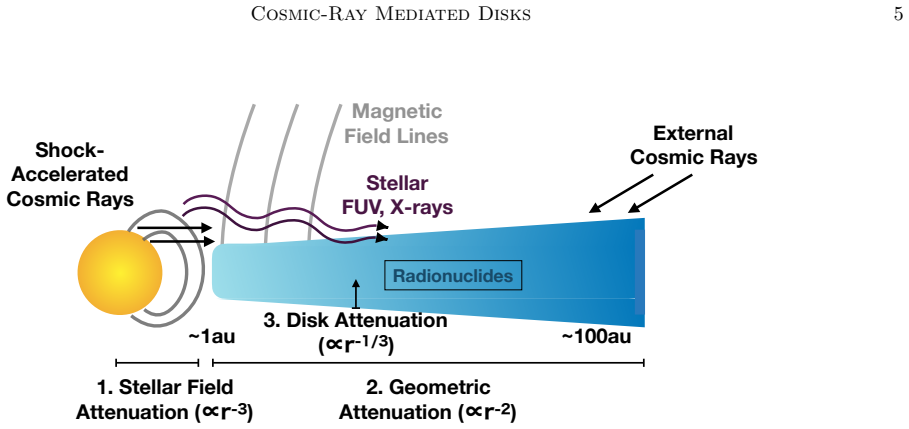
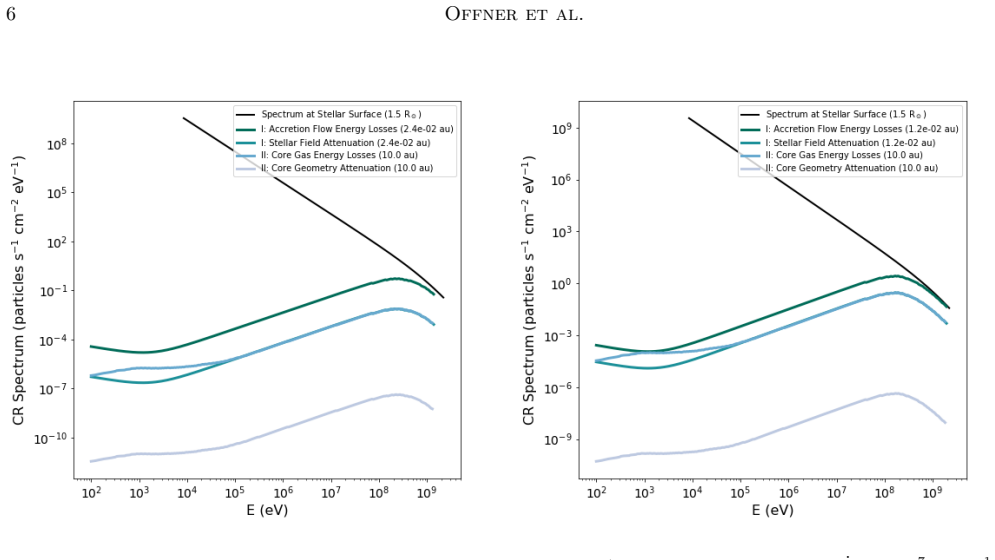
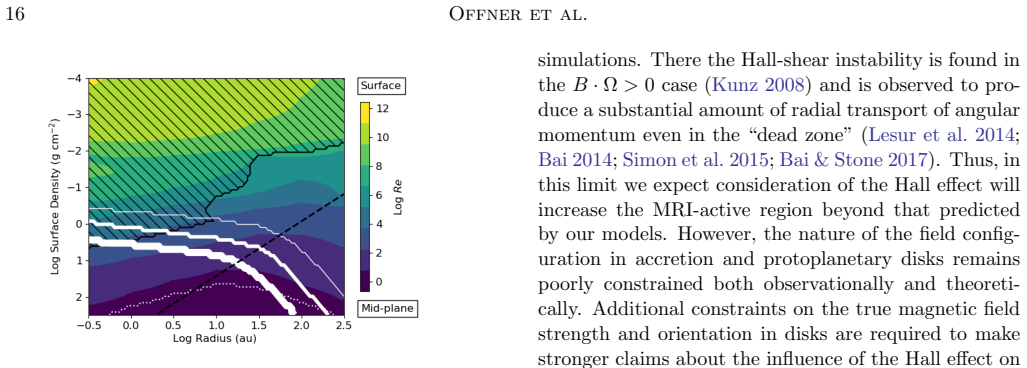
The load-bearing machinery is a three-stage propagation model for an accretion-shock cosmic-ray spectrum with energy dependence $E^{-2}$ and energies up to a few GeV. It is attenuated by inverse funneling and energy losses in the ionized accretion flow between the star and the inner disk, by geometric spreading and energy losses above the disk surface, and by a power-law column-density attenuation within the disk, $\zeta_{\rm CR} = \zeta_0 \, (N_{\rm H}/10^{18}\,\mathrm{cm}^{-2})^{-0.34}$, taken from interstellar CR studies. The propagated spectrum feeds a gas-grain chemistry calculation that yields electron and ion abundances, which are then converted into magnetic Reynolds and Ambipolar numbers to locate MRI-active regions. The same machinery produces the proposed feedback loop: accretion rate sets CR luminosity, accretion-column column density sets CR attenuation, and MRI activity sets accretion rate.
What would settle it
Measure the cosmic-ray ionization rate in the inner ~10 au of a T Tauri disk, for example through H3+ line emission or absorption; if the rate is consistent with the shielded Galactic background (~1e-16 $s^{-1}$) rather than the predicted zeta >= 1e-14 $s^{-1}$, the accretion-shock CR source is not effective at the claimed level.
Extended reading notes
Core claim
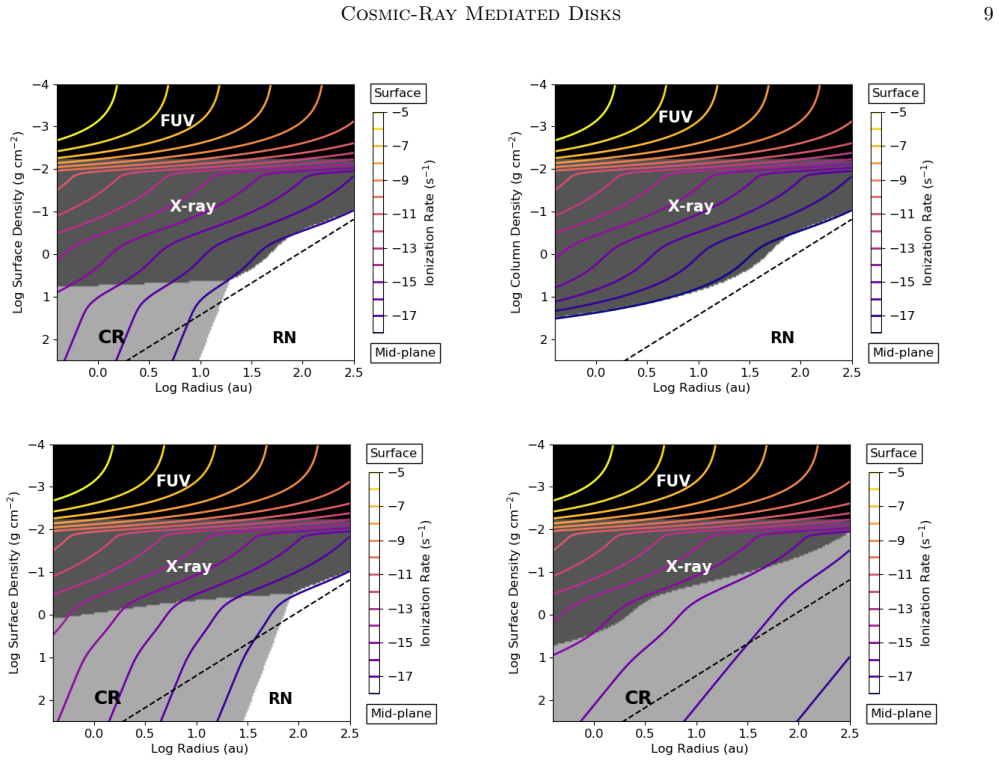
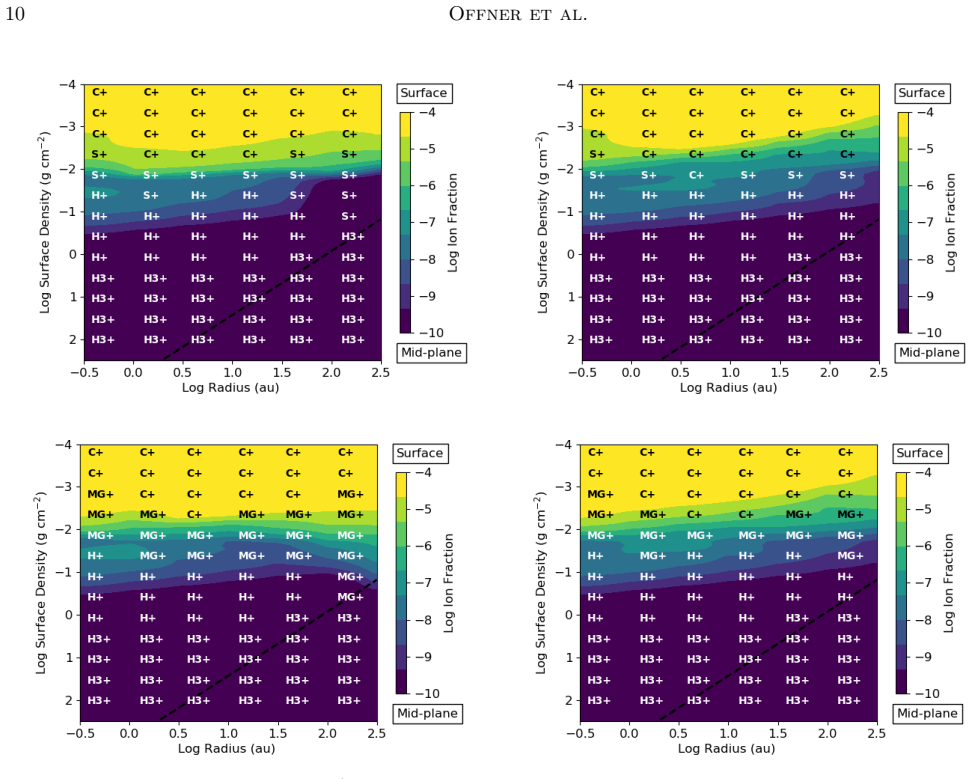
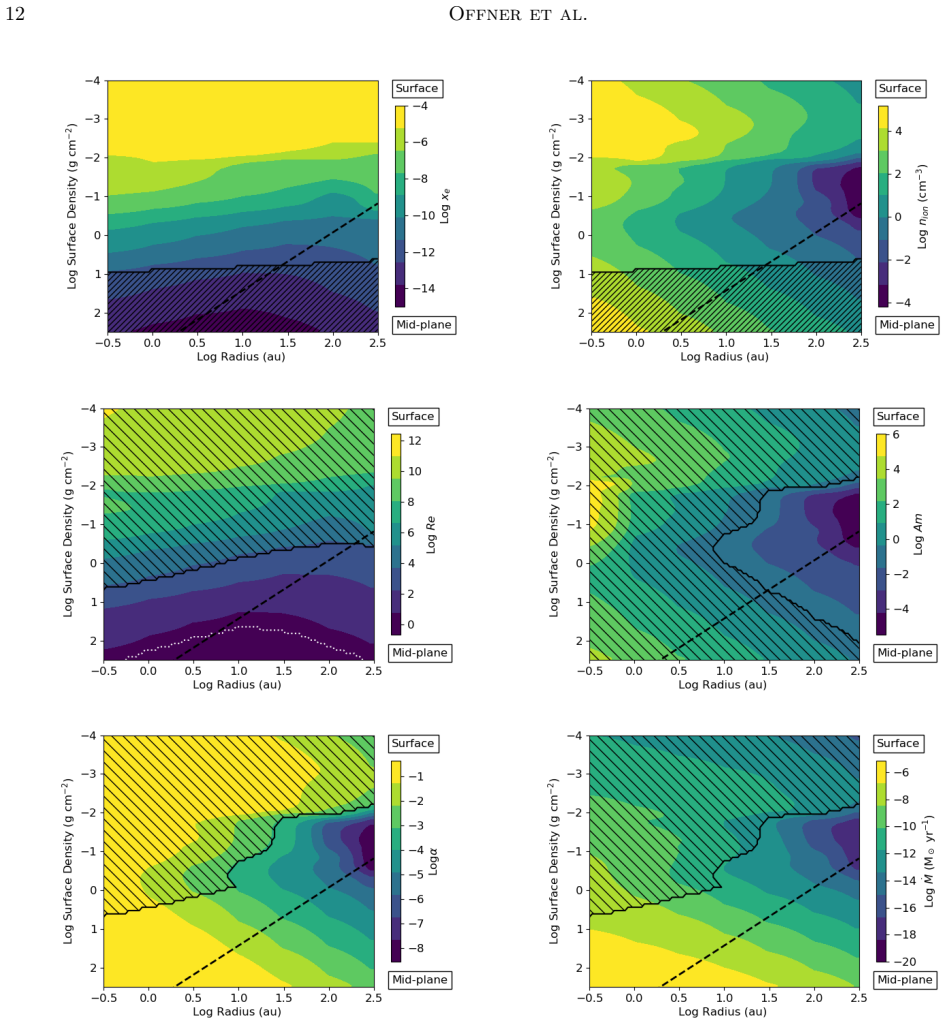
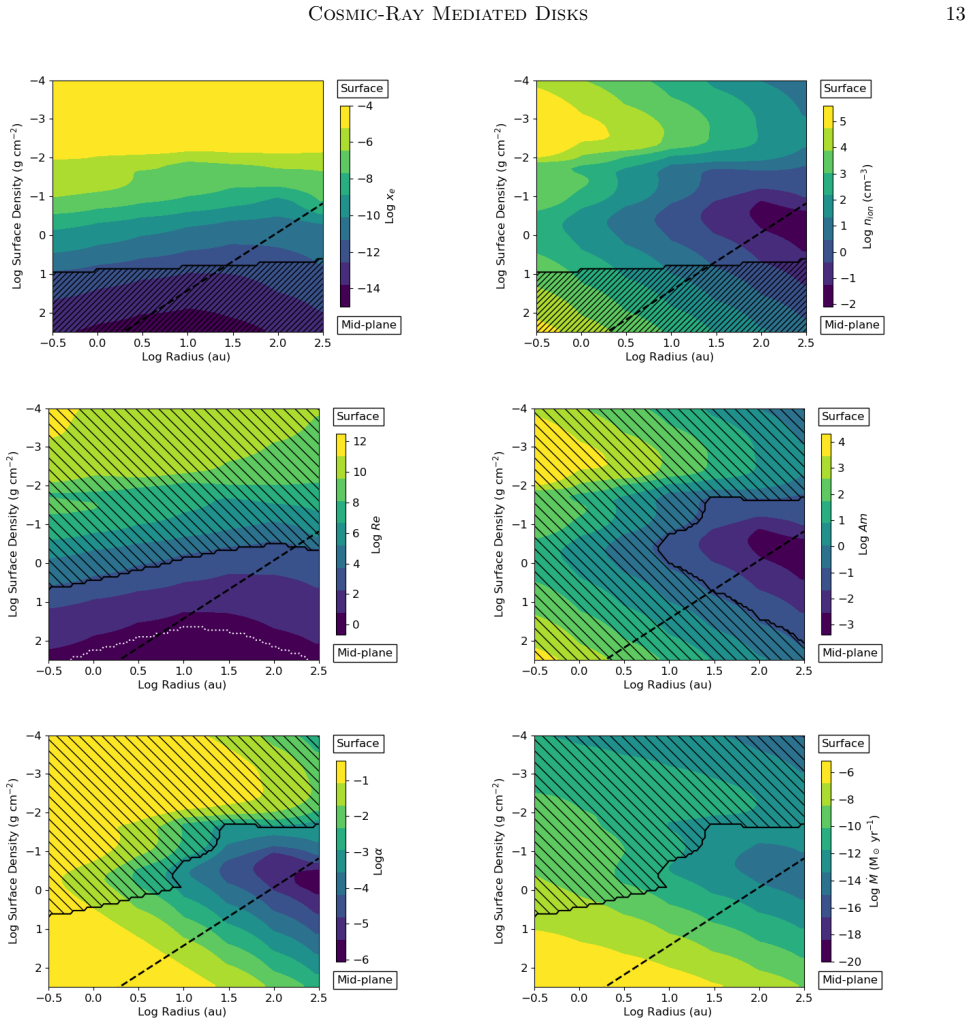
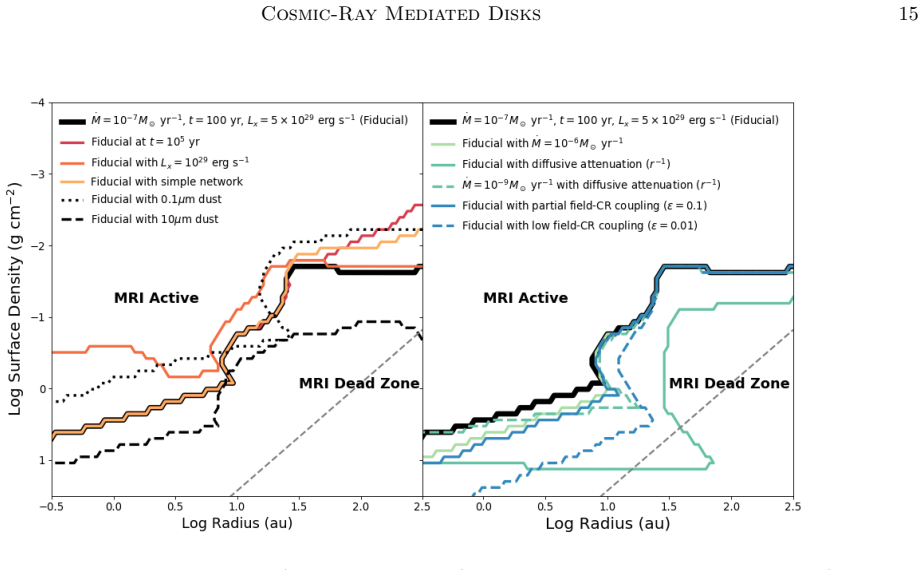
The central discovery is that cosmic rays accelerated by the stellar accretion shock of a T Tauri star can dominate disk ionization in the inner ~10 au. For accretion rates $\dot{M}_* \sim 10^{-9}$ to $10^{-6}\,M_\odot$ yr$^{-1}$, the paper computes surface ionization rates $\zeta \geq 10^{-15}$ s$^{-1}$, exceeding the Galactic background by at least an order of magnitude, with $\zeta \geq 10^{-14}$ s$^{-1}$ inside 10 au. This CR flux raises the ionization at intermediate to high column densities ($\Sigma > 10$ g cm$^{-2}$), makes C$^{+}$, S$^{+}$, and Mg$^{+}$ the surface ions and H$_3^+$ the ion above 1 g cm$^{-2}$, and extends the MRI-active region toward the midplane. Only with diffusive propagation ($\zeta \propto r^{-1}$) does the minimum-mass solar nebula midplane become MRI-active; otherwise it remains a dead zone. The paper concludes that the same accretion that accelerates CRs, the accretion column that attenuates them, and the MRI they enable form a feedback loop that can mediate accretion and drive luminosity variability.
Load-bearing premise
The calculation assumes the interstellar cosmic-ray attenuation law (ionization scales as column density to the -0.34 power) applies to the steeper, lower-energy spectrum accelerated at the accretion shock; if the true attenuation is materially different, the computed midplane ionization and MRI boundaries shift.
Editorial extensions
If this is right
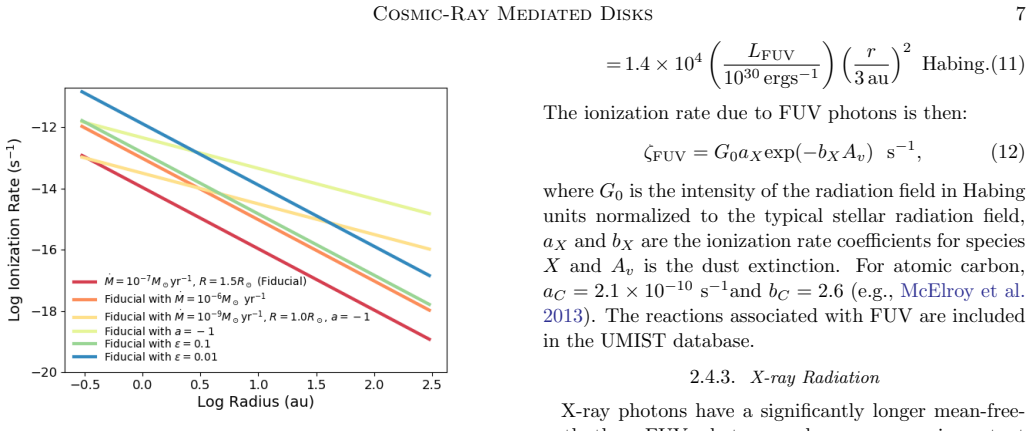
- For accretion rates $10^{-9}$ to $10^{-6}\,M_\odot$ yr$^{-1}$, shock-accelerated CRs give disk-surface ionization rates $\zeta \geq 10^{-15}$ s$^{-1}$, at least ten times the Galactic CR background, reaching about $10^{-14}$ s$^{-1}$ within 10 au.
- CR ionization dominates over X-rays and FUV at surface densities above $10$ g cm$^{-2}$ inside roughly 10 au, shifting the ion-neutral transition and changing the dominant ions: C$^{+}$, S$^{+}$, and Mg$^{+}$ at the surface, H$_3^+$ above 1 g cm$^{-2}$.
- The MRI-active region extends toward the midplane; in the fiducial model the disk is MRI-active at column densities near 1 g cm$^{-2}$ inside about 20 au, but the minimum-mass solar nebula midplane remains a dead zone.
- If CRs propagate diffusively ($\zeta \propto r^{-1}$), the midplane can become MRI-active, enabling an accretion self-regulation loop.
- At very high accretion rates the dense accretion flow attenuates the CRs, so CR feedback is strongest in T Tauri disks ($10^{-9}$ to $10^{-7}\,M_\odot$ yr$^{-1}$) and weaker in protostellar disks.
Reading between the lines
- A testable extension: molecular-line observations of H$_3^+$ in the inner ~10 au of an accreting T Tauri disk could distinguish shock-accelerated CR ionization from X-ray ionization, since the paper predicts H$_3^+$ dominates above 1 g cm$^{-2}$ with a CR-driven floor.
- If the CR feedback loop operates, young-star accretion should be self-limiting on timescales of a few years at the MRI-active boundary; this is an inference, as the paper only sketches the loop.
- Applying a steeper or shallower attenuation law for the $E^{-2}$ shock spectrum would shift the MRI-active boundary; a particle-transport calculation through disk gas would directly test the assumed $-0.34$ power law.
- The paper's discussion implies that CR-enhanced gas-phase CO could make CO observations of accreting sources overestimate the luminosity of past accretion bursts; this follows from its discussion but is not a central claim.
Signed reviews
Editorial analysis
A structured set of objections, weighed in public.
Referee Report
Summary. The paper uses the gas-grain chemistry code UCLCHEM to study whether cosmic rays accelerated at the accretion shock of a T Tauri star can ionize its circumstellar disk. Starting from the shock-accelerated E^-2 spectrum of Gaches & Offner (2018b), the authors propagate the spectrum through the accretion flow, the magnetosphere, and the disk, and compute the local ionization rate from cosmic rays together with FUV, X-rays, and radionuclides. They then run the chemistry at fixed density and temperature structure and map the electron fraction and ion abundances, using the magnetic Reynolds number and the ambipolar diffusion number to define the MRI-active region. The main claims are that local cosmic rays produce zeta >= 1e-15 to 1e-14 s^-1 at the disk surface within about 10 au, extend the MRI-active region to Sigma ~ 1 g cm^-2 inside about 20 au, and leave the MMSN midplane MRI-dead except for diffusive cosmic-ray propagation. The paper also proposes a feedback loop connecting accretion rate, cosmic-ray attenuation, and MRI activity.
Significance. If the results hold, this paper would establish a local, accretion-powered cosmic-ray source as a major term in the ionization budget of protoplanetary disks, with consequences for dead-zone structure, disk chemistry, and accretion variability. The modeling is transparent and forward-looking: the parameters are listed in Table 2, the chemistry code is public, the cosmic-ray spectrum is taken from an independent acceleration calculation rather than fitted to disk observables, and the paper states its main limitations explicitly. The predictions for dominant ions, H3+ abundances, CH3CN/HCN ratios, and the location of the MRI-active boundary are falsifiable and should stimulate observations. The quantitative MRI boundary is the key deliverable, and its robustness is the main thing the revision needs to establish.
major comments (3)
- [Section 2.4.1, Eq. (9)] The attenuation law zeta_CR = zeta_0 (N_H / 1e18 cm^-2)^-0.34 is adopted from Padovani et al. (2018) for interstellar cosmic-ray spectra and applied to the accretion-shock E^-2 spectrum, with the justification 'we assume the attenuation will be qualitatively similar in our case.' This assumption is load-bearing: the MRI-active boundary at Sigma ~ 1 g cm^-2 corresponds to N_H ~ 6e23 cm^-2, precisely the column range where the exponent matters. Changing the exponent from -0.34 to -0.6 lowers zeta by roughly a factor of 30 at that column and moves the CR-dominated active region to substantially lower surface density. The law is also applied beyond the stated validity range N_H < 1e25 cm^-2 when the MMSN midplane is evaluated. I ask for either a direct transport calculation of the post-shock spectrum through region III using the same loss-function machinery as regions I and II, or an explicit sensitivity study over the attenuation exponent and column range, with the resulting MRI boundaries reported. Without this, the quantitative MRI-active boundary and the midplane dead-zone conclusion remain conditional.
- [Section 2.1 and Section 4.6] The model assumes that photons and cosmic rays enter the disk only vertically and neglects side-entry at the inner rim. The authors acknowledge in Section 4.6 that this underestimates ionization at the midplane within the inner ~10 au and may extend the MRI-active region. This is not a minor caveat: the paper's negative conclusion that the MMSN midplane remains MRI-dead except for diffusive propagation is derived in the vertical-only geometry, and the proposed feedback loop depends on where the dead zone actually sits. Please quantify the side-entry contribution, at least with an approximate treatment of the inner-edge column, or explicitly restrict the midplane-dead-zone claim to the vertical-entry geometry.
- [Section 4.1 and Conclusions] The abstract and conclusions present a cosmic-ray feedback loop that 'mediates accretion and may produce luminosity variability,' but no time-dependent or even steady-state feedback model is presented. The paper demonstrates monotonic relationships between accretion rate, cosmic-ray production, attenuation, and MRI activity, but a negative-feedback loop that regulates accretion or produces variability requires an additional stability or timescale argument. Please add a simple estimate, such as the equilibrium accretion rate or the loop response time, or soften the wording to describe a possible feedback pathway rather than an established accretion-regulation mechanism.
minor comments (7)
- [Eq. (11)] The radial dependence in Eq. (11) appears inverted: as written G0 grows as r^2, whereas Eq. (10) gives G0 proportional to r^-2. This should presumably be (3 au / r)^2, and the implementation should be checked against the intended scaling.
- [Eq. (9)] The normalization column should be written with consistent units, N_H in cm^-2, and the meaning of N_H as the vertical hydrogen column from the disk surface should be stated at first use.
- [Section 3.1] The phrase 'a minor affect on the disk ionization' should read 'a minor effect.'
- [Section 4.6] The text 'grains colagulate and sediment' should read 'coagulate,' and 'ionization fraction of up to 10^-8 s^-1' should have dimensionless units for a fraction, not s^-1.
- [Section 3.4.2] In the sentence about large grains, 'Sigma ~ 10 g cm^-3' should be 'g cm^-2.'
- [References] The two Gaches & Offner references appear with identical bibliographic data (ApJ 861, 87); if 2018a and 2018b are distinct papers, the page or journal data should be corrected, and if they are the same paper, one citation should be removed.
- [Eq. (15)] The time unit in the radionuclide ionization expression should be specified explicitly, since the exponent 1.04 t is only sensible with t in a stated unit such as Myr.
Circularity Check
No significant circularity: forward-modeled CR ionization and MRI predictions with acknowledged external attenuation assumptions.
full rationale
The derivation chain is a forward model: an initial shock-accelerated CR spectrum from Gaches & Offner (2018b) is propagated through inverse funneling, accretion-flow energy losses, and disk attenuation using external loss functions and the Padovani et al. (2018) column-density relation; the resulting ionization rates drive UCLCHEM chemistry; electron fractions then set Re and Am and hence the MRI-active regions. No output quantity is fitted back into any input, and the proposed feedback loop is qualitative rather than a parameter used in the calculation. The CR spectrum from the authors' prior work is an independent physical model, not a fit to the disk observables being predicted. The application of the ISM-calibrated attenuation law to a different spectrum is explicitly acknowledged as an assumption ('we assume the attenuation will be qualitatively similar in our case'); that is a modeling uncertainty and correctness risk, not circularity. Self-citations are present but none make a derived result equivalent to an input by construction.
Assumptions & free parameters
free parameters (4)
- Accretion hot-spot covering fraction facc =
0.001, 0.01, 0.1
- CR accretion-column coupling epsilon =
1, 0.1, 0.01
- Radial CR attenuation exponent a =
2 (fiducial), 1 (diffusive)
- Dust grain radius agr =
0.1, 1.0, 10.0 micron
assumptions (6)
- domain assumption Diffusive shock acceleration at the stellar accretion shock produces CRs with an E^-2 spectrum up to a few GeV (Gaches & Offner 2018b).
- domain assumption The funneling attenuation factor ffunnel follows the multipole field model in Eq. (7).
- ad hoc to paper The disk CR attenuation law zeta = zeta0 (N_H/1e18)^-0.34 (Eq. 9) applies to the shock-accelerated spectrum.
- domain assumption The disk is vertically isothermal with T = 384 r^-3/7 K (Eq. 2).
- domain assumption CRs and radiation enter the disk only vertically through the surface; horizontal transport is neglected.
- domain assumption The MRI is active for Re > 3000 and Am > 0.1.
Cite this review
Pith. "Pith review of Impact of Cosmic-Ray Feedback on Accretion and Chemistry in Circumstellar Disks." pith.science (2026). https://pith.science/paper/35FZSHIG
@misc{pith2026190808061,
  author       = {Pith},
  title        = {Pith review of: Impact of Cosmic-Ray Feedback on Accretion and Chemistry in Circumstellar Disks},
  year         = {2026},
  howpublished = {\url{https://pith.science/paper/35FZSHIG}},
  note         = {Machine review of arXiv:1908.08061}
}
abstract
We use the gas-grain chemistry code UCLCHEM to explore the impact of cosmic-ray feedback on the chemistry of circumstellar disks. We model the attenuation and energy losses of the cosmic-rays as they propagate outwards from the star and also consider ionization due to stellar radiation and radionuclides. For accretion rates typical of young stars, $\dot M_* \sim 10^{-9}-10^{-6}$ M_\odot yr$^{-1}$, we show that cosmic rays accelerated by the stellar accretion shock produce a cosmic-ray ionization rate at the disk surface $\zeta \gtrsim 10^{-15}$ s$^{-1}$, at least an order of magnitude higher than the ionization rate associated with the Galactic cosmic-ray background. The incident cosmic-ray flux enhances the disk ionization at intermediate to high surface densities ($\Sigma > 10$ g cm$^{-2}$) particularly within 10 au of the star. We find the dominant ions are C$^+$, S$^+$ and Mg$^+$ in the disk surface layers, while the H$_3^+$ ion dominates at surface densities above 1.0 g cm$^{-2}$. We predict the radii and column densities at which the magneto-rotational instability (MRI) is active in T Tauri disks and show that ionization by cosmic-ray feedback extends the MRI-active region towards the disk mid-plane. However, the MRI is only active at the mid-plane of a minimum mass solar nebula disk if cosmic-rays propagate diffusively ($\zeta \propto r^{-1}$) away from the star. The relationship between accretion, which accelerates cosmic rays, the dense accretion columns, which attenuate cosmic rays, and the MRI, which facilitates accretion, create a cosmic-ray feedback loop that mediates accretion and may produce luminosity variability.
Figures
Figures from the paper (6 more)
Reference graph
Works this paper leans on
-
[1]
2014, in Protostars and Planets VI, ed
Cieza, L. 2014, in Protostars and Planets VI, ed. H. Beuther, R. S. Klessen, C. P. Dullemond, & T. Henning, 475
work page 2014
- [2]
- [3]
- [4]
-
[5]
Bai, X.-N., Ostriker, E. C., Plotnikov, I., & Stone, J. M. 2019, arXiv e-prints, arXiv:1902.10219
arXiv 2019
-
[6]
Bai, X.-N., & Stone, J. M. 2011, ApJ, 736, 144 —. 2017, ApJ, 836, 46
work page 2011
-
[7]
A., & Hawley, J
Balbus, S. A., & Hawley, J. F. 1991, ApJ, 376, 214
1991
-
[8]
Ceccarelli, C., Dominik, C., L´ opez-Sepulcre, A., et al. 2014, ApJ, 790, L1
work page 2014
Show all 76 references
-
[9]
I., Adams, F
Cleeves, L. I., Adams, F. C., Bergin, E. A., & Visser, R. 2013b, ApJ, 777, 28 D’Alessio, P., Calvet, N., Hartmann, L., Franco-Hern´ andez, R., & Serv´ ın, H. 2006, ApJ, 638, 314
2006
-
[10]
2006, Proceedings of the National Academy of Science, 103, 12269
Dalgarno, A. 2006, Proceedings of the National Academy of Science, 103, 12269
2006
-
[11]
J., & Turner, N
Desch, S. J., & Turner, N. J. 2015, ApJ, 811, 156
2015
-
[12]
M., Gregory, S
Donati, J.-F., Jardine, M. M., Gregory, S. G., et al. 2008, MNRAS, 386, 1234
2008
-
[13]
P., & Dominik, C
Dullemond, C. P., & Dominik, C. 2004, A&A, 421, 1075
2004
-
[14]
2014, Protostars and Planets VI, 317
Dutrey, A., Semenov, D., Chapillon, E., et al. 2014, Protostars and Planets VI, 317
2014
-
[15]
2018, ApJ, 859, 136
Favre, C., Ceccarelli, C., L´ opez-Sepulcre, A., et al. 2018, ApJ, 859, 136
2018
-
[16]
D., Getman, K., Townsley, L., et al
Feigelson, E. D., Getman, K., Townsley, L., et al. 2005, ApJS, 160, 379
2005
-
[17]
A., & Mouschovias, T
Fiedler, R. A., & Mouschovias, T. C. 1993, ApJ, 415, 680
1993
-
[18]
M., Hughes, A
Flaherty, K. M., Hughes, A. M., Rosenfeld, K. A., et al. 2015, ApJ, 813, 99
2015
-
[19]
M., Hughes, A
Flaherty, K. M., Hughes, A. M., Teague, R., et al. 2018, ApJ, 856, 117
2018
-
[20]
M., Hughes, A
Flaherty, K. M., Hughes, A. M., Rose, S. C., et al. 2017, ApJ, 843, 150
2017
-
[21]
J., Cohen, O., & Garraffo, C
Fraschetti, F., Drake, J. J., Cohen, O., & Garraffo, C. 2018, ApJ, 853, 112
2018
-
[22]
K., Padoan, P., & Haugbølle, T
Frimann, S., Jørgensen, J. K., Padoan, P., & Haugbølle, T. 2016, A&A, 587, A60
2016
-
[23]
Fromang, S., Terquem, C., & Balbus, S. A. 2002, MNRAS, 329, 18
2002
-
[24]
Gaches, B. A. L., Offner, S. S. R., & Bisbas, T. G. 2019, ApJ, 878, 105
2019
-
[25]
Gammie, C. F. 1996, ApJ, 457, 355
1996
-
[26]
E., Lizano, S., & Galli, D
Glassgold, A. E., Lizano, S., & Galli, D. 2017, MNRAS, 472, 2447
2017
-
[27]
E., Najita, J
Glassgold, A. E., Najita, J. R., & Igea, J. 2007, ApJ, 656, 515
2007
-
[28]
A., & Simon, J
Gole, D. A., & Simon, J. B. 2018, ApJ, 869, 84
2018
-
[29]
H., & Yan, M
Gredel, R., Black, J. H., & Yan, M. 2001, A&A, 375, 553
2001
-
[30]
P., & Turner, N
Gressel, O., Nelson, R. P., & Turner, N. J. 2012, MNRAS, 422, 1140
2012
-
[31]
2016, Annual Review of Astronomy and Astrophysics, 54, 135
Hartmann, L., Herczeg, G., & Calvet, N. 2016, Annual Review of Astronomy and Astrophysics, 54, 135
2016
-
[32]
A., & Findeisen, K
Hillenbrand, L. A., & Findeisen, K. P. 2015, ApJ, 808, 68
2015
-
[33]
2017, AJ, 154, 38
Priestley, F. 2017, AJ, 154, 38
2017
-
[34]
Hunter, J. D. 2007, Computing in Science and Engineering, 9, 90
2007
-
[35]
Igea, J., & Glassgold, A. E. 1999, ApJ, 518, 848
1999
-
[36]
R., Oka, T., & McCall, B
Indriolo, N., Geballe, T. R., Oka, T., & McCall, B. J. 2007, ApJ, 671, 1736
2007
-
[37]
Indriolo, N., & McCall, B. J. 2012, ApJ, 745, 91
2012
-
[38]
A., Gerin, M., et al
Indriolo, N., Neufeld, D. A., Gerin, M., et al. 2015, ApJ, 800, 40
2015
-
[39]
Johns-Krull, C. M. 2007, ApJ, 664, 975
2007
-
[40]
2001–, SciPy: Open source scientific tools for Python, , , [Online; accessed ¡today¿]
Jones, E., Oliphant, T., Peterson, P., et al. 2001–, SciPy: Open source scientific tools for Python, , , [Online; accessed ¡today¿]. http://www.scipy.org/ Jørgensen, J. K., Visser, R., Williams, J. P., & Bergin, E. A. 2015, A&A, 579, A23
2001
-
[41]
Kunz, M. W. 2008, MNRAS, 385, 1494
2008
-
[42]
W., & Fromang, S
Lesur, G., Kunz, M. W., & Fromang, S. 2014, A&A, 566, A56
2014
-
[43]
F., Testi, L., Natta, A., et al
Manara, C. F., Testi, L., Natta, A., et al. 2014, A&A, 568, A18
2014
-
[44]
1994, A&A, 286, 983
Mannheim, K., & Schlickeiser, R. 1994, A&A, 286, 983
1994
-
[45]
J., et al
McElroy, D., Walsh, C., Markwick, A. J., et al. 2013, A&A, 550, A36 ¨Oberg, K. I., Guzm´ an, V. V., Furuya, K., et al. 2015, Nature, 520, 198 Offner, S. S. R., & Chaban, J. 2017, ApJ, 847, 104 Offner, S. S. R., Klein, R. I., McKee, C. F., & Krumholz, M. R. 2009, ApJ, 703, 131 Off...
2013
-
[46]
2011, A&A, 530, A109
Padovani, M., & Galli, D. 2011, A&A, 530, A109
2011
-
[47]
Padovani, M., Galli, D., & Glassgold, A. E. 2009, A&A, 501, 619
2009
-
[48]
V., Galli, D., & Caselli, P
Padovani, M., Ivlev, A. V., Galli, D., & Caselli, P. 2018, A&A, 614, A111
2018
-
[49]
2016, A&A, 590, A8
Padovani, M., Marcowith, A., Hennebelle, P., & Ferri` ere, K. 2016, A&A, 590, A8
2016
-
[50]
2011, ApJ, 735, 8 Cosmic-Ray Mediated Disks 19
Perez-Becker, D., & Chiang, E. 2011, ApJ, 735, 8 Cosmic-Ray Mediated Disks 19
2011
-
[51]
2005, ApJS, 160, 401 Qu´ enard, D., Jim´ enez-Serra, I., Viti, S., Holdship, J., &
Preibisch, T., Kim, Y.-C., Favata, F., et al. 2005, ApJS, 160, 401 Qu´ enard, D., Jim´ enez-Serra, I., Viti, S., Holdship, J., &
2005
-
[52]
2018, MNRAS, 474, 2796
Coutens, A. 2018, MNRAS, 474, 2796
2018
-
[53]
M., Cody, A
Rebull, L. M., Cody, A. M., Covey, K. R., et al. 2014, AJ, 148, 92
2014
-
[54]
M., Ray, T
Rodgers-Lee, D., Taylor, A. M., Ray, T. P., & Downes, T. P. 2017, MNRAS, 472, 26
2017
-
[55]
M., & Owocki, S
Romanova, M. M., & Owocki, S. P. 2015, SSRv, 191, 339
2015
-
[56]
M., Umebayashi, T., & Nakano, T
Sano, T., Miyama, S. M., Umebayashi, T., & Nakano, T. 2000, ApJ, 543, 486
2000
-
[57]
Sano, T., & Stone, J. M. 2002, ApJ, 577, 534
2002
-
[58]
2002, Cosmic Ray Astrophysics
Schlickeiser, R. 2002, Cosmic Ray Astrophysics
2002
-
[59]
2016, ApJ, 824, 89
Schlickeiser, R., Caglar, M., & Lazarian, A. 2016, ApJ, 824, 89
2016
-
[60]
2004, A&A, 417, 93
Semenov, D., Wiebe, D., & Henning, T. 2004, A&A, 417, 93
2004
-
[61]
2000, A&A, 358, 593
Siess, L., Dufour, E., & Forestini, M. 2000, A&A, 358, 593
2000
-
[62]
V., Padovani, M., & Caselli, P
Silsbee, K., Ivlev, A. V., Padovani, M., & Caselli, P. 2018, ApJ, 863, 188
2018
-
[63]
B., Bai, X.-N., Flaherty, K
Simon, J. B., Bai, X.-N., Flaherty, K. M., & Hughes, A. M. 2018, ApJ, 865, 10
2018
-
[64]
B., Lesur, G., Kunz, M
Simon, J. B., Lesur, G., Kunz, M. W., & Armitage, P. J. 2015, MNRAS, 454, 1117
2015
-
[65]
M., Ostriker, E
Stone, J. M., Ostriker, E. C., & Gammie, C. F. 1998, ApJL, 508, L99
1998
-
[66]
2016, A&A, 592, A49
Teague, R., Guilloteau, S., Semenov, D., et al. 2016, A&A, 592, A49
2016
-
[67]
2019, MNRAS, 485, 2977
Thomas, T., & Pfrommer, C. 2019, MNRAS, 485, 2977
2019
-
[68]
Tielens, A. G. G. M. 2005, The Physics and Chemistry of the Interstellar Medium
2005
-
[69]
J., Sano, T., & Dziourkevitch, N
Turner, N. J., Sano, T., & Dziourkevitch, N. 2007, ApJ, 659, 729
2007
-
[70]
1981, PASJ, 33, 617 —
Umebayashi, T., & Nakano, T. 1981, PASJ, 33, 617 —. 2009, ApJ, 690, 69 van der Walt, S., Colbert, S. C., & Varoquaux, G. 2011, Computing in Science and Engineering, 13, 22 van Dishoeck, E. F. 2014, Faraday Discussions, 168, 9
1981
-
[71]
M., & Herbst, E
Wakelam, V., Cuppen, H. M., & Herbst, E. 2013, arXiv e-prints, arXiv:1309.7792
2013 arXiv
-
[72]
2012, ApJS, 199, 21
Wakelam, V., Herbst, E., Loison, J.-C., et al. 2012, ApJS, 199, 21
2012
-
[73]
J., Nomura, H., et al
Walsh, C., Millar, T. J., Nomura, H., et al. 2014, A&A, 563, A33
2014
-
[74]
2007, Ap&SS, 311, 35
Wardle, M. 2007, Ap&SS, 311, 35
2007
-
[75]
2012, MNRAS, 422, 2737
Wardle, M., & Salmeron, R. 2012, MNRAS, 422, 2737
2012
-
[76]
2016, ApJ, 819, 68
Xu, R., & Bai, X.-N. 2016, ApJ, 819, 68
2016
Reviewed August 14, 2026 · model on record in the stance chip above.
Discussion (0). Continue with ORCID to comment.