REVIEW 3 major objections 6 minor 39 references
Lagrangian stochastic modeling of acceleration in turbulent wall-bounded flows
T0 review · 3 major / 6 minor · reviewed 2026-08-14 · deepseek-v4-flash
Pith's one-line read A three-variable stochastic model reproduces acceleration statistics in wall-bounded turbulence.
desk verdict A credible generalization of the Sawford/Pope acceleration model to wall-bounded flows, but its quantitative predictions rest on an unverified order-one coefficient for the acceleration timescale. read the letter →
The pith
A machine-rendered reading of the paper's core claim, the machinery that carries it, and where it could break.
The reading
What carries the argument
The mechanism that carries the argument is the stochastic differential system (2.1)-(2.3): position $x_i$ and velocity $U_i$ evolve with a drift that returns the velocity toward its mean with a matrix $D_{ij}$ taken from the generalized Langevin model, while the acceleration $a_i$ follows an Ornstein-Uhlenbeck process $da_i = -\beta a_i\,dt + \sqrt{B}\,dW_i$. The key identity is the closure $\beta = 1/\tau_\eta$ and $B = (C_0\langle\epsilon\rangle/\tau_\eta)(1/\tau_\eta + 1/T_L)$, obtained by matching the moment equations for $\langle u_i a_j\rangle$ and $\langle a_i a_j\rangle$ to the velocity-based Langevin model in the limit $\tau_\eta \to 0$. This colored-noise construction replaces the white noise of velocity-only models, and the finite memory time $\beta^{-1}$ is what produces the finite acceleration correlation time, the viscous near-wall acceleration signal, and the modified Reynolds-stress balance.
What would settle it
Measure the Lagrangian acceleration autocorrelation function for fluid particles in a DNS of a channel flow at $\mathrm{Re}_\tau \approx 1440$ at several wall-normal positions, and compare the initial decay time of the correlation to $\tau_\eta = \sqrt{\nu/\langle\epsilon\rangle}$; if the ratio differs from one by more than the statistical uncertainty, the assumed $\beta = 1/\tau_\eta$ fails and the model's acceleration predictions for that wall distance cannot be correct.
Extended reading notes
Core claim
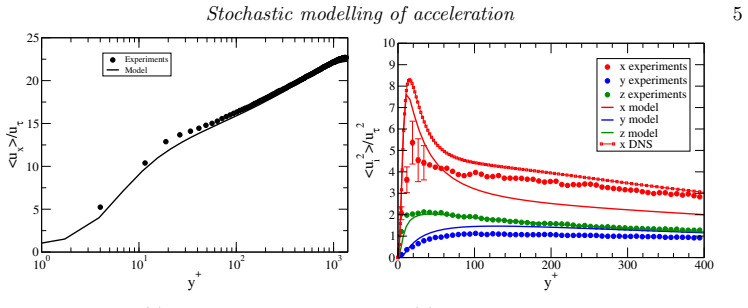
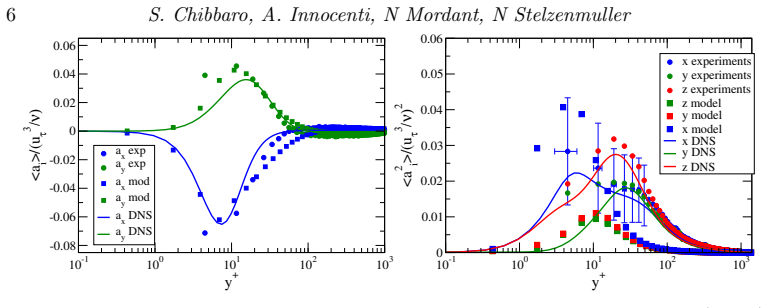
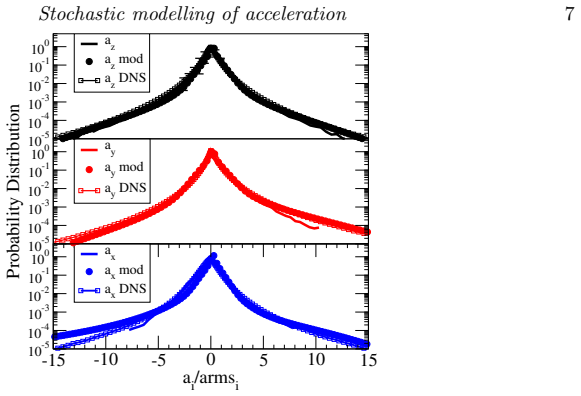
On the paper's own terms, the discovery is that a diffusion process on position, velocity, and acceleration with the closure $\beta = 1/\tau_\eta$ and $B = (C_0\langle\epsilon\rangle/\tau_\eta)(1/\tau_\eta + 1/T_L)$ is enough to capture the statistical signature of fluid-particle acceleration in an inhomogeneous wall-bounded flow. The diffusion coefficient $B$ is fixed by requiring the velocity-acceleration covariance equations to reduce to the standard Langevin model in the limit $\tau_\eta \to 0$, while the acceleration memory rate $\beta$ is set to the local Kolmogorov time scale. Without low-Reynolds-number corrections and without multiplicative noise, the model gives the correct mean streamwise acceleration near the wall, the anisotropy of the acceleration variance, wall-distance-dependent decorrelation, and heavy-tailed probability distributions consistent with experiments and direct numerical simulation. The authors attribute the heavy tails to inhomogeneity: the spatially varying dissipation rate that enters $B$ along particle trajectories creates the extreme events, a mechanism they note is absent in homogeneous-turbulence models.
Load-bearing premise
The model assumes the acceleration memory time is exactly the local viscous time scale $\tau_\eta$, with no adjustable factor; if the real ratio differs, the predicted acceleration variance and correlation shape shift.
Editorial extensions
If this is right
- The standard velocity-only Langevin description is insufficient near walls: the acceleration variable is what brings in the near-wall mean acceleration, the anisotropy, and the intermittent tails without extra low-Reynolds-number terms.
- The same closed model, with the same $\beta$ and $B$ formulas, can be coupled to any available RANS mean field in a different inhomogeneous flow; the channel test suggests no flow-specific tuning beyond the choice of $C_0$.
- The model supplies explicit transport equations for the velocity-acceleration correlations and the acceleration variance, so the near-wall budget of these correlations can be inspected in the same framework.
- Heavy-tailed acceleration probability distributions in wall turbulence can be generated by spatial inhomogeneity of the mean dissipation alone, without modeling the fluctuations of $\epsilon$; the paper argues this is what the channel data show.
Reading between the lines
- Beyond the paper: because the heavy tails are attributed to inhomogeneity rather than to fluctuating dissipation, a natural test is to run the same closure in homogeneous turbulence; the model would predict much weaker tails, isolating the inhomogeneity mechanism.
- Beyond the paper: the proportionality constant in $\beta = 1/\tau_\eta$ is the model's main free ratio; a direct measurement of the Lagrangian acceleration correlation time at several wall distances would either confirm the value one or supply a spatial correction function that could be inserted without changing the model's structure.
- Beyond the paper: the same colored-noise construction can be iterated to include higher velocity derivatives, such as jerk, using the Kolmogorov scaling of derivative correlations that the paper derives; the second-order form in Appendix B shows the extension path.
Signed reviews
Editorial analysis
A structured set of objections, weighed in public.
Referee Report
Summary. The paper proposes a stochastic Lagrangian model that includes fluid particle position, velocity, and acceleration as dynamical variables for inhomogeneous turbulent flows. The acceleration is modeled as an Ornstein-Uhlenbeck process, and the coefficients are fixed by Kolmogorov scaling (β = 1/τη) and by requiring consistency with the standard velocity-only Langevin model in the limit τη → 0, which fixes B via Eq. (2.8) and C0 from the Rotta constant. The closed model is applied to a channel flow at Reτ ≈ 1440 using a hybrid RANS/PDF approach with the Durbin elliptic-relaxation Reynolds-stress model. Predictions for the mean and variance of acceleration, Lagrangian autocorrelations, and acceleration PDFs are compared with experiments and DNS, and the paper claims good agreement including anisotropy and strong intermittency. The model is shown to reduce to Sawford's isotropic model and to the generalized Langevin model in appropriate limits.
Significance. If the results hold, the model provides a relatively simple, theoretically motivated way to include acceleration as a dynamical variable in inhomogeneous wall-bounded flows, with potential applications to dispersion, mixing, and inertial-particle modeling. A clear strength is that the acceleration statistics are not used to calibrate the model: B is fixed by consistency with the velocity-only Langevin model, and C0 is inherited from the Rotta constant, so the acceleration variance, correlations, and PDFs are genuine outputs of the model rather than fits. The numerical scheme in Appendix A is explicitly given, and the comparisons with experiments and DNS are valuable. The main weakness is that the acceleration timescale β−1 is fixed by an unverified proportionality constant, and the validation is largely qualitative, so the quantitative agreement claimed is conditional on that assumption.
major comments (3)
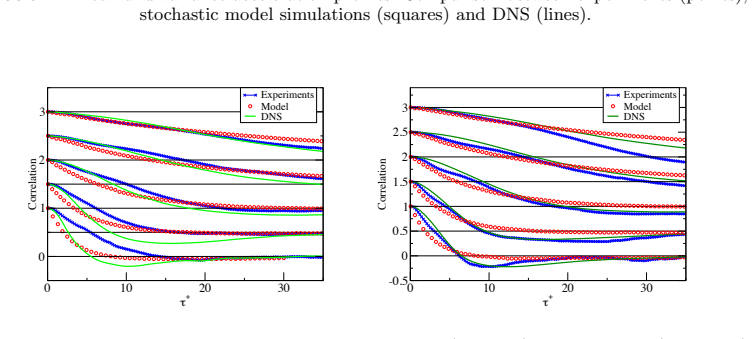
- [Section 2, paragraph following the dimensional analysis of the acceleration correlation (β = 1/τη)] The choice β = 1/τη, made 'assuming a constant of proportionality of one', is not derived from Kolmogorov theory, not measured, and not independently tested. This is load-bearing because β enters every acceleration statistic. From Eq. (2.3), the stationary acceleration variance is B/(2β), and with Eq. (2.8) this gives ⟨a_i²⟩ = C0⟨ε⟩/(2τη) per component, so a factor c in β = c/τη multiplies all variance profiles by c (after re-imposing consistency through Eq. 2.8). The acceleration autocorrelation is exp(−βτ), so the decorrelation times shown in Fig. 3 scale as 1/c, and the velocity–acceleration correlation in Eq. (2.6) also changes with β. The statement that results are insensitive to C0 ∈ [0.2, 1.5] does not probe c independently, because for the variance C0 and c are partly degenerate. A sensitivity analysis on c, or an independent determination of c from DNS/experiment, is required before the quantitative agreement in Figs. 2–4 can be asserted.
- [Section 4, Figs. 2–4] The validation is essentially qualitative. The text explicitly concedes 'qualitative overall agreement' for the acceleration variances and 'satisfactory' for the correlations, and the PDF tails in Fig. 4 are compared down to 10⁻⁵ without any quantification of the sampling error (the paper states that statistical error is significant but gives no estimate). Since the central claim is that the model reproduces the acceleration statistics, quantitative measures are needed: relative errors for the variance peaks, integral timescales extracted from the correlations, and moment-based statistics such as flatness or kurtosis of the PDFs, together with confidence intervals. This is particularly important for the extreme tails, which are used to support the conclusion that inhomogeneity alone generates the observed intermittency.
- [Section 3, Eqs. (2.1)–(2.3)] The paper describes the hybrid RANS/PDF approach as 'self-consistent', but the stochastic model is not shown to satisfy the well-mixed condition with respect to the prescribed RANS Eulerian fields. With G^a_ij = 0, the stationary velocity statistics of the stochastic particles will generally differ from the RANS Reynolds stresses that determine the model coefficients. Consequently, the spatial distribution of particles, and hence the sampled Lagrangian acceleration statistics (especially the correlations and PDFs that depend on particle paths), may be distorted. The authors should either demonstrate that the model's one-point velocity statistics are consistent with the RANS fields used in the coefficients, or discuss the sensitivity of the acceleration results to this mismatch.
minor comments (6)
- [Equation (2.8) and surrounding text] The typeset expression 'B 2τη(1/τη + 1/TL)⁻¹' is ambiguous; it should read (B τη/2)(1/τη + 1/TL)⁻¹. The subsequent limit and the final expression for B are consistent with this reading, but the notation should be cleaned up to avoid confusion.
- [Figure 2 caption] The caption refers to 'stochastic model simulations (squares)', but the figure legend appears to use continuous 'model' lines; please harmonize the caption with the actual symbols.
- [Figure 3] The DNS curve is shown for only one wall distance, with no explanation of which y₀⁺ it corresponds to or why only one case is given; please specify or add DNS data for the other positions.
- [Section 2, text near Eq. (2.5)] There is a typo: 'responsable' should be 'responsible'.
- [Introduction and Section 5] The claim that the model 'generalises both the acceleration-based models for homogeneous flows' appears overstated: the homogeneous limit of Eq. (2.3) is a linear Ornstein-Uhlenbeck process, which does not include the conditional cubic-Gaussian model of Lamorgese et al. (2007) cited earlier. Please clarify the intended sense of 'generalise'.
- [Section 2, after Eq. (2.8)] The statement that 'results do not change qualitatively in the range C0 ∈ [0.2, 1.5]' is not supported by any figure or table; please provide a sensitivity plot or a reference.
Circularity Check
No circular derivation: acceleration statistics are genuine outputs; the quantitative agreement is conditional on the unverified β=1/τη assumption, which is a correctness risk, not a circularity.
full rationale
The derivation chain is not circular. The model (2.1)-(2.3) has free coefficients β and B. β is set dimensionally to the Kolmogorov rate in Section 2 after Eq. (2.7): 'On the basis of these estimates, the fluid particle acceleration timescale β−1 is taken proportional to the local Kolmogorov timescale, assuming a constant of proportionality of one we get β−1 = τη.' B is fixed separately by Eq. (2.8), B = C0⟨ε⟩/τη (1/τη + 1/TL) ≈ C0⟨ε⟩/τη^2, from the requirement that the colored-noise model reduce to the standard Langevin velocity model in the fast limit (2.5)-(2.6). This consistency condition imports C0 = 0.35 from the Rotta constant used in the RANS field, not from acceleration data. The stationary acceleration variance then follows from Eqs. (2.3)/(2.7): ⟨ai^2⟩ = B/(2β) = C0⟨ε⟩/(2τη), and the acceleration correlation is exp(−βτ). These are genuine model outputs, algebraically derived from the stated coefficients; neither β nor B is fitted to the acceleration statistics in Figs. 2-4. The comparison with the channel-flow experiments and DNS of Stelzenmuller et al. (2017) is therefore a real test of the closure, and the self-citation to that dataset is not load-bearing to the coefficient choice. The principal caveat is the unverified proportionality constant unity in β=1/τη: it controls the magnitude and shape of all acceleration predictions and is not measured or derived, so the quantitative agreement is conditional on that order-one assumption. That is a robustness/correctness limitation, not an input-output equivalence; no equation reduces to itself and no fitted parameter is relabeled as a prediction. Score 2 reflects a minor, non-circular assumption and a self-cited benchmark rather than any circular reduction.
Assumptions & free parameters
free parameters (2)
- C0 =
0.35
- acceleration timescale proportionality constant =
1
assumptions (5)
- domain assumption Kolmogorov similarity hypotheses for structure functions and derivative correlations, including universal functions zeta(x), alpha_n(x) and A^2 = K nu^{-1/2} <epsilon>^{3/2}
- domain assumption The three-state vector (x, U, a) is Markovian and a is an Ornstein-Uhlenbeck process driven by white noise, so all higher-order derivatives beyond acceleration are negligible
- domain assumption In the limit tau_eta -> 0 the new model must reduce to the generalized Langevin velocity model (Eq. 2.4), which fixes B through the limit calculation leading to Eq. (2.8)
- domain assumption The Durbin elliptic-relaxation RANS model, with parameters from Durbin (1993), supplies accurate mean velocity, pressure, k, and dissipation fields for the hybrid coupling
- ad hoc to paper The velocity redistribution matrix G^a_ij is set to zero for simplicity
Cite this review
Pith. "Pith review of Lagrangian stochastic modeling of acceleration in turbulent wall-bounded flows." pith.science (2026). https://pith.science/paper/36J7ZJD6
@misc{pith2026190803437,
  author       = {Pith},
  title        = {Pith review of: Lagrangian stochastic modeling of acceleration in turbulent wall-bounded flows},
  year         = {2026},
  howpublished = {\url{https://pith.science/paper/36J7ZJD6}},
  note         = {Machine review of arXiv:1908.03437}
}
read the original abstract
The Lagrangian approach is natural to study issues of turbulent dispersion and mixing. We propose in this work a general Lagrangian stochastic model including velocity and acceleration as dynamical variables for inhomogeneous turbulent flows. The model takes the form of a diffusion process and the coefficients of the model are determined via Kolmogorov theory and the requirement of consistency with the velocity-based models. It is shown that the present model generalises both the acceleration-based models for homogeneous flows and the generalised Langevin models for the velocity. The resulting closed model is applied to a channel flow at high Reynolds number and compared to experiments as well as direct numerical simulations. A hybrid approach coupling the stochastic model with a Reynolds-Averaged-Navier-Stokes (RANS) is used to obtain a self-consistent model, as commonly used in probability density function methods. Results highlight that most of the acceleration features are well represented, notably the anisotropy and the strong intermittency. These results are valuable, since the model allows to improve the modelling of boundary layers yet remaining relatively simple. It sheds also some light on the statistical mechanisms at play in the near-wall region.
Figures
Figures from the paper (1 more)
Reference graph
Works this paper leans on
-
[1]
, " * write output.state after.block = add.period write newline
ENTRY address author booktitle chapter edition editor howpublished institution journal key month note number organization pages publisher school series title type volume year eprint label extra.label sort.label short.list INTEGERS output.state before.all mid.sentence after.sentence after.block FUNCTION init.state.consts #0 'before.all := #1 'mid.sentence ...
-
[2]
write newline
" write newline "" before.all 'output.state := FUNCTION n.dashify 't := "" t empty not t #1 #1 substring "-" = t #1 #2 substring "--" = not "--" * t #2 global.max substring 't := t #1 #1 substring "-" = "-" * t #2 global.max substring 't := while if t #1 #1 substring * t #2 global.max substring 't := if while FUNCTION word.in bbl.in capitalize " " * FUNCT...
-
[3]
International Journal of Multiphase Flow 37 (3), 293--297
Chibbaro, S & Minier, JP 2011 A note on the consistency of hybrid eulerian/lagrangian approach to multiphase flows . International Journal of Multiphase Flow 37 (3), 293--297
work page 2011
- [4]
-
[5]
Dreeben, T. D. & Pope, S. B. 1998 Probability density function/ M onte C arlo simulation of near-wall turbulent flows . J. Fluid Mech. 357 , 141
work page 1998
-
[6]
Journal of Fluid Mechanics 249 , 465--498
Durbin, PA 1993 A reynolds stress model for near-wall turbulence . Journal of Fluid Mechanics 249 , 465--498
work page 1993
-
[7]
Durbin, PA 1991 Near-wall turbulence closure modeling without “damping functions” . Theoretical and Computational Fluid Dynamics 3 (1), 1--13
work page 1991
-
[8]
Fox, RO 2003 Computational models for turbulent reacting flows\/ . Cambridge Univ. Press
work page 2003
Show all 39 references
-
[9]
Gardiner, CW & others 1985 Handbook of stochastic methods\/ , , vol. 3 . springer Berlin
1985
-
[10]
Physica D: Nonlinear Phenomena 193 (1-4), 231--244
Gotoh, T & Kraichnan, RH 2004 Turbulence and tsallis statistics . Physica D: Nonlinear Phenomena 193 (1-4), 231--244
2004
-
[11]
Geophysical & Astrophysical Fluid Dynamics 2 (1), 123--146
Krasnoff, E & Peskin, RL 1971 The langevin model for turbulent diffusion . Geophysical & Astrophysical Fluid Dynamics 2 (1), 123--146
1971
-
[12]
Journal of Fluid Mechanics 582 , 423--448
Lamorgese, AG , Pope, SB , Yeung, PK & Sawford, BL 2007 A conditionally cubic-gaussian stochastic lagrangian model for acceleration in isotropic turbulence . Journal of Fluid Mechanics 582 , 423--448
2007
-
[13]
Physical review letters 92 (14), 144502
Lee, C , Yeo, K & Choi, J 2004 Intermittent nature of acceleration in near wall turbulence . Physical review letters 92 (14), 144502
2004
-
[14]
Physics reports 461 (4-6), 111--195
Marconi, UMB , Puglisi, A , Rondoni, L & Vulpiani, A 2008 Fluctuation--dissipation: response theory in statistical physics . Physics reports 461 (4-6), 111--195
2008
-
[15]
Annual Review of Fluid Mechanics 43 , 219--245
Meneveau, C 2011 Lagrangian dynamics and models of the velocity gradient tensor in turbulent flows . Annual Review of Fluid Mechanics 43 , 219--245
2011
-
[16]
Physics Reports 665 , 1--122
Minier, JP 2016 Statistical descriptions of polydisperse turbulent two-phase flows . Physics Reports 665 , 1--122
2016
-
[17]
Physics of Fluids 26 (11), 113303
Minier, JP , Chibbaro, S & Pope, SB 2014 Guidelines for the formulation of lagrangian stochastic models for particle simulations of single-phase and dispersed two-phase turbulent flows . Physics of Fluids 26 (11), 113303
2014
-
[18]
& Peirano, E
Minier, J.-P. & Peirano, E. 2001 The PDF approach to turbulent and polydispersed two-phase flows . Phys. Rep. 352 (1-3), 1--214
2001
-
[19]
Monin, AS & Yaglom, AM 2013 Statistical fluid mechanics . Dover
2013
-
[20]
Physical review letters 89 (25), 254502
Mordant, N , Delour, J , L \'e veque, E , Arn \'e odo, A & Pinton, J-F 2002 Long time correlations in lagrangian dynamics: a key to intermittency in turbulence . Physical review letters 89 (25), 254502
2002
-
[21]
New Journal of Physics 6 (1), 116
Mordant, N , L \'e v \^e que, E & Pinton, JF 2004 Experimental and numerical study of the lagrangian dynamics of high reynolds turbulence . New Journal of Physics 6 (1), 116
2004
-
[22]
Physical Review Letters 87 (21), 214501
Mordant, N , Metz, P , Michel, O & Pinton, JF 2001 Measurement of Lagrangian velocity in fully developed turbulence . Physical Review Letters 87 (21), 214501
2001
-
[23]
Physical Review 91 (6), 1505
Onsager, L & Machlup, S 1953 Fluctuations and irreversible processes . Physical Review 91 (6), 1505
1953
-
[24]
, Chibbaro, S
Peirano, E. , Chibbaro, S. , Pozorski, J. & Minier, J.-P. 2006 Mean-field/ PDF numerical approach for polydispersed turbulent two-phase flows . Prog. Energy Combust. Sci. 32 (3), 315--371
2006
-
[25]
Pope, S. B. 1985 Pdf methods for turbulent reactive flows . Prog. Energy Combust. Sci. 11 , 119--192
1985
-
[26]
Pope, S. B. 1994 Lagrangian pdf methods for turbulent reactive flows . Ann. Rev. Fluid Mech. 26 , 23--63
1994
-
[27]
Pope, S. B. 2000 Turbulent Flows\/ . Cambridge University Press
2000
-
[28]
Pope, S. B. 2002 Stochastic L agrangian models of velocity in homogeneous turbulent shear flow . Phys. Fluids 14 (5), 1696--1702
2002
-
[29]
Pope, S. B. 2014 The determination of turbulence-model statistics from the velocity--acceleration correlation . Journal of Fluid Mechanics 757
2014
-
[30]
Pope, S. B. & Chen, Y. L. 1990 The velocity-dissipation probability density function model for turbulent flows . Phys. Fluids A 2 , 1437
1990
-
[31]
Physics Of Fluids 15 (1), L1--L4
Reynolds, A M 2003 On the application of nonextensive statistics to Lagrangian turbulence . Physics Of Fluids 15 (1), L1--L4
2003
-
[32]
Physics of Fluids A: Fluid Dynamics 3 (6), 1577--1586
Sawford, BL 1991 Reynolds number effects in lagrangian stochastic models of turbulent dispersion . Physics of Fluids A: Fluid Dynamics 3 (6), 1577--1586
1991
-
[33]
Physical Review Fluids 2 (5), 054602
Stelzenmuller, N , Polanco, JI , Vignal, L , Vinkovic, I & Mordant, N 2017 Lagrangian acceleration statistics in a turbulent channel flow . Physical Review Fluids 2 (5), 054602
2017
-
[34]
Journal of Fluid Mechanics 469 , 121--160
Voth, G A , la Porta, A , Crawford, A M , Alexander, J & Bodenschatz, E 2002 Measurement of particle accelerations in fully developed turbulence . Journal of Fluid Mechanics 469 , 121--160
2002
-
[35]
Physics of Fluids 10 (9), 2268--2280
Voth, G A , Satyanarayan, K & Bodenschatz, E 1998 Lagrangian acceleration measurements at large reynolds numbers . Physics of Fluids 10 (9), 2268--2280
1998
-
[36]
Journal of Fluid Mechanics 867 , 438--481
Watteaux, R , Sardina, G , Brandt, Luca & Iudicone, D 2019 On the time scales and structure of lagrangian intermittency in homogeneous isotropic turbulence . Journal of Fluid Mechanics 867 , 438--481
2019
-
[37]
Wilson, J D & Sawford, BL 1996 Review of lagrangian stochastic models for trajectories in the turbulent atmosphere
1996
-
[38]
Journal of Fluid Mechanics 207 , 531--586
Yeung, PK & Pope, SB 1989 Lagrangian statistics from direct numerical simulations of isotropic turbulence . Journal of Fluid Mechanics 207 , 531--586
1989
-
[39]
Journal Of Turbulence 11 , N30
Zamansky, R , Vinkovic, I & Gorokhovski, M 2010 LES approach coupled with stochastic forcing of subgrid acceleration in a high-Reynolds-number channel flow . Journal Of Turbulence 11 , N30
2010
Reviewed August 14, 2026 · model on record in the stance chip above.
Discussion (0). Continue with ORCID to comment.