REVIEW 3 major objections 5 minor 2 cited by
Puffy accretion disks: sub-Eddington, optically thick, and stable
T0 review · 3 major / 5 minor · reviewed 2026-08-14 · deepseek-v4-flash
Pith's one-line read This paper claims that sub-Eddington black hole accretion disks can settle into a thermally stable “puffy” state: a thin dense core, a thick magnetically supported, optically thick layer, and a photosphere at height comparable to the…
desk verdict A genuinely new disk state in radiative GRMHD, but the stability claim leans on initial data engineered to be magnetically stable. read the letter →
The pith
A machine-rendered reading of the paper's core claim, the machinery that carries it, and where it could break.
The reading
What carries the argument
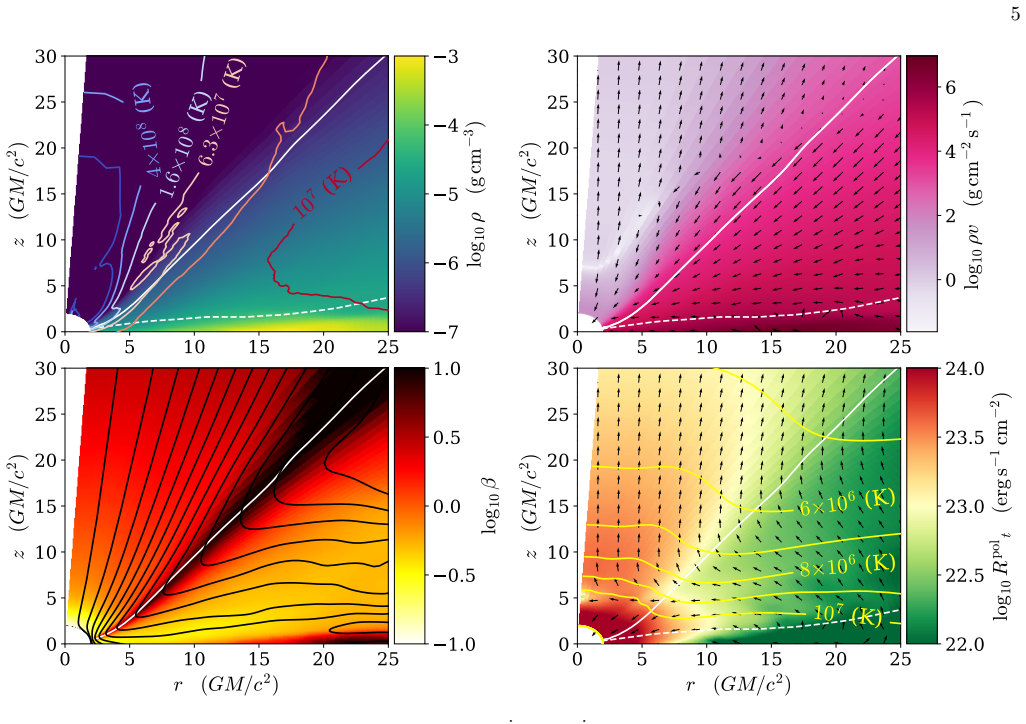
The key object is the puffy layer: the region between the density scale-height $h_\rho$ and the photosphere $H$, which contains most of the mass inflow, turbulence, and advected radiation. The simulation creates this state by advecting poloidal magnetic field with a significant radial component from a quadrupole mass reservoir, so that after magnetorotational instability saturation the plasma parameter $\beta=(p_{\rm gas}+p_{\rm rad})/p_{\rm mag}\sim1$. Magnetic pressure then stabilizes the disk against the thermal instability of radiation-pressure-dominated thin disks. Radiation transport is handled with the M1 closure, and the full three-dimensional flow is evolved in a Schwarzschild metric.
What would settle it
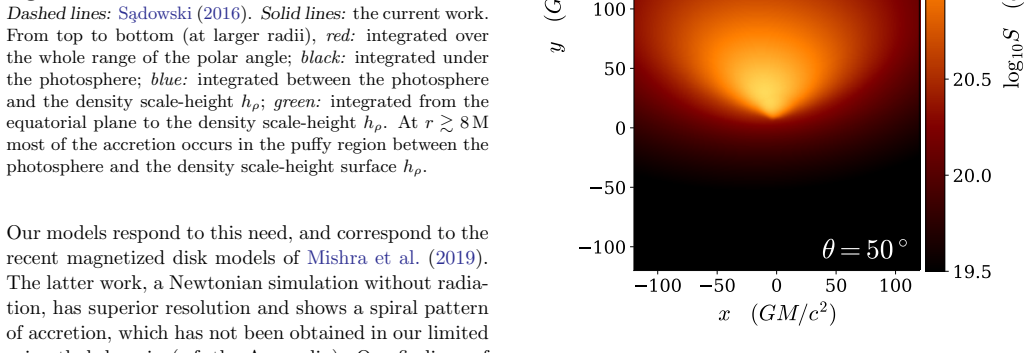
Run the same radiative GRMHD simulation at 0.6 Eddington rate starting from a radiation-pressure-dominated thin disk with only weak, tangled magnetic fields and no imposed radial poloidal flux: the puffy layer should not form if the claimed state depends on the advected field. Observationally, measure the inclination dependence of the isotropic luminosity and color temperature of a bright sub-Eddington black hole binary; puffy disks predict a bright axial funnel, a dark spot over the hole, and a large spectral color correction, unlike thin or slim disk images.
Extended reading notes
Core claim
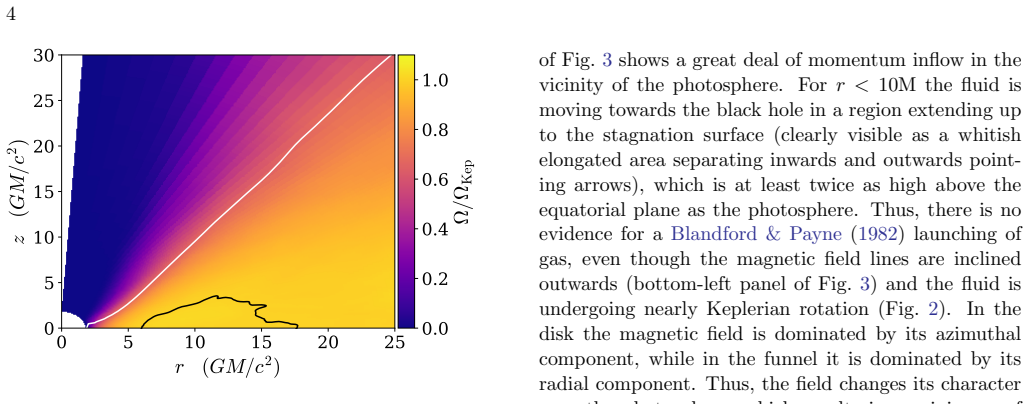
The central claim is that at sub-Eddington rates around 0.6 Eddington, the equilibrium state of a radiative black hole accretion disk is not a canonical thin, slim, or thick disk but a hybrid “puffy” disk. It combines a high-density equatorial core of height $h_\rho\sim 0.1r$, so thin by the density scale-height measure, with an extended lower-density optically thick region reaching the photosphere at $H\sim r$. The whole layer is turbulent and rotates at nearly Keplerian speed up to the photosphere; the accreting fluid is supported in part by magnetic pressure, and much of the radiation is advected inward and swallowed by the black hole rather than escaping vertically. The result is a disk that is thermally stable despite radiation-pressure dominance, with an inner luminosity of about 0.36 Eddington, less than a thin disk at the same accretion rate. The authors conclude that one-dimensional, height-integrated thin and slim disk models miss the meridional flow of matter and radiation that defines this state.
Load-bearing premise
The puffy, stable solution appears because the simulations are started with an advected poloidal magnetic field carrying significant radial flux; if real sub-Eddington disks do not naturally carry that magnetic flux, the state may be an artifact of the initial setup rather than the generic solution.
Editorial extensions
If this is right
- At accretion rates near 0.6 Eddington, black hole disks can be geometrically thin by density yet geometrically thick by photosphere, so the standard thin/slim/thick trichotomy is incomplete.
- A radiation-pressure-dominated disk can be thermally stable when magnetic pressure contributes comparably to gas plus radiation pressure, resolving a long-standing instability that otherwise collapses such disks.
- Radiation is advected inward and partly swallowed by the black hole, making the disk's luminosity lower than a thin disk at the same accretion rate.
- The observable appearance depends strongly on inclination: a bright funnel near the axis, a dark shadow over the black hole, and obscuration of the near side at large inclinations.
- Because most of the inflow occurs in the puffy layer above the dense core, one-dimensional height-integrated disk models miss the dominant accretion flow and radiation transport.
Reading between the lines
- If the puffy state is the generic sub-Eddington equilibrium, then classifying disk states by observed Eddington ratio is unreliable: the same intrinsic accretion rate can appear subluminous or super-Eddington depending on viewing angle through the funnel.
- The central role of advected poloidal flux suggests puffy disks may be tied to the magnetic flux threading the black hole; varying the initial flux or including black hole spin would test whether the state persists across the parameter space of real sources.
- A concrete spectral prediction follows from the paper's structure: the low-density, hot puffy layer should produce a large color correction and a spectrum that is not a sum of thin-disk blackbodies, so joint spectral and inclination fitting of bright X-ray binaries can distinguish puffy from slim states.
- The photon stagnation surface implies that radiation advection is not confined to the disk body; coronal models that treat disk and corona as separate thermal components may systematically misattribute the emission of this layer.
Editorial analysis
A structured set of objections, weighed in public.
Referee Report
Summary. This Letter reports global, three-dimensional, radiative GRMHD simulations with the koral code of a non-spinning 10 solar-mass black hole at a mass accretion rate of 0.6 Mdot_Edd. The resulting disk has a high-density core with density scale-height h_rho ~ 0.1r, but its photosphere lies at H ~ r, so the disk is simultaneously 'thin' by the density measure and 'thick' by the photospheric measure. The flow remains nearly Keplerian up to the photosphere, the plasma parameter beta = (pgas + prad)/pmag is order unity, and the disk is described as thermally stable despite radiation-pressure dominance. The authors argue that magnetic pressure support and inward advection of radiation define a new class of 'puffy' accretion disks distinct from thin, slim, and thick models, and that the resulting luminosity of 0.36 L_Edd is below the thin-disk expectation because a significant fraction of radiation is captured by the black hole. The Appendix gives numerical details: resolution 320x320x32, a pi/2 azimuthal wedge, MRI quality factors Q_theta ~ 25 and Q_phi ~ 20, inflow equilibrium out to r ~ 20 M over 15000 GM/c^3, and the seeding of lower-Mdot runs by rescaling a previous strongly magnetized stable solution.
Significance. If the claim is robust, this is a significant result: it would establish a sub-Eddington, optically thick disk branch in which the photosphere is decoupled from the density scale-height, magnetic pressure stabilizes a radiation-pressure-dominated state, and radiation advection reduces the effective luminosity. This would challenge the usual identification of sub-Eddington accretion disks with thin disks and has concrete observational consequences for spectra, inclination-dependent images, and timing behavior. The paper's strengths include a genuine numerical experiment with no fitting to data, explicit MRI resolution quality factors, inflow equilibrium, and ray-traced images that are falsifiable predictions. The main caveat is that the claimed new class is not yet shown to be the generic outcome of sub-Eddington accretion rather than a state reached only from specially prepared, strongly magnetized initial data.
major comments (3)
- [§2 (initial conditions) and Appendix] The stability mechanism is imposed through the initial conditions rather than shown to emerge. Section 2 states that “to ensure thermal stability … the disk was made to advect poloidal magnetic field with a significant radial component,” and the Appendix states that only reservoirs with quadrupole magnetic-field topology are used, with successively lower-Mdot runs seeded by rescaling a previous “strongly magnetized stable solution,” preserving beta. Because beta ~ 1 is the mechanism invoked for both magnetic support and thermal stability, the paper demonstrates the existence of a family of initial data that relaxes to a puffy disk, but it does not demonstrate that the puffy branch is the generic sub-Eddington solution. Please add at least one 0.6 Mdot_Edd run starting from different initial data, such as a much weaker poloidal field, a purely toroidal field, or beta >> 1 in the initial torus, and show whether it converges to the same puffy state or behaves differently. At minimum, reword the abstract and introduction so the claim is explicitly about a stable state reached from strongly magnetized initial conditions rather than about the generic sub-Eddington solution.
- [§2, Figs. 3–4] Thermal stability is asserted from a single run with no perturbation or convergence test. A single trajectory that reaches inflow equilibrium over 15000 GM/c^3 does not exclude a slow growth of the thermal instability or a long-lived metastable branch. Please provide a quantitative stability diagnostic: time histories of midplane beta, h_rho, H, and luminosity over the full run; a linear-growth or fluctuation analysis of the relevant thermal modes; or a second run at higher resolution or with full 2pi azimuth to show that the equilibrium and its fluctuations are converged. Without such evidence, the word “stable” in the title is stronger than what the simulation alone establishes.
- [§2, radiation transport] The radiation field is evolved with the M1 closure (Levermore 1984; Sadowski et al. 2013), which is known to systematically affect the angular distribution of radiation and the diffusion–free-streaming transition. The claimed sub-Eddington luminosity of 0.36 L_Edd and the detailed funnel radiation pattern in Fig. 3 (lower right) could be sensitive to this closure. While M1 is a standard approximation for global radiative GRMHD, the paper should state the expected quantitative uncertainty from M1 and, ideally, test at least one time-averaged snapshot with a different closure or a Monte-Carlo post-processing step to confirm that the inward radiation advection at r < 10 M and the photon capture fraction are not artifacts of the closure.
minor comments (5)
- [§1] “appearence” should be “appearance”.
- [Appendix] The detailed numerical setup is deferred to “Lančová et al. (in preparation)”; for a Letter, at least the initial density and magnetic-field profiles, the radiative boundary conditions, and the exact rescaling procedure used to produce lower-Mdot runs should be stated explicitly.
- [Fig. 3 caption] The lower-right panel caption lists radiation temperature contours “from top to bottom” of 5.0, 6.0, 7.0, 8.0, 9.0, 10.0 MK, but the panel itself shows contours at 6×10^6, 8×10^6, and 10^7 K; please unify these notations.
- [References] The reference list contains two entries for “Jiang et al. 2019” (arXiv:1904.01674 and ApJ 880, 67); please check whether these are duplicate citations of the same work and, if so, consolidate them.
- [Fig. 2] The use of both “R” and “r” for cylindrical radius is confusing; label the coordinate consistently and state clearly whether the super-Keplerian black contour refers to a time-averaged or instantaneous quantity.
Circularity Check
Stability and beta~1 are seeded by initial data, so the puffy disk's central stability claim is partly inherited; emergent geometry and advection remain independent.
-
self definitional
[Section 2 (paragraph beginning 'We have performed global, 3D...'); Appendix (initial conditions)]
"To ensure thermal stability (Zheng et al. 2011) the disk was made to advect poloidal magnetic field with a significant radial component (Sadowski 2016) from the toroidal mass reservoir often included in disk simulations. Upon evolution of this field through the MRI a major component of the pressure is due to the magnetic field, with the plasma parameter beta = (pgas + prad)/pmag ~ 1. ..."
The stability and beta~1 that the abstract and Section 3 credit with making the disk thermally stable are not emergent from a generic weak-field sub-Eddington initial state; they are placed into the calculation. Section 2 says the disk 'was made to advect poloidal magnetic field' precisely 'to ensure thermal stability,' and the Appendix obtains lower-Mdot runs by rescaling a previous 'strongly magnetized stable solution' while preserving beta. Thus the central claimed property (stable radiation-pressure-dominated disk) is inherited by construction from the initial data, and the simulation demonstrates persistence of a pre-seeded stable branch rather than generic approach to it.
full rationale
This is a genuine numerical experiment with no data fitting, and much of the reported structure is emergent: the thin dense core, thick photosphere, Keplerian rotation up to that photosphere, inward radiation advection, and funnel-dominated emission all follow from the simulation rather than from the initial conditions. However, the load-bearing stability claim is conditioned on tailored initial data. The paper explicitly states that the disk was made to advect poloidal magnetic field 'to ensure thermal stability,' and the lower-accretion-rate runs are seeded from a prior 'strongly magnetized stable solution' with beta preserved. The stability mechanism is also imported from prior work by a coauthor (Sadowski 2016) and Zheng et al. (2011), so the central 'stable puffy disk' claim partially reduces to its own setup. The paper would need a run starting from generic, weakly magnetized sub-Eddington conditions to show that the puffy state is reached rather than merely persisting. The circularity is therefore partial rather than complete, since the geometrical and radiative findings remain independent simulation output.
Assumptions & free parameters
free parameters (2)
- Mass accretion rate =
0.6 M_Edd
- Initial magnetic field configuration =
Quadrupole topology, advected poloidal field, beta ~ 1
assumptions (5)
- domain assumption M1 closure approximates the radiation field
- ad hoc to paper Initial advected poloidal magnetic field with quadrupole topology
- domain assumption MRI is resolved with quality factors Q_theta ~ 25 and Q_phi ~ 20
- domain assumption A pi/2 azimuthal wedge with periodic boundaries is representative
- domain assumption Inflow equilibrium to r ~ 20 M in 15000 GM/c^3 is sufficient to judge stability
Cite this review
Pith. "Pith review of Puffy accretion disks: sub-Eddington, optically thick, and stable." pith.science (2026). https://pith.science/paper/36JTRWCW
@misc{pith2026190808396,
  author       = {Pith},
  title        = {Pith review of: Puffy accretion disks: sub-Eddington, optically thick, and stable},
  year         = {2026},
  howpublished = {\url{https://pith.science/paper/36JTRWCW}},
  note         = {Machine review of arXiv:1908.08396}
}
abstract
We report on a new class of solutions of black hole accretion disks that we have found through three-dimensional, global, radiative magnetohydrodynamic simulations in general relativity. It combines features of the canonical thin, slim and thick disk models but differs in crucial respects from each of them. We expect these new solutions to provide a more realistic description of black hole disks than the slim disk model. We are presenting a disk solution for a non-spinning black hole at a sub-Eddington mass accretion rate, $\dot M=0.6\,\dot M_{\rm Edd}$. By the density scale-height measure the disk appears to be thin, having a high density core near the equatorial plane of height $h_{\rho} \sim 0.1 \,r$, but most of the inflow occurs through a highly advective, turbulent, optically thick, Keplerian region that sandwiches the core and has a substantial geometrical thickness comparable to the radius, $H \sim r$. The accreting fluid is supported above the midplane in large part by the magnetic field, with the gas and radiation to magnetic pressure ratio $\beta \sim 1$, this makes the disk thermally stable, even though the radiation pressure strongly dominates over gas pressure. A significant part of the radiation emerging from the disk is captured by the black hole, so the disk is less luminous than a thin disk would be at the same accretion rate.
Figures

Figures from the paper (2 more)

Forward citations
Cited by 2 Pith papers
-
Non-Newtonian corrections to radiative viscosity: Israel-Stewart theory as a viscosity limiter
The infinite Chapman-Enskog series for radiative shear viscosity is computed exactly for linear incompressible flows, and Israel-Stewart theory with shear-heat coupling is shown to reproduce the resulting non-Newtonia...
-
Stepping Up Superradiance Constraints on Axions
Including superradiant axion states through n=5 with relativistic scattering rates strengthens black-hole spin-down constraints on axions by roughly an order of magnitude.
Reference graph
Works this paper leans on
-
[1]
thebibliography [1] 20pt to REFERENCES 6pt =0pt 10pt plus 3pt =0pt =0pt =1pt plus 1pt =0pt =0pt -12pt =13pt plus 1pt =20pt =13pt plus 1pt \@M =10000 =-1.0em =0pt =0pt 0pt =0pt =1.0em @enumiv\@empty 10000 10000 `\.\@m \@noitemerr \@latex@warning Empty `thebibliography' environment \@ifnextchar \@reference \@latexerr Missing key on reference command Each re...
-
[2]
Abramowicz\,M.A., Czerny\,B., Lasota\,J.-P., Szuszkiewicz\,E. 1988, ApJ, 332, 646
work page 1988
-
[3]
Abramowicz, M., Jaroszy\'nski, M., & Sikora, M., 1978, A&A, 63, 221
work page 1978
- [4]
-
[5]
Begelman, M.C., Silk, J., 2017, MNRAS, 464, 2311
work page 2017
- [6]
- [7]
-
[8]
Brandenburg A., Nordlund A., Stein R.F., Torkelsson U., 1995, ApJ, 446, 741
work page 1995
Show all 52 references
-
[9]
D., Bursa, M., Dov c iak, M., Fabrika, S., Castro-Tirado, A
Caballero-Garcia, M. D., Bursa, M., Dov c iak, M., Fabrika, S., Castro-Tirado, A. J., Karas, V., 2017, Contrib. Astron. Obs. Skalnat\'e Pleso 47, 84
2017
-
[10]
Czerny, B., 2019, Univ, 5, 131
2019
-
[11]
Davis S.W., Done, C., Blaes, O.M., 2006, ApJ, 647, 525
2006
-
[12]
C., Etheridge, S
Fragile, P. C., Etheridge, S. M., Anninos, P., Mishra, B., & Klu \'z niak, W.\ 2018, , 857, 1
2018
-
[13]
Igumenshchev I.V., Abramowicz M.A., 2000, ApJSS vol 130, pp. 463-484
2000
-
[14]
& Paczy \'n ski\,B
Jaroszy\'nski\,M., Abramowicz\,M.A. & Paczy \'n ski\,B. 1980, Acta Astron., 30, 1
1980
-
[15]
Jiang, Yan-Fei, Blaes, O., Stone, J.M., Davis, S.W., 2019, arXiv:1904.01674
2019 arXiv
-
[16]
M., & Davis, S
Jiang, Y.-F., Stone, J. M., & Davis, S. W.\ 2019, , 880, 67
2019
-
[17]
Kato S., 2001, PASJ, 53, 1
2001
-
[18]
Kawaguchi, T., 2003, ApJ, 593, 69
2003
-
[19]
Klu\'zniak, W.; Kita, D., 2000, arXiv:astro-ph/0006266
2000 arXiv
-
[20]
2004, ApJ, 601, 428
Kubota, A., Makishima, K. 2004, ApJ, 601, 428
2004
-
[21]
Lee, W.H., Ramirez-Ruiz, E., 2002, ApJ, 577, 893
2002
-
[22]
D., 1984, J
Levermore C. D., 1984, J. Quant. Spectrosc. Radiat. Transf., 31, 149
1984
-
[23]
Li\,L., Zimmerman\,E.R., Narayan\,R., McClintock\,J.E., 2005, ApJS, 157, 335
2005
-
[24]
1974, ApJ, 187, L1
Lightman\,A.P., Eardley\, D.M. 1974, ApJ, 187, L1
1974
-
[25]
Liska, M., Tchekhovskoy, A., Ingram, A., van der Klis, M., 2019, MNRAS 487, 550
2019
-
[26]
Machida, M., Matsumoto, R., 2003, ApJ, 585, 429
2003
-
[27]
Klu \'z niak, W., 2016, MNRAS, 456, 3245
Mazur, G.P., Zanotti, O., S a dowski, A., Mishra, B. Klu \'z niak, W., 2016, MNRAS, 456, 3245
2016
-
[28]
C., Johnson, L
Mishra, B., Fragile, P. C., Johnson, L. C., Klu \'z niak, W.\ 2016, , 463, 3437
2016
-
[29]
H., Manousakis A., Fragile P
Mishra B.,Vincent F. H., Manousakis A., Fragile P. C., Paumard T., Klu\'zniak W., 2017, MNRAS, 467, 4036
2017
-
[30]
Mishra, B., Begelman, M.C., Armitage, Philip J., Simon, J.B., 2019, arXiv190708995
2019
-
[31]
Mitsuda, K.; Inoue, H.; Koyama, K.; Makishima, K.; Matsuoka, M.; Ogawara, Y.; Shibazaki, N.; Suzuki, K.; Tanaka, Y.; Hirano, T., 1984, PASJ, 36, 741
1984
-
[32]
Muchotrzeb, B., Paczy\'nski, B., 1982, Acta Astron., 32, 1
1982
-
[33]
Narayan, R., Zhu, Y., Psaltis, D., S a dowski, A., 2016, MNRAS, 457, 608
2016
-
[34]
Ohsuga, K., Mineshige, S., 2011, ApJ 736, 2
2011
-
[35]
A., & Rafikov, R
Philippov, A. A., & Rafikov, R. R.\ 2017, , 837, 101
2017
-
[36]
Piran T., 1978, ApJ, 221, 652
1978
-
[37]
Pringle, J.E., 1976, MNRAS, 177, 65
1976
-
[38]
A., McClintock J
Remillard R. A., McClintock J. E., 2006, ARA&A, 44, 49
2006
-
[39]
Regev, O., Gitelman, L., 2002, A&A, 396, 623
2002
-
[40]
Rezzolla L., Yoshida S., Zanotti O., 2003, MNRAS, 344, 978
2003
-
[41]
S a dowski A., Narayan R., Tchekhovskoy A., Zhu Y., 2013, MNRAS, 429, 3533
2013
-
[42]
C., & Tchekhovskoy, A., 2014, MNRAS, 439, 503
S a dowski, A., Narayan, R., McKinney, J. C., & Tchekhovskoy, A., 2014, MNRAS, 439, 503
2014
-
[43]
S a dowski, A., 2016, MNRAS, 459, p.4397-4407
2016
-
[44]
& Sunyaev\,R.A
Shakura\,N.I. & Sunyaev\,R.A. 1973, A&A, 24, 337
1973
-
[45]
& Sunyaev\,R.A., 1976, MNRAS, 175, 613
Shakura\,N.I. & Sunyaev\,R.A., 1976, MNRAS, 175, 613
1976
-
[46]
Straub\,O., Bursa\,M., S a dowski\,A., Steiner\,J.F., Abramowicz\,M.A., Klu \'z niak\,W., McClintock\,J.E., Narayan\,R., Remillard\,R.A., 2011, A&A 533, id.A67
2011
-
[47]
Urpin, V. A. 1984, Sov. Astron., 28, 50
1984
-
[48]
Vierdayanti, K., Mineshige, S., Ebisawa, K., & Kawaguchi, T.\ 2006, , 58, 915
2006
-
[49]
V., 1999, Phys
Wagoner R. V., 1999, Phys. Rep., 311, 259
1999
-
[50]
Zheng, S.-M., Yuan, F., Gu, W.-M., & Lu, J.-F.\ 2011, , 732, 52
2011
-
[51]
Zhu, Y., Narayan, R., Sadowski, A., & Psaltis, D.\ 2015, , 451, 1661
2015
-
[52]
M.\ 2018, , 857, 34
Zhu, Z., & Stone, J. M.\ 2018, , 857, 34
2018
Reviewed August 14, 2026 · model on record in the stance chip above.
Discussion (0). Continue with ORCID to comment.