REVIEW 4 major objections 4 minor 2 references
Envelope Polyhedra
T0 review · 4 major / 4 minor · reviewed 2026-08-14 · deepseek-v4-flash
Pith's one-line read This paper defines envelope polyhedra, a new class of regular polyhedra with identical vertex arrangements but variable, sometimes zero, dihedral angles.
desk verdict Envelope polyhedra are a real but modest extension of the regular polyhedron family; the finite examples check out, but the informal definition leaves the infinite flagship examples unverified. read the letter →
The pith
A machine-rendered reading of the paper's core claim, the machinery that carries it, and where it could break.
The reading
What carries the argument
The central object is the envelope polyhedron, defined by identical vertex arrangements while allowing dihedral angles of 0 degrees. The generative machinery is the deletion construction: remove a chosen set of faces from a known regular, semiregular, or pseudopolyhedral network so that those positions become holes joining the exterior surface to the interior surface. Around each resulting vertex, the ant's circuit picks up both sides of the remaining faces, doubling the face count. The Euler characteristic identity $F-E+V=2(1-g)$ is then used to compute genus for finite examples, and the sum of face angles around a vertex places each structure in the positive, zero, or negative curvature class.
What would settle it
Build the rhombicuboctahedron with its eight triangular faces removed and trace, at every one of the 24 vertices, the circuit of an ant tethered to the vertex; if any vertex visits fewer or more than six square faces, the cyclic order differs between two vertices, or the surface self-intersects, the squares-6 example fails. The same check, together with explicit face, edge, and vertex counts and the Euler characteristic, can be applied to every row of Table 1.
Extended reading notes
Core claim
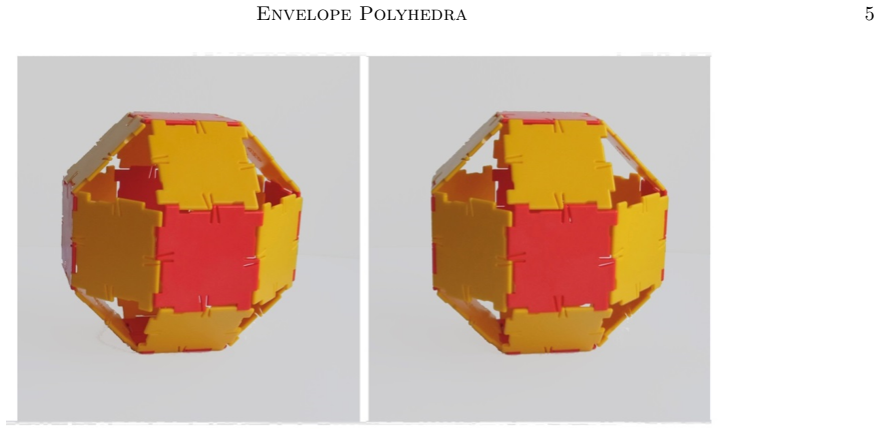
The paper claims that there is a larger class of regular polyhedra than the standard lists, obtained by keeping the requirement that an ant tethered to a vertex encounters the same sequence of polygon faces while circling it, but dropping the requirement of equal dihedral angles and allowing some to be exactly zero. Deleting selected faces from a polyhedron or pseudopolyhedron opens holes that connect exterior and interior faces, so around each vertex the ant's circuit doubles. The flagship finite example is squares-6 around a point: remove the eight triangles from a rhombicuboctahedron, obtaining a hollow polyhedron with 36 square faces, 72 edges, 24 vertices, and genus 7. Infinite examples include squares-14 around a point, with 1260 degrees of angle around each vertex, and triangles-18 around a point; the appendix records many more, including structures whose vertices are congruent only by mirror reflection.
Load-bearing premise
The load-bearing premise is that the phrase 'the arrangement of polygons around each vertex is identical' is precise enough to recognize by inspection, and that every deletion listed in the appendix yields one continuous, non-self-intersecting surface with exactly the stated counts.
Editorial extensions
If this is right
- Finite envelope polyhedra such as squares-6 around a point give explicit all-regular-polygon models of negatively curved, multiply connected surfaces, with genus 7.
- Infinite envelope polyhedra extend the pseudopolyhedron catalog to higher per-vertex angle sums, with squares-14 around a point reaching 1260 degrees around each vertex.
- The deletion recipe gives a systematic way to generate new regular polyhedral surfaces from any known regular, semiregular, or pseudopolyhedral network.
- Envelope polyhedra with exactly 360 degrees around each vertex, such as squares-4 around a point, connect the planar tessellations to finite toroidal polyhedra under the same definition.
- If mirror-vertex structures are admitted as regular, the total list of known regular polyhedral surfaces grows further, as organized in the paper's Table 1.
Reading between the lines
- The paper leaves vertex congruence informal; a precise version, requiring the same cyclic order of face angles at every vertex up to rotation or reflection, would turn the table into a testable classification and would show which mirror-vertex entries belong in the same list.
- The same delete-faces-to-open-holes recipe should generalize to higher dimensions, producing envelope polytopes with back-to-back facets from regular polytopes in four or more dimensions.
- Because these surfaces concentrate large negative curvature at vertices, they are natural candidates for lightweight lattice structures or for simplified topological models of porous media, an application the paper leaves for the future.
Signed reviews
Editorial analysis
A structured set of objections, weighed in public.
Referee Report
Summary. The paper introduces a class of 'envelope polyhedra': polyhedra made of regular polygons whose vertex figures are all identical, but whose dihedral angles may vary and may be 0 degrees, meaning paired faces lie back to back. The main finite example is squares–6 around a point {4,6}, obtained by deleting the triangular faces of a rhombicuboctahedron to produce a hollow polyhedron with 36 square faces, 72 edges, 24 vertices, and genus 7. Further examples include octagons–4 around a point and decagons–4 around a point, and the paper claims infinite examples such as squares–14 around a point and triangles–18 around a point. The Appendix catalogs many additional examples, many obtained by deleting polygons from previously published pseudopolyhedra, and Section 7 introduces a separate subclass with mirror-image vertex figures.
Significance. If the constructions are valid, the paper enlarges the classical taxonomy of regular polyhedra in an interesting direction, connecting to the historical work of Coxeter and Petrie, Gott, Wells, and Wachman-Burt-Kleinmann. The finite examples are genuinely checkable: the Euler characteristic computation for {4,6} (F=36, E=72, V=24 gives genus 7) and the decagon example (genus 19) are consistent, and the paper honestly credits prior discoveries. However, the central notion of regularity for envelope polyhedra is never formalized, and the infinite flagship examples are described only verbally, so the claimed classification in Table 1 cannot currently be independently verified. The paper offers no machine-checked proofs or explicit coordinates; its value depends on a definition and verification standard that are not supplied.
major comments (4)
- [Section 3] The defining condition for a regular envelope polyhedron is informal. The phrase 'the arrangement of polygons (creating a single surface) around each vertex must be identical' does not specify what data constitute the arrangement: is it the cyclic order of face sectors, the list of interior angles, the dihedral angles, the distinction between interior and exterior sides, or some quotient where back-to-back coincident faces are identified? The paper also does not state whether vertex figures are considered up to combinatorial isomorphism, metric congruence, or ambient isometry. This is load-bearing because every example and every row of Table 1 is certified by appeal to this condition.
- [Section 5, squares–14 around a point] The flagship infinite construction {4,14} is described only in words: 'add east-west fins of back-to-back squares above this single layer of cells in a dashed pattern' and 'these fins are then connected to another plane of squares–12 around a point triangular cell layer above it.' No coordinates, no diagram, and no explicit vertex-by-vertex accounting are provided, so the claim that every vertex has the same cyclic 14-square configuration cannot be checked. In particular, the construction must rule out free edges, additional surface components, and vertices where the fins attach differently, none of which is demonstrated. A formal construction with coordinates or an unambiguous polyhedral complex is needed before {4,14} can be accepted as an envelope polyhedron under the paper's own definition.
- [Appendix A and Appendix B] The catalog in the Appendix relies extensively on page references to Wachman, Burt, and Kleinmann (1974) without reproducing the starting structures or verifying the deletion process. For example, 'Squares–8 around a point (1): Start with the semi-regular pseudopolyhedron shown by WBK on page 9 at the top' gives the reader no way to check that deleting the triangles yields a single non-self-intersecting surface with all vertices congruent. Since Table 1 claims many entries on the basis of these constructions, the paper needs either a general lemma stating sufficient conditions under which deleting a specified set of faces from a WBK pseudopolyhedron yields an envelope polyhedron, or a case-by-case verification for every listed entry. Without this, the completeness and correctness of Table 1 are not established.
- [Section 7] The mirror-vertex subclass changes the equivalence relation for vertex figures, but the paper does not define when a vertex figure and its mirror image are to count as 'congruent' in three dimensions. Section 7 says some structures have 'pairs of mirror vertices whose vertex figures are not identical except under mirror reflection,' yet it also argues that mirror-image vertices cannot be superimposed in 3D. This is a different regularity notion from the one used for Section 3 examples and Table 1, and the paper needs to state explicitly whether mirror congruence is considered admissible in the main definition or only in a separate weaker class. The current text leaves the boundary between 'identical vertices' and 'mirror vertices' unclear, which affects the interpretation of the entire classification.
minor comments (4)
- [References] The reference to Coxeter is misspelled as 'Coexter' in the bibliography; the spelling should be corrected.
- [Throughout] Some LaTeX artifacts remain, such as 'Schl¨ afli' and 'Pellicer and Shulte'; these should be cleaned up before publication.
- [Figure 5] The figure for squares–14 around a point is cited as the visual evidence for the construction, but the text does not explain how the photograph encodes the 'dashed pattern' of fins or how the fin placement is uniform at every vertex. Adding a schematic diagram with the fins highlighted would help.
- [Table 1] The table uses symbols (⋄, ◦, •, +) with a legend below, but the legend is easy to miss because it appears after the table; moving the legend into the caption would improve readability.
Circularity Check
No significant circularity: the envelope polyhedra are constructed by explicit face deletions from known polyhedra and pseudopolyhedra, with vertex and edge counts computed arithmetically rather than derived from the target claim.
full rationale
The paper's derivation chain is constructive rather than circular. Each envelope polyhedron is introduced by specifying a starting object (an Archimedean solid, a regular tessellation, a known pseudopolyhedron, or a WBK structure) and then deleting a specified set of faces, after which the paper computes face, edge, and vertex counts and vertex angle sums directly. These counts are not fitted parameters and do not presuppose the existence of the envelope polyhedron being claimed. The regularity condition in Section 3 ('the arrangement of polygons touching each vertex must be identical') is a stipulated definition, and the paper's examples are checked against it informally; this is an under-specification or verification concern, not circularity, because the definition is not expressed in terms of the examples' conclusions. Self-citations are present (Gott 1967 as the source of pseudopolyhedra used as starting structures, and Gott, Melott, and Dickinson 1986 for cosmological context), but they supply input structures or background, not a uniqueness theorem or a result whose conclusion is the envelope-polyhedron classification. The dihedra example is explicitly acknowledged as a rediscovery of an already accepted class, so it is not a disguised new claim. No equation reduces to its own input, no fitted quantity is renamed a prediction, and no load-bearing argument depends on an unverified self-citation. Thus the circularity score is 0.
Assumptions & free parameters
assumptions (4)
- standard math Standard Euclidean geometry of regular polygons, including angle sums.
- domain assumption The Archimedean solids and known pseudopolyhedra exist with the stated face configurations.
- domain assumption Deleting faces and taking interior/exterior copies of remaining faces yields a single connected surface with Euler characteristic F-E+V=2(1-g).
- ad hoc to paper Mirror-image vertex figures are considered congruent when defining the 'mirror vertices' subclass.
Cite this review
Pith. "Pith review of Envelope Polyhedra." pith.science (2026). https://pith.science/paper/37LX4K7U
@misc{pith2026190805395,
  author       = {Pith},
  title        = {Pith review of: Envelope Polyhedra},
  year         = {2026},
  howpublished = {\url{https://pith.science/paper/37LX4K7U}},
  note         = {Machine review of arXiv:1908.05395}
}
read the original abstract
This paper presents an additional class of regular polyhedra--envelope polyhedra--made of regular polygons, where the arrangement of polygons (creating a single surface) around each vertex is identical; but dihedral angles between faces need not be identical, and some of the dihedral angles are 0 degrees (i.e., some polygons are placed back to back). For example, squares, 6 around a point, is produced by deleting the triangles from the rhombicuboctahedron, creating a hollow polyhedron of genus 7 with triangular holes connecting 18 interior and 18 exterior square faces. An empty cube missing its top and bottom faces becomes an envelope polyhedron, squares, 4 around a point, with a toroidal topology. This definition leads to many interesting finite and infinite multiply connected regular polygon networks, including one infinite network with squares, 14 around a point, and another with triangles, 18 around a point. These are introduced just over 50 years after my related paper on infinite spongelike pseudopolyhedra in American Mathematical Monthly (Gott, 1967).
Figures


Figures from the paper (3 more)


Reference graph
Works this paper leans on
-
[1]
Regular Skew Polyhedra in Three and Four Dimensions, and Their Topological Analogues,
Coexter, H. S. M., 1937, “Regular Skew Polyhedra in Three and Four Dimensions, and Their Topological Analogues,” Proc. London Math. Soc., 2, 1937 Gott, J. R., 1967, “Pseudopolyhedrons,” The American Mathematical Monthly, 74, 497,
work page 1937
-
[1967]
Regular Polygonal Complexes in Space, I
Gott, J. R., 2016, The Cosmic Web: Mysterious Architecture of the Universe , Princeton and Oxford: Princeton University Press, 114 Gott, J. R., Melott, A. & Dickinson, M., 1986, “The Sponge-Like Topology of Large-Scale Structure in the Universe,” Astrophysical Journal, 306, 341 Green, M., “Infinite Regular Polyhedra Page”, http://superliminal.com/geometry/...
work page Pith review arXiv 2016
Reviewed August 14, 2026 · model on record in the stance chip above.
Discussion (0). Continue with ORCID to comment.