REVIEW 3 major objections 4 minor 2 cited by
Quasi-geodesics in the Cannon-Thurston metric
T0 review · 3 major / 4 minor · reviewed 2026-08-04 · deepseek-v4-flash
Pith's one-line read The Cannon–Thurston pushforwards of surface measures — Lebesgue and random-walk hitting measures on the circle — are mutually singular with every natural 3-manifold measure, because typical geodesics spend different amounts of time near a f
desk verdict A real advance on Cannon–Thurston measure singularity, with a load-bearing gap in the 'full surface measure' statement and a small rescaling error in Prop 52. read the letter →
The pith
A machine-rendered reading of the paper's core claim, the machinery that carries it, and where it could break.
The reading
What carries the argument
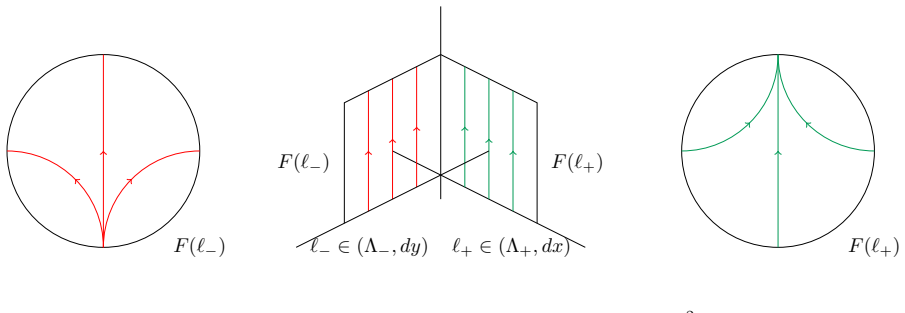
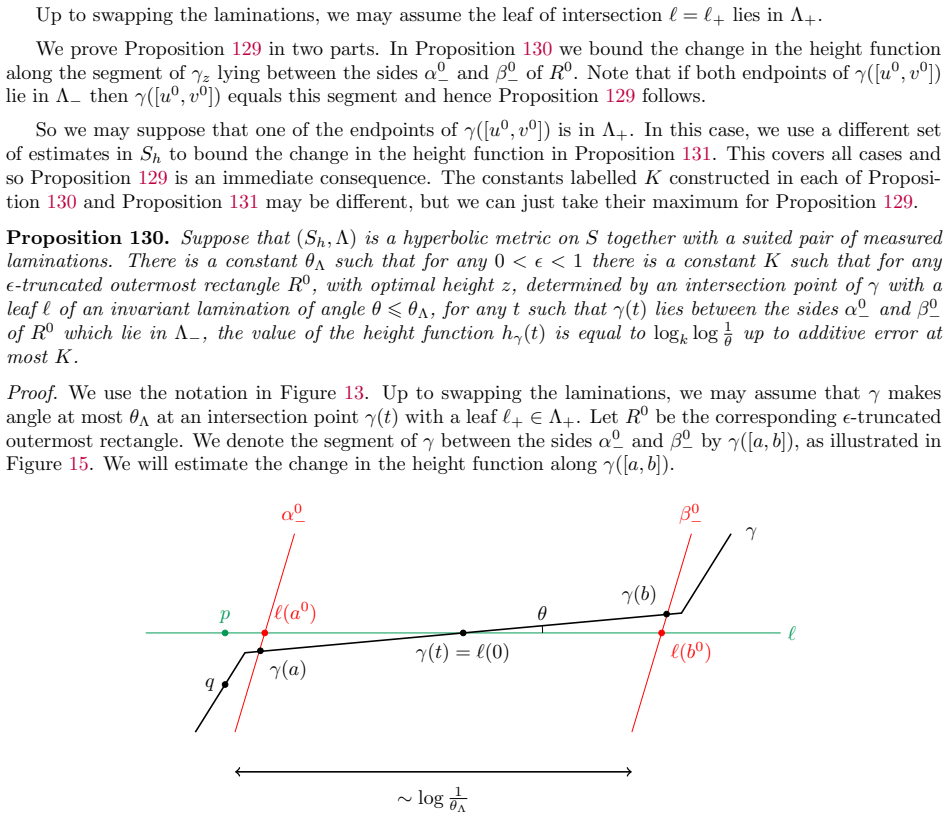
The central object is the height function hθ(v) = log_k⌊log(1/d(v, Λ1+)) − log(1/θ)⌋_1 − log_k⌊log(1/d(v, Λ1−)) − log(1/θ)⌋_1 on the unit tangent bundle of the surface, where Λ1± are the extended invariant laminations. For a non-exceptional geodesic γ the test path τγ(t) = (γ(t), hθ(γ1(t))) is shown to be a uniform unparametrized quasigeodesic in the Cannon–Thurston metric with the same endpoints as ι(γ). Combined with rectangle/bottleneck estimates (optimal-height rectangles are bottlenecks for opposite quadrants), this yields the effective control of time spent near the base fiber. The non-effective half uses ergodicity of the geodesic flow and, for the 3-manifold side, a mixing estimate f
What would settle it
Compute the Cannon–Thurston distance between adjacent fibers S×{n} and S×{n+1} in the universal cover of the mapping torus. If it equals log k rather than 1, the estimate d(w_n x0, S0) ≥ 2A log n in Proposition 52 must be rescaled by log k, and for k < e the claimed 1/√n decay (and hence zero limiting fiber-time) may fail for the hitting-measure half of Theorem 8.
Extended reading notes
Core claim
Theorem 4: pushforwards of full surface measures by the Cannon–Thurston map are mutually singular with every 3-manifold measure. The proof rests on two statistical statements: Theorem 6 (a ι∗ν-typical geodesic has liminf T→∞ (1/T)|γ([0,T]) ∩ N_R(S0)| ≥ ε > 0) and Theorem 8 (a ν-typical geodesic for any 3-manifold measure has the same proportion tend to 0). The dichotomy gives an explicit description of sets witnessing singularity. Theorem 7 strengthens the surface half, for geometric surface measures, to a lower bound 1 − K e^{−αkR}.
Load-bearing premise
The random-walk half of Theorem 8 assumes adjacent fibers are exactly one unit apart in the Cannon–Thurston metric, but the metric's definition gives separation log k (k = stretch factor); the displayed estimates need rescaling that is not provided.
Editorial extensions
If this is right
- Full surface measure pushforwards are mutually singular with all 3-manifold measures (Theorem 4).
- Hitting measures from incompressible surfaces in closed hyperbolic 3-manifolds are singular with Lebesgue measure and with π1(M)-random-walk hitting measures (Corollary 5).
- For geometric surface measures the proportion of time near the fiber is exponentially close to 1, at rate e^{−αkR} (Theorem 7).
- The explicit quasi-geodesic test paths in the Cannon–Thurston metric give a uniform description of geodesic behavior that can be used for other averaging problems.
- Sets witnessing singularity are described concretely: geodesics with positive limiting fiber-time versus those with zero limiting fiber-time.
Reading between the lines
- The dichotomy likely extends to broader classes of stationary measures: if the paper's mechanism transfers, any stationary measure on the sphere whose geodesics avoid fibers would be singular to any surface-pushforward with positive fiber time.
- The log k vs 1 fiber-separation issue in Proposition 52 suggests the random-walk half of Theorem 8 needs a rescaling by log k; if k<e the stated 2A log n estimate may fail, though singularity may survive with adjusted constants.
- The test-path construction gives a candidate route to effective statistics for saddle connections in the singular solv metric, which the paper explicitly does not pursue.
- A testable extension: for random walks on π1(M) with finite first moment but not finite exponential moment, the fiber-avoidance dichotomy should still hold if the local limit theorem is replaced by a weaker recurrence estimate.
Editorial analysis
A structured set of objections, weighed in public.
Referee Report
Summary. The paper proves a measure-singularity theorem for Cannon–Thurston maps of closed hyperbolic fibered 3-manifolds. The main result, Theorem 4, states that the pushforward to S²∞ of any "full surface measure" on S¹∞ (including Lebesgue measure and hitting measures of nonelementary, full random walks on π₁(S)) is mutually singular with any "3-manifold measure" on S²∞ (Lebesgue measure or hitting measures of geometric random walks on π₁(M)). The proof is organized around two geodesic-statistics assertions: Theorem 6, that geodesics sampled by pushforwards of surface measures spend a definite positive proportion of time near the base fiber S₀, and Theorem 8, that geodesics sampled by 3-manifold measures spend asymptotically negligible time near S₀. The effective Theorem 7 gives exponential rates for geometric surface measures, using an explicit construction of quasigeodesic test paths in Section 6. The paper is well structured and the overall architecture—deducing singularity from incompatible typical behavior of geodesics—is sound.
Significance. If the theorem holds in the stated generality, it provides a unified geometric explanation for Tukia's Lebesgue singularity theorem and extends singularity statements to random-walk hitting measures. The construction of uniform quasigeodesic test paths with a height function and tame bottlenecks is substantial and of independent interest, and the effective exponential bounds in Theorem 7 are a genuine strengthening. The paper also correctly identifies the key geometric inputs: ladders over lamination leaves, separation properties, and quasigeodesic stability. The manuscript is careful in many places, especially in isolating the suited-lamination hypothesis and in Remark 78 concerning bounded geometry. However, the full generality of Theorem 4 currently rests on moment-free random-walk estimates that are neither stated nor proved, and the random-walk half of Theorem 8 contains a metric-scaling error; these issues need to be addressed before the central claim is fully supported.
major comments (3)
- [Definition 2 and §3.3 (Lemma 51); §2.8] Theorem 4 and Theorem 6 quantify over all full surface measures, which by Definition 2 include nonelementary full probability measures with no finite exponential moment. However, the random-walk estimates used in the proof assume geometric or finite-exponential-moment measures: Proposition 32, Corollary 33, Proposition 35, and Proposition 37 are stated with finite exponential moment; Lemma 36 is stated for geometric μ; and Corollary 34's upper linear-rate conclusion also uses finite exponential moment. Lemma 51's argument that good events occur "linearly often" needs not only ergodicity of the shift map but also control of the projected times t_n in order to convert event frequencies into a positive proportion of geodesic time. For a heavy-tailed μ, t_n/n may diverge, so the conversion can fail. No moment-free version of these estimates is supplied. This is load-bearing because Theorem 4
- [§3.3, proof of Proposition 52] The proof states that the distance between adjacent fibers S×{n} and S×{n+1} is equal to one in the Cannon–Thurston metric. This contradicts Eq. (1): the vertical term is (log k)² dz², so the metric distance between fibers with z-coordinates n and n+1 is log k, not 1 (unless k=e). Consequently, the implication |φ(w_n)| ≥ 2A log n ⇒ d(w_n x₀, S₀) ≥ 2A log n needs a factor 1/log k in the choice of A. The error appears repairable by rescaling A, but as written the proof contains a false metric statement in a central step of Theorem 8.
- [§3, Proposition 41 and §3.3, Lemma 51] The proof that ν-almost all geodesics are non-exceptional for full surface measures invokes double ergodicity of the boundary action, citing Kaimanovich [Kai03, Theorem 17]. Double ergodicity is typically stated under finite-first-moment or finite-exponential-moment hypotheses, and the manuscript does not verify that Definition 2's full measures satisfy them. Similarly, Lemma 51's use of "ergodicity" to get linearly many translates of α along a random-walk-sampled geodesic is not tied to a specific ergodic theorem; for finite-moment measures one could use Corollaries 33–35, but those are exactly the inputs missing in the no-moment case. This is part of the same gap as the first major comment, but it is important enough to flag separately because Proposition 41 is needed already to define the test paths and to rule out exceptional geodesics.
minor comments (4)
- [Title/abstract] The arXiv title is "Quasi-geodesics in the Cannon-Thurston metric," while the manuscript itself is titled "Singularity of Cannon–Thurston maps" and the abstract is correspondingly different. Please align the title and abstract for the intended submission.
- [Definitions 54 and 94] The height function is defined twice, in Definition 54 and again in Definition 94, with slightly different wording (one says "regular pair," the other "suited pair"). Merge these into a single definition to avoid confusion.
- [§4, Theorem 61] The effective bound Theorem 7 relies on Theorem 61, imported from [GH24], which states that d(ι(γ(0)), ι(γ(T))) grows linearly for Lebesgue-almost all γ. If [GH24] is a companion or unpublished manuscript, please state the exact theorem and, ideally, sketch the proof; as written, this is an external dependency for the effective half.
- [§3.2, proof of Lemma 49] The phrase "the forward and backward projections of φ'_t to eS_h × R converge to Lebesgue measure" is vague; these are pushforwards, not projections. Please clarify the wording.
Circularity Check
No significant circularity: the singularity theorem is derived from independent geometric and ergodic estimates, not from its own conclusion.
full rationale
The paper's central claim (Theorem 4) is derived from two independent dynamical statements: surface-measure typical geodesics spend a definite proportion of time near the base fiber (Theorem 6) and 3-manifold-measure typical geodesics spend asymptotically negligible time near it (Theorem 8). Neither of these statements is assumed or fitted; Theorem 8 uses mixing estimates of Oh–Pan (Theorem 50) and the local central limit theorem (Proposition 53), while Theorem 6 uses random-walk hitting measure properties, Birman–Series estimates, and the explicit geometric construction of test paths. The effective Theorem 7 uses the paper's own quasigeodesic construction (Theorem 55), verified through Farb's criteria, together with Birman–Series volume bounds and a cited linear-growth result of Gadre–Hensel. That cited theorem is a self-citation only in the weak sense that one of the present authors is a coauthor of the cited work, but it is a parameter-free, externally stated prior theorem about linear growth of Cannon–Thurston distance along typical geodesics; it is not the target singularity claim and does not by construction force the conclusion. No constants are fitted to the predicted singularity, and no uniqueness theorem from the authors' prior work is invoked to exclude alternatives. The manuscript's own Remark 78 explicitly notes a limitation of the effective discussion in the bounded-geometry setting, which is a scope restriction, not a circular step. The remaining concerns about finite-exponential-moment hypotheses versus 'full surface measures' are potential correctness or gap issues, not instances where a prediction reduces to its input by definition.
Assumptions & free parameters
free parameters (1)
- θ_Λ (height-function cutoff) =
θ_Λ = θ_min^6 · e^{−6(T0 + LΛ + 3ρΛ + DΛ + QΛ cΛ)} (Definition 109)
assumptions (10)
- domain assumption Cannon–Thurston metric is quasi-isometric to the hyperbolic metric on H³ [CT07, Thm 5.1] (Theorem 12).
- domain assumption The Cannon–Thurston metric is Gromov hyperbolic via the Bestvina–Feighn combination theorem [BF92, p.88] (Theorem 13).
- domain assumption Ladders over geodesics in eS_h are K-quasiconvex in eS_h×R [Mit98, Lemma 4.1] (Theorem 14).
- standard math Ergodic uniform distribution of Lebesgue geodesics in T¹(M) (Prop 28, Hopf).
- domain assumption Oh–Pan mixing theorem for Z-covers of a hyperbolic 3-manifold [OP19, Thm 1.7] (Theorem 50).
- domain assumption Random-walk estimates: linear progress, exponential shadow decay, gap bounds [BMSS23], [Gou22], [Kai94] (Props 32–37).
- standard math Local Central Limit Theorem for aperiodic random walks on Z [LL10, Prop 2.4.4] (Proposition 53).
- domain assumption Birman–Series bounds on neighborhoods of geodesic laminations [BS85] (Theorems 58 and 64).
- domain assumption Double ergodicity of the boundary action for hitting measures of random walks on surface groups [Kai03, Thm 17].
- domain assumption Tameness and Covering theorems: incompressible surfaces in hyperbolic 3-manifolds are quasi-Fuchsian or virtually fibered [CG06], [Can96].
invented entities (3)
-
Height function h_θ and test path τ_γ
-
Extended laminations Λ̄⁺, Λ̄⁻ (extended leaves added in complementary regions)
-
Corner/straight segment decomposition and tame bottlenecks
Cite this review
Pith. "Pith review of Quasi-geodesics in the Cannon-Thurston metric." pith.science (2026). https://pith.science/paper/3AB2PQJX
@misc{pith2026251004350,
  author       = {Pith},
  title        = {Pith review of: Quasi-geodesics in the Cannon-Thurston metric},
  year         = {2026},
  howpublished = {\url{https://pith.science/paper/3AB2PQJX}},
  note         = {Machine review of arXiv:2510.04350}
}
read the original abstract
A closed fibered 3-manifold admits a complete hyperbolic metric if and only if it has a fibration with a pseudo-Anosov monodromy. The stable and the unstable laminations associated to the pseudo-Anosov homeomorphism on the fiber surface give rise to a natural metric on the 3-manifold, the Cannon-Thurston metric, which is quasi-isometric to the hyperbolic metric. In this paper, we describe a specific family of quasi-geodesics in the Cannon-Thurston metric. We use the main results of this article in a companion paper to obtain statistics for typical geodesics with respect to various natural measures on the 2-sphere, thus giving a geometric criterion for singularity between some of these measure classes.
Figures


Figures from the paper (24 more)




Forward citations
Cited by 2 Pith papers
-
Determining subgroups via stationary measures
Non-singular stationary measures for random walks on a discrete isometry group force the subgroups generated by the random walks to be commensurable.
-
Singularity of Cannon-Thurston maps
Pushforwards of full surface measures under Cannon-Thurston maps are mutually singular to 3-manifold measures, via distinct asymptotic time spent by typical geodesics near the base fiber.
Reference graph
Works this paper leans on
-
[1]
[Aga85] Stephen Agard,Remarks on the boundary mapping for a Fuchsian group, Ann. Acad. Sci. Fenn. Ser. A I Math.10 (1985), 1–13. MR802463 [BBF15] Mladen Bestvina, Ken Bromberg, and Koji Fujiwara,Constructing group actions on quasi-trees and applications to mapping class groups, Publ. Math. Inst. Hautes ´Etudes Sci.122(2015), 1–64. MR3415065 [BCM12] Jeffre...
1985
-
[1988]
MR964685 [CG06] Danny Calegari and David Gabai,Shrinkwrapping and the taming of hyperbolic 3-manifolds, J. Amer. Math. Soc. 19(2006), no. 2, 385–446. MR2188131 [CP25a] Stephen Cantrell and Mark Pollicott,Counting statistics for saddle connections on flat surfaces(2025), available at 2503.13091. [CP25b] P. Colognese and M. Pollicott,The growth and distribu...
arXiv 2006
-
[1994]
MR2690989 [GH24] Vaibhav Gadre and Sebastian Hensel,Linear progress in fibres, Groups Geom
Thesis (Ph.D.)–Princeton University. MR2690989 [GH24] Vaibhav Gadre and Sebastian Hensel,Linear progress in fibres, Groups Geom. Dyn.18(2024), no. 3, 1099–1129. MR4760271 [Gou22] S´ ebastien Gou¨ ezel,Exponential bounds for random walks on hyperbolic spaces without moment conditions, Tunis. J. Math.4(2022), no. 4, 635–671. MR4533553 [Hof07] Diane Hoffoss,...
2024
-
[1996]
MR1410263 [McM01] Curtis T
Corrected third printing of the 1975 original. MR1410263 [McM01] Curtis T. McMullen,Local connectivity, Kleinian groups and geodesics on the blowup of the torus, Invent. Math. 146(2001), no. 1, 35–91. MR1859018 [Min10] Yair Minsky,The classification of Kleinian surface groups. I. Models and bounds, Ann. of Math. (2)171(2010), no. 1, 1–107. MR2630036 [Mit9...
1975
-
[1999]
MR1744486 [BMSS23] Adrien Boulanger, Pierre Mathieu, Cagri Sert, and Alessandro Sisto,Large deviations for random walks on Gromov- hyperbolic spaces, Ann. Sci. ´Ec. Norm. Sup´ er. (4)56(2023), no. 3, 885–944. MR4650159 [BS85] Joan S. Birman and Caroline Series,Geodesics with bounded intersection number on surfaces are sparsely distributed, Topology24(1985...
2023
-
[2001]
Kim and Hee Oh,Conformal measure rigidity for representations via self-joinings, Adv
MR1792613 [KO24] Dongryul M. Kim and Hee Oh,Conformal measure rigidity for representations via self-joinings, Adv. Math.458 (2024), Paper No. 109992,
2024
-
[2003]
Thurston,Hyperbolic structures on 3-manifolds, II: surface groups and 3-manifolds which fiber over the circle, Collected works of William P
MR2007488 [Thu22] William P. Thurston,Hyperbolic structures on 3-manifolds, II: surface groups and 3-manifolds which fiber over the circle, Collected works of William P. Thurston with commentary. Vol. II. 3-manifolds, complexity and geometric group theory, 2022, pp. 79–110. August 1986 preprint, January 1998 eprint. MR4556467 [Tuk89] P. Tukia,A rigidity t...
2022
-
[2010]
MR2677157 [Mah12] Joseph Maher,Exponential decay in the mapping class group, J. Lond. Math. Soc. (2)86(2012), no. 2, 366–386. MR2980916 [Man91] Anthony Manning,Dynamics of geodesic and horocycle flows on surfaces of constant negative curvature, Ergodic theory, symbolic dynamics, and hyperbolic spaces (Trieste, 1989), 1991, pp. 71–91. MR1130173 [Mar96] Geo...
2012
Show all 9 references
-
[2024]
Kim and Andrew Zimmer,Rigidity for Patterson–Sullivan systems with applications to random walks and entropy rigidity(2025), available at2505.16556
MR4783431 [KZ25] Dongryul M. Kim and Andrew Zimmer,Rigidity for Patterson–Sullivan systems with applications to random walks and entropy rigidity(2025), available at2505.16556. [LL10] Gregory F. Lawler and Vlada Limic,Random walk: a modern introduction, Cambridge Studies in Ad...
2025
Reviewed August 4, 2026 · model on record in the stance chip above.
Discussion (0). Continue with ORCID to comment.