REVIEW 3 major objections 6 minor 2 cited by
Cyclotron emitting magnetic white dwarfs in post common envelope binaries discovered with the Zwicky Transient Facility
T0 review · 3 major / 6 minor · reviewed 2026-08-11 · deepseek-v4-flash
Pith's one-line read ZTF light curves reveal 14 new cyclotron-emitting white dwarf binaries, doubling the known sample.
desk verdict A solid, honest discovery paper that doubles a rare class but leans on eyeballed B-field measurements for its population comparison. read the letter →
The pith
A machine-rendered reading of the paper's core claim, the machinery that carries it, and where it could break.
The reading
What carries the argument
The identifying machinery is the cyclotron harmonic relation $C_n = \frac{10710}{n} \left(\frac{100\,\mathrm{MG}}{B}\right)$ Å, which ties the wavelengths of broad emission humps to the magnetic field strength $B$ and harmonic number $n$. The paper uses low-resolution spectra, subtracts an M-dwarf template, and visually matches residual humps to this relation (assuming a viewing angle $\Theta = 90^\circ$) to assign field strengths. The discovery method itself is the phase-folded ZTF light curve in three bands: cyclotron emission from a rotating spot produces characteristic pulse-like, sinusoidal, or M-shaped profiles and strong $g$–$r$–$i$ colour differences that distinguish these binaries from spotted stars and ellipsoidal variables. A simple toy model of an emitting spot with intensity $I \propto \sin\Theta \cos\Theta$ then maps observed light curve shape to inclination and spot latitude, while Roche lobe fill factors computed from the donor mass and radius are used to argue whether a system is a pre-polar, detached polar, low-state polar, or period bouncer.
What would settle it
Phase-resolved spectropolarimetry of one of the new systems, such as ZTF J0054+1429, would settle the field-strength assignments: if the hump wavelengths and their polarization behaviour do not follow the harmonic spacing predicted by $C_n$ for $B \approx 110$ MG, the magnetic field estimates and the claimed similarity to the known sample would be called into question. A cleaner test is to detect Zeeman splitting in the white dwarf's Balmer lines, which gives a model-independent surface field strength to compare against the cyclotron value.
Extended reading notes
Core claim
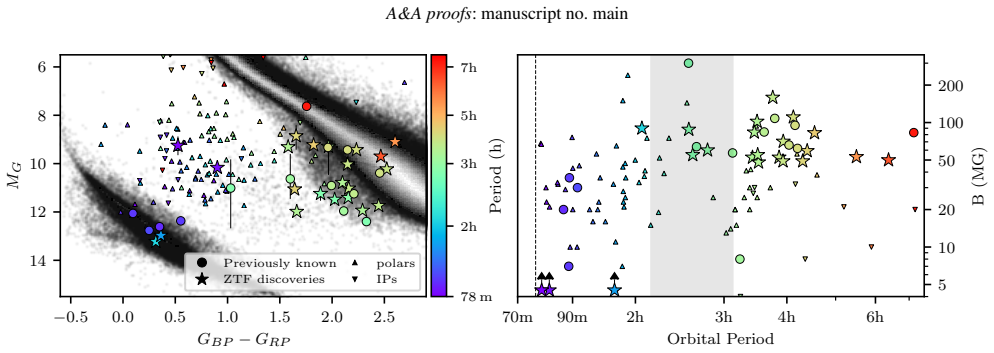
The central claim is that multi-colour time-domain photometry can serve as a discovery tool for cyclotron-emitting magnetic white dwarfs in post-common-envelope binaries, and that applying it to ZTF data roughly doubles the known sample from about 17 to 31 candidate systems. The new objects show strictly periodic light curves with shapes (pulse-like, sinusoidal, or M-shaped) and inter-band colour variations that are distinct from other variable stars, and low-resolution spectra confirm broad cyclotron humps in all but three of the short-period objects. The measured orbital periods (81 minutes to 6.37 hours), magnetic field strengths (48 to 204 MG), and white dwarf temperatures (6500 to 12,000 K) of the new systems are statistically indistinguishable from the previously known sample, which the authors take as evidence that light-curve selection does not strongly bias these parameters. The light curve diversity is explained by a toy model in which the emission from a single cyclotron spot depends on viewing angle like $I \propto \sin\Theta \cos\Theta$, so inclination and spot latitude determine the observed shape, while optical depth differences between harmonics explain why the same object looks different in $g$, $r$, and $i$ bands.
Load-bearing premise
The field strengths and the conclusion that the new sample matches the old one rest on the assumption that the broad humps left after removing the M-dwarf spectrum are truly cyclotron harmonics with the assigned harmonic numbers and a viewing angle of 90 degrees.
Editorial extensions
If this is right
- The known population of low-accretion-rate magnetic white dwarfs in post-common-envelope binaries is at least twice as large as previously catalogued, and the paper's completeness estimate of ≲30 per cent implies the true population is likely several times larger still.
- Phase-folded multi-colour light curves alone can serve as a relatively clean selection tool: spotted stars are the main false positives and can be rejected by inspecting the multi-band light curves.
- Because the period and field-strength distributions of the light-curve-selected sample match the spectroscopically selected sample, the combined sample can be used for population statistics without strong correction for these two parameters.
- The two new low-state polars with likely brown dwarf companions (ZTF J0146+4914 and ZTF J1144+3657) add to the small list of candidate magnetic period bouncers and support the idea that some magnetic cataclysmic variables detach near the period minimum.
- Long-timescale monitoring of ZTF J0116+4417, which shows ~2.4-year amplitude and phase changes, could distinguish between wind-accretion-rate variability and libration of the magnetic axis, both of which are viable explanations.
Reading between the lines
- If the ≲30 per cent completeness estimate holds across the ZTF footprint, a simple extrapolation suggests the Milky Way contains of order a hundred such systems detectable with current surveys, many more than the ~31 now known; deeper and longer-baseline surveys such as Rubin/LSST should find them.
- The paper's toy model predicts that systems with two visible spots should show a secondary peak offset by half a phase; a targeted search for such asymmetry in the new light curves could reveal the fraction of these binaries with two active poles, which carries information about the field geometry and accretion geometry.
- If the short-period systems ZTF J0112+5827 and ZTF J0343-1655 are low-state polars rather than detached pre-polars, as their position above the white-dwarf track suggests, then their accretion geometry may be testable with X-ray observations: genuine polars in low state should have faint X-ray emission unlike wind-accreting systems.
Signed reviews
Editorial analysis
A structured set of objections, weighed in public.
Referee Report
Summary. van Roestel et al. present the discovery of 14 new low-accretion-rate magnetic white dwarfs in post-common-envelope binaries (PCEBs) that show strong cyclotron emission, selected from ZTF light curves, plus the recovery of four known systems and additional candidate magnetic period bouncers. They confirm cyclotron humps in low-resolution spectra for 19 objects, measure orbital periods from phase-folded ZTF photometry, estimate magnetic field strengths by visually matching cyclotron harmonic wavelengths (Eq. 1), and derive white dwarf temperatures and donor properties from SEDs and parallaxes. The paper argues that, despite diverse light curve morphologies, the intrinsic properties (orbital period, magnetic field strength, white dwarf temperature) of the new sample are similar to those of previously known systems.
Significance. If confirmed, the discovery doubles the known sample of these rare systems and demonstrates that multi-color time-domain surveys can efficiently identify cyclotron-emitting magnetic white dwarfs without prior spectroscopy. The paper's use of public ZTF data, the blind recovery of known objects, and the extension to short-period candidate period bouncers are clear strengths. The main scientific value lies in providing a larger population for testing models of magnetic field generation in CV evolution, provided the magnetic field measurements are robust.
major comments (3)
- [Sect. 4.2, Eq. (1), Table B.1] The magnetic field strengths are determined by visually matching cyclotron harmonics with Eq. (1), and for several objects only one hump is detected, making the harmonic assignment degenerate. Examples include ZTF J0257+3328 (B=204/102 MG, harmonic 1/2?), ZTF J1723+3427 (B=174/87/58 MG, harmonic 1/2/3?), and ZTF J1239+7041 (B=159 MG, harmonic 1). These values are included in Figure 2 (right panel) and in the Section 5 statement that the B-field distribution 'is again not unusual compared to the sample of known objects.' Because an incorrect harmonic order changes B by an integer factor, the apparent similarity of the B-field distributions between the new and known samples is not yet secured. A quantitative treatment of the harmonic degeneracy, or a robustness test excluding single-line systems, is needed before this comparison is used as evidence.
- [Sect. 4.2] The template-subtraction step can remove a genuine cyclotron peak (as the authors note), and this systematic is not quantified. For objects with a single detected hump, such as ZTF J1239+7041, the B-field estimate rests entirely on one residual feature; a brief discussion of how often re-fitting was required and how sensitive the B-field values are to the subtraction choice would strengthen the analysis.
- [Sect. 4.2] The assumption of Theta = 90 degrees and of optically thin emission affects the wavelengths of the cyclotron peaks. The authors cite Campbell et al. (2008) for the complex dependence of cyclotron spectra on viewing angle and optical depth, but do not assess how this assumption might bias the B-field estimates. Since the comparison in Figure 2 mixes B-fields from this paper (estimated with this assumption) with those from the literature (often measured with more detailed cyclotron modeling), a cross-check on a few systems with multiple harmonics would help.
minor comments (6)
- [Abstract] The phrase 'are vary' is a typo; it should read 'are various' or 'vary'.
- [Sect. 5] The sentence beginning 'The The magnetic field strength' contains a duplicated article.
- [Table B.1] The footnote numbering is inconsistent: the caption jumps from footnote 3 to footnote 5, with footnote 4 mentioned only in the running text.
- [Appendix B] The spectra in Figures B.1 and B.2 would be more informative if the residual spectra after M-dwarf subtraction were shown, since the B-field measurements are based on these residuals.
- [Sect. 6.3] The recovery-rate denominator (13 non-eclipsing known systems) should clarify the excluded systems (e.g., HS 0922+1333 has no ZTF data; SDSS J0837+3830 and IL Leo are reclassified as polars), as this affects the completeness upper limit.
- [Sect. 4.1] The orbital periods are given without uncertainties; a typical uncertainty or the periodogram peak width would be useful for comparison with known systems.
Circularity Check
No circular derivation; the B-field measurement ambiguity is a calibration concern, not a reduction to the paper's inputs.
full rationale
The discovery and characterization chain is internally independent. Objects were selected from ZTF multi-colour light curves by strictly periodic, filter-dependent, unusual variability; follow-up spectroscopy independently confirmed broad cyclotron humps. Orbital periods come from Lomb-Scargle timing of the ZTF photometry, distances from Gaia parallaxes, donor masses from 2MASS K-band photometry and Gaia parallax, and white dwarf temperatures from SED fits with independent white-dwarf and M-dwarf models. Magnetic field strengths are measured from cyclotron harmonic wavelengths via the standard relation C_n = 10710/n x (100 MG / B) (Eq. 1). The field strength is a measured quantity, not a fitted constant that is later renamed a prediction, and the claimed similarity of the B-distributions is a comparison of measurements, not an output of the same fitting step. The paper explicitly flags the relevant caveats: template subtraction can erroneously remove a cyclotron peak (Sec. 4.2), some harmonic assignments are visibly ambiguous (e.g. ZTF J0257+3328 listed as B = 204/102 MG with '1/2?' in Table B.1), and the evolutionary states are said to be uncertain (Sec. 6.4). These are legitimate measurement and interpretation uncertainties, not circular reductions. Self-citations (van Roestel et al. 2021a, 2021b, in prep; Schreiber et al. 2023, which includes van Roestel as coauthor) are used for method reuse, survey context, or as one of several possible evolutionary channels; none is a load-bearing uniqueness claim on which the central discovery depends. No step of the derivation reduces to its own input by construction, so there is no significant circularity.
Assumptions & free parameters
free parameters (4)
- White dwarf radius prior in SED fits =
0.01 to 0.014 solar radii
- White dwarf mass range for Roche lobe geometry =
0.5 to 0.8 solar masses
- Companion mass uncertainty floor =
5%
- Magnetic field strength (per object) =
48-204 MG (reported range)
assumptions (5)
- domain assumption Cyclotron emission peak wavelengths follow C_n = 10710/n x (100 MG / B) Angstrom, and the emitting region is optically thin and viewed at Theta = 90 degrees.
- domain assumption At low accretion rates, the accretion spot is heated by fast ions and cools radiatively through cyclotron emission.
- domain assumption After subtracting the best-fit M-dwarf template, residual broad features are cyclotron emission, plus a small white dwarf continuum.
- domain assumption Companion masses and radii follow the Mann et al. (2019) and Brown et al. (2022) or Baraffe et al. (2015) relations, and white dwarf SEDs follow Koester (2009) and BT-SETTL models.
- domain assumption The strictly periodic multi-band variability is orbital modulation of a cyclotron spot in a binary, not rotation of a single star or another variable class.
Cite this review
Pith. "Pith review of Cyclotron emitting magnetic white dwarfs in post common envelope binaries discovered with the Zwicky Transient Facility." pith.science (2026). https://pith.science/paper/3ADPFCXO
@misc{pith2026241215153,
  author       = {Pith},
  title        = {Pith review of: Cyclotron emitting magnetic white dwarfs in post common envelope binaries discovered with the Zwicky Transient Facility},
  year         = {2026},
  howpublished = {\url{https://pith.science/paper/3ADPFCXO}},
  note         = {Machine review of arXiv:2412.15153}
}
read the original abstract
We present the discovery of 14 new (and recovery of 4 known) low accretion rate magnetic white dwarfs in post-common envelope binaries that emit strong cyclotron emission using the Zwicky Transient Facility (ZTF) light curves, doubling the known sample size. In addition, we discovered a candidate magnetic period bouncer and recovered three known ones. We confirmed the presence of cyclotron emission using low-resolution spectra in 19 objects. Using the ZTF light curves, follow-up spectra, and the spectral energy distribution, we measured the orbital period, magnetic field strength, and white dwarf temperature of each system. Although the phase-folded light curves have diverse shapes and show a much larger variability amplitude, we show that their intrinsic properties (e.g. period distribution, magnetic field strength) are similar to those of previously known systems. The diversity in light curve shapes can be explained by differences in the optical depth of the accretion spot and geometric differences, the inclination angle and the magnetic spot latitude. The evolutionary states of the longer period binaries are somewhat uncertain but are vary; we found systems consistent with being pre-polars, detached polars, or low-state polars. In addition, we discovered two new low-state polars that likely have brown dwarf companions and could be magnetic period bouncers.
Figures


Figures from the paper (1 more)

Forward citations
Cited by 2 Pith papers
-
A Link Between White Dwarf Pulsars and Polars: Multiwavelength Observations of the 9.36-Minute Period Variable Gaia22ayj
Gaia22ayj is a magnetic, accreting white dwarf with a 9.36-minute spin period and a rapid spin-down, possibly the missing link between white dwarf pulsars and polars.
-
On accretion in the polar V379 Vir
V379 Vir is accreting at roughly 3 x 10^-13 solar masses per year from a brown dwarf onto a 0.61 solar mass white dwarf, placing it in a stable low accretion state rather than wind-fed accretion.
Reference graph
Works this paper leans on
-
[1]
, " * write output.state after.block = add.period write newline
ENTRY address archiveprefix author booktitle chapter edition editor howpublished institution eprint journal key month note number organization pages publisher school series title type volume year label extra.label sort.label short.list INTEGERS output.state before.all mid.sentence after.sentence after.block FUNCTION init.state.consts #0 'before.all := #1 ...
-
[2]
write newline
" write newline "" before.all 'output.state := FUNCTION n.dashify 't := "" t empty not t #1 #1 substring "-" = t #1 #2 substring "--" = not "--" * t #2 global.max substring 't := t #1 #1 substring "-" = "-" * t #2 global.max substring 't := while if t #1 #1 substring * t #2 global.max substring 't := if while FUNCTION word.in bbl.in " " * FUNCTION format....
-
[3]
2003, 211, 325
Allard, F., Guillot, T., Ludwig, H.-G., et al. 2003, 211, 325
2003
-
[4]
& Landstreet, J
Bagnulo, S. & Landstreet, J. D. 2020, , 643, A134
2020
-
[5]
Bailer-Jones, C. A. L., Rybizki, J., Fouesneau, M., Demleitner, M., & Andrae, R. 2021, , 161, 147
2021
-
[6]
2015, , 577, A42, publisher: EDP Sciences
Baraffe, I., Homeier, D., Allard, F., & Chabrier, G. 2015, , 577, A42, publisher: EDP Sciences
2015
-
[7]
2019, 233, 363.08, conference Name: American Astronomical Society Meeting Abstracts \#233
Bellm, E., Kulkarni, S., & Graham, M. 2019, 233, 363.08, conference Name: American Astronomical Society Meeting Abstracts \#233
2019
-
[8]
V., Schreiber, M
Belloni, D., Rodrigues, C. V., Schreiber, M. R., et al. 2021, , 256, 45
2021
Show all 113 references
-
[9]
& Schreiber, M
Belloni, D. & Schreiber, M. R. 2020, , 492, 1523
2020
-
[10]
2004, 315, 187, conference Name: IAU Colloq
Beuermann, K. 2004, 315, 187, conference Name: IAU Colloq. 190: Magnetic Cataclysmic Variables
2004
-
[11]
V., & Schwope, A
Beuermann, K., Dreizler, S., Hessman, F. V., & Schwope, A. D. 2014, , 562, A63
2014
-
[12]
D., Walters, R., et al
Blagorodnova, N., Neill, J. D., Walters, R., et al. 2018, , 130, 035003
2018
-
[13]
J., West, A
Bochanski, J. J., West, A. A., Hawley, S. L., & Covey, K. R. 2007, , 133, 531
2007
-
[14]
T., Marsh, T
Breedt, E., Gänsicke, B. T., Marsh, T. R., et al. 2012, , 425, 2548
2012
-
[15]
J., Parsons, S
Brown, A. J., Parsons, S. G., Littlefair, S. P., et al. 2022, , 513, 3050
2022
-
[16]
K., Harrison, T
Campbell, R. K., Harrison, T. E., Schwope, A. D., & Howell, S. B. 2008, , 672, 531
2008
-
[17]
S., Villar, V
Chan, H. S., Villar, V. A., Cheung, S. H., et al. 2022, , 932, 118, arXiv:2112.03306 [astro-ph, physics:physics]
2022 arXiv
-
[18]
Costa, J. E. R. & Rodrigues, C. V. 2009, , 398, 240
2009
-
[19]
W., Burdge, K., Duev, D
Coughlin, M. W., Burdge, K., Duev, D. A., et al. 2021, , 505, 2954
2021
-
[20]
1990, , 54, 195
Cropper, M. 1990, , 54, 195
1990
-
[21]
2016, 507, 97, conference Name: Multi-Object Spectroscopy in the Next Decade: Big Questions, Large Surveys, and Wide Fields
Dalton, G. 2016, 507, 97, conference Name: Multi-Object Spectroscopy in the Next Decade: Big Questions, Large Surveys, and Wide Fields
2016
-
[22]
2023, , 674, A2
De Angeli, F., Weiler, M., Montegriffo, P., et al. 2023, , 674, A2
2023
-
[23]
S., Agertz, O., Berbel, A
de Jong, R. S., Agertz, O., Berbel, A. A., et al. 2019, Published in The Messenger vol. 175, pp. 3-11, 9 pages, arXiv:1903.02464 [astro-ph]
2019 arXiv
-
[24]
M., Riddle, R., et al
Dekany, R., Smith, R. M., Riddle, R., et al. 2020, , 132, 038001
2020
-
[25]
2016, The DESI Experiment Part I : Science , Targeting , and Survey Design , publication Title: arXiv e-prints
DESI Collaboration , Aghamousa, A., Aguilar, J., et al. 2016, The DESI Experiment Part I : Science , Targeting , and Survey Design , publication Title: arXiv e-prints
2016
-
[26]
J., Djorgovski, S
Drake, A. J., Djorgovski, S. G., Mahabal, A., et al. 2009, , 696, 870, publisher: American Astronomical Society
2009
-
[27]
J., Graham, M
Drake, A. J., Graham, M. J., Djorgovski, S. G., et al. 2014, , 213, 9
2014
-
[28]
2022, , 510, 2998
du Plessis, L., Venter, C., Wadiasingh, Z., et al. 2022, , 510, 2998
2022
-
[29]
2022, , 516, 3144
Duffy, C., Ramsay, G., Wu, K., et al. 2022, , 516, 3144
2022
-
[30]
2023, , 674, A13
Eyer, L., Audard, M., Holl, B., et al. 2023, , 674, A13
2023
-
[31]
2015, , 191, 111, arXiv:1504.08072 [astro-ph]
Ferrario, L., de Martino, D., & Gaensicke, B. 2015, , 191, 111, arXiv:1504.08072 [astro-ph]
2015 arXiv
-
[32]
& Beuermann, K
Fischer, A. & Beuermann, K. 2001, , 373, 211
2001
-
[33]
J., Kulkarni, S
Graham, M. J., Kulkarni, S. R., Bellm, E. C., et al. 2019, , 131, 078001, arXiv: 1902.01945 [astro-ph.IM]
2019 arXiv
-
[34]
Groot, P. J. 2019, Nature Astronomy, 3, 1160, number: 12 Publisher: Nature Publishing Group
2019
-
[35]
A., Vanderbosch, Z
Guidry, J. A., Vanderbosch, Z. P., Hermes, J. J., et al. 2021, , 912, 125
2021
-
[36]
T., Dillon, M., Southworth, J., et al
Gänsicke, B. T., Dillon, M., Southworth, J., et al. 2009, , 397, 2170
2009
-
[37]
T., Fischer, A., Silvotti, R., & de Martino, D
Gänsicke, B. T., Fischer, A., Silvotti, R., & de Martino, D. 2001, , 372, 557
2001
-
[38]
G., Marsh, T
Hakala, P., Parsons, S. G., Marsh, T. R., et al. 2022, , 513, 3858
2022
-
[39]
M., Bianco, F
Hambleton, K. M., Bianco, F. B., Street, R., et al. 2023, , 135, 105002, publisher: The Astronomical Society of the Pacific
2023
-
[40]
F., Coughlin, M
Healy, B. F., Coughlin, M. W., Mahabal, A. A., et al. 2024, , 272, 14
2024
-
[41]
T., Schwope, A., et al
Inight, K., Gänsicke, B. T., Schwope, A., et al. 2023, , 525, 3597, publisher: OUP
2023
-
[42]
P., Güdel, M., Brott, I., & Lüftinger, T
Johnstone, C. P., Güdel, M., Brott, I., & Lüftinger, T. 2015, , 577, A28, arXiv:1503.07494 [astro-ph]
2015 arXiv
-
[43]
2021, , 507, L30
Kawka, A., Vennes, S., Ferrario, L., et al. 2021, , 507, L30
2021
-
[44]
R., Frank, J., & Whitehurst, R
King, A. R., Frank, J., & Whitehurst, R. 1990, , 244, 731
1990
-
[45]
King, A. R. & Whitehurst, R. 1991, , 250, 152
1991
-
[46]
2011, , 194, 28
Knigge, C., Baraffe, I., & Patterson, J. 2011, , 194, 28
2011
-
[47]
2009, , 498, 517
Koester, D. 2009, , 498, 517
2009
-
[48]
I., Borisov, N
Kolbin, A. I., Borisov, N. V., Serebriakova, N. A., et al. 2022, , 511, 20
2022
-
[49]
A., Zasowski, G., Rix, H.-W., et al
Kollmeier, J. A., Zasowski, G., Rix, H.-W., et al. 2017, arXiv:1711.03234 [astro-ph], arXiv: 1711.03234
2017 arXiv
-
[50]
2020, , 493, 5208, publisher: OUP ADS Bibcode: 2020MNRAS.493.5208K
Krushinsky, V., Benni, P., Burdanov, A., et al. 2020, , 493, 5208, publisher: OUP ADS Bibcode: 2020MNRAS.493.5208K
2020
-
[51]
R., Harrison, F
Kulkarni, S. R., Harrison, F. A., Grefenstette, B. W., et al. 2021, Science with the Ultraviolet Explorer ( UVEX ), publication Title: arXiv e-prints
2021
-
[52]
C., Smith, R
Lam, M. C., Smith, R. J., Arcavi, I., et al. 2023, , 166, 13
2023
-
[53]
Landstreet, J. D. & Bagnulo, S. 2019, , 628, A1
2019
-
[54]
T., Schmidt, G
Liebert, J., Wickramasinghe, D. T., Schmidt, G. D., et al. 2005, , 129, 2376
2005
-
[55]
P., Szkody, P., Plotkin, R
Linnell, A. P., Szkody, P., Plotkin, R. M., et al. 2010, , 713, 1183, publisher: The American Astronomical Society
2010
-
[56]
W., Dupuy, T., Kraus, A
Mann, A. W., Dupuy, T., Kraus, A. L., et al. 2019, , 871, 63
2019
-
[57]
R., Stanway, E
Marcote, B., Marsh, T. R., Stanway, E. R., Paragi, Z., & Blanchard, J. M. 2017, , 601, L7
2017
-
[58]
R., Gänsicke, B
Marsh, T. R., Gänsicke, B. T., Hümmerich, S., et al. 2016, Nature, 537, 374
2016
-
[59]
J., Laher, R
Masci, F. J., Laher, R. R., Rusholme, B., et al. 2019, , 131, 018003, arXiv: 1902.01872 [astro-ph.IM]
2019 arXiv
-
[60]
K., Cohen, J
McCarthy, J. K., Cohen, J. G., Butcher, B., et al. 1998, in Optical astronomical instrumentation, ed. S. D'Odorico, Vol. 3355 (SPIE), 81 -- 92, tex.organization: International Society for Optics and Photonics
1998
-
[61]
& Stone, R
Miller, J. & Stone, R. 1994, No. 66
1994
-
[62]
2000, Supplement Series, 143, 23
Ochsenbein, F., Bauer, P., & Marcout, J. 2000, Supplement Series, 143, 23
2000
-
[63]
& Schwope, A
Ok, S. & Schwope, A. 2022, , 662, A116
2022
-
[64]
B., Cohen, J
Oke, J. B., Cohen, J. G., Carr, M., et al. 1995, , 107, 375
1995
-
[65]
Oke, J. B. & Gunn, J. E. 1982, , 94, 586
1982
-
[66]
1976, 73, 75, conference Name: Structure and Evolution of Close Binary Systems
Paczynski, B. 1976, 73, 75, conference Name: Structure and Evolution of Close Binary Systems
1976
-
[67]
1967, Acta Astronomica, 17, 287
Paczyński, B. 1967, Acta Astronomica, 17, 287
1967
-
[68]
Pala, A. F. & Gänsicke, B. T. 2017, 509, 91, conference Name: 20th European White Dwarf Workshop
2017
-
[69]
F., Gänsicke, B
Pala, A. F., Gänsicke, B. T., Breedt, E., et al. 2020, , 494, 3799
2020
-
[70]
F., Schmidtobreick, L., Tappert, C., Gänsicke, B
Pala, A. F., Schmidtobreick, L., Tappert, C., Gänsicke, B. T., & Mehner, A. 2018, , 481, 2523
2018
-
[71]
G., Agurto-Gangas, C., Gänsicke, B
Parsons, S. G., Agurto-Gangas, C., Gänsicke, B. T., et al. 2015, , 449, 2194
2015
-
[72]
G., Gänsicke, B
Parsons, S. G., Gänsicke, B. T., Schreiber, M. R., et al. 2021, , 502, 4305
2021
-
[73]
G., Marsh, T
Parsons, S. G., Marsh, T. R., Gänsicke, B. T., et al. 2013, , 436, 241
2013
-
[74]
R., Buckley, D
Pelisoli, I., Marsh, T. R., Buckley, D. A. H., et al. 2023, Nature Astronomy, 7, 931
2023
-
[75]
Perley, D. A. 2019, PASP, 131, 084503, arXiv: 1903.07629 [astro-ph.IM]
2019 arXiv
-
[76]
Potter, S. B. & Buckley, D. A. H. 2018, , 481, 2384
2018
-
[77]
2020, JOSS, 5, 2308
Prochaska, J., Hennawi, J., Westfall, K., et al. 2020, JOSS, 5, 2308
2020
-
[78]
E., & Alcock, C
Rebbapragada, U., Protopapas, P., Brodley, C. E., & Alcock, C. 2009, Finding Anomalous Periodic Time Series : An Application to Catalogs of Periodic Variable Stars , publication Title: arXiv e-prints
2009
-
[79]
& Hagen, H
Reimers, D. & Hagen, H. J. 2000, , 358, L45
2000
-
[80]
J., & Hopp, U
Reimers, D., Hagen, H. J., & Hopp, U. 1999, , 343, 157
1999
-
[81]
2023, , 264, 39
Ren, L., Li, C., Ma, B., et al. 2023, , 264, 39
2023
-
[82]
D., Blagorodnova, N., et al
Rigault, M., Neill, J. D., Blagorodnova, N., et al. 2019, , 627, A115
2019
-
[83]
Rodriguez, A. C. 2024, , 136, 054201
2024
-
[84]
D., Szkody, P., Vanlandingham, K
Schmidt, G. D., Szkody, P., Vanlandingham, K. M., et al. 2005, , 630, 1037
2005
-
[85]
R., Belloni, D., Gänsicke, B
Schreiber, M. R., Belloni, D., Gänsicke, B. T., Parsons, S. G., & Zorotovic, M. 2021, Nature Astronomy, 5, 648
2021
-
[86]
R., Belloni, D., & Roestel, J
Schreiber, M. R., Belloni, D., & Roestel, J. v. 2023, , 679, L8
2023
-
[87]
R., Belloni, D., Zorotovic, M., et al
Schreiber, M. R., Belloni, D., Zorotovic, M., et al. 2022, , 513, 3090
2022
-
[88]
2024, , 686, A110
Schwope, A., Kurpas, J., Baecke, P., et al. 2024, , 686, A110
2024
-
[89]
R., Standke, A., et al
Schwope, A., Marsh, T. R., Standke, A., et al. 2023, , 674, L9
2023
-
[90]
Schwope, A. D. & Beuermann, K. 1990, , 238, 173
1990
-
[91]
D., Beuermann, K., Jordan, S., & Thomas, H
Schwope, A. D., Beuermann, K., Jordan, S., & Thomas, H. C. 1993, , 278, 487
1993
-
[92]
D., Brunner, H., Hambaryan, V., & Schwarz, R
Schwope, A. D., Brunner, H., Hambaryan, V., & Schwarz, R. 2002, 261, 102, conference Name: The Physics of Cataclysmic Variables and Related Objects
2002
-
[93]
D., Nebot Gomez-Moran, A., Schreiber, M
Schwope, A. D., Nebot Gomez-Moran, A., Schreiber, M. R., & Gänsicke, B. T. 2009, , 500, 867
2009
-
[94]
D., Staude, A., Koester, D., & Vogel, J
Schwope, A. D., Staude, A., Koester, D., & Vogel, J. 2007, , 469, 1027
2007
-
[95]
D., Thomas, H
Schwope, A. D., Thomas, H. C., Mante, K. H., Haefner, R., & Staude, A. 2003, , 402, 201
2003
-
[96]
Silva, K. M. G., Rodrigues, C. V., Costa, J. E. R., et al. 2013, , 432, 1587
2013
-
[97]
F., Cutri, R
Skrutskie, M. F., Cutri, R. M., Stiening, R., et al. 2006, , 131, 1163
2006
-
[98]
F., Schmidt, G., et al
Szkody, P., Anderson, S. F., Schmidt, G., et al. 2003, , 583, 902
2003
-
[99]
L., Denneau, L., Heinze, A
Tonry, J. L., Denneau, L., Heinze, A. N., et al. 2018, , 130, 064505
2018
-
[100]
A., Wickramasinghe, D
Tout, C. A., Wickramasinghe, D. T., Liebert, J., Ferrario, L., & Pringle, J. E. 2008, , 387, 897
2008
-
[101]
Townsley, D. M. & Gänsicke, B. T. 2009, , 693, 1007
2009
-
[102]
1999, , 195, 87.01, conference Name: American Astronomical Society Meeting Abstracts
Uomoto, A., Smee, S., Rockosi, C., et al. 1999, , 195, 87.01, conference Name: American Astronomical Society Meeting Abstracts
1999
-
[103]
A., Mahabal, A
van Roestel, J., Duev, D. A., Mahabal, A. A., et al. 2021 a , , 161, 267
2021
-
[104]
J., et al
van Roestel, J., Kupfer, T., Bell, K. J., et al. 2021 b , , 919, L26
2021
-
[105]
Vanderplas, J., Naul, B., Willmer, A., Williams, P., & Morris, B. M. 2016, Zenodo
2016
-
[106]
& Zwaan, C
Verbunt, F. & Zwaan, C. 1981, , 100, L7
1981
-
[107]
1995, Cambridge Astrophysics Series, 28
Warner, B. 1995, Cambridge Astrophysics Series, 28
1995
-
[108]
Webbink, R. F. & Wickramasinghe, D. T. 2005, 330, 137, conference Name: The Astrophysics of Cataclysmic Variables and Related Objects
2005
-
[109]
Wickramasinghe, D. T. & Ferrario, L. 2000, , 112, 873
2000
-
[110]
Wickramasinghe, D. T. & Wu, K. 1991, , 253, 11P
1991
-
[111]
& Beuermann, K
Woelk, U. & Beuermann, K. 1996, , 306, 232
1996
-
[112]
E., Müller, H.-R., Redfield, S., et al
Wood, B. E., Müller, H.-R., Redfield, S., et al. 2021, , 915, 37
2021
-
[113]
G., Adelman, J., Anderson, Jr., J
York, D. G., Adelman, J., Anderson, Jr., J. E., et al. 2000, , 120, 1579
2000
Reviewed August 11, 2026 · model on record in the stance chip above.
Discussion (0). Continue with ORCID to comment.