REVIEW 2 major objections 5 minor 1 cited by
2-dimensional TFTs via modular $\infty$-operads
T0 review · 2 major / 5 minor · reviewed 2026-08-06 · deepseek-v4-flash
Pith's one-line read 2D topological field theories valued in any symmetric monoidal ∞-category are exactly algebras over the surface modular ∞-operad, and the genus filtration of that operad decomposes every such theory into a genus-0 cyclic algebra plus one…
desk verdict Sharp lecture notes announcing a new genus filtration and spectral sequence for 2D TFTs; main theorems are black-boxed from in-preparation papers and one key connectivity claim for k>0 is explicitly unproved. read the letter →
The pith
A machine-rendered reading of the paper's core claim, the machinery that carries it, and where it could break.
The reading
What carries the argument
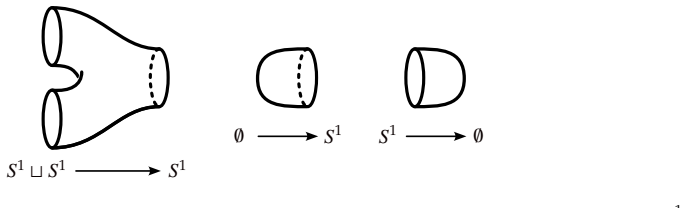
The central object is the surface modular $\infty$-operad $\mathcal{M}$: a functor from a category $\mathrm{Gr}$ of connected graphs to spaces, satisfying a Segal condition, whose value at a genus-$g$, $k$-ary corolla is $\coprod_{g\ge 0} B\mathrm{Diff}(\Sigma_{g,k})$ and whose value at the single edge is $B SO(2)$. The Segal condition means the value at any graph is determined by these local corolla and edge data, which makes gluing along boundary circles algebraic. Algebras over $\mathcal{M}$ are defined as maps $\mathcal{M}\to \mathcal{U}^{\mathrm{dual}}(\mathcal{C})$, and the envelope adjunction for properads delivers $\mathrm{Env}(\mathcal{M}) = \mathrm{Bord}_2$, so such maps are literally 2D TFTs. The paper then forms the genus filtration $\mathcal{M}^{(0)}\to\mathcal{M}^{(1)}\to\cdots$ by restricting to graphs whose vertex genera are bounded and extending back by freely adding the missing gluing operations; the genus-$g$ step is governed by the $g$-th latching module, a right module over the genus-0 operad $\mathrm{E}^{SO}_2$ whose value at $\sqcup_k D^2$ is $\mathrm{Emb}(\sqcup_k D^2,\Sigma_g)//\mathrm{Diff}(\Sigma_g)$. The convergence of the tower is driven by a curve-complex duality theorem that shows the relevant homotopy fibers are highly connected.
What would settle it
Test the unproved boundary case by computing, for a genus-2 surface with one boundary circle, the space of genus-$\le 1$ cut systems: the claim requires its first two homotopy groups to vanish, so producing any non-contractible loop would refute the convergence rate.
Extended reading notes
Core claim
The paper establishes a dictionary: for any symmetric monoidal $\infty$-category $\mathcal{C}$, the $\infty$-category of symmetric monoidal functors $\mathrm{Bord}_2 \to \mathcal{C}$ is equivalent to the $\infty$-category of modular algebras over the surface modular $\infty$-operad $\mathcal{M}$ in $\mathcal{C}$. Algebraically, this is the space of maps $\mathcal{M} \to \mathcal{U}^{\mathrm{dual}}(\mathcal{C})$, where $\mathcal{U}^{\mathrm{dual}}(\mathcal{C})$ is the modular operad whose colours are dualisable objects of $\mathcal{C}$ and whose operations are maps from tensor products to the unit. The proof constructs $\mathcal{M}$ from surfaces with cut systems, so that $\mathcal{M}(\mathfrak{c}_k^{(g)}) \simeq \coprod_{g\ge 0} B\mathrm{Diff}(\Sigma_{g,k})$, and uses the envelope adjunction to obtain $\mathrm{Env}(\mathcal{M}) = \mathrm{Bord}_2$. The paper then filters $\mathcal{M}$ by genus; the genus-$g$ approximation $\mathcal{M}^{(g)}$ is freely generated by the genus-$\le g$ part, the filtration is convergent, and the passage from genus $g-1$ to $g$ is controlled by a latching module expressed through cut systems and factorization homology. For invertible TFTs this produces a new convergent spectral sequence with $\mathrm{E}^1$-page given by mapping class group cohomology (plus an $H^*(B SO(3))$ column) and target $H^{g+k}(CP^\infty;\mathbb{Q})$.
Load-bearing premise
The tower only converges at the claimed speed if, even for surfaces with boundary circles, the genus-$g$ approximation already matches the full surface operad in all topological features up to dimension $2g-1$; the notes prove this only for closed surfaces and leave the boundary case unproved.
Editorial extensions
If this is right
- If the paper is right, a 2D TFT valued in any symmetric monoidal $\infty$-category $\mathcal{C}$ is completely specified by an $\mathrm{E}^{SO}_2$-Calabi–Yau algebra together with, for each genus $g\ge 1$, a lift of the previous data across the latching module $\mathcal{L}_g\mathcal{M}$, turning the classification of TFTs into an obstruction theory.
- For truncated targets the tower is finite: whenever $\mathcal{C}$ is a symmetric monoidal $(n,1)$-category and $2g\ge n$, restriction along $\mathcal{M}^{(g)}\to\mathcal{M}$ is an equivalence, so in particular modular functors valued in linear categories are determined by genus $\le 1$ data.
- Invertible 2D TFTs valued in $\Omega^\infty X$ are maps of spectra $\tau_{\ge0}\Sigma MTSO(2)\to X$, and the genus filtration produces a rational spectral sequence with $\mathrm{E}^1_{g,k} = H^k(B SO(3);\mathbb{Q})$ for $g=0$, $H^{k-1}(B\mathrm{Diff}(S^1\times S^1)/B\mathrm{Diff}(S^1\times D^2);\mathbb{Q})$ for $g=1$, and $H^{5g-6-k}(B\Gamma_g;\mathbb{Q})$ for $g\ge2$, converging to $H^{g+k}(CP^\i
- The handlebody part of the story gives a classification of ansular functors: symmetric monoidal functors out of the handlebody category $\mathrm{Hbdy}$ are exactly $\mathrm{E}^{SO}_2$-Calabi–Yau algebras in the target.
- A by-product is the 1-dimensional cobordism hypothesis with singularities: $\mathrm{Fun}^{\otimes}(\mathrm{Bord}_1,\mathcal{C}) \simeq (\mathcal{C}^{\mathrm{dbl}})^\simeq$, so 1D TFTs are classified by dualisable objects.
Reading between the lines
- If the connectivity bound for surfaces with boundary is proved, the same obstruction-theoretic tower should apply uniformly to cohomological field theories based on the Deligne–Mumford compactification $\overline{\mathcal{M}}_{g,k}$; the paper sketches the relevant pushout square but does not compute the resulting spectral sequence.
- The new spectral sequence in the invertible case is plausibly the same as the tropical-weight spectral sequences studied in recent graph-complex work; the paper notes the resemblance and leaves the comparison open, so checking the first non-trivial differentials against known classes would test that isomorphism.
- A deformation theory for 2D TFTs could be extracted from the latching-module description: formal deformations should be governed by mapping class group cohomology with coefficients in factorization homology of the local algebra, which the paper's extension problems make tangible but do not develop.
- The classification should specialise to the classical vector-space case and recover commutative Frobenius algebras; there the paper's connectivity bound is not optimal because the target is 1-truncated, so a truncation-sensitive sharper statement may exist.
Editorial analysis
A structured set of objections, weighed in public.
Referee Report
Summary. These lecture notes develop a framework of modular ∞-operads for studying 2-dimensional TFTs valued in arbitrary symmetric monoidal ∞-categories. The central construction is the surface modular operad M, and the paper claims an equivalence between symmetric monoidal functors Bord_2 → C and algebras over M in C. A genus filtration M^(0) → M^(1) → ⋯ is introduced, and the paper claims it converges with (2g−1)-connectivity at each genus step, leading to an obstruction-theoretic description of 2D TFTs as a genus-0 cyclic algebra (an E^{SO}_2-Calabi–Yau algebra) plus a sequence of extension problems. Applications include a finite-determination result for modular functors in LinCat_k (genus ≤ 1) and a new spectral sequence whose E_1 terms involve mapping class group cohomology and whose target is H^{g+k}(CP^∞). The proofs rely on several theorems quoted from three in-preparation papers by the authors, and the key k>0 connectivity case of Corollary 5.11 is explicitly not proved.
Significance. If the companion papers deliver the promised results, this is a significant conceptual advance: it gives a uniform ∞-categorical framework for 2D TFTs, recovers and extends classical finite-determination results for modular functors, and produces a novel spectral sequence relating mapping class group cohomology to the cohomology of CP^∞. The exposition is clear and honest about its dependencies, and the graph-categorical machinery is set up carefully. The main strengths are the clean formulation of modular ∞-operads via algebraic patterns, the monoidal envelope comparison with the bordism category, and the obstruction-theoretic reinterpretation of the genus filtration. However, the centrality of the unproved k>0 connectivity statement and the reliance on three in-preparation papers make the results conditional; the paper should be revised to either supply the missing arguments or clearly flag the affected statements as conditional.
major comments (2)
- [§5.2, Corollary 5.11] The claim that M^(g)(Γ) → M(Γ) is (2g−1)-connected for all Γ is not established. The proof idea reduces to showing that the fiber |Cut_g(Σ_{g+1,k})| is (2g−1)-connected, and for k=0 this follows from Harer–Ivanov (Theorem 5.10), but the text explicitly states for k>0 that 'the fiber is still (2g−1)-connected, though we will not show this here'. This is load-bearing: Corollary 5.12 (Alg_M(C) ≃ Alg_{M^(g)}(C) for 2g ≥ n) uses pointwise (2g−1)-connectivity on all corollas, including those with boundary circles, and Example 5.13 (modular functors in LinCat_k are determined in genus ≤ 1) requires the k>0, g=1 case to be 1-connected. Without a proof of the k>0 case (or a precise reference to [*gen]) the finite-determination statements and the slope-2 convergence claim are unsupported. Please provide the missing argument or explicitly restrict the affected corollaries.
- [Theorems 2.30, 3.14, 3.19, 4.9, 5.18] The central structural results of the paper are all quoted verbatim from three in-preparation papers ([*mod], [*cyc], [*gen]), with only proof ideas or no proof at all. In particular, Theorem 3.19 (complete modular operads ≃ complete rigid properads) is what makes the definition of modular algebras over M equivalent to 2D TFTs, and Theorem 5.18 (the fiber of the genus-restriction functor) is the basis for the entire obstruction-theoretic description of Section 5.3 and for the spectral sequence in Section 5.5. The paper is honest about these dependencies, but as a standalone manuscript the main claims are conditional. The authors should either include the proofs (or at least detailed sketches) in the notes, or clearly label these results as 'proved elsewhere' and state which of the paper's advertised new results would survive if any of these black boxes were modified.
minor comments (5)
- [Definition 2.2] The graph is declared to be a 4-tuple (V,A,†,r), but the root map is denoted t in the text and r(v) later; please unify the notation.
- [Proof of Corollary 5.11] 'Harrer' is a typo for 'Harer'.
- [Corollary 1.17] This corollary is stated without proof or reference; since it is listed as a consequence of the main theorem, a proof sketch or citation would be helpful.
- [Remark 4.18] The contractibility of outer space is attributed to 'Culler–Vogtmann' without a citation; please add the reference (e.g., [CV86]).
- [§5.5, Corollary 5.25] The construction of the convergent filtration of τ≥0ΣMTSO(2) and the identification of the associated graded (particularly the g=1 term) are only asserted; a sketch of the computation would make the spectral sequence more self-contained.
Circularity Check
Central framework is imported from the authors' own in-preparation companion papers, but the spectral sequence and finite-determination applications retain independent content.
-
self citation load bearing
[Section 3.4 (Theorem 3.19) and Section 3.2 (Theorem 3.8), applied in Definition 3.22]
"Theorem 3.19([*mod]). Restriction along the forgetful functor φ : daGr→Gr induces an equivalence ModOp_cpl ≃→ Prpd_cpl,rig ... Combining all the above we have Fun⊗(Bord_d, C) ≃ MapPrpd(B_d, U(C)) ≃ MapModOp(B_d, U dual(C)) = Algmod_{B_d}(C)."
The identification of 2D TFTs with modular M-algebras, which is the paper's stated main goal, is not proved in these notes. It is assembled from Theorem 3.8, attributed to the authors' preprint [BS22], and Theorem 3.19, attributed to the in-preparation [*mod]; the construction of B_d as a modular operad also uses Theorem 2.30 from [*mod]. These companion works are by the same authors and are not machine-checked or otherwise independently verified here. The notes thus defer the central equivalence to a chain of self-citations rather than deriving it. This is load-bearing self-citation, though not definitional circularity: the external results used later (GMTW, Harer-Ivanov, Willwacher) are not fed back into the framework.
full rationale
No fitted-input or definitional circularity was found: the genus filtration is defined from M and its convergence is measured by connectivity of M^(g)→M, with the spectral sequence target H^{g+k}(CP∞) coming from the external GMTW theorem, not from the filtration data. The main circularity concern is structural: the paper's core equivalence between Bord_2-valued TFTs and algebras over the modular ∞-operad M is imported as a black box from the authors' own unpublished/preprint framework ([BS22], [*mod], [*cyc], [*gen]). A separate, non-circular weakness is flagged by the paper itself at the end of Section 5.2: Corollary 5.11 asserts (2g−1)-connectivity of M^(g)→M for all k≥0, but the k>0 case is explicitly not shown ('the fiber is still (2g−1)-connected, though we will not show this here'); Corollary 5.12 and Example 5.13 depend on this unproved connectivity. This is a gap in the written argument, not a circular step. Overall, the notes are an exposition of work in progress; their central claim is self-citation-load-bearing, but the applications retain independent external content, so score 4.
Assumptions & free parameters
assumptions (6)
- domain assumption The envelope adjunction Env ⊣ U between ∞-properads and symmetric monoidal ∞-categories (Theorem 3.8) is assumed from [BS22].
- ad hoc to paper The extension theorem for non-unital modular operads, the DK-equivalence characterization, and the rigid properad equivalence (Theorems 2.30, 3.14, 3.19) are assumed from the in-preparation paper [*mod].
- ad hoc to paper The cyclic operad theorem via right modules (Theorem 4.9) is assumed from [*cyc].
- ad hoc to paper The genus-extension theorem (Theorem 5.18) is assumed from [*gen].
- standard math The Harer-Ivanov theorem that the curve complex is a wedge of spheres in dimension 2g-2 is invoked (Theorem 5.10).
- standard math The Galatius-Madsen-Tillmann-Weiss theorem |Bord_d| ≃ Ω^{∞-1}MTSO(d) is invoked (Sections 1.4 and 5.5).
invented entities (1)
-
The modular ∞-operad of surfaces M and its genus-g approximations M^(g)
independent evidence
Cite this review
Pith. "Pith review of 2-dimensional TFTs via modular $\infty$-operads." pith.science (2026). https://pith.science/paper/3CGEJGZE
@misc{pith2026250622104,
  author       = {Pith},
  title        = {Pith review of: 2-dimensional TFTs via modular $\infty$-operads},
  year         = {2026},
  howpublished = {\url{https://pith.science/paper/3CGEJGZE}},
  note         = {Machine review of arXiv:2506.22104}
}
abstract
This lecture series is based on joint work in progress with Shaul Barkan, as well as work in progress of the author. The five sections of these notes correspond to the five lectures, but more details have been added. $2$-dimensional topological field theories ($2$D TFTs) valued in vector spaces are commutative Frobenius algebras. The goal of this lecture series is to generalize from the $1$-category of vector spaces to any symmetric monoidal $\infty$-category $\mathcal{C}$, i.e. to study symmetric monoidal functors $\mathrm{Bord}_2 \to \mathcal{C}$. Choosing $\mathcal{C}$ to be the $(2,1)$-category of linear categories, this recovers a definition of modular functors, and choosing it to be the derived category of a ring yields a notion closely related to cohomological field theories. We will introduce a notion of modular $\infty$-operads and algebras over them, construct the modular $\infty$-operad of surfaces $\mathcal{M}$, and show that algebras over $\mathcal{M}$ in $\mathcal{C}$ are exactly $2$D TFTs valued in $\mathcal{C}$. Along the way we will encounter variants modular $\infty$-operads (such as cyclic $\infty$-operads and $\infty$-properads) as well as a proof of the $1$D cobordism hypothesis with singularities. This uses some (mild) $\infty$-category theory, but no familiarity with ($\infty$-)operads will be assumed. The main goal will be to filter $\mathcal{M}$ by genus to obtain an obstruction-theoretic description of $2$D TFTs with general target. Applying this to invertible TFTs one can construct a new spectral sequence exhibiting relations between the cohomology groups of moduli spaces of curves.
Figures


Figures from the paper (11 more)


Forward citations
Cited by 1 Pith paper
-
Reflection Equivariance and the Heisenberg Picture for Spaces of Conformal Blocks
Orientation reversal of surfaces corresponds algebraically to the modified trace, and reflection equivariant modular functors are exactly those whose circle category is modular and whose conformal blocks are the uniqu...
Reference graph
Works this paper leans on
-
[4]
The surface category and tropical curves
url: https://arxiv.org/abs/2111.14757. 66 [Tom05] Orsola Tommasi. “Rational cohomology of the moduli space of genus 4 curves”. In: CompositioMathematica 141.02(Feb.2005),pp.359–384. url: http://dx.doi.org/10. 1112/S0010437X0400123X. [Wil24] Thomas Willwacher. Cyclic operads through modules. 2024.url: https://arxiv.org/ abs/2403.18399. [Wit91] Edward Witte...
work page Pith review arXiv 2005
-
[587]
Arity Approximation of $\infty$-Operads
url: http://dx.doi.org/10.1142/S0218216596000333. [Ati88] MichaelFAtiyah.“Topologicalquantumfieldtheory”.In: PublicationsMathématiques de l’IHÉS68 (1988), pp. 175–186. [Bar22] Shaul Barkan. Arity Approximation of∞-Operads. Available at arXiv:2207.07200. 2022. [BBS24] Rachael Boyd, Corey Bregman, and Jan Steinebrunner. Moduli spaces of 3-manifolds with bou...
work page Pith review arXiv 1988
-
[2021]
Categories of graphs for operadic structures
url: https://arxiv.org/abs/2109.06231. [Har12] YonatanHarpaz. TheCobordismHypothesisinDimension1 .2012. url: https://arxiv. org/abs/1210.0229. [Har86] John L. Harer. “The virtual cohomological dimension of the mapping class group of anorientablesurface”.In: InventionesMathematicae 84.1(Feb.1986),pp.157–176. url: http://dx.doi.org/10.1007/BF01388737. [Hat8...
work page Pith review arXiv 1981
-
[2024]
url: https://arxiv.org/abs/2409.10991. 65 [KK24b] Manuel Krannich and Alexander Kupers. “The Disc-structure space”. In: Forum of Mathematics, Pi12 (2024).url: http://dx.doi.org/10.1017/fmp.2024.25. [KM94] M. Kontsevich and Yu. Manin. “Gromov-Witten classes, quantum cohomology, and enumerativegeometry”.In: CommunicationsinMathematicalPhysics 164.3(Aug.1994...
arXiv 2024
Reviewed August 6, 2026 · model on record in the stance chip above.
Discussion (0). Continue with ORCID to comment.