REVIEW 4 major objections 6 minor 15 references
Continuation maps for the Morse fundamental group
T0 review · 4 major / 6 minor · reviewed 2026-08-16 · deepseek-v4-flash
Pith's one-line read Continuation maps make the Morse fundamental group a functor, even across different manifolds.
desk verdict A genuinely new but under-proved paper: the non-grafted continuation map is plausible and probably repairable, but the grafted version rests on an unproved assertion that grafted moduli spaces behave like non-grafted ones. read the letter →
The pith
A machine-rendered reading of the paper's core claim, the machinery that carries it, and where it could break.
The reading
What carries the argument
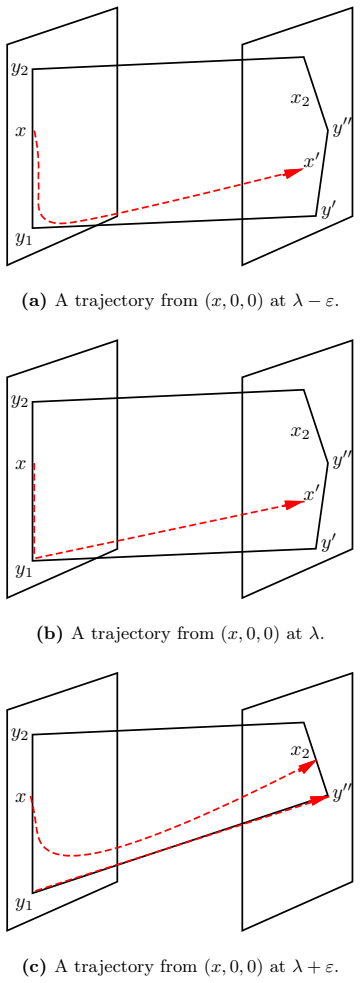
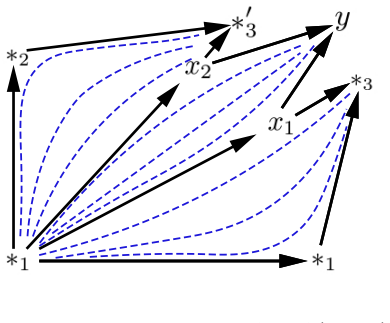
The central machinery is the positive moduli space $M^+((x,0),\emptyset)$, the space of anti-gradient trajectories of the interpolation function $F$ that start at a critical point $(x,0)\in M\times\{0\}$ and flow upward in the $\mathbb{R}$-direction. For an index-2 critical point $z$ of $f_1$, Lemma 2.1 asserts that this space is a 3-disk whose boundary decomposes into an $f_1$-side, an intermediate cylinder, and an $f_2$-side $M((z,0),M\times\{1\})$, which is itself a 2-disk; Lemma 2.2 identifies the boundary of that disk with the image $\phi_F(\ell)$ of the Morse loop $\ell$ bounding $z$. This disk-to-loop identification carries relators of $\pi_1^{\mathrm{Morse}}(f_1)$ into relators of $\pi_1^{\mathrm{Morse}}(f_2)$. In the grafted setting the same role is played by the grafted moduli space $M^{\mathrm{gr}}((z,0),\emptyset)$, and in Section 4 the evaluation of steps along the flow, projected onto sublevel sets, establishes the isomorphism to the relative fundamental group. The interpolation square with angle parameters $\lambda$ and $\alpha$ is the auxiliary device used to prove functoriality.
What would settle it
Take a standard Morse-Smale pair on $S^2$ with one index-2 point $z$, use the interpolation $F$ of Section 2, and compute the compactified stratum $M((z,0),M\times\{1\})$ explicitly: if it is not a single 2-disk, or if its boundary word under $ev_{f_2}$ differs from $\phi_F(\ell)$, then Lemma 2.1 fails and the proof that relations map to relations collapses. Alternatively, take $M=S^1$ with a Morse function having two minima and one maximum and $h(s)=s^3-\frac{3}{2}s^2$: Theorem 4.1 predicts $\pi_1^{\mathrm{Morse}}(F,(m,-\infty))$ is trivial, so exhibiting two inequivalent Morse paths based at $(m,-\infty)$ would disprove injectivity.
Extended reading notes
Core claim
The paper's central claim is that the Morse fundamental group is a natural object under continuation data. Given an interpolation pair $(F,G)$ between Morse-Smale pairs $(f_1,g_1)$ and $(f_2,g_2)$ on a closed manifold $M$, the positive unstable moduli spaces $M^+((x,0),\emptyset)$ define a map on Morse steps whose concatenation gives a morphism $\phi_F:\pi_1^{\mathrm{Morse}}(f_1,\ast_1)\to\pi_1^{\mathrm{Morse}}(f_2,\ast_2)$; Theorem 2.1 states that it descends to the relations. In the grafted case, where $f_1$ and $f_2$ live on different manifolds $X$ and $Y$ and a map $H:X\to Y$ is used to join flow lines, Theorem 2.2 produces a morphism $\phi_H^{\mathrm{gr}}$ between the two Morse fundamental groups. Theorems 3.1 and 3.3 make both constructions functorial, and Theorem 4.1 identifies the Morse fundamental group of an interpolation-type function $F$ with the relative fundamental group $\pi_1(\mathbb{R}\times M, F^{-1}(]-\infty,c])\cup\{\ast'\},\ast')$.
Load-bearing premise
The proof rests on Lemma 2.1's assertion that $M^+((z,0),\emptyset)$ is topologically a 3-disk with the stated boundary decomposition, so that the $f_2$-side is a 2-disk whose boundary is $\phi_F(\ell)$; the lemma is justified by a schematic figure and dimension counts rather than a full gluing proof, and the grafted version simply asserts that the same topology carries over.
Editorial extensions
If this is right
- Any two Morse-Smale pairs on the same closed manifold connected by an interpolation pair have isomorphic Morse fundamental groups, with the continuation morphism itself giving the isomorphism (Corollary 1.1).
- A diffeomorphism between two manifolds induces an isomorphism between their Morse fundamental groups through the grafted continuation morphism (Corollary 1.2).
- Grafted continuation morphisms depend only on the isotopy class of the map $H$: an isotopy changes the morphism by conjugation by a Morse path (Theorem 3.2).
- For an interpolation-type function $F$ on $M\times\mathbb{R}$, the Morse fundamental group is isomorphic to the relative fundamental group of $\mathbb{R}\times M$ based at a sublevel set (Theorem 4.1), which yields an alternative proof of surjectivity of the continuation morphism.
- The continuation construction is functorial: the triangle formed by three Morse-Smale pairs commutes up to a canonical isomorphism (Theorems 3.1 and 3.3).
Reading between the lines
- The same boundary-decomposition argument should carry over to Floer fundamental groups, where continuation maps are usually defined only at chain level; the missing input is a compactness and transversality analogue of Lemma 2.1.
- Because the grafted morphism depends only on the isotopy class of $H$, the construction should descend to a purely Morse-theoretic model of the induced map on $\pi_1$ for any continuous map between manifolds.
- Theorem 4.1 makes the Morse fundamental group of an interpolation-type function computable from the topology of a sublevel set, so continuation maps could be compared by computing relative groups rather than by chasing moduli spaces.
- A natural test would be to promote the construction to a Morse fundamental groupoid whose objects are minima, including formal minima at infinity; the Section 4 examples suggest the pointed-set formulation hides part of the concatenation structure.
Signed reviews
Editorial analysis
A structured set of objections, weighed in public.
Referee Report
Summary. The paper defines continuation maps for the Morse fundamental group of a closed manifold. For two Morse-Smale pairs connected by an interpolation pair (F,G) on M×R, it constructs a morphism ϕ_F between the Morse fundamental groups and proves functoriality, first in the same-manifold case (Theorems 1.1, 1.2, 3.1) and then for grafted trajectories between different manifolds (Theorems 1.3–1.5, 2.2, 3.2, 3.3). It also introduces interpolation-type functions on M×R and proves a relative-fundamental-group description (Theorem 4.1), together with corollaries asserting independence of the Morse data and invariance under diffeomorphisms.
Significance. If the announced results are fully established, the paper would give a direct Morse-theoretic proof of invariance of the Morse fundamental group and a new relative description of the fundamental group for interpolation-type functions. The construction is explicit and the paper contains useful examples, notably Example 4.1 and Remark 4.5. The author is also transparent about the folklore isomorphism and does not claim circularly to prove it. However, several load-bearing topological identifications are only sketched or asserted, especially in the grafted setting, and the proof of the relative theorem relies on an unproved flow argument. These gaps prevent the paper from currently supporting the full range of its claims.
major comments (4)
- [Section 2.1, Lemma 2.1] The lemma asserts that M_+((z,0),∅) is topologically a 3-disk and that M((z,0),M×{1}) is a 2-disk with the stated boundary decomposition. The proof does not give a rigorous topological argument for these identifications; it relies on a schematic figure, dimension counts, and a cylinder/disk union heuristic. This is load-bearing because Lemma 2.2 and the proof of Theorem 2.1 use the disk identification to conclude that the boundary of M((z,0),M×{1}) is ϕ_F(ℓ), which is exactly what is needed to show that relations map to relations. A complete proof, for example by an explicit collar-flow or product decomposition of the compactification, should be provided.
- [Section 2.2, Theorem 2.2] The proof of the grafted continuation morphism is not established. After defining the grafted moduli spaces, the proof states that 'Since the moduli spaces involved have the same topology and properties as in the non-grafted case, the rest of the arguments from the proofs of Lemma 2.2 and Theorem 2.1 hold.' This is an assertion, not a proof. Grafted trajectories compactify with breaks both before and after the graft, and the graph-transversality condition introduces a stratum structure genuinely different from the non-grafted case. In particular, the paper does not prove that M^gr((z,0),{1}) is a 2-disk whose boundary is ϕ_H^gr(ℓ) for ℓ = ∂W^u(z). Since Theorem 2.2 is the basis for Theorems 1.3–1.5 and Corollary 1.2, this gap affects the central claims of the grafted part of the paper.
- [Section 4, proof of Theorem 4.1] The proof of Theorem 4.1 relies on the vector field X = ∇F̃ + ρ∇h to flow arbitrary paths into tubular neighborhoods of unstable manifolds of index at most 1, and similarly to flow disks into neighborhoods of unstable manifolds of index at most 2, while preserving homotopy classes. No proof is supplied for this flow-and-project statement. Since the manifold is non-compact, convergence of the flow and control at infinity are not automatic. This is the mechanism for both surjectivity and injectivity of the morphism ϕ, so Theorem 4.1 is not fully established without a rigorous argument.
- [Section 3, Proposition 3.1 and Section 3.2, Proposition 3.3] The proof of Proposition 3.1 says that the descent to the quotient is 'analogous to that of Theorem 2.1' after replacing moduli spaces by trajectories at a fixed angle λ. But the angle restriction is not a product situation, and the strata of the compactified moduli spaces at fixed λ require separate verification. Similarly, Proposition 3.3 asserts that the grafted singularities 'are not affected by the graft' and then applies the non-grafted arguments. These statements are not demonstrated, and they are load-bearing for the functoriality theorems in Section 3.
minor comments (6)
- [Introduction, Corollary 1.1 and Corollary 1.2] The notation '(f1,g2)' and '(f2,g2)' appears to contain typos: the first should presumably be '(f1,g1)' and the second should denote a pair on M2 in Corollary 1.2.
- [Section 2.1, definition of M+((x,0),∅)] The condition 'γ(0)∈M×{u}, 0≤u<1' in the displayed definition is followed by a description that also involves broken trajectories; the notation for the space of unbroken trajectories versus its compactification is not consistently distinguished.
- [Section 2.2, Figure 7 and grafted trajectory definition] The domain of γ_+ is written as R_+ in the displayed equation, but the subsequent discussion and Remark 2.1 treat γ_+ as defined on [0,v]. This should be clarified.
- [Section 3.2, Theorem 3.2 proof] The proof refers to ϕ_0 and ϕ_π/2, but the statement of Theorem 3.2 uses ϕ_H0^gr and ϕ_H1^gr; the relation between the two notations is not explained.
- [Section 4, Definition 4.3] The equivalence relation (2) is described in words and the reader must infer how 'forming the oriented boundary of the compactification' interacts with rule (3); a precise enumeration of the allowed replacements would improve readability.
- [Figures 2–6] Several figures are schematic and not all labels are referenced in the text; for instance, the colors used in Figures 4–6 are described in the captions but the connection to the formal moduli-space notation is often implicit.
Circularity Check
No circularity found: continuation morphism and relative-group theorem are derived from moduli-space geometry and checked against an independent topological target; the grafted transfer is a rigor gap, not a circular reduction.
full rationale
The derivation chain is not circular. The continuation morphism φ_F is constructed directly from the moduli spaces M^+((x,0),∅) and evaluation maps ev_{f2} (Section 2.1); Theorem 2.1 does not presuppose the isomorphism it proves. Lemma 2.1 identifies M((z,0),M×{1}) as a 2-disk by decomposing the boundary of the 3-disk M^+((z,0),∅), and Lemma 2.2 identifies its boundary with φ_F(ℓ) via boundary matching with opposite orientations—not by taking φ_F(ℓ) as an input. The quotient argument then applies Lemma 1.1, whose proof uses only the definition of R(f,∗) as the normal subgroup generated by boundaries of index-2 unstable manifolds. Theorem 4.1 is checked against the genuinely independent topological object π_1(R×M,F^{-1}(]−∞,c])∪{∗′},∗′); surjectivity flows an arbitrary path onto unstable 1-manifolds and injectivity flows a bounding disk onto 1- and 2-dimensional unstable manifolds, so the isomorphism is not true by construction. The folklore theorem π_Morse^1≅π_1(M) is cited only as background from Bertuol's thesis, not as a load-bearing premise, and the single author has no prior self-citations. The one flagged weakness is Theorem 2.2: its proof transfers the non-grafted arguments by asserting 'Since the moduli spaces involved have the same topology and properties as in the non-grafted case, the rest of the arguments from the proofs of Lemma 2.2 and Theorem 2.1 hold' (Section 2.2). That is an unproved transfer/omitted proof, not a circular step, because it does not assume the conclusion φ^gr_H(ℓ)=0; it assumes a geometric fact about grafted moduli spaces. Hence the circularity score is 0.
Assumptions & free parameters
free parameters (1)
- Large constant C in interpolation functions =
sufficiently large, not numerically specified
assumptions (5)
- domain assumption Morse-Smale condition is generic and metrics can be chosen so stable and unstable manifolds intersect transversally, including grafted conditions.
- standard math The moduli space M(x,∅) of anti-gradient trajectories is diffeomorphic to the unstable manifold W^u(x), via evaluation at time 0.
- standard math Folklore theorem: πMorse1(f,∗) is isomorphic to π1(M,∗), with proof cited to Bertuol [5].
- domain assumption Compactified moduli spaces of broken trajectories form manifolds with corners of expected dimension, e.g., M+((z,0),∅) is a 3-disk and M((z,0),M×{1}) is a 2-disk.
- ad hoc to paper The vector field X = ∇F̃ + ρ∇h in the proof of Theorem 4.1 can be used to flow arbitrary paths into tubular neighborhoods of unstable manifolds of index at most 1, preserving homotopy classes.
Cite this review
Pith. "Pith review of Continuation maps for the Morse fundamental group." pith.science (2026). https://pith.science/paper/3D2SBEYT
@misc{pith2026250420803,
  author       = {Pith},
  title        = {Pith review of: Continuation maps for the Morse fundamental group},
  year         = {2026},
  howpublished = {\url{https://pith.science/paper/3D2SBEYT}},
  note         = {Machine review of arXiv:2504.20803}
}
abstract
We study properties of the continuation map for the Morse fundamental group $\pi_1^\text{Morse}(f,\ast)$ associated to a Morse-Smale pair $(f,g)$ on a manifold $M$. We get a morphism between $\pi_1^\text{Morse}(f_1,\ast_1)$ and $\pi_1^\text{Morse}(f_2,\ast_2)$ and show that it is functorial. We also define the morphism in the case of Morse data over different manifolds, thanks to the use of grafted trajectories. Finally, given an interpolation function on $M\times\mathbb{R}$ between two Morse functions (used for example to define the continuation map), we study the Morse fundamental group associated to that function and show that it is isomorphic to a relative fundamental group on $M\times\mathbb{R}$.
Figures


Figures from the paper (11 more)




Reference graph
Works this paper leans on
-
[1]
Its limit at−∞ is−∞, and its limit at +∞ is +∞
Let’s look at what the Morse fundamental group looks like for the case described in Section 2, whereh(s) =s3− 3 2s2. Its limit at−∞ is−∞, and its limit at +∞ is +∞. We suppose ˜F ≡ f, where f : M → 46 R is a Morse function. Then the anti-gradient trajectories ofF are determined byf onM coordinates, and byh on theR coordinate. We suppose f has a unique min...
-
[2]
Suppose h(s) = s2. We have a unique critical point ats = 0, which happens to be a minimum, and its limits at±∞ are +∞ (in particular, it is decreasing befores = 0, and increasing after). ThereforeF does not have any critical points outside of{s = 0}, and no trajectory start- ing at{s = 0} can leave this zone. Morse steps based at a minimum ∗ = (m∗, 0) ofF...
-
[3]
between their Morse fundamental groups, where (∗2, 1) is the unique other end of the trajectory from(∗1, 0) defined by the anti-gradient flow line ofF12, (∗3, 1) is the unique other end of the trajec- tory from (∗1, 0) defined by the anti-gradient flow line ofF13, and (∗′ 3, 1) is the unique other end of the trajectory from(∗2, 0) defined by the anti-grad...
-
[4]
Jean-François Barraud, Florian Bertuol, Fundamental group in stable Morse theory,preprint arXiv:2410.07802, 2024. 51
work page Pith review arXiv 2024
-
[5]
Suppose h(s) = −s2. Then it has a unique critical point ats = 0, which is a maximum, and its limits at±∞ are−∞ (in particular, it is increasing befores = 0, and decreasing after). As in the first example, we suppose ˜F≡f, wheref :M→R is a Morse function which has a unique minimum∗. Therefore,F’s only critical points are in{s = 0}, so correspond to critica...
-
[6]
Blumberg, Foundation of Floer ho- motopy theory I: Flow categories,preprint arXiv:2404.03193, 2024
Mohammed Abouzaid, Andrew J. Blumberg, Foundation of Floer ho- motopy theory I: Flow categories,preprint arXiv:2404.03193, 2024
arXiv 2024
-
[7]
Translated from the 2010 French original by Reinie Erné
Michèle Audin, Mihai Damian, Morse Theory and Floer Homology,Uni- versitext, EDP Sciences, Les Ulis, Springer, London, 2014. Translated from the 2010 French original by Reinie Erné
work page 2014
-
[8]
Jean-François Barraud, A Floer Fundamental Group,Annales Scien- tifiques de l’École Normale Supérieure.vol 51, pp. 773-809, 2018
work page 2018
Show all 15 references
-
[9]
Allen Hatcher, Algebraic Topology,Cambridge University Press, Cam- bridge, 2002
2002
-
[10]
Florian Bertuol, Groupe fondamental de Morse stable, Variables com- plexes [math.CV], Université Paul Sabatier - Toulouse III, 2022, NNT: 2022TOU30073, tel-03726679
2022
-
[11]
Guillem Cazassus, Equivariant Lagrangian Floer homology via cotan- gent bundles ofEGN, Journal of Topology, 17(1), Article e12328, 2024
2024
-
[12]
Octav Cornea, Andrew Ranicki, Rigidity and gluing for Morse and Novikov complexes,J. Eur. Math. Soc. 5, no. 4, pp. 343–394, 2003
2003
-
[13]
Then there exists an isomorphism ψ such that the following diagram is commutative: πMorse 1 (f1,∗1) πMorse 1 (f3,∗′ 3) πMorse 1 (f2,∗2) πMorse 1 (f3,∗3)
between the corresponding Morse fundamental groups. Then there exists an isomorphism ψ such that the following diagram is commutative: πMorse 1 (f1,∗1) πMorse 1 (f3,∗′ 3) πMorse 1 (f2,∗2) πMorse 1 (f3,∗3). ϕgr 13 ϕgr 12 ψ ≃ ϕgr 23 Proof. The following theorem is an immediate c...
-
[14]
Kenji Fukaya, Yong-Geun Oh, Hiroshi Ohta, Kaoru Ono, Kuranishi structures and virtual fundamental chains, Springer Monographs in Mathematics, Springer, Singapore, 2020
2020
-
[15]
Salammbo Connolly, Université Paris-Saclay, CNRS, Laboratoire de math- ématiques d’Orsay, 91405, Orsay, France
Peter Kronheimer, Tomasz Mrowka, Monopoles and Three-Manifolds, Cambridge University Press, 2007. Salammbo Connolly, Université Paris-Saclay, CNRS, Laboratoire de math- ématiques d’Orsay, 91405, Orsay, France. E-mail address : salammbo.connolly@universite-paris-saclay.fr 52
2007
Reviewed August 16, 2026 · model on record in the stance chip above.
Discussion (0). Continue with ORCID to comment.