REVIEW 4 major objections 5 minor 1 cited by
Listen, Analyze, and Adapt to Learn New Attacks: An Exemplar-Free Class Incremental Learning Method for Audio Deepfake Source Tracing
T0 review · 4 major / 5 minor · reviewed 2026-08-07 · deepseek-v4-flash
Pith's one-line read AnaST learns new audio deepfake attacks incrementally in one epoch with no stored examples, substantially narrowing the gap to joint training.
desk verdict A competent port of analytic class-incremental learning to audio deepfake source tracing, with a real empirical contribution, but the central 'same as joint training' claim is untested against a matched analytic baseline. read the letter →
The pith
A machine-rendered reading of the paper's core claim, the machinery that carries it, and where it could break.
The reading
What carries the argument
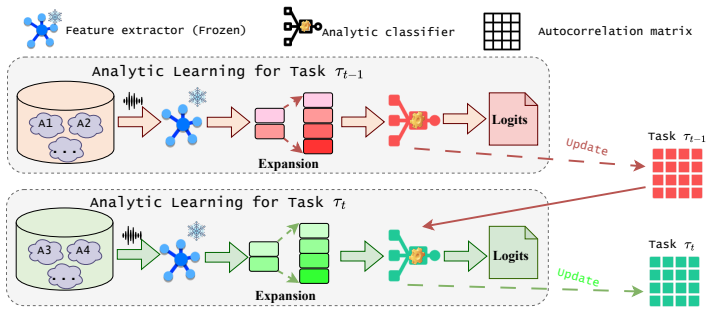
The load-bearing object is the feature autocorrelation matrix (FAuM), a recursively updated matrix $R_t$ that stores the inverse of the accumulated expanded-feature Gram matrix plus regularization, $\left(\sum_{i=0}^t F_i'^\top F_i' + \gamma I\right)^{-1}$. Together with the classifier weight $\hat{W}_{cls}^{(t)}$, it lets the analytic classifier be updated from only the new task's expanded features $F_t'$ and labels $y_t$, using a recursive identity that never touches past data. A random feature-expansion layer projects the frozen CNN embeddings into a higher-dimensional space before the least-squares fit, and the block-diagonal label matrix $Y_{0:t-1}$ encodes the growing class set; the recursive update is designed so that the analytic solution equals the joint-training solution over all tasks.
What would settle it
Compute the classifier weight from the recursive update in Equation (7) and compare it with the batch least-squares solution on the union of all tasks' expanded features; if they differ by more than floating-point error, the claimed equivalence to joint training is false. A task-ordering experiment that starts with a single attack family would also settle whether the frozen features generalize to very different generators.
Extended reading notes
Core claim
AnaST claims that class-incremental learning for audio deepfake source tracing reduces to a linear-recursive problem once the acoustic feature extractor is fixed. After task 0 is trained with standard back-propagation and then frozen, the classifier is reframed as a least-squares layer: for each new task, the expanded features are passed through, the feature autocorrelation matrix is updated via a recursive formula, and the classifier weight is revised in closed form so that the output matches what joint training on all tasks would have produced. The paper reports average accuracies of 91.68% (ASVspoof 2019 LA), 87.85% (WaveFake), and 77.85% (multi-dataset), with backward transfer of -3.1, -10.3, and -5.4 percentage points and no exemplar buffer, compared with joint-training upper bounds of 95.37%, 99.50%, and 96.91%. The result is offered as the first class-incremental formulation for source tracing and as evidence that analytic learning can replace replay in this setting.
Load-bearing premise
The method's guarantee depends on the feature extractor learned from the first task alone producing a representation in which every future attack class can be separated by a simple linear decision rule, even though that extractor is frozen and never sees the later attacks.
Editorial extensions
If this is right
- Deployed source-tracing systems can be updated on new attack data alone, so forensic labs never need to retain or share the original training utterances.
- Memory use stays bounded by the classifier weight and the feature autocorrelation matrix, making the method suitable for on-device or embedded deployment.
- Each new task costs one epoch of classifier adaptation, so reaction time to a newly discovered deepfake generator drops to near-instant.
- Within the fixed feature space, the incremental classifier should behave as if it had seen all previous tasks, keeping old attack classes recognizable.
- The reported comparisons provide a first class-incremental benchmark for source tracing, with joint training as upper bound and fine-tuning as lower bound.
Reading between the lines
- The same recursive analytic update applies to any attribution problem with a growing class set, such as voice-clone attribution or music synthesizer identification; the exemplar-free property is what makes that transfer attractive.
- Because the feature extractor is frozen after task 0, the ceiling on accuracy is set by the quality of that one-time representation; no improvement to the incremental rule alone can fix a representation that fails to separate a future attack family.
- An online deployment with asynchronous label arrivals would need an explicit rule for aligning the block-diagonal label matrix, a step the task-batched formulation leaves implicit.
Editorial analysis
A structured set of objections, weighed in public.
Referee Report
Summary. This paper proposes AnaST, an exemplar-free class incremental learning method for audio deepfake source tracing. The method pre-trains a RawNet2 feature extractor and a linear classifier on a first set of attacks with backpropagation, then replaces the classifier with an analytic least-squares classifier on randomly expanded features. For subsequent tasks, the feature extractor is frozen, and the classifier is updated recursively using a feature autocorrelation matrix, with the stated goal of reproducing the joint-training least-squares solution without storing past data. Experiments on ASVspoof 2019 LA and WaveFake in single- and multi-dataset settings report accuracies of 91.68%, 87.85%, and 77.85%, respectively, outperforming replay-free baselines and approaching (but not reaching) an end-to-end joint-training upper bound.
Significance. If the claimed equivalence were established, the approach would be valuable: it is exemplar-free, updates in one epoch, and has a memory footprint of just the autocorrelation matrix. The underlying recursive least-squares update follows from the Woodbury identity and is sound in principle. The paper is also the first to apply CIL to ST, and the experimental setup covers a realistic multi-dataset scenario. However, the significance is currently limited by the absence of a matched analytic joint baseline, the ambiguous recursive update, and the lack of uncertainty estimates; the empirical contribution is therefore suggestive rather than definitive.
major comments (4)
- [Section 2.2.2, Eq. (7)] The recursive weight update is garbled as printed. The expression cW(t)_cls = [ cW(t-1)_cls - R_t F^T_t F'_t cW(t-1)_cls R_t F'_t^T y_t ] has inconsistent dimensions (R_t F'^T F' is square, multiplied by W, then multiplied by R_t F'^T y_t) and does not correspond to the standard RLS update W_t = W_{t-1} + R_t F'^T (Y_t - F' W_{t-1}). The symbol F_t is used inconsistently with the expanded feature F'_t. Because Eqs. (7)-(8) define the algorithm, this needs to be corrected and verified, e.g., by a derivation or a numerical check that the recursion matches the closed-form solution in Eq. (5).
- [Section 2.2.2, Eqs. (4)-(5)] The label alignment for new classes is unspecified. The paper states that Y_{0:t-1} is block-diagonal with y_i on the diagonal and that W has a column size proportional to task size, but it never describes how columns corresponding to new attack classes are appended to W or how Y_t is constructed when each task introduces new classes. Without this, the recursive update in Eq. (7) is not well-defined, because the dimensions of F'_t and Y_t relative to W are ambiguous. This is load-bearing for the claimed equivalence to joint training.
- [Section 3.2 and Tables 1-2] The central claim that the classifier can reach the same output as joint training is not tested against the correct baseline. The Joint Training baseline trains the entire network end-to-end on all tasks, which adapts the feature extractor to every class; AnaST uses a frozen task-0 feature extractor, so the two are solving different optimization problems. The accuracy gaps (e.g., 91.68 vs. 95.37 in Table 1) therefore conflate representation quality with forgetting. The authors should report an analytic joint-training baseline (frozen task-0 features plus a single least-squares fit on all tasks, Eq. (5)) to verify that the recursion actually reproduces the joint solution and to quantify the cost of freezing features.
- [Section 3.2 and Table 3] The experimental results lack uncertainty quantification, and the hyperparameter gamma appears to be selected on the test split. The pre-training attack selection is random, but only one run is reported per setting, so the differences between methods (e.g., AnaST 87.85% vs. DER++ 81.10% on WaveFake) may be within run-to-run variability. The ablation in Table 3 changes gamma and reports test accuracy without a validation set, which risks optimistic bias. The authors should report means and standard deviations over multiple seeds and a clear train/validation/test split for hyperparameter selection.
minor comments (5)
- [Eq. (7)] The feature matrix is written as F_t in one place and F'_t in another within the same equation; use the prime consistently for the expanded feature matrix.
- [Section 2.2.2] The sentence 'Suppose have access to datasets' is missing the subject 'we'.
- [Section 2.1, Eq. (1)] The notation for the cross-entropy loss is not fully specified: L_CE(y, f(x; W)) is written for a single sample, but the expectation is over a distribution; also, the tasks are indexed τ_1... in the text while the sum runs from t=0 to T, which is inconsistent.
- [Section 2.2.2] The hat notation for the estimated weight is rendered as 'cW' in the PDF; this should be typeset as \hat{W} to avoid confusion with a variable named cW.
- [Section 3.1] The description 'we re-split entire ASVspoof 2019 LA into an 80:20 ratio' is ambiguous; the original dataset has train/dev/eval subsets, and the authors should specify how these were combined and whether the split is stratified by attack class.
Circularity Check
No circularity found: the incremental update is an exact RLS identity and results are benchmarked externally.
full rationale
The paper's central mechanism is an algebraic recursion: Eq. (4) defines a regularized least-squares objective on frozen expanded features, Eq. (5) gives its closed-form solution, and Eqs. (7)-(8) are the standard Woodbury/recursive least-squares update that reproduces Eq. (5) incrementally. The 'same output as joint training' claim is therefore a mathematical identity with respect to the analytic joint solution, not an empirical prediction; the experimental Joint Training baseline trains the network end-to-end and is a different (stronger) objective, so the accuracy gap in Tables 1-2 reflects feature quality, not a circular fit. The method is evaluated on held-out splits of ASVspoof 2019 LA and WaveFake and compared to external baselines (EWC, LWF, Rwalk, DER++), so the empirical contribution is independently testable. The paper cites the authors' prior AnalyticKWS and other self-work, but these are contextual citations; the RLS/frozen-extractor construction is sourced to the external analytic learning reference and to the paper's own stated equations. No fitted parameter is renamed as a prediction, and no uniqueness result is imported from the authors. The main caveats are that Eq. (7) appears typographically garbled and the proof is deferred to supplementary material; these are correctness/completeness concerns, not circularity.
Assumptions & free parameters
free parameters (5)
- Expansion size =
1000
- Regularization gamma =
0.01 (multi-dataset); unspecified for single dataset
- Random feature projection initialization =
unspecified
- Pre-training attack selection and task order =
random 9 attacks (single) / 9+1 (multi)
- Training hyperparameters (learning rate, batch size, epochs) =
lr=0.0001, batch=128, 50 epochs
assumptions (5)
- standard math Woodbury matrix identity gives exact recursive update for ridge regression
- standard math Closed-form ridge regression solution (Eq. 3) is the optimal classifier for the squared-error objective
- domain assumption Features from the frozen extractor are linearly separable for all future attacks after feature expansion
- domain assumption Block-diagonal label matrix alignment across tasks is correctly handled when new classes appear
- domain assumption Feature expansion improves class separability
Cite this review
Pith. "Pith review of Listen, Analyze, and Adapt to Learn New Attacks: An Exemplar-Free Class Incremental Learning Method for Audio Deepfake Source Tracing." pith.science (2026). https://pith.science/paper/3D3SV2Q4
@misc{pith2026250514601,
  author       = {Pith},
  title        = {Pith review of: Listen, Analyze, and Adapt to Learn New Attacks: An Exemplar-Free Class Incremental Learning Method for Audio Deepfake Source Tracing},
  year         = {2026},
  howpublished = {\url{https://pith.science/paper/3D3SV2Q4}},
  note         = {Machine review of arXiv:2505.14601}
}
read the original abstract
As deepfake speech becomes common and hard to detect, it is vital to trace its source. Recent work on audio deepfake source tracing (ST) aims to find the origins of synthetic or manipulated speech. However, ST models must adapt to learn new deepfake attacks while retaining knowledge of the previous ones. A major challenge is catastrophic forgetting, where models lose the ability to recognize previously learned attacks. Some continual learning methods help with deepfake detection, but multi-class tasks such as ST introduce additional challenges as the number of classes grows. To address this, we propose an analytic class incremental learning method called AnaST. When new attacks appear, the feature extractor remains fixed, and the classifier is updated with a closed-form analytical solution in one epoch. This approach ensures data privacy, optimizes memory usage, and is suitable for online training. The experiments carried out in this work show that our method outperforms the baselines.
Figures

Forward citations
Cited by 1 Pith paper
-
Towards Generalized Source Tracing for Codec-Based Deepfake Speech
SASTNet, which fuses Whisper semantic features with Wav2Vec2 and AudioMAE acoustic features, improves source tracing for codec-based deepfake speech on CodecFake+, while exposing that prior models overfit to silence.
Reference graph
Works this paper leans on
-
[1]
detecting fake without forgetting
Introduction In recent years, deepfake generation and detection have drawn much attention [1–3]. Many global competitions, such as ASVspoof and the ADD challenge series [4–8], encourage re- search on developing advanced and effective deepfake coun- termeasures. As binary classification (real/fake) has improved over the past few years, studies now focus on...
-
[2]
AnaST: Analytic Source Tracing 2.1. Problem Formulation In this work, we examine an ST system that learns different attack categories through a sequence of tasks {τ1, τ2, . . . , τT }. We consider this problem as a CIL scenario, where the system arXiv:2505.14601v1 [eess.AS] 20 May 2025 A1 A2 ... A3 A4 ... Logits Logits Analytic Learning for Task Analytic ...
arXiv 2025
-
[3]
This FE ap- proach is useful for AnaST as it converts the original features into a richer representation without greatly increasing compu- tational costs. The expanded features retain subtle distinctions in speech signals and help in preserving complex patterns. This expanded space, set by a chosen expansion size, provides more information to support anal...
-
[4]
Dataset We used two datasets in our studies: ASVspoof 2019 LA [4] and WaveFake [29]
Experiments 3.1. Dataset We used two datasets in our studies: ASVspoof 2019 LA [4] and WaveFake [29]. The ASVspoof 2019 LA dataset has three subsets: training, development, and evaluation. Spoofed utter- ances are generated by various TTS, VC, and hybrid TTS/VC algorithms. In total, there are 19 attacks, which create 20 classes for the ST task. Because of...
work page 2019
-
[5]
Results and Analysis 4.1. Source Tracing Studies in Single Dataset Setting Table 1 reports the performance of various methods on the two datasets for ST. The joint training results depict the upper bound, indicating high performance on both datasets. In con- trast, the fine-tuning method represents the lowest performance with the highest negative BWT indi...
work page 2019
-
[6]
Conclusion In this work, we proposed AnaST, an exemplar-free analytic CIL method for deepfake audio ST. Our method replaces gradi- ent back-propagation with a recursive least-squares procedure and employs feature expansion with proper regularization to update the classifier efficiently while preserving past knowl- edge. Experiments on the ASVspoof 2019 LA...
work page 2019
-
[7]
ASVspoof: The automatic speaker verification spoofing and countermeasures challenge,
Z. Wu, J. Yamagishi, T. Kinnunen, C. Hanilc ¸i, M. Sahidullah, A. Sizov, N. Evans, M. Todisco, and H. Delgado, “ASVspoof: The automatic speaker verification spoofing and countermeasures challenge,” IEEE Journal of Selected Topics in Signal Processing, vol. 11, no. 4, pp. 588–604, 2017
work page 2017
-
[8]
V oice conversion challenge 2020 — intra-lingual semi-parallel and cross-lingual voice conversion —,
Z. Yi, W.-C. Huang, X. Tian, J. Yamagishi, R. K. Das, T. Kin- nunen, Z.-H. Ling, and T. Toda, “V oice conversion challenge 2020 — intra-lingual semi-parallel and cross-lingual voice conversion —,” in Proc. Joint Workshop for the Blizzard Challenge and Voice Conversion Challenge 2020, 2020, pp. 80–98
work page 2020
Show all 40 references
-
[9]
Speaking in wavelet domain: A simple and efficient approach to speed up speech diffusion model,
X. Zhang, D. Liu, H. Liu, Q. Zhang, H. Meng, L. P. G. Perera, E. Chng, and L. Yao, “Speaking in wavelet domain: A simple and efficient approach to speed up speech diffusion model,” in Pro- ceedings of the 2024 Conference on Empirical Methods in Natural Language Processing, 202...
2024
-
[10]
ASVspoof 2019: spoofing countermeasures for the detec- tion of synthesized, converted and replayed speech,
A. Nautsch, X. Wang, N. Evans, T. H. Kinnunen, V . Vestman, M. Todisco, H. Delgado, M. Sahidullah, J. Yamagishi, and K. A. Lee, “ASVspoof 2019: spoofing countermeasures for the detec- tion of synthesized, converted and replayed speech,”IEEE Trans- actions on Biometrics, Behavi...
2019
-
[11]
ASVspoof 2021: accelerating progress in spoofed and deepfake speech detection,
J. Yamagishi, X. Wang, M. Todisco, M. Sahidullah, J. Patino, A. Nautsch, X. Liu, K. A. Lee, T. Kinnunen, N. Evans et al. , “ASVspoof 2021: accelerating progress in spoofed and deepfake speech detection,” in Proc. The Automatic Speaker Verification Spoofing Countermeasures Work...
2021
-
[12]
ASVspoof 5: crowd- sourced speech data, deepfakes, and adversarial attacks at scale,
X. Wang, H. Delgado, H. Tak, J. weon Jung, H. jin Shim, M. Todisco, I. Kukanov, X. Liu, M. Sahidullah, T. H. Kinnunen, N. Evans, K. A. Lee, and J. Yamagishi, “ASVspoof 5: crowd- sourced speech data, deepfakes, and adversarial attacks at scale,” in Proc. The Automatic Speaker V...
2024
-
[13]
ADD 2022: the first audio deep synthe- sis detection challenge,
J. Yi, R. Fu, J. Tao, S. Nie, H. Ma, C. Wang, T. Wang, Z. Tian, Y . Bai, C. Fan et al., “ADD 2022: the first audio deep synthe- sis detection challenge,” in Proc. IEEE International Conference on Acoustics, Speech and Signal Processing (ICASSP), 2022, pp. 9216–9220
2022
-
[14]
ADD 2023: the second audio deepfake detection challenge,
J. Yi, J. Tao, R. Fu, X. Yan, C. Wang, T. Wang, C. Y . Zhang, X. Zhang, Y . Zhao, Y . Renet al., “ADD 2023: the second audio deepfake detection challenge,” in Proc. IJCAI 2023 Workshop on Deepfake Audio Detection and Analysis, 2023, pp. 125–130
2023
-
[15]
Synthetic speech detection through short-term and long-term prediction traces,
C. Borrelli, P. Bestagini, F. Antonacci, A. Sarti, and S. Tubaro, “Synthetic speech detection through short-term and long-term prediction traces,” EURASIP Journal on Information Security , vol. 2021, pp. 1–14, 2021
2021
-
[16]
Source tracing: detecting voice spoofing,
T. Zhu, X. Wang, X. Qin, and M. Li, “Source tracing: detecting voice spoofing,” in Proc. IEEE Asia-Pacific Signal and Informa- tion Processing Association Annual Summit and Conference (AP- SIPA ASC), 2022, pp. 216–220
2022
-
[17]
Attacker attribution of audio deepfakes,
N. M ¨uller, F. Diekmann, and J. Williams, “Attacker attribution of audio deepfakes,” in Proc. Interspeech, 2022, pp. 2788–2792
2022
-
[18]
Source trac- ing of audio deepfake systems,
N. Klein, T. Chen, H. Tak, R. Casal, and E. Khoury, “Source trac- ing of audio deepfake systems,” in Proc. Interspeech, 2024, pp. 1100–1104
2024
-
[19]
Generalized source tracing: Detecting novel audio deep- fake algorithm with real emphasis and fake dispersion strategy,
Y . Xie, R. Fu, Z. Wen, Z. Wang, X. Wang, H. Cheng, L. Ye, and J. Tao, “Generalized source tracing: Detecting novel audio deep- fake algorithm with real emphasis and fake dispersion strategy,” in Proc. Interspeech, 2024, pp. 4833–4837
2024
-
[20]
XLSR-Mamba: a dual-column bidirec- tional state space model for spoofing attack detection,
Y . Xiao and R. K. Das, “XLSR-Mamba: a dual-column bidirec- tional state space model for spoofing attack detection,” IEEE Sig- nal Processing Letters, vol. 32, pp. 1276–1280, 2025
2025
-
[21]
Overcoming Catastrophic Forgetting in Neural Networks,
J. Kirkpatrick, R. Pascanu, N. Rabinowitz, J. Veness, G. Des- jardins, A. A. Rusu, K. Milan, J. Quan, T. Ramalho, A. Grabska- Barwinska et al., “Overcoming Catastrophic Forgetting in Neural Networks,” the National Academy of Sciences , vol. 114, no. 13, pp. 3521–3526, 2017
2017
-
[22]
Continual lifelong learning with neural networks: A review,
G. I. Parisi, R. Kemker, J. L. Part, C. Kanan, and S. Wermter, “Continual lifelong learning with neural networks: A review,” Neural networks, vol. 113, pp. 54–71, 2019
2019
-
[23]
Continual learning for on-device environmental sound classification,
Y . Xiao, X. Liu, J. King, A. Singh, E. S. Chng, M. D. Plumbley, and W. Wang, “Continual learning for on-device environmental sound classification,” in Proc. the Detection and Classification of Acoustic Scenes and Events Workshop (DCASE), 2022
2022
-
[24]
UCIL: An unsupervised class incremental learning approach for sound event detection,
Y . Xiao and R. K. Das, “UCIL: An unsupervised class incremental learning approach for sound event detection,” inProc. IEEE Inter- national Conference on Acoustics, Speech and Signal Processing (ICASSP), 2025
2025
-
[25]
Where’s that voice coming? Continual learning for sound source localization,
——, “Where’s that voice coming? Continual learning for sound source localization,” in Proc. IEEE International Conference on Multimedia and Expo (ICME), 2024
2024
-
[26]
Continual learning for fake audio detection,
H. Ma, J. Yi, J. Tao, Y . Bai, Z. Tian, and C. Wang, “Continual learning for fake audio detection,” inProc. Interspeech, 2021, pp. 886–890
2021
-
[27]
A comprehensive study of class incremental learning algorithms for visual tasks,
E. Belouadah, A. Popescu, and I. Kanellos, “A comprehensive study of class incremental learning algorithms for visual tasks,” Neural Networks, vol. 135, pp. 38–54, 2021
2021
-
[28]
Large scale incremental learning,
Y . Wu, Y . Chen, L. Wang, Y . Ye, Z. Liu, Y . Guo, and Y . Fu, “Large scale incremental learning,” in Proc. the IEEE/CVF Conference on Computer Vision and Pattern Recognition (CVPR) , 2019, pp. 374–382
2019
-
[29]
Rainbow Keywords: Effi- cient incremental learning for online spoken keyword spotting,
Y . Xiao, N. Hou, and E. S. Chng, “Rainbow Keywords: Effi- cient incremental learning for online spoken keyword spotting,” in Proc. Interspeech, 2022, pp. 3764–3768
2022
-
[30]
Dark experience for incremental keyword spotting,
T. Peng and Y . Xiao, “Dark experience for incremental keyword spotting,” in Proc. IEEE International Conference on Acoustics, Speech and Signal Processing (ICASSP), 2025
2025
-
[31]
Overcom- ing catastrophic forgetting by exemplar selection in task-oriented dialogue system,
C. Chen, R. Li, Y . Hu, Y . Chen, C. Qin, and Q. Zhang, “Overcom- ing catastrophic forgetting by exemplar selection in task-oriented dialogue system,” in Proc. Findings of the Association for Com- putational Linguistics: ACL, 2024, pp. 48–61
2024
-
[32]
Analyt- icKWS: towards exemplar-free analytic class incremental learn- ing for small-footprint keyword spotting,
Y . Xiao, T. Peng, R. K. Das, Y . Hu, and H. Zhuang, “Analyt- icKWS: towards exemplar-free analytic class incremental learn- ing for small-footprint keyword spotting,” in Proc. Findings of the Association for Computational Linguistics (ACL), 2025
2025
-
[33]
Do you re- member? overcoming catastrophic forgetting for fake audio de- tection,
X. Zhang, J. Yi, J. Tao, C. Wang, and C. Y . Zhang, “Do you re- member? overcoming catastrophic forgetting for fake audio de- tection,” in Proc. International Conference on Machine Learning (ICML), 2023, pp. 41 819–41 831
2023
-
[34]
Blockwise recursive moore– penrose inverse for network learning,
H. Zhuang, Z. Lin, and K.-A. Toh, “Blockwise recursive moore– penrose inverse for network learning,”IEEE Transactions on Sys- tems, Man, and Cybernetics: Systems , vol. 52, no. 5, pp. 3237– 3250, 2021
2021
-
[35]
WaveFake: A data set to facilitate audio deepfake detection,
J. Frank and L. Sch ¨onherr, “WaveFake: A data set to facilitate audio deepfake detection,” in Proc. The Annual Conference on Neural Information Processing Systems (NeurIPS), 2021
2021
-
[36]
End-to-end anti-spoofing with RawNet2,
H. Tak, J. Patino, M. Todisco, A. Nautsch, N. Evans, and A. Larcher, “End-to-end anti-spoofing with RawNet2,” in Proc. IEEE International Conference on Acoustics, Speech and Signal Processing (ICASSP), 2021, pp. 6369–6373
2021
-
[37]
Speaker recognition from raw wave- form with sincnet,
M. Ravanelli and Y . Bengio, “Speaker recognition from raw wave- form with sincnet,” in Proc. IEEE Spoken Language Technology Workshop (SLT), 2018, pp. 1021–1028
2018
-
[38]
Learning without Forgetting,
Z. Li and D. Hoiem, “Learning without Forgetting,” IEEE Trans- actions on Pattern Analysis and Machine Intelligence , vol. 40, no. 12, pp. 2935–2947, 2017
2017
-
[39]
Rie- mannian walk for incremental learning: Understanding forgetting and intransigence,
A. Chaudhry, P. K. Dokania, T. Ajanthan, and P. H. Torr, “Rie- mannian walk for incremental learning: Understanding forgetting and intransigence,” in Proc. the European Conference on Com- puter Vision (ECCV), 2018, pp. 532–547
2018
-
[40]
Dark experience for general continual learning: a strong, simple baseline,
P. Buzzega, M. Boschini, A. Porrello, D. Abati, and S. Calderara, “Dark experience for general continual learning: a strong, simple baseline,” in Proc. The Annual Conference on Neural Information Processing Systems (NeurIPS), vol. 33, 2020, pp. 15 920–15 930
2020
Reviewed August 7, 2026 · model on record in the stance chip above.
Discussion (0). Continue with ORCID to comment.