REVIEW 2 major objections 6 minor 1 cited by
The HRT Conjecture for Symmetric Configurations and Real-Valued Functions
T0 review · 2 major / 6 minor · reviewed 2026-07-30 · grok-4.5
Pith's one-line read Every symmetric (2n+1,2) time-frequency configuration generates a linearly independent Gabor system for any nonzero L2 function, and every four-point configuration does so when the function is real-valued.
desk verdict Solid unconditional HRT theorems for symmetric (2n+1,2) configs and all four-point geometries when g is real-valued; the factorization-plus-DZ argument looks clean. read the letter →
The pith
A machine-rendered reading of the paper's core claim, the machinery that carries it, and where it could break.
The reading
What carries the argument
Factorization of the collinear trigonometric polynomial P into linear factors in omega = e to the 2 pi i a t, followed by simultaneous Demeter-Zaharescu product estimates (and Riemann-sum bounds for off-circle roots) that give N-independent two-sided control of the ratio of backward to forward products of |P| on a large-measure set of starting points.
What would settle it
Exhibit a nonzero g in L2(R) and coefficients making g(t)P(t)=g(t-1)Q(t) hold almost everywhere for some symmetric (3,2) or (2n+1,2) configuration, yet |g(t plus or minus N)| tends to zero fast enough that the product ratio of |P| along those orbits is forced outside every N-independent bound on a full-measure set.
Extended reading notes
Core claim
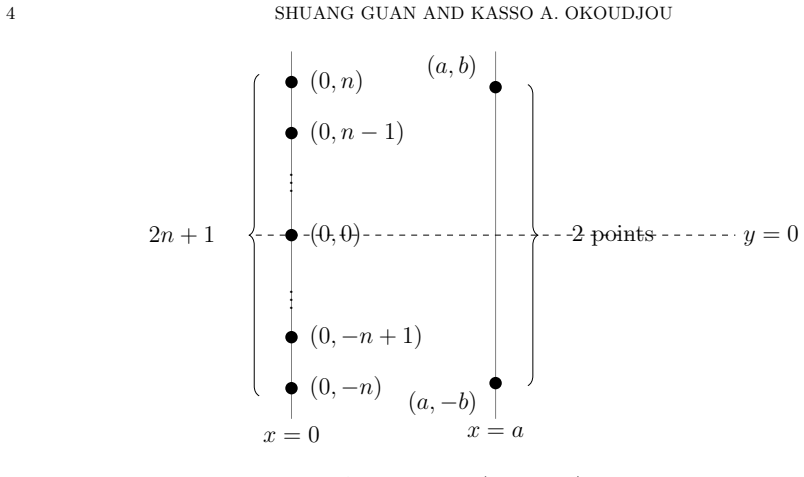
For every n greater than or equal to 1 and every nonzero g in L2(R), the Gabor system generated by the symmetric configuration Lambda_n = {(0,k) : -n less than or equal to k less than or equal to n} union {(a,b),(a,-b)} with ab not zero is linearly independent. The conclusion remains valid when the collinear set is replaced by any nonempty subset of those frequencies, provided the spacings stay commensurable. When g is real-valued this implies linear independence for every four distinct points in the time-frequency plane.
Load-bearing premise
After factoring the collinear trigonometric polynomial, the product of its absolute values along forward and backward integer orbits stays bounded above and below independently of orbit length on a set of positive measure.
Editorial extensions
If this is right
- The HRT conjecture holds for every symmetric (3,2) configuration and every g in L2(R), closing the cases left open by earlier work.
- Every four-point time-frequency configuration generates an independent Gabor system whenever the window is real-valued.
- The same independence persists after multiplying a real-valued window by a quadratic phase factor.
- Any (m,2) configuration whose collinear frequencies are commensurable reduces to the integer-spaced case already covered.
- The remaining obstruction for general four-point HRT is isolated to the phase of a complex-valued window.
Reading between the lines
- If the same factorization-plus-orbit method can be adapted to unequally spaced collinear points, a large further class of (m,2) configurations would fall.
- The real-valued four-point result suggests that phase cancellation, rather than amplitude decay, is the essential remaining difficulty for complex windows.
- Extension principles already in the literature may now push independence from these symmetric skeletons to nearby non-symmetric configurations without extra decay assumptions.
Editorial analysis
A structured set of objections, weighed in public.
Referee Report
Summary. The paper proves the HRT conjecture for the symmetric (2n+1,2) configurations Λ_n = {(0,k) : −n≤k≤n} ∪ {(a,b),(a,−b)} (ab≠0) for every n≥1 and every nonzero g∈L²(ℝ), and more generally when the collinear frequencies are an arbitrary nonempty commensurable subset of {−n,…,n}. The argument factors the collinear trigonometric polynomial into linear factors in ω=e^{2πiat}, obtains N-independent two-sided product bounds along integer orbits by combining Demeter–Zaharescu estimates (on-circle roots) with Riemann-sum comparisons (off-circle roots), and derives a contradiction to the decay g(t±N)→0 via periodic telescoping or a conjugate-orbit pairing according to the arithmetic of a and v=ab. As a stated consequence, the HRT conjecture is claimed for every four-point configuration when g is real-valued; the body proves this for the normal form {(0,0),(0,1),(s,0),(a,b)} by reducing a hypothetical dependence, via conjugation, to a symmetric (3,2) dependence ruled out by the main theorem.
Significance. The HRT conjecture remains open for general four-point configurations even under strong assumptions on g. Establishing an infinite family of (2n+1,2) configurations for arbitrary L² generators is a genuine advance, and the product-estimate technology (Lemmas 1–2) cleanly extends the Demeter–Zaharescu method beyond linear trigonometric polynomials. The real-valued four-point consequence, even if ultimately restricted to a normal form, is of clear interest and sits naturally with prior (2,2) and (1,3) results. The proofs are explicit, case-divided by arithmetic type, and rely on standard tools (Egorov, continued-fraction convergents, metaplectic invariance, conjugate trick) used in a transparent way.
major comments (2)
- [Abstract; §1; Corollary 1 and its proof] Abstract and Introduction claim the HRT conjecture for every configuration of four distinct points when g is real-valued. Corollary 1 and its proof establish only the specific normal form Λ̃={(0,0),(0,1),(s,0),(a,b)}. The conjugation argument cancels the (s,0) term and produces a symmetric (3,2) dependence, which works for this geometry. A general four-point set Λ need not reduce to this form by time translation and rescaling alone; full symplectic/metaplectic normalization typically destroys real-valuedness of the window, and Λ∪Λ* need not be a configuration covered by Theorem 1. Either supply a reduction that preserves the real-valued hypothesis, or restrict the abstract/intro claims to the normal form actually proved (and to configurations reducible to it without leaving the real category).
- [§2, paragraph after (1); cf. Lemma 3] In §2, after (1), non-vanishing of all c_i,d_j is justified by citing resolved (2,2) and (1,3) cases. For n=1 this is fine. Lemma 3 later handles vanishing for general n, but the n=1 write-up should explicitly note that a vanishing coefficient would collapse to a known independent configuration (or to g=0), so the reader can see that the quadratic P and two-term Q used in Lemma 1 are without loss. A one-sentence cross-reference to Lemma 3 (or a local argument) would close this.
minor comments (6)
- [Title page / headers] Title on p. 1 and running header: “REAL-V ALUED” contains a spurious space (also “V ALUED” in the section title style).
- [§2] §2, line after the definition of S: “holdsuniformly” needs a space; similarly “casen=1” in the opening of §2.
- [§2, Prop. 4 and Lemma 1] Proposition 4 is quoted as giving bounds on products from n=−N to −1 and n=0 to N−1; Lemma 1 uses ranges n=−N…−1 and n=1…N. The boundary-factor adjustment is mentioned for off-circle roots but could be flagged once globally so the range mismatch is not re-checked by the reader in every case.
- [§3.3] In §3.3 Step 1, the integer m is defined by an identity involving t0,t1,n′,v,θ′; a brief remark that m is independent of the orbit index j (so the Q-pairing is exact for all j) would help.
- [Figure 1] Figure 1 is helpful; labelling the two parallel lines explicitly as the supports of the (2n+1)- and 2-point subsets would match the (m,n)-configuration terminology used in the text.
- [References] Reference [17] is dated 2026 and described as a Lean formalization; ensure the citation is stable (arXiv id or DOI) before publication.
Circularity Check
No significant circularity: independent contradiction via new multi-factor product estimates on external Demeter–Zaharescu bounds.
full rationale
This is a pure existence/independence proof in time-frequency analysis. The load-bearing chain is: assume linear dependence → identity gP = T g · Q → factor the collinear trigonometric polynomial P into linear factors in ω = e^{2π i a t} → control each factor’s forward/backward orbit products by Demeter–Zaharescu (on-circle roots, after removing O(δ) exceptional sets) or uniform Riemann-sum comparison (off-circle roots) → obtain N-independent two-sided bounds (Lemmas 1–2) → contradict g(t ± N) → 0 by periodic telescoping, conjugate-orbit pairing, or role-reversed periodicity. Those product estimates and the four arithmetic cases are proved in the manuscript; they do not redefine the HRT statement or fit parameters to the claimed configurations. Citations to Linnell, Demeter–Zaharescu, and Liu are external base cases used only for coefficient non-vanishing and lattice subcases. Self-citations to Okoudjou [15, 16] supply motivation, the already-settled subcases of symmetric (3,2), and the elementary real-valued reduction reproduced in full for Corollary 1; none of them is used as an unverified uniqueness theorem that forces the new lemmas. No self-definitional loop, fitted-input-as-prediction, or renaming of a known empirical pattern appears. Score 0 is appropriate.
Assumptions & free parameters
assumptions (7)
- domain assumption Linnell: finite Gabor systems over lattice subsets (and hence all configurations of size ≤3) are linearly independent in L2.
- domain assumption Demeter–Zaharescu product estimates for |A+B e^{2πi α x}| along orbits of irrational rotations (Props. 3–4 / [6]).
- domain assumption Known HRT for (2,2) configurations and for (1,3) with equally spaced collinear points, used to force all coefficients of P and Q nonzero.
- standard math Metaplectic operators (and time-frequency translations) preserve linear independence of finite Gabor systems; used to normalize configurations to Λ_n and to the four-point normal form.
- standard math Egorov's theorem plus ∫∑_n |g(t+n)|^2 dt < ∞ imply uniform decay g(t±n) o0 on a positive-measure set S avoiding zeros of P,Q.
- standard math Irrational rotation is ergodic / measure-preserving; continued-fraction convergents satisfy the standard approximation and gcd relations used in DZ.
- domain assumption Okoudjou restriction/extension principles and the real-valued reflection argument that turns a four-point dependence into a symmetric (3,2) dependence.
Cite this review
Pith. "Pith review of The HRT Conjecture for Symmetric Configurations and Real-Valued Functions." pith.science (2026). https://pith.science/paper/3D6ZJ4R5
@misc{pith2026260726878,
  author       = {Pith},
  title        = {Pith review of: The HRT Conjecture for Symmetric Configurations and Real-Valued Functions},
  year         = {2026},
  howpublished = {\url{https://pith.science/paper/3D6ZJ4R5}},
  note         = {Machine review of arXiv:2607.26878}
}
abstract
The Heil-Ramanathan-Topiwala (HRT) conjecture asserts that every finite collection of distinct time-frequency shifts of a nonzero square-integrable function is linearly independent. Despite its simple formulation, the conjecture remains open even under strong regularity and decay assumptions on the generating function, and in particular for general configurations of four distinct points. In this paper, we establish the HRT conjecture for an infinite family of symmetric $(2n+1,2)$ configurations and arbitrary functions in $L^2(\mathbb{R})$. More generally, our argument applies whenever the collinear points have commensurable spacings. As a consequence, we prove the HRT conjecture for every configuration of four distinct points when the generating function is real-valued. The proof combines a reduction to products of trigonometric polynomials with estimates along orbits of irrational rotations.
Figures
Forward citations
Cited by 1 Pith paper
-
The Minimum Cardinality of a Dependent Finite Gabor System Is Four
Four time-frequency shifts of a nonzero Schwartz function can be linearly dependent, and no smaller number can, so the minimum cardinality of a dependent Gabor system is exactly 4.
Reference graph
Works this paper leans on
-
[1]
Antezana, J
J. Antezana, J. Bruna, and E. Pujals,Linear independence of time-frequency translates inL p spaces, Journal of Fourier Analysis and Applications26(2020), no. 4, 63
2020
-
[2]
J. J. Benedetto and A. Bourouihiya,Linear independence of finite Gabor systems determined by behavior at infinity, Journal of Geometric Analysis25(2015), no. 1, 226–254
2015
-
[3]
Bownik and D
M. Bownik and D. Speegle,Linear independence of time–frequency translates of functions with faster than exponential decay, Bulletin of the London Mathematical Society45(2013), no. 3, 554–566
2013
-
[4]
Currey and V
B. Currey and V. Oussa,Translates of functions on the Heisenberg group and the HRT conjecture, Canadian Mathematical Bulletin63(2020), no. 4, 871–881
2020
-
[5]
Demeter,Linear independence of time frequency translates for special configurations, Mathematical research letters17(2010), no
C. Demeter,Linear independence of time frequency translates for special configurations, Mathematical research letters17(2010), no. 4, 761–779
2010
-
[6]
Demeter and A
C. Demeter and A. Zaharescu,Proof of the HRT conjecture for (2, 2) configurations, Journal of Mathe- matical Analysis and Applications388(2012), no. 1, 151–159
2012
-
[7]
Enstad and J
U. Enstad and J. T. van Velthoven,Linear independence of coherent systems associated to discrete subgroups, Bulletin of the London Mathematical Society57(2025), no. 2, 315–329
2025
-
[8]
Gr¨ ochenig,Foundations of Time-Frequency Analysis, Applied and Numerical Harmonic Analysis, Springer-Birkh¨ auser, New York, 2001
K. Gr¨ ochenig,Foundations of Time-Frequency Analysis, Applied and Numerical Harmonic Analysis, Springer-Birkh¨ auser, New York, 2001
2001
Show all 17 references
-
[9]
Heil,Linear independence of finite Gabor systems, Harmonic Analysis and Applications: In Honor of John J
C. Heil,Linear independence of finite Gabor systems, Harmonic Analysis and Applications: In Honor of John J. Benedetto, Springer, 2006, pp. 171–206
2006
-
[10]
C. Heil, J. Ramanathan, and P. Topiwala,Linear independence of time-frequency translates, Proceedings of the American Mathematical Society124(1996), no. 9, 2787–2795. THE HRT CONJECTURE FOR SYMMETRIC CONFIGURATIONS AND REAL-V ALUED FUNCTIONS 21
1996
-
[11]
Heil and D
C. Heil and D. Speegle,The HRT conjecture and the zero divisor conjecture for the Heisenberg group, Excursions in Harmonic Analysis, Volume 3: The February Fourier Talks at the Norbert Wiener Center, Springer, 2015, pp. 159–176
2015
-
[12]
Kreisel,Linear independence of time-frequency shifts up to extreme dilations, Journal of Fourier Analysis and Applications25(2019), no
M. Kreisel,Linear independence of time-frequency shifts up to extreme dilations, Journal of Fourier Analysis and Applications25(2019), no. 6, 3214–3219
2019
-
[13]
Linnell,Von Neumann algebras and linear independence of translates, Proceedings of the American Mathematical Society127(1999), no
P. Linnell,Von Neumann algebras and linear independence of translates, Proceedings of the American Mathematical Society127(1999), no. 11, 3269–3277
1999
-
[14]
Liu,Proof of the HRT conjecture for almost every (1, 3) configuration, Journal of Fourier Analysis and Applications25(2019), no
W. Liu,Proof of the HRT conjecture for almost every (1, 3) configuration, Journal of Fourier Analysis and Applications25(2019), no. 4, 1350–1360
2019
-
[15]
K. A. Okoudjou,Extension and restriction principles for the HRT conjecture, Journal of Fourier Analysis and Applications25(2019), no. 4, 1874–1901
2019
-
[16]
K. A. Okoudjou and V. Oussa,Letter to the editor: On a special configuration for the HRT conjecture, Journal of Fourier Analysis and Applications31(2025), no. 4, Paper No. 48, 2 pp
2025
-
[17]
Vignon Oussa,Lean-certified four-point HRT results for three lattice points and one off-lattice point, 2026. Department of Mathematics, Tufts University, Medford MA 02155, USA Email address:shuang.guan@tufts.edu Department of Mathematics, Tufts University, Medford MA 02155, US...
2026
Reviewed July 30, 2026 · model on record in the stance chip above.
Discussion (0). Continue with ORCID to comment.