REVIEW 4 major objections 4 minor 6 cited by
The Cosmic Evolution of Fast Radio Bursts Inferred from the CHIME/FRB Baseband Catalog 1
T0 review · 4 major / 4 minor · reviewed 2026-08-10 · deepseek-v4-flash
Pith's one-line read Calibrating the joint DM–fluence distribution of 94 CHIME/FRB baseband bursts yields a Schechter energy function with slope -1.94 and a population in which roughly 31% of fast radio burst sources track star formation.
desk verdict First baseband-based DM-fluence FRB calibration, with a well-constrained energy slope but high-z forecasts that hinge on an under-documented selection function. read the letter →
The pith
A machine-rendered reading of the paper's core claim, the machinery that carries it, and where it could break.
The reading
What carries the argument
The load-bearing object is the product of the theoretical rate function R(z, Fν0) and CHIME's injection-derived detection probability P(SNR|DM, Fν0), which together produce the observable joint DM–fluence distribution. The energy distribution is a Schechter function in specific energy, P(Eν) ∝ (Eν/E_char)^γ exp(-Eν/E_char), supplemented by a power-law spectral energy index α, while redshift evolution enters either as a hybrid star-formation/stellar-mass density track or as a constant delay time. The detection probability function is what converts the 94 observed bursts into a calibrated rate, and it does the heavy lifting in mapping fluence and DM to intrinsic energy and redshift.
What would settle it
Run a much larger injection campaign with synthetic bursts placed densely in the fluence range 0.5 to 5 Jy ms and across high dispersion measures; if the recovered detection probability at 1 Jy ms is substantially higher than the current function, the quoted spectral index and characteristic energy would shift by more than their stated errors and the high-redshift forecasts would need to be revised.
Extended reading notes
Core claim
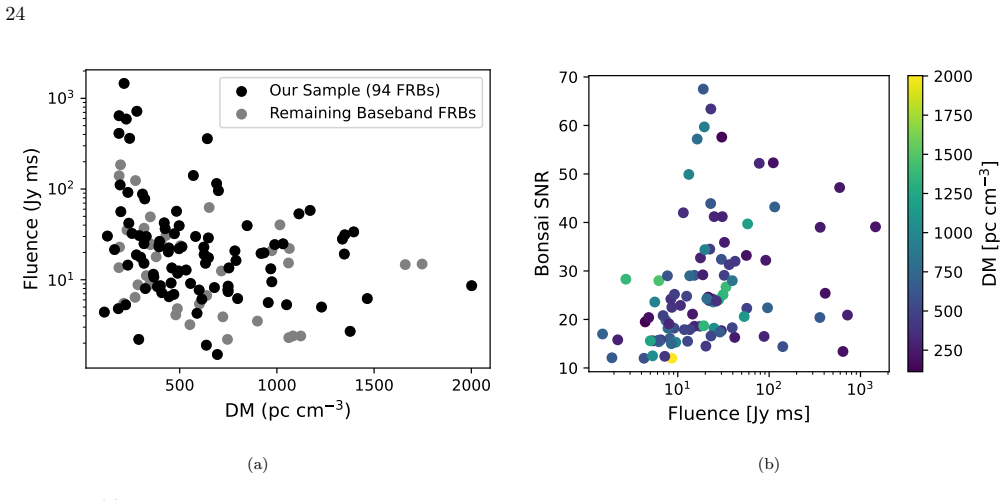
The paper's central discovery is that the joint dispersion-measure–fluence distribution of CHIME/FRB baseband bursts can be calibrated, and that the inferred FRB rate function is described by a Schechter energy distribution with slope γ = -1.94 +0.14 -0.12 and characteristic specific energy E_char ≈ 3×$10^{33}$ erg $Hz^{-1}$ at 600 MHz. With this calibration, it finds that a purely star-formation-tracking population is excluded at >2σ in the hybrid model, with a young-population fraction f_Y = 0.31 +0.31 -0.21; the comparable constant-delay model gives a median delay time of 1.94 +1.54 -1.31 Gyr. Extrapolating with an updated JWST-based cosmic star-formation history, it forecasts that a 200 MHz telescope with system-equivalent flux density ≤ 0.07 Jy and sky coverage ≥ 400 square degrees should detect 630 +730 -485 FRBs per year at z ≥ 6 and 53 +83 -43 per year at z ≥ 8, enough to distinguish between reionization histories.
Load-bearing premise
The entire calibration rests on the assumption that CHIME's injection-derived detection probability, as a function of fluence and dispersion measure, correctly describes how likely the telescope is to catch a burst, especially at fluences below about 2 Jy ms where that function is steepest and least sampled.
Editorial extensions
If this is right
- The FRB energy distribution is consistent with one steep power law with an exponential cutoff, so future surveys can predict their yields using γ ≈ -2 and E_char ≈ 3×10^33 erg Hz^-1.
- A purely star-formation-tracking FRB population is disfavored, while hybrid or delayed channels are favored, meaning some FRB progenitors form long after their host galaxy's star formation.
- None of the currently planned next-generation radio telescopes is expected to catch FRBs from the epoch of reionization; the farthest likely detection is around z ≈ 5.
- A 200 MHz telescope with SEFD ≤ 0.07 Jy and ≥ 400 square degrees of sky coverage should detect hundreds of FRBs per year at z ≥ 6 and tens per year at z ≥ 8, enough to discriminate between fast and slow reionization histories.
- The calibrated all-sky FRB rate above 5 Jy ms is about 552 per day, consistent with earlier Catalog 1 estimates despite the new fluence measurement system.
Reading between the lines
- If a future injection campaign revises the steep low-fluence slope of the detection probability function, the inferred spectral index α and characteristic energy E_char would shift; the high-redshift telescope forecasts, which depend on α, are therefore less stable than the locally measured energy slope.
- The paper's comparison with hyperactive repeaters, whose energy distributions break near 10^30 erg Hz^-1, implies that apparently non-repeating FRBs and hyperactive repeaters may not share the same energy law; a larger sample of repeaters could settle this.
- Because a top-heavy IMF at high redshift would produce more neutron-star progenitors than the assumed star-formation history, the quoted OpTel detection rates are more plausibly conservative lower limits than upper limits.
- The inferred delay times suggest that FRB host galaxies should transition from mostly star-forming to mostly quiescent across z ≈ 0.3–1; this is testable with the growing sample of localized FRB hosts.
Editorial analysis
A structured set of objections, weighed in public.
Referee Report
Summary. The paper calibrates the joint DM-fluence distribution of 94 CHIME/FRB baseband bursts, fitting a Schechter energy function with slope γ = -1.94^{+0.14}_{-0.12}, a characteristic energy E_char ≈ 3×10^33 erg Hz^{-1}, and a spectral index α ≈ -2.9, under two redshift-evolution models: an SFR-SMD hybrid yielding f_Y = 0.31^{+0.31}_{-0.21}, and a constant-delay-time model yielding τ = 1.94^{+1.54}_{-1.31} Gyr. The authors use this calibration to update the cosmic SFRD to z ≈ 14 with JWST data and to forecast detection rates for next-generation telescopes, most notably 630^{+730}_{-485} FRBs yr^{-1} at z ≳ 6 and 53^{+83}_{-43} yr^{-1} at z ≳ 8 for an EoR-optimized 200 MHz telescope. The analysis is an unbinned MCMC fit with publicly released code, and the paper is unusually transparent about its robustness tests, particularly in Section 6.4.
Significance. If the inferred energy distribution and redshift evolution are reliable, this is a substantial step: it is the first calibration of the joint DM-fluence distribution using accurate baseband fluences, and it provides concrete, falsifiable predictions for upcoming radio facilities. The paper is commendable for releasing code and data products, for using an unbinned likelihood that avoids binning losses, and for explicitly testing the sensitivity of its results to the observation function and DM models rather than hiding them. The central results, however, rest on a privately provided CHIME injection-based observation function whose plausible variants shift all model parameters by more than 1σ, so the headline high-redshift forecasts must be viewed as conditional on that function being correct.
major comments (4)
- [Section 6.4, Eqs. (10) and (33)] The paper's own robustness test shows that replacing P(SNR|DM, Fν0) with a linear function in log-log space changes all parameters by more than 1σ for both the SSH and CDT models, and that modifying the slope of the observation function near 1 Jy ms moves the spectral index α from approximately -2.9 to -1.6. Because α and E_char,ν enter the energy conversion in Eq. (10) and the high-redshift rate forecasts in Eq. (33), the headline rates of 630 FRBs yr^{-1} at z≳6 and 53 yr^{-1} at z≳8 are not stable against the largest uncalibrated input in the pipeline. The authors are transparent about this test, but the test itself demonstrates that the parameter posteriors are not yet pinned down independently of the assumed selection function. I would ask for either an independent validation of the observation function, a marginalization over its uncertainty, or a substantial caveat on the forecast numbers.
- [Appendix D, Eq. (D5)] The baseband survey duration Δt_base = 65.8 days is not a measured uptime but is inferred from the ratio of high-quality burst counts between the baseband system and the CHIME/FRB pipeline, with an assumed efficiency η_base = 0.46. This quantity enters directly into the volumetric rate Φ0 through Eq. (32), so any error in Δt_base propagates linearly into all absolute rate predictions, including the all-sky rate and the OpTel forecasts. The paper does not provide an uncertainty on Δt_base or quantify how the result would change if the operational-efficiency assumptions are varied; this should be added to the robustness discussion.
- [Section 2.1, Table 1] The high-redshift UVLF fits impose Gaussian priors on β at z~10.5 and on both β and M* at z~12.5, with the prior medians fixed to the posteriors of the lower-redshift bins. This assumes no evolution of these parameters across the bins, which is a strong assumption for the z~12.5 universe. These parameters feed into the SFRD in Eq. (5) and hence into ψ*(z) in Eqs. (23) and (24), directly affecting the high-redshift FRB forecasts in Section 5.1. The paper should either test the sensitivity of the final FRB predictions to this prior assumption or provide explicit justification that the assumed priors are conservative.
- [Section 4.5] The observation function P(SNR|DM, Fν0) is the cornerstone of the calibration, but it is described as a private CHIME injection product, smoothed with nearest-value interpolation and SmoothBivariateSpline because the raw injected events have holes and poor sampling at low fluence. The specific functional form, the grid resolution, and the smoothing parameters are not fully specified in the paper, making the analysis difficult to reproduce independently. Given the demonstrated sensitivity in Section 6.4, I strongly recommend that the authors release the observation function itself (or a detailed machine-readable description) as part of the paper's data products.
minor comments (4)
- [Title and Abstract] There is a typo in the title: 'F ast' should be 'Fast'. The same spacing issue appears in Appendix F: 'F AST' should be 'FAST'.
- [Section 2.2, Eq. (5)] The piecewise SFRD expression uses '10−0.257z−0.275'; it is unclear whether the base-10 exponent is intended as log10 or as a power of 10 with a sign convention that could be misread. Please clarify the notation, e.g., by writing 10^{(-0.257z-0.275)}.
- [References] The reference list uses inconsistent capitalization for the CHIME/FRB Collaboration: 'CHIME/FRB Collaboration' in some entries and 'Chime/Frb Collaboration' in others (e.g., the 2023 baseband catalog). Please standardize.
- [Section 5, Figure 5 caption] The caption of Figure 5(b) is dense and difficult to parse. In particular, the description of the green lines ('without this effect accounted for') and the indigo lines ('CHIME observation function calibrated evolution') would benefit from a clearer distinction between the model predictions and the CHIME-selection-calibrated curves.
Circularity Check
No circular derivation: energy/evolution parameters are fitted to external CHIME baseband data, and future-telescope rates are extrapolations rather than identities.
full rationale
The derivation chain is self-contained under the circularity criteria. The joint DM-fluence likelihood (Eqs. 25-31) combines an external CHIME injection observation function P(SNR|DM,Fnu0), external DM component models (NE2001, Macquart et al. 2020, Jaroszynski 2019, Mo et al. 2023), and an externally compiled SFRD. The Schechter energy-distribution parameters and fY/tau are estimated by MCMC from the 94 baseband bursts, not assumed. The volumetric rate Phi0 is fixed by sample normalization (Eq. 32) and is explicitly presented as a calibration, with the all-sky rate comparison to Catalog 1 flagged as a consistency check rather than an independent prediction. The high-redshift OpTel forecasts are extrapolations of the fitted model through Eq. (33) and Appendix F; they inherit sensitivity to the observation function and SFRD, but this is a calibration-dependence limitation, not an identity. Section 6.4 is transparent that changing the observation function shifts parameters by more than 1 sigma, which argues for caution but does not make any step circular by construction. Self-citations to Beniamini et al. (2021) and Finkelstein & Bagley (2022) supply external published inputs; they do not define the target quantities or forbid alternatives. No reduction of a predicted quantity to a fitted input, and no load-bearing self-citation chain, is present.
Assumptions & free parameters
free parameters (9)
- gamma (Schechter slope) =
-1.94 +0.14 -0.12 (SSH); -1.97 +0.14 -0.12 (CDT)
- E_char,nu (characteristic energy) =
log10 = 33.45 +1.07 -0.67 (SSH); 33.78 +1.04 -0.70 (CDT)
- alpha (SED index) =
-2.89 +1.23 -1.61 (SSH); -3.65 +1.36 -1.55 (CDT)
- fY (SFR-tracking fraction) =
0.31 +0.31 -0.21
- tau (constant delay time) =
1.94 +1.54 -1.31 Gyr
- E_pivot,nu =
1e30 erg/Hz
- Delta t_base (baseband survey duration) =
65.8 days
- SFRD piecewise parameters =
0.015, 2.73, 6.24; 10^(-0.257 z - 0.275)
- UVLF DPL parameters at z~9, 10.5, 12.5 =
Table 1 values
assumptions (9)
- domain assumption FRB energy distribution is a truncated Schechter function that does not evolve with redshift (Eq. 6, Sec. 4.1).
- domain assumption A single power-law statistical SED with constant alpha relates specific energies at different frequencies (Eq. 9).
- domain assumption Observed DM is a sum of independent MW-ISM, MW-halo, IGM, and host components, with MW-halo fixed at 50 pc/cm3 (Eqs. 13-14).
- domain assumption IGM DM scatter follows Jaroszynski (2019) moments through a sinh-arcsinh family (Appendix C).
- domain assumption Host galaxy DM distribution and evolution are taken from Illustris-TNG fits in Mo et al. (2023) (Eq. 20).
- domain assumption Redshift evolution of FRB sources is either a hybrid SFR-SMD mixture or a constant delay relative to SFR (Eqs. 23-24).
- domain assumption No IMF evolution at z>0 and Salpeter IMF kappa_UV applies for SFRD estimates (Sec. 2.1, Sec. 6.1).
- ad hoc to paper High-z UVLF fits impose Gaussian priors on beta and M* assuming no evolution from lower bins (Table 1, Sec. 2.1).
- ad hoc to paper Baseband survey duration is inferred from CHIME pipeline burst-count ratio rather than measured uptime (Appendix D).
Cite this review
Pith. "Pith review of The Cosmic Evolution of Fast Radio Bursts Inferred from the CHIME/FRB Baseband Catalog 1." pith.science (2026). https://pith.science/paper/3DJWZFQ5
@misc{pith2026250109810,
  author       = {Pith},
  title        = {Pith review of: The Cosmic Evolution of Fast Radio Bursts Inferred from the CHIME/FRB Baseband Catalog 1},
  year         = {2026},
  howpublished = {\url{https://pith.science/paper/3DJWZFQ5}},
  note         = {Machine review of arXiv:2501.09810}
}
abstract
Redshift and luminosity distributions are essential for understanding the cosmic evolution of extragalactic objects and phenomena, such as galaxies, gamma-ray bursts, and fast radio bursts (FRBs). For FRBs, these distributions are primarily estimated using the fluence and the Dispersion Measure (DM). Calibrating their joint distribution has been challenging due to a lack of accurate fluences in the intensity data of the CHIME/FRB survey. Using the baseband update of CHIME/FRB Catalog 1, we calibrate the 2D fluence-DM distribution for the first time. We find the energy distribution is described well by a Schechter function with power-law slope of $-1.94^{+0.14}_{-0.12}$. Testing two types of redshift evolution models suggests a likely combination of young and old formation channels. $31^{+31}_{-21}$% of FRB sources may track star formation, or correspondingly, FRB sources may have delay times of $1.94^{+1.54}_{-1.31}$ Gyr. A pure star formation tracking population is excluded by only one model at $> 2\sigma$ confidence. An updated cosmic star formation rate density evolution up to redshift 14 is constrained by compiling results from several JWST studies. The furthest FRB detection with planned radio facilities is expected to be at $z \approx 5$. A radio telescope operating at 200 MHz with a system-equivalent flux density of $\leq 0.07$ Jy (equivalent to a detection threshold of 1 mJy ms) and instantaneous sky coverage of $\gtrsim 400$ square degrees should be able to detect $630^{+730}_{-485}$ FRBs year$^{-1}$ at $z \gtrsim 6$ and $53^{+83}_{-43}$ FRBs year$^{-1}$ at $z\gtrsim 8$, which is sufficient to differentiate between reionization histories.
Figures


Figures from the paper (8 more)




Forward citations
Cited by 6 Pith papers
-
Can repeating and non-repeating FRBs be drawn from the same population?
FRB sources follow a Zipf-like inverse relation between number density and burst rate, and a single power-law population with index a≈1.1-1.3 can explain the observed repeater fraction, the SGR count ratio, and the cl...
-
The role of the galaxy stellar mass function in determining the cosmological distribution of astrophysical transients with applications to fast radio bursts and merging binary black holes
Using the galaxy stellar mass function weighted by observed FRB host masses lowers the relevant stellar-mass density by ~3x, boosting the implied FRB formation efficiency and biasing standard population-inference results.
-
A Unified Volumetric Rate-Energy Relation from Magnetar Radio Bursts to Fast Radio Bursts
The volumetric rate of radio bursts from magnetar SGR 1935+2154, repeating FRB 20180916B, and non-repeating CHIME FRBs follows a single power law R ∝ E^-1.31 from 10^29 to 10^42 erg.
-
Constraining the Faint-End Slope of the FRB Energy Function Using CHIME/FRB Catalog-1 and Local Volume Galaxies
No CHIME/FRB Catalog-1 burst is associated with 495 local volume galaxies, yielding a 95% upper limit gamma < 2.3 on the faint-end slope of the FRB energy function down to ~3e34 erg.
-
The Northern Cross Fast Radio Burst project: V. Search for transient radio emission from Galactic magnetars
A 560-hour radio campaign on seven Galactic magnetars found no transient pulses, setting a rate upper limit of less than 52 events per year above 10^28 erg and narrowing the parameter space for magnetar-powered FRB models.
-
Constraints on fast radio burst population from the first CHIME/FRB catalog with the Hierarchical Bayesian Inference
Hierarchical Bayesian analysis of CHIME/FRB Catalog 1 yields an FRB redshift distribution delayed relative to the cosmic star formation history.
Reference graph
Works this paper leans on
-
[1]
Adams, N. J., Conselice, C. J., Austin, D., et al. 2024, ApJ, 965, 169, doi: 10.3847/1538-4357/ad2a7b
-
[2]
Alibay, F., Sindiy, O. V., Jansma, P. A. T., et al. 2023, in 2023 IEEE Aerospace Conference, 1–18, doi: 10.1109/AERO55745.2023.10115793
arXiv 2023
-
[3]
Arcus, W. R., James, C. W., Ekers, R. D., et al. 2024, arXiv e-prints, arXiv:2408.09351, doi: 10.48550/arXiv.2408.09351 Astropy Collaboration, Robitaille, T. P., Tollerud, E. J., et al. 2013, A&A, 558, A33, doi: 10.1051/0004-6361/201322068 Astropy Collaboration, Price-Whelan, A. M., Sip˝ ocz, B. M., et al. 2018, AJ, 156, 123, doi: 10.3847/1538-3881/aabc4f...
-
[4]
The role of magnetic and rotation axis alignment in driving fast radio burst phenomenology
Beniamini, P., & Kumar, P. 2024, arXiv e-prints, arXiv:2410.19043, doi: 10.48550/arXiv.2410.19043
work page Pith review arXiv doi:10.48550/arxiv.2410.19043 2024
-
[5]
2021, MNRAS, 502, 5134, doi: 10.1093/mnras/stab309
Beniamini, P., Kumar, P., Ma, X., & Quataert, E. 2021, MNRAS, 502, 5134, doi: 10.1093/mnras/stab309
-
[6]
2023, MNRAS, 520, 1872, doi: 10.1093/mnras/stad208
Beniamini, P., Wadiasingh, Z., Hare, J., et al. 2023, MNRAS, 520, 1872, doi: 10.1093/mnras/stad208
-
[7]
Beniamini, P., Wadiasingh, Z., & Metzger, B. D. 2020, MNRAS, 496, 3390, doi: 10.1093/mnras/staa1783
-
[8]
2024a, arXiv e-prints, arXiv:2408.01876, doi: 10.48550/arXiv.2408.01876
Bhardwaj, M., Lee, J., & Ji, K. 2024a, arXiv e-prints, arXiv:2408.01876, doi: 10.48550/arXiv.2408.01876
Show all 127 references
-
[9]
M., Kaspi, V
Bhardwaj, M., Gaensler, B. M., Kaspi, V. M., et al. 2021, ApJL, 910, L18, doi: 10.3847/2041-8213/abeaa6
2021 doi
-
[10]
Y., et al
Bhardwaj, M., Michilli, D., Kirichenko, A. Y., et al. 2024b, ApJL, 971, L51, doi: 10.3847/2041-8213/ad64d1
-
[11]
Bhattacharya, M., Kumar, P., & Linder, E. V. 2021, PhRvD, 103, 103526, doi: 10.1103/PhysRevD.103.103526
2021 doi
-
[12]
2023, MNRAS, 522, 3349, doi: 10.1093/mnras/stad458
Bhattacharyya, S., Bharadwaj, S., Tiwari, H., & Majumdar, S. 2023, MNRAS, 522, 3349, doi: 10.1093/mnras/stad458
2023 doi
-
[13]
D., Ravi, V., Belov, K
Bochenek, C. D., Ravi, V., Belov, K. V., et al. 2020, Nature, 587, 59, doi: 10.1038/s41586-020-2872-x
2020 doi
-
[14]
J., Illingworth, G
Bouwens, R. J., Illingworth, G. D., Oesch, P. A., et al. 2014, ApJ, 793, 115, doi: 10.1088/0004-637X/793/2/115
2014 doi
-
[15]
J., Oesch, P
Bouwens, R. J., Oesch, P. A., Stefanon, M., et al. 2021, AJ, 162, 47, doi: 10.3847/1538-3881/abf83e
2021 doi
-
[16]
J., Stefanon, M., Brammer, G., et al
Bouwens, R. J., Stefanon, M., Brammer, G., et al. 2023, MNRAS, 523, 1036, doi: 10.1093/mnras/stad1145
2023 doi
-
[17]
Bowler, R. A. A., Jarvis, M. J., Dunlop, J. S., et al. 2020, MNRAS, 493, 2059, doi: 10.1093/mnras/staa313
2020 doi
- [18]
-
[19]
Bromm, V., & Larson, R. B. 2004, ARA&A, 42, 79, doi: 10.1146/annurev.astro.42.053102.134034
2004
-
[20]
S., & Conselice, C
Bundy, K., Ellis, R. S., & Conselice, C. J. 2005, ApJ, 625, 621, doi: 10.1086/429549
2005 doi
-
[21]
Caleb, M., Flynn, C., & Stappers, B. W. 2019, MNRAS, 485, 2281, doi: 10.1093/mnras/stz571
2019 doi
-
[22]
C., Leja, J., Johnson, B
Carnall, A. C., Leja, J., Johnson, B. D., et al. 2019, ApJ, 873, 44, doi: 10.3847/1538-4357/ab04a2
2019 doi
-
[23]
M., Akins, H
Casey, C. M., Akins, H. B., Shuntov, M., et al. 2024, ApJ, 965, 98, doi: 10.3847/1538-4357/ad2075
2024 doi
-
[24]
2023, ApJL, 948, L14, doi: 10.3847/2041-8213/accea5
Castellano, M., Fontana, A., Treu, T., et al. 2023, ApJL, 948, L14, doi: 10.3847/2041-8213/accea5
2023 doi
-
[25]
Cen, R., & Ostriker, J. P. 2006, ApJ, 650, 560, doi: 10.1086/506505
2006 doi
-
[26]
J., et al
Chemerynska, I., Atek, H., Furtak, L. J., et al. 2024, MNRAS, 531, 2615, doi: 10.1093/mnras/stae1260
2024 doi
-
[27]
H., Jia, X
Chen, J. H., Jia, X. D., Dong, X. F., & Wang, F. Y. 2024, ApJL, 973, L54, doi: 10.3847/2041-8213/ad7b39 CHIME/FRB Collaboration, Andersen, B. C., Bandura, K. M., et al. 2020, Nature, 587, 54, doi: 10.1038/s41586-020-2863-y 28 CHIME/FRB Collaboration, Amiri, M., Andersen, B. C....
2024 doi
-
[28]
L., Boylan-Kolchin, M., et al
Chworowsky, K., Finkelstein, S. L., Boylan-Kolchin, M., et al. 2024, AJ, 168, 113, doi: 10.3847/1538-3881/ad57c1
2024 doi
-
[29]
2023, MNRAS, 521, 4024, doi: 10.1093/mnras/stad667
Connor, L., & Ravi, V. 2023, MNRAS, 521, 4024, doi: 10.1093/mnras/stad667
2023 doi
-
[30]
M., Bhardwaj, M., Gaensler, B
Cook, A. M., Bhardwaj, M., Gaensler, B. M., et al. 2023, ApJ, 946, 58, doi: 10.3847/1538-4357/acbbd0
2023 doi
-
[31]
J., Gupta, O., Wadiasingh, Z., et al
Cooper, A. J., Gupta, O., Wadiasingh, Z., et al. 2023, MNRAS, 519, 3923, doi: 10.1093/mnras/stac3580
2023 doi
- [32]
-
[33]
M., & McLaughlin, M
Cordes, J. M., & McLaughlin, M. A. 2003, ApJ, 596, 1142, doi: 10.1086/378231
2003 doi
-
[34]
M., & Wasserman, I
Cordes, J. M., & Wasserman, I. 2016, MNRAS, 457, 232, doi: 10.1093/mnras/stv2948
2016 doi
-
[35]
2025, arXiv e-prints, arXiv:2502.19138
Cui, X., James, C., Li, D., & Zhang, C. 2025, arXiv e-prints, arXiv:2502.19138. https://arxiv.org/abs/2502.19138
2025 arXiv
- [36]
-
[37]
2021, JCAP, 2021, 050, doi: 10.1088/1475-7516/2021/05/050
Dai, J.-P., & Xia, J.-Q. 2021, JCAP, 2021, 050, doi: 10.1088/1475-7516/2021/05/050
2021 doi
-
[38]
G., Wang, J
Dai, Z. G., Wang, J. S., Wu, X. F., & Huang, Y. F. 2016, ApJ, 829, 27, doi: 10.3847/0004-637X/829/1/27
2016 doi
-
[39]
T., McLeod, D
Donnan, C. T., McLeod, D. J., McLure, R. J., et al. 2023a, MNRAS, 520, 4554, doi: 10.1093/mnras/stad471
-
[40]
T., McLeod, D
Donnan, C. T., McLeod, D. J., Dunlop, J. S., et al. 2023b, MNRAS, 518, 6011, doi: 10.1093/mnras/stac3472
- [41]
-
[42]
L., & Bagley, M
Finkelstein, S. L., & Bagley, M. B. 2022, ApJ, 938, 25, doi: 10.3847/1538-4357/ac89eb
2022 doi
-
[43]
L., Bagley, M
Finkelstein, S. L., Bagley, M. B., Ferguson, H. C., et al. 2023, ApJL, 946, L13, doi: 10.3847/2041-8213/acade4
2023 doi
-
[44]
L., Leung, G
Finkelstein, S. L., Leung, G. C. K., Bagley, M. B., et al. 2024, ApJL, 969, L2, doi: 10.3847/2041-8213/ad4495
2024 doi
-
[45]
2016, The Journal of Open Source Software, 1, 24, doi: 10.21105/joss.00024
Foreman-Mackey, D. 2016, The Journal of Open Source Software, 1, 24, doi: 10.21105/joss.00024
2016 doi
-
[46]
W., Lang, D., & Goodman, J
Foreman-Mackey, D., Hogg, D. W., Lang, D., & Goodman, J. 2013, PASP, 125, 306, doi: 10.1086/670067
2013 doi
-
[47]
B., Casey, C
Franco, M., Akins, H. B., Casey, C. M., et al. 2024, ApJ, 973, 23, doi: 10.3847/1538-4357/ad5e6a
2024 doi
-
[48]
J., & Peebles, P
Fukugita, M., Hogan, C. J., & Peebles, P. J. E. 1998, ApJ, 503, 518, doi: 10.1086/306025
1998 doi
-
[49]
Fukugita, M., & Peebles, P. J. E. 2004, ApJ, 616, 643, doi: 10.1086/425155
2004 doi
-
[50]
Gajjar, V., Siemion, A. P. V., Price, D. C., et al. 2018, ApJ, 863, 2, doi: 10.3847/1538-4357/aad005
2018 doi
-
[51]
W., van Leeuwen, J., Connor, L., & Petroff, E
Gardenier, D. W., van Leeuwen, J., Connor, L., & Petroff, E. 2019, A&A, 632, A125, doi: 10.1051/0004-6361/201936404
2019 doi
-
[52]
2022, ApJ, 932, 10, doi: 10.3847/1538-4357/ac6e43
Ghirlanda, G., & Salvaterra, R. 2022, ApJ, 932, 10, doi: 10.3847/1538-4357/ac6e43
2022 doi
- [53]
-
[54]
C., Fong, W.-f., Kilpatrick, C
Gordon, A. C., Fong, W.-f., Kilpatrick, C. D., et al. 2023, ApJ, 954, 80, doi: 10.3847/1538-4357/ace5aa
2023 doi
-
[55]
2021, MNRAS, 501, 3825, doi: 10.1093/mnras/staa3963
Hackstein, S., Br¨ uggen, M., & Vazza, F. 2021, MNRAS, 501, 3825, doi: 10.1093/mnras/staa3963
2021 doi
- [56]
-
[57]
2023, ApJS, 265, 5, doi: 10.3847/1538-4365/acaaa9
Harikane, Y., Ouchi, M., Oguri, M., et al. 2023, ApJS, 265, 5, doi: 10.3847/1538-4365/acaaa9
2023 doi
-
[58]
H., et al
Hashimoto, T., Goto, T., Chen, B. H., et al. 2022, MNRAS, 511, 1961, doi: 10.1093/mnras/stac065
2022 doi
-
[59]
S., Fialkov, A., & Lorimer, D
Heimersheim, S., Sartorio, N. S., Fialkov, A., & Lorimer, D. R. 2022, ApJ, 933, 57, doi: 10.3847/1538-4357/ac70c9
2022 doi
-
[60]
W., Prochaska, J
James, C. W., Prochaska, J. X., Macquart, J. P., et al. 2022a, MNRAS, 510, L18, doi: 10.1093/mnrasl/slab117 —. 2022b, MNRAS, 509, 4775, doi: 10.1093/mnras/stab3051
-
[61]
2019, MNRAS, 484, 1637, doi: 10.1093/mnras/sty3529 Jaroszy´ nski, M
Jaroszynski, M. 2019, MNRAS, 484, 1637, doi: 10.1093/mnras/sty3529 Jaroszy´ nski, M. 2020, AcA, 70, 87, doi: 10.32023/0001-5237/70.2.1
2019 doi
-
[62]
C., & Pewsey, A
Jones, M. C., & Pewsey, A. 2009, Biometrika, 96, 761, doi: 10.1093/biomet/asp053
2009 doi
-
[63]
Katz, J. I. 2017, MNRAS, 469, L39, doi: 10.1093/mnrasl/slx052
2017 doi
-
[64]
P., Jenkins, M., et al
Kirsten, F., Snelders, M. P., Jenkins, M., et al. 2021, Nature Astronomy, 5, 414, doi: 10.1038/s41550-020-01246-3
2021 doi
-
[65]
2022, Nature, 602, 585, doi: 10.1038/s41586-021-04354-w
Kirsten, F., Marcote, B., Nimmo, K., et al. 2022, Nature, 602, 585, doi: 10.1038/s41586-021-04354-w
2022 doi
-
[66]
S., Herrmann, W., et al
Kirsten, F., Ould-Boukattine, O. S., Herrmann, W., et al. 2024, Nature Astronomy, 8, 337, doi: 10.1038/s41550-023-02153-z
2024 doi
-
[67]
C., Hewitt, D
Konijn, D. C., Hewitt, D. M., Hessels, J. W. T., et al. 2024, arXiv e-prints, arXiv:2407.10155, doi: 10.48550/arXiv.2407.10155
2024 doi
-
[68]
2020, MNRAS, 494, 2385, doi: 10.1093/mnras/staa774 29
Kumar, P., & Boˇ snjak,ˇZ. 2020, MNRAS, 494, 2385, doi: 10.1093/mnras/staa774 29
2020 doi
-
[69]
2017, MNRAS, 468, 2726, doi: 10.1093/mnras/stx665 Labb´ e, I., van Dokkum, P., Nelson, E., et al
Kumar, P., Lu, W., & Bhattacharya, M. 2017, MNRAS, 468, 2726, doi: 10.1093/mnras/stx665 Labb´ e, I., van Dokkum, P., Nelson, E., et al. 2023, Nature, 616, 266, doi: 10.1038/s41586-023-05786-2
2017 doi
-
[70]
J., Sharma, K., Ravi, V., et al
Law, C. J., Sharma, K., Ravi, V., et al. 2024, ApJ, 967, 29, doi: 10.3847/1538-4357/ad3736
2024 doi
-
[71]
Leung, G. C. K., Bagley, M. B., Finkelstein, S. L., et al. 2023, ApJL, 954, L46, doi: 10.3847/2041-8213/acf365
2023 doi
- [72]
- [73]
-
[74]
2022, PASP, 134, 094106, doi: 10.1088/1538-3873/ac8f71
Lin, H.-H., Lin, K.-y., Li, C.-T., et al. 2022, PASP, 134, 094106, doi: 10.1088/1538-3873/ac8f71
2022 doi
-
[75]
2024, ApJ, 962, 73, doi: 10.3847/1538-4357/ad1b4f
Lin, H.-N., & Zou, R. 2024, ApJ, 962, 73, doi: 10.3847/1538-4357/ad1b4f
2024 doi
-
[76]
R., & Kramer, M
Lorimer, D. R., & Kramer, M. 2012, Handbook of Pulsar Astronomy (Cambridge University Press)
2012
-
[77]
2022, MNRAS, 510, 1867, doi: 10.1093/mnras/stab3500
Lu, W., Beniamini, P., & Kumar, P. 2022, MNRAS, 510, 1867, doi: 10.1093/mnras/stab3500
2022 doi
-
[78]
2020, MNRAS, 498, 1397, doi: 10.1093/mnras/staa2450
Lu, W., Kumar, P., & Zhang, B. 2020, MNRAS, 498, 1397, doi: 10.1093/mnras/staa2450
2020 doi
-
[79]
Lu, W., & Piro, A. L. 2019, ApJ, 883, 40, doi: 10.3847/1538-4357/ab3796
2019 doi
-
[80]
2020, MNRAS, 494, 665, doi: 10.1093/mnras/staa704
Luo, R., Men, Y., Lee, K., et al. 2020, MNRAS, 494, 665, doi: 10.1093/mnras/staa704
2020 doi
-
[81]
P., Shannon, R
Macquart, J. P., Shannon, R. M., Bannister, K. W., et al. 2019, ApJL, 872, L19, doi: 10.3847/2041-8213/ab03d6
2019 doi
-
[82]
P., Prochaska, J
Macquart, J. P., Prochaska, J. X., McQuinn, M., et al. 2020, Nature, 581, 391, doi: 10.1038/s41586-020-2300-2
2020 doi
-
[83]
2014, ARA&A, 52, 415, doi: 10.1146/annurev-astro-081811-125615
Madau, P., & Dickinson, M. 2014, ARA&A, 52, 415, doi: 10.1146/annurev-astro-081811-125615
2014 doi
-
[84]
J., McLure, R
McLeod, D. J., McLure, R. J., & Dunlop, J. S. 2016, MNRAS, 459, 3812, doi: 10.1093/mnras/stw904
2016 doi
-
[85]
J., Donnan, C
McLeod, D. J., Donnan, C. T., McLure, R. J., et al. 2024, MNRAS, 527, 5004, doi: 10.1093/mnras/stad3471
2024 doi
-
[86]
J., Dunlop, J
McLure, R. J., Dunlop, J. S., Bowler, R. A. A., et al. 2013, MNRAS, 432, 2696, doi: 10.1093/mnras/stt627
2013 doi
-
[87]
2014, ApJL, 780, L33, doi: 10.1088/2041-8205/780/2/L33 —
McQuinn, M. 2014, ApJL, 780, L33, doi: 10.1088/2041-8205/780/2/L33 —. 2016, ARA&A, 54, 313, doi: 10.1146/annurev-astro-082214-122355
2014 doi
-
[88]
2012, A&A, 545, A96, doi: 10.1051/0004-6361/201219364
Melinder, J., Dahlen, T., Menc ´ ıa Trinchant, L., et al. 2012, A&A, 545, A96, doi: 10.1051/0004-6361/201219364
2012 doi
-
[89]
P., Shin, K., et al
Merryfield, M., Tendulkar, S. P., Shin, K., et al. 2023, AJ, 165, 152, doi: 10.3847/1538-3881/ac9ab5
2023 doi
-
[90]
R., Heckman, T
Meurer, G. R., Heckman, T. M., & Calzetti, D. 1999, ApJ, 521, 64, doi: 10.1086/307523
1999 doi
-
[91]
2023, ApJ, 950, 134, doi: 10.3847/1538-4357/accf89
Michilli, D., Bhardwaj, M., Brar, C., et al. 2023, ApJ, 950, 134, doi: 10.3847/1538-4357/accf89
2023 doi
-
[92]
2023, MNRAS, 518, 539, doi: 10.1093/mnras/stac3104
Mo, J.-F., Zhu, W., Wang, Y., Tang, L., & Feng, L.-L. 2023, MNRAS, 518, 539, doi: 10.1093/mnras/stac3104
2023 doi
-
[93]
2018, ApJ, 867, 150, doi: 10.3847/1538-4357/aae68c
Morishita, T., Trenti, M., Stiavelli, M., et al. 2018, ApJ, 867, 150, doi: 10.3847/1538-4357/aae68c
2018 doi
-
[94]
P., Oesch, P
Naidu, R. P., Oesch, P. A., van Dokkum, P., et al. 2022, ApJL, 940, L14, doi: 10.3847/2041-8213/ac9b22
2022 doi
-
[95]
2018, Nature, 558, 406, doi: 10.1038/s41586-018-0204-1
Nicastro, F., Kaastra, J., Krongold, Y., et al. 2018, Nature, 558, 406, doi: 10.1038/s41586-018-0204-1
2018 doi
-
[96]
H., Aggarwal, K., Li, D., et al
Niu, C. H., Aggarwal, K., Li, D., et al. 2022, Nature, 606, 873, doi: 10.1038/s41586-022-04755-5
2022 doi
-
[97]
A., Bouwens, R
Oesch, P. A., Bouwens, R. J., Illingworth, G. D., Labb´ e, I., & Stefanon, M. 2018, ApJ, 855, 105, doi: 10.3847/1538-4357/aab03f
2018 doi
-
[98]
A., Carollo, C
Oesch, P. A., Carollo, C. M., Feldmann, R., et al. 2010, ApJL, 714, L47, doi: 10.1088/2041-8205/714/1/L47
2010 doi
-
[99]
S., Chawla, P., Hessels, J
Ould-Boukattine, O. S., Chawla, P., Hessels, J. W. T., et al. 2024, arXiv e-prints, arXiv:2410.17024, doi: 10.48550/arXiv.2410.17024
2024 doi
-
[100]
2021, MNRAS, 505, 2195, doi: 10.1093/mnras/stab1438 Particle Data Group, Zyla, P
Pagano, M., & Fronenberg, H. 2021, MNRAS, 505, 2195, doi: 10.1093/mnras/stab1438 Particle Data Group, Zyla, P. A., Barnett, R. M., et al. 2020, Progress of Theoretical and Experimental Physics, 2020, 083C01, doi: 10.1093/ptep/ptaa104 P´ erez-Gonz´ alez, P. G., Costantin, L., L...
2021 doi
-
[101]
A., Fremling, C., Sollerman, J., et al
Perley, D. A., Fremling, C., Sollerman, J., et al. 2020, ApJ, 904, 35, doi: 10.3847/1538-4357/abbd98 Planck Collaboration, Aghanim, N., Akrami, Y., et al. 2020, A&A, 641, A6, doi: 10.1051/0004-6361/201833910
2020 doi
-
[102]
G., et al
Pleunis, Z., Michilli, D., Bassa, C. G., et al. 2021, ApJL, 911, L3, doi: 10.3847/2041-8213/abec72
2021 doi
- [103]
-
[104]
X., Simha, S., Heintz, K
Prochaska, J. X., Simha, S., Heintz, K. E., et al. 2023, FRB: Fast Radio Burst calculations, estimations, and analysis, Astrophysics Source Code Library, record ascl:2306.018
2023
-
[105]
2022, JCAP, 2022, 040, doi: 10.1088/1475-7516/2022/01/040
Qiang, D.-C., Li, S.-L., & Wei, H. 2022, JCAP, 2022, 040, doi: 10.1088/1475-7516/2022/01/040
2022 doi
- [106]
-
[107]
D., Tacchella, S., et al
Robertson, B., Johnson, B. D., Tacchella, S., et al. 2024, ApJ, 970, 31, doi: 10.3847/1538-4357/ad463d
2024 doi
-
[108]
Santoliquido, F., Mapelli, M., Giacobbo, N., Bouffanais, Y., & Artale, M. C. 2021, MNRAS, 502, 4877, doi: 10.1093/mnras/stab280
2021 doi
- [109]
- [110]
-
[111]
2024, arXiv e-prints, arXiv:2409.03255, doi: 10.48550/arXiv.2409.03255
Kumar, P. 2024, arXiv e-prints, arXiv:2409.03255, doi: 10.48550/arXiv.2409.03255
2024 doi
-
[112]
W., Bhardwaj, M., et al
Shin, K., Masui, K. W., Bhardwaj, M., et al. 2023, ApJ, 944, 105, doi: 10.3847/1538-4357/acaf06
2023 doi
-
[113]
Speagle, J. S. 2020, MNRAS, 493, 3132, doi: 10.1093/mnras/staa278
2020 doi
-
[114]
J., et al
Stefanon, M., Labb´ e, I., Bouwens, R. J., et al. 2019, ApJ, 883, 99, doi: 10.3847/1538-4357/ab3792
2019 doi
-
[115]
T., Yuan, F.-T., Ikeyama, A., Murata, K
Takeuchi, T. T., Yuan, F.-T., Ikeyama, A., Murata, K. L., & Inoue, A. K. 2012, ApJ, 755, 144, doi: 10.1088/0004-637X/755/2/144
2012 doi
-
[116]
2023, Chinese Physics C, 47, 085105, doi: 10.1088/1674-1137/acda1c
Tang, L., Lin, H.-N., & Li, X. 2023, Chinese Physics C, 47, 085105, doi: 10.1088/1674-1137/acda1c
2023 doi
- [117]
-
[118]
2019, in Canadian Long Range Plan for Astronomy and Astrophysics White Papers, Vol
Vanderlinde, K., Liu, A., Gaensler, B., et al. 2019, in Canadian Long Range Plan for Astronomy and Astrophysics White Papers, Vol. 2020, 28, doi: 10.5281/zenodo.3765414
2019 doi
-
[119]
J., Desprez, G., Asada, Y., et al
Willott, C. J., Desprez, G., Asada, Y., et al. 2024, ApJ, 966, 74, doi: 10.3847/1538-4357/ad35bc
2024 doi
-
[120]
2023, Universe, 9, 330, doi: 10.3390/universe9070330
Xu, J., Feng, Y., Li, D., et al. 2023, Universe, 9, 330, doi: 10.3390/universe9070330
2023 doi
-
[121]
B., Wu, Q., & Wang, F
Yang, K. B., Wu, Q., & Wang, F. Y. 2022, ApJL, 940, L29, doi: 10.3847/2041-8213/aca145
2022 doi
-
[122]
M., Manchester, R
Yao, J. M., Manchester, R. N., & Wang, N. 2017, ApJ, 835, 29, doi: 10.3847/1538-4357/835/1/29
2017 doi
- [123]
-
[124]
C., & Zhang, B
Zhang, R. C., & Zhang, B. 2022, ApJL, 924, L14, doi: 10.3847/2041-8213/ac46ad
2022 doi
-
[125]
C., Zhang, B., Li, Y., & Lorimer, D
Zhang, R. C., Zhang, B., Li, Y., & Lorimer, D. R. 2021a, MNRAS, 501, 157, doi: 10.1093/mnras/staa3537
-
[126]
2022, Research in Astronomy and Astrophysics, 22, 124002, doi: 10.1088/1674-4527/ac98f7
Zhang, Y.-K., Wang, P., Feng, Y., et al. 2022, Research in Astronomy and Astrophysics, 22, 124002, doi: 10.1088/1674-4527/ac98f7
2022 doi
-
[127]
J., Yan, K., Li, C
Zhang, Z. J., Yan, K., Li, C. M., Zhang, G. Q., & Wang, F. Y. 2021b, ApJ, 906, 49, doi: 10.3847/1538-4357/abceb9
Reviewed August 10, 2026 · model on record in the stance chip above.
Discussion (0). Continue with ORCID to comment.