REVIEW 3 minor
Granular Instrumental Variables in Large Panels: Identification and Inference Across Strong, Nearly Weak, and Weak GIV
T0 review · 0 major / 3 minor · reviewed 2026-07-03 · grok-4.3
Pith's one-line read The GIV estimator is consistent and asymptotically normal at the √T rate when a few units dominate the aggregate, but only at slower rates or inconsistent when they do not.
desk verdict The paper gives a usable trichotomy for GIV strength in large N,T panels based on dominance, with matching rates and first-stage variance adjustment. read the letter →
The pith
A machine-rendered reading of the paper's core claim, the machinery that carries it, and where it could break.
The reading
What carries the argument
Granular Instrumental Variables (GIV) whose strength is determined by the presence and degree of dominant units in the aggregate.
What would settle it
A Monte Carlo experiment or empirical panel in which all units have comparable size, showing that the GIV point estimate fails to converge to the true parameter or that Wald intervals have incorrect coverage.
Extended reading notes
Core claim
When a few units dominate the aggregate, the GIV estimator is consistent and asymptotically normal at the standard √T rate. When large units stand out but do not dominate, the estimator remains consistent and asymptotically normal at a slower rate. When units are comparable in size, the estimator is inconsistent with a non-standard distribution. Wald inference is reliable only outside the weak regime. When the instrument is weak, Anderson-Rubin confidence sets are recommended. The feasible estimator attains the same rate but its asymptotic variance includes an additional term from the first-stage estimation.
Load-bearing premise
The classification of panels into strong, nearly weak, and weak regimes according to the relative sizes of units in the aggregate correctly governs the asymptotic behavior of the estimator.
Editorial extensions
If this is right
- The parameter of interest remains recoverable in the nearly weak regime despite slower convergence than √T.
- Standard errors for the feasible GIV estimator must incorporate the extra variability from constructing the instrument in a first stage.
- Anderson-Rubin confidence sets maintain validity in the weak-instrument regime where Wald inference does not.
- The same three-regime analysis applies when recovering short-run demand elasticities for commodities such as refined copper, crude oil, and natural gas.
Reading between the lines
- Dominance diagnostics could be used in practice to select between standard errors and Anderson-Rubin sets before estimation.
- The regime framework may extend to other aggregate instruments or to settings with time-varying dominance.
- Researchers studying cross-sectional dependence in macro panels could test for the presence of the nearly weak regime to interpret reported convergence rates.
Signed reviews
Editorial analysis
A structured set of objections, weighed in public.
Referee Report
Summary. The manuscript develops the asymptotic theory of Granular Instrumental Variables (GIV) in large N,T panels. It formalizes dominance of units in the aggregate and characterizes three regimes of instrument strength: strong (a few units dominate, yielding consistency and asymptotic normality at the √T rate), nearly weak (large units stand out but do not dominate, yielding consistency and asymptotic normality at a slower rate), and weak (units comparable in size, yielding inconsistency and a non-standard limiting distribution). The paper shows that Wald inference is reliable only outside the weak regime and recommends Anderson-Rubin confidence sets when the instrument is weak; it also derives the asymptotic behavior of the feasible two-step estimator that accounts for first-stage construction of the instrument and applies the corrected procedure to short-run demand elasticities for refined copper, crude oil, and natural gas.
Significance. If the derivations hold, the paper supplies a practically relevant extension of IV asymptotics to the granular setting that is common in macro and industrial-organization panels. The explicit trichotomy of regimes, together with the feasible-estimator correction and the recommendation for Anderson-Rubin sets, gives applied researchers concrete guidance on when standard errors are valid and when they are not. The three-commodity application demonstrates that the corrected GIV procedure can be implemented on real data.
minor comments (3)
- [Abstract] The abstract states that the feasible estimator 'attains the same rate' as the infeasible one but does not restate the precise rate (e.g., T^{1/3} or T^{2/5}) that applies in the nearly-weak regime; adding this sentence would improve readability.
- [Section 2] Section 2 (or wherever the dominance measure is introduced) would benefit from an explicit statement of the normalization used for the size vector s_i so that readers can immediately verify whether the three regimes are exhaustive and mutually exclusive.
- [Empirical application] In the empirical application, the paper reports point estimates and standard errors but does not show the first-stage F-statistic or the estimated dominance measure for each commodity; adding these diagnostics would help readers assess which regime applies in practice.
Simulated Author's Rebuttal
We thank the referee for the careful and accurate summary of our manuscript, as well as for the positive assessment of its significance and practical relevance. The recommendation of minor revision is noted. No specific major comments were raised in the report.
Circularity Check
No significant circularity; derivation self-contained from stated assumptions
full rationale
The paper derives the trichotomy of instrument strength regimes (strong, nearly weak, weak) and the associated rates of consistency/asymptotic normality directly from formal definitions of dominance in large N,T panels and the construction of the GIV instrument. No step reduces a target parameter to a fitted quantity by construction, renames a known result, or relies on a load-bearing self-citation whose content is unverified. The central claims follow from the model's assumptions without circular reduction, consistent with the reader's assessment of score 2.0 as minor at most.
Assumptions & free parameters
assumptions (1)
- domain assumption Standard panel data assumptions for identification and asymptotics of instrumental variables estimators, including relevance and exogeneity conditions adapted to the granular setting.
Cite this review
Pith. "Pith review of Granular Instrumental Variables in Large Panels: Identification and Inference Across Strong, Nearly Weak, and Weak GIV." pith.science (2026). https://pith.science/paper/3DQZR2O5
@misc{pith2026260702095,
  author       = {Pith},
  title        = {Pith review of: Granular Instrumental Variables in Large Panels: Identification and Inference Across Strong, Nearly Weak, and Weak GIV},
  year         = {2026},
  howpublished = {\url{https://pith.science/paper/3DQZR2O5}},
  note         = {Machine review of arXiv:2607.02095}
}
abstract
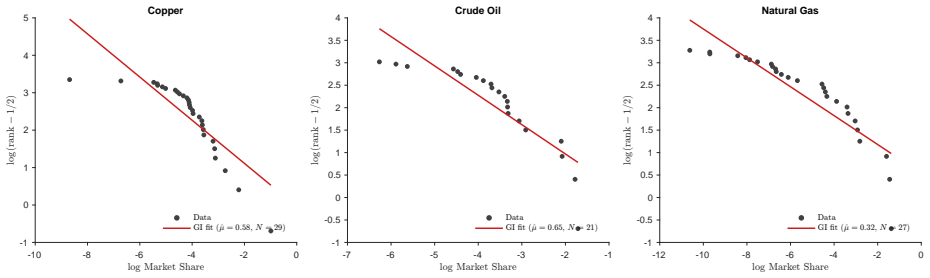
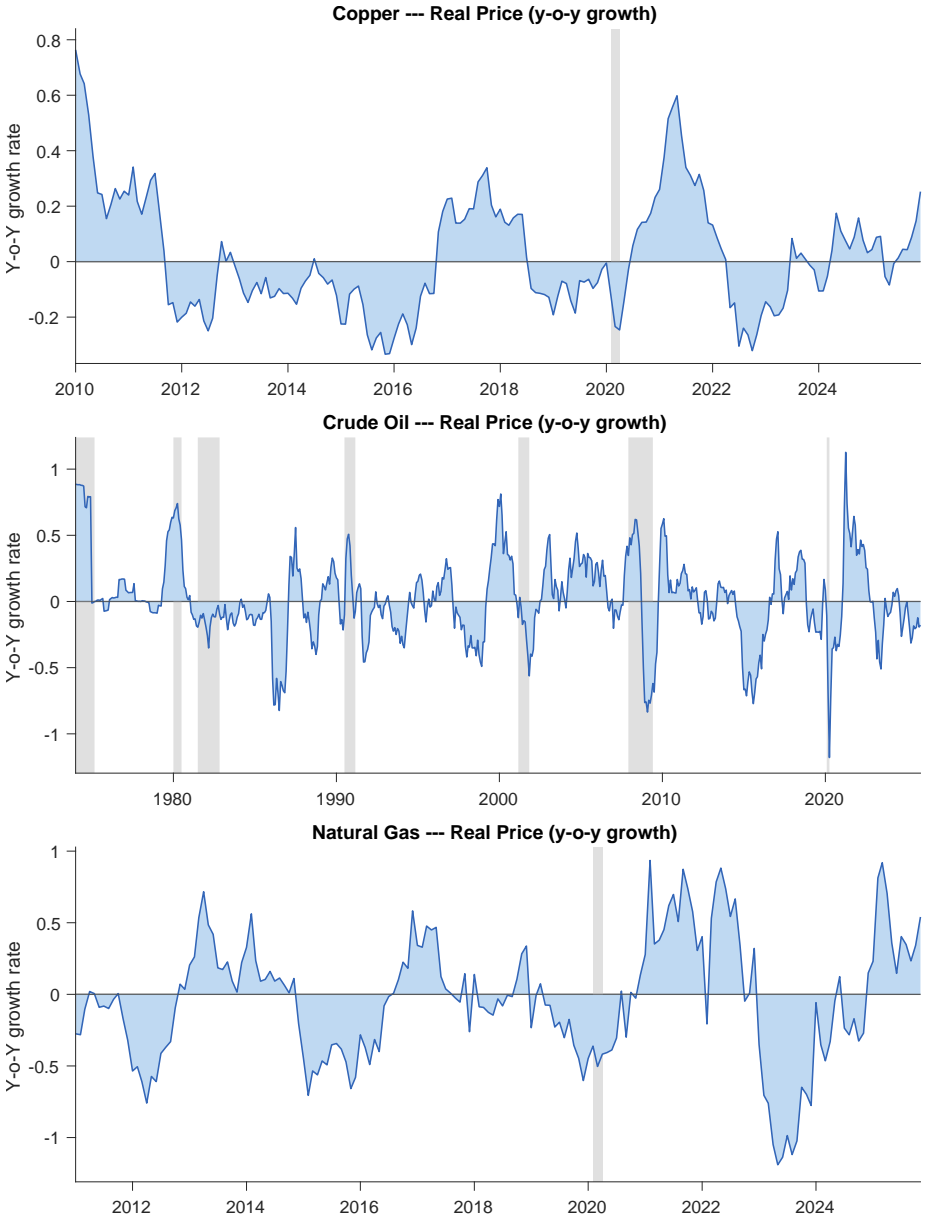
I develop the asymptotic theory for Granular Instrumental Variables (GIV) in large panels with both $N$ and $T$ growing. The strength of the GIV depends on the presence of dominant units with large shares. I find three regimes. First, when a few units dominate the aggregate, the instrument is strong. The GIV estimator is consistent and asymptotically normal at the standard $\sqrt{T}$ rate. Second, when large units stand out but do not dominate, the instrument weakens. But if the sample size ($T$) is larger than the cross-section ($N$), then the GIV estimator remains consistent and asymptotically normal, now at a rate slower than $\sqrt{T}$. Finally, when units are comparable in size and none stands out, the instrument is weak in the standard sense. Here the relative growth of $T$ and $N$ decides the outcome. If $N$ grows in proportion to $T$, the GIV estimator is inconsistent and has a non-standard distribution. Across all three regimes, the first-stage construction of the GIV changes the second-stage asymptotic variance. It replaces the structural error with its factor-residualised version. The correction has no determinate sign. Wald inference with the corrected variance is valid in the first two regimes. In the third I recommend a first-stage-corrected Anderson--Rubin test. Applying this theory to data, I find that copper and natural gas markets fall into the strong-instrument regime while crude oil is in the nearly weak regime, and I recover the short-run demand and supply elasticities of these commodities. Across the six elasticities the correction moves standard errors by up to a fifth, in both directions.
Figures
Reviewed July 3, 2026 · model on record in the stance chip above.
Discussion (0). Continue with ORCID to comment.