REVIEW 2 major objections 4 minor 20 references
A model field theory with $(\psi \ln \psi)^2$ potential: Kinks with super-exponential profiles
T0 review · 2 major / 4 minor · reviewed 2026-08-14 · deepseek-v4-flash
Pith's one-line read A (1+1)-dimensional scalar field theory with potential $(\psi\ln\psi)^2$ has exact asymmetric kink solutions of the form $\psi=\mp\exp(-\exp(\pm x))$, the first kinks with super-exponential tails, and they are linearly stable.
desk verdict New exact kinks with super-exponential tails, but the printed stability operator has a factor-of-two error and the collision claims are not backed by simulation. read the letter →
The pith
A machine-rendered reading of the paper's core claim, the machinery that carries it, and where it could break.
The reading
What carries the argument
The load-bearing machinery is the first-order reduction $\psi_y=\pm\psi\ln\psi$ and its double-exponential integrals, $\psi=\mp\exp(-\exp(\pm y))$. This reduction turns the second-order field equation into a solvable ODE and turns the fluctuation operator into a Morse-like potential with known spectral properties. The resulting profile is recognized as the Gumbel distribution from extreme-value statistics, and the super-exponential approach to $\psi=0$ is a direct consequence of the divergent curvature $V''(0)$ of the potential at that minimum. The same machinery supplies closed-form energies, the Goldstone wavefunctions $\Psi_0(y)=e^{\pm y}e^{-e^{\pm y}}$, and the topological counting of domain sequences.
What would settle it
Solve the full static second-order equation $-c\psi_{xx}+d\psi\ln\psi(\ln\psi+1)=0$ numerically with boundary conditions approaching the three minima, without imposing the first-order reduction, and check whether any additional finite-energy kink-like solution exists. Also, computing the fluctuation spectrum around $\psi_B(y)$ by direct numerical diagonalization and looking for a negative eigenvalue would test the stability claim; the analytic Morse-potential calculation predicts none.
Extended reading notes
Core claim
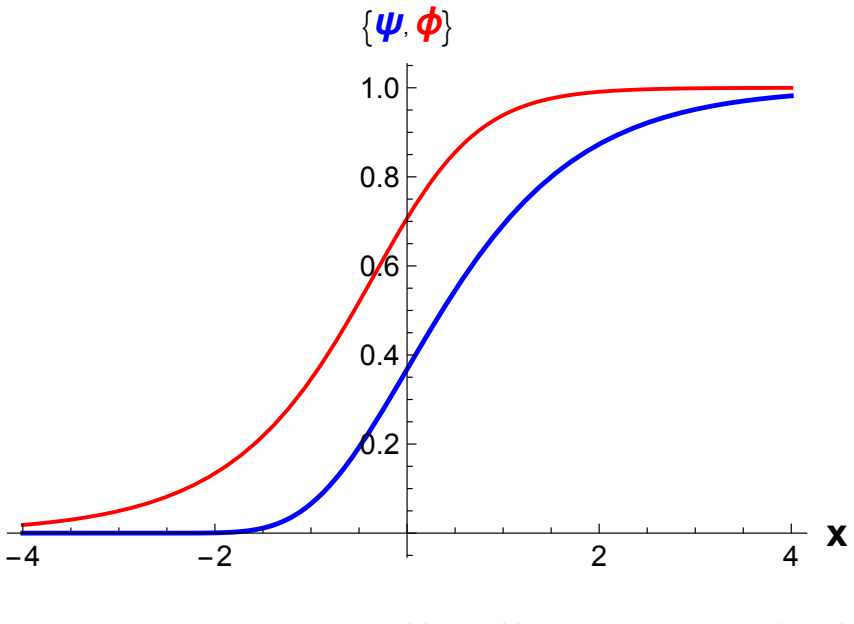
The central discovery is a soluble field theory whose topological kinks are double exponentials: $\psi_A(y)=-\exp(-\exp y)$ connects $-1$ to $0$, and $\psi_B(y)=\exp(-\exp(-y))$ connects $0$ to $1$, with antikinks obtained by reversing $y$. These profiles satisfy the first-order equation $\psi_y=\pm\psi\ln\psi$ obtained after integrating the static Euler-Lagrange equation once, and the same equation yields the linearized fluctuation potentials $2(e^{2y}-3e^y+1)$ and $2(e^{-2y}-3e^{-y}+1)$. Each fluctuation problem has exactly one bound state, the translation mode at $\omega=0$, and a continuum starting at $\omega=1$; all propagating waves are perfectly reflected from the $\psi=0$ side, which is the signature of the divergent curvature $V''(0)$. Topologically the three minima yield six elementary kink configurations whose allowed sequences are restricted, and the interactions between kinks are attractive or repulsive with exponential or super-exponential asymptotics.
Load-bearing premise
The displayed kinks are taken to be all finite-energy static solutions because the paper assumes the integration constant in the first-order reduction is zero, without ruling out static kink solutions that would correspond to a nonzero constant.
Editorial extensions
If this is right
- The model provides closed-form kink profiles, energies, and fluctuation spectra, so numerical solvers for kink-antikink collisions can be checked against exact benchmarks.
- Because the $\psi=0$ domain expels phonons with perfect reflection, the theory acts as a one-sided frequency-gapped barrier for linear waves, a concrete difference from models with regular minima.
- The topological constraints imply that in a one-dimensional chain the only possible infinite domain-wall sequences are those built from the six elementary configurations, giving a finite combinatorial classification of ground states.
- The comparison with $\phi^6$ indicates that the exponential-versus-super-exponential tail difference is controlled by the curvature of the potential at the minimum: finite curvature gives exponential tails, divergent curvature gives super-exponential tails.
- Collisions of certain kink pairs can convert one species into another, and multi-particle conversion beyond two kinks is kinematically allowed but not observed, suggesting hidden selection rules.
Reading between the lines
- An extension the paper leaves implicit is that a small polynomial perturbation of the potential could convert the super-exponential tail into an exponential one; this could be tested by near-identity numerical continuation.
- Because the kink profile is the Gumbel distribution, the same double-exponential form may appear in stochastic field theories where extreme-value statistics govern approach to an absorbing boundary; the paper only notes the distributional identity.
- The perfect reflection of phonons from the $\psi=0$ domain suggests the model could be assembled into a lattice or waveguide where domain walls act as switchable mirrors for linear waves, something the paper does not discuss.
- The reduction to a first-order ODE raises the possibility that higher-dimensional defects, such as domain-wall junctions, are also tractable in this model; this is speculation beyond the paper's one-dimensional setting.
Signed reviews
Editorial analysis
A structured set of objections, weighed in public.
Referee Report
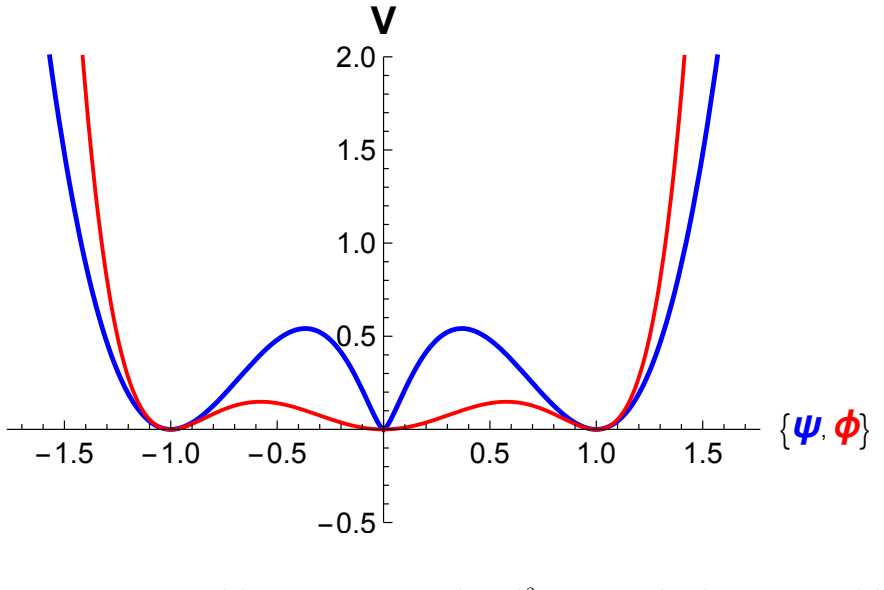
Summary. The manuscript studies a (1+1)-dimensional scalar field theory with potential d(ψ lnψ)^2, which has three degenerate minima at ψ=0 and ψ=±1. The authors construct two families of analytic kink solutions connecting ψ=0 to ψ=-1 or ψ=1, with profiles ψ_A(y)=-exp(-e^y) and ψ_B(y)=exp(-e^{-y}). These profiles are asymmetric: one side has a super-exponential approach to ψ=0 and the other has an exponential approach to ψ=±1. The paper claims that these are the first kink solutions with super-exponential profiles and tails. It then gives a linear stability analysis of the kinks, describes topological restrictions on domain-wall sequences, discusses kink-antikink collisions, and compares the model with the φ6 model and its half-kink. The profile construction is correct and the central mathematical idea is sound; however, the linearized stability equations as printed contain a factor-of-two error that invalidates the displayed zero-mode check. The error is mechanical and correctable, and the corrected equations do support the stability conclusion.
Significance. If the stability calculation is repaired, this is a genuinely useful contribution to the kink literature. The exact kink solutions are parameter-free, analytically derived, and have a novel asymptotic form: super-exponential tails that are not present in the usual polynomial field theories. The topological constraints on domain sequences and the comparison with the φ6 half-kink are valuable and clearly presented. The paper does not rely on fitting or numerical simulation for its main construction, and the central profile equations are verified exactly. The main weakness is the incorrect fluctuation operator in Eqs. (7) and (9); once corrected, the nodeless zero mode restores the stability claim. The collision statements are qualitative and should be labeled as conjectures.
major comments (2)
- [Section 3, Eqs. (7) and (9)] The fluctuation equations as printed are not the linearization of the static equation (4). Linearizing -ψ_yy + ψ lnψ(lnψ+1)=0 around ψ_A gives L_A = -d²/dy² + (e^{2y}-3e^y+1), not -d²/dy² + 2(e^{2y}-3e^y+1). Acting with the printed operator in Eq. (7) on the candidate zero mode Ψ0=e^{y-e^y} yields (e^{2y}-3e^y+1)Ψ0, which is not zero, so Eq. (7) has no zero mode as written. The same factor-of-two error appears in Eq. (9), where the correct fluctuation potential is e^{-2y}-3e^{-y}+1. Once the extra factor is removed, Ψ0 is an exact nodeless eigenfunction at ω=0, which restores the absence of negative eigenvalues. The stability proof must be corrected and the spectral statements re-derived.
- [Section 3, Eqs. (7)-(10)] The statement that the Morse-type potential has 'only one bound state at ω=0' is asserted without derivation. A nodeless zero mode rules out negative eigenvalues, but it does not by itself rule out additional bound states with 0<λ<1. Please provide a proof or an explicit spectral solution, for example by transforming to z=e^y and showing that no L² eigenfunctions exist for 0<λ<1, so that the 'only one bound state' claim and the resulting stability picture are fully supported.
minor comments (4)
- [Section 3, after Eq. (5)] The reported energy EA=f0√cd/(2√2) does not appear to match the stated first-order equation and normalization. Using ψ_y=ψlnψ and the integral ∫0∞ t e^{-2t}dt=1/4, I obtain EA=f0√cd/2; please check the numerical prefactor.
- [Sections 4 and 6] Several collision outcomes, such as conversion between (A,A) and (B,B) pairs, particle-creation thresholds, and forbidden multi-particle events, are described as results without simulations or analytic derivations. If these are conjectures, please mark them as such explicitly.
- [Fig. 1 caption and Section 2] The potential is described as 'smooth' at ψ=0; more precisely, it is C¹ there but not C² because V'' diverges as ψ→0. Please rephrase as 'continuous and C¹' or 'smooth away from ψ=0'.
- [Eq. (3) and Eqs. (7)-(9)] There is a general factor-of-two normalization ambiguity among Eq. (1), Eq. (3), and the fluctuation equations. After correcting Eqs. (7) and (9), please state the convention used for γ, c, and d, or explicitly set c=d=1 after rescaling, so the equations are mutually consistent.
Circularity Check
No circularity: kink profiles and their energies are derived directly from the stated Lagrangian by integration, with no fitted input, no self-referential normalization, and no load-bearing self-citation.
full rationale
The paper's central claims are the kink profiles ψ_A = −exp(−exp(y)) and ψ_B = exp(−exp(−y)) with super-exponential tails, their energies, and their stability. These are obtained from the stated model: integrating the static Euler-Lagrange equation (4) once gives ψ_y = ±ψ lnψ, and the quoted profiles are elementary solutions of that first-order equation. No parameter is fitted to the solutions, no data subset is used to define a prediction, and no external benchmark is required. The comparison with the φ6 model and its half-kink is an independent, external contrast rather than an input to the derivation. The references to the authors' earlier work on higher-order phase transitions [6]-[8] are motivational provenance for the potential, not evidence for the kink solutions or their stability; the kink construction is self-contained in the present manuscript. The stability analysis is presented as a direct linearization of the fluctuation equation, and although the printed coefficient in Eqs. (7) and (9) appears to be internally inconsistent with the stated Goldstone wave functions (a correctness issue, not a circularity issue), a circularity analysis concerns whether results reduce by construction to their inputs. Here the fluctuation operator is derived from the model and the kink profile, not assumed to possess the claimed spectrum. Therefore no pattern of self-definition, fitted-input-as-prediction, self-citation load-bearing, imported uniqueness, ansatz-smuggling, or renaming of a known result is present. A non-finding is appropriate.
Assumptions & free parameters
assumptions (4)
- domain assumption The potential is extended to negative ψ by the definition lnψ = (1/2)ln(ψ²), making V(ψ)=(ψlnψ)² defined for all real ψ.
- domain assumption Finite-energy static kinks satisfy the first-order equation ψ_y = ±ψ ln ψ; the integration constant from the energy integral is set to zero.
- standard math The spectrum of the linearized fluctuation operator determines linear stability, with a nodeless zero mode implying the ground state.
- domain assumption Topological constraints on kink/antikink sequences follow from the minima structure (0, ±1) and the directions of the kinks A, A', B, B'.
Cite this review
Pith. "Pith review of A model field theory with $(\psi \ln \psi)^2$ potential: Kinks with super-exponential profiles." pith.science (2026). https://pith.science/paper/3DTDVXCZ
@misc{pith2026190804978,
  author       = {Pith},
  title        = {Pith review of: A model field theory with $(\psi \ln \psi)^2$ potential: Kinks with super-exponential profiles},
  year         = {2026},
  howpublished = {\url{https://pith.science/paper/3DTDVXCZ}},
  note         = {Machine review of arXiv:1908.04978}
}
abstract
We study a (1+1)-dimensional field theory based on $(\psi \ln \psi)^2$ potential. There are three degenerate minima at $\psi = 0$ and $\psi=\pm1$. There are novel, asymmetric kink solutions of the form $\psi = \mp\exp (-\exp(\pm x))$ connecting the minima at $\psi = 0$ and $\psi = \mp 1$. The domains with $\psi = 0$ repel the linear excitations, the waves (e.g. phonons). Topology restricts the domain sequences and therefore the ordering of the domain walls. Collisions between domain walls are rich for properties such as transmission of kinks and particle conversion, etc. To our knowledge this is the first example of kinks with super-exponential profiles and super-exponential tails. Finally, we provide a comparison of these results with the $\phi^6$ model and its half-kink solution.
Figures

Figures from the paper (3 more)


Reference graph
Works this paper leans on
-
[1]
Rajaraman, “Solitons and Instantons, Elsevier, Amsterdam, Netherlands (1982)
R. Rajaraman, “Solitons and Instantons, Elsevier, Amsterdam, Netherlands (1982). Basic reference on topological solitons
work page 1982
- [2]
- [3]
-
[4]
Nonlinear Problems: Present and Future
P. Kumar and R. R. Holland in “Nonlinear Problems: Present and Future”, ed. by A. Bishop, D. K. Campbell and B. Nicolaides, North Holland, Amsterdam (1982), p. 229
work page 1982
-
[5]
A. C. Scott, F. Y. F. Chu and D. W. McLaughlin, Proc. IEEE 61, 1443 (1973)
work page 1973
- [6]
-
[7]
A.-K. Farid, Y.-Gang Yu, A. Saxena and P. Kumar, Phys. Rev. B 71, 104509 (2005)
work page 2005
-
[8]
Minimal Nonlinearity and Infinite Order Phase Transition
P. Kumar, A. Khare and A. Saxena, in preparation (2019), “Minimal Nonlinearity and Infinite Order Phase Transition”
work page 2019
Show all 20 references
-
[9]
E. J. Gumbel, Statistics of Extremes, Columbia Univ. Press (1958)
1958
-
[10]
Bargmann, Proc
V. Bargmann, Proc. Nat. Acad. Sci. (USA) 38, 961 (1952), On the number of bound states in a central field of force
1952
-
[11]
Lohe, Phys
M. Lohe, Phys. Rev. D 20, 3120 (1979)
1979
-
[12]
Khare, I
A. Khare, I. C. Christov and A. Saxena, Phys. Rev. E 90, 023208 (2014). 13
2014
-
[13]
N. S. Manton, J. Phys. A 52, 065401 (2019)
2019
-
[14]
I. C. Christov et al., Phys. Rev. Lett. 122, 171601 (2019)
2019
-
[15]
Khare and A
A. Khare and A. Saxena, J. Phys. A 52, 365401 (2019)
2019
-
[16]
S. N. Behera and A. Khare, Pramana 15 (1980) 245
1980
-
[17]
Sanati and A
M. Sanati and A. Saxena, J. Phys. A 32 (1999) 4311
1999
-
[18]
N. S. Manton, Nucl. Phys. B 150, 397 (1979)
1979
-
[19]
Dorey, K
P. Dorey, K. Mersh, T. Romanczukiewicz and Y. Shnir, Phys. Rev. Lett. 107, 091602 (2011)
2011
-
[20]
D. K. Campbell, J. F. Schonfeld, and C. A. Wingate, Physica D 9, 1 (1983). 14
1983
Reviewed August 14, 2026 · model on record in the stance chip above.
Discussion (0). Continue with ORCID to comment.