REVIEW 2 major objections 6 minor 17 references
On the enumeration of double cosets and self-inverse double cosets
T0 review · 2 major / 6 minor · reviewed 2026-08-07 · deepseek-v4-flash
Pith's one-line read For any finite group G and subgroup H, the number of self-inverse double cosets in H\G/H equals (1/|H|) times the sum over the conjugacy classes C_i of G of |H∩C_i|·Sq(C_i).
desk verdict A genuinely useful reformulation of Frame's double-coset count with new computational machinery for GL_n and type B; minor proof gaps, but the central theorem is sound and the paper deserves a serious referee. read the letter →
The pith
A machine-rendered reading of the paper's core claim, the machinery that carries it, and where it could break.
The reading
What carries the argument
The machinery is the square-root counting function $\mathrm{Sq}(C_i)$ together with class-intersection data $|H\cap C_i|$. For the symmetric group, conjugacy classes are cycle types $\lambda$ and the paper gives the explicit formula $\mathrm{Sq}(C_\lambda)$ from Equation (3.2), while $|H\cap C_\lambda|$ is encoded in the cycle index $Z_H(x_1,x_2,\dots)$. For $\mathrm{GL}_n(\mathbb{F}_q)$, conjugacy classes are parametrized by functions $f$ from irreducible monic polynomials to partitions; the centralizer size $z_f$ gives $|C_f|$, and the square of a class is computed by Proposition 3.3, which says a Jordan block $J_k(\rho)$ under squaring becomes $J_k(\rho^2)$ if $q$ is odd and splits into two blocks of sizes $\lceil k/2\rceil$ and $\lfloor k/2\rfloor$ if $q$ is even. These pieces plug directly into Theorem 2.1 and Formula (2.13), turning abstract character data into computable enumerations.
What would settle it
The central formula can be tested directly on a small group by enumerating all double cosets and marking the self-inverse ones, then comparing with the right-hand side of Theorem 2.1; any mismatch refutes it. The even-characteristic GL_n rule can be tested by computing $J_3(1)^2$ over $\mathbb{F}_4$ and checking whether it really has Jordan blocks of sizes $2$ and $1$, or by brute-force square-root counts in $\mathrm{GL}_4(\mathbb{F}_2)$ against the algorithm's output.
Extended reading notes
Core claim
The central claim is Theorem 2.1: if $G$ is a finite group with conjugacy classes $C_1,\dots,C_r$ and $H$ is a subgroup, the number $|\Theta^G_H|$ of self-inverse double cosets in $H\backslash G/H$ is $$\frac{1}{|H|}\sum_{i=1}^r |H\cap C_i|\cdot \mathrm{Sq}(C_i),$$ where $\mathrm{Sq}(C_i)$ is the number of square roots in $G$ of any element of $C_i$. The proof passes through the identity $|\Theta^G_H| = \frac{1}{|H|}\sum_{h\in H} |\{g\in G : g^2=h\}|$, so the count is literally a sum over elements of $H$ of square-root counts. The paper also gives the companion formula $|H_1\backslash G/H_2| = \frac{1}{|H_1||H_2|}\sum_i \frac{|G|}{|C_i|}|H_1\cap C_i||H_2\cap C_i|$, and then computes the three ingredients $|C_i|$, $\mathrm{Sq}(C_i)$, and $|H\cap C_i|$ for $S_n$ and $\mathrm{GL}_n(\mathbb{F}_q)$. The result is a computational route for enumerating self-inverse double cosets from class data alone.
Load-bearing premise
The load-bearing premise is a linear-algebra fact about matrices over fields with $q$ even: squaring a $k\times k$ Jordan block produces two Jordan blocks of sizes $\lceil k/2\rceil$ and $\lfloor k/2\rfloor$; the general-linear-group square-root algorithm and all its applications depend on this fact.
Editorial extensions
If this is right
- For any finite group where conjugacy classes and square-root counts are known, Theorem 2.1 gives $|\Theta^G_H|$ from $|H\cap C_i|$ alone, without computing irreducible characters or Frobenius-Schur indicators.
- In the symmetric group, the formula yields the generating function (3.3) for the sum of character table entries, and new values of sequences for parabolic double cosets without computing Kostka numbers.
- For cycles and polygons, Propositions 4.1 and 4.2 count self-inverse objects up to $Z_n$ and $D_n$ symmetry, and Proposition 4.3 gives the doubling relation $|\Theta^{S_n}_{Z_n}| = 2|\Theta^{S_n}_{D_n}|$ when $n\equiv 3 \pmod 4$.
- For finite fields, the algorithm computes $|P_n\backslash \mathrm{GL}_n(\mathbb{F}_2)/P_n|$ and $|\Theta^{\mathrm{GL}_n(\mathbb{F}_2)}_{P_n}|$ up to $n=9$, and the conjectured polynomiality of $|\mathrm{GL}_\lambda\backslash\mathrm{GL}_n(\mathbb{F}_q)/\mathrm{GL}_\mu|$ is verified by examples such as $q^4+7q^3+32q^2+89q+117$.
Reading between the lines
- Because the proof identifies self-inverse double cosets as exactly those containing an element whose square lies in $H$, one could search for them in large groups by backtracking over elements $g$ with $g^2\in H$, without enumerating conjugacy classes.
- The same sum-over-classes template may apply to other families with known centralizer structures, such as other finite Coxeter groups or classical groups, where a splitting rule analogous to Proposition 3.3 would supply $\mathrm{Sq}(C_i)$.
- The polynomiality conjecture, if true, suggests a hidden algebraic or geometric meaning for these double-coset counts, for instance as Poincaré-type polynomials or Hall-type polynomials; the paper does not pursue that interpretation.
- A testable extension is to seek a closed form for $\mathrm{Sq}(C_f)$ for $\mathrm{GL}_n(\mathbb{F}_q)$ analogous to the symmetric-group formula (3.2), with Proposition 3.3 serving as the core of such a formula.
Editorial analysis
A structured set of objections, weighed in public.
Referee Report
Summary. The paper proves a character-theoretic formula for the number of self-inverse double cosets in H\G/H, namely |Theta^G_H| = (1/|H|) sum_i |H cap C_i| Sq(C_i), where C_i are the conjugacy classes of G and Sq(C_i) is the number of square roots of any element of C_i. The proof is based on Frame's double-coset formula and the Frobenius-Schur indicator, and the paper also shows equivalence with the character-multiplicity form. The remaining sections develop the auxiliary data needed to apply the formula: square-root counts and class-intersection counts for symmetric groups and general linear groups, including a Jordan-block rule for GL_n over even characteristic. These tools are then applied to cycles, polygons, Boolean functions, polytope vertex permutations, parabolic double cosets in symmetric groups and type-B Coxeter groups, and matrices up to row/column permutations or scalar multiplications. The paper also states a conjecture that |GL_lambda \ GL_n / GL_mu| is a monic polynomial in q with positive integer coefficients.
Significance. If the results are correct, Theorem 2.1 is a clean and useful reformulation of the self-inverse double-coset count, and the paper gives a substantial menu of applications with explicit numerical tables. The derivation of the main theorem is self-contained and the equivalence with Frame's character formula is shown. The paper is also honest about the empirical status of Conjecture 4.10, which is checked only up to n=8. The main weakness is not in the central theorem but in one of the applied identities: Equation (4.10) in Section 4.3 is false as written, and the derivation of the subsequent sequence formula depends on it. Since the numerical sequence A068313 appears to be computed from the right-hand side of that false identity, the published values may be correct, but the displayed mathematics needs correction. The paper would also benefit from more detail in Proposition 3.3, on which the GL_n square-root algorithm relies.
major comments (2)
- [4.3, Eq. (4.10)] The displayed identity is false. For n=3 and lambda=mu=(2,1), the left side sum over nu of K_{nu,(2,1)} K_{nu,(2,1)} equals 1^2 + 1^2 = 2, while the right side equals 1, which is also the actual number of (0,1)-matrices with row and column sums (2,1). The preceding sentence correctly says that (0,1)-matrices correspond to pairs of semistandard Young tableaux with conjugate shapes, so the left side should be sum_nu K_{nu,lambda} K_{nu',mu}. The same correction is needed in the left side of Eq. (4.11). The right-hand side of (4.11) appears to give the corrected total, so the table values may be unaffected, but the derivation as printed is invalid.
- [3.2, Proposition 3.3] The rule for q odd needs to specify that irreducible factors are counted with multiplicity and that the partitions attached to all roots of phi mapping to the same factor must be merged. For example, over F_3, phi=X^2+1 is irreducible with roots i and -i, and both roots square to -1, so phi^2=(X+1)^2; therefore a class with f(phi)=(2) squares to a class with f^2(X+1)=(2,2), not (2). As written, 'f^2 maps each irreducible factor of phi^2 to lambda' is ambiguous and, if read as referring to distinct factors only, gives incorrect values for Sq(C_f) in the GL_n algorithm of Section 3.2.
minor comments (6)
- [2, Proof of Theorem 2.1] The passage from Eq. (2.8) to Eq. (2.10) skips the intermediate identity |{g : g^2 in C_i}| = |C_i| * Sq(C_i); the equality is correct, but stating it explicitly would make the proof easier to follow.
- [3.2, Proposition 3.3] For the even-characteristic case, the displayed matrix is helpful but the similarity transformation to J_{ceil(k/2)}(rho^2) direct-sum J_{floor(k/2)}(rho^2) is not shown; a sentence or a reference to the standard nilpotent-block argument would strengthen the proof.
- [4.6, Proof of Theorem 4.8] The proof states that diagonal matrices with eigenvalue multiplicities lambda belong to (prod(q-i)) * (prod m_k!) conjugacy classes; the count should be (prod(q-i)) / (prod m_k!), as the displayed formula in the theorem requires.
- [Figure 1] The layout of the figure caption and the two mapping displays is garbled in the manuscript: for the GL_7(F_3) example, the displayed 'square' mapping appears to have total degree 15 rather than 7. Please redraw the figure so that each mapping and its square are clearly separated.
- [4.2, Polytope examples] The values for the icosahedron, dodecahedron, 24-cell, 600-cell and 120-cell are stated without any indication of which group and subgroup were used or how the computation was performed; a sentence describing the setup and the source of the numbers would improve reproducibility.
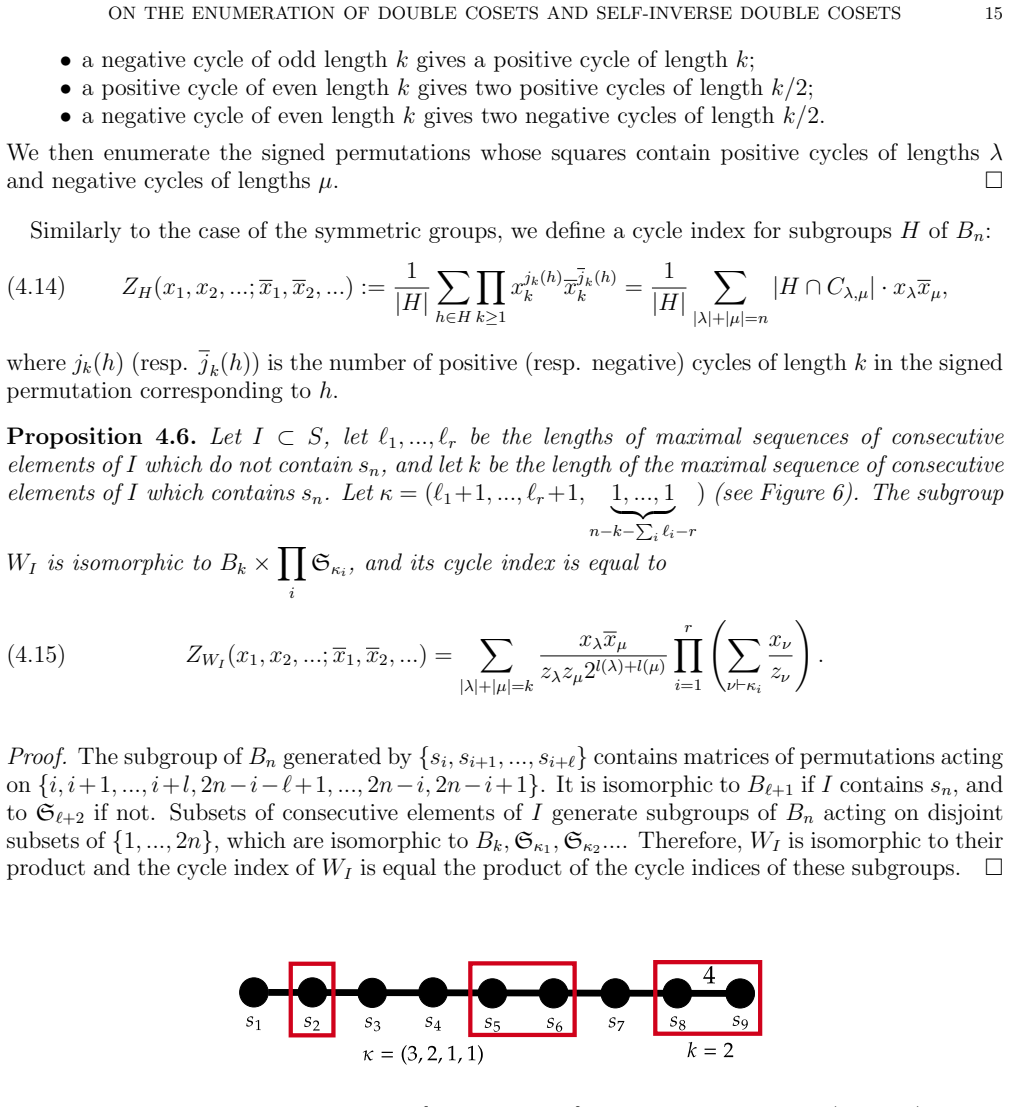
- [4.4, Example after Proposition 4.6] The set I in the numerical example contains the duplicate entry s_4; it should be s_3, s_4, s_6, ... .
Circularity Check
No significant circularity: Theorem 2.1 is proved from Frame's classical formula by explicit double counting and is shown equivalent to the character-theoretic expression; no fitted inputs or load-bearing self-citations appear.
full rationale
The paper's central claim, Theorem 2.1, is derived directly from Frame's fixed-point formula (2.6) by a transparent double-counting argument in (2.8)-(2.10), and the paper then explicitly verifies equivalence with the character-theoretic formula (2.3) via (2.11). No parameter is fitted to data and no input quantity is defined in terms of the target enumeration: Sq(C_i) is the standard number of square roots, and |H ∩ C_i| is computed from cycle-index data. The auxiliary Proposition 3.3 on Jordan blocks in even characteristic is a supporting computational lemma, not a premise of Theorem 2.1, and it is argued from matrix structure rather than assumed. Conjecture 4.10 is explicitly labeled a conjecture checked only up to n=8, not a derived prediction. The paper contains no self-citations, no imported uniqueness theorem, and no renamed known result used as if it were new support. The duplication of Theorem 1.1 and Theorem 2.1 is a presentation artifact only. Accordingly, the derivation chain is self-contained and none of the identified circularity patterns applies.
Assumptions & free parameters
assumptions (4)
- standard math Frame's formula (2.6): |Θ^G_H| = 1/|G| Σ_{g∈G} χ(g^2) where χ is the trace on G/H
- standard math Character decomposition of the permutation representation R_H (Eqs. 2.1-2.3) and the Frobenius-Schur indicator identity (Eqs. 2.4-2.5)
- domain assumption Squaring rule for Jordan blocks over even characteristic (Prop. 3.3): for q even, J_k(ρ)^2 splits as two Jordan blocks of sizes ceil(k/2) and floor(k/2)
- standard math Cycle index formulas for Z_n, D_n, S_λ, GL_λ(F_q), and W_I in type B (Eqs. 3.6-3.8, 3.16, 4.15)
Cite this review
Pith. "Pith review of On the enumeration of double cosets and self-inverse double cosets." pith.science (2026). https://pith.science/paper/3E6SADJI
@misc{pith2026250604007,
  author       = {Pith},
  title        = {Pith review of: On the enumeration of double cosets and self-inverse double cosets},
  year         = {2026},
  howpublished = {\url{https://pith.science/paper/3E6SADJI}},
  note         = {Machine review of arXiv:2506.04007}
}
abstract
Double cosets appear in many contexts in combinatorics, for example in the enumeration of certain objects up to symmetries. Double cosets in a quotient of the form $H\backslash G / H$ have an inverse, and can be their own inverse. In this paper we present various formulas enumerating double cosets, and in particular self-inverse double cosets. We study double cosets in classical groups, especially the symmetric groups and the general linear groups, explaining how to obtain the informations on their conjugacy classes required to apply our formulas. We also consider double cosets of parabolic subgroups of Coxeter groups of type B.
Figures


Figures from the paper (3 more)


Reference graph
Works this paper leans on
-
[1]
How large is the character degree sum compared to the character table sum for a finite group?
Arvind Ayyer, Hiranya Kishore Dey, and Digjoy Paul. How large is the character degree sum compared to the character table sum for a finite group?, 2024. arXiv:2406.06036 [math.RT]
work page Pith review arXiv 2024
-
[2]
Billey, Matjaˇ z Konvalinka, T
Sara C. Billey, Matjaˇ z Konvalinka, T. Kyle Petersen, William Slofstra, and Bridget E. Tenner. Parabolic double cosets in Coxeter groups.The Electronic Journal of Combinatorics, 25(1):P1.23, 2017
work page 2017
-
[3]
Statistical enumeration of groups by double cosets.Journal of Algebra, 607A:214–246, 2022
Persi Diaconis and Mackenzie Simper. Statistical enumeration of groups by double cosets.Journal of Algebra, 607A:214–246, 2022
work page 2022
-
[4]
David S. Dummit and Richard M. Foote.Abstract algebra. John Wiley & Sons, Inc., Hoboken, NJ, third edition, 2004
work page 2004
-
[5]
James S. Frame. The double cosets of a finite group.Bulletin of the American Mathematical Society, 47(6):458– 467, 1941
work page 1941
-
[6]
Dmitry Fuchs and Alexandre Kirillov. Jordan types of triangular matrices over a finite field.Arnold Mathe- matical Journal, (8):543–559, 2022. 18 LUDOVIC SCHWOB
work page 2022
-
[7]
Joseph Ben Geloun and Sanjaye Ramgoolam. Counting tensor model observables and branched covers of the 2-sphere.Annales de l’Institut Henri Poincar´ e D, 1:77–138, 2014
work page 2014
-
[8]
Ian P. Goulden and David M. Jackson. Maps in locally orientable surfaces, the double coset algebra, and zonal polynomials.Canadian Journal of Mathematics, 48:569–584, 1996
work page 1996
Show all 17 references
-
[9]
Academic Press, 1976
Irving Martin Isaacs.Character theory of finite groups. Academic Press, 1976
1976
-
[10]
Joseph P. S. Kung. The cycle structure of a linear transformation over a finite field.Linear Algebra Appl., 36:141–155, 1981
1981
-
[11]
Computing the number of the equivalence classes for reversible logic functions.International Journal of Theoretical Physics, 59(8):2384–2396, 2020
Qing-Bin Luo, Guo-Wu Yang, Jin-Zhao Wu, and Chen Lin. Computing the number of the equivalence classes for reversible logic functions.International Journal of Theoretical Physics, 59(8):2384–2396, 2020
2020
-
[12]
Macdonald.Symmetric functions and Hall polynomials
Ian G. Macdonald.Symmetric functions and Hall polynomials. Oxford University Press, 1998
1998
-
[13]
Morrison
Kent E. Morrison. Integer sequences and matrices over finite fields.Journal of Integer Sequences, 9:06.2.1, 2006
2006
-
[14]
The On-Line Encyclopedia of Integer Sequences
OEIS Foundation Inc. The On-Line Encyclopedia of Integer Sequences. Published electronically athttp: //oeis.org
-
[15]
Sage-Combinat: enhancing Sage as a toolbox for computer exploration in algebraic combinatorics, 2024.https://wiki.sagemath.org/combinat
The Sage-Combinat community. Sage-Combinat: enhancing Sage as a toolbox for computer exploration in algebraic combinatorics, 2024.https://wiki.sagemath.org/combinat
2024
-
[16]
Stanley and Sergey Fomin.Enumerative Combinatorics, volume 2
Richard P. Stanley and Sergey Fomin.Enumerative Combinatorics, volume 2. Cambridge University Press, 1999
1999
-
[17]
Sagemath, the Sage Mathematics Software System (Version 10.2), 2023
The Sage Developers. Sagemath, the Sage Mathematics Software System (Version 10.2), 2023. https://www.sagemath.org. AppendixA. The number of permutations of the 120-cell up to isometry is equal to 61 032 615 558 710 973 309 310 755 426 074 601 165 467 804 119 765 918 056 461 3...
2023
Reviewed August 7, 2026 · model on record in the stance chip above.
Discussion (0). Sign in to comment.