Photons in Media: A Second-Quantization Scheme Based on a Dirac-like Equation
Pith reviewed 2026-06-26 07:21 UTC · model grok-4.3
The pith
The electromagnetic field in media is recast as a four-component spinor obeying a Dirac-like equation whose positive- and negative-energy modes define bosonic photon and antiphoton operators.
A machine-rendered reading of the paper's core claim, the machinery that carries it, and where it could break.
Core claim
By expanding the electromagnetic field in terms of the eigenmodes of the optical Dirac equation, the photon field operators are shown to obey bosonic commutation relations in direct analogy with the Dirac quantization of the electron field, while the negative-energy solutions furnish a consistent antiphoton interpretation.
What carries the argument
The four-component spinor-like wave function that encodes the electromagnetic field and whose positive- and negative-energy eigenmodes serve as the single-photon basis.
If this is right
- In structured media the optical Dirac equation acquires effective mass and coupling terms induced by the dielectric tensor.
- Photon propagation is reinterpreted as the evolution of boosted spinor states, unifying vacuum and medium-modified dispersion relations.
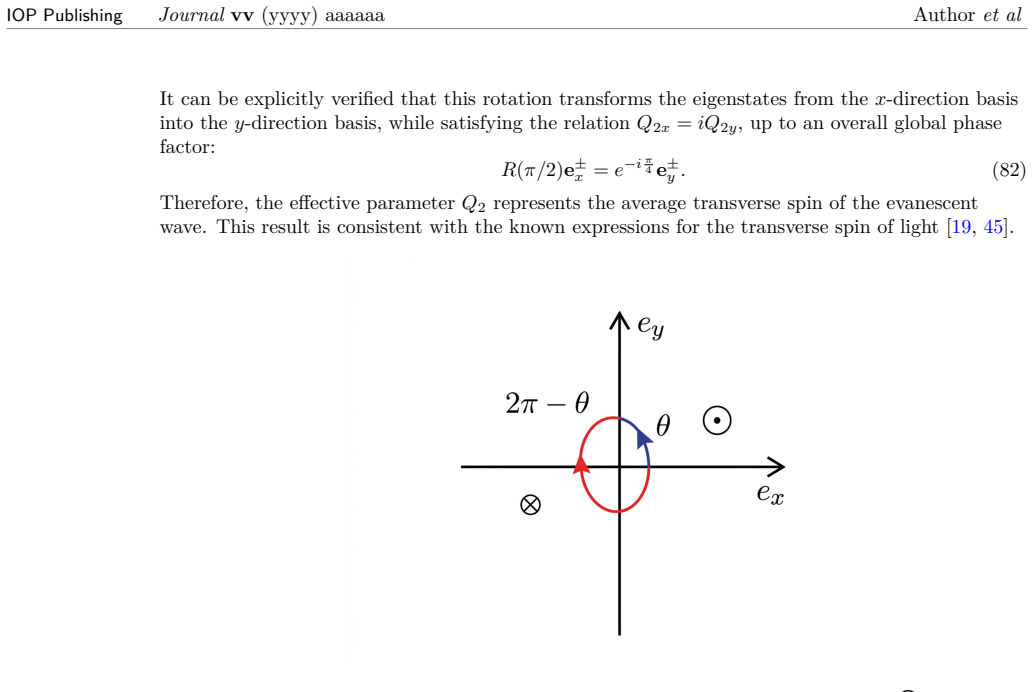
- Transverse spin in evanescent waves and other structured fields arises directly from the underlying helicity structure of the spinor solutions.
- The framework supplies a single quantum-field-theoretic description of light-matter coupling that treats vacuum and media on the same footing.
Where Pith is reading between the lines
- The spinor formulation may supply a natural language for describing photon spin-orbit coupling in nanophotonic devices without additional ad-hoc terms.
- If negative-energy modes can be excited in a controlled way, the scheme would predict observable signatures of antiphoton-like behavior in time-reversed optical setups.
- The effective-mass terms induced by the dielectric tensor suggest a route to analog Dirac physics for photons that parallels strained graphene or topological insulators.
Load-bearing premise
The source-free Maxwell equations in generic linear media can be rewritten exactly as a first-order four-component Dirac-like equation that admits both positive- and negative-energy solutions.
What would settle it
A direct calculation showing that the commutation relations derived from the optical Dirac eigenmode expansion fail to reproduce the canonical equal-time commutators of the electromagnetic field operators in a homogeneous isotropic medium.
Figures
read the original abstract
We develop a second-quantization framework for photons based on the optical Dirac equation of source-free Maxwell theory in generic media. In this formulation, the electromagnetic field is recast as a four-component spinor-like wave function that admits both positive-energy and negative-energy solutions, which are naturally interpreted as photon and antiphoton states. By expanding the field in terms of single-photon eigenmodes, we construct a consistent quantization scheme in which the photon field operators obey bosonic commutation relations, in close analogy with the Dirac quantization of electrons. In structured media, the optical Dirac equation acquires effective mass and coupling terms induced by the dielectric tensor, analogous to an electronic Dirac-type structure. This allows photon propagation in media to be interpreted in terms of boosted spinor states and provides a unified description of vacuum and medium-modified dispersion relations. The framework further reveals a natural quantum-mechanical origin of transverse spin in structured electromagnetic fields, including evanescent waves, where spin components perpendicular to the propagation direction emerge from the underlying helicity structure. In the context of optical Dirac theory, this work presents a quantum field-theoretic description of photons in both vacuum and media, offering a new perspective on photon quantization, spin-orbit interaction, and light-matter coupling in structured optical systems.
Editorial analysis
A structured set of objections, weighed in public.
Referee Report
Summary. The paper develops a second-quantization framework for photons based on the optical Dirac equation derived from source-free Maxwell theory in generic media. The electromagnetic field is recast as a four-component spinor-like wave function admitting both positive-energy and negative-energy solutions, interpreted as photon and antiphoton states. Expanding the field in single-photon eigenmodes yields field operators obeying bosonic commutation relations, analogous to Dirac quantization of electrons. In structured media the equation acquires effective mass and coupling terms from the dielectric tensor; the framework is used to interpret boosted spinor states, vacuum and medium-modified dispersion, and the quantum-mechanical origin of transverse spin (including in evanescent waves) via the underlying helicity structure.
Significance. If the central construction is shown to be internally consistent with the real-valued character of the electromagnetic field and reproduces standard results of quantum optics, the work would supply a unified spinor-based description of photon propagation in inhomogeneous media together with a natural account of transverse spin and spin-orbit effects. The Dirac-like analogy could also facilitate transfer of techniques between photonics and relativistic quantum mechanics.
major comments (1)
- [Abstract] Abstract (central claim): the quantization step rests on expanding the field operator over a complete set of both positive- and negative-energy eigenmodes and interpreting the latter as independent antiphoton states. Because the physical fields E and B are real, standard mode expansions determine the negative-frequency components by Hermitian conjugation of the positive-frequency ones; independent antiphoton operators would either violate this reality condition or double-count degrees of freedom. This assumption is load-bearing for the claimed bosonic algebra and must be resolved by an explicit derivation showing how the commutation relations are obtained without these inconsistencies.
Simulated Author's Rebuttal
We thank the referee for their careful reading of our manuscript and for highlighting the important issue of consistency with the real-valued electromagnetic fields. We provide a point-by-point response below and will revise the manuscript accordingly to strengthen the presentation of the quantization procedure.
read point-by-point responses
-
Referee: [Abstract] Abstract (central claim): the quantization step rests on expanding the field operator over a complete set of both positive- and negative-energy eigenmodes and interpreting the latter as independent antiphoton states. Because the physical fields E and B are real, standard mode expansions determine the negative-frequency components by Hermitian conjugation of the positive-frequency ones; independent antiphoton operators would either violate this reality condition or double-count degrees of freedom. This assumption is load-bearing for the claimed bosonic algebra and must be resolved by an explicit derivation showing how the commutation relations are obtained without these inconsistencies.
Authors: We acknowledge that the real-valued nature of the electromagnetic fields imposes strict constraints on the mode expansion. In the optical Dirac formulation, the four-component wave function is treated as complex, allowing for independent positive- and negative-energy solutions. However, the physical electric and magnetic fields are recovered as appropriate real linear combinations of these components. The antiphoton operators are not entirely independent; they are related to the photon operators through the requirement that the total field operators for E and B remain Hermitian. This ensures no violation of the reality condition and avoids double-counting. We agree that an explicit step-by-step derivation of the commutation relations is necessary to demonstrate this consistency clearly. In the revised manuscript, we will add a dedicated subsection deriving the bosonic algebra from the mode expansion while explicitly verifying the Hermitian property of the field operators. revision: yes
Circularity Check
No circularity: derivation proceeds from Maxwell equations via standard mode expansion
full rationale
The paper recasts source-free Maxwell fields in media as a four-component spinor admitting positive- and negative-energy solutions, then expands the field operator in the resulting eigenmodes to obtain bosonic commutation relations. This construction is presented as following directly from the completeness and orthogonality of the eigenmodes of the optical Dirac equation, without any fitted parameters, self-definitional loops, or load-bearing self-citations that reduce the claimed result to its inputs. The analogy to Dirac quantization of electrons is invoked as an external parallel rather than a self-referential premise. No step in the provided abstract or described chain exhibits the enumerated circularity patterns.
Axiom & Free-Parameter Ledger
axioms (1)
- domain assumption The electromagnetic field in generic media can be recast as a four-component spinor-like wave function from source-free Maxwell theory.
invented entities (2)
-
antiphoton states
no independent evidence
-
effective mass and coupling terms
no independent evidence
Reference graph
Works this paper leans on
-
[1]
Darwin C G 1932Proceedings of The Royal Society A: Mathematical, Physical and Engineering Sciences13636–52 URLhttps://api.semanticscholar.org/CorpusID:120059864
-
[2]
Bialynicki-Birula I 1994Acta Physica Polonica A8697–116 URL https://api.semanticscholar.org/CorpusID:9597794
-
[3]
Bialynicki-Birula I 1996 V photon wave function (Progress in Opticsvol 36) ed Wolf E (Elsevier) pp 245–294 URL https://www.sciencedirect.com/science/article/pii/S0079663808703160
1996
-
[4]
Laporte O and Uhlenbeck G E 1931Physical Review371380–1397 URL https://api.semanticscholar.org/CorpusID:122296182
-
[5]
Moses H E 1959Physical Review1131670–1679 URL https://api.semanticscholar.org/CorpusID:119346777
-
[6]
Cohen-Tannoudji C, Dupont-Roc J and Grynberg G 1989Photons and Atoms: Introduction to Quantum Electrodynamics(New York: Wiley) URL https://api.semanticscholar.org/CorpusID:123590331 15 IOP PublishingJournalvv(yyyy) aaaaaa Authoret al
-
[7]
Barnett S M 2014New Journal of Physics16093008 URL https://doi.org/10.1088/1367-2630/16/9/093008
-
[8]
Alpeggiani F, Bliokh K Y, Nori F and Kuipers L 2018Physical Review Letters120(24) 243605 URLhttps://link.aps.org/doi/10.1103/PhysRevLett.120.243605
-
[9]
Bialynicki-Birula I and Bialynicka-Birula Z 2006Optics Communications264342–351 ISSN 0030-4018 quantum Control of Light and Matter URL https://www.sciencedirect.com/science/article/pii/S0030401806004950
-
[10]
Keller O 2005Physics Reports4111–232 ISSN 0370-1573 URL https://www.sciencedirect.com/science/article/pii/S0370157305000438
-
[11]
Horsley S A R 2018Physical Review A97013844 URL https://api.semanticscholar.org/CorpusID:4939337
-
[12]
Cugnon J 2011 The photon wave function available online URL https://api.semanticscholar.org/CorpusID:38258992
2011
-
[13]
Elbistan M, Horvathy P, Horvathy P and Zhang P M 2016Physics Letters A3812375–2379 URLhttps://api.semanticscholar.org/CorpusID:119180293
-
[14]
Yamamoto N 2017Physical Review D96ISSN 2470-0029 URL http://dx.doi.org/10.1103/PhysRevD.96.051902
-
[15]
Enk S J V and Nienhuis G 1994EPL25497–501 URL https://api.semanticscholar.org/CorpusID:120542119
-
[16]
Kobe D H 1999Foundations of Physics291203–1231 URL https://api.semanticscholar.org/CorpusID:116265911
-
[17]
Bliokh K Y, Kivshar Y S and Nori F 2013Physical Review Letters113033601 URL https://api.semanticscholar.org/CorpusID:6806540
-
[18]
Bliokh K Y, Bekshaev A Y and Nori F 2012New Journal of Physics15URL https://api.semanticscholar.org/CorpusID:262246091
-
[19]
Bliokh K Y and Nori F 2015Physics Reports5921–38 ISSN 0370-1573 URL http://dx.doi.org/10.1016/j.physrep.2015.06.003
-
[20]
Feng L and Wu Q 2022Physical Review A106(4) 043513 URL https://link.aps.org/doi/10.1103/PhysRevA.106.043513
-
[21]
Yang L and Feng L 2025Physical Review A112(1) 013515 URL https://link.aps.org/doi/10.1103/PhysRevA.112.013515
-
[22]
Adlard C, Pike E R and Sarkar S 1997Physical Review Letters791585–1587 URL https://api.semanticscholar.org/CorpusID:13855661
-
[23]
Bialynicki-Birula I 1998Physical Review Letters805247–5250 URL https://api.semanticscholar.org/CorpusID:121789848
-
[24]
Bliokh K Y, Bekshaev A Y and Nori F 2014Nature Communications53300 URL https://www.nature.com/articles/ncomms4300
-
[25]
Yang L, Feng L and Zhang P 2026Physics Letters A590131848 ISSN 0375-9601 URL https://www.sciencedirect.com/science/article/pii/S0375960126005232
-
[26]
¨Unal N 1997Foundations of Physics27731–746 ISSN 1572-9516 URL https://doi.org/10.1007/BF02550173
-
[27]
Kobe D H 1999Physics Letters A2537–11 ISSN 0375-9601 URL https://www.sciencedirect.com/science/article/pii/S0375960199000110
-
[28]
Fuda M G and Furlani E 1982American Journal of Physics50545–549 ISSN 0002-9505 (Preprint https://pubs.aip.org/aapt/ajp/article-pdf/50/6/545/11742903/545_1_online.pdf) URLhttps://doi.org/10.1119/1.12819 16 IOP PublishingJournalvv(yyyy) aaaaaa Authoret al
-
[29]
Wang Z Y, Xiong C D and Qiu Q 2009Phys. Rev. A80(3) 032118 URL https://link.aps.org/doi/10.1103/PhysRevA.80.032118
-
[30]
Silenko A J 2022Phys. Rev. A105(6) 062211 URL https://link.aps.org/doi/10.1103/PhysRevA.105.062211
-
[31]
Cohen-Tannoudji C 1997Classical Electrodynamics: The Fundamental Equations and the Dynamical Variables(John Wiley & Sons, Ltd) ISBN 9783527618422 (Preprint https://onlinelibrary.wiley.com/doi/pdf/10.1002/9783527618422.ch1) URL https://onlinelibrary.wiley.com/doi/abs/10.1002/9783527618422.ch1
-
[32]
Peskin M E and Schroeder D V 1995An Introduction to Quantum Field Theory(Reading, MA: Addison-Wesley) ISBN 978-0201503975 URLhttps://www.worldcat.org/title/32494659
-
[33]
Williams A G 2022Introduction to Quantum Field Theory(Singapore: World Scientific) URL https://www.worldscientific.com/worldscibooks/10.1142/12345
-
[34]
Bender C M, Jones H and Rivers R 2005Physics Letters B625333–340 ISSN 0370-2693 URL https://www.sciencedirect.com/science/article/pii/S0370269305012098
-
[35]
Ashida Y, Gong Z and Ueda M 2020Advances in Physics69249 – 435 URL https://api.semanticscholar.org/CorpusID:219260918
-
[36]
Fernandez-Corbaton I, Zambrana-Puyalto X, Tischler N, Vidal X, Juan M L and Molina-Terriza G 2013Physical Review Letters111060401 URL https://doi.org/10.1103/PhysRevLett.111.060401
-
[37]
Barnett S M 2010Phys. Rev. Lett.104(7) 070401 URL https://link.aps.org/doi/10.1103/PhysRevLett.104.070401
-
[38]
Pfeifer R N C, Nieminen T A, Heckenberg N R and Rubinsztein-Dunlop H 2009Physical Review A79023813 URLhttps://api.semanticscholar.org/CorpusID:30942836
-
[39]
D, Particles and fields35 8 2383–2387 URLhttps://api.semanticscholar.org/CorpusID:32302914
Bialynicki-Birula I and Bia/suppress lynicka-Birula Z 1987Physical Review. D, Particles and fields35 8 2383–2387 URLhttps://api.semanticscholar.org/CorpusID:32302914
-
[40]
Skagerstam B S 1992arXiv: High Energy Physics - TheoryURL https://api.semanticscholar.org/CorpusID:14554044
-
[41]
B´ erard A and Mohrbach H 2006Physics Letters A352190–195 (Preprinthep-th/0404165)
-
[42]
Duval C and Horvathy P 2001Journal of Physics A3410097–10107 URL https://api.semanticscholar.org/CorpusID:10573051
-
[43]
B´ erard A and Mohrbach H 2003Physical Review D69127701 URL https://api.semanticscholar.org/CorpusID:119387358
-
[44]
Duval C and Horvathy P 2004Theoretical and Mathematical Physics144899–906 URL https://api.semanticscholar.org/CorpusID:182659
-
[45]
Bliokh K Y, Bekshaev A Y and Nori F 2013Nature Communications5URL https://api.semanticscholar.org/CorpusID:15832637
-
[46]
Feng S and Winful H G 2001Optics letters26 8485–7 URL https://api.semanticscholar.org/CorpusID:7004355
-
[47]
Bliokh K and Bliokh Y 2005Annals of Physics31913–47 ISSN 0003-4916 URL https://www.sciencedirect.com/science/article/pii/S0003491605000394
-
[48]
A, Atomic, molecular, and optical physics45 118185–8189 URL https://api.semanticscholar.org/CorpusID:1292384
Allen L, Beijersbergen M W, Spreeuw R J C and Woerdman J P 1992Physical review. A, Atomic, molecular, and optical physics45 118185–8189 URL https://api.semanticscholar.org/CorpusID:1292384
-
[49]
Bliokh K Y and Nori F 2015Physics Reports5921–38 ISSN 0370-1573 transverse and longitudinal angular momenta of light URL https://www.sciencedirect.com/science/article/pii/S0370157315003336 17
discussion (0)
Sign in with ORCID, Apple, or X to comment. Anyone can read and Pith papers without signing in.