REVIEW 5 major objections 5 minor 35 references
Study of the Turbulent/Non-turbulent Interface of Zero-Pressure-Gradient Turbulent Boundary Layer Using the Uniform Momentum Zone Concept
T0 review · 5 major / 5 minor · reviewed 2026-08-07 · deepseek-v4-flash
Pith's one-line read The turbulent/non-turbulent interface of a boundary layer can be identified as the velocity contour at the first histogram valley next to the free-stream peak, with no threshold required.
desk verdict A genuinely new threshold-free TNTI detector with real promise, but the paper has not yet shown that its interface is the actual turbulent/non-turbulent boundary rather than a convenient velocity contour. read the letter →
The pith
A machine-rendered reading of the paper's core claim, the machinery that carries it, and where it could break.
The reading
What carries the argument
The carrying object is the uniform momentum zone (UMZ) concept: the boundary layer is viewed as a stack of nearly uniform-momentum layers separated by thin shear layers, so the streamwise velocity histogram inside a sliding window has peaks for each zone and valleys at the edges between them. The first valley on the free-stream side of the histogram defines the edge velocity $u_{edge}$, and the iso-contour at $u_{edge}$ is declared the turbulent/non-turbulent interface. This replaces an externally set threshold with an internally defined feature of the velocity PDF, which is why the method is called threshold-free; the derived vorticity thickness $\delta_\omega = D[\tilde U]/(\mathrm{d}\tilde U/\mathrm{d}\tilde y)_{\max}$ then supplies the length scale that collapses the conditional statistics.
What would settle it
Take a ZPG-TBL DNS or experiment below $Re_\tau \approx 1{,}000$ or with elevated free-stream turbulence and compute the sliding-window histogram; if the first local minimum beside the free-stream peak is absent, or the resulting $u_{edge}$ contour jumps discontinuously while a vorticity- or TKE-based interface remains smooth, the central claim fails for that regime.
Extended reading notes
Core claim
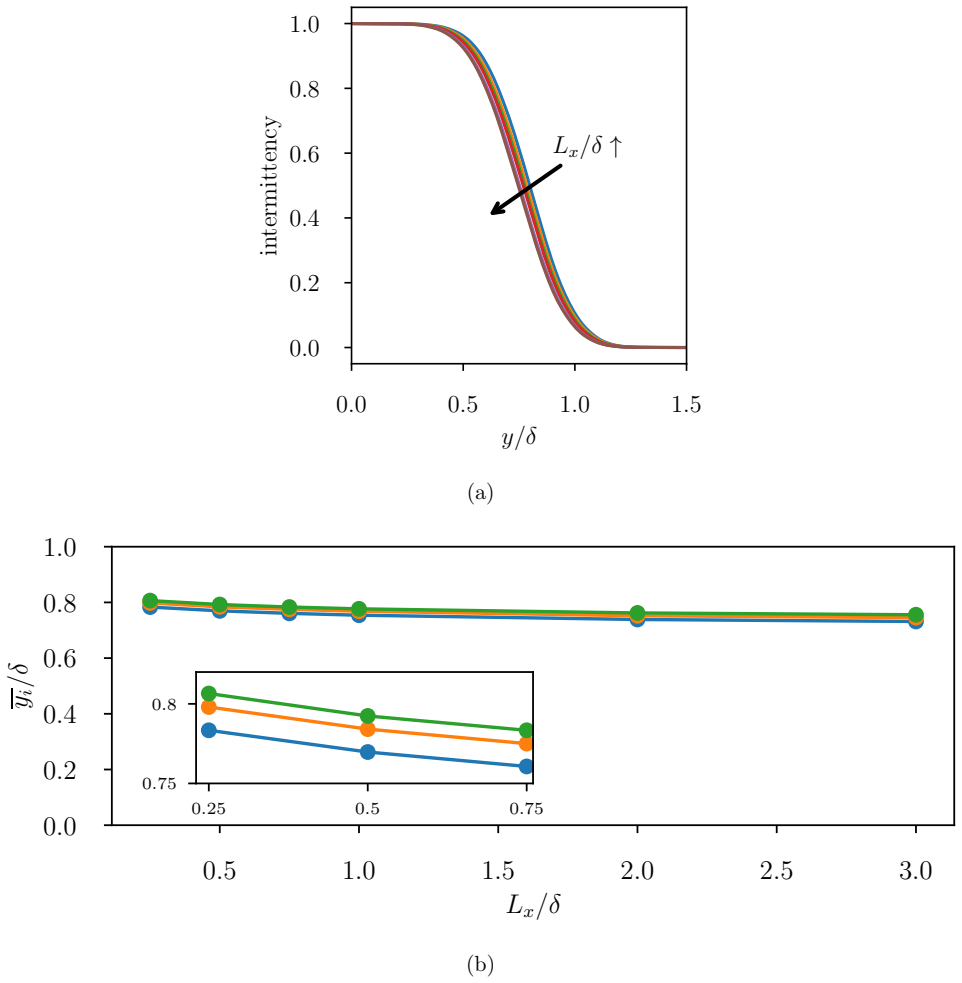
The central claim is that the turbulent/non-turbulent interface in a ZPG-TBL is a uniform-momentum-zone edge: the iso-contour of the streamwise velocity $u_{edge}$, defined as the first local minimum adjacent to the free-stream peak in the velocity histogram of a sliding $1\delta \times 2\delta$ window. Removing closed pocket boundaries and taking the lower envelope as the interface height, the method detects an interface whose mean height $y_i/\delta \approx 0.74\text{--}0.77$ and standard deviation $\sigma(y_i)/\delta \approx 0.16\text{--}0.17$ across $Re_\tau \approx 1{,}045\text{--}1{,}965$, matching non-vorticity-based measurements from the literature. The interface scales with $\delta$, is nearly insensitive to streamwise window length between $0.25\delta$ and $3\delta$, and produces conditional mean-velocity profiles with a sharp mixing-layer-like jump; the jump is about 50% larger than that from a local-TKE threshold method, while a vorticity-threshold interface lies on average $0.18\delta$ farther from the wall. When the conditional profiles are normalized by the interface velocity jump $D[\tilde U]$ and the vorticity thickness $\delta_\omega$, mean velocity and vorticity profiles collapse across Reynolds numbers.
Load-bearing premise
The load-bearing premise is that in every sliding window the streamwise velocity histogram has a clear local minimum between the free-stream peak and the turbulent region, and that the corresponding iso-velocity contour is the turbulent/non-turbulent interface.
Editorial extensions
If this is right
- TNTI detection becomes threshold-free and Reynolds-number-consistent across $Re_\tau \approx 1{,}045\text{--}1{,}965$, with mean interface height $y_i/\delta \approx 0.74\text{--}0.77$ and standard deviation $\sigma(y_i)/\delta \approx 0.16\text{--}0.17$.
- Because only planar streamwise velocity is required, the method transfers directly to experimental PIV without tuning a threshold or relying on resolved vorticity.
- The UMZ-TNTI interface gives a sharper velocity jump across the interface: $D[\tilde U]/u_\tau$ is about 50% larger than the local-TKE interface, and the maximum gradient $\delta/u_\tau\,\mathrm{d}\tilde U/\mathrm{d}\tilde y|_{\max}$ grows linearly with $Re_\tau$.
- Conditional mean and fluctuating vorticity profiles collapse better across Reynolds numbers when scaled by the interface velocity jump and vorticity thickness than for TKE-based interfaces.
- Reynolds stresses respond anisotropically across the interface: streamwise fluctuations change most, wall-normal moderately, and spanwise least.
Reading between the lines
- The same histogram-valley logic could be extended to other shear flows, such as jets, wakes, and mixing layers, wherever a free-stream peak is identifiable, potentially giving a unified threshold-free TNTI definition.
- The method's robustness has a testable boundary: at lower Reynolds numbers, higher free-stream turbulence, or noisy experimental data, the free-stream peak may merge with the turbulent distribution, making $u_{edge}$ ill-defined; the paper demonstrates the minimum only for $Re_\tau \approx 1{,}000\text{--}2{,}000$.
- Because the $u_{edge}$ distribution is negatively skewed while interface heights are nearly Gaussian, the velocity-valley-to-interface mapping is smooth in this dataset; examining that mapping under measurement noise would clarify the practical resolution limits of the method.
Editorial analysis
A structured set of objections, weighed in public.
Referee Report
Summary. The paper proposes a new way to identify the turbulent/non-turbulent interface (TNTI) in a zero-pressure-gradient turbulent boundary layer using the uniform momentum zone (UMZ) concept. For each spanwise plane and each sliding window of size 1δ × 2δ, the streamwise velocity histogram is used to find the local minimum uedge adjacent to the free-stream peak, and the iso-contour u = uedge is declared the TNTI. The method is applied to the DNS data of Sillero et al. at Reτ ≈ 1,000–2,000. The paper reports geometric properties (interface-height PDF, intermittency), a sensitivity study of the streamwise window length, comparisons with TKE- and vorticity-threshold interfaces, and conditionally averaged mean velocity, Reynolds stress, and vorticity profiles relative to the detected interface. The central claims are that the method is threshold-free, scales with δ, agrees with non-vorticity-based experiments, and produces sharper conditional velocity and vorticity profiles than threshold-based methods.
Significance. If the method is valid, it is attractive because it uses only planar streamwise velocity and could be applied directly to experimental PIV data, avoiding the need to choose threshold levels that are Reynolds-number dependent. The paper is grounded in a well-established DNS dataset, and the demonstration that the detected interface height is only weakly sensitive to the streamwise window size is a useful robustness result. However, the central identification claim is not yet independently validated: the detected UMZ contour is on average 0.18δ below a standard vorticity-based TNTI, and the reported velocity jump across the interface is partly a selection effect of defining the interface as a streamwise-velocity iso-contour. The paper therefore presents a promising method whose physical interpretation as the TNTI requires additional evidence before its statistical results can be taken as definitive.
major comments (5)
- [Section VI, Fig. 5] The difference between the UMZ-TNTI and the vorticity-threshold TNTI is 0.18δ on average, which is about six times the interface thickness δω/δ reported in Fig. 10. Because the vorticity threshold is the standard marker of the rotational/non-rotational boundary in DNS, this offset means that the two surfaces cannot both be the same physical interface. The paper interprets the offset as a deficiency of vorticity thresholds, but no independent identification (e.g., based on enstrophy, Lagrangian trajectories, or a passive scalar) is provided to show that the UMZ contour is the correct TNTI. This is load-bearing because all conditional statistics in Section VII are conditioned on this contour.
- [Section VII A, Figs. 6–8] The sharp velocity jump D[U] is to a substantial degree a selection effect: because the interface is defined as the u = uedge iso-contour, the conditionally averaged streamwise velocity must change across it. The magnitude and shape of the jump are informative, but the paper also uses this jump as evidence that the UMZ method 'fits better with the conceptual model of the TNTI' (Section VII A). That reasoning is circular. The authors should quantify what velocity jump would be obtained for an arbitrary contour with the same height distribution, or provide an independent marker of the turbulent/non-turbulent boundary, before using D[U] as evidence for the correctness of the method.
- [Section VII, Eqs. (7), Figs. 9–10] Equation (7) is not a parameter-free prediction: a1 and a2 are the linear-fit parameters obtained in Fig. 9. The statement in the text that Eq. (7) 'shows good agreement with the data points, as expected' is therefore a fit to the data rather than an independent validation of the δω/δ ~ 1/(a1 Reτ + a2) scaling. The collapse claim based on this equation should be reframed accordingly, and the fit parameters and their uncertainties should be reported.
- [Section III and Section V] The paper describes the method as 'threshold-free,' but it actually relies on several hand-chosen rules: the sliding-window height of 2δ, the definition of the interface height as the lower envelope of the interface contour, the removal of closed pockets, and the histogram bin width and local-minimum detection procedure. The sensitivity analysis in Section V varies only the streamwise window length Lx. Since the claimed advantage over TKE- and vorticity-based methods is the absence of arbitrary thresholds, the authors should demonstrate that the results are insensitive to the histogram bin width, the window height, and the pocket-removal rule, or explicitly state these as parameters of the method.
- [Section III] The method assumes that, in every sliding window, the streamwise velocity histogram has a clean local minimum between the free-stream peak and the turbulent region. This assumption is demonstrated only for the present DNS at Reτ ≈ 1,000–2,000. At lower Reynolds numbers, in flows with significant free-stream turbulence, or with experimental noise, the free-stream peak may merge with the turbulent distribution and uedge may become ill-defined or jump discontinuously. The paper should either demonstrate robustness of the local-minimum criterion across a wider parameter range or clearly state this limitation as a condition of applicability.
minor comments (5)
- [Table III] The comparison with previous work excludes the two vorticity-based studies (Jiménez et al. and Eisma et al.) when concluding that the measured yi/δ is consistent with the literature. Since the paper's main discrepancy is precisely with vorticity-based detection, the table should include those points in the comparison and discuss what the scatter implies for the validation of the method.
- [Fig. 10] The caption of Fig. 10 appears to be a copy of the caption of Fig. 9; it describes the maximum velocity gradient, while the plotted quantity is δω/δ. This should be corrected.
- [Section VII A, Eq. (5)] The notation in Eq. (5) is inconsistent with the rest of the paper: U and V are used for mean quantities, but the equation is presented as a conditional balance. Please clarify whether these are ensemble-mean or conditionally averaged quantities and define all terms.
- [Section III and Fig. 1] The bin width used to construct the velocity histogram is not specified. Since uedge is defined by a local minimum of this histogram, the bin width is a parameter of the method and should be reported.
- [Section V] The statement that 'the intermittency profiles exhibit negligible variation across Reynolds numbers' should be supported by quantitative measures, since the profiles in Fig. 3(a) are shown only for station 1 and the text says stations 2 and 3 follow the same trend.
Circularity Check
UMZ-TNTI geometry is externally benchmarked, but the reported velocity jump and Eq. (7) collapse are built into the contour definition and fitted constants.
-
self definitional
[Section III, Fig. 1; Section VII A, Fig. 8]
"The local minima separating this peak from the rest of the turbulent flow is identified as the edge velocity uedge, and the velocity iso-contour line corresponding to uedge is identified as the TNTI within the window. ... The most probable uedge is 0.957 u∞, while the mean uedge is 0.950 u∞."
Because the TNTI is defined as the u=uedge iso-contour, the conditional mean streamwise velocity at the interface is pinned near uedge≈0.95u∞, while the non-turbulent side approaches u∞. In the outer layer U∞−U is O(uτ), so the reported 'velocity jump' D[U]≈uτ and the sharp conditional gradient are largely the algebraic image of the chosen contour rather than an independent measurement of interface dynamics. The later statement that this 'fits better with the conceptual model of the TNTI' is therefore partly self-definitional: any u=constant surface separating a high-speed free stream from a lower-speed turbulent region will produce such a jump.
-
fitted input called prediction
[Section VII A, Eq. (7), Fig. 10]
"From the definition of δω, the relationship between δω/δ and Reτ can be expressed as δω/δ = D[ ˜U ]/uτ / (a1Reτ + a2), where a1 and a2 are the parameters of the linear fit in Fig. 9. This relationship is also plotted in Fig. 10 and shows good agreement with the data points, as expected."
Equation (7) is not an independent collapse or prediction: a1 and a2 are obtained from the linear fit of δ/uτ d ˜U/d˜y|max versus Reτ in Fig. 9 using the same stations, and δω is defined in Eq. (4) as D[ ˜U ]/(d ˜U/d˜y|max). Substituting the fitted straight line into Eq. (4) reproduces Eq. (7) identically, so plotting Eq. (7) against the same δω/δ data cannot fail. The 'good agreement' is a tautological consequence of the fit, not confirmation of a scaling law.
full rationale
The paper is not wholly circular: the UMZ-TNTI interface height, intermittency profiles, and comparisons with the external Sillero/Jiménez DNS and prior experimental literature provide independent geometric content, and no load-bearing self-citation chain was found. However, two headline results reduce by construction. First, the sharp velocity jump and mixing-layer-like D[U] scaling are partly forced by defining the interface as the u=uedge contour, since uedge is concentrated near 0.95u∞; the comparison with the vorticity-threshold interface partly reflects different contour-selection conventions rather than an independent check. Second, Eq. (7) uses a1 and a2 fitted from the same data it is then plotted against, making the reported collapse 'as expected' by construction. The literature comparison in Table III also excludes the two vorticity-based studies, which weakens but does not by itself make the geometric comparison circular. Overall, the method has substantial independent content, but the central claims about the velocity jump and the Eq. (7) collapse are partially built into the definition and fit, giving a score of 5.
Assumptions & free parameters
free parameters (6)
- Sliding window streamwise length Lx =
1δ, tested from 0.25δ to 3δ
- Sliding window height =
2δ
- TKE thresholds k2C,th and k3C,th =
0.13 to 0.18 and 0.20 to 0.25 by station
- Vorticity threshold omega_th =
omega+ from 2e-3 to 5e-4; omega* from 6.47e-2 to 2.22e-2
- Linear fit parameters a1, a2 in Eq. (7) =
not given explicitly
- Histogram bin width and local-minimum detection parameters =
not specified
assumptions (6)
- domain assumption The DNS dataset of Sillero et al. accurately represents a zero-pressure-gradient turbulent boundary layer.
- domain assumption Each spanwise plane is statistically independent.
- ad hoc to paper A local minimum in the velocity histogram separates the free stream from the turbulent region.
- ad hoc to paper The lower envelope of the interface contour is the representative interface height yi.
- ad hoc to paper Closed pockets of turbulent or non-turbulent fluid can be removed without affecting TNTI statistics.
- domain assumption The thin shear layer equation with streamwise homogeneity applies within the TNTI.
Cite this review
Pith. "Pith review of Study of the Turbulent/Non-turbulent Interface of Zero-Pressure-Gradient Turbulent Boundary Layer Using the Uniform Momentum Zone Concept." pith.science (2026). https://pith.science/paper/3FTDMHGO
@misc{pith2026250523589,
  author       = {Pith},
  title        = {Pith review of: Study of the Turbulent/Non-turbulent Interface of Zero-Pressure-Gradient Turbulent Boundary Layer Using the Uniform Momentum Zone Concept},
  year         = {2026},
  howpublished = {\url{https://pith.science/paper/3FTDMHGO}},
  note         = {Machine review of arXiv:2505.23589}
}
abstract
This paper investigates the turbulent--non-turbulent interface (TNTI) in a zero-pressure-gradient turbulent boundary layer (ZPG-TBL) using a novel, threshold-free method based on the uniform momentum zone (UMZ) concept. Requiring only planar streamwise velocity data, the method is directly applicable to experimental PIV and ensures consistent TNTI detection across simulations and experiments. Its performance is demonstrated using DNS data at $Re_\tau = 1,000 - 2,000$. The TNTI height scales with the local boundary layer thickness ($\delta$), yielding an error-function-like intermittency profile and statistics consistent with prior studies. Sensitivity to streamwise domain length is minimal. Compared to TKE- and vorticity-based methods, the UMZ-TNTI partially overlaps with the TKE interface but differs significantly from the vorticity threshold, which lies farther from the wall. Conditional averages reveal sharp velocity gradients across the TNTI, consistent with mixing-layer-like dynamics. When normalized by TNTI height and velocity jump, mean velocity profiles collapse across Reynolds numbers. Reynolds stresses respond asymmetrically: $\tilde{\overline{u'u'}}$ varies most, $\tilde{\overline{v'v'}}$ moderately, and $\tilde{\overline{w'w'}}$ least. Mean and fluctuating vorticity profiles collapse well when scaled by the UMZ-TNTI vorticity scale. A localized peak in spanwise mean vorticity is observed within the TNTI, while $\tilde{\overline{\omega_x'\omega_x'}}$ decreases across it and the other components show local maxima.
Figures


Figures from the paper (15 more)


Reference graph
Works this paper leans on
-
[1]
C. B. da Silva, J. C. Hunt, I. Eames, and J. Westerweel, Annual Review of Fluid Mechanics 46, 567 (2014)
work page 2014
-
[2]
S. Corrsin and A. L. Kistler, Free-Stream Boundaries of Turbulent Flows, Tech. Rep. NACA- TN-3133 (The Johns Hopkins University, 1955)
work page 1955
-
[3]
D. K. Bisset, J. C. R. Hunt, and M. M. Rogers, Journal of Fluid Mechanics 451, 383 (2002)
work page 2002
-
[4]
J. Westerweel, C. Fukushima, J. M. Pedersen, and J. C. R. Hunt, Journal of Fluid Mechanics 631, 199 (2009)
work page 2009
- [5]
- [6]
-
[7]
A. A. R. Townsend, The Structure of Turbulent Shear Flow(Cambridge University Press, 1980)
work page 1980
-
[8]
C. M. de Silva, J. Philip, K. Chauhan, C. Meneveau, and I. Marusic, Physical Review Letters 111, 044501 (2013)
work page 2013
Show all 35 references
-
[9]
Borrell and J
G. Borrell and J. Jim´ enez, Journal of Fluid Mechanics 801, 554 (2016). 31
2016
-
[10]
R. K. Anand, B. J. Boersma, and A. Agrawal, Experiments in Fluids 47, 995 (2009)
2009
-
[11]
R. R. Prasad and K. R. Sreenivasan, Experiments in Fluids 7, 259 (1989)
1989
-
[12]
C. B. da Silva, R. J. N. dos Reis, and J. C. F. Pereira, Journal of Fluid Mechanics 685, 165 (2011)
2011
-
[13]
Chauhan, J
K. Chauhan, J. Philip, C. M. de Silva, N. Hutchins, and I. Marusic, Journal of Fluid Mechanics 742, 119 (2014)
2014
-
[14]
14a shows that ˜w′w′ follows a similar trend above, within, and below the TNTI, without sharp changes
Fig. 14a shows that ˜w′w′ follows a similar trend above, within, and below the TNTI, without sharp changes. This reinforces the idea that the TNTI separates the turbulent and 24 non-turbulent regions with varying effect for the three directions of Reynolds normal stresses: the...
-
[15]
R. J. Adrian, C. D. Meinhart, and C. D. Tomkins, Journal of Fluid Mechanics 422, 1 (2000)
2000
-
[16]
C. D. Meinhart and R. J. Adrian, Physics of Fluids 7, 694 (1995)
1995
-
[17]
Senthil, C
S. Senthil, C. Atkinson, and J. Soria, Journal of Physics: Conference Series 1522, 012013 (2020)
2020
-
[18]
Laskari, R
A. Laskari, R. de Kat, R. J. Hearst, and B. Ganapathisubramani, Journal of Fluid Mechanics 842, 554 (2018)
2018
-
[19]
B. Sun, C. Atkinson, and J. Soria, in 1st European Fluid Dynamics Conference (EFDC1) (2024)
2024
-
[20]
C. M. de Silva, J. Philip, N. Hutchins, and I. Marusic, Journal of Fluid Mechanics 820, 451 (2017)
2017
-
[21]
C. M. de Silva, N. Hutchins, and I. Marusic, Journal of Fluid Mechanics 786, 309 (2016)
2016
-
[22]
Thavamani, C
A. Thavamani, C. Cuvier, C. Willert, J. Foucaut, C. Atkinson, and J. Soria, Experimental Thermal and Fluid Science 115, 110080 (2020)
2020
-
[23]
Borrell, J
G. Borrell, J. A. Sillero, and J. Jim´ enez, Computers & Fluids 80, 37 (2013)
2013
-
[24]
J. A. Sillero, J. Jim´ enez, and R. D. Moser, Physics of Fluids 25, 10.1063/1.4823831 (2013)
2013 doi
-
[25]
Jim´ enez, Physics of Fluids25, 10.1063/1.4824988 (2013)
J. Jim´ enez, Physics of Fluids25, 10.1063/1.4824988 (2013)
2013 doi
-
[26]
M. P. Simens, J. Jim´ enez, S. Hoyas, and Y. Mizuno, Journal of Computational Physics 228, 4218 (2009)
2009
-
[27]
Jim` enez, S
J. Jim` enez, S. Hoyas, M. P. Simens, and Y. Mizuno, Journal of Fluid Mechanics 657, 335 (2010)
2010
-
[28]
Excluding these two results, yi/δ and σ (yi) /δ obtained in this study are comparable with values reported in the literature
have higher mean TNTI heights because a threshold in vorticity is used to identify the interface. Excluding these two results, yi/δ and σ (yi) /δ obtained in this study are comparable with values reported in the literature. The PDFs of the instantaneous TNTI height, yi, normal...
-
[29]
J. A. Sillero, J. Jim´ enez, and R. D. Moser, Physics of Fluids 26, 10.1063/1.4899259 (2014)
2014 doi
-
[30]
Eisma, J
J. Eisma, J. Westerweel, G. Ooms, and G. E. Elsinga, Physics of Fluids 27, 10.1063/1.4919909 (2015)
2015 doi
-
[31]
C.-H. P. Chen and R. F. Blackwelder, Journal of Fluid Mechanics 89, 1 (1978)
1978
-
[32]
L. S. G. Kovasznay, Annual Review of Fluid Mechanics 2, 95 (1970). 32
1970
-
[33]
T. B. Hedley and J. F. Keffer, Journal of Fluid Mechanics 64, 645 (1974)
1974
-
[34]
Corrsin, Investigation of Flow in an Axially Symmetrical Heated Jet of Air, Tech
S. Corrsin, Investigation of Flow in an Axially Symmetrical Heated Jet of Air, Tech. Rep. NACA-ACR-3L23 (California Institute of Technology, 1943)
1943
-
[35]
Chauhan, J
K. Chauhan, J. Philip, and I. Marusic, Journal of Fluid Mechanics 751, 298 (2014). 33
2014
Reviewed August 7, 2026 · model on record in the stance chip above.
Discussion (0). Continue with ORCID to comment.