REVIEW 4 major objections 5 minor 44 references
Anomalous diffusions in option prices: connecting trade duration and the volatility term structure
T0 review · 4 major / 5 minor · reviewed 2026-08-14 · deepseek-v4-flash
Pith's one-line read Long-dated option prices converge to their payoff as a power law $T^{-\beta}$ when tick-by-tick waiting times are heavy-tailed, making the volatility skew fade slower than the conventional $1/T$ rate.
desk verdict A worthwhile but conditional paper: the new asymptotic results are real, the empirical premise is untested, and Theorem 7.2 has a fixable technical gap. read the letter →
The pith
A machine-rendered reading of the paper's core claim, the machinery that carries it, and where it could break.
The reading
What carries the argument
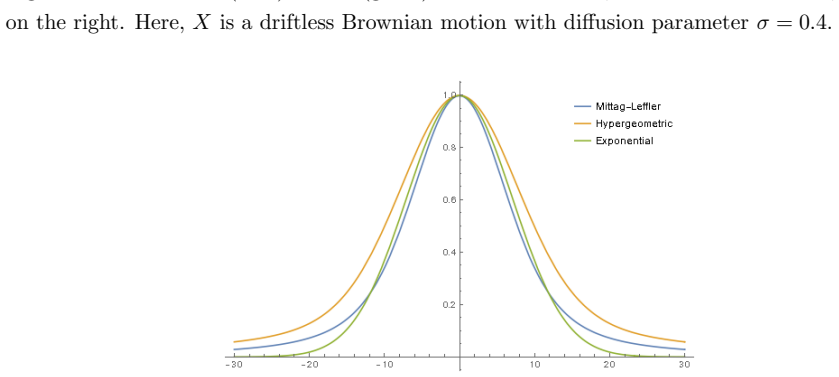
The load-bearing machinery is the CTRW scaling-limit theorem, which turns a triangular array of tick-by-tick returns and waiting times into the process $((X^-)_{H_t})^+$: a Lévy process $X$ run on the inverse $H$ of a $\beta$-stable subordinator. Here $H_t$ is the first time the subordinator exceeds $t$, and in the DRD model the relevant time change $L^H_t$ has the explicitly known law $tB_{\beta,1-\beta}$, a Beta distribution scaled by $t$. This tractability yields characteristic functions $\Phi_t(z)=E_\beta(-\psi_X(z)t^\beta)$ for SL and $\Phi_t(z)={}_1F_1(\beta,1,-t\psi_X(z))$ for DRD, which feed the Lewis-type pricing integral. The large-maturity analysis then rests on a model-free skew-level relation: if implied volatility itself vanishes, the skew cannot decay as fast as $1/T$.
What would settle it
Measure the tail of inter-trade durations on high-frequency data: if the estimated tail index is consistently at least 1, meaning finite mean waiting times, the CTRW scaling-limit assumption fails and the predicted slow skew loses its foundation. Alternatively, fit the models to option prices and test out of sample: if long-dated implied volatility skews decline as $1/T$ rather than slower than every $T^{-\alpha}$ with $\alpha>1/2$, the paper's central asymptotic claim is contradicted.
Extended reading notes
Core claim
Within the CTRW framework, the central discovery is that non-exponential waiting times do not average out at long horizons. The scaling limit makes the log-price $Y_t = X_{H_t^-}$, where $X$ is a Lévy process and $H$ is the inverse of an independent $\beta$-stable subordinator (SL model), or a coupled version $X_L$ time-changed by $H$ (DRD model), whose time change $L^H_t$ is distributed as $tB_{\beta,1-\beta}$. For both models, the large-maturity Call price behaves as $1 - C T^{-\beta}$ (plus an exponentially small correction in DRD), which is much slower than the Laplace-type decay of standard Lévy models. Inverting Black-Scholes, the implied volatility satisfies $\sigma_\beta(K,T) \sim 2\sqrt{W_0(C T^{2\beta})/T}$, so the skew $S_\beta(K,T)$ decays slower than every $T^{-\alpha}$ with $\alpha>1/2$, in particular slower than the usual $1/T$, while the short-maturity ATM skew matches the underlying Lévy model. The paper interprets this as a structural connection between trade duration and the persistence of the volatility skew.
Load-bearing premise
The whole slow-skew conclusion rests on real waiting times between trades being so heavy-tailed that their average is infinite; if real waiting times have a finite mean, the anomalous-diffusion limit and the $T^{-\beta}$ option-price decay no longer apply.
Editorial extensions
If this is right
- If the central claim is right, a persistent long-maturity volatility skew does not require a separate stochastic-volatility mechanism: one duration parameter $\beta$, encoding infinite-mean trade waits, produces it.
- Because $\beta=1$ recovers the underlying Lévy model, $\beta$ acts as a long-term skew component: it leaves the short-maturity ATM skew essentially unchanged but controls how slowly the smile flattens.
- The implied volatility term structure in both models declines to zero like $\sqrt{\log T/T}$, so long-dated options should be priced with lower implied vols but a skew that survives far longer than in exponential Lévy models.
- The DRD model has uncorrelated, weakly stationary increments and non-vanishing skewness and kurtosis limits, reproducing two stylized facts of returns while keeping the slow-skew property.
- A model-free consequence of Lemma 7.1 is that any vanishing long-dated implied volatility level forces a slower-than-$1/T$ skew decay; anomalous diffusions provide one concrete construction.
Reading between the lines
- Editorial inference: the mechanism predicts a testable link between the tail index $\beta$ estimated from tick-by-tick waiting times and the long-maturity skew slope estimated from options; the paper does not connect the two on data.
- Editorial inference: since the calibration in Section 8 is in-sample on synthetic smiles, a natural extension is an out-of-sample test in which $\beta$ estimated from one maturity cross-section predicts the skew at another maturity.
- Editorial inference: if real waiting times are heavy-tailed but have finite mean (tail index above 1), the CTRW limit changes and the slow-skew effect weakens or disappears, so the model's empirical relevance hinges on trade-duration data rather than option data alone.
- Editorial inference: the same CTRW construction extends to other long-dated derivatives such as digital options or variance swaps, where the $T^{-\beta}$ price decay should appear directly in the leading-order asymptotics.
Signed reviews
Editorial analysis
A structured set of objections, weighed in public.
Referee Report
Summary. The paper develops two classes of anomalous diffusion asset price models, SL (purely subdiffusive Lévy) and DRD (dependent returns and trade durations), obtained as scaling limits of continuous-time random walks with power-law waiting times. It derives no-arbitrage pricing formulae in terms of Mittag-Leffler and confluent hypergeometric functions, studies moments and correlation properties, and analyzes large-maturity Call price asymptotics. The central result is that Call prices decay as T^{-β}, so the implied volatility vanishes as √(log T/T) and the implied volatility skew decays more slowly than 1/T, which the authors interpret as a structural explanation of the persistent market skew via trade duration. Section 8 calibrates the models to synthetic smiles built by shifting a Lévy skew to longer maturities and reports RMSE improvements.
Significance. The theoretical framework is attractive and the derivation path (CTRW limit, Fourier-Laplace transforms, special-function expansions, saddle-point integration) is coherent. The paper gives explicit, analytically tractable pricing formulae and unifies several earlier subdiffusive models; the large-maturity asymptotics constitute concrete, falsifiable predictions that can be tested once β is estimated. However, the central asymptotic theorem is not rigorously proven as written, and the empirical support for the market-behaviour claim is currently only synthetic and in-sample; the defining premise (β<1 for real trade durations) is untested. These issues are fixable but essential, so the paper is best viewed for now as a theoretical mechanism with conditional empirical illustration.
major comments (4)
- [§8.2, Tables 2–3; Abstract/Introduction] The paper's headline claim that anomalous diffusions 'reproduce the market behaviour of the implied volatility' (Abstract) and provide a 'good fit to market data' (Section 8) is not supported by the evidence presented. Section 8.2 calibrates only to synthetic smiles obtained by shifting a 6-month Lévy skew to 1-year and 18-month maturities, not to observed option prices. Because β is an additional free parameter, the RMSE improvements in Tables 2–3 are in-sample and would be expected even under a misspecified model; no out-of-sample exercise or model-comparison criterion (e.g., BIC/AIC) is reported. Moreover, the persistence mechanism requires the real inter-trade waiting times to be in the domain of attraction of a β-stable law with β<1 (infinite mean); this premise is neither tested using trade data nor supported by empirical tail-index estimates, without which the claim that trade duration explains the market's persistent skew remains conditional.
- [§7, Theorem 7.2, after Eq. (7.13)] In the proof of Theorem 7.2, the asymptotic expansion of 1F1 is substituted into the pricing integral (7.11) under the assertion that 'so long as T is much larger than 1/|ψX(i/2)| we can replace ΦT in (7.11) with (7.13)'. This is a pointwise asymptotic; no uniform-in-u bound or justification for interchanging the limit with the integral is supplied. The preceding Stokes-phenomenon discussion is also problematic: in the SL case the condition 'πβ < |arg(-ψX(u+i/2)T0^β)|' is invariant in T0 because T0^β is a positive real, so a large T0 cannot of itself move the argument into the required sector. A rigorous argument (e.g., splitting the u-domain or a Watson-type lemma with uniform error control) is required to establish the T^{-β} leading order in (7.9)-(7.10).
- [§7, Corollary 7.3, Eq. (7.20)] Corollary 7.3, Eq. (7.20), states lim_{T→∞} Sβ(K,T)√T = 0. This contradicts the proof of the same corollary: combining (7.3), (7.23), and the final equivalence (7.24) gives a digital-term contribution of order cM/√T, so Sβ(K,T)√T does not converge to zero (it tends to a nonzero constant up to the leading term). The intended conclusion that the skew decays as T^{-1/2}, slower than 1/T, may be correct, but the corollary statement must be corrected and reconciled with its proof.
- [§7, Corollary 7.3, proof of (7.24)] The proof of Corollary 7.3 asserts that 'the long-term price decay for the Digital option I_{ST≥K} is identical to that of the Call option, namely c/T^β for some c>0.' This is not demonstrated and does not follow directly from (7.9)-(7.10); a digital payoff requires its own asymptotic analysis. Since this assertion underpins the second term of the skew formula (7.3), it is load-bearing for the main quantitative result and needs a proof.
minor comments (5)
- [§8.2] The text says 'we calibrate a total of four anomalous diffusions models, namely: SL-VG, SL-NIG, SL-VG and DRD-VG'; the list contains a duplicate (SL-VG) and omits DRD-NIG.
- [Eq. (7.17)] The expression '4√K' is ambiguous; from the saddle point integration it should presumably be K^{1/4} or √K, and the notation should be made consistent with (7.11).
- [§8.2] There is a typo in 'Its core MATLAB implementatio'; also 'explained above explained above' is duplicated.
- [§6.1] The paper states the models are described in a 'semimartingale setting leading no-arbitrage pricing formulae', but the choice of risk-neutral measures explicitly excludes a market price of duration risk; the abstract and introduction should acknowledge this limitation more prominently.
- [§7, Corollary 7.3 proof] The constant Cβ is used both as a generic constant in (7.9)-(7.10) and as Cβ1, Cβ2 in Proposition 7.2; this might confuse readers.
Circularity Check
No circularity: the large-maturity volatility and skew asymptotics are derived from model primitives, with self-citations and the synthetic calibration non-load-bearing.
full rationale
The derivation of the headline result is not circular: the paper assumes a CTRW triangular array whose waiting times lie in the domain of attraction of a beta-stable law (beta<1), cites external CTRW limit theorems (Theorem 3.1), derives the characteristic functions via external transform results (Proposition 3.2 and Proposition 4.2), and obtains the large-maturity Call expansions (Eqs. (7.9)-(7.10)) and the implied-volatility/skew rates (Corollary 7.3) by asymptotic analysis of those characteristic functions. Beta is a model parameter in this derivation, not a fitted output, so the T^{-beta} decay and slower-than-1/T skew are consequences of the model rather than restatements of an input. Section 8.2 is an in-sample illustration: it explicitly generates synthetic smiles from a given Levy model and shifts the 6-month skew to create persistence, then calibrates beta; this can show identifiability but is not the source of the theoretical rates, and the lack of real duration data or an empirical estimate of beta is an external-validity limitation, not circularity. The self-citations (Torricelli 2020 for measure changes; Figueroa-Lopez, Forde and Jacquier 2011 for a technical lemma) are not load-bearing for the main asymptotic claim and are not used to exclude competing explanations, so they do not raise the circularity score.
Assumptions & free parameters
free parameters (4)
- β (stability index of the waiting-time subordinator) =
0.72 (DRD-VG, scenario 1); 0.65 (DRD-VG, scenario 2); see Tables 2-3
- VG parameters κ, σ, θ =
e.g., (0.90, 0.38, -0.28) for DRD-VG scenario 1
- NIG parameters κ, σ, θ =
e.g., (2.56, 0.31, -0.10) for DRD-NIG scenario 1
- CGMY parameters C, G, M, Y =
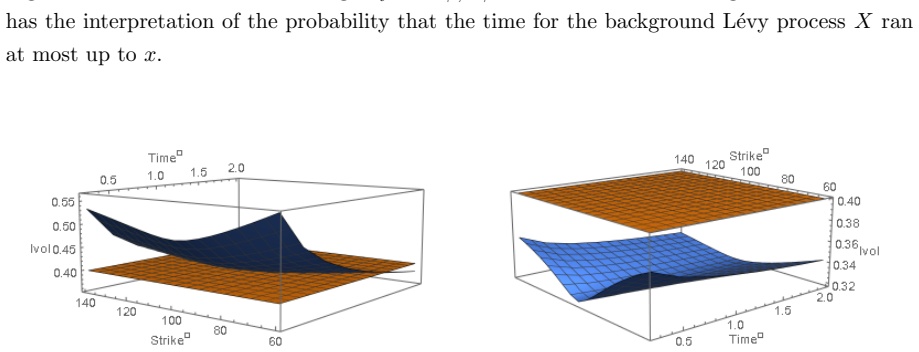
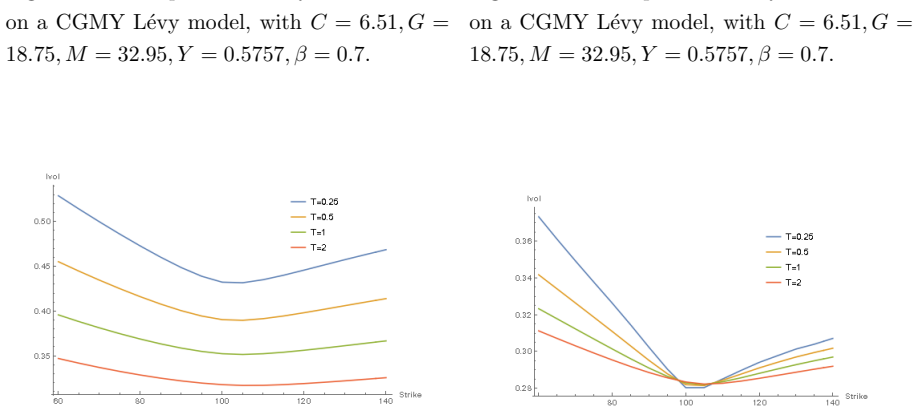
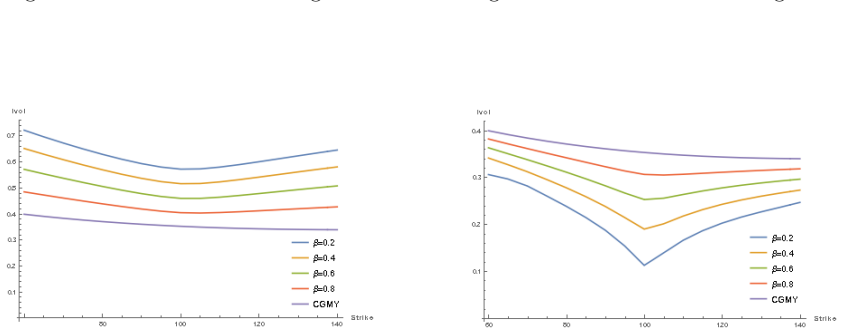
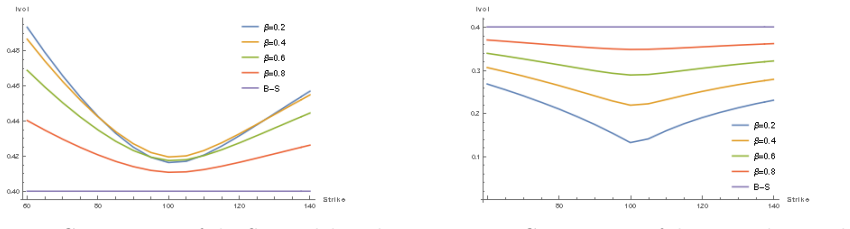
(6.51, 18.75, 32.95, 0.5757) used in Figures 6-9
assumptions (5)
- standard math The CTRW convergence theorem (Theorem 3.1) holds for the triangular arrays considered, including dependent components and compound Poisson cases.
- ad hoc to paper Real trade waiting times are in the domain of attraction of a β-stable law with β∈(0,1), so infinite-mean waiting times are assumed.
- domain assumption Under the pricing measure Q, only the law of the Lévy process X is changed; the stable subordinator L is left unchanged, so there is no market price of duration risk.
- standard math The Lévy exponent ψX satisfies (2.2) and the regularity conditions used in Theorem 7.2, including the existence of ψX(i/2) and ψX''(i/2).
- standard math The asymptotic expansions of the confluent hypergeometric and Mittag-Leffler functions (Luke 2012; Haubold et al. 2011) are valid on the integration contour and can be interchanged with the integral.
Cite this review
Pith. "Pith review of Anomalous diffusions in option prices: connecting trade duration and the volatility term structure." pith.science (2026). https://pith.science/paper/3G5YYPBV
@misc{pith2026190803007,
  author       = {Pith},
  title        = {Pith review of: Anomalous diffusions in option prices: connecting trade duration and the volatility term structure},
  year         = {2026},
  howpublished = {\url{https://pith.science/paper/3G5YYPBV}},
  note         = {Machine review of arXiv:1908.03007}
}
read the original abstract
Anomalous diffusions arise as scaling limits of continuous-time random walks (CTRWs) whose innovation times are distributed according to a power law. The impact of a non-exponential waiting time does not vanish with time and leads to different distribution spread rates compared to standard models. In financial modelling this has been used to accommodate for random trade duration in the tick-by-tick price process. We show here that anomalous diffusions are able to reproduce the market behaviour of the implied volatility more consistently than usual L\'evy or stochastic volatility models. We focus on two distinct classes of underlying asset models, one with independent price innovations and waiting times, and one allowing dependence between these two components. These two models capture the well-known paradigm according to which shorter trade duration is associated with higher return impact of individual trades. We fully describe these processes in a semimartingale setting leading no-arbitrage pricing formulae, and study their statistical properties. We observe that skewness and kurtosis of the asset returns do not tend to zero as time goes by. We also characterize the large-maturity asymptotics of Call option prices, and find that the convergence rate is slower than in standard L\'evy regimes, which in turn yields a declining implied volatility term structure and a slower decay of the skew.
Figures

Figures from the paper (5 more)

Reference graph
Works this paper leans on
-
[1]
Andersen, L. and Lipton, A. (2012). Asymptotic exponential L \'e vy processes and their volatility smile: survey and new results. International Journal of Theoretical and Applied Finance , 16(1)
work page 2012
-
[2]
Barndorff- N ielsen, O. E. (1997). Normal inverse G aussian distributions and stochastic volatility modelling. Scandinavian Journal of Statistics , 24:1--13
work page 1997
-
[3]
Baumer, B., Meerschaert, M. M., and Scheffler, H. P. (2005). Space-time fractional derivative operator. Proceedings of the American Mathematical Society , 133:2273--2282
work page 2005
-
[4]
Becker-Kern, P., Meerschaert, M. M., and Scheffler, H. P. (2004). Limit theorems for coupled continuous time random walks. The Annals of Probability , 32:730--756
work page 2004
-
[5]
Bertoin, J. (1996). L\'evy Processes . Cambridge University Press
work page 1996
-
[6]
Bertoin, J. (1997). Subordinators: examples and applications. In Lectures on Probability Theory and Statistics , volume 1717, chapter 1, pages 1--91. Springer
work page 1997
-
[7]
Carr., P., Geman, H., Madan, D., and Yor, M. (2001). The fine structure of asset returns: an empirical investigation. The Journal of Business , 75:305--332
work page 2001
-
[8]
Cartea, A. and del-Castillo-Negrete , D. (2007). Fractional diffusion models of option prices in markets with jumps. Physica A , 374:749--763
work page 2007
Show all 44 references
-
[9]
and Meyer-Brandis, T
Cartea, A. and Meyer-Brandis, T. (2010). How duration between trades of underlying securities affects option prices. The Finance Review , 14:749--785
2010
-
[10]
and Meerschaert, M
Chakrabarty, A. and Meerschaert, M. M. (2011). Tempered stable laws as random walks limits. Statistics and Probability Letters , 81:989--997
2011
-
[11]
and Tankov, P
Cont, R. and Tankov, P. (2004). Financial Modelling with Jump Processes . Chapman & Hall
2004
-
[12]
and Schachermayer, W
Delbaen, F. and Schachermayer, W. (1994). A general version of the fundamental theorem of asset pricing. Mathematische Annalen , pages 463--520
1994
-
[13]
and Meyer, P
Dellacherie, C. and Meyer, P. A. (1978). Probability and Potential , volume 1. Elsevier
1978
-
[14]
and Engle, R
Dufour, A. and Engle, R. (2000). Time and the price impact of a trade. The Journal of Finance , 55:2467--2498
2000
-
[15]
Engle, R. (2000). The econometrics of ultra-high frequency data. Econometrica , 68:1--22
2000
-
[16]
and Russell, J
Engle, R. and Russell, J. (1998). Autoregressive conditional duration: a new model for irregularly spaced transaction data. Econometrica , 66:1127--1162
1998
-
[17]
E., Forde, M., and Jacquier, A
Figueroa- L\'opez , J. E., Forde, M., and Jacquier, A. (2011). The large-time smile and skew for exponential L \'evy models. Working paper
2011
-
[18]
and Torricelli, L
Fries, C. and Torricelli, L. (2020). An analytical valuation framework for financial assets with trading suspensions. To appear in SIFN
2020
-
[19]
C., and Pinter, A
Gerhold, S., G\"ul\"um, I. C., and Pinter, A. (2016). Small-maturity asymptotics for at-the-money implied volatility slope in L \'evy models. Applied Mathematical Finance , 23:135--157
2016
-
[20]
and Schumann, E
Gilli, M. and Schumann, E. (2011). Numerical Methods and Optimization in Finance . Academic Press
2011
-
[21]
J., Mathai, A
Haubold, H. J., Mathai, A. M., and Saxena, R. K. (2011). Mittag-leffler functions and their applications. Journal of Applied Mathematics
2011
-
[22]
Heston, S. L. (1993). A closed-form solution for options with stochastic volatility with applications to bond and currency options. The Review of Financial Studies , 6:327--343
1993
-
[23]
Jacod, J. (1979). Calcul Stochastique et Probl\`emes de Martingales . Lecture notes in Mathematics. Springer
1979
-
[24]
M., and Scheffler, H
Jurlewicz, A., Kern, P., Meerschaert, M. M., and Scheffler, H. P. (2012). Fractional governing equations for coupled random walks. Computers and Mathematics with Applications , 64:3021--3036
2012
-
[25]
Fluctuations of L \'e vy processes with Applications
Kyprianou (2014). Fluctuations of L \'e vy processes with Applications . Springer-Verlag Berlin Heidelberg
2014
-
[26]
Laskin, N. (2003). The fractional P oisson process. Communication in Nonlinear Science , 8:201--213
2003
-
[27]
N., Meerschaert, M
Leonenko, N. N., Meerschaert, M. M., Schilling, R. L., and Sikorskii, A. (2014). Correlation structure of time-changed L \'evy processes. Communications in Applied and Industrial Mathematics , 6
2014
-
[28]
Lewis, A. (2001). A simple option formula for general jump-diffusion and other exponential L \'e vy processes. OptionCity.net
2001
-
[29]
Luke, Y. L. (2012). The Special Functions and Their Approximations . Academy Press
2012
-
[30]
Madan, D., Carr, P., and Chang, E. (1998). The variance gamma process and option pricing. European Finance Review , 2:79--105
1998
-
[31]
Magdziarz, M. (2009). B lack- S choles formula in subdiffusive regime. Journal of Statistical Physics , 136:553--564
2009
-
[32]
Mainardi, F., Gorenflo, R., and Scalas, E. (2004). A fractional generalization of the P oisson process. Vietnam Journal of Mathematics , 32:53--64
2004
-
[33]
Mainardi, F., Raberto, M., Gorenflo, R., and Scalas, E. (2000). Fractional calculus and continuous-time finance II : the waiting time distribution. Physica A , 287:468--481
2000
-
[34]
M., Nane, E., and Vellaisamy, P
Meerschaert, M. M., Nane, E., and Vellaisamy, P. (2011). The fractional P oisson process and the inverse stable subordinator. Electronic Journal in Probability , 16:1600--1620
2011
-
[35]
M., Nane, E., and Vellaisamy, P
Meerschaert, M. M., Nane, E., and Vellaisamy, P. (2013). Transient anomalous sub-diffusions on bounded domains. Proceedings of the A merican M athematical S ociety , 141:699--710
2013
-
[36]
Meerschaert, M. M. and Scalas, E. (2004). Coupled continuous time random walks in finance. Physica A , 41:114--118
2004
-
[37]
Meerschaert, M. M. and Scheffler, H. P. (2004). Limit theorems for continuous-time random walks with infinite mean waiting times. Journal of Applied Probability , 41:623--638
2004
-
[38]
Meerschaert, M. M. and Scheffler, H. P. (2008). Triangular array limits for continuous random walks. Stochastic Processes and their Applications , 118:1606--1633
2008
-
[39]
Meerschaert, M. M. and Scheffler, H. P. (2010). Erratum to: `triangular array limits for continuous random walks'. Stochastic Processes and their Applications , 120:2520--2521
2010
-
[40]
Meerschaert, M. M. and Straka, P. (2014). Semi- M arkov approach to continuous time random walk limit processes. The Annals of Probability , 42:1699--1723
2014
-
[41]
and Tehranchi, M
Rogers, L. and Tehranchi, M. (2010). Can the implied volatiliy move by parallel shifts? Finance and Stochastics , 14:235--248
2010
-
[42]
Scalas, E., Gorenflo, R., and Mainardi, F. (2000). Fractional calculus and continuous-time finance. Physica A , 284:376--384
2000
-
[43]
and Henry, B
Straka, P. and Henry, B. I. (2011). Lagging and leading coupled continuous time random walks, renewal times and their joint limits. Stochastic processes and their applications , 121:324--336
2011
-
[44]
Torricelli, L. (2020). Trade duration risk in subdiffusive financial models. Physica A , 541
2020
Reviewed August 14, 2026 · model on record in the stance chip above.
Discussion (0). Continue with ORCID to comment.