A high-order Fourier Continuation (FC)-based spectral incompressible Smoothed Particle Hydrodynamics (ISPH) scheme for general boundary conditions in wall-bounded domains
Pith reviewed 2026-06-27 23:32 UTC · model grok-4.3
The pith
Incorporating Fourier Continuation into spectral ISPH enables high-order simulation of wall-bounded incompressible flows with general boundary conditions.
A machine-rendered reading of the paper's core claim, the machinery that carries it, and where it could break.
Core claim
A polynomial-based Fourier Continuation algorithm is applied to the velocity and pressure fields to render the computational domain periodic and C^p smooth; the spectral ISPH discretization is then performed in frequency space by FFT, and the combination with projection-based time integration and a spectral PPE solver produces high-order convergence together with accurate capture of complex vortex dynamics for wall-bounded incompressible flows under general boundary conditions.
What carries the argument
Polynomial-based Fourier Continuation (FC) extension of velocity and pressure, which enforces periodicity and C^p smoothness across the domain for subsequent FFT-based frequency-space SPH discretization regardless of boundary condition type.
Load-bearing premise
The polynomial-based Fourier continuation extension of velocity and pressure preserves the spectral accuracy and stability of the subsequent SPH discretization in frequency space without introducing new truncation or aliasing errors at the artificial periodic interfaces.
What would settle it
A sequence of lid-driven cavity simulations at successively doubled particle resolutions in which the measured L2 error norms fail to decrease at the claimed high-order rate after the FC extension is applied.
Figures
read the original abstract
In this paper, a high-order Fourier Continuation (FC) algorithm is introduced into the spectral smoothed particle hydrodynamics (SPH) scheme to simulate the wall-bounded incompressible flows. This work aims to extend the spectral ISPH scheme towards the high-order simulation of flows with non-periodic wall boundary conditions. Herein, a polynomial-based Fourier continuation technique is applied to the velocity and pressure to make the domain both periodic and Cp smooth. The spatial SPH discretisation is performed subsequently in the frequency space on the FC-extended domain by building upon the convolution theorem using fast Fourier transform (FFT). The incorporation of Neumann boundary conditions is straightforward, and more generally, the FC method enforces periodicity across the domain regardless of the boundary condition type. The convergence order, additional computational cost, and implementation technique of the FC method are also discussed. Combined with a projection-based time integration scheme and a spectral PPE solver, the FC-based spectral ISPH framework is validated against several classical CFD benchmarks. The principal finding of this work is that the incorporation of FC techniques enables the spectral ISPH scheme to simulate wall-bounded flows with high-order convergence, and accurately capturing complex vortex dynamics. This work therefore represents a step towards a fully high-order spectral Lagrangian SPH solver with complex geometries
Editorial analysis
A structured set of objections, weighed in public.
Referee Report
Summary. The manuscript introduces a high-order Fourier Continuation (FC)-based spectral incompressible Smoothed Particle Hydrodynamics (ISPH) scheme for wall-bounded incompressible flows with general boundary conditions. A polynomial-based FC technique is applied to velocity and pressure fields to enforce periodicity and C^p smoothness on the domain; spatial discretization then proceeds in frequency space via the convolution theorem and FFT. The scheme is combined with a projection-based time integrator and a spectral pressure Poisson equation (PPE) solver. Validation is performed on classical CFD benchmarks, with the central claim that FC incorporation enables high-order convergence while accurately capturing complex vortex dynamics in non-periodic domains.
Significance. If the quantitative high-order convergence claim holds after verification of the FC extension step, the work would constitute a meaningful advance toward fully spectral Lagrangian solvers for wall-bounded flows, extending the applicability of FFT-based SPH operators beyond periodic domains without loss of accuracy order. The approach of using FC to enable periodicity regardless of boundary-condition type is a clear technical strength if interface artifacts are shown to be controlled.
major comments (2)
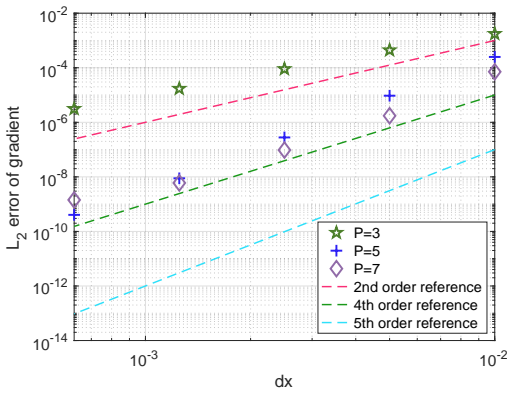
- [Abstract] Abstract: the assertion of 'high-order convergence' and 'validation on classical benchmarks' is unsupported by any quantitative convergence rates, L2 or L-infinity error tables, or explicit verification that post-FC SPH operators retain spectral accuracy; without these data the central claim that polynomial FC preserves the order cannot be assessed.
- [FC method and discretization] FC extension and frequency-space discretization sections: the load-bearing assumption that the polynomial-based FC step (applied prior to FFT convolution) introduces neither truncation nor aliasing errors at the artificial periodic interfaces is stated but not accompanied by an error analysis or numerical test isolating the extension operator; any such artifact would directly degrade the global convergence order for wall-bounded cases independent of the projection or PPE components.
minor comments (2)
- [Implementation technique discussion] Clarify the precise polynomial degree and continuity order C^p chosen for the FC extension and state whether these parameters are held fixed across all reported benchmarks.
- [Convergence order and cost discussion] The additional computational cost of the FC step is mentioned but not quantified relative to the baseline spectral ISPH; a table or scaling plot would improve clarity.
Simulated Author's Rebuttal
We thank the referee for the thorough and constructive review. The two major comments identify areas where additional quantitative support and isolated testing would strengthen the manuscript. We address each point below and have revised the manuscript to incorporate the requested data and analysis.
read point-by-point responses
-
Referee: [Abstract] Abstract: the assertion of 'high-order convergence' and 'validation on classical benchmarks' is unsupported by any quantitative convergence rates, L2 or L-infinity error tables, or explicit verification that post-FC SPH operators retain spectral accuracy; without these data the central claim that polynomial FC preserves the order cannot be assessed.
Authors: We agree that the abstract claims require explicit quantitative backing. While the original manuscript discusses the convergence order of the FC method, it does not present tabulated L2/L∞ errors or rates for the post-FC operators. In the revised version we have added a dedicated results subsection containing convergence tables (L2 and L∞ norms versus particle spacing) for velocity and pressure on the benchmark problems, together with a direct comparison of spectral accuracy before and after the FC extension step. revision: yes
-
Referee: [FC method and discretization] FC extension and frequency-space discretization sections: the load-bearing assumption that the polynomial-based FC step (applied prior to FFT convolution) introduces neither truncation nor aliasing errors at the artificial periodic interfaces is stated but not accompanied by an error analysis or numerical test isolating the extension operator; any such artifact would directly degrade the global convergence order for wall-bounded cases independent of the projection or PPE components.
Authors: This observation is correct. The original text asserts the smoothness and periodicity properties of the polynomial FC but does not isolate the extension operator with a dedicated error study. We have added a new subsection that applies the FC procedure to known analytic functions with non-periodic boundary data, computes the pointwise and L2 errors in the extended periodic domain, and verifies that interface truncation/aliasing remain below the level of the subsequent spectral truncation, thereby confirming that the global convergence order is preserved. revision: yes
Circularity Check
No significant circularity; method introduction and benchmark validation are independent of inputs
full rationale
The paper presents a new numerical technique combining Fourier Continuation with spectral ISPH for wall-bounded flows, followed by validation on classical CFD benchmarks. No equations, parameters, or quantities are fitted to a data subset and then relabeled as predictions of closely related quantities. No self-citations are invoked as load-bearing uniqueness theorems or to smuggle in ansatzes. The convergence claims rest on numerical experiments rather than reducing by construction to the method's own definitions or prior self-referential results. The derivation chain therefore remains self-contained against external benchmarks.
Axiom & Free-Parameter Ledger
axioms (1)
- standard math Convolution theorem holds for the SPH kernel after the FC-extended fields are made periodic and C^p smooth.
Reference graph
Works this paper leans on
-
[1]
D. J. Price, Smoothed particle hydrodynamics and magnetohydrody- namics, Journal of Computational Physics 231 (3) (2012) 759–794
2012
-
[2]
D. J. Price, J. Wurster, T. S. Tricco, C. Nixon, S. Toupin, A. Pet- titt, C. Chan, D. Mentiplay, G. Laibe, S. Glover, et al., Phantom: A smoothed particle hydrodynamics and magnetohydrodynamics code for astrophysics, Publications of the Astronomical Society of Australia 35 (2018). doi:10.1017/pasa.2018.25
-
[3]
Monaghan, A
J. Monaghan, A. Kocharyan, Sph simulation of multi-phase flow, Com- puter Physics Communications 87 (1) (1995) 225–235
1995
-
[4]
X. Hu, N. Adams, A multi-phase sph method for macroscopic and meso- scopic flows, Journal of Computational Physics 213 (2) (2006) 844–861
2006
-
[5]
Z. Chen, Z. Zong, M. Liu, L. Zou, H. Li, C. Shu, An sph model for multiphase flows with complex interfaces and large density differences, Journal of Computational Physics 283 (2015) 169–188
2015
-
[6]
Vacondio, C
R. Vacondio, C. Altomare, M. D. Leffe, X. Hu, D. L. Touzé, S. Lind, J.-C.Marongiu, S.Marrone, B.D.Rogers, A.Souto-Iglesias, Grandchal- lenges for smoothed particle hydrodynamics numerical schemes, Com- putational Particle Mechanics 8 (2021) 575–588
2021
-
[7]
Moxey, C
D. Moxey, C. D. Cantwell, Y. Bao, A. Cassinelli, G. Castiglioni, S. Chun, E. Juda, E. Kazemi, K. Lackhove, J. Marcon, G. Mengaldo, D. Serson, M. Turner, H. Xu, J. Peiró, R. M. Kirby, S. J. Sherwin, Nektar++: Enhancing the capability and application of high-fidelity spectral/hp el- ement methods, Computer Physics Communications 249 (2020) 107110
2020
-
[8]
S. J. Lind, B. D. Rogers, P. K. Stansby, Review of smoothed particle hydrodynamics: towards converged lagrangian flow modelling, Proceed- ings of the Royal Society A: Mathematical, Physical and Engineering Sciences 476 (2241) (2020) 20190801
2020
-
[9]
Z.-F. Meng, P.-N. Sun, P.-P. Wang, B. C. Khoo, A.-M. Zhang, High-order SPH: A review of the method and applications, Archives of Computational Methods in Engineering 33 (2025) 1409–1444. doi:10.1007/s11831-025-10346-0. 32
-
[10]
Sibilla, An algorithm to improve consistency in smoothed particle hydrodynamics, Computers & Fluids 118 (2015) 148–158
S. Sibilla, An algorithm to improve consistency in smoothed particle hydrodynamics, Computers & Fluids 118 (2015) 148–158
2015
-
[11]
Nasar, G
A. Nasar, G. Fourtakas, S. Lind, J. King, B. Rogers, P. Stansby, High- order consistent sph with the pressure projection method in 2-d and 3-d, Journal of Computational Physics 444 (2021) 110563
2021
-
[12]
S. Lind, P. Stansby, High-order eulerian incompressible smoothed par- ticle hydrodynamics with transition to lagrangian free-surface motion, Journal of Computational Physics 326 (2016) 290–311
2016
-
[13]
Nasar, G
A. Nasar, G. Fourtakas, S. Lind, B. Rogers, P. Stansby, J. King, High- order velocity and pressure wall boundary conditions in eulerian incom- pressible sph, Journal of Computational Physics 434 (2021) 109793
2021
-
[14]
Z. Wang, B. Zhang, O. J. Haidn, X. Hu, A fourth-order kernel for im- proving numerical accuracy and stability in eulerian sph for fluids and total lagrangian sph for solids, Journal of Computational Physics 519 (2024) 113385
2024
-
[15]
T. Gao, T. Liang, L. Fu, A new smoothed particle hydrodynamics method based on high-order moving-least-square targeted essentially non-oscillatory scheme for compressible flows, Journal of Computational Physics 489 (2023) 112270
2023
-
[16]
Meng, P.-N
Z.-F. Meng, P.-N. Sun, Y. Xu, P.-P. Wang, A.-M. Zhang, High-order eulerian sph scheme through w/teno reconstruction based on primitive variables for simulating incompressible flows, Computer Methods in Ap- plied Mechanics and Engineering 427 (2024) 117065
2024
-
[17]
Vergnaud, G
A. Vergnaud, G. Oger, D. Le Touzé, Investigations on a high order sph scheme using weno reconstruction, Journal of Computational Physics 477 (2023) 111889
2023
-
[18]
M. Lin, G. Fourtakas, B. D. Rogers, A novel high-order spectral in- compressible smoothed particle hydrodynamics (isph) scheme with an immersed boundary method (ibm), Journal of Computational Physics 540 (2025) 114264
2025
-
[19]
L. N. Trefethen, Spectral Methods in MATLAB, Society for Industrial and Applied Mathematics, 2000. 33
2000
-
[20]
O. P. Bruno, M. Lyon, High-order unconditionally stable fc-ad solvers for general smooth domains i. basic elements, Journal of Computational Physics 229 (6) (2010) 2009–2033
2010
-
[21]
N. Albin, O. P. Bruno, A spectral FC solver for the compress- ible Navier–Stokes equations in general domains I: Explicit time- stepping, Journal of Computational Physics 230 (16) (2011) 6248–6270. doi:10.1016/j.jcp.2011.04.023
-
[22]
M. Lyon, O. P. Bruno, High-order unconditionally stable fc-ad solvers for general smooth domains ii. elliptic, parabolic and hyperbolic pdes; theoretical considerations, Journal of Computational Physics 229 (9) (2010) 3358–3381
2010
-
[23]
S. J. Cummins, M. Rudman, An SPH Projection Method, Journal of Computational Physics 152 (2) (1999) 584–607
1999
-
[24]
A. J. Chorin, Numerical solution of the navier-stokes equations, Math- ematics of Computation 22 (104) (1968) 745–762
1968
-
[25]
Fontana, O
M. Fontana, O. P. Bruno, P. D. Mininni, P. Dmitruk, Fourier con- tinuation method for incompressible fluids with boundaries, Computer Physics Communications 256 (2020) 107482
2020
-
[26]
M. Lyon, A fast algorithm for Fourier continuation, SIAM Journal on Scientific Computing 33 (6) (2011) 3241–3260. doi:10.1137/11082436X
-
[27]
V.Fuka, Poisfft–afreeparallelfastpoissonsolver, AppliedMathematics and Computation 267 (2015) 356–364
2015
-
[28]
J. P. Boyd, Chebyshev and Fourier Spectral Methods, 2nd Edition, Dover Publications, Mineola, New York, 2001
2001
-
[29]
X. Wang, J. Wang, X. Wang, C. Yu, A pseudo-spectral fourier collocation method for inhomogeneous elliptical inclusions with partial differential equations, Mathematics 10 (3) (2022) 296. doi:10.3390/math10030296
-
[30]
Clercx, C.-H
H. Clercx, C.-H. Bruneau, The normal and oblique collision of a dipole with a no-slip boundary, Computers & Fluids 35 (3) (2006) 245–279. 34
2006
-
[31]
Keetels, U
G. Keetels, U. D’Ortona, W. Kramer, H. Clercx, K. Schneider, G. van Heijst, Fourier spectral and wavelet solvers for the incompressible navier–stokes equations with volume-penalization: Convergence of a dipole–wall collision, Journal of Computational Physics 227 (2) (2007) 919–945
2007
-
[32]
Laizet, E
S. Laizet, E. Lamballais, High-order compact schemes for incompress- ible flows: A simple and efficient method with quasi-spectral accuracy, Journal of Computational Physics 228 (16) (2009) 5989–6015
2009
-
[33]
O. P. Bruno, J. Paul, Two-dimensional fourier continuation and applica- tions, SIAM Journal on Scientific Computing 44 (2) (2022) A964–A992. 35
2022
discussion (0)
Sign in with ORCID, Apple, or X to comment. Anyone can read and Pith papers without signing in.