REVIEW 4 major objections 5 minor 44 references
Purity results for some arithmetically defined measures
T0 review · 4 major / 5 minor · reviewed 2026-08-14 · deepseek-v4-flash
Pith's one-line read The paper proves that digit-expansion measures from sofic shifts are pure, and that absolute continuity is equivalent to vanishing of all Fourier limits at Pisot powers.
desk verdict The purity theorem's proof has a real gap in Lemma 1, but the paper extends Erdős measures to sofic shifts in a way that deserves a serious referee. read the letter →
The pith
A machine-rendered reading of the paper's core claim, the machinery that carries it, and where it could break.
The reading
What carries the argument
The load-bearing device is the two-sided digital map $\Phi:K\to\mathbb{T}^r$, sending a bi-infinite digit sequence to the vector of fractional parts $(\sum_{k=-\infty}^{\infty} x_k\beta^{-k+m})_{m=0}^{r-1}$; the Pisot property makes the series converge and makes this map conjugate the shift to a hyperbolic toral endomorphism. Its push-forward $\psi$ has Fourier coefficient at $(m_0,\dots,m_{r-1})$ equal to $\lim_{k\to\infty}\hat\nu(z\beta^k)$ for $z=m_0+\cdots+m_{r-1}\beta^{r-1}$ (Theorem 4). The Fourier transform of $\nu$ is also written as an infinite product of weighted transition matrices, $\hat\nu(t)=v_L^T\prod_{n=1}^\infty W(\beta^{-n}t)\,v_R$ with $W(t)=\lambda^{-1}\sum_a e(-at)M_a$, which is what makes the limits computable in examples.
What would settle it
Construct a primitive finite automaton and a Pisot $\beta$ for which all limits $\lim_{k\to\infty}\hat\nu(z\beta^k)$ with $z\in\mathbb{Z}[\beta]\setminus\{0\}$ vanish but $\nu$ is singular (e.g. singular continuous); such an example would refute Theorem 5. Concretely, one could search among automata of the same small size as the paper's examples, computing the matrix product numerically, and then test absolute continuity by estimating the density of $\nu$ from long digit strings.
Extended reading notes
Core claim
The paper's central claim is that for every Pisot number $\beta$ and every sofic shift with primitive language, the measure $\nu$ obtained by pushing the Parry measure through the digital map $(x_k)\mapsto\sum_{k=1}^\infty x_k\beta^{-k}$ is absolutely continuous with respect to Lebesgue measure if and only if $\lim_{k\to\infty}\hat\nu(z\beta^k)=0$ for every nonzero $z\in\mathbb{Z}[\beta]$ (Theorem 5). The 'if' direction is proved by packaging all these limits as the Fourier coefficients of a measure $\psi$ on the $r$-dimensional torus obtained from the two-sided shift: $\psi$ is Lebesgue exactly when all coefficients vanish, and the paper asserts that Lebesgue $\psi$ forces $\nu$ to be absolutely continuous. The 'only if' direction is the standard fact that a non-vanishing limit obstructs absolute continuity. The same framework shows the measure is pure (Theorem 1) and that it is atomic exactly when every cycle in the automaton has the same digit-series value (Theorems 2 and 3).
Load-bearing premise
The proof's key unproven premise is that if the auxiliary measure on the high-dimensional torus is Lebesgue measure, then the projected one-dimensional measure $\nu$ must be absolutely continuous; singular measures on the line can project to Lebesgue on the circle, so this implication needs the special structure of these digital measures and is not established in the paper.
Editorial extensions
If this is right
- For any sofic digit system with Pisot base, the question 'is the measure smooth?' reduces to checking whether certain Fourier limits vanish; this is in principle decidable by approximating matrix products.
- The purity theorem rules out mixtures: a measure of this type can never be partly absolutely continuous and partly singular.
- The atomic case has a graph-theoretic characterization: the measure is a finite sum of point masses exactly when every cycle in the automaton satisfies equation (17) with the same value.
- The class covered includes measures from optimal base-2 expansions used in fast scalar multiplication on elliptic curves and spectral measures of substitution systems, so the criterion applies across those settings.
- If the main theorem is right, then for this class the Rajchman property—Fourier transform tending to 0 at infinity—actually implies absolute continuity, matching a recently proved phenomenon for self-similar measures.
Reading between the lines
- A practical test emerges that the author did not spell out: enumerate a finite set of $z\in\mathbb{Z}[\beta]$ and approximate $\lim_k\hat\nu(z\beta^k)$ by truncating the matrix product; any nonzero limit certifies singularity, and vanishing on the finite set is evidence for absolute continuity.
- The unproven implication in Theorem 5's proof—Lebesgue $\psi$ forces absolutely continuous $\nu$—is the natural place to look for a hidden counterexample; testing it requires a sofic shift whose torus measure is uniform while its one-dimensional projection is singular.
- The same matrix-product formalism should extend to non-Parry weightings (e.g. arbitrary Bernoulli digit probabilities), where purity may fail but the Fourier-limit criterion for absolute continuity may still hold in modified form.
- Combining purity with Hausdorff dimension computations could yield that dimension 1 plus vanishing limits implies absolute continuity, a sharper statement than either property alone.
Signed reviews
Editorial analysis
A structured set of objections, weighed in public.
Referee Report
Summary. This paper studies measures obtained by pushing forward the Parry measure on a primitive sofic shift K+ under the digital map x ↦ Σ_{k≥1} x_k β^{-k}, where β > 1 is a Pisot number and the digits belong to a finite integer alphabet. The author states four main results: a purity theorem for the pushed measures (Theorem 1), a finite/perfect dichotomy for the image set φ+(K+) (Theorems 2 and 3), a formula expressing lim_{k→∞} ν̂(zβ^k) as a Fourier coefficient of a two-sided torus measure ψ (Theorem 4), and an equivalence between absolute continuity of ν and the vanishing of those limits for all nonzero z ∈ Z[β] (Theorem 5). Several examples illustrate atomic, absolutely continuous, and singular cases, including classical Erdős measures and greedy β-expansions.
Significance. If the results were correct, the paper would give an attractive automata-theoretic and Fourier characterization of absolute continuity for a broad class of digit measures, extending Erdős's classical work and paralleling recent Rajchman-property results for self-similar measures. The matrix-product point of view and the use of Pisot conjugates to lift the problem to a torus are natural and potentially useful, and the statement of Theorem 5 is elegant. The examples are informative and include both known and new-looking cases. However, several proofs contain load-bearing errors, so the main theorems are not established as written.
major comments (4)
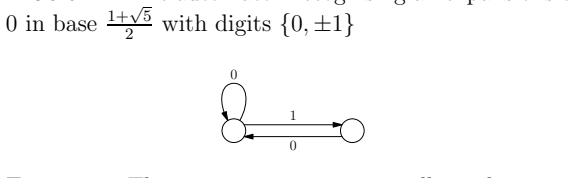
- [§5, Lemma 1] The proof of Lemma 1 claims that the sets X^{-1}(D) and X^{-1}(S) are shift-invariant. This is false. Since X∘σ = X − X_1, or equivalently X∘σ = β(X − X_1) for the digital map, the membership of σx in X^{-1}(D) requires X(x) − X_1(x) ∈ D, which is an invariance property of the atom set that is neither stated nor proved. In the setting of Example 1, D = {0, ±1, ±1/β} and A = {−1, 0, 1}; with digit a = 0 and atom 1 ∈ D, the required condition would give β(1 − 0) = β ∉ D. Thus the ergodicity argument does not go through, and Theorem 1 is unsupported. A different proof of purity, or a corrected hypothesis that guarantees the needed invariance, is required.
- [§5, Lemma 4] Lemma 4 asserts that for an atom x of ν, the equality (φ+)^{−1}({x}) = (φ+)^{−1}(x−ε, x+ε) holds for small ε because the set of atoms is finite. Finiteness separates x from the other atoms, but not from the continuous part of the image: if x is not an isolated point of φ+(K+), every interval around x contains image points different from x. The asserted equality would in fact force x to be isolated in φ+(K+), which is precisely the dichotomy that Theorem 2 is trying to establish. Consequently the use of Lemma 4 in the proof of Theorem 2 to exclude atoms in the perfect case is invalid.
- [§5, Lemma 3] The proof of Lemma 3 claims that every element of E is an algebraic integer. This is false for β = 2, which the paper explicitly treats as a Pisot number. With digits {0, ±1}, the word (1, −1, −1) satisfies 1/2 − 1/4 − 1/4 = 0, and the suffix after the first digit has value −1/2, which is not an algebraic integer. The bounded-conjugate argument therefore does not apply as written. The lemma may still be true, but the finiteness proof needs a different mechanism, such as a finite carry set, before the statement can be accepted.
- [§6, Theorem 5] The proof of Theorem 5 asserts without argument that if ψ is Lebesgue measure on T^r, then ν = P_*∘~Φ_*(μ) is absolutely continuous on R. This implication is true, but it is not immediate and the manuscript should prove it. One natural proof is to disintegrate η = ~Φ_*(μ) with respect to Lebesgue measure on T^r along the fibers of the mod-1 map; since these fibers are copies of Z^r, a finite measure on R^r whose mod-1 projection is Lebesgue is a countable sum of absolutely continuous pieces. As written, a central step of the characterization is missing, although it is repairable.
minor comments (5)
- [Introduction] There are typographical errors, for example 'refe r' in the first paragraph of Section 1.
- [§5, Lemma 2] In the proof of Lemma 2, the sentence 'from which shows that x ∈ Q(β)' is ungrammatical; moreover, the return time n depends on the chosen y, and the paper should state explicitly that the conjugate bound remains uniform because |β_q|^n ≤ 1 for |β_q| < 1.
- [§7, Example 4] Example 4 quotes a numerical value of lim_{n→∞} ν̂(β^n) without specifying the accuracy or the method of computation; a brief description of the numerical procedure and an error bound would be helpful.
- [§6, Remark 4] Remark 4 states that B is ergodic with respect to ψ because ψ is the pushforward of an ergodic measure under Φ; this is correct, but the manuscript should also justify that Φ intertwines the shift with B, since Φ is not known to be injective.
- [References] Reference [5] is cited as forthcoming; if it has appeared by the time of publication, the citation should be updated.
Circularity Check
No circularity: the central Fourier characterization is derived from the explicit definition of the measures; the proof gap in Lemma 1 is a correctness issue, not an input-conclusion loop.
full rationale
The paper's central results are not circular. The measures ν and ν_I are defined by pushing forward the Parry measure on a sofic shift under the digital map; all subsequent statements (Proposition 1, Theorems 4-5) are derived from this definition via explicit matrix products and the Pisot embedding, not assumed in the inputs. Theorem 5 is an equivalence between absolute continuity of ν and vanishing of the limits lim_k ν̂(zβ^k); the proof derives these limits as Fourier coefficients of a torus measure ψ, uses Fourier uniqueness to identify ψ with Lebesgue measure, and then uses the linear finite-to-one relationship between Φ̃ and Φ (and the standard fact that a measure on R^r whose mod-1 projection is Lebesgue is absolutely continuous) to transfer absolute continuity back to ν. No free parameter is fitted, and no target statement is hidden in an input. The author's self-citations (e.g., [17-21]) are historical or contextual and appear in the introduction and Example 5; the load-bearing theorems cite standard external results (Perron-Frobenius, Jessen-Wintner, Fourier uniqueness). There is a genuine proof gap in Lemma 1: the sentence 'Then X^{-1}(D) is a shift invariant subset of K+' is asserted without proof and is not generally true for the present cocycle φ+(σx)=β(φ+(x)-x_1) unless β(D-A)⊆D; this makes Theorem 1's purity proof incomplete. But this is an invalid step, not a circular reduction: it does not assume the theorem's conclusion as an input, and it does not make the derivation equivalent to its premises. Under the hard rules, gaps and overgeneralizations are correctness risks, not circularity.
Assumptions & free parameters
assumptions (5)
- standard math Perron-Frobenius theorem for primitive nonnegative matrices
- standard math Jessen-Wintner theorem
- standard math Pisot number properties: powers almost integers and bounded conjugates
- ad hoc to paper Lemma 1: generalized purity for ergodic shift-invariant measures
- domain assumption Primitive/irreducible language assumption
Cite this review
Pith. "Pith review of Purity results for some arithmetically defined measures." pith.science (2026). https://pith.science/paper/3GLF7OAQ
@misc{pith2026190809023,
  author       = {Pith},
  title        = {Pith review of: Purity results for some arithmetically defined measures},
  year         = {2026},
  howpublished = {\url{https://pith.science/paper/3GLF7OAQ}},
  note         = {Machine review of arXiv:1908.09023}
}
abstract
We study measures that are obtained as push-forwards of measures of maximal entropy on sofic shifts under digital maps $(x_k)_{k\in\mathbb{N}}\mapsto\sum_{k\in\mathbb{N}}x_k\beta^{-k}$, where $\beta>1$ is a Pisot number. We characterise the continuity of such measures in terms of the underlying automaton and show a purity result.
Figures


Figures from the paper (1 more)

Reference graph
Works this paper leans on
-
[1]
M. Baake and U. Grimm, Aperiodic order. Vol. 1, Encyclopedia of Mathematics and its Applications, vol. 149, Cambridge University Press, Cambridg e, 2013, A mathematical invitation, With a foreword by Roger Penrose. 2. , Fourier transform of Rauzy fractals and point spectrum of 1D Pisot inflation tilings , arXiv:1907.11012, July 2019
arXiv 2013
-
[3]
M.-P. B´ eal and D. Perrin, Symbolic dynamics and finite automata , Handbook of formal languages, Vol. 2, Springer, Berlin, 1997, pp. 463–505. 18 P. J. GRABNER
work page 1997
- [4]
-
[5]
Self-similar measures and the Rajchman property
J. Br´ emont, Self-similar measures and the Rajchman property , Ann. H. Lebesgue (2021), to appear, https://arxiv.org/abs/1910.03463
work page Pith review arXiv 2021
-
[6]
E. Breuillard and P. P. Varj´ u, On the dimension of Bernoulli convolutions , Ann. Probab. 47 (2019), no. 4, 2582–2617
work page 2019
-
[7]
I. P. Cornfeld, S. V. Fomin, and Ya. G. Sina ˘ ı, Ergodic theory, Grundlehren der Mathematischen Wissenschaften [Fundamental Principles of Mathe matical Sci- ences], vol. 245, Springer-Verlag, New York, 1982, Translated fr om the Russian by A. B. Sosinski ˘ ı
work page 1982
-
[8]
K. Dajani and C. Kraaikamp, Ergodic theory of numbers , Carus Mathematical Monographs, vol. 29, Mathematical Association of America, Washin gton, DC, 2002
work page 2002
-
[9]
Diestel, Graph theory , fifth ed., Graduate Texts in Mathematics, vol
R. Diestel, Graph theory , fifth ed., Graduate Texts in Mathematics, vol. 173, Springer, Berlin, 2017
work page 2017
Show all 44 references
-
[10]
Eilenberg, Automata, languages, and machines
S. Eilenberg, Automata, languages, and machines. Vol. A , Academic Press [A subsidiary of Harcourt Brace Jovanovich, Publishers], New York, 1 974, Pure and Applied Mathematics, Vol. 58
-
[11]
P. D. T. A. Elliott, Probabilistic number theory. I, mean-value theorems , Grundlehren der Mathematischen Wissenschaften, vol. 239, Sprin ger-Verlag, New York, 1979
1979
-
[12]
Erd˝ os,On a family of symmetric Bernoulli convolutions , Amer
P. Erd˝ os,On a family of symmetric Bernoulli convolutions , Amer. J. Math. 61 (1939), 974–976
1939
-
[13]
, On the smoothness properties of a family of Bernoulli convol utions, Amer. J. Math. 62 (1940), 180–186
1940
-
[14]
Feng and H
D.-J. Feng and H. Hu, Dimension theory of iterated function systems , Comm. Pure Appl. Math. 62 (2009), no. 11, 1435–1500
2009
-
[15]
Frougny, Representations of numbers and finite automata , Math
C. Frougny, Representations of numbers and finite automata , Math. Systems Theory 25 (1992), no. 1, 37–60
1992
-
[16]
, Numeration systems , ch. 7, pp. 230–268, vol. 90 of Encyclopedia of Mathematics and its Applications [25], 2002
2002
-
[17]
P. J. Grabner and C. Heuberger, On the number of optimal base 2 representa- tions of integers , Des. Codes Cryptogr. 40 (2006), 25–39
2006
-
[18]
P. J. Grabner, C. Heuberger, and H. Prodinger, Distribution results for low- weight binary representations for pairs of integers , Theor. Comput. Sci. 319 (2004), 307–331
2004
-
[19]
3, A09, 19 pages (electronic)
, Counting optimal joint digit expansions , Integers 5 (2005), no. 3, A09, 19 pages (electronic)
2005
-
[20]
P. J. Grabner, P. Liardet, and R. F. Tichy, Spectral disjointness of dynamical systems related to some arithmetic functions , Publ. Math. Debrecen 66 (2005), 213–244
2005
-
[21]
P. J. Grabner and W. Steiner, Redundancy of minimal weight expansions in Pisot bases , Theor. Comput. Sci 412 (2011), 6303–6315
2011
-
[22]
M. A. Harrison, Introduction to formal language theory , Addison-Wesley Pub- lishing Co., Reading, Mass., 1978
1978
-
[23]
Jessen and A
B. Jessen and A. Wintner, Distribution functions and the Riemann zeta func- tion, Trans. Amer. Math. Soc. 38 (1935), 48–88. PURITY RESULTS FOR SOME ARITHMETICALLY DEFINED MEASURES 19
1935
-
[24]
Lind and B
D. Lind and B. Marcus, An introduction to symbolic dynamics and coding , Cambridge University Press, Cambridge, 1995
1995
-
[25]
Lothaire, Algebraic combinatorics on words , Encyclopedia of Mathematics and its Applications, vol
M. Lothaire, Algebraic combinatorics on words , Encyclopedia of Mathematics and its Applications, vol. 90, Cambridge University Press, Cambridge , 2002
2002
-
[26]
Parry, On the β -expansions of real numbers , Acta Math
W. Parry, On the β -expansions of real numbers , Acta Math. Acad. Sci. Hung. 11 (1960), 401–416
1960
-
[27]
Parry, Intrinsic Markov chains , Trans
W. Parry, Intrinsic Markov chains , Trans. Amer. Math. Soc. 112 (1964), 55–66
1964
-
[28]
, Symbolic dynamics and transformations of the unit interval , Trans. Amer. Math. Soc. 122 (1966), 368–378
1966
-
[29]
Peres, W
Y. Peres, W. Schlag, and B. Solomyak, Sixty years of Bernoulli convolu- tions, Fractal geometry and stochastics, II (Greifswald/Koserow, 1 998), Progr. Probab., vol. 46, Birkh¨ auser, Basel, 2000, pp. 39–65
2000
-
[30]
Queff´ elec, Substitution dynamical systems—spectral analysis , second ed., Lecture Notes in Mathematics, vol
M. Queff´ elec, Substitution dynamical systems—spectral analysis , second ed., Lecture Notes in Mathematics, vol. 1294, Springer-Verlag, Berlin, 2010
2010
-
[31]
Rajchman, Une classe de s´ eries trigonom´ etriques qui convergent pre sque partout vers z´ ero, Math
A. Rajchman, Une classe de s´ eries trigonom´ etriques qui convergent pre sque partout vers z´ ero, Math. Ann. 101 (1929), no. 1, 686–700
1929
-
[32]
R´ enyi, Representation for real numbers and their ergodic properti es, Acta Math
A. R´ enyi, Representation for real numbers and their ergodic properti es, Acta Math. Acad. Sci. Hung. 8 (1957), 477–493
1957
-
[33]
Saglietti, P
S. Saglietti, P. Shmerkin, and B. Solomyak, Absolute continuity of non- homogeneous self-similar measures , Adv. Math. 335 (2018), 60–110
2018
-
[34]
Sakarovitch, Elements of automata theory , Cambridge University Press, Cambridge, 2009, Translated from the 2003 French original by Reu ben Thomas
J. Sakarovitch, Elements of automata theory , Cambridge University Press, Cambridge, 2009, Translated from the 2003 French original by Reu ben Thomas
2009
-
[35]
Seneta, Nonnegative matrices and Markov chains , second ed., Springer Series in Statistics, Springer-Verlag, New York, 1981
E. Seneta, Nonnegative matrices and Markov chains , second ed., Springer Series in Statistics, Springer-Verlag, New York, 1981
1981
-
[36]
Shmerkin, On the exceptional set for absolute continuity of Bernoulli convo- lutions, Geom
P. Shmerkin, On the exceptional set for absolute continuity of Bernoulli convo- lutions, Geom. Funct. Anal. 24 (2014), no. 3, 946–958
2014
-
[37]
Shmerkin and B
P. Shmerkin and B. Solomyak, Absolute continuity of self-similar measures, their projections and convolutions , Trans. Amer. Math. Soc. 368 (2016), no. 7, 5125–5151
2016
-
[38]
Sidorov and A
N. Sidorov and A. Vershik, Ergodic properties of the Erd˝ os measure, the entropy of the golden shift, and related problems , Monatsh. Math. 126 (1998), no. 3, 215–261
1998
-
[39]
N. A. Sidorov, Bijective and general arithmetic codings for Pisot toral au to- morphisms, J. Dynam. Control Systems 7 (2001), no. 4, 447–472
2001
-
[40]
Solomyak, On the random series ∑ ±λ n (an Erd˝ os problem), Ann
B. Solomyak, On the random series ∑ ±λ n (an Erd˝ os problem), Ann. of Math. (2) 142 (1995), no. 3, 611–625
1995
-
[41]
P. P. Varj´ u,Absolute continuity of Bernoulli convolutions for algebra ic param- eters, J. Amer. Math. Soc. 32 (2019), no. 2, 351–397
2019
-
[42]
, On the dimension of Bernoulli convolutions for all transcen dental pa- rameters, Ann. of Math. (2) 189 (2019), no. 3, 1001–1011
2019
-
[43]
Varj´ u,Recent progress on Bernoulli convolutions , European Congress of Mathematics, Eur
P´ eter P. Varj´ u,Recent progress on Bernoulli convolutions , European Congress of Mathematics, Eur. Math. Soc., Z¨ urich, 2018, pp. 847–867
2018
-
[44]
Walters, Ergodic theory, Springer, Berlin, 1982
P. Walters, Ergodic theory, Springer, Berlin, 1982
1982
-
[45]
Winkler, The order theoretic structure of the set of P -sums of a sequence , Publ
R. Winkler, The order theoretic structure of the set of P -sums of a sequence , Publ. Math. Debrecen 58 (2001), no. 3, 467–490. 20 P. J. GRABNER Institut f ¨ur Analysis und Zahlentheorie, Technische Universit ¨at Graz, Kopernikusgasse 24/II, 8010 Graz, Austria Email address : ...
2001
Reviewed August 14, 2026 · model on record in the stance chip above.
Discussion (0). Continue with ORCID to comment.