REVIEW 3 major objections 4 minor 83 references
An enhanced single Gaussian point continuum finite element formulation using automatic differentiation
T0 review · 3 major / 4 minor · reviewed 2026-08-11 · deepseek-v4-flash
Pith's one-line read This paper claims that replacing the Taylor-series approximation of the inverse Jacobian with an exact automatic-differentiation computation turns the one-point hourglass-stabilized brick element Q1STc into a version, Q1STc+, that passes…
desk verdict A modest, honest improvement to a one-point hex element: exact AD inverse Jacobian fixes the membrane patch test and distortion sensitivity, but the solids patch test still fails and the 'approximation-free' label overreaches. read the letter →
The pith
A machine-rendered reading of the paper's core claim, the machinery that carries it, and where it could break.
The reading
What carries the argument
The load-bearing mechanism is the pointwise inverse Jacobian and its evaluation. In Q1STc, $J^{-1}$ is expanded as $J^{-1} \approx (J^0)^{-1} - \sum_i (J^0)^{-1} J^{\xi_i}(J^0)^{-1}\xi_i$, so all geometry enters the analytically integrated residual through a linear approximation taken at the element center. Q1STc+ replaces that formula with the exact matrix inverse $j = J(\xi)^{-1}$ computed by automatic differentiation, so the cartesian strain components inherit the true geometry pointwise. The rest of the hourglass stabilization still works through a Taylor expansion, up to bilinear terms, of the second Piola-Kirchhoff stress and the compatible and enhanced B-operators, with the volume element still approximated as $dV_e \approx \det(J^0)\,d\xi\,d\eta\,d\zeta$; only the inverse Jacobian is approximation-free.
What would settle it
Rerun the seven-element solid patch test with Q1STc+ after adding a trilinear $\xi\eta\zeta$ term to the Taylor expansion behind Equation (19). If the stress errors do not fall from their reported 14.5% peak toward the analytical values $2001.5$ and $400.5\ \mathrm{N/mm^2}$, then the residual failure is not caused by the bilinear truncation and the paper's explanation of the missing patch-test pass is wrong.
Extended reading notes
Core claim
On its own terms, the paper's central claim is that the Taylor-series expansion of the inverse Jacobian, used in the Q1STc formulation to keep the one-point element analytically integrable, is both unnecessary and harmful. With automatic differentiation, the inverse Jacobian $J^{-1}$ can be evaluated exactly at any point of the element, so the enhanced formulation Q1STc+ computes the geometry exactly while keeping all other ingredients of Q1STc unchanged. The payoff is that Q1STc+ passes the membrane patch test for linear elasticity, with stresses $1334.20$ and $400.50\ \mathrm{N/mm^2}$ reproduced to four decimals and no spurious out-of-plane stress; in the elasto-plastic version it agrees with a locking-free reference element where Q1STc overestimates the reaction force once plasticity starts; and on distorted meshes the force-displacement response no longer depends on distortion amplitude. The paper also states the limitation plainly: the solid patch test is still not passed, and the cause is attributed to the bilinear truncation of the Taylor expansion for the strain and constitutive quantities, not to the Jacobian approximation.
Load-bearing premise
The load-bearing assumption is that the bilinear Taylor truncation of strain and stress quantities suffices for hourglass stabilization and for capturing the element response, so that only the Jacobian needs to be exact; the paper's own seven-element solid patch test contradicts that assumption, with errors up to 14.5%.
Editorial extensions
If this is right
- A one-point hourglass-stabilized brick can pass the membrane patch test for a St. Venant-Kirchhoff material without any extra integration points, because exact Jacobian geometry removes the stress scatter that the Taylor-based element produced.
- In the elasto-plastic membrane test, Q1STc+ matches the locking-free reference curve, so the geometry upgrade also fixes the over-stiff plastic response of Q1STc.
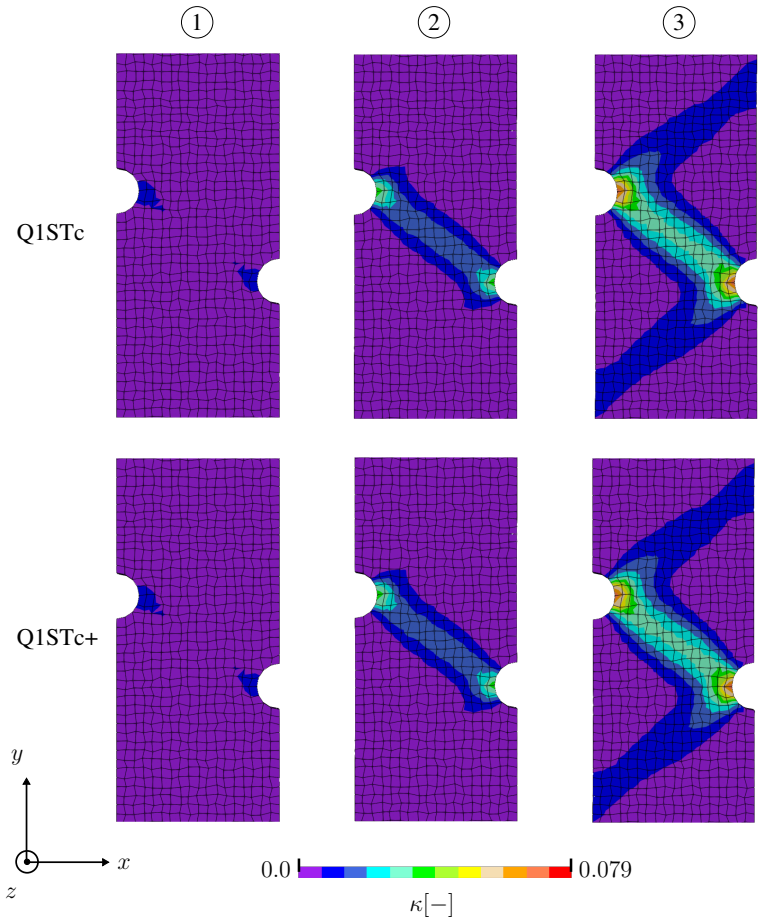
- Mesh distortion in the plane of the asymmetrically notched specimen no longer shifts the force-displacement curve for Q1STc+, whereas Q1STc drifts visibly for distortions of $\pm 0.5$ mm.
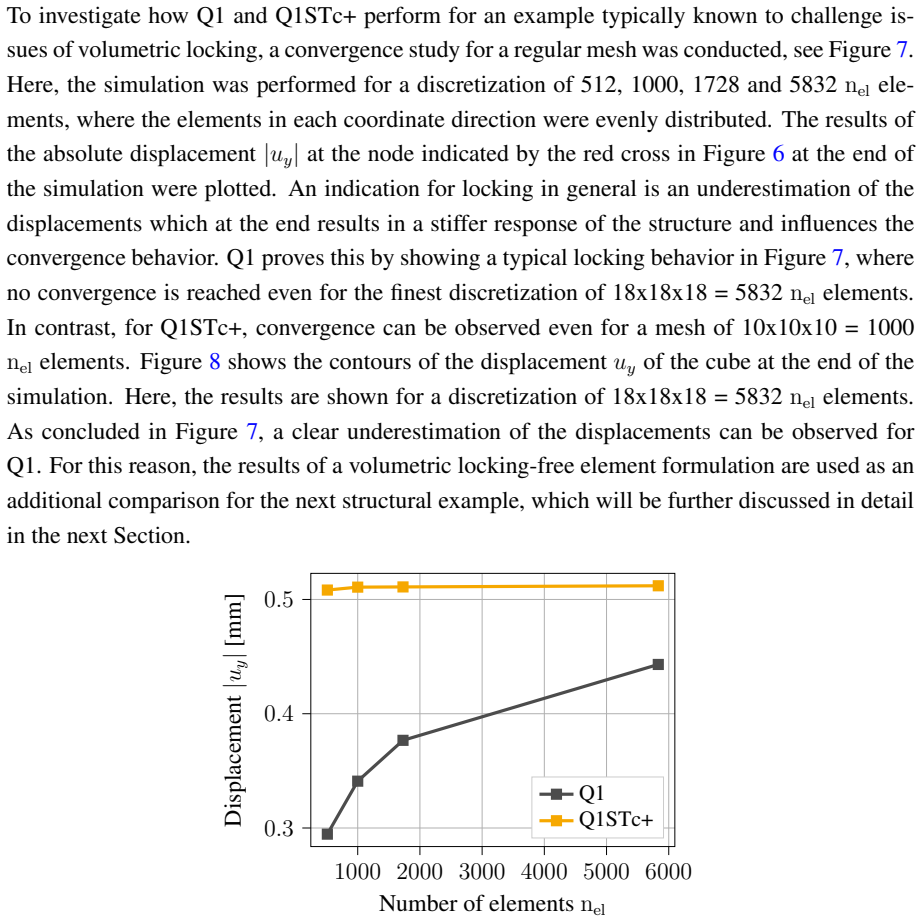
- In the cube-compression benchmark, Q1STc+ converges already at $10\times10\times10$ elements while the full-integration Q1 element still locks at $18\times18\times18$ elements.
- The solid patch test remains an open failure for both formulations, and the paper's suggested remedy is to extend the Taylor expansion to the trilinear terms.
Reading between the lines
- Because the volume measure still uses $\det(J^0)$ and the enhanced strain operator still uses $T^0$ at the element center, 'approximation-free' applies only to the inverse Jacobian; testing exact evaluation of those two quantities as well would show whether the remaining 14.5% solid-patch error is purely a truncation effect.
- The membrane patch test passes on a thin structure where out-of-plane stress vanishes, so the gain from exact Jacobian geometry is most visible where the structure is dominated by in-plane response; the same improvement may not carry over to a full three-dimensional stress state, as the solid patch test shows.
- The proposed trilinear extension is directly testable in the same automatic-differentiation framework: add the $\xi\eta\zeta$ term to the expansion behind Equation (19) and rerun the seven-element patch, and if exactness is restored, the truncation hypothesis is confirmed.
- Since the material derivations assume volume-preserving plasticity with $J_p=1$, the element's behavior under non-volume-preserving models such as pressure-dependent plasticity remains an open empirical question.
Editorial analysis
A structured set of objections, weighed in public.
Referee Report
Summary. The paper presents Q1STc+, a modification of the single-Gauss-point hourglass-stabilized hexahedral element Q1STc, in which the Taylor-series approximation of the inverse Jacobian used by Q1STc is replaced by an exact automatic differentiation (AD) evaluation. The authors compare Q1STc and Q1STc+ on the membrane patch test and the solid patch test, on a cube-under-compression locking benchmark, and on an elasto-plastic asymmetrically notched specimen with distorted meshes, using the mixed U-P-SBFEM formulation as a reference. The main reported outcomes are that Q1STc+ reproduces the analytical membrane patch stresses to four decimals while Q1STc does not, that Q1STc+ is insensitive to the tested mesh distortions in the notched specimen while Q1STc is not, and that Q1STc+ converges in the cube compression where Q1 locks. The paper also reports that both Q1STc and Q1STc+ fail the solid patch test, with Q1STc+ errors up to 14.5%, and attributes this to the bilinear Taylor truncation of strain and constitutive quantities.
Significance. If the results hold, the contribution provides a simple implementation-level improvement to a widely used reduced-integration element family: replacing a hand-derived Taylor approximation of the inverse Jacobian by an AD evaluation improves membrane patch behavior and distortion robustness without changing the element topology or the stabilization framework. The public availability of the element and material routines (Zenodo DOI) is a concrete strength, as is the use of an external analytical benchmark (Macneal and Harder membrane patch test) and an independent locking-free reference (U-P-SBFEM) for key comparisons. The significance is, however, moderated by the paper's own solid patch test failure, which leaves the scope of the improvement narrower than the phrase 'exact geometry' might suggest; the central claim is better stated as 'exact inverse Jacobian with remaining center-point approximations elsewhere in the formulation.'
major comments (3)
- [§7, Eq. (26); §4, Eq. (18); §9] The paper's conclusion states that 'the geometry of the system was calculated exactly using AD,' but the element formulation still uses the center-point volume measure dV0_e = det(J0) dξ dη dζ in all element integrals (Section 7, below Eq. (26)) and the center-point transformation T0 in the enhanced B-operator (Eq. (18)). Thus 'approximation-free' is demonstrated only for the inverse Jacobian, not for the geometry treatment as a whole. This distinction is load-bearing because the solid patch test failure documented in Table 3 could originate from these remaining center-point approximations rather than from the bilinear truncation in Eq. (19). The authors should either temper the conclusion or provide a diagnostic experiment: evaluate the solid patch test with an exact det(J(ξ)) and full T(ξ) field (e.g., via numerical quadrature) to identify which approximation actually produces the observed errors.
- [§8.1, Table 3; §9] The paper attributes the solid patch test failure to the 'non-sufficient approximation of the strain and constitutive quantities by a Taylor series expansion' and proposes extending the expansion to trilinear terms. This diagnosis is not tested by any numerical experiment. The same failure is equally consistent with the remaining det(J0) and T0 center-point approximations identified in Eq. (18) and Eq. (26); since a trilinear stress/strain expansion would not remove those center-point approximations, the proposed fix may not restore the solid patch test. The authors should either implement and test the trilinear extension or present a numerical comparison that isolates the two error sources before offering this explanation as the likely cause.
- [§8.2, Figure 7] The convergence study for the cube-under-compression example plots only Q1 and Q1STc+, with no reference solution. The text uses this figure to support the claim that Q1STc+ avoids volumetric locking, but a plateau in the displacement-versus-mesh curve only demonstrates mesh insensitivity; it does not by itself show that the converged value is the correct one. Adding the U-P-SBFEM result already used elsewhere in the paper, or another well-established reference solution, to Figure 7 would directly support the locking-free claim and remove the ambiguity.
minor comments (4)
- [§8.1, Table 1 and text] The element name is written inconsistently as 'Q1Stc+' in Table 1 and in several places in Section 8.1; it should be 'Q1STc+' everywhere.
- [§8.1] The material model name is written both as 'St.Venant Kirchhoff' and 'St. Venant-Kirchhoff'; please unify the spelling.
- [§8.2, Figure 7] In Figure 7, adding a horizontal reference line or a U-P-SBFEM curve, as suggested in the major comments, would make the convergence behavior immediately interpretable.
- [§2, Eq. (7); Table 2] The unit of the kinematic hardening parameter b is listed as '-' in Table 2, but the term b/(2a) tr(dev(Θ)^2) in Eq. (7) suggests that b has units of stress; please clarify the units or the normalization.
Circularity Check
No circularity: Q1STc+ replaces the Taylor-approximated inverse Jacobian with an exact AD evaluation and is validated against independent analytical and reference benchmarks; the admitted solids patch-test failure confirms the claim is not forced by construction.
full rationale
The paper's central claim is computational, not definitional: Q1STc+ computes the inverse Jacobian exactly via AD (Algorithm 2) instead of using the Taylor expansion of Equations (21)-(24). The claimed improvements are demonstrated on fixed benchmark problems with literature material parameters and no fitting to the benchmark responses. The hourglass stabilization tangent C^hg and effective shear modulus in Equation (20) are computed from the element state, not calibrated to the examples. The membrane patch test is an independent analytical benchmark from Macneal and Harder [51], and the paper reports Q1STc+ reproducing the analytical stresses to four decimals while Q1STc does not. This is a falsifiable numerical result, not a quantity that is equal to its input by construction. The cube-compression convergence and distorted-mesh force-displacement results are likewise obtained from the stated formulation and compared against Q1 and the mixed U-P-SBFEM element. The paper's own Table 3 and Section 9 explicitly report that Q1STc+ still fails the solids patch test with errors up to 14.5%, and the authors attribute this to the Taylor truncation of strain and constitutive quantities; this negative evidence further shows that the improvement is not a tautology. Self-citations, including Barfusz et al. for the baseline Q1STc formulation and Sauren and Klinkel for the U-P-SBFEM comparison element, are used as references and validation tools rather than as the logical derivation of the claimed enhancement. No equation, fitted parameter, or self-citation chain makes the predictions reduce to the inputs, so the appropriate finding is no significant circularity.
Assumptions & free parameters
free parameters (2)
- mu_hg_eff (effective shear modulus) =
Computed per Eq. (20) from dev(S0) and dev(E0_c) at the last converged step
- Material parameters (lambda, mu, a, b, e, f, sigma_y0) =
Tables 2 and 4 values (e.g., lambda = 25000 N/mm2, mu = 55000 N/mm2 for the elasto-plastic examples)
assumptions (5)
- domain assumption Bilinear Taylor truncation of the constitutively dependent quantities is sufficient for the hourglass stabilization
- domain assumption Volume-preserving plasticity with Jp = 1, so Je = J and p = kappa (J - 1)
- domain assumption The deviatoric hourglass tangent C^hg with the effective shear modulus adequately stabilizes the element in the elasto-plastic regime
- domain assumption Co-rotated intermediate configuration framework with multiplicative split F = Fe Fp and Voce/Armstrong-Frederick hardening
- standard math AD derivatives are exact and numerically stable for the generated AceGen code
Cite this review
Pith. "Pith review of An enhanced single Gaussian point continuum finite element formulation using automatic differentiation." pith.science (2026). https://pith.science/paper/3GRLUAPJ
@misc{pith2026241202309,
  author       = {Pith},
  title        = {Pith review of: An enhanced single Gaussian point continuum finite element formulation using automatic differentiation},
  year         = {2026},
  howpublished = {\url{https://pith.science/paper/3GRLUAPJ}},
  note         = {Machine review of arXiv:2412.02309}
}
read the original abstract
This contribution presents an improved low-order 3D finite element formulation with hourglass stabilization using automatic differentiation (AD). Here, the former Q1STc formulation is enhanced by an approximation-free computation of the inverse Jacobian. To this end, AD tools automate the computation and allow a direct evaluation of the inverse Jacobian, bypassing the need for a Taylor series expansion. Thus, the enhanced version, Q1STc+, is introduced. Numerical examples are conducted to compare the performance of both element formulations for finite strain applications, with particular focus on distorted meshes. Moreover, the performance of the new element formulation for an elasto-plastic material is investigated. To validate the obtained results, a volumetric locking-free element based on scaled boundary parametrization is used. Both the implementation of the element routine Q1STc+ and the corresponding material subroutine are made accessible to the public at https://doi.org/10.5281/zenodo.14259791
Figures


Figures from the paper (12 more)




Reference graph
Works this paper leans on
-
[1]
R. Alves de Sousa, R. Natal Jorge, R. Fontes Valente, and J. C´esar de S´a. A new volumetric and shear locking-free 3d enhanced strain element. Engineering Computations, 20(7): 36 896–925, 2003. doi: 10.1108/02644400310502036. URL https://www.emerald. com/insight/content/doi/10.1108/02644400310502036/full/html
-
[2]
Ambati, R
M. Ambati, R. Kruse, and L. De Lorenzis. A phase-field model for ductile fracture at finite strains and its experimental verification. Computational Mechanics, 57(1):149–167,
-
[3]
P. Areias, J. C´esar de S´a, C. C. Ant´onio, and A. Fernandes. Analysis of 3d problems using a new enhanced strain hexahedral element. International Journal for Numerical Methods in Engineering, 58(11):1637–1682, 2003. ISSN 1097-0207. doi: 10.1002/nme.835. URL https://onlinelibrary.wiley.com/doi/abs/10.1002/nme.835
-
[4]
P. J. Armstrong, C. O. Frederick, et al. A mathematical representation of the multiaxial Bauschinger effect, volume 731. Berkeley Nuclear Laboratories Berkeley, CA, 1966
1966
-
[7]
O. Barfusz, T. Brepols, T. van der Velden, J. Frischkorn, and S. Reese. A single gauss point continuum finite element formulation for gradient-extended damage at large deformations. Computer Methods in Applied Mechanics and Engineering , 373:113440, 2021. ISSN 00457825. doi: 10.1016/j.cma.2020.113440. URL https://linkinghub.elsev ier.com/retrieve/pii/S004...
arXiv 2021
-
[8]
O. Barfusz, T. van der Velden, T. Brepols, H. Holthusen, and S. Reese. A reduced integration-based solid-shell finite element formulation for gradient-extended damage. Computer Methods in Applied Mechanics and Engineering , 382:113884, 2021. ISSN 00457825. doi: 10.1016/j.cma.2021.113884. URL https://linkinghub.elsev ier.com/retrieve/pii/S0045782521002218
-
[9]
Bartholomew-Biggs, S
M. Bartholomew-Biggs, S. Brown, B. Christianson, and L. Dixon. Automatic differen- tiation of algorithms. Journal of Computational and Applied Mathematics , 2000. URL https://www.sciencedirect.com/science/article/pii/S0377042 700004222. 37
2000
-
[11]
P. Betsch and E. Stein. Numerical implementation of multiplicative elasto-plasticity into assumed strain elements with application to shells at large strains. Computer methods in applied mechanics and engineering , 179(3):215–245, 1999. ISSN 0045-7825. doi: 10.1016/S0045-7825(99)00063-8. URL https://www.sciencedirect.com/sc ience/article/pii/S0045782599000638
Show all 83 references
-
[13]
Bieber, B
S. Bieber, B. Oesterle, E. Ramm, and M. Bischoff. A variational method to avoid lock- ing—independent of the discretization scheme.International Journal for Numerical Meth- ods in Engineering, 114(8):801–827, 2018. ISSN 1097-0207. doi: 10.1002/nme.5766. URL https://onlinelibra...
2018 doi
-
[14]
Bieber, F
S. Bieber, F. Auricchio, A. Reali, and M. Bischoff. Artificial instabilities of finite el- ements for nonlinear elasticity: Analysis and remedies. International Journal for Nu- merical Methods in Engineering , 124(11):2638–2675, 2023. ISSN 1097-0207. doi: 10.1002/nme.7224. URL...
2023 doi
-
[15]
Bischoff and E
M. Bischoff and E. Ramm. Shear deformable shell elements for large strains and rotations. International Journal for Numerical Methods in Engineering , 40(23):4427–4449, 1997. ISSN 1097-0207. doi: 10.1002/(SICI)1097-0207(19971215)40:23 ⟨4427::AID-NME268⟩ 3.0.CO;2-9. URL https:/...
1997 doi
-
[16]
B ¨ohm, J
C. B ¨ohm, J. Korelc, B. Hudobivnik, A. Kraus, and P. Wriggers. Mixed virtual element formulations for incompressible and inextensible problems. Computational Mechanics, 72(6):1141–1174, 2023. ISSN 1432-0924. doi: 10.1007/s00466-023-02340-9. URL https://doi.org/10.1007/s00466-...
2023 doi
-
[17]
Bonet and P
J. Bonet and P. Bhargava. A uniform deformation gradient hexahedron element with arti- ficial hourglass control. International Journal for Numerical Methods in Engineering, 38 38 (16):2809–2828, 1995. ISSN 1097-0207. doi: 10.1002/nme.1620381608. URL https: //onlinelibrary.wile...
1995 doi
-
[18]
Bradbury, R
J. Bradbury, R. Frostig, P. Hawkins, M. J. Johnson, C. Leary, D. Maclaurin, G. Necula, A. Paszke, J. VanderPlas, S. Wanderman-Milne, et al. Jax: composable transformations of python+ numpy programs. 2018
2018
-
[19]
B ¨uchter, E
N. B ¨uchter, E. Ramm, and D. Roehl. Three-dimensional extension of non-linear shell formulation based on the enhanced assumed strain concept. International journal for numerical methods in engineering, 37(15):2551–2568, 1994. ISSN 1097-0207. doi: 10.1 002/nme.1620371504. URL ...
1994 doi
-
[20]
Cangiani, G
A. Cangiani, G. Manzini, A. Russo, and N. Sukumar. Hourglass stabilization and the virtual element method. International Journal for Numerical Methods in Engineering , 102(3):404–436, 2015. ISSN 1097-0207. doi: 10.1002/nme.4854. URL https: //onlinelibrary.wiley.com/doi/abs/10....
2015 doi
-
[22]
R. P. R. Cardoso, J. W. Yoon, M. Mahardika, S. Choudhry, R. J. Alves de Sousa, and R. A. Fontes Valente. Enhanced assumed strain (EAS) and assumed natural strain (ANS) meth- ods for one-point quadrature solid-shell elements. International Journal for Numerical Methods in Engin...
2008 doi
-
[23]
Cihan, B
M. Cihan, B. Hudobivnik, J. Korelc, and P. Wriggers. A virtual element method for 3d contact problems with non-conforming meshes. Computer Methods in Applied Mechanics and Engineering, 402:115385, 2022. ISSN 0045-7825. doi: 10.1016/j.cma.2022.115385. URL https://www.sciencedir...
2022
-
[24]
B. D. Coleman and W. Noll. Foundations of linear viscoelasticity. Reviews of modern physics, 33(2):239–249, 1961. ISSN 0034-6861. doi: 10.1103/RevModPhys.33.239. URL https://link.aps.org/doi/10.1103/RevModPhys.33.239. 39
1961 doi
-
[25]
Crisfield, G
M. Crisfield, G. Moita, L. Lyons, and G. Jeleni ´c. Enhanced lower-order element formu- lations for large strains. Computational mechanics, 17(1):62–73, 1995. ISSN 1432-0924. doi: 10.1007/BF00356479. URL https://doi.org/10.1007/BF00356479
1995 doi
-
[26]
L. B. Da Veiga, F. Brezzi, and L. D. Marini. Virtual elements for linear elasticity problems. SIAM Journal on Numerical Analysis , 51(2):794–812, 2013. URL https://epubs. siam.org/doi/abs/10.1137/120874746
2013 doi
-
[27]
de Souza Neto, D
E. de Souza Neto, D. Peri ´c, G. Huang, and D. Owen. Remarks on the stability of enhanced strain elements in finite elasticity and elastoplasticity. Communications in Numerical Methods in Engineering , 11(11):951–961, 1995. ISSN 1099-0887. doi: 10.1002/cnm.1640111109. URL http...
1995 doi
-
[28]
Dettmer and S
W. Dettmer and S. Reese. On the theoretical and numerical modelling of arm- strong–frederick kinematic hardening in the finite strain regime. Computer Methods in Applied Mechanics and Engineering , 193(1):87–116, 2004. ISSN 00457825. doi: 10.1016/j.cma.2003.09.005. URL https:/...
2004 doi
-
[29]
D. C. Drucker and W. Prager. Soil mechanics and plastic analysis or limit design. Appl. Math, 10(2):157–165, 1952. ISSN 0033-569X. URL https://www.jstor.org/st able/43633942
1952
-
[30]
Frischkorn and S
J. Frischkorn and S. Reese. A solid-beam finite element and non-linear constitutive mod- elling. Computer Methods in Applied Mechanics and Engineering , 265:195–212, 2013. ISSN 00457825. doi: 10.1016/j.cma.2013.06.009. URL https://linkinghub.e lsevier.com/retrieve/pii/S0045782...
2013 doi
-
[31]
A. L. Gain, C. Talischi, and G. H. Paulino. On the virtual element method for three- dimensional linear elasticity problems on arbitrary polyhedral meshes.Computer Methods in Applied Mechanics and Engineering , 282:132–160, 2014. URL https://www.sc iencedirect.com/science/arti...
2014
-
[32]
Glaser and F
S. Glaser and F. Armero. On the formulation of enhanced strain finite elements in finite deformations. Engineering Computations, 14(7):759–791, 1997. ISSN 0264-4401. doi: 10.1108/02644409710188664. URL https://doi.org/10.1108/0264440971 0188664
1997 doi
-
[33]
Griewank and A
A. Griewank and A. Walther. Evaluating derivatives: principles and techniques of algo- rithmic differentiation. SIAM, 2008. 40
2008
-
[34]
Q. Hao, J. Yu, X. Wang, Y . Yu, and B. Zhang. Stabilized low-order finite-element for- mulation for static and dynamic simulation of saturated soils based on a hybrid integra- tion scheme. Computers and Geotechnics , 161:105596, 2023. ISSN 0266-352X. doi: 10.1016/j.compgeo.202...
2023
-
[35]
Hascoet and V
L. Hascoet and V . Pascual. The tapenade automatic differentiation tool: Principles, model, and specification. ACM Transactions on Mathematical Software (TOMS) , 39(3):20:1– 20:43, 2013. ISSN 0098-3500. doi: 10.1145/2450153.2450158. URL https://dl.a cm.org/doi/10.1145/2450153.2450158
2013
-
[36]
Holthusen, C
H. Holthusen, C. Rothkranz, L. Lamm, T. Brepols, and S. Reese. Inelastic material formu- lations based on a co-rotated intermediate configuration—application to bioengineered tis- sues. Journal of the Mechanics and Physics of Solids, 172:105174, 2023. ISSN 00225096. doi: 10.10...
2023
-
[37]
Hudobivnik and J
B. Hudobivnik and J. Korelc. Closed-form representation of matrix functions in the formu- lation of nonlinear material models. Finite Elements in Analysis and Design, 111:19–32, Apr. 2016. ISSN 0168-874X. doi: 10.1016/j.finel.2015.12.002. URL https://www. sciencedirect.com/sci...
2016 doi
-
[38]
T. J. R. Hughes. Equivalence of finite elements for nearly incompressible elasticity. Jour- nal of Applied Mechanics , 44(1):181–183, 1977. ISSN 0021-8936, 1528-9036. doi: 10.1115/1.3423994. URL https://asmedigitalcollection.asme.org /appliedmechanics/article/44/1/181/388644/E...
1977 doi
-
[39]
Juhre and S
D. Juhre and S. Reese. A reduced integration finite element technology based on a thermomechanically consistent stabilisation for 3d problems. Computer methods in ap- plied mechanics and engineering , 199(29):2050–2058, 2010. ISSN 00457825. doi: 10.1016/j.cma.2010.03.004. URL ...
2010 doi
-
[40]
Klinkel and R
S. Klinkel and R. Reichel. A finite element formulation in boundary representation for the analysis of nonlinear problems in solid mechanics. Computer Methods in Applied Mechanics and Engineering, 347:295–315, 2019. ISSN 0045-7825. doi: 10.1016/j.cma. 2018.12.020. URL https://...
2019 doi
-
[41]
Klinkel and W
S. Klinkel and W. Wagner. A geometrical non-linear brick element based on the EAS- method. International Journal for Numerical Methods in Engineering, 40(24):4529–4545, 41
-
[42]
Klinkel, F
S. Klinkel, F. Gruttmann, and W. Wagner. A robust non-linear solid shell element based on a mixed variational formulation. Computer methods in applied mechanics and engi- neering, 195(1):179–201, 2006. ISSN 0045-7825. doi: 10.1016/j.cma.2005.01.013. URL https://www.sciencedire...
2006 doi
-
[43]
J. Korelc. Automatic generation of finite-element code by simultaneous optimization of expressions. Theoretical Computer Science , 187(1):231–248, Nov. 1997. ISSN 0304-
1997
-
[44]
J. Korelc. Multi-language and multi-environment generation of nonlinear finite element codes. Engineering with computers, 2002. URL https://link.springer.com/ article/10.1007/s003660200028
2002 doi
-
[45]
Korelc and P
J. Korelc and P. Wriggers. Consistent gradient formulation for a stable enhanced strain method for large deformations. Engineering Computations, 13(1):103–123, 1996. ISSN 0264-4401. doi: 10.1108/02644409610111001. URL https://doi.org/10.110 8/02644409610111001
1996 doi
-
[46]
Korelc and P
J. Korelc and P. Wriggers. An efficient 3d enhanced strain element with taylor expansion of the shape functions. Computational Mechanics, 19(2):30–40, 1996. ISSN 1432-0924. doi: 10.1007/BF02757781. URL https://doi.org/10.1007/BF02757781
1996 doi
-
[47]
Korelc and P
J. Korelc and P. Wriggers. Automation of Finite Element Methods. Springer, 2016. URL https://link.springer.com/content/pdf/10.1007/978-3-319-390 05-5.pdf
2016 doi
-
[48]
Legay and A
A. Legay and A. Combescure. Elastoplastic stability analysis of shells using the phys- ically stabilized finite element shb8ps. International Journal for Numerical Methods in Engineering, 57(9):1299–1322, 2003. ISSN 1097-0207. doi: 10.1002/nme.728. URL https://onlinelibrary.wi...
2003 doi
-
[49]
A. Lion. Constitutive modelling in finite thermoviscoplasticity: a physical approach based on nonlinear rheological models. International Journal of Plasticity, 2000. URL https: //www.sciencedirect.com/science/article/pii/S0749641999000 388. 42
2000
-
[50]
W. K. Liu, Y . Guo, S. Tang, and T. Belytschko. A multiple-quadrature eight-node hex- ahedral finite element for large deformation elastoplastic analysis. Computer Methods in Applied Mechanics and Engineering , 154(1):69–132, 1998. ISSN 00457825. doi: 10.1016/S0045-7825(97)001...
1998 doi
-
[51]
R. H. Macneal and R. L. Harder. A proposed standard set of problems to test finite element accuracy. Finite elements in analysis and design, 1(1):3–20, 1985. ISSN 0168874X. doi: 10.1016/0168-874X(85)90003-4. URL https://linkinghub.elsevier.com/ retrieve/pii/0168874X85900034
1985
-
[52]
Mohseni-Mofidi and C
S. Mohseni-Mofidi and C. Bierwisch. Application of hourglass control to eulerian smoothed particle hydrodynamics. Computational Particle Mechanics, 8(1):51–67, 2021. ISSN 2196-4386. doi: 10.1007/s40571-019-00312-6. URL https://doi.org/10 .1007/s40571-019-00312-6
2021 doi
-
[53]
Pfefferkorn and P
R. Pfefferkorn and P. Betsch. Hourglassing- and locking-free mesh distortion insensitive petrov–galerkin EAS element for large deformation solid mechanics. International Jour- nal for Numerical Methods in Engineering , 124(6):1307–1343, 2023. ISSN 1097-0207. doi: 10.1002/nme.7...
2023 doi
-
[54]
Pfefferkorn, S
R. Pfefferkorn, S. Bieber, B. Oesterle, M. Bischoff, and P. Betsch. Improving efficiency and robustness of enhanced assumed strain elements for nonlinear problems.International Journal for Numerical Methods in Engineering , 122(8):1911–1939, 2021. ISSN 1097-
1911
-
[55]
M. A. Puso. A highly efficient enhanced assumed strain physically stabilized hexahedral element. International Journal for Numerical Methods in Engineering, 49(8):1029–1064,
-
[56]
S. Reese. On a consistent hourglass stabilization technique to treat large inelastic defor- mations and thermo-mechanical coupling in plane strain problems. International journal for numerical methods in engineering , 57(8):1095–1127, 2003. ISSN 0029-5981, 1097-
2003
-
[57]
S. Reese. On a physically stabilized one point finite element formulation for three- dimensional finite elasto-plasticity. Computer Methods in Applied Mechanics and En- gineering, 194(45):4685–4715, 2005. ISSN 00457825. doi: 10.1016/j.cma.2004.12.012. 43 URL https://linkinghub...
2005 doi
-
[58]
S. Reese. A large deformation solid-shell concept based on reduced integration with hourglass stabilization. International Journal for Numerical Methods in Engineering , 69(8):1671–1716, 2007. ISSN 0029-5981, 1097-0207. doi: 10.1002/nme.1827. URL https://onlinelibrary.wiley.co...
2007 doi
-
[59]
Reese and P
S. Reese and P. Wriggers. A stabilization technique to avoid hourglassing in finite elas- ticity. International Journal for Numerical Methods in Engineering, 48(1):79–109, 2000. ISSN 1097-0207. doi: 10.1002/(SICI)1097-0207(20000510)48:1 ⟨79::AID-NME869 ⟩3. 0.CO;2-D. URL https:...
-
[60]
Reese, M
S. Reese, M. K ¨ussner, and B. D. Reddy. A new stabilization technique for finite elements in non-linear elasticity. International Journal for Numerical Methods in Engineering , 44 (11):1617–1652, 1999. ISSN 1097-0207. doi: 10.1002/(SICI)1097-0207(19990420)44: 11⟨1617::AID-NME...
1999 doi
-
[61]
Sauren and S
B. Sauren and S. Klinkel. Mesh topology-based spurious pressure stabilization in 3d finite elasticity using voronoi tessellations. Computational Mechanics, 2024. ISSN 1432-0924. doi: 10.1007/s00466-024-02558-1. URL https://doi.org/10.1007/s00466 -024-02558-1
2024 doi
-
[62]
Sauren and S
B. Sauren and S. Klinkel. On the stability of mixed polygonal finite element formulations in nonlinear analysis. International Journal for Numerical Methods in Engineering , 125 (9):e7358, 2024. ISSN 0029-5981, 1097-0207. doi: 10.1002/nme.7358. URL https: //onlinelibrary.wiley...
2024 doi
-
[63]
URL https://onlinelibrary.wiley.com/do i/10.1002/nme.719
doi: 10.1002/nme.719. URL https://onlinelibrary.wiley.com/do i/10.1002/nme.719
-
[64]
J. C. Schulz. Finite element hourglassing control. International Journal for Numerical Methods in Engineering , 21(6):1039–1048, 1985. ISSN 0029-5981, 1097-0207. doi: 10.1002/nme.1620210606. URL https://onlinelibrary.wiley.com/doi/ 10.1002/nme.1620210606. 44
1985 doi
-
[65]
Schwarze and S
M. Schwarze and S. Reese. A reduced integration solid-shell finite element based on the EAS and the ANS concept—geometrically linear problems. International Journal for Numerical Methods in Engineering , 80(10):1322–1355, 2009. ISSN 0029-5981, 1097-
2009
-
[66]
Schwarze and S
M. Schwarze and S. Reese. A reduced integration solid-shell finite element based on the EAS and the ANS concept—large deformation problems. International Journal for Numerical Methods in Engineering, 85(3):289–329, 2011. ISSN 0029-5981, 1097-0207. doi: 10.1002/nme.2966. URL ht...
2011 doi
-
[68]
J. C. Simo and F. Armero. Geometrically non-linear enhanced strain mixed methods and the method of incompatible modes. International journal for numerical methods in engi- neering, 33(7):1413–1449, 1992. ISSN 0029-5981, 1097-0207. doi: 10.1002/nme.1620 330705. URL https://onli...
1992 doi
-
[69]
C. Song. The Scaled Boundary Finite Element Method: Introduction to Theory and Im- plementation. John Wiley & Sons, 2018. ISBN 978-1-119-38815-9
2018
-
[70]
Sauren, S
B. Sauren, S. Klarmann, L. Kobbelt, and S. Klinkel. A mixed polygonal finite element formulation for nearly-incompressible finite elasticity. Computer Methods in Applied Me- chanics and Engineering, 403:115656, 2023. ISSN 00457825. doi: 10.1016/j.cma.2022 .115656. URL https://...
2023 doi
-
[71]
R. L. Taylor and S. Govindjee. FEAP- a finite element analysis program. 2014
2014
-
[72]
R. A. F. Valente, R. J. A. d. Sousa, and R. M. N. Jorge. An enhanced strain 3d element for large deformation elastoplastic thin-shell applications. Computational Mechanics, 34 (1):38–52, 2004. ISSN 1432-0924. doi: 10.1007/s00466-004-0551-7. URL https: //doi.org/10.1007/s00466-...
2004 doi
-
[73]
URL https://onlinelibrary.wiley.com/do i/10.1002/nme.2653
doi: 10.1002/nme.2653. URL https://onlinelibrary.wiley.com/do i/10.1002/nme.2653
-
[74]
I. N. Vladimirov and S. Reese. Anisotropic finite plasticity with combined hardening and application to sheet metal forming. International Journal of Material Forming , 1: 293–296, 2008. ISSN 1960-6206, 1960-6214. doi: 10.1007/s12289-008-0346-z. URL http://link.springer.com/10...
2008 doi
-
[75]
E. V oce. A practical strain hardening function. Metallurgia, 51:219–226, 1955
1955
-
[76]
R. E. Wengert. A simple automatic derivative evaluation program. Communications of the ACM, 7(8):463–464, 1964. URL https://dl.acm.org/doi/10.1145/35558 6.364791
1964 doi
-
[77]
Wriggers and S
P. Wriggers and S. Reese. A note on enhanced strain methods for large deformations. Computer Methods in Applied Mechanics and Engineering, 135(3):201–209, 1996. ISSN 0045-7825. doi: 10.1016/0045-7825(96)01037-7. URL https://www.sciencedir ect.com/science/article/pii/0045782596010377
1996
-
[78]
Steinmann, M
P. Steinmann, M. Hossain, and G. Possart. Hyperelastic models for rubber-like materials: consistent tangent operators and suitability for treloar’s data. Archive of Applied Mechan- ics, 82(9):1183–1217, 2012. ISSN 0939-1533, 1432-0681. doi: 10.1007/s00419-012-061 0-z. URL http...
2012 doi
-
[79]
Wriggers, B
P. Wriggers, B. Hudobivnik, and F. Aldakheel. A virtual element formulation for general element shapes. Computational Mechanics, 66:963–977, 2020. URL https://link .springer.com/article/10.1007/s00466-020-01891-5
2020 doi
-
[80]
O. C. Zienkiewicz, R. L. Taylor, and J. Zhu. The finite element method: its basis and fundamentals. Elsevier, Amsterdam Heidelberg, 6. ed., reprint., transferred to digital print edition, 2010. ISBN 978-0-7506-6320-5. 46
2010
-
[81]
Veiga, F
L. Veiga, F. Brezzi, A. Cangiani, G. Manzini, L. Marini, and A. Russo. Basic principles of virtual element methods. Mathematical Models and Methods in Applied Sciences , 23,
-
[87]
Wriggers, B
P. Wriggers, B. D. Reddy, W. Rust, and B. Hudobivnik. Efficient virtual element formu- lations for compressible and incompressible finite deformations. Computational Mechan- ics, 60(2):253–268, 2017. ISSN 1432-0924. doi: 10.1007/s00466-017-1405-4. URL https://doi.org/10.1007/s...
2017 doi
-
[207]
URL https://onlinelibrary.wiley.com/do i/abs/10.1002/nme.6605
doi: 10.1002/nme.6605. URL https://onlinelibrary.wiley.com/do i/abs/10.1002/nme.6605
-
[409]
URL https://onlinelibrary.wiley.com/doi/abs/10.1002/nme. 409
-
[1997]
doi: 10.1002/(SICI)1097-0207(19971230)40:24 ⟨4529::AID-N ME271⟩3.0.CO;2-I
ISSN 1097-0207. doi: 10.1002/(SICI)1097-0207(19971230)40:24 ⟨4529::AID-N ME271⟩3.0.CO;2-I. URL https://onlinelibrary.wiley.com/doi/abs/10 .1002/%28SICI%291097-0207%2819971230%2940%3A24%3C4529%3A%3 AAID-NME271%3E3.0.CO%3B2-I
-
[2000]
doi: 10.1002/1097-0207(20001120)49:8 ⟨1029::AID-NME990 ⟩ 3.0.CO;2-3
ISSN 1097-0207. doi: 10.1002/1097-0207(20001120)49:8 ⟨1029::AID-NME990 ⟩ 3.0.CO;2-3. URL https://onlinelibrary.wiley.com/doi/abs/10.100 2/1097-0207(20001120)49:8%3C1029::AID-NME990%3E3.0.CO;2-3
-
[2013]
URL https://www.worldscientifi c.com/doi/abs/10.1142/S0218202512500492
doi: 10.1142/S0218202512500492. URL https://www.worldscientifi c.com/doi/abs/10.1142/S0218202512500492. 45
-
[2016]
doi: 10.1007/s00466-015-1225-3
ISSN 0178-7675, 1432-0924. doi: 10.1007/s00466-015-1225-3. URL http: //link.springer.com/10.1007/s00466-015-1225-3
-
[3975]
URL https://www.sciencedirec t.com/science/article/pii/S0304397597000674
doi: 10.1016/S0304-3975(97)00067-4. URL https://www.sciencedirec t.com/science/article/pii/S0304397597000674
Reviewed August 11, 2026 · model on record in the stance chip above.
Discussion (0). Continue with ORCID to comment.