A rare sextuple-merging brightest cluster galaxy system in a disturbed galaxy cluster observed with the Einstein Probe Follow-up X-ray Telescope
Pith reviewed 2026-06-27 00:00 UTC · model grok-4.3
The pith
A galaxy cluster at redshift 0.151 hosts six massive galaxies merging as a single brightest cluster galaxy system.
A machine-rendered reading of the paper's core claim, the machinery that carries it, and where it could break.
Core claim
X-ray data from the Einstein Probe Follow-up X-ray Telescope classify the cluster as dynamically young, while optical imaging reveals six galaxies forming a multi-merging BCG with total stellar mass 1.16×10^12 solar masses and extended intracluster light. Systematic comparison with other systems in large surveys establishes that this sextuple configuration is rare in the local universe and favors formation inside moderately disturbed clusters.
What carries the argument
The sextuple-merging brightest cluster galaxy system, identified by combining X-ray indicators of dynamical youth with optical detection of the six galaxies and their shared intracluster light envelope.
If this is right
- Merging BCGs of this multiplicity arise preferentially in moderately disturbed clusters.
- The extended intracluster light records the cumulative effect of the multiple mergers.
- Repeated galaxy mergers inside young clusters drive the growth of the most massive BCGs.
- The total stellar mass assembled here exceeds 10^12 solar masses before the cluster relaxes.
Where Pith is reading between the lines
- Finding additional examples at higher redshift could map the typical timescale for BCG assembly through multiple mergers.
- The rarity suggests most BCGs complete their major growth phase early, before clusters settle into relaxed states.
- Targeted searches in other X-ray surveys of disturbed clusters may uncover similar multi-merger systems.
Load-bearing premise
The six galaxies form one bound merging system and the X-ray temperature plus luminosity correctly indicate the cluster remains dynamically young.
What would settle it
Velocity measurements from spectroscopy showing the six galaxies have relative speeds too high to remain gravitationally bound within the same halo.
Figures
read the original abstract
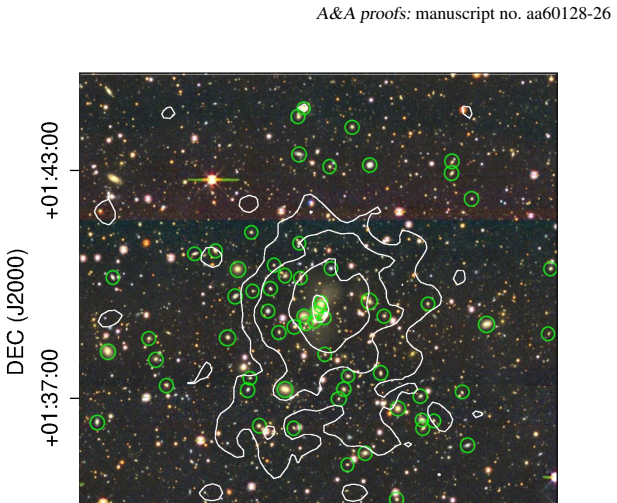
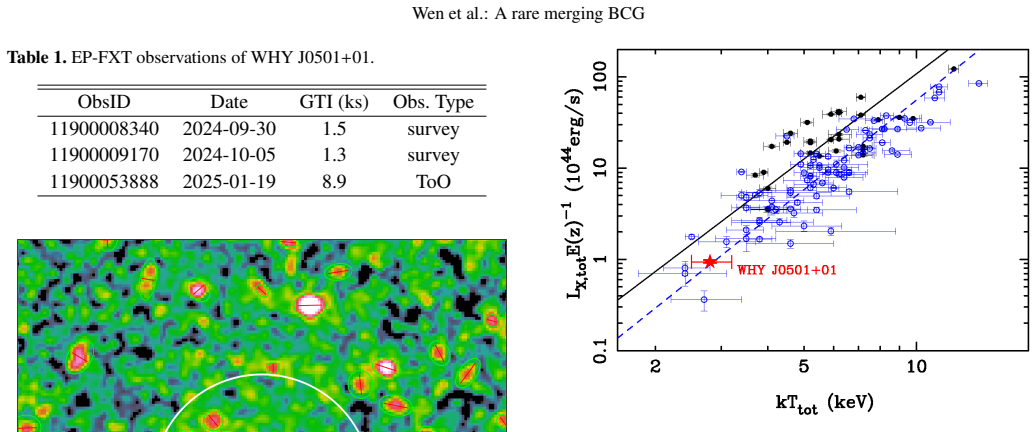
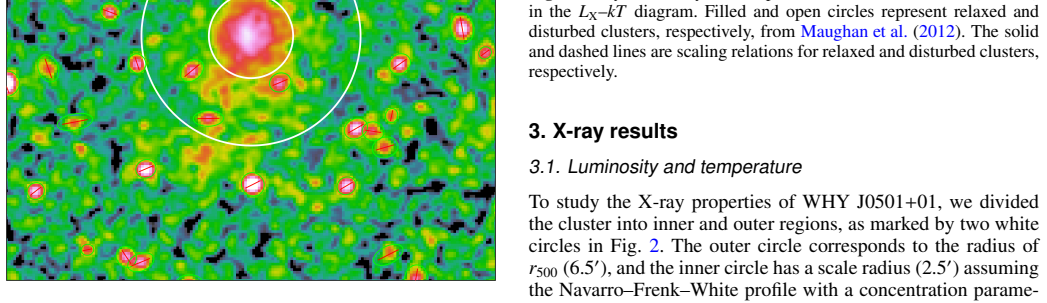
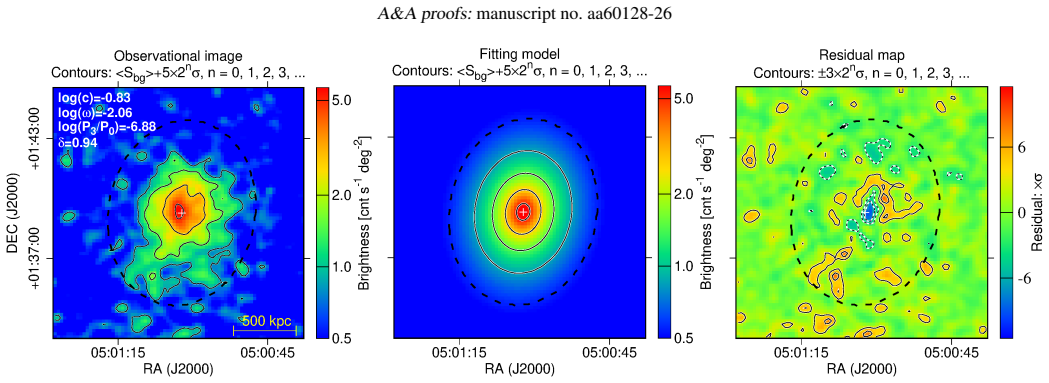
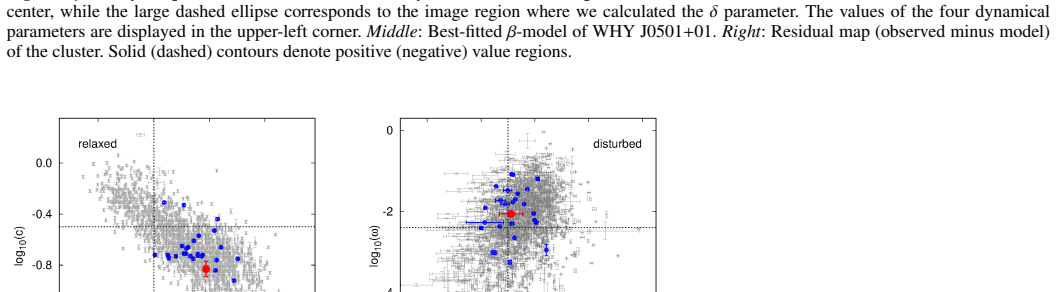
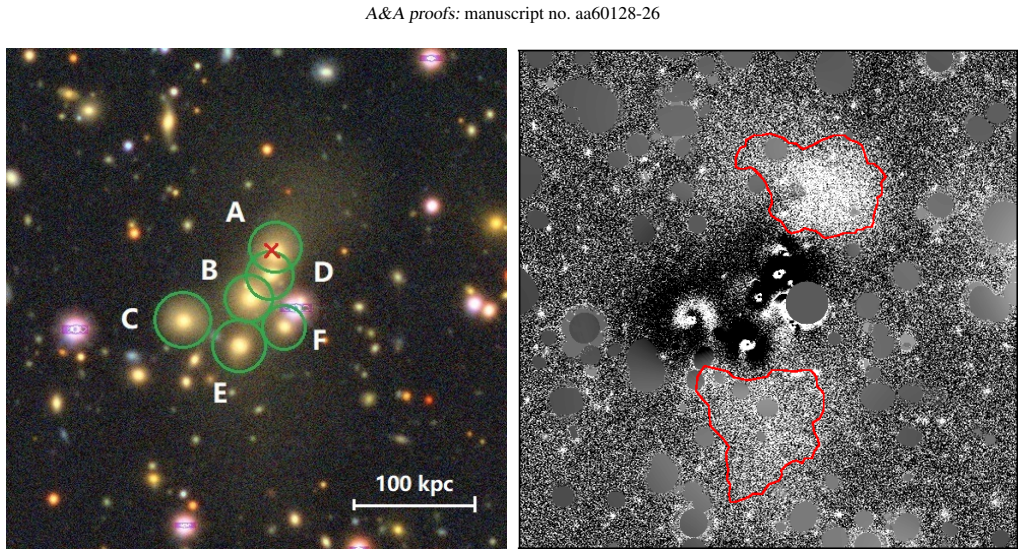
The evolutionary processes of galaxy clusters influence the properties of their member galaxies. We present a joint X-ray--optical analysis of the galaxy cluster WHY J050106.2+013714 at $z_{\rm c}=0.151$. X-ray observations with the Einstein Probe Follow-up X-ray Telescope indicate that the cluster is dynamically young. The cluster displays an average X-ray temperature of $2.8^{+0.4}_{-0.3}$ keV and a total luminosity of 9.4$\pm0.3\times10^{43}$ erg s$^{-1}$, consistent with the scaling relation of typical disturbed clusters. Remarkably, the cluster hosts a multi-merging brightest cluster galaxy (BCG) system composed of six massive galaxies, with a total stellar mass of $1.16\times10^{12}M_{\odot}$. We detected a well-defined intracluster light component extending to a size of 310 kpc. A systematic search for merging BCGs in the DESI Legacy Surveys reveals that this sextuple-merging BCG is extremely rare in the local Universe. Additionally, other merging BCGs are also likely to form in moderately disturbed clusters, which provides valuable insights into the formation of BCGs.
Editorial analysis
A structured set of objections, weighed in public.
Referee Report
Summary. The manuscript reports X-ray and optical observations of the galaxy cluster WHY J050106.2+013714 at z_c=0.151. X-ray data from the Einstein Probe Follow-up X-ray Telescope indicate a dynamically young cluster with average temperature 2.8^{+0.4}_{-0.3} keV and luminosity 9.4±0.3×10^{43} erg s^{-1}. The cluster is claimed to host a sextuple-merging BCG system of six massive galaxies with total stellar mass 1.16×10^{12} M_⊙, accompanied by extended intracluster light to 310 kpc. A search in the DESI Legacy Surveys is used to argue that such sextuple-merging BCGs are extremely rare locally, with implications for BCG formation in moderately disturbed clusters.
Significance. If the six galaxies can be shown to form a single bound merging system, the result would provide a rare observational example of multi-galaxy BCG assembly and link it to cluster dynamical state. The joint X-ray/optical analysis and ICL detection add concrete data on disturbed clusters at low redshift.
major comments (2)
- [Section describing BCG identification and the DESI search] The central claim that the six galaxies constitute a single sextuple-merging BCG system (and therefore that the system is extremely rare) rests on optical identification plus X-ray indicators of disturbance, but no explicit quantitative merging criteria—such as maximum projected separation, line-of-sight velocity offsets, or tidal-feature thresholds—are stated. This definition is load-bearing for both the system classification and the DESI Legacy Survey rarity conclusion.
- [Section on optical data and BCG system] The abstract and provided text give no details on the spectroscopic or dynamical confirmation (velocity data, binding-energy estimates) used to establish that the six galaxies are dynamically associated rather than chance projections within the cluster. Without these, the interpretation as one merging entity cannot be assessed.
minor comments (2)
- [Abstract] The abstract states the X-ray temperature and luminosity but supplies no explicit error analysis or comparison sample for the claim that these values are 'consistent with the scaling relation of typical disturbed clusters.'
- [Abstract and early sections] Notation for the cluster name (WHY J050106.2+013714) and redshift (z_c) should be defined at first use; the intracluster light size (310 kpc) should specify the isophotal or surface-brightness threshold used.
Simulated Author's Rebuttal
We thank the referee for their constructive comments, which help clarify the presentation of our results. We respond to each major comment below and have revised the manuscript to address the points raised where possible.
read point-by-point responses
-
Referee: [Section describing BCG identification and the DESI search] The central claim that the six galaxies constitute a single sextuple-merging BCG system (and therefore that the system is extremely rare) rests on optical identification plus X-ray indicators of disturbance, but no explicit quantitative merging criteria—such as maximum projected separation, line-of-sight velocity offsets, or tidal-feature thresholds—are stated. This definition is load-bearing for both the system classification and the DESI Legacy Survey rarity conclusion.
Authors: We agree that explicit quantitative criteria strengthen the classification. In the revised manuscript we now state the criteria used: the six galaxies must lie within a maximum projected separation of 100 kpc, each must exceed 10^{11} M_⊙ in stellar mass, and all must be embedded in the detected ICL. The DESI Legacy Survey search applied identical selection criteria. Although line-of-sight velocities are unavailable, the X-ray morphology indicating a dynamically young cluster provides supporting context for the merging interpretation. revision: yes
-
Referee: [Section on optical data and BCG system] The abstract and provided text give no details on the spectroscopic or dynamical confirmation (velocity data, binding-energy estimates) used to establish that the six galaxies are dynamically associated rather than chance projections within the cluster. Without these, the interpretation as one merging entity cannot be assessed.
Authors: We acknowledge the value of spectroscopic confirmation. Our analysis relies on photometric imaging from DESI Legacy Surveys combined with X-ray data; no new spectroscopy was obtained. The revised manuscript now includes an explicit caveat in the discussion section noting the absence of velocity data and recommending future spectroscopic follow-up to measure line-of-sight offsets and binding energies. revision: partial
Circularity Check
No circularity: purely observational report with no derivations or self-referential fits
full rationale
The paper is an observational study reporting X-ray measurements (T=2.8 keV, L_X=9.4e43 erg/s) and optical identification of six galaxies plus ICL in a cluster at z=0.151, followed by a search in the external DESI Legacy Surveys. No equations, parameter fitting, predictions, or derivations are present that could reduce to inputs by construction. The rarity conclusion follows directly from the survey search result without any self-citation chain or ansatz. This matches the default case of a self-contained observational paper (score 0-2).
Axiom & Free-Parameter Ledger
free parameters (1)
- total stellar mass of BCG system
axioms (2)
- domain assumption The six galaxies constitute a single multi-merging BCG system
- domain assumption X-ray temperature and luminosity indicate a dynamically young disturbed cluster
Reference graph
Works this paper leans on
-
[1]
Ahad, S. L., Reid, R., Mpetha, C. T., et al. 2025, Submitted to ApJ, arXiv:2512.14636
arXiv 2025
-
[2]
W., Evrard, A
Allen, S. W., Evrard, A. E., & Mantz, A. B. 2011, ARA&A, 49, 409
2011
-
[3]
R., et al
Andrade-Santos, F., Jones, C., Forman, W. R., et al. 2017, ApJ, 843, 76
2017
-
[4]
W., et al
Banks, K., Brough, S., Holwerda, B. W., et al. 2021, ApJ, 921, 47
2021
-
[5]
F., McIntosh, D
Bell, E. F., McIntosh, D. H., Katz, N., & Weinberg, M. D. 2003, ApJS, 149, 289
2003
-
[6]
2016, MNRAS, 460, 2862
Bellstedt, S., Lidman, C., Muzzin, A., et al. 2016, MNRAS, 460, 2862
2016
-
[7]
2009, MNRAS, 395, 1491
Bernardi, M. 2009, MNRAS, 395, 1491
2009
-
[8]
B., Sheth, R
Bernardi, M., Hyde, J. B., Sheth, R. K., Miller, C. J., & Nichol, R. C. 2007, AJ, 133, 1741
2007
-
[9]
2024, A&A, 685, A106
Bulbul, E., Liu, A., Kluge, M., et al. 2024, A&A, 685, A106
2024
-
[10]
Buote, D. A. & Tsai, J. C. 1995, ApJ, 452, 522
1995
-
[11]
M., Cibinel, A., Lilly, S
Carollo, C. M., Cibinel, A., Lilly, S. J., et al. 2013, ApJ, 776, 71
2013
-
[12]
H., Böhringer, H., Ikebe, Y ., & Zhang, Y .-Y
Chen, Y ., Reiprich, T. H., Böhringer, H., Ikebe, Y ., & Zhang, Y .-Y . 2007, A&A, 466, 805
2007
-
[13]
2014, MNRAS, 437, 3787 De Lucia, G
Contini, E., De Lucia, G., Villalobos, Á., & Borgani, S. 2014, MNRAS, 437, 3787 De Lucia, G. & Blaizot, J. 2007, MNRAS, 375, 2
2014
-
[14]
J., Lang, D., et al
Dey, A., Schlegel, D. J., Lang, D., et al. 2019, AJ, 157, 168
2019
-
[15]
1980, ApJ, 236, 351
Dressler, A. 1980, ApJ, 236, 351
1980
-
[16]
& Kalita, B
Ebeling, H. & Kalita, B. S. 2019, ApJ, 882, 127
2019
-
[17]
2012, A&A Rev., 20, 54
Feretti, L., Giovannini, G., Govoni, F., & Murgia, M. 2012, A&A Rev., 20, 54
2012
-
[18]
V ., et al
Geng, C., Ge, C., Lal, D. V ., et al. 2022, MNRAS, 511, 3994
2022
-
[19]
N., Skelton, R
Groenewald, D. N., Skelton, R. E., Gilbank, D. G., & Loubser, S. I. 2017, MN- RAS, 467, 4101
2017
-
[20]
S., Mittal, R., Reiprich, T
Hudson, D. S., Mittal, R., Reiprich, T. H., et al. 2010, A&A, 513, A37
2010
-
[21]
M., Böhringer, H., Pointecouteau, E., Chen, Y ., & Zhang, Y
Jia, S. M., Böhringer, H., Pointecouteau, E., Chen, Y ., & Zhang, Y . Y . 2008, A&A, 489, 1 Jiménez-Teja, Y ., Román, J., HyeongHan, K., et al. 2025, A&A, 694, A216
2008
-
[22]
& Bender, R
Kluge, M. & Bender, R. 2023, ApJS, 267, 41
2023
-
[23]
2025, Radiation Detection Technology and Methods, 9, 250
Li, C., Jia, S.-M., Song, L.-M., et al. 2025, Radiation Detection Technology and Methods, 9, 250
2025
-
[24]
S., Mao, S., Deng, Z
Liu, F. S., Mao, S., Deng, Z. G., Xia, X. Y ., & Wen, Z. L. 2009, MNRAS, 396, 2003
2009
-
[25]
J., Giles, P
Maughan, B. J., Giles, P. A., Randall, S. W., Jones, C., & Forman, W. R. 2012, MNRAS, 421, 1583
2012
-
[26]
& Giacintucci, S
Mazzotta, P. & Giacintucci, S. 2008, ApJ, 675, L9
2008
-
[27]
H., Guo, Y ., Hertzberg, J., et al
McIntosh, D. H., Guo, Y ., Hertzberg, J., et al. 2008, MNRAS, 388, 1537
2008
-
[28]
2016, MNRAS, 455, 2994
McPartland, C., Ebeling, H., Roediger, E., & Blumenthal, K. 2016, MNRAS, 455, 2994
2016
-
[29]
2015, ApJ, 806, 4
Merten, J., Meneghetti, M., Postman, M., et al. 2015, ApJ, 806, 4
2015
-
[30]
J., Fabricant, D
Mohr, J. J., Fabricant, D. G., & Geller, M. J. 1993, ApJ, 413, 492
1993
-
[31]
2023, MN- RAS, 521, 800
Montenegro-Taborda, D., Rodriguez-Gomez, V ., Pillepich, A., et al. 2023, MN- RAS, 521, 800
2023
-
[32]
F., Ribeiro, A
Morell, D. F., Ribeiro, A. L. B., de Carvalho, R. R., et al. 2020, MNRAS, 494, 3317 O’Dea, C. P., Baum, S. A., Privon, G., et al. 2008, ApJ, 681, 1035
2020
-
[33]
S., Couch, W
Owers, M. S., Couch, W. J., Nulsen, P. E. J., & Randall, S. W. 2012, ApJ, 750, L23
2012
-
[34]
Peebles, P. J. E. 1993, Principles of Physical Cosmology (Princeton: Princeton University Press)
1993
-
[35]
Y ., Ho, L
Peng, C. Y ., Ho, L. C., Impey, C. D., & Rix, H.-W. 2002, AJ, 124, 266
2002
-
[36]
B., Fardal, M
Poole, G. B., Fardal, M. A., Babul, A., et al. 2006, MNRAS, 373, 881
2006
-
[37]
D., Edge, A
Rawle, T. D., Edge, A. C., Egami, E., et al. 2012, ApJ, 747, 29
2012
-
[38]
Roberts, I. D. & Parker, L. C. 2017, MNRAS, 467, 3268
2017
-
[39]
S., Rosati, P., Tozzi, P., et al
Santos, J. S., Rosati, P., Tozzi, P., et al. 2008, A&A, 483, 35
2008
-
[40]
Sarazin, C. L. 1986, Reviews of Modern Physics, 58, 1
1986
-
[41]
Soares, N. R. & Rembold, S. B. 2019, MNRAS, 483, 4354
2019
-
[42]
2024, ApJ, 967, L34 Véliz Astudillo, S., Carrasco, E
Sun, H., Wang, T., Xu, K., et al. 2024, ApJ, 967, L34 Véliz Astudillo, S., Carrasco, E. R., Nilo Castellón, J. L., Zenteno, A., & Cuevas, H. 2025, A&A, 702, A251
2024
-
[43]
2006, ApJ, 640, 691
Vikhlinin, A., Kravtsov, A., Forman, W., et al. 2006, ApJ, 640, 691
2006
-
[44]
Wen, Z. L. & Han, J. L. 2013, MNRAS, 436, 275
2013
-
[45]
Wen, Z. L. & Han, J. L. 2024, ApJS, 272, 39
2024
-
[46]
L., Han, J
Wen, Z. L., Han, J. L., & Liu, F. S. 2012, ApJS, 199, 34
2012
-
[47]
L., Han, J
Wen, Z. L., Han, J. L., & Yang, F. 2018, MNRAS, 475, 343
2018
-
[48]
L., Liu, F
Wen, Z. L., Liu, F. S., & Han, J. L. 2009, ApJ, 692, 511
2009
-
[49]
R., Tinker, J
Wetzel, A. R., Tinker, J. L., & Conroy, C. 2012, MNRAS, 424, 232
2012
-
[50]
Willingale, R., Starling, R. L. C., Beardmore, A. P., Tanvir, N. R., & O’Brien, P. T. 2013, MNRAS, 431, 394
2013
-
[51]
2024, MNRAS, 531, 4006
Yang, L., Silverman, J., Oguri, M., et al. 2024, MNRAS, 531, 4006
2024
-
[52]
2025, Science China Physics, Mechanics, and Astronomy, 68, 239501
Yuan, W., Dai, L., Feng, H., et al. 2025, Science China Physics, Mechanics, and Astronomy, 68, 239501
2025
-
[53]
Yuan, Z. S. & Han, J. L. 2020, MNRAS, 497, 5485
2020
-
[54]
S., Han, J
Yuan, Z. S., Han, J. L., & Wen, Z. L. 2016, MNRAS, 460, 3669
2016
-
[55]
Yuan, Z. S. & Wen, Z. L. 2022, MNRAS, 516, 3159
2022
-
[56]
2025, A&A, 698, A171
Zenteno, A., Kluge, M., Kharkrang, R., et al. 2025, A&A, 698, A171
2025
-
[57]
2025, Research in Astronomy and Astrophysics, 25, 115019
Zhang, J., Chen, Y ., Jia, S., et al. 2025, Research in Astronomy and Astrophysics, 25, 115019
2025
-
[58]
2025, Radiation Detection Technology and Methods, 9, 215
Zhao, H.-S., Li, C.-K., Wang, J., et al. 2025, Radiation Detection Technology and Methods, 9, 215
2025
-
[59]
2025, A&A, 700, A248
Zheng, X., Jia, S., Li, C., et al. 2025, A&A, 700, A248
2025
-
[60]
E., et al
Zhou, R., Guy, J., Koposov, S. E., et al. 2025, The Open Journal of Astrophysics, 8, 83 Article number, page 7
2025
discussion (0)
Sign in with ORCID, Apple, or X to comment. Anyone can read and Pith papers without signing in.