REVIEW 3 major objections 5 minor 57 references
BPI: A Novel Efficient and Reliable Search Structure for Hybrid Storage Blockchain
T0 review · 3 major / 5 minor · reviewed 2026-08-05 · deepseek-v4-flash
Pith's one-line read This paper claims that a bitmask forest index, combined with token-based query resumption and randomized-CRC verification, makes keyword search in hybrid-storage blockchains efficient, compact, and verifiable against omitting or injecting s
desk verdict A genuinely new append-only bitmap index with a tight storage bound; the verification scheme needs a real security analysis, and the experiments need bitmap baselines, but the core idea is worth engaging. read the letter →
The pith
A machine-rendered reading of the paper's core claim, the machinery that carries it, and where it could break.
The reading
What carries the argument
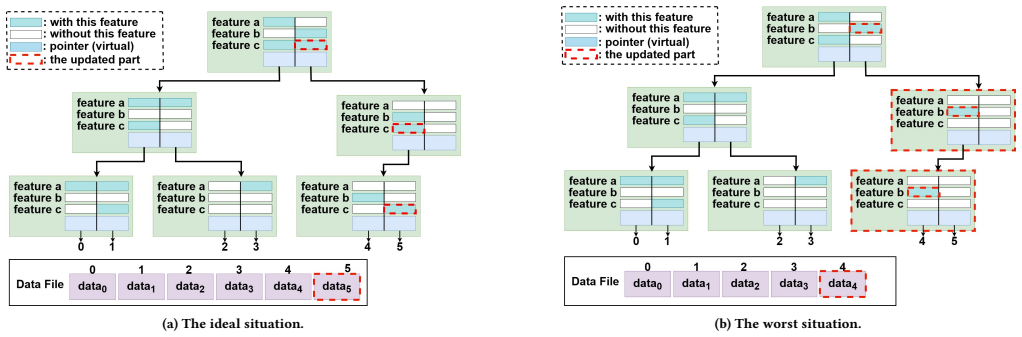
The BitMask Forest (BMF): a forest of height-h_BMF trees in which every node is a bitmask — a 1 in a leaf marks a specific record as containing the queried keyword, and a 1 in a parent marks that some descendant block contains it. A 32-bit mask per node lets the search proceed by bitwise operations, including de Bruijn-based lowest-set-bit lookup, and a tree becomes immutable once full. BMF+ is the compressed variant that omits zero masks and uses a FirstNode Index Table (FIT) plus an Empty-tree Binary Filter (EBF) to preserve random access, which yields the per-entry storage bound independent of feature count. The Persistence and Configuration Manager (PCM) appends only the newest mask page
What would settle it
Compute the improved CRC with k=32 on a 10,000-item digest list under several random r values, delete one item, and recompute: if the checksum survives deletion at a rate observably above 1/2^32, the completeness bound is false. In the adversarial direction, let the SP see r before answering; if it can construct a subset whose VO checksums collide with the full set's VO_chain, or can hide one item without changing any of the k-bit codes, the omission guarantee fails.
Extended reading notes
Core claim
At the center of BPI is a forest of complete bitmask trees. Each leaf packs B_BMF consecutive records into one integer mask whose 1-bits mark records containing a given feature; middle and root masks summarize whether any descendant contains that feature. Once a tree reaches capacity it is frozen, so later insertions only update masks along the rightmost growing path, making per-record maintenance constant and persistence append-only. BMF+ drops all-zero masks and adds an Empty-tree Binary Filter plus a FirstNode Index Table to retain random access, producing the paper's bound that per-entry index size is at most 3*B_BMF*DimSize_data bits, independent of the number of features once each dime
Load-bearing premise
The reliability claim collapses if the storage provider can learn or choose the user's random 128-bit value r before committing to a result set, or if the CRC with a polynomial derived from r does not behave like a uniform random k-bit mapping; the paper states this as a design premise but proves neither, and it never specifies the rejection threshold gamma.
Editorial extensions
If this is right
- BMF insertion cost stays constant as history grows: roughly 20-54 ms per 10,000 records in the reported experiments, while B+ tree-based baselines grow to tens of seconds.
- Repeated keyword queries stay flat: Articulated Search reports under 30 ms on 7M records regardless of dataset size, while full rescans scale with history.
- Index storage saturates instead of growing with vocabulary: BMF+ is reported about 99% smaller than uncompressed BMF and remains near 640 MB at 7M records even with over a million distinct features.
- Verification communication drops 50-87.5% while still catching injected records with probability at least alpha and omitted records under the beta bound; unmatched checksums permit local revalidation of replacement results.
- Conjunctive keyword queries over arbitrary feature sets cost only bitwise ANDs of masks, so composite indexes require virtually no extra storage or insertion work.
Reading between the lines
- The same bitmask-forest design could transfer to other append-only high-cardinality categorical datasets such as telemetry, audit logs, or sensor tags, where index size would stop growing with vocabulary; the paper itself restricts BPI to keyword queries, so this is an extension.
- A token could become a general checkpoint for incremental analytics: any client holding a token could reconstruct just the delta after it, turning Articulated Search into a synchronization primitive rather than only a query-resume mechanism.
- The completeness guarantee is testable beyond the paper's experiments: an SP that can predict or choose r before committing could exploit CRC linearity to build omission-undetectable subsets, so the random-polynomial assumption should be stress-tested adversarially.
- If BMF trees are immutable, each completed tree's root could be committed on-chain once, allowing later verification without re-executing the query across all nodes; the paper does not propose this.
Editorial analysis
A structured set of objections, weighed in public.
Referee Report
Summary. The paper proposes BPI, a keyword-search framework for hybrid-storage blockchains. It consists of BMF, a forest of fixed-height bitmask trees that exploits the append-only nature of blockchain data to achieve constant-overhead insertion; BMF+, a space-optimized variant that omits zero masks and uses a Persistence and Configuration Manager (PCM); Articulated Search, a token-based mechanism for incremental re-queries; and a CRC-based validation scheme that compresses query-result digests into short checksums to detect missing or injected results. The paper derives an analytic storage bound for BMF+ (Section 5.7), presents algorithms for feature creation, update, query, and validation (Sections 5.2–5.8), and reports experiments on 7.3M Ethereum transactions comparing BPI against EthMB+, MySQL, PostgreSQL, and EASL.
Significance. The BMF design is a credible engineering contribution: the immutable-tree forest is well matched to the CR-only workload of a blockchain, the storage bound in Section 5.7 is derived from a rank argument rather than fitted to data, and Articulated Search is a clean and falsifiable idea that directly exploits immutability. The experimental comparison uses a real Ethereum dataset and shows large speedups for the tested keyword queries. However, the paper's other central claim—'reliable search' via the improved CRC validation model—is not rigorously established. No formal security proof is provided for the CRC-as-random-map assumption, the B3 threshold γ is never specified, and the experiments do not include adversarial settings or actual blockchain gas costs. These gaps affect the load-bearing 'reliability' contribution, not just its presentation.
major comments (3)
- [§5.5, Algorithm 2] The completeness guarantee is not established. The B1 probability 1−N_h/2^k and the B2 birthday product are valid only if the improved CRC is a uniform random map from SHA-256 digests to k bits. The paper gives no proof or reduction for this; CRC is linear over GF(2), and the polynomial is derived from r, which the user sends to the blockchain network (§3). The secrecy of r from the SP is asserted but not modeled, and the local-revalidation mode exposes r to the SP after the first verification. Moreover, the B1 formula treats an injected item as a random draw; an adversary that learns r and the VO checksum list can brute-force a colliding digest in about 2^k/N_h evaluations (≈4×10^5 for k=32, N_h=10^4), which makes the claim of '32-bit security' misleading. The B3 threshold γ is never specified or analyzed. A security game, an explicit adversarial model for r, and a construction with a p
- [§6, experimental setup] The paper's motivation is reducing on-chain maintenance and validation cost, but all experiments run in C++ on a single PC with no smart-contract execution. There are no gas measurements for BMF+/PCM updates, no consensus execution cost, and no end-to-end verification cost on an actual blockchain. Table 7 measures only local hashing, mapping, and comparison times. The central claim of low overhead in a blockchain context is therefore not quantitatively supported. In addition, no experiments exercise the adversarial behaviors B1–B3, so the reliability claim is untested even empirically.
- [§6, baselines] The related work explicitly cites bitmap indexes [37] and Bloofi [7] as relevant competitors, but the experimental comparison omits them. The conclusion that BPI 'surpasses state of the art search databases' is overbroad without a compressed bitmap-index baseline (e.g., RoaringBitmap or Bloofi). Also, Figures 10 and Tables 3–5 report point estimates only; no variance, error bars, or confidence intervals are given, despite the stated averaging over 100 runs. The efficiency result would be more convincing with variance reporting and a broader baseline set.
minor comments (5)
- [§5.5, Algorithm 2] The text says the blockchain 'extracts k consecutive bits from r as a polynomial,' but the pseudocode sets polynomial ← r ∧ crc, i.e., the lower k bits. This discrepancy should be resolved, and the role of c = Σ 2^{4k−1} in guaranteeing a nonzero leading coefficient should be explained more clearly.
- [§5.2, Algorithm 1] The loop 'for each buffer b in {leafBuffer, middleBuffer}' is ambiguous and can be read as processing middleBuffer before it is populated. The aggregation should be specified as a sequential pipeline: leafBuffer → middleBuffer → rootBuffer.
- [§5.5] The safety parameters α, β, and γ are introduced, but only α and β appear in Table 7. The paper should state default values for α, β, and γ, and explain how γ is chosen to avoid false positives in the B3 case.
- [§6.4, Figure 12] Axis labels and units are missing. The 'at most 640MB' figure and the 'over 99%' reduction need a precise definition of what is measured (total index size, peak memory, or disk footprint) and whether FIT/EBF overhead is included.
- [§5.7] The derived bound gives roughly 168 bytes per entry for B=32 and DimSize_data=14, which is about 1.18GB for 7M entries, while the experiments report 640MB. This is not a contradiction, but the relationship between the theoretical upper bound and the measured value should be clarified so readers do not confuse the bound with a measured maximum.
Circularity Check
No significant circularity: BPI's design equations and experiments are self-contained; identified gaps are correctness risks, not circular reductions.
full rationale
The claimed derivations do not reduce to their inputs. The BMF+ storage bound (Section 5.7) follows from a matrix-rank argument over masks with at most one nonzero per column, and the per-entry bound 3*B_BMF*DimSize_data is an analytical consequence, not a fitted or renamed result. The constant insertion overhead claim is implied directly by the immutability/full-tree property and the restriction of updates to the newest leaf, not by a parameter fitted to data. The CRC validation formulas in Section 5.5 are computed under an explicit random-mapping assumption: that assumption is not proven, Algorithm 2's polynomial/mask construction is questionable, and the B3 threshold gamma is never specified, but these are security/correctness gaps rather than cases where a prediction is equivalent to its input by construction. Experiments use external baselines and real Ethereum data; no quantity called a prediction is reconstructed from a fitted subset. The only self-citations ([4],[5]) are general background on blockchain/authentication and are not load-bearing for BPI's central claims. The Section 7 limitation discussion narrows scope but introduces no circularity.
Assumptions & free parameters
free parameters (4)
- B_BMF (branching factor / mask width) =
32
- h_BMF (tree height) =
3
- N_create (batch feature creation threshold)
- gamma (B3 all-malicious rejection threshold)
assumptions (5)
- domain assumption Blockchain ledger data is immutable and append-only, so previously returned query results remain valid.
- domain assumption Each data item has exactly one value per dimension, giving at most one nonzero mask per column in a leaf node's per-dimension mask matrix.
- domain assumption The storage provider does not know the user's random value r before committing to its result set.
- ad hoc to paper The improved CRC with a random polynomial behaves like a uniform random mapping of SHA-256 digests into k-bit space.
- standard math SHA-256 digests are collision-resistant and computed correctly by consensus nodes.
Cite this review
Pith. "Pith review of BPI: A Novel Efficient and Reliable Search Structure for Hybrid Storage Blockchain." pith.science (2026). https://pith.science/paper/3IK66KUC
@misc{pith2026250900480,
  author       = {Pith},
  title        = {Pith review of: BPI: A Novel Efficient and Reliable Search Structure for Hybrid Storage Blockchain},
  year         = {2026},
  howpublished = {\url{https://pith.science/paper/3IK66KUC}},
  note         = {Machine review of arXiv:2509.00480}
}
read the original abstract
Hybrid storage solutions have emerged as potent strategies to alleviate the data storage bottlenecks prevalent in blockchain systems. These solutions harness off-chain Storage Services Providers (SPs) in conjunction with Authenticated Data Structures (ADS) to ensure data integrity and accuracy. Despite these advancements, the reliance on centralized SPs raises concerns about query correctness. Although ADS can verify the existence of individual query results, they fall short of preventing SPs from omitting valid results. In this paper, we delineate the fundamental distinctions between data search in blockchains and traditional database systems. Drawing upon these insights, we introduce BPI, a lightweight framework that enables efficient keyword queries and maintenance with low overhead. We propose "Articulated Search", a query pattern specifically designed for blockchain environments that enhances search efficiency while significantly reducing costs during data user updates. Furthermore, BPI employs a suite of validation models to ensure the inclusion of all valid content in search results while maintaining low overhead. Extensive experimental evaluations demonstrate that the BPI framework achieves outstanding scalability and performance in keyword searches within blockchain, surpassing EthMB+ and state of the art search databases commonly used in mainstream hybrid storage blockchains (HSB).
Figures


Figures from the paper (7 more)



Reference graph
Works this paper leans on
-
[37]
Junchang Wang and Manos Athanassoulis. 2024. CUBIT: Concurrent Updatable Bitmap Indexing. Proceedings of the VLDB Endowment 18, 2 (2024), 399–412
work page 2024
-
[7]
Adina Crainiceanu and Daniel Lemire. 2015. Bloofi: Multidimensional bloom filters. Information Systems 54 (2015), 311–324
work page 2015
-
[1]
Sonia Abdennadher, Walid Cheffi, Anang Hudaya Muhamad Amin, and Munir Naveed. 2024. Performance analysis of a blockchain process modeling: Applica- tion of distributed ledger technology in trading, clearing and settlement processes. Journal of Open Innovation: Technology, Market, and Complexity 10, 3 (2024), 100348
work page 2024
-
[2]
Samy Chambi, Daniel Lemire, Owen Kaser, and Robert Godin. 2016. Better bitmap performance with roaring bitmaps. Software: practice and experience 46, 5 (2016), 709–719
work page 2016
-
[3]
Qian Chen, Haibo Hu, and Jianliang Xu. 2015. Authenticated online data integra- tion services. In Proceedings of the 2015 ACM SIGMOD International Conference on Management of Data. 167–181
work page 2015
-
[4]
Guanjie Cheng, Junqin Huang, Yewei Wang, Jun Zhao, Linghe Kong, Shuiguang Deng, and Xueqiang Yan. 2024. Conditional Privacy-Preserving Multi-Domain Authentication and Pseudonym Management for 6G-Enabled IoV. IEEE Transac- tions on Information Forensics and Security 19 (2024), 10206–10220
work page 2024
-
[5]
Guanjie Cheng, Yewei Wang, Shuiguang Deng, Zhengzhe Xiang, Xueqiang Yan, Peng Zhao, and Schahram Dustdar. 2024. A Lightweight Authentication-Driven Trusted Management Framework for IoT Collaboration. IEEE Transactions on Services Computing 17, 3 (2024), 747–760
work page 2024
-
[6]
Mohammad Jabed Morshed Chowdhury, Alan Colman, Muhammad Ashad Kabir, Jun Han, and Paul Sarda. 2018. Blockchain as a notarization service for data shar- ing with personal data store. In 2018 17th ieee international conference on trust, security and privacy in computing and communications/12th ieee international conference on big data science and engineerin...
work page 2018
Show all 57 references
-
[8]
Zhihua Cui, XUE Fei, Shiqiang Zhang, Xingjuan Cai, Yang Cao, Wensheng Zhang, and Jinjun Chen. 2020. A hybrid blockchain-based identity authentication scheme for multi-WSN. IEEE Transactions on Services Computing 13, 2 (2020), 241–251
2020
-
[9]
Nicolaas Govert De Bruijn. 1946. A combinatorial problem. Proceedings of the Section of Sciences of the Koninklijke Nederlandse Akademie van Wetenschappen te Amsterdam 49, 7 (1946), 758–764
1946
-
[10]
Pengting Du, Yingjian Liu, Yue Li, and Haoyu Yin. 2022. EthMB+: A Tamper-Proof Data Query Model Based on B+ Tree and Merkle Tree. In CCF China Blockchain Conference. Springer, 49–59
2022
-
[11]
Etherscan. 2025. Etherscan: The Ethereum Blockchain Explorer. https://etherscan. io/. Accessed: March 1, 2025
2025
-
[12]
Arthur Gervais, Ghassan O Karame, Karl Wüst, Vasileios Glykantzis, Hubert Ritzdorf, and Srdjan Capkun. 2016. On the security and performance of proof of work blockchains. In Proceedings of the 2016 ACM SIGSAC conference on computer and communications security. 3–16
2016
-
[13]
Chang Yeop Han, Jongwon Oh, Jinyeol Kim, Raehyeong Kim, Kwanghyun Go, Jung Hwan Oh, and Seung Eun Lee. 2025. A CRC Comparison-Based Screen Data Management for Energy Efficient Virtual Desktop Infrastructure. IEEE Access (2025)
2025
-
[14]
HelloGitHub. 2025. DB-Engines Ranking Report. https://hellogithub.com/report/ db-engines. Accessed: March 1, 2025
2025
-
[15]
Jun Wook Heo, Gowri Sankar Ramachandran, Ali Dorri, and Raja Jurdak. 2024. Blockchain data storage optimisations: a comprehensive survey. Comput. Surveys 56, 7 (2024), 1–27
2024
-
[16]
Meenakshi Kandpal, Veena Goswami, Rojalina Priyadarshini, and Rabindra Ku- mar Barik. 2023. Towards data storage, scalability, and availability in blockchain systems: a bibliometric analysis. Data 8, 10 (2023), 148
2023
-
[17]
Aniket Kate, Gregory M Zaverucha, and Ian Goldberg. 2010. Constant-size commitments to polynomials and their applications. In International conference on the theory and application of cryptology and information security. Springer, 177–194
2010
-
[18]
Ismail Keshta. 2024. A CRC-Based Authentication Model and ECC-Based Au- thentication Protocol for Resource-Constrained IoT Applications. IEEE Access (2024)
2024
-
[19]
K Karthika Lekshmi and M Vigilson Prem. 2020. Multi-keyword score thresh- old and B+ tree indexing based top-K query retrieval in cloud. Peer-to-Peer Networking and Applications 13, 6 (2020), 1990–2000
2020
-
[20]
Feifei Li, Marios Hadjieleftheriou, George Kollios, and Leonid Reyzin. 2006. Dy- namic authenticated index structures for outsourced databases. In Proceedings of the 2006 ACM SIGMOD international conference on Management of data. 121–132
2006
-
[21]
Hongwei Li, Rongxing Lu, Liang Zhou, Bo Yang, and Xuemin Shen. 2013. An efficient merkle-tree-based authentication scheme for smart grid. IEEE Systems Journal 8, 2 (2013), 655–663
2013
-
[22]
Bin Liu, Xiao Liang Yu, Shiping Chen, Xiwei Xu, and Liming Zhu. 2017. Blockchain based data integrity service framework for IoT data. In 2017 IEEE international conference on web services (ICWS). IEEE, 468–475
2017
-
[23]
Qin Liu, Yu Peng, Mingzuo Xu, Hongbo Jiang, Jie Wu, Tian Wang, Tao Peng, and Guojun Wang. 2024. Mpv: Enabling fine-grained query authentication in hybrid- storage blockchain. IEEE Transactions on Knowledge and Data Engineering 36, 7 (2024), 3297–3311
2024
-
[24]
Chen Luo and Michael J Carey. 2020. LSM-based storage techniques: a survey. The VLDB Journal 29, 1 (2020), 393–418
2020
-
[25]
Fuchen Ma, Yuanliang Chen, Meng Ren, Yuanhang Zhou, Yu Jiang, Ting Chen, Huizhong Li, and Jiaguang Sun. 2023. LOKI: State-Aware Fuzzing Framework for the Implementation of Blockchain Consensus Protocols. In NDSS
2023
-
[26]
Shin Morishima and Hiroki Matsutani. 2018. Accelerating blockchain search of full nodes using GPUs. In 2018 26th Euromicro International Conference on Parallel, Distributed and Network-based Processing (PDP). IEEE, 244–248
2018
-
[27]
Amir Pasha Motamed and Behnam Bahrak. 2019. Quantitative analysis of cryp- tocurrencies transaction graph. Applied Network Science 4 (2019), 1–21
2019
-
[28]
Abdulbary Naji, Xingfu Wang, Ping Liu, Ammar Hawbani, Liang Zhao, Xiaohua Xu, and Fuyou Miao. 2025. NetCRC-NR: In-Network 5G NR CRC Accelerator. IEEE Trans. Comput. (2025)
2025
-
[29]
Senthil Nathan, Chander Govindarajan, Adarsh Saraf, Manish Sethi, and Praveen Jayachandran. 2019. Blockchain meets database: Design and implementation of 14 a blockchain relational database. arXiv preprint arXiv:1903.01919 (2019)
2019 arXiv
-
[30]
Jared Newell, Sabih ur Rehman, Quazi Mamun, and Md Zahidul Islam. 2025. EASL: Enhanced append-only skip list index for agile block data retrieval on blockchain. Future Generation Computer Systems 164 (2025), 107554
2025
-
[31]
Patrick O’Neil, Edward Cheng, Dieter Gawlick, and Elizabeth O’Neil. 1996. The log-structured merge-tree (LSM-tree). Acta Informatica 33 (1996), 351–385
1996
-
[32]
Xiaodong Qi. 2022. S-store: A scalable data store towards permissioned blockchain sharding. In IEEE INFOCOM 2022-IEEE Conference on Computer Communica- tions. IEEE, 1978–1987
2022
-
[33]
Iqra Sadia Rao, ML Mat Kiah, M Muzaffar Hameed, and Zain Anwer Memon
-
[34]
Muhammad Jafar Sadeq, S Rayhan Kabir, Marjan Akter, Rokeya Forhat, Rafita Haque, and Md Akhtaruzzaman. 2021. Integration of blockchain and remote database access protocol-based database. In Proceedings of Fifth International Congress on Information and Communication Technology...
2021
-
[35]
Soonh Taj, Ali Shariq Imran, Zenun Kastrati, Sher Muhammad Daudpota, Ra- heel Ahmed Memon, and Javed Ahmed. 2023. IoT-based supply chain manage- ment: A systematic literature review. Internet of Things 24 (2023), 100982
2023
-
[36]
Shikun Tian, Zhonghao Lu, Haizhen Zhuo, Xiaojing Tang, Peiyi Hong, Shenglong Chen, Dayi Yang, Ying Yan, Zhiyong Jiang, Hui Zhang, et al. 2024. LETUS: A Log-Structured Efficient Trusted Universal BlockChain Storage. In Companion of the 2024 International Conference on Managemen...
2024
-
[38]
Peng Wang, Guangyu Sun, Song Jiang, Jian Ouyang, Shiding Lin, Chen Zhang, and Jason Cong. 2014. An efficient design and implementation of LSM-tree based key-value store on open-channel SSD. In Proceedings of the Ninth European Conference on Computer Systems. 1–14
2014
-
[39]
Xiaoqing Wang, Chunping Wang, Kun Zhou, and Hongbing Cheng. 2021. Ess: An efficient storage scheme for improving the scalability of bitcoin network. IEEE Transactions on Network and Service Management 19, 2 (2021), 1191–1202
2021
-
[40]
Qian Wei and Zhaoyan Shen. 2023. Improving Blockchain Scalability from Storage Perspective. In Proceedings of the ACM Turing Award Celebration Conference- China 2023. 112–113
2023
-
[41]
Kesheng Wu, Ekow J Otoo, and Arie Shoshani. 2006. Optimizing bitmap indices with efficient compression. ACM Transactions on Database Systems (TODS) 31, 1 (2006), 1–38
2006
-
[42]
Lijun Wu, Kun Meng, Shuo Xu, Shuqin Li, Meng Ding, and Yanfeng Suo. 2017. Democratic centralism: a hybrid blockchain architecture and its applications in energy internet. In 2017 IEEE international conference on energy internet (ICEI). IEEE, 176–181
2017
-
[43]
Hao Xu, Bin Xiao, Xiulong Liu, Li Wang, Shan Jiang, Weilian Xue, Jianrong Wang, and Keqiu Li. 2023. Empowering authenticated and efficient queries for STK transaction-based blockchains. IEEE Trans. Comput. 72, 8 (2023), 2209–2223
2023
-
[44]
Yang Yang, Zhangshuang Guan, Zhiguo Wan, Jian Weng, Hwee Hwa Pang, and Robert H Deng. 2021. PriScore: Blockchain-based self-tallying election system supporting score voting. IEEE Transactions on Information Forensics and Security 16 (2021), 4705–4720
2021
-
[45]
Yin Yang, Dimitris Papadias, Stavros Papadopoulos, and Panos Kalnis. 2009. Authenticated join processing in outsourced databases. In Proceedings of the 2009 ACM SIGMOD International Conference on Management of data. 5–18
2009
-
[46]
Bo Yin, Weilong Zeng, Peng Zhang, and Xuetao Wei. 2023. EAQ: Enabling authenticated complex query services in sustainable-storage blockchain. IEEE Transactions on Sustainable Computing 8, 3 (2023), 435–447
2023
-
[47]
Mingchao Yu, Saeid Sahraei, Songze Li, Salman Avestimehr, Sreeram Kannan, and Pramod Viswanath. 2020. Coded merkle tree: Solving data availability attacks in blockchains. In International Conference on Financial Cryptography and Data Security. Springer, 114–134
2020
-
[48]
Xu Yuan, Fangbo Li, Muhammad Zeeshan Haider, Feng Ding, Ange Qi, and Shuo Yu. 2023. Query Optimization Mechanism for Blockchain-Based Efficient Data Traceability. In International Conference on Algorithms and Architectures for Parallel Processing. Springer, 349–367
2023
-
[49]
Ce Zhang, Cheng Xu, Haixin Wang, Jianliang Xu, and Byron Choi. 2021. Authen- ticated keyword search in scalable hybrid-storage blockchains. In 2021 IEEE 37th International Conference on Data Engineering (ICDE). IEEE, 996–1007
2021
-
[50]
Yao Zhao, Youyang Qu, Yong Xiang, Yushu Zhang, and Longxiang Gao. 2023. A lightweight model-based evolutionary consensus protocol in blockchain as a service for IoT. IEEE Transactions on Services Computing 16, 4 (2023), 2343–2358
2023
-
[51]
Peilin Zheng, Zibin Zheng, Jiajing Wu, and Hong-Ning Dai. 2020. Xblock-eth: Extracting and exploring blockchain data from ethereum. IEEE Open Journal of the Computer Society 1 (2020), 95–106
2020
-
[52]
Zibin Zheng, Shaoan Xie, Hongning Dai, Xiangping Chen, and Huaimin Wang
-
[53]
Zibin Zheng, Shaoan Xie, Hong-Ning Dai, Xiangping Chen, and Huaimin Wang
-
[54]
Enyuan Zhou, Zicong Hong, Yang Xiao, Dongxiao Zhao, Qingqi Pei, Song Guo, and Rajendra Akerkar. 2022. MSTDB: A hybrid storage-empowered scalable semantic blockchain database. IEEE Transactions on Knowledge and Data Engi- neering 35, 8 (2022), 8228–8244. 15
2022
-
[2017]
In 2017 IEEE international congress on big data (BigData congress)
An overview of blockchain technology: Architecture, consensus, and future trends. In 2017 IEEE international congress on big data (BigData congress). Ieee, 557–564
2017
-
[2018]
International journal of web and grid services 14, 4 (2018), 352–375
Blockchain challenges and opportunities: A survey. International journal of web and grid services 14, 4 (2018), 352–375
2018
-
[2024]
Cluster Computing 27, 5 (2024), 5547–5570
Scalability of blockchain: a comprehensive review and future research direction. Cluster Computing 27, 5 (2024), 5547–5570
2024
Reviewed August 5, 2026 · model on record in the stance chip above.
Discussion (0). Sign in to comment.