REVIEW 4 major objections 5 minor 1 cited by
The Mechanism of Electron Injection and Acceleration in Trans-Relativistic Reconnection
T0 review · 4 major / 5 minor · reviewed 2026-08-14 · deepseek-v4-flash
Pith's one-line read The first stage of electron acceleration in trans-relativistic reconnection is controlled by the out-of-plane component of the parallel electric field at X-points, and the number of X-points sets the hardness of the high-energy tail.
desk verdict A strong, careful PIC study that convincingly shows X-point parallel-electric-field injection in the simulated regime; the anti-parallel extrapolation is plausible but not directly demonstrated. read the letter →
The pith
A machine-rendered reading of the paper's core claim, the machinery that carries it, and where it could break.
The reading
What carries the argument
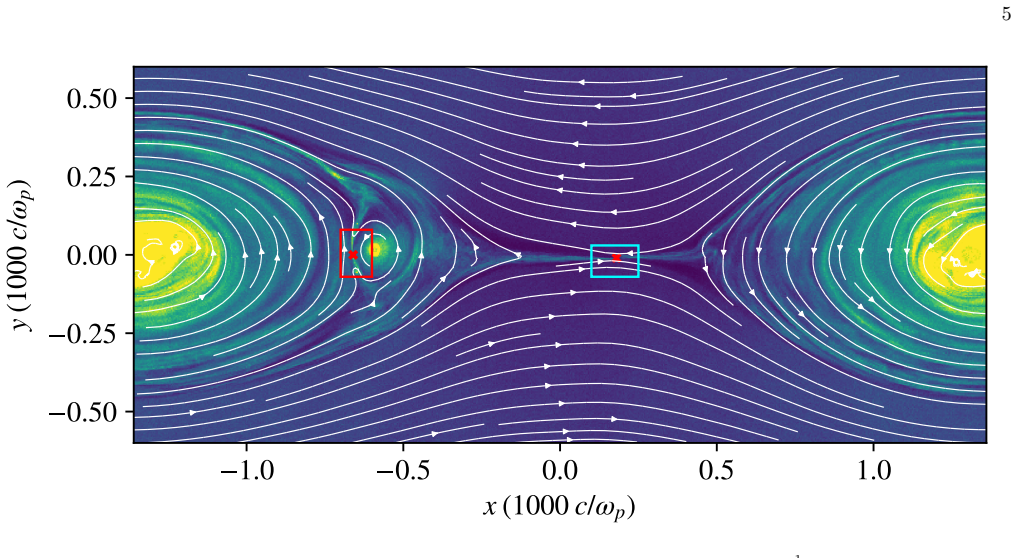
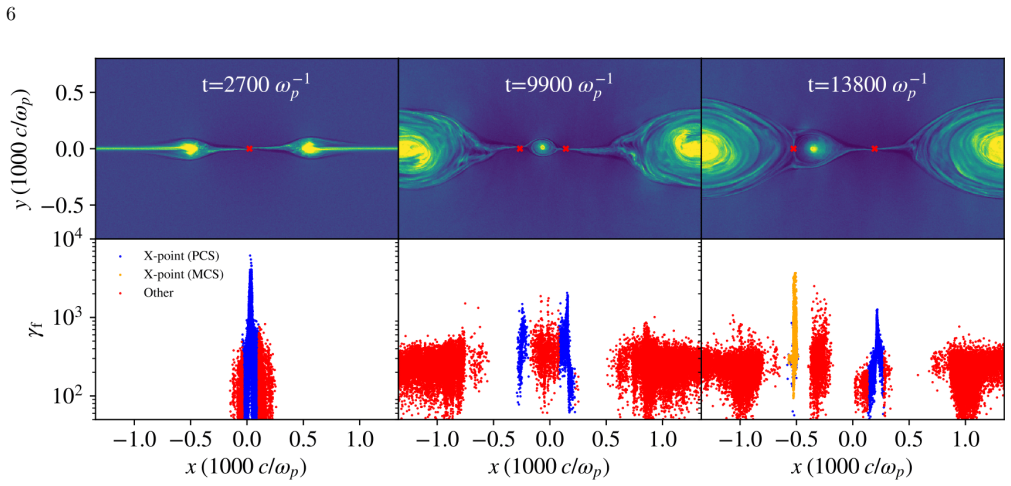
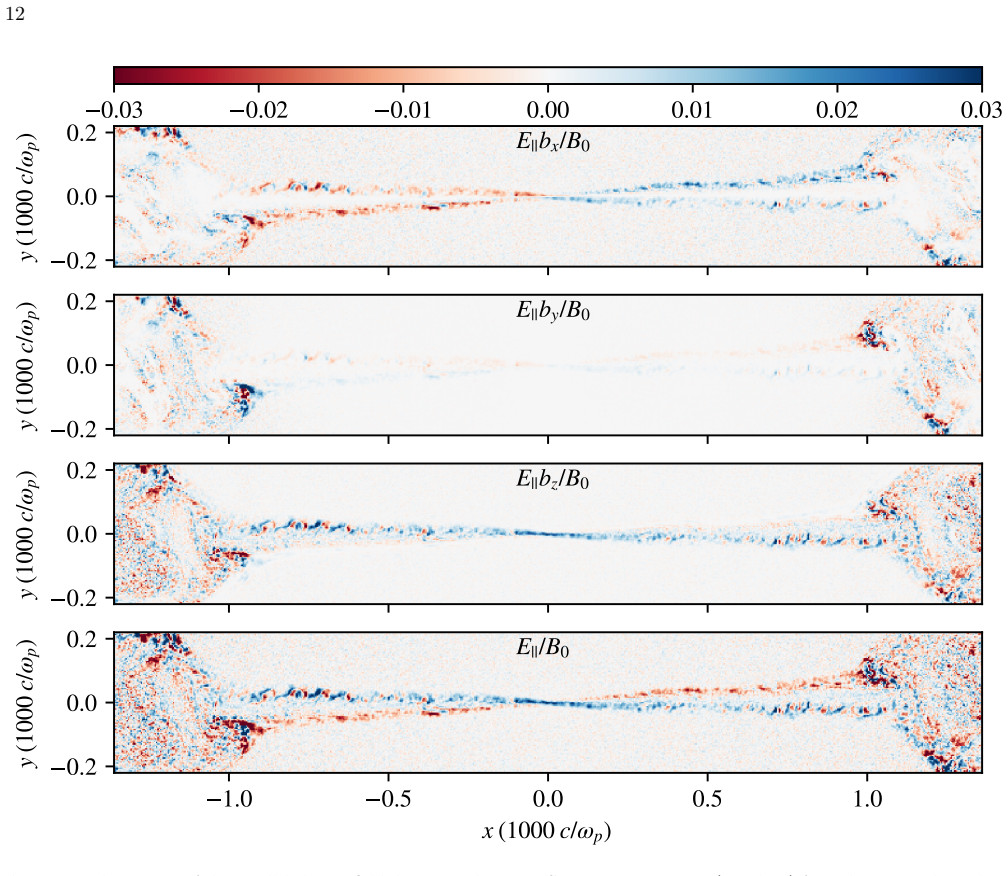
The load-bearing diagnostic is $W_{\parallel,z} = (1/m_e c^2)\int_0^{t_f} q E_{\parallel,z} v_z\, dt$, the cumulative work done by the out-of-plane part of the parallel electric field, accumulated on the fly for every electron to avoid time- and particle-downsampling biases. The companion machinery is (i) X-point identification as saddle points of the magnetic vector potential $A_z$, tested by the Hessian eigenvalues; (ii) an Alfvénic causal-connection criterion that assigns a particle's first $\gamma>\sigma_e/2$ crossing to a nearby X-point; and (iii) two test-particle populations evolved without depositing current onto the grid, one with $E_\parallel=0$ and one with $E_{\parallel,z}=0$, which isolate the role of the parallel non-ideal field. The small guide field $B_g/B_0=0.1$ is what makes $E_\parallel$ well-defined at X-points, where the field would vanish in the anti-parallel case.
What would settle it
Run the same trans-relativistic simulation at zero guide field and remove the non-ideal out-of-plane electric field from a test population while keeping all other dynamics; if a hard non-thermal tail still forms, the claim that $E_{\parallel,z}$ at X-points controls injection does not transfer to anti-parallel reconnection. Conversely, if the hard tail disappears, the guide-field proxy is validated.
Extended reading notes
Core claim
The central claim is that the non-ideal reconnection electric field at X-points — specifically the $z$-component of the field parallel to the local magnetic field, $E_{\parallel,z}$ — governs the injection of electrons into the ultra-relativistic non-thermal tail, while the hardness of that tail is set by how many X-points and plasmoids populate the reconnection layer. In the simulations, electrons that first cross the energy threshold $\gamma \simeq \sigma_e/2$ are almost always found within an Alfvén-crossing distance of an X-point, either in the primary current sheet or in merger-driven sheets between plasmoids. The cumulative work $W_{\parallel,z}$ correlates tightly with final electron energy at early times; at late times additional ideal-field processes such as Fermi-type reflection, plasmoid compression, and merging outflows add energy, but the tail's existence and slope depend on the X-point pre-acceleration. Test electrons that feel the in-plane parallel field but not $E_{\parallel,z}$ end up with the same thermal peak but no hard non-thermal tail, whereas test electrons that feel no parallel field are barely heated at all. The authors take the near-identity of spectra between $B_g=0$ and $B_g/B_0=0.1$ as evidence that the result transfers to the anti-parallel case.
Load-bearing premise
The load-bearing assumption is that a small guide field ($B_g/B_0=0.1$) is close enough to the anti-parallel case that the out-of-plane parallel electric field $E_{\parallel,z}$ faithfully captures the same non-ideal reconnection electric field that acts at anti-parallel X-points, where the magnetic field vanishes and $E_\parallel$ is undefined.
Editorial extensions
If this is right
- If the claim is right, models of non-thermal emission from low-luminosity accretion flows should tie acceleration efficiency to the density of X-points per unit length of current sheet, not just to the sheet's magnetization.
- Current sheets with a guide field at or above $B_g/B_0 \simeq 0.3$ suppress the secondary tearing mode; electron acceleration can then become negligible unless the sheet is thin or externally perturbed, so a timescale analysis of sheet formation and tearing is needed before invoking reconnection.
- In the trans-relativistic regime with $\sigma \sim 0.3$ and the true mass ratio, X-point injection dominates Fermi processes because the energy gain at an X-point scales with $\sigma_e \simeq 550$, while the outflow energy gain scales only as $\Gamma^2 = \sigma + 1$; at high $\sigma$ or in pair plasmas the balance shifts.
- The test-particle ablation result implies that any physical prescription for electron spectra in reconnection must include the parallel non-ideal field at X-points as the injection step, even if the final energy budget is dominated by ideal fields.
Reading between the lines
- The diagnostic logic suggests a direct test in zero-guide-field simulations: ablate the full non-ideal out-of-plane electric field $E_z$ rather than $E_{\parallel,z}$, and check whether the hard tail disappears; if it does not, the $E_{\parallel,z}$ criterion is an artifact of the guide-field proxy.
- Because hardness correlates with X-points per unit length, the result implies a resolution requirement for astrophysical models: unresolved sub-grid prescriptions should parameterize the injection probability by the tearing-mode growth rate and sheet thickness rather than by a fixed acceleration rate.
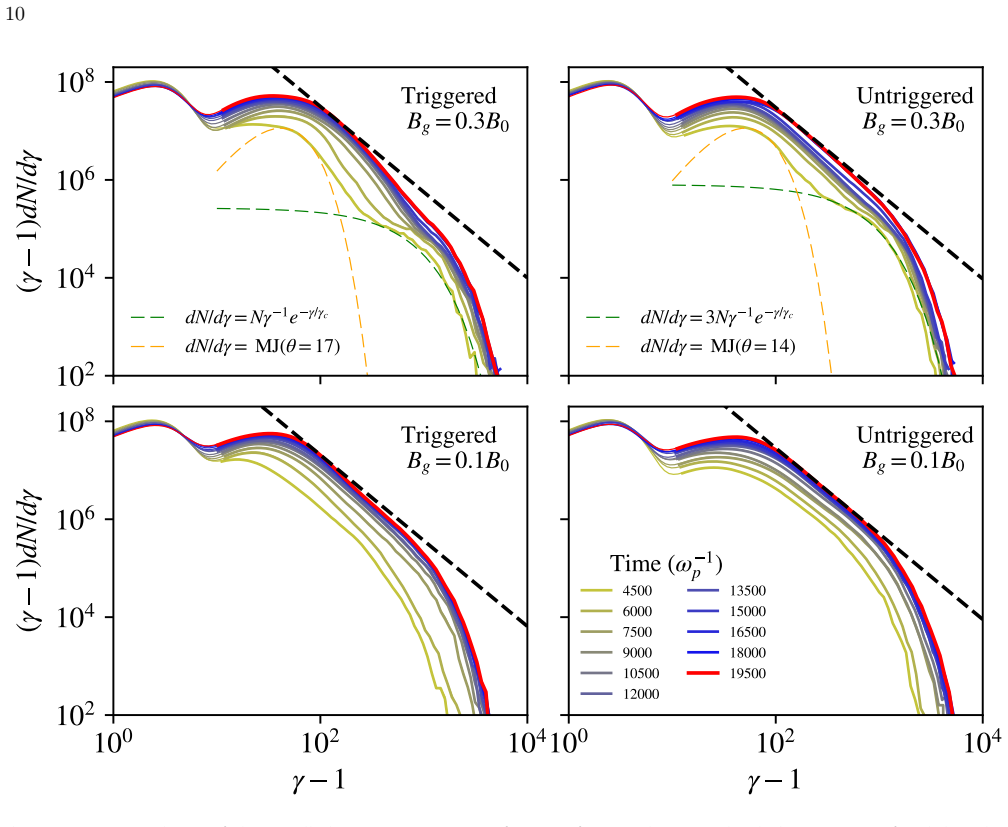
- The two-component spectra at $B_g=0.3B_0$ suggest that spectral breaks in observed synchrotron emission from sources such as Sgr A* could encode the relative normalization of X-point-injected versus outflow-heated electrons, offering an observational handle on reconnection layer structure.
- Extending the test-particle method to three-dimensional reconnection would test whether X-points in 3D, which form as lines with localized electric-field patches, still control injection; the authors' 2.5D setup may overestimate the coherence of $E_{\parallel,z}$.
Signed reviews
Editorial analysis
A structured set of objections, weighed in public.
Referee Report
Summary. The paper presents 2.5D particle-in-cell simulations of trans-relativistic (σ = 0.3) electron–proton reconnection with the true mass ratio, varying the guide field strength (Bg/B0 = 0.1 and 0.3) and the triggered versus untriggered setup to control the number of X-points and plasmoids. Using on-the-fly diagnostics for all electrons, the authors classify the location of first acceleration episodes, track the work W||,z done by the out-of-plane component of the parallel electric field, and run two test-particle populations that selectively do not feel E|| or E||,z. They find that X-points, both in the primary current sheet and in merger-induced current sheets, dominate the injection of electrons into the nonthermal tail, that W||,z correlates with the final Lorentz factor of the highest-energy electrons, and that suppressing E||,z removes the nonthermal tail while leaving the thermal peak roughly intact. The paper concludes that the number of X-points per unit length controls the hardness of the electron spectrum and that the out-of-plane component of the parallel electric field is the key injection mechanism. An appendix compares the Bg/B0 = 0.1 runs with a zero-guide-field run and argues, on the basis of spectral and structural similarity, that the conclusions transfer to anti-parallel reconnection.
Significance. If the central claims hold, this is a significant advance in understanding electron acceleration in a regime relevant to radiatively inefficient accretion flows and Sgr A*: it provides a causal, rather than correlative, demonstration of the role of X-point electric fields in injection, uses the physical electron–proton mass ratio, tracks all particles without downsampling, and systematically varies the density of X-points. The test-particle ablation is a strong and relatively clean experiment, and the comparison with the σ = 50 pair-plasma results of Guo et al. (2019) gives a physically motivated explanation of why non-ideal fields can dominate at low sigma. The main weakness is that the mechanism is directly demonstrated only for nonzero guide field, while the paper generalizes to the anti-parallel case on the basis of spectral similarity rather than an acceleration diagnostic.
major comments (4)
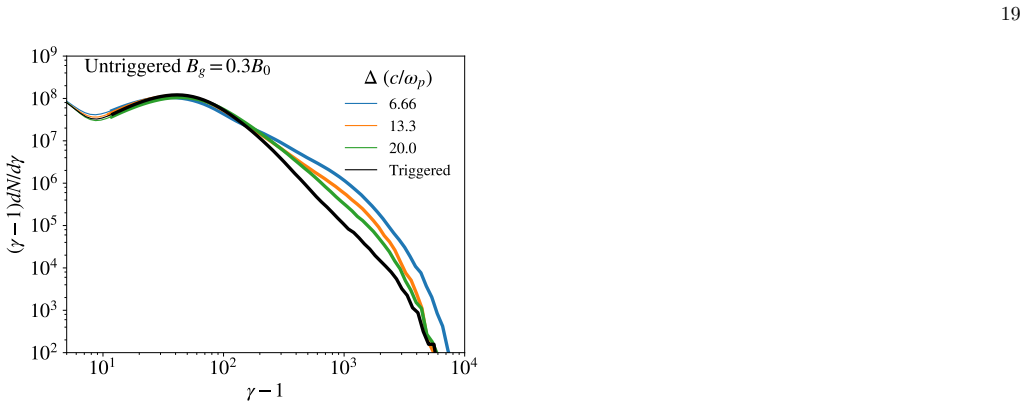
- [Section 3.1, Section 6, Appendix C, Abstract] The paper's headline claim that the out-of-plane component of the parallel electric field controls the nonthermal tail is directly demonstrated only for the nonzero guide field runs (Bg/B0 = 0.1 and 0.3). At Bg = 0, E|| = E·b_hat vanishes at X-points by definition, so the W||,z diagnostic and the test-particle ablation of Section 6 cannot be applied to the anti-parallel case. Appendix C bridges to Bg = 0 only via the 'remarkably similar' spectra in Fig. 19 and structures in Fig. 20; a spectral match does not establish that the same field component does the accelerating work. Because the Abstract states the mechanism without this caveat, the anti-parallel transfer is load-bearing for the generality of the claim. Please either restrict the causal statements to guide-field reconnection, or add a diagnostic in the zero-guide-field run (e.g., test particles with the out-of-plane non-ideal field Ez removed) to test whether the same acceleration channel controls the tail there.
- [Section 5, Figure 6, Appendix A] The quantitative claim that the number of X-points per unit length sets the spectral hardness rests on power-law indices that are fitted without quoted uncertainties. The caption of Fig. 6 describes the p = 2.7 reference as 'normalized to lie tangent' to the spectra, and the insets of Figs. 13–16 plot power-law index versus box length with no error bars, fit ranges, or formal fitting procedure. Given that this trend is a central result, please report the fitted power-law indices with uncertainties (or specify the energy range and fitting method), or soften the quantitative claim to a qualitative correlation demonstrated by the controlled comparisons.
- [Section 2.1, Section 7] All simulations are 2.5D (two spatial dimensions, three velocity components), but the paper applies the conclusions to realistic three-dimensional accretion flows without discussing possible 3D effects, such as the finite extent of current sheets along z, drift-kink instabilities, or differences in the secondary tearing mode. A paragraph in the conclusions acknowledging these limitations and why the 2.5D results are expected to carry over would make the astrophysical claims more balanced.
- [Section 2.1] The decision to exclude the initially hot, overdense current-sheet particles from all spectra and analyses is a strong modeling choice, since these particles are part of the Harris equilibrium and participate in the dynamics. The paper asserts that this exclusion is warranted because their properties depend on initialization, but does not test whether the injection statistics would change if these particles were included. Please either justify this exclusion with a convergence check or defer the exclusion to a caveat in the text.
minor comments (5)
- [Figure 12 caption] The caption reads 'taken only in th reconnection region'; it should read 'taken only in the reconnection region.'
- [Section 6, first paragraph] In the sentence describing Fig. 11, 'the triggered simulation with Bg = 0.3Bg' should read 'Bg = 0.3B0.'
- [Section 4, Figure 6 discussion] The sentence describing the two-component fit says the normalization is three times higher in the untriggered case 'as compared to the single primary X-point in the untriggered case'; the second occurrence should be 'triggered case.'
- [Section 3.1] The on-the-fly threshold γ > σe/2 is applied to each particle only once, so a particle that later falls below the threshold or has multiple acceleration episodes is classified only by its first crossing. This should be stated explicitly as a limitation, since the first-crossing location may not coincide with the dominant energy-gain episode for all high-energy electrons.
- [Section 5] The term 'efficiency' is defined via the hardness of the nonthermal spectral tail, not via the total energy contained in nonthermal electrons. Footnote 7 makes the proxy clear, but the conclusions would benefit from an explicit statement that a harder slope is used as a proxy for injection efficiency rather than a direct measurement of the nonthermal energy fraction.
Circularity Check
No significant circularity: the central mechanism claim is established by a non-fitted ablation and on-the-fly diagnostics, with only a minor, non-load-bearing self-citation.
full rationale
The paper's core causal claim—that the out-of-plane component of the parallel electric field (E||,z) controls the nonthermal tail—is tested by a controlled intervention: test electrons with E||,z set to zero fail to produce a hard tail, while electrons lacking all parallel electric fields also fail to be heated or accelerated (Section 6, Figures 11-12). This is an external benchmark inside the simulation, not a fitted parameter renamed as a prediction. The W||,z diagnostic (Eq. 1) is a bookkeeping work integral, and the correlation between Δγ and W||,z is an empirical finding, not a tautology. The paper's self-citations to Ball et al. (2018) motivate the parameter regime (σ=0.3, βi=0.003) and provide preliminary context, but the present conclusions are independently demonstrated by the new diagnostics and ablation runs; no load-bearing argument reduces to those citations. Appendix C explicitly limits the E||-based diagnostic to nonzero guide field, noting that in anti-parallel reconnection E|| is undefined at X-points where B=0, and extends to Bg=0 only via the 'remarkably similar' spectra (Figure 19). That is an acknowledged extrapolation from spectral similarity, not a derivation that assumes the conclusion as a premise. No uniqueness theorem is imported, no ansatz is smuggled via citation, and no known result is merely renamed: the authors explicitly attribute X-point acceleration to prior works (Zenitani & Hoshino 2001; Sironi & Spitkovsky 2014; Nalewajko et al. 2015) and extend it to the trans-relativistic, true-mass-ratio regime with new evidence. Therefore no significant circularity is present; the score of 1 reflects only the presence of minor, non-load-bearing self-citation in the parameter choice and preliminary motivation.
Assumptions & free parameters
free parameters (5)
- Magnetization sigma =
0.3
- Proton plasma beta beta_i =
0.003
- Guide field ratio Bg/B0 =
0.1 and 0.3
- Injection threshold =
sigma_e/2 ~ 275 (for sigma=0.3, m_i/m_e=1836)
- Alfvenic causality tolerance in Eq. (2) =
vA speed threshold
assumptions (6)
- domain assumption PIC simulation with the public TRISTAN-MP code correctly captures collisionless reconnection dynamics in the trans-relativistic regime.
- domain assumption 2.5D geometry (2D spatial plane, three field/velocity components) captures the essential X-point and plasmoid statistics; 3D effects are ignorable.
- ad hoc to paper The initially hot, overdense current-sheet particles can be excluded from all spectra and analyses without biasing the acceleration mechanism conclusions.
- domain assumption X-points identified via the Hessian of Az with a density filter (following Haggerty et al. 2017) correspond to active acceleration sites.
- domain assumption In a guide-field reconnection, the parallel electric field E|| (and specifically its z-component) faithfully represents the non-ideal reconnection electric field at X-points.
- domain assumption Test particles that do not deposit currents are valid probes of the acceleration mechanism in the self-consistent fields.
Cite this review
Pith. "Pith review of The Mechanism of Electron Injection and Acceleration in Trans-Relativistic Reconnection." pith.science (2026). https://pith.science/paper/3J6U5IPU
@misc{pith2026190805866,
  author       = {Pith},
  title        = {Pith review of: The Mechanism of Electron Injection and Acceleration in Trans-Relativistic Reconnection},
  year         = {2026},
  howpublished = {\url{https://pith.science/paper/3J6U5IPU}},
  note         = {Machine review of arXiv:1908.05866}
}
abstract
Electron acceleration during magnetic reconnection is thought to play a key role in time-variable high-energy emission from astrophysical systems. By means of particle-in-cell simulations of trans-relativistic reconnection, we investigate electron injection and acceleration mechanisms in low-$\beta$ electron-proton plasmas. We set up a diversity of density and field structures (e.g., X-points and plasmoids) by varying the guide field strength and choosing whether to trigger reconnection or let it spontaneously evolve. We show that the number of X-points and plasmoids controls the efficiency of electron acceleration, with more X-points leading to a higher efficiency. Using on-the-fly acceleration diagnostics, we also show that the non-ideal electric fields associated with X-points play a critical role in the first stages of electron acceleration. As a further diagnostic, we include two populations of test particles that selectively experience only certain components of electric fields. We find that the out-of-plane component of the parallel electric field determines the hardness of the high-energy tail of the electron energy distribution. These results further our understanding of electron acceleration in this regime of magnetic reconnection and have implications for realistic models of black hole accretion flows.
Figures

Figures from the paper (16 more)






Forward citations
Cited by 1 Pith paper
-
Particle Injection Problem in Magnetic Reconnection and Turbulence
A review of the particle injection problem in magnetic reconnection and turbulence, arguing that injection is set by direct acceleration, Fermi kicks, and pickup processes, not by E>B diffusion regions.
Reference graph
Works this paper leans on
-
[1]
Achterberg, A., Gallant, Y. A., Kirk, J. G., & Guthmann, A. W. 2001, MNRAS, 328, 393
work page 2001
-
[2]
Ball, D., ¨Ozel, F., Psaltis, D., & Chan, C.-k. 2016, ApJ, 826, 77
work page 2016
-
[3]
2017, ArXiv e-prints, arXiv:1705.06293
Ball, D., ¨Ozel, F., Psaltis, D., Chan, C.-K., & Sironi, L. 2017, ArXiv e-prints, arXiv:1705.06293
arXiv 2017
- [4]
- [5]
-
[6]
Brittnacher, M., Quest, K. B., & Karimabadi, H. 1995, J. Geophys. Res., 100, 3551
work page 1995
-
[7]
Buneman, O. 1993, in“Computer Space Plasma Physics”, Terra Scientific, Tokyo, 67
work page 1993
-
[8]
Cerutti, B., & Philippov, A. A. 2017, A&A, 607, A134
2017
Show all 50 references
-
[9]
A., & Begelman, M
Cerutti, B., Uzdensky, D. A., & Begelman, M. C. 2012, ApJ, 746, 148
2012
-
[10]
R., Uzdensky, D
Cerutti, B., Werner, G. R., Uzdensky, D. A., & Begelman, M. C. 2014, Physics of Plasmas, 21, 056501
2014
-
[11]
M., Petropoulou, M., Sironi, L., & Giannios, D
Christie, I. M., Petropoulou, M., Sironi, L., & Giannios, D. 2019, MNRAS, 482, 65
2019
-
[12]
Coroniti, F. V. 1990, ApJ, 349, 538
1990
-
[13]
T., Drake, J
Dahlin, J. T., Drake, J. F., & Swisdak, M. 2014, Physics of Plasmas, 21, 092304 —. 2015, Physics of Plasmas, 22, 100704 —. 2016a, Physics of Plasmas, 23, 120704 —. 2016b, ArXiv e-prints, arXiv:1607.03857 de Gouveia Dal Pino, E., Kowal, G., Kadowaki, L., et al. 2018, arXiv e-pr...
2014 arXiv
-
[14]
F., Swisdak, M., Che, H., & Shay, M
Drake, J. F., Swisdak, M., Che, H., & Shay, M. A. 2006, Nature, 443, 553
2006
-
[15]
Drenkhahn, G., & Spruit, H. C. 2002, A&A, 391, 1141
2002
-
[16]
G., & Acton, L
Forbes, T. G., & Acton, L. W. 1996, ApJ, 459, 330
1996
-
[17]
A., Rosner, R., & Vaiana, G
Galeev, A. A., Rosner, R., & Vaiana, G. S. 1979, ApJ, 229, 318
1979
-
[18]
2008, A&A, 480, 305 —
Giannios, D. 2008, A&A, 480, 305 —. 2010, MNRAS, 408, L46 —. 2013, MNRAS, 431, 355
2008
-
[19]
A., & Begelman, M
Giannios, D., Uzdensky, D. A., & Begelman, M. C. 2009, MNRAS, 395, L29
2009
-
[20]
2019, arXiv e-prints, arXiv:1901.08308
Guo, F., Li, X., Daughton, W., et al. 2019, arXiv e-prints, arXiv:1901.08308
2019 arXiv
-
[21]
2015, ApJ, 806, 167
Guo, F., Liu, Y.-H., Daughton, W., & Li, H. 2015, ApJ, 806, 167
2015
-
[22]
C., Parashar, T
Haggerty, C. C., Parashar, T. N., Matthaeus, W. H., et al. 2017, Physics of Plasmas, 24, 102308
2017
-
[23]
2018, arXiv e-prints, arXiv:1809.10772
Hakobyan, H., Philippov, A., & Spitkovsky, A. 2018, arXiv e-prints, arXiv:1809.10772
2018 arXiv
-
[24]
G., & Skjæraasen, O
Kirk, J. G., & Skjæraasen, O. 2003, ApJ, 591, 366
2003
-
[25]
2015, ApJ, 810, 19
Li, Y.-P., Yuan, F., Yuan, Q., et al. 2015, ApJ, 810, 19
2015
-
[26]
Lyubarsky, Y., & Kirk, J. G. 2001, ApJ, 547, 437
2001
-
[27]
2008, ApJ, 682, 1436
Lyubarsky, Y., & Liverts, M. 2008, ApJ, 682, 1436
2008
-
[28]
2003, ArXiv Astrophysics e-prints, astro-ph/0312347
Lyutikov, M., & Blandford, R. 2003, ArXiv Astrophysics e-prints, astro-ph/0312347
2003 arXiv
-
[29]
2016, Galaxies, 4, 28 —
Nalewajko, K. 2016, Galaxies, 4, 28 —. 2018, MNRAS, 481, 4342
2016
-
[30]
Begelman, M. C. 2015, ApJ, 815, 101 P´ etri, J., & Lyubarsky, Y. 2008, in American Institute of Physics Conference Series, Vol. 983, 40 Years of Pulsars: Millisecond
2015
-
[31]
2016, MNRAS, 462, 3325
Petropoulou, M., Giannios, D., & Sironi, L. 2016, MNRAS, 462, 3325
2016
-
[32]
2018, MNRAS, 481, 5687
Petropoulou, M., & Sironi, L. 2018, MNRAS, 481, 5687
2018
-
[33]
A., & Spitkovsky, A
Philippov, A. A., & Spitkovsky, A. 2014, ApJ, 785, L33 Rodr´ ıguez-Ram´ ırez, J. C., de Gouveia Dal Pino, E. M., & Alves
2014
-
[34]
2018, arXiv e-prints, arXiv:1811.02812
Batista, R. 2018, arXiv e-prints, arXiv:1811.02812
2018 arXiv
-
[35]
M., & Lovelace, R
Romanova, M. M., & Lovelace, R. V. E. 1992, A&A, 262, 26
1992
-
[36]
2011, Living Reviews in Solar Physics, 8, 6
Shibata, K., & Magara, T. 2011, Living Reviews in Solar Physics, 8, 6
2011
-
[37]
2011, ApJ, 726, 75 —
Sironi, L., & Spitkovsky, A. 2011, ApJ, 726, 75 —. 2014, ApJ, 783, L21
2011
-
[38]
2005, in AIP Conf
Spitkovsky, A. 2005, in AIP Conf. Ser., Vol. 801, Astrophysical Sources of High Energy Particles and Radiation, ed. T. Bulik, B. Rudak, & G. Madejski, 345
2005
-
[39]
C., Daigne, F., & Drenkhahn, G
Spruit, H. C., Daigne, F., & Drenkhahn, G. 2001, A&A, 369, 694
2001
-
[40]
1994, MNRAS, 270, 480 —
Thompson, C. 1994, MNRAS, 270, 480 —. 2006, ApJ, 651, 333
1994
-
[41]
Usov, V. V. 1994, MNRAS, 267, 1035
1994
-
[42]
A., & Goodman, J
Uzdensky, D. A., & Goodman, J. 2008, ApJ, 682, 608
2008
-
[43]
A., & Loureiro, N
Uzdensky, D. A., & Loureiro, N. F. 2016, Phys. Rev. Lett., 116, 105003
2016
-
[44]
2016, ApJ, 821, 84
Wang, H., Lu, Q., Huang, C., & Wang, S. 2016, ApJ, 821, 84
2016
-
[45]
R., Philippov, A
Werner, G. R., Philippov, A. A., & Uzdensky, D. A. 2019, MNRAS, 482, L60
2019
-
[46]
R., & Uzdensky, D
Werner, G. R., & Uzdensky, D. A. 2017, ApJ, 843, L27
2017
-
[47]
2018, MNRAS, 473, 4840
Nalewajko, K. 2018, MNRAS, 473, 4840
2018
-
[48]
Begelman, M. C. 2016, ApJ, 816, L8
2016
-
[49]
2001, The Astrophysical Journal Letters, 546, L69
Yokoyama, T., Akita, K., Morimoto, T., Inoue, K., & Newmark, J. 2001, The Astrophysical Journal Letters, 546, L69
2001
-
[50]
2001, ApJ, 562, L63 —
Zenitani, S., & Hoshino, M. 2001, ApJ, 562, L63 —. 2007, ApJ, 670, 702
2001
Reviewed August 14, 2026 · model on record in the stance chip above.
Discussion (0). Continue with ORCID to comment.