REVIEW 4 major objections 4 minor 113 references
The optically-selected 1.4-GHz quasar luminosity function below 1 mJy
T0 review · 4 major / 4 minor · reviewed 2026-08-14 · deepseek-v4-flash
Pith's one-line read Bayesian stacking of FIRST pixels at SDSS quasar positions measures the quasar radio luminosity function to about 100 times fainter than the survey limit, exposing a flattening then steepening where radio-quiet quasars emerge.
desk verdict Competent application of bayestack to a new sample, but the sub-mJy RLF shape is conditional on optical selection effects the authors themselves flag. read the letter →
The pith
A machine-rendered reading of the paper's core claim, the machinery that carries it, and where it could break.
The reading
What carries the argument
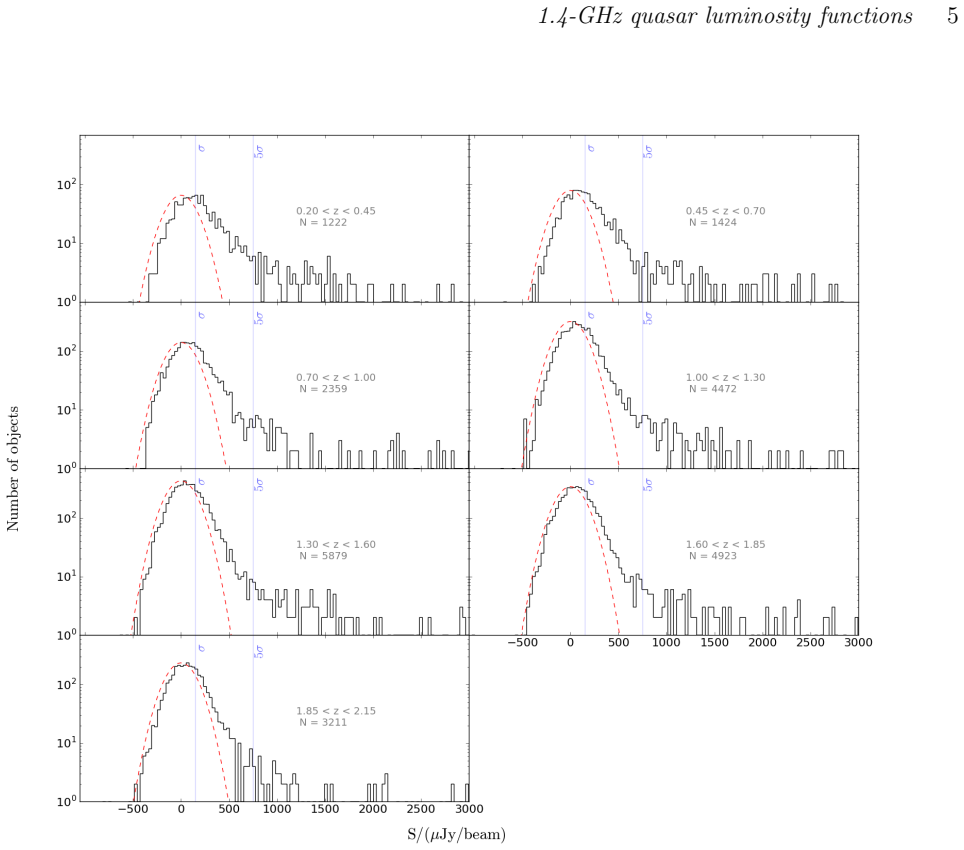
The central mechanism is a forward-modeled Poisson likelihood for binned FIRST pixel flux densities. A parametric radio luminosity function is converted to a source-count model, the FIRST clean and snapshot biases are applied, and the predicted counts are convolved with Gaussian noise before being compared to the histogram of extracted pixel values at SDSS quasar positions. This lets sources buried in the 150-$\mu$Jy noise constrain the luminosity function rather than being averaged into a single stacked flux. The faint-end models tested are a power law, a double power law, and a log-normal power law, with the double power law winning by Bayesian evidence in all redshift bins.
What would settle it
Run the same Bayesian stacking fit on a quasar sample with a fainter optical magnitude limit or with relaxed absolute-magnitude cuts over the same redshift bins: if the flattening near $\log_{10}[L_{1.4}/\mathrm{W\,Hz}^{-1}] \approx 25.5$ and the steepening near $\approx 24.8$ stay fixed in luminosity, the shape is physical, whereas if they shift or disappear the optical selection created them.
Extended reading notes
Core claim
The central claim is that a full Bayesian stacking analysis of FIRST survey pixels can recover the 1.4-GHz radio luminosity function of optically selected quasars two orders of magnitude below the 1 mJy detection threshold, and that the recovered RLF has a distinctive faint-end shape. In every redshift bin from $0.2 < z < 2.15$, the data prefer a model with a double power-law for both the luminous and the faint populations. The bright-end function rises steeply toward lower luminosity, flattens near $\log_{10}[L_{1.4}/\mathrm{W\,Hz}^{-1}] \approx 25.5$, and then steepens again below $\approx 24.8$, the regime where the authors associate the population with radio-quiet quasars. The agreement of the low-redshift reconstruction with deep JVLA observations of the same quasars, together with the coincidence between the steepening luminosity and the expected crossover to star-forming galaxy dominance, is presented as evidence that host-galaxy star formation may contribute to the radio emission of quasars; the paper explicitly notes that at least part of the flattening could instead be imposed by the SDSS optical magnitude limit.
Load-bearing premise
The load-bearing premise is that the SDSS optical magnitude limit, after the per-bin absolute magnitude cut, does not itself imprint the observed flattening and steepening on the radio luminosity function; the paper concedes that at least some of the flattening could be due to optical incompleteness.
Editorial extensions
If this is right
- A wide, shallow survey like FIRST is sufficient to constrain the faint end of the optically selected quasar RLF down to radio luminosities around $10^{22}\,\mathrm{W\,Hz}^{-1}$, roughly two orders of magnitude below the nominal detection threshold.
- The double power-law description of the faint population is preferred over a power law or a log-normal in all seven redshift bins, so the faint-end shape is not confined to a single redshift range.
- The flattening near $\log_{10}[L_{1.4}/\mathrm{W\,Hz}^{-1}] \approx 25.5$ and the steepening near $\approx 24.8$ recur in every bin, indicating that the same population change is present at all redshifts studied.
- The steepening luminosity coincides with where star-forming galaxies are expected to dominate radio source counts, so host-galaxy star formation may contribute significantly to radio-quiet quasar emission.
- In the lowest redshift bin the sub-mJy RLF matches deep JVLA observations of individual quasars, validating the stacking reconstruction against direct detections.
Reading between the lines
- Applying the same forward-model stacking to a parent quasar sample with a fainter optical magnitude limit would directly test whether the flattening luminosity tracks the optical limit or stays fixed, distinguishing a selection artifact from a true physical break.
- A bivariate optical-radio luminosity function, a route the authors mention, would remove the need for hard absolute-magnitude cuts and could separate accretion-driven from star-formation-driven radio emission more cleanly than the RLF alone.
- High-resolution imaging that resolves the host-galaxy scale would allow the extended, star-formation-related radio component to be separated from the AGN core, giving a direct test of the star-formation interpretation.
- The same noise-dominated pixel fitting could measure luminosity functions of other faint populations in current and future wide surveys, since it extracts shape information from sources buried below the detection threshold without needing deep images.
Signed reviews
Editorial analysis
A structured set of objections, weighed in public.
Referee Report
Summary. The paper applies a Bayesian stacking technique (bayestack) to 1.4-GHz FIRST flux densities extracted at the positions of SDSS DR7 quasars, fitting parametric models for the radio luminosity function (RLF) in seven redshift bins up to z=2.15. The authors claim to reconstruct the optically selected quasar RLF down to roughly two orders of magnitude below the FIRST 1 mJy detection threshold, and report that the bright-end RLF flattens below log10[L1.4/W Hz^-1] ~ 25.5 and steepens below ~24.8, where radio-quiet quasars and a possible star-formation contribution emerge. The method is tested on SKADS simulations and the lowest-redshift RLF is compared with deeper VLA data from Kellermann et al. (2016) and Condon et al. (2013).
Significance. If the reconstruction is reliable, this is a valuable technique for measuring the faint radio emission of optically selected quasars using wide, shallow surveys, and the deep low-z agreement with Kellermann et al. (2016) is an encouraging validation. The authors are careful to test the pipeline on SKADS simulations with realistic FIRST noise and to compare with independent data at low redshift; these are genuine strengths. However, the central physical claims about the RLF shape below the detection threshold rest on parametric model assumptions and on a subtle treatment of optical selection, and the paper itself acknowledges that at least part of the flattening may be caused by the optical magnitude limit. Because the claimed star-formation coincidence depends on the shape of the reconstructed faint end, the significance of that interpretation is not yet established.
major comments (4)
- [§5, Table 4, Eqs. 12–14] The claimed flattening at log10[L1.4/W Hz^-1] ~ 25.5 and the steepening below ~24.8 are not independent measurements but are properties of the winning double power-law model (Model B, Eq. 13): the turnover locations are essentially the break luminosities L*1 and L*2 of the fitted functions. The model-selection evidence in Table 4 only ranks Models A, B, and C relative to each other; it does not demonstrate that a turnover is required by the data, for example by testing against a model without a low-luminosity break or by computing an absolute goodness of fit. As a result, the abstract's statement of these transition luminosities, without associated uncertainties and without an explicit statement that they are posterior model parameters, is stronger than the analysis supports.
- [§2.1 (Eq. 1) and §6.1] The optical selection can imprint the very features the paper interprets physically. The sample is limited by i<19.1 and each redshift bin is truncated at a maximum absolute magnitude (Eq. 1); if optical and radio luminosities are correlated (as in White et al. 2017, with roughly an order of magnitude scatter), this cut differentially removes low-optical-luminosity quasars whose radio luminosities populate the regime where the flattening and steepening appear. The authors themselves state in Sec. 6.1 that 'at least some of the flattening is due to incompleteness introduced by the optical magnitude limit of the parent sample' and that they 'cannot rule out' an optical-selection origin for the bright-end flattening. Their robustness test, raising the optical limit and finding that the turnover becomes more prominent, is fully consistent with selection imprinting the shape rather than with a physical break. The SKADS validation does not address this issue because the simulated samples are cut in radio luminosity, not by an optical flux limit correlated with radio luminosity. To support the physical interpretation, the paper needs a forward-model test that injects an optical-radio correlation and an optical flux limit into the simulations and quantifies how much flattening/steepening is produced.
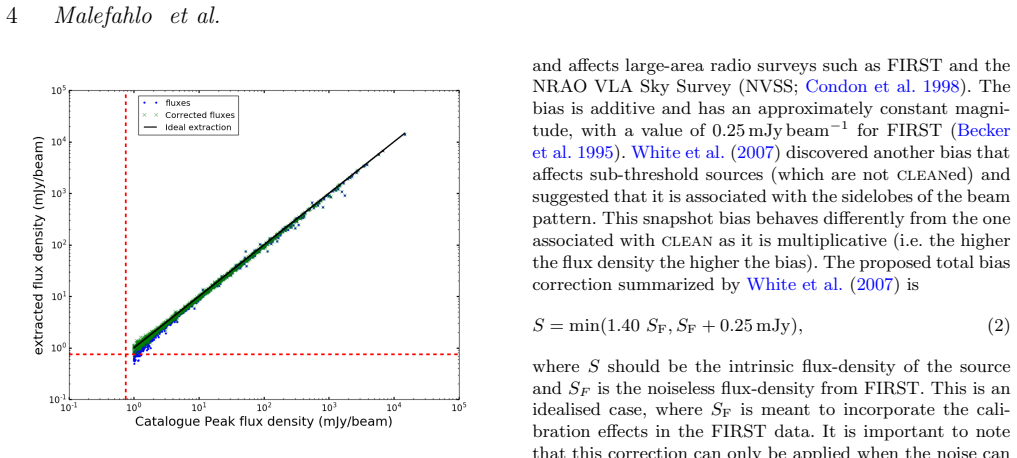
- [§3.2, Eq. 2 and §4] The White et al. (2007) bias correction (Eq. 2) was derived for sources above or near the detection threshold where noise can be neglected, and the authors correctly note this in the text. Applying this correction per source inside the likelihood, via SF = max{S/1.4, S - 0.25 mJy}, to noise-dominated sub-threshold flux densities is an extrapolation that is not validated by the SKADS simulations, which set S = SF and therefore do not include the clean or snapshot biases. Because the faint end of the RLF is precisely where this correction is applied, a mis-modeled bias could artificially produce or modify the apparent steepening below log10[L1.4/W Hz^-1] ~ 24.8. The paper should either justify the inverse correction for sub-threshold sources with simulations that include these biases or demonstrate that the results are robust to the assumed bias model.
- [§5.1, Table 5, and Appendix Fig. A0] The parameters that most directly control the low-luminosity shape are poorly constrained. Table 5 shows that the boundary parameters Lmin1, Lmax1, Lmin2, and Lmax2 are largely unconstrained, with many posterior intervals spanning several decades, and the appendix states that the faint-end slope beta2 is not well constrained. The authors argue that these 'have very little impact on the actual observed numbers,' but the claimed values of the flattening and steepening luminosities, and the integrated radio-quiet fractions in Table 1, are derived from these posterior components. The paper should quantify how the uncertainty in these boundary and slope parameters propagates into the claimed turnover locations and into the conclusion that the RLF 'peaks' and then 'drops rather abruptly,' rather than only presenting the MAP reconstruction.
minor comments (4)
- [§3.1] The description of the Bayes factor contains a typo: 'ln[ZB−ZA]' should be 'ln(ZB/ZA)'.
- [References] Several references are incomplete in the bibliography: Chen et al. (2017) is listed only as an arXiv preprint, Gürkan et al. (2018) has no journal or arXiv identifier, and Richards (2006) is listed as 'ArXiv Astrophysics e-prints.'
- [§5.1] The phrase 'the sources are volume-limited in the optical (i.e no brightness cutoff)' is misleading because the sample does have an absolute-magnitude cut (Eq. 1); the intended meaning is that there is no radio brightness cutoff, but the wording should be clarified.
- [Fig. 8 caption] The blue dotted and red dashed lines in Fig. 8 are described as 'an estimate of the radio-luminosity limit that corresponds to the optical limit' based on White et al. (2017); the caption should explicitly state that these are not measured limits but model-dependent extrapolations of the optical-radio correlation, given the scatter in that relation.
Circularity Check
No significant circularity: the fitted RLF features are model-based inferences, not definitional outputs, and the paper's self-citations are not load-bearing.
full rationale
The paper's derivation chain is data -> likelihood (Eqs. 6-9) -> parametric RLF model (Eqs. 12-14) -> fitted parameters and reconstructed RLF. The claimed flattening near log10[L1.4/W Hz^-1] ~ 25.5 and steepening near ~ 24.8 are properties of the best-fit double power-law, Model B, but that is ordinary statistical inference: the stacked FIRST flux-density distributions including the noise-dominated tail do constrain the parameters, and the method is validated against external SKADS simulations and against the independent low-redshift Kellermann et al. (2016) data. No equation defines one target quantity in terms of another target quantity by construction, and no fitted parameter is relabeled as a prediction. The self-citations are not load-bearing: bayestack (Zwart et al. 2015b) is a tool re-tested here, and the White et al. (2017) optical-radio correlation is used only to quantify an acknowledged selection caveat. The paper explicitly states in Sec. 6.1 that 'at least some of the flattening is due to incompleteness introduced by the optical magnitude limit of the parent sample,' which is a limitation on the physical interpretation, not a circularity in the derivation. The central measurement of the sub-mJy RLF remains an independent, externally benchmarked inference, so the circularity score is 0.
Assumptions & free parameters
free parameters (11)
- Bright-end RLF normalization, log10 Phi*1 =
-8.01 to -9.02 across redshift bins (Table 5)
- Bright-end break luminosity, log10 L*1 =
25.04 to 27.74 W/Hz across bins (Table 5)
- Bright-end bright slope, alpha1 =
0.27 to 2.46 across bins (Table 5)
- Bright-end faint slope, beta1 =
-3.44 to 0.24 across bins (Table 5)
- Faint-end normalization, log10 Phi*2 =
-6.53 to -6.97 across bins (Table 5)
- Faint-end break luminosity, log10 L*2 =
22.55 to 24.00 across bins (Table 5)
- Faint-end bright slope, alpha2 =
0.68 to 1.67 across bins (Table 5)
- Faint-end faint slope, beta2 =
-4.21 to -1.48 across bins (Table 5)
- Low-luminosity boundary, log10 Lmin1/Lmin2 =
18.6 to 23.4 across bins (Table 5)
- High-luminosity boundary, log10 Lmax1/Lmax2 =
24.2 to 29.9 across bins (Table 5)
- Spectral index alpha =
0.7 (assumed, not fitted)
assumptions (9)
- domain assumption FIRST map noise is Gaussian with sigma_n = 150 microJy per beam at quasar positions.
- domain assumption The bias correction S = min(1.40 S_F, S_F + 0.25 mJy), derived by White et al. (2007), holds for sub-threshold sources when included in the forward model.
- domain assumption The optically selected SDSS DR7 sample, after the per-bin absolute magnitude cut (Eq. 1), is complete enough that the optical limit does not imprint the observed radio RLF flattening.
- ad hoc to paper The radio luminosity function can be represented by the parametric family in Eqs. 12-14 (single/double power laws and log-normal power law).
- domain assumption A single spectral index alpha = 0.7 applies to all sources for flux-to-luminosity conversion and K-correction.
- standard math Poisson likelihood and independence of flux bins (Eqs. 6-9).
- standard math Bayes theorem and nested sampling provide unbiased posterior and evidence.
- domain assumption SKADS simulations represent the true radio sky well enough to validate the method.
- domain assumption Lambda-CDM cosmology with H0 = 70 km/s/Mpc, Omega_m = 0.3, Omega_Lambda = 0.7.
Cite this review
Pith. "Pith review of The optically-selected 1.4-GHz quasar luminosity function below 1 mJy." pith.science (2026). https://pith.science/paper/3JU3Y73X
@misc{pith2026190805316,
  author       = {Pith},
  title        = {Pith review of: The optically-selected 1.4-GHz quasar luminosity function below 1 mJy},
  year         = {2026},
  howpublished = {\url{https://pith.science/paper/3JU3Y73X}},
  note         = {Machine review of arXiv:1908.05316}
}
abstract
We present the radio luminosity function (RLF) of optically-selected quasars below 1~mJy, constructed by applying a Bayesian-fitting stacking technique to objects well below the nominal radio flux-density limit. We test the technique using simulated data, confirming that we can reconstruct the RLF over three orders of magnitude below the typical $5\sigma$ detection threshold. We apply our method to 1.4-GHz flux-densities from the Faint Images of the Radio Sky at Twenty-cm survey (FIRST), extracted at the positions of optical quasars from the Sloan Digital Sky Survey (SDSS) over seven redshift bins up to $z=2.15$ {and measure the RLF down to two orders of magnitude below the FIRST detection threshold}. In the lowest redshift bin ($0.2<z<0.45$), we find that our measured RLF agrees well with deeper data from the literature. The RLF for the radio-loud quasars flattens below $\log_{10}[L_{1.4}/{\rm W\,Hz}^{-1}] \approx 25.5$ and becomes steeper again below $\log_{10}[L_{1.4}/{\rm W\,Hz}^{-1}] \approx 24.8$, where radio-quiet quasars start to emerge. The radio luminosity where radio-quiet quasars emerge coincides with the luminosity where star-forming galaxies are expected to start to dominate the radio source counts. This implies that there could be a significant contribution from star formation in the host galaxies, but additional data is required to investigate this further. The higher-redshift bins show a similar behaviour as for the lowest-$z$ bin, implying that the same physical process may be responsible.
Figures

Figures from the paper (4 more)


Reference graph
Works this paper leans on
-
[1]
Abazajian K. N., et al., 2009, @doi [ ] 10.1088/0067-0049/182/2/543 , http://adsabs.harvard.edu/abs/2009ApJS..182..543A 182, 543
-
[2]
Antonucci R., 1993, @doi [ ] 10.1146/annurev.aa.31.090193.002353 , https://ui.adsabs.harvard.edu/abs/1993ARA&A..31..473A 31, 473
arXiv 1993
-
[4]
Balokovi \'c M., Smol c i \'c V., Ivezi \'c Z ., Zamorani G., Schinnerer E., Kelly B. C., 2012, @doi [ ] 10.1088/0004-637X/759/1/30 , https://ui.adsabs.harvard.edu/abs/2012ApJ...759...30B 759, 30
-
[5]
D., 1989, @doi [ ] 10.1086/167038 , https://ui.adsabs.harvard.edu/abs/1989ApJ...336..606B 336, 606
Barthel P. D., 1989, @doi [ ] 10.1086/167038 , https://ui.adsabs.harvard.edu/abs/1989ApJ...336..606B 336, 606
doi:10.1086/167038 1989
-
[6]
Becker R. H., White R. L., Helfand D. J., 1995, @doi [ ] 10.1086/176166 , http://adsabs.harvard.edu/abs/1995ApJ...450..559B 450, 559
doi:10.1086/176166 1995
-
[7]
Bessiere P. S., Tadhunter C. N., Ramos Almeida C., Villar Mart \' n M., 2012, @doi [ ] 10.1111/j.1365-2966.2012.21701.x , http://adsabs.harvard.edu/abs/2012MNRAS.426..276B 426, 276
arXiv 2012
-
[8]
Blandford R. D., Znajek R. L., 1977, @doi [ ] 10.1093/mnras/179.3.433 , http://adsabs.harvard.edu/abs/1977MNRAS.179..433B 179, 433
-
[9]
Bonzini M., Padovani P., Mainieri V., Kellermann K. I., Miller N., Rosati P., Tozzi P., Vattakunnel S., 2013, @doi [ ] 10.1093/mnras/stt1879 , http://adsabs.harvard.edu/abs/2013MNRAS.436.3759B 436, 3759
Show all 113 references
-
[10]
J., Shanks T., Peterson B
Boyle B. J., Shanks T., Peterson B. A., 1988, @doi [ ] 10.1093/mnras/235.3.935 , http://adsabs.harvard.edu/abs/1988MNRAS.235..935B 235, 935
1988 doi
-
[11]
Buchner J., et al., 2014, @doi [ ] 10.1051/0004-6361/201322971 , http://saaoads.chpc.ac.za/abs/2014A
2014 doi
-
[12]
Chen S., Zwart J. T. L., Santos M. G., 2017, preprint, http://adsabs.harvard.edu/abs/2017arXiv170904045C ( @eprint arXiv 1709.04045 )
2017 arXiv
-
[14]
J., Cotton W
Condon J. J., Cotton W. D., Greisen E. W., Yin Q. F., Perley R. A., Broderick J. J., 1994, in Crabtree D. R., Hanisch R. J., Barnes J., eds, Astronomical Society of the Pacific Conference Series Vol. 61, Astronomical Data Analysis Software and Systems III. p. 155
1994
-
[15]
J., Cotton W
Condon J. J., Cotton W. D., Greisen E. W., Yin Q. F., Perley R. A., Taylor G. B., Broderick J. J., 1998, @doi [ ] 10.1086/300337 , http://adsabs.harvard.edu/abs/1998AJ....115.1693C 115, 1693
1998 doi
-
[16]
J., Cotton W
Condon J. J., Cotton W. D., Yin Q. F., Shupe D. L., Storrie-Lombardi L. J., Helou G., Soifer B. T., Werner M. W., 2003, @doi [ ] 10.1086/374633 , http://adsabs.harvard.edu/abs/2003AJ....125.2411C 125, 2411
2003 doi
-
[17]
J., Kellermann K
Condon J. J., Kellermann K. I., Kimball A. E., Ivezi \'c Z ., Perley R. A., 2013, @doi [ ] 10.1088/0004-637X/768/1/37 , http://adsabs.harvard.edu/abs/2013ApJ...768...37C 768, 37
2013 doi
-
[18]
P., Andernach H., 2015, @doi [ ] 10.1088/0004-6256/149/6/192 , http://adsabs.harvard.edu/abs/2015AJ....149..192C 149, 192
Coziol R., Torres-Papaqui J. P., Andernach H., 2015, @doi [ ] 10.1088/0004-6256/149/6/192 , http://adsabs.harvard.edu/abs/2015AJ....149..192C 149, 192
2015 doi
-
[19]
P., Ortega-Minakata R
Coziol R., Andernach H., Torres-Papaqui J. P., Ortega-Minakata R. A., Moreno del Rio F., 2017, @doi [ ] 10.1093/mnras/stw3164 , https://ui.adsabs.harvard.edu/#abs/2017MNRAS.466..921C 466, 921
2017 doi
-
[20]
J., et al., 2006, @doi [ ] 10.1111/j.1365-2966.2005.09675.x , http://adsabs.harvard.edu/abs/2006MNRAS.365...11C 365, 11
Croton D. J., et al., 2006, @doi [ ] 10.1111/j.1365-2966.2005.09675.x , http://adsabs.harvard.edu/abs/2006MNRAS.365...11C 365, 11
2006
-
[21]
S., McLure R
Dunlop J. S., McLure R. J., Kukula M. J., Baum S. A., O'Dea C. P., Hughes D. H., 2003, @doi [ ] 10.1046/j.1365-8711.2003.06333.x , http://adsabs.harvard.edu/abs/2003MNRAS.340.1095D 340, 1095
2003
-
[23]
L., 1995, , https://ui.adsabs.harvard.edu/abs/1995A
Falcke H., Biermann P. L., 1995, , https://ui.adsabs.harvard.edu/abs/1995A
1995
-
[24]
Fan X., 1999, @doi [ ] 10.1086/300848 , http://adsabs.harvard.edu/abs/1999AJ....117.2528F 117, 2528
1999 doi
-
[25]
Fan X., et al., 2001, @doi [ ] 10.1086/324111 , https://ui.adsabs.harvard.edu/#abs/2001AJ....122.2833F 122, 2833
2001 doi
-
[28]
P., Zwart J
Feroz F., Hobson M. P., Zwart J. T. L., Saunders R. D. E., Grainge K. J. B., 2009b, @doi [ ] 10.1111/j.1365-2966.2009.15247.x , 398, 2049
2009
-
[29]
Ferrarese L., Merritt D., 2000, @doi [ ] 10.1086/312838 , http://adsabs.harvard.edu/abs/2000ApJ...539L...9F 539, L9
2000 doi
-
[30]
L., De Zotti G., Silva L., Bressan A., Danese L., 2004, @doi [ ] 10.1086/379875 , http://adsabs.harvard.edu/abs/2004ApJ...600..580G 600, 580
Granato G. L., De Zotti G., Silva L., Bressan A., Danese L., 2004, @doi [ ] 10.1086/379875 , http://adsabs.harvard.edu/abs/2004ApJ...600..580G 600, 580
2004 doi
-
[31]
J., Muxlow T
Guidetti D., Bondi M., Prandoni I., Beswick R. J., Muxlow T. W. B., Wrigley N., Smail I., McHardy I., 2013, @doi [ ] 10.1093/mnras/stt633 , https://ui.adsabs.harvard.edu/abs/2013MNRAS.432.2798G 432, 2798
2013 doi
-
[32]
G \"u rkan G., et al., 2018, arXiv e-prints, http://adsabs.harvard.edu/abs/2018arXiv181107933G
2018
-
[33]
G \"u rkan G., et al., 2019, @doi [ ] 10.1051/0004-6361/201833892 , https://ui.adsabs.harvard.edu/abs/2019A&A...622A..11G 622, A11
2019 doi
-
[34]
1480, American Institute of Physics Conference Series
Haiman Z., Tanaka T., Perna R., 2012, in Umemura M., Omukai K., eds, American Institute of Physics Conference Series Vol. 1480, American Institute of Physics Conference Series. pp 303--308, @doi 10.1063/1.4754372
2012 doi
-
[35]
R., Vives-Arias H., 2019, @doi [ ] 10.1093/mnras/stz510 , https://ui.adsabs.harvard.edu/abs/2019MNRAS.485.3009H 485, 3009
Hartley P., Jackson N., Sluse D., Stacey H. R., Vives-Arias H., 2019, @doi [ ] 10.1093/mnras/stz510 , https://ui.adsabs.harvard.edu/abs/2019MNRAS.485.3009H 485, 3009
2019 doi
-
[36]
A., et al., 2014, @doi [ ] 10.1093/mnras/stu1725 , https://ui.adsabs.harvard.edu/abs/2014MNRAS.445..280H 445, 280
Hatch N. A., et al., 2014, @doi [ ] 10.1093/mnras/stu1725 , https://ui.adsabs.harvard.edu/abs/2014MNRAS.445..280H 445, 280
2014 doi
-
[37]
P., Maini A., 2016, @doi [ ] 10.1051/0004-6361/201628302 , http://adsabs.harvard.edu/abs/2016A
Herrera Ruiz N., Middelberg E., Norris R. P., Maini A., 2016, @doi [ ] 10.1051/0004-6361/201628302 , http://adsabs.harvard.edu/abs/2016A
2016 doi
-
[38]
A., Becker R
Hodge J. A., Becker R. H., White R. L., de Vries W. H., 2008, @doi [ ] 10.1088/0004-6256/136/3/1097 , http://adsabs.harvard.edu/abs/2008AJ....136.1097H 136, 1097
2008 doi
-
[39]
F., Hernquist L., Cox T
Hopkins P. F., Hernquist L., Cox T. J., Di Matteo T., Robertson B., Springel V., 2006, @doi [ ] 10.1086/499298 , http://adsabs.harvard.edu/abs/2006ApJS..163....1H 163, 1
2006 doi
-
[40]
M., McClure-Griffiths N
Hopkins A. M., McClure-Griffiths N. M., Gaensler B. M., 2008, @doi [ ] 10.1086/590494 , http://adsabs.harvard.edu/abs/2008ApJ...682L..13H 682, L13
2008 doi
-
[41]
L., Alexandroff R
Hwang H.-C., Zakamska N. L., Alexandroff R. M., Hamann F., Greene J. E., Perrotta S., Richards G. T., 2018, @doi [ ] 10.1093/mnras/sty742 , http://adsabs.harvard.edu/abs/2018MNRAS.477..830H 477, 830
2018 doi
-
[42]
F., Khachikian E
Ivezi \'c Z ., et al., 2002, in Green R. F., Khachikian E. Y., Sanders D. B., eds, Astronomical Society of the Pacific Conference Series Vol. 284, IAU Colloq. 184: AGN Surveys. p. 137 ( @eprint astro-ph/0111024 )
2002 arXiv
-
[43]
J., Rawlings S., 2004, @doi [ ] 10.1016/j.newar.2004.09.006 , http://adsabs.harvard.edu/abs/2004NewAR..48.1173J 48, 1173
Jarvis M. J., Rawlings S., 2004, @doi [ ] 10.1016/j.newar.2004.09.006 , http://adsabs.harvard.edu/abs/2004NewAR..48.1173J 48, 1173
2004 doi
-
[44]
E., et al., 2019, @doi [ ] 10.1093/mnras/stz556 , https://ui.adsabs.harvard.edu/abs/2019MNRAS.485.2710J 485, 2710
Jarvis M. E., et al., 2019, @doi [ ] 10.1093/mnras/stz556 , https://ui.adsabs.harvard.edu/abs/2019MNRAS.485.2710J 485, 2710
2019 doi
-
[45]
Oxford: Clarendon Press
Jeffreys H., 1961, Theory of Probability . Oxford: Clarendon Press
1961
-
[46]
T., Schneider D
Jiang L., Fan X., Ivezi \'c Z ., Richards G. T., Schneider D. P., Strauss M. A., Kelly B. C., 2007, @doi [ ] 10.1086/510831 , https://ui.adsabs.harvard.edu/abs/2007ApJ...656..680J 656, 680
2007 doi
-
[47]
Jiang L., et al., 2010, @doi [ ] 10.1038/nature08877 , http://adsabs.harvard.edu/abs/2010Natur.464..380J 464, 380
2010 doi
-
[48]
Karim A., et al., 2011, @doi [ ] 10.1088/0004-637X/730/2/61 , http://adsabs.harvard.edu/abs/2011ApJ...730...61K 730, 61
2011 doi
-
[49]
I., Sramek R., Schmidt M., Shaffer D
Kellermann K. I., Sramek R., Schmidt M., Shaffer D. B., Green R., 1989, @doi [ ] 10.1086/115207 , http://adsabs.harvard.edu/abs/1989AJ.....98.1195K 98, 1195
1989 doi
-
[50]
I., Fomalont E
Kellermann K. I., Fomalont E. B., Mainieri V., Padovani P., Rosati P., Shaver P., Tozzi P., Miller N., 2008, @doi [ ] 10.1086/591055 , http://adsabs.harvard.edu/abs/2008ApJS..179...71K 179, 71
2008 doi
-
[51]
I., Condon J
Kellermann K. I., Condon J. J., Kimball A. E., Perley R. A., Ivezi \'c Z ., 2016, @doi [ ] 10.3847/0004-637X/831/2/168 , http://adsabs.harvard.edu/abs/2016ApJ...831..168K 831, 168
2016 doi
-
[52]
E., Kellermann K
Kimball A. E., Kellermann K. I., Condon J. J., Ivezi \'c Z ., Perley R. A., 2011, @doi [ ] 10.1088/2041-8205/739/1/L29 , http://adsabs.harvard.edu/abs/2011ApJ...739L..29K 739, 29
2011 doi
-
[54]
A., Ridgway S
Lacy M., Laurent-Muehleisen S. A., Ridgway S. E., Becker R. H., White R. L., 2001, @doi [ ] 10.1086/319836 , http://adsabs.harvard.edu/abs/2001ApJ...551L..17L 551, L17
2001 doi
-
[56]
D., Behar E., 2019, @doi [ ] 10.1093/mnras/sty3098 , https://ui.adsabs.harvard.edu/abs/2019MNRAS.482.5513L 482, 5513
Laor A., Baldi R. D., Behar E., 2019, @doi [ ] 10.1093/mnras/sty3098 , https://ui.adsabs.harvard.edu/abs/2019MNRAS.482.5513L 482, 5513
2019 doi
-
[57]
Lynden-Bell D., 1969, @doi [ ] 10.1038/223690a0 , http://adsabs.harvard.edu/abs/1969Natur.223..690L 223, 690
1969 doi
-
[58]
J., Bonfield D
McAlpine K., Jarvis M. J., Bonfield D. G., 2013, @doi [ ] 10.1093/mnras/stt1638 , https://ui.adsabs.harvard.edu/abs/2013MNRAS.436.1084M 436, 1084
2013 doi
-
[59]
McAlpine K., et al., 2015, Advancing Astrophysics with the Square Kilometre Array (AASKA14), https://ui.adsabs.harvard.edu/abs/2015aska.confE..83M p. 83
2015
-
[61]
A., Mead A
Miller L., Peacock J. A., Mead A. R. G., 1990, , http://adsabs.harvard.edu/abs/1990MNRAS.244..207M 244, 207
1990
-
[62]
A., et al., 2013, @doi [ ] 10.1088/0067-0049/205/2/13 , http://adsabs.harvard.edu/abs/2013ApJS..205...13M 205, 13
Miller N. A., et al., 2013, @doi [ ] 10.1088/0067-0049/205/2/13 , http://adsabs.harvard.edu/abs/2013ApJS..205...13M 205, 13
2013 doi
-
[63]
G., Afonso J., Jarvis M
Mitchell-Wynne K., Santos M. G., Afonso J., Jarvis M. J., 2014, @doi [ ] 10.1093/mnras/stt2035 , http://adsabs.harvard.edu/abs/2014MNRAS.437.2270M 437, 2270
2014 doi
-
[64]
Novak M., Smol c i \'c V., Schinnerer E., Zamorani G., Delvecchio I., Bondi M., Delhaize J., 2018, @doi [ ] 10.1051/0004-6361/201731635 , http://adsabs.harvard.edu/abs/2018A
2018 doi
-
[65]
I., Fomalont E
Padovani P., Mainieri V., Tozzi P., Kellermann K. I., Fomalont E. B., Miller N., Rosati P., Shaver P., 2009, @doi [ ] 10.1088/0004-637X/694/1/235 , http://adsabs.harvard.edu/abs/2009ApJ...694..235P 694, 235
2009 doi
-
[66]
I., Mainieri V., Rosati P., Tozzi P., 2011, @doi [ ] 10.1088/0004-637X/740/1/20 , http://adsabs.harvard.edu/abs/2011ApJ...740...20P 740, 20
Padovani P., Miller N., Kellermann K. I., Mainieri V., Rosati P., Tozzi P., 2011, @doi [ ] 10.1088/0004-637X/740/1/20 , http://adsabs.harvard.edu/abs/2011ApJ...740...20P 740, 20
2011 doi
-
[67]
I., Miller N., Mainieri V., Tozzi P., 2015, @doi [ ] 10.1093/mnras/stv1375 , http://adsabs.harvard.edu/abs/2015MNRAS.452.1263P 452, 1263
Padovani P., Bonzini M., Kellermann K. I., Miller N., Mainieri V., Tozzi P., 2015, @doi [ ] 10.1093/mnras/stv1375 , http://adsabs.harvard.edu/abs/2015MNRAS.452.1263P 452, 1263
2015 doi
-
[68]
D., Laor A., Padovani P., Behar E., McHardy I., 2019, @doi [Nature Astronomy] 10.1038/s41550-019-0765-4 , https://ui.adsabs.harvard.edu/abs/2019NatAs...3..387P 3, 387
Panessa F., Baldi R. D., Laor A., Padovani P., Behar E., McHardy I., 2019, @doi [Nature Astronomy] 10.1038/s41550-019-0765-4 , https://ui.adsabs.harvard.edu/abs/2019NatAs...3..387P 3, 387
2019 doi
-
[69]
Paris I., et al., 2012, VizieR Online Data Catalog, http://adsabs.harvard.edu/abs/2012yCat.7269....0P 7269, 0
2012
-
[70]
P \^a ris I., et al., 2017, @doi [ ] 10.1051/0004-6361/201527999 , http://adsabs.harvard.edu/abs/2017A
2017 doi
-
[71]
427, Accretion and Ejection in AGN: a Global View
Polletta M., Maraschi L., Chiappetti L., Trinchieri G., Giorgetti M., Molina M., 2010, in Maraschi L., Ghisellini G., Della Ceca R., Tavecchio F., eds, Astronomical Society of the Pacific Conference Series Vol. 427, Accretion and Ejection in AGN: a Global View. p. 116
2010
-
[72]
F., et al., 2018, @doi [ ] 10.1051/0004-6361/201833399 , https://ui.adsabs.harvard.edu/abs/2018A&A...619A..48R 619, A48
Radcliffe J. F., et al., 2018, @doi [ ] 10.1051/0004-6361/201833399 , https://ui.adsabs.harvard.edu/abs/2018A&A...619A..48R 619, A48
2018 doi
-
[73]
J., 2004, @doi [ ] 10.1111/j.1365-2966.2004.08234.x , https://ui.adsabs.harvard.edu/abs/2004MNRAS.355L...9R 355, L9
Rawlings S., Jarvis M. J., 2004, @doi [ ] 10.1111/j.1365-2966.2004.08234.x , https://ui.adsabs.harvard.edu/abs/2004MNRAS.355L...9R 355, L9
2004
-
[74]
J., 1984, @doi [ ] 10.1146/annurev.aa.22.090184.002351 , http://adsabs.harvard.edu/abs/1984ARA
Rees M. J., 1984, @doi [ ] 10.1146/annurev.aa.22.090184.002351 , http://adsabs.harvard.edu/abs/1984ARA
1984
-
[75]
T., 2006, ArXiv Astrophysics e-prints, http://adsabs.harvard.edu/abs/2006astro.ph..3827R
Richards G. T., 2006, ArXiv Astrophysics e-prints, http://adsabs.harvard.edu/abs/2006astro.ph..3827R
2006
-
[76]
T., et al., 2001, @doi [ ] 10.1086/320392 , http://adsabs.harvard.edu/abs/2001AJ....121.2308R 121, 2308
Richards G. T., et al., 2001, @doi [ ] 10.1086/320392 , http://adsabs.harvard.edu/abs/2001AJ....121.2308R 121, 2308
2001 doi
-
[77]
T., et al., 2002, @doi [ ] 10.1086/340187 , http://adsabs.harvard.edu/abs/2002AJ....123.2945R 123, 2945
Richards G. T., et al., 2002, @doi [ ] 10.1086/340187 , http://adsabs.harvard.edu/abs/2002AJ....123.2945R 123, 2945
2002 doi
-
[78]
G., Best P
Roseboom I. G., Best P. N., 2014, @doi [ ] 10.1093/mnras/stt2452 , http://adsabs.harvard.edu/abs/2014MNRAS.439.1286R 439, 1286
2014 doi
-
[79]
A., Edelson R
Rush B., Malkan M. A., Edelson R. A., 1996, @doi [ ] 10.1086/178132 , http://adsabs.harvard.edu/abs/1996ApJ...473..130R 473, 130
1996 doi
-
[80]
E., 1964, @doi [ ] 10.1086/147973 , http://adsabs.harvard.edu/abs/1964ApJ...140..796S 140, 796
Salpeter E. E., 1964, @doi [ ] 10.1086/147973 , http://adsabs.harvard.edu/abs/1964ApJ...140..796S 140, 796
1964 doi
-
[81]
P., 2004, @doi [ ] 10.1086/386542 , http://adsabs.harvard.edu/abs/2004ApJ...608...62S 608, 62
Scannapieco E., Oh S. P., 2004, @doi [ ] 10.1086/386542 , http://adsabs.harvard.edu/abs/2004ApJ...608...62S 608, 62
2004 doi
-
[82]
Schmidt M., 1963, @doi [ ] 10.1038/1971040a0 , http://adsabs.harvard.edu/abs/1963Natur.197.1040S 197, 1040
1963 doi
-
[83]
Schmidt M., 1968, @doi [ ] 10.1086/149446 , https://ui.adsabs.harvard.edu/abs/1968ApJ...151..393S 151, 393
1968 doi
-
[84]
Schmidt M., 1970, @doi [ ] 10.1086/150668 , http://adsabs.harvard.edu/abs/1970ApJ...162..371S 162, 371
1970 doi
-
[85]
P., et al., 2010, @doi [ ] 10.1088/0004-6256/139/6/2360 , http://adsabs.harvard.edu/abs/2010AJ....139.2360S 139, 2360
Schneider D. P., et al., 2010, @doi [ ] 10.1088/0004-6256/139/6/2360 , http://adsabs.harvard.edu/abs/2010AJ....139.2360S 139, 2360
2010 doi
-
[86]
Schulze A., Done C., Lu Y., Zhang F., Inoue Y., 2017, @doi [ ] 10.3847/1538-4357/aa9181 , http://adsabs.harvard.edu/abs/2017ApJ...849....4S 849, 4
2017 doi
-
[88]
Shankar F., 2010, in Active Galactic Nuclei 9: Black Holes and Revelations. p. 46
2010
-
[89]
Shankar F., Bernardi M., Haiman Z., 2009, @doi [ ] 10.1088/0004-637X/694/2/867 , http://adsabs.harvard.edu/abs/2009ApJ...694..867S 694, 867
2009 doi
-
[90]
Shen Y., 2009, @doi [ ] 10.1088/0004-637X/704/1/89 , http://adsabs.harvard.edu/abs/2009ApJ...704...89S 704, 89
2009 doi
-
[91]
C., 2012, @doi [ ] 10.1088/0004-637X/746/2/169 , http://adsabs.harvard.edu/abs/2012ApJ...746..169S 746, 169
Shen Y., Kelly B. C., 2012, @doi [ ] 10.1088/0004-637X/746/2/169 , http://adsabs.harvard.edu/abs/2012ApJ...746..169S 746, 169
2012 doi
-
[92]
Shen Y., et al., 2011, @doi [ ] 10.1088/0067-0049/194/2/45 , http://adsabs.harvard.edu/abs/2011ApJS..194...45S 194, 45
2011 doi
-
[93]
Singal J., Petrosian V., Lawrence A., Stawarz ., 2011, @doi [ ] 10.1088/0004-637X/743/2/104 , http://adsabs.harvard.edu/abs/2011ApJ...743..104S 743, 104
2011 doi
-
[94]
V., eds, American Institute of Physics Conference Series Vol
Skilling J., 2004, in Fischer R., Preuss R., Toussaint U. V., eds, American Institute of Physics Conference Series Vol. 735, American Institute of Physics Conference Series. pp 395--405, @doi 10.1063/1.1835238
2004 doi
-
[95]
Smolcic V., et al., 2015, Advancing Astrophysics with the Square Kilometre Array (AASKA14), https://ui.adsabs.harvard.edu/abs/2015aska.confE..69S p. 69
2015
-
[96]
Smol c i \'c V., et al., 2009, @doi [ ] 10.1088/0004-637X/696/1/24 , http://adsabs.harvard.edu/abs/2009ApJ...696...24S 696, 24
2009 doi
-
[97]
Smol c i \'c V., et al., 2017, @doi [ ] 10.1051/0004-6361/201730685 , http://adsabs.harvard.edu/abs/2017A
2017 doi
-
[98]
Soltan A., 1982, @doi [ ] 10.1093/mnras/200.1.115 , http://adsabs.harvard.edu/abs/1982MNRAS.200..115S 200, 115
1982 doi
-
[99]
R., et al., 2018, @doi [ ] 10.1093/mnras/sty458 , https://ui.adsabs.harvard.edu/abs/2018MNRAS.476.5075S 476, 5075
Stacey H. R., et al., 2018, @doi [ ] 10.1093/mnras/sty458 , https://ui.adsabs.harvard.edu/abs/2018MNRAS.476.5075S 476, 5075
2018 doi
-
[100]
A., Hill P., Pauliny-Toth I
Strittmatter P. A., Hill P., Pauliny-Toth I. I. K., Steppe H., Witzel A., 1980, , http://adsabs.harvard.edu/abs/1980A
1980
-
[101]
A., Yahil A., Sandage A., 1979, @doi [ ] 10.1086/157556 , http://adsabs.harvard.edu/abs/1979ApJ...234..775T 234, 775
Tammann G. A., Yahil A., Sandage A., 1979, @doi [ ] 10.1086/157556 , http://adsabs.harvard.edu/abs/1979ApJ...234..775T 234, 775
1979 doi
-
[102]
E., Fricke K
Terlevich R., Melnick J., Moles M., 1987, in Khachikian E. E., Fricke K. J., Melnick J., eds, IAU Symposium Vol. 121, Observational Evidence of Activity in Galaxies. p. 499
1987
-
[103]
Terlevich R., Tenorio-Tagle G., Franco J., Melnick J., 1992, @doi [ ] 10.1093/mnras/255.4.713 , http://adsabs.harvard.edu/abs/1992MNRAS.255..713T 255, 713
1992 doi
-
[104]
R., Clark B
Thompson A. R., Clark B. G., Wade C. M., Napier P. J., 1980, @doi [ ] 10.1086/190688 , http://adsabs.harvard.edu/abs/1980ApJS...44..151T 44, 151
1980 doi
-
[105]
M., Padovani P., 1995, @doi [ ] 10.1086/133630 , http://adsabs.harvard.edu/abs/1995PASP..107..803U 107, 803
Urry C. M., Padovani P., 1995, @doi [ ] 10.1086/133630 , http://adsabs.harvard.edu/abs/1995PASP..107..803U 107, 803
1995 doi
-
[106]
Vernstrom T., et al., 2014, @doi [ ] 10.1093/mnras/stu470 , http://adsabs.harvard.edu/abs/2014MNRAS.440.2791V 440, 2791
2014 doi
-
[107]
L., Helfand D
White R. L., Helfand D. J., Becker R. H., Glikman E., de Vries W., 2007, @doi [ ] 10.1086/507700 , http://adsabs.harvard.edu/abs/2007ApJ...654...99W 654, 99
2007 doi
-
[108]
V., Jarvis M
White S. V., Jarvis M. J., H \"a u ler B., Maddox N., 2015, @doi [ ] 10.1093/mnras/stv134 , http://adsabs.harvard.edu/abs/2015MNRAS.448.2665W 448, 2665
2015 doi
-
[109]
V., Jarvis M
White S. V., Jarvis M. J., Kalfountzou E., Hardcastle M. J., Verma A., Cao Orjales J. M., Stevens J., 2017, @doi [ ] 10.1093/mnras/stx284 , http://adsabs.harvard.edu/abs/2017MNRAS.468..217W 468, 217
2017 doi
-
[110]
J., Rawlings S., Blundell K
Willott C. J., Rawlings S., Blundell K. M., Lacy M., 1998, @doi [ ] 10.1046/j.1365-8711.1998.01946.x , https://ui.adsabs.harvard.edu/abs/1998MNRAS.300..625W 300, 625
1998
-
[111]
J., Rawlings S., Blundell K
Willott C. J., Rawlings S., Blundell K. M., Lacy M., Eales S. A., 2001, @doi [ ] 10.1046/j.1365-8711.2001.04101.x , http://adsabs.harvard.edu/abs/2001MNRAS.322..536W 322, 536
2001
-
[112]
J., et al., 2008, @doi [ ] 10.1111/j.1365-2966.2008.13486.x , http://adsabs.harvard.edu/abs/2008MNRAS.388.1335W 388, 1335
Wilman R. J., et al., 2008, @doi [ ] 10.1111/j.1365-2966.2008.13486.x , http://adsabs.harvard.edu/abs/2008MNRAS.388.1335W 388, 1335
2008
-
[113]
J., Jarvis M
Wilman R. J., Jarvis M. J., Mauch T., Rawlings S., Hickey S., 2010, @doi [ ] 10.1111/j.1365-2966.2010.16453.x , http://adsabs.harvard.edu/abs/2010MNRAS.405..447W 405, 447
2010
-
[114]
S., Colbert E
Wilson A. S., Colbert E. J. M., 1995, @doi [ ] 10.1086/175054 , http://adsabs.harvard.edu/abs/1995ApJ...438...62W 438, 62
1995 doi
-
[115]
G., et al., 2000, @doi [ ] 10.1086/301513 , http://adsabs.harvard.edu/abs/2000AJ....120.1579Y 120, 1579
York D. G., et al., 2000, @doi [ ] 10.1086/301513 , http://adsabs.harvard.edu/abs/2000AJ....120.1579Y 120, 1579
2000 doi
-
[116]
L., Greene J
Zakamska N. L., Greene J. E., 2014, @doi [ ] 10.1093/mnras/stu842 , https://ui.adsabs.harvard.edu/abs/2014MNRAS.442..784Z 442, 784
2014 doi
-
[117]
L., et al., 2016, @doi [ ] 10.1093/mnras/stv2571 , http://adsabs.harvard.edu/abs/2016MNRAS.455.4191Z 455, 4191
Zakamska N. L., et al., 2016, @doi [ ] 10.1093/mnras/stv2571 , http://adsabs.harvard.edu/abs/2016MNRAS.455.4191Z 455, 4191
2016 doi
-
[118]
B., Novikov I
Zel'dovich Y. B., Novikov I. D., 1965, Soviet Physics Doklady, http://adsabs.harvard.edu/abs/1965SPhD....9..834Z 9, 834
1965
-
[119]
Zwart J. T. L., Jarvis M. J., Deane R. P., Bonfield D. G., Knowles K., Madhanpall N., Rahmani H., Smith D. J. B., 2014, @doi [ ] 10.1093/mnras/stu053 , http://adsabs.harvard.edu/abs/2014MNRAS.439.1459Z 439, 1459
2014 doi
-
[120]
Zwart J., et al., 2015a, Advancing Astrophysics with the Square Kilometre Array (AASKA14), http://adsabs.harvard.edu/abs/2015aska.confE.172Z p. 172
-
[121]
Zwart J. T. L., Santos M., Jarvis M. J., 2015b, @doi [ ] 10.1093/mnras/stv1716 , http://adsabs.harvard.edu/abs/2015MNRAS.453.1740Z 453, 1740
-
[122]
write newline
" write newline "" before.all 'output.state := FUNCTION fin.entry write newline FUNCTION new.block output.state before.all = 'skip after.block 'output.state := if FUNCTION new.sentence output.state after.block = 'skip output.state before.all = 'skip after.sentence 'output.stat...
Reviewed August 14, 2026 · model on record in the stance chip above.
Discussion (0). Continue with ORCID to comment.