REVIEW 2 major objections 7 minor
GLOW II: A Census of Oxygen in Low-Mass Galaxies
T0 review · 2 major / 7 minor · reviewed 2026-08-11 · deepseek-v4-flash
Pith's one-line read Low-mass galaxies keep only about one tenth of the oxygen their stars forge, and nearly all of it stays in gas.
desk verdict A transparent, well-documented oxygen census of 37 resolved dwarf galaxies; the 4–25% retention range is solid at the adopted yield, with a real but manageable sensitivity to that choice. read the letter →
The pith
A machine-rendered reading of the paper's core claim, the machinery that carries it, and where it could break.
The reading
What carries the argument
The central accounting device is the oxygen budget: produced oxygen is $M_{\rm O}^{\rm prod} = P\,M_*/(1-R)$, with oxygen yield $P=0.010$ and return fraction $R=0.433$, and the retained fraction is $(M_{\rm O}^{\rm gas}+M_{\rm O}^{\rm dust}+M_{\rm O}^{*})/M_{\rm O}^{\rm prod}$. The gas term dominates, so the calculation hinges on multiplying the gas-phase oxygen abundance measured in HII regions by the HI mass within 4.4 times the 3.6 micron stellar scale length; HI beyond that radius is treated as unenriched. Supporting pieces are the resolved-star star formation histories and age–metallicity relations used to estimate oxygen in stars, a dust-depletion framework for oxygen in dust, and a regulator-type galaxy evolution model used to interpret the retention fractions in terms of wind mass loading, outflow metallicity, and accretion suppression.
What would settle it
Measure the oxygen abundance in the extended HI disk beyond 4.4 stellar scale lengths for galaxies such as NGC 3741; if the outer gas is even modestly enriched, the retained oxygen mass would exceed the paper's 4–25 percent range and push some systems past 100 percent retention, invalidating the central census.
Extended reading notes
Core claim
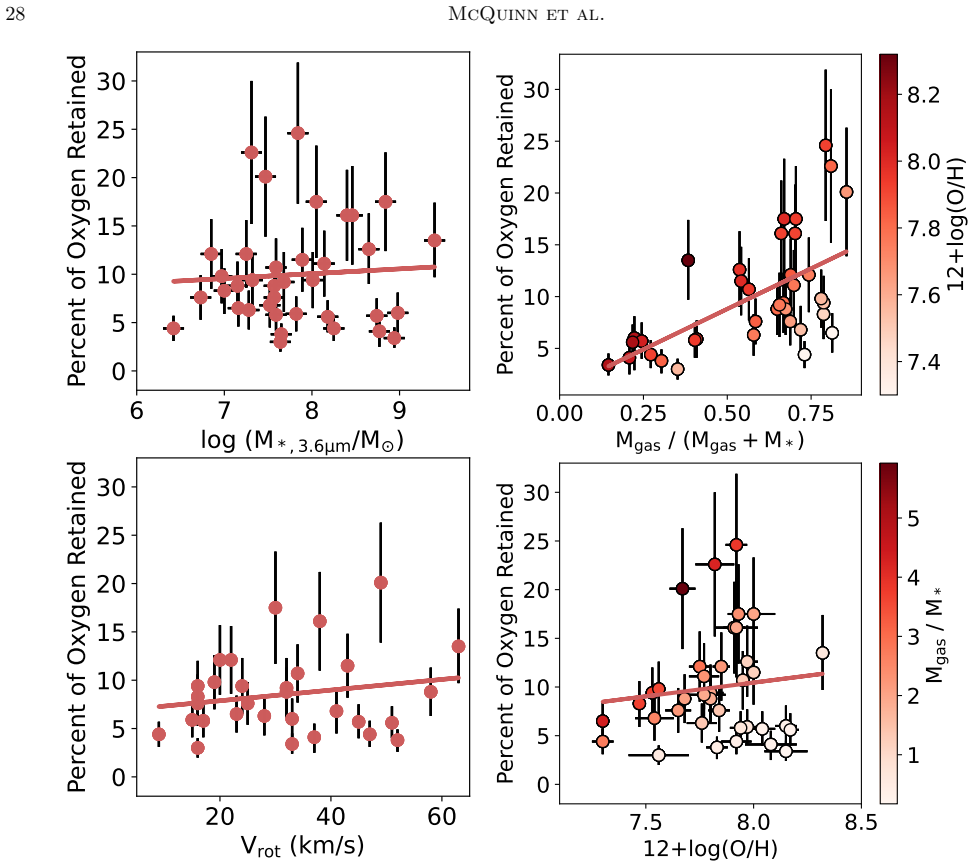
The paper reports that low-mass galaxies with stellar masses between about $10^{6.5}$ and $10^{9.5}$ solar masses retain between 4 and 25 percent (mean 10.7 percent) of the oxygen produced by stellar nucleosynthesis, with almost all of the retained oxygen in the gas. Stars and stellar remnants hold only a small fraction, and dust holds the least. Because the galaxies are gas-rich, the retention fraction is set almost entirely by how much oxygen-bearing gas remains inside roughly 4.4 stellar scale lengths. The authors find no correlation between retention fraction and position on the mass–metallicity relation, but do find that galaxies in denser environments or within about 1 Mpc of a more massive neighbor show increased scatter toward higher retention. They also show that three hydrodynamical simulations, which reproduce the mass–metallicity relation, predict retention fractions two to four times higher than observed, and that a simple regulator model can match the observations only with stellar-mass-dependent wind mass loading, wind metallicity about twice the ISM value, and gas accretion suppressed to about 60 percent of the cosmic baryon fraction.
Load-bearing premise
The calculation assumes that the oxygen abundance measured in bright star-forming regions is uniform across the HI disk out to 4.4 stellar scale lengths, and that HI beyond that radius is essentially unenriched; if significant oxygen sits in the outer HI disks, retention fractions would be higher, possibly exceeding 100 percent in some systems.
Editorial extensions
If this is right
- If these retention fractions are correct, low-mass galaxies expel roughly 75–96 percent of the oxygen they ever forged, making them a major source of metal pollution in the intergalactic medium.
- The steep rise in retention at $M_* \gtrsim 10^{10}\,M_\odot$—where stars rather than gas hold most oxygen—means the dominant metal reservoir shifts from gas to stars as galaxies grow.
- Simulations that reproduce only the mass–metallicity relation are not strongly constrained; matching the observed retention fractions is a much sharper test of feedback physics.
- A model with $\eta_w \propto M_*^{-0.45}$, outflow metallicity about twice the ISM, and 40 percent suppressed gas accretion simultaneously explains the retention fractions and the stellar mass–halo mass relation of dwarf galaxies.
- Denser local environments appear to recycle or accrete metals back into disks, so environment must be included in predictions of metal retention.
Reading between the lines
- One implicit consequence is that the 4.4-scale-length cutoff makes the reported retention fractions lower limits; deep abundance measurements of outer HI disks would test how much oxygen may hide beyond the cutoff.
- If wind metallicity is genuinely about twice the ISM value, then the hot, metal-enriched phase ejected by supernovae should be visible in high-ionization UV absorption lines around dwarfs, a prediction future ultraviolet spectroscopy can check.
- The lack of correlation with the mass–metallicity relation suggests the scatter in that relation at dwarf masses is set by accretion and outflow stochasticity rather than by current metal retention, which would redirect how the MZ scatter is interpreted.
- A practical extension is to apply the same oxygen-budget accounting to a larger sample spanning different environments, which could confirm whether the environmental trend seen here is real or a small-sample fluctuation.
Signed reviews
Editorial analysis
A structured set of objections, weighed in public.
Referee Report
Summary. This paper presents a census of oxygen production, distribution, and retention in 37 nearby low-mass galaxies (10^6.5 < Mstar < 10^9.5 Msun), using resolved-star star formation histories from Paper I, direct-method gas-phase oxygen abundances, HI masses, stellar and dust oxygen estimates, and literature CGM constraints. The oxygen produced is calculated from an adopted yield and stellar mass (Eq. 2); the retained oxygen is the sum of gas, dust, and stellar components (Eqs. 3, 4, 7); the retention fraction is their ratio (Eq. 9). The headline result is that the galaxies retain 4-25% (mean 10.7%) of the oxygen produced, with most retained oxygen in the gas phase. The paper also examines trends with stellar mass, rotation velocity, gas fraction, and environment, compares against the mass-metallicity relation and hydrodynamical simulations, and uses a regulator-type model to interpret the low retention fractions in terms of wind mass loading, wind metallicity enhancement, and IGM accretion suppression.
Significance. If the absolute retention fractions hold, this is a valuable empirical anchor for the baryon and metal cycle in dwarf galaxies, a regime where feedback is expected to dominate. The strengths of the paper are its direct observational accounting, the careful component-by-component uncertainty propagation, the use of a homogeneous sample with resolved-star SFHs, and the explicit comparison against both scaling relations and simulations. The paper also makes falsifiable statements about simulation retention fractions and about the role of environment, and it is appropriately cautious about the CGM/IGM split. However, the absolute retention values rest on two linked assumptions - the adopted oxygen yield P and the 4.4 stellar scale-length truncation of the HI disk used in Eq. 3 - and the paper's own justification for the truncation depends on the value of P. This degeneracy directly affects the headline range and must be addressed before the quantitative result can be considered robust.
major comments (2)
- [§2.3, Eqs. (2)-(3); §4.2] The test used to justify the 4.4α truncation is not independent of the adopted oxygen yield. Equation (2) makes the produced oxygen mass proportional to P, so the retention fraction obtained by assigning the total HI mass the ISM metallicity scales as 1/P. If P=0.015, the value adopted by Peeples et al. (2014) and discussed in §4.2, all retention fractions decrease by roughly one-third in relative terms; for galaxies with a substantial fraction of HI outside 4.4α (Figure 5 shows several systems with less than 75% of their HI within 4.4α), the hypothetical total-HI retention need no longer exceed 100%. The truncation is therefore not required on the stated physical grounds once the yield is allowed to vary, and an enriched outer HI disk remains a viable way to raise the absolute retention fractions. Since the gas term dominates the numerator of Eq. (9), this degeneracy directly affects the headline 4-25% (mean 10.7%) range. Please quantify retention fractions with and without the 4.4α cutoff under both P=0.010 and P=0.015, and where possible use empirical constraints on outer-disk metallicities; at minimum, the reported range should be presented as conditional on the cutoff and the joint systematic uncertainty should be propagated.
- [§3.3 and Figure 3] The conclusion that oxygen retention does not correlate with position on the mass-metallicity relation depends on the reference relation of Berg et al. (2012), and the manuscript does not state whether that relation was derived from a sample overlapping the GLOW galaxies. If the GLOW galaxies are included in the fit, the perpendicular offsets plotted in the inset are residuals to a relation constrained by the same points, and the absence of a trend is partly by construction. Please state the degree of overlap; if it is substantial, recompute the offsets using an independent mass-metallicity relation or by explicitly fitting on a withheld subset, and revisit the associated conclusions in §3.3 and the abstract.
minor comments (7)
- [Abstract and Table 2] The abstract states that 'nearly all retained oxygen residing in the gas,' but Table 2 lists several galaxies (e.g., NGC 3738, IC 4662, NGC 6789, IC 5152) for which the stellar oxygen reservoir exceeds the gas reservoir; consider saying 'typically' or 'on average.'
- [Eq. (4) and §2.2] Equation (4) uses R=0.433 while Equation (2) and the surrounding text adopt R=0.43; the value should be stated consistently.
- [Table 1 note] The table note should specify whether M_HI and f_gas are total values or values truncated at 4.4α; §3.2 explicitly uses M_HI,4.4α when computing effective yields, so the distinction matters for interpreting Figure 2.
- [§3.5 and Figure 5] The text refers to a 'dashed box' in Figure 5, but no dashed box appears in the figure as printed; either add the box or remove the reference.
- [Figure 10 caption] The caption uses 'ηz' where the text defines ζ_w as the wind metallicity enhancement factor; the notation should be unified.
- [§2.3, footnote 17] The exclusion of molecular gas from the gas mass is noted in a footnote, but the potential impact on galaxies with significant molecular content should be mentioned explicitly in the oxygen budget discussion.
- [Acknowledgments] There is a typo ('manuscrupt') in the acknowledgments, and the phrasing 'The authors would like to the thank the referee' should be corrected.
Circularity Check
No circularity: the 4-25% oxygen retention fractions are direct observational ratios, and the interpretive models are fits checked against independent constraints.
full rationale
The central claim (Section 2.6, Eqs. 8-9) is a ratio of independently measured oxygen masses: M_O_produced = P M*/(1-R) with P=0.010 from Nomoto et al. (2013) and R=0.43 from Vincenzo et al. (2016), and M_O_gas from direct-method abundances and HI mass within 4.4 alpha (Eq. 3). No parameter is fitted to the retention fractions; the values follow from the data and adopted external yields. The y_eff-retention correlation (Section 3.2) is explicitly derived by the authors as an algebraic consequence of the definitions (y_eff approximately f_retain P/(1-R)), so it is not a hidden circular prediction. The regulator model (Section 4.4) is fitted to the observed retention fractions, but the paper uses independent empirical mass-loading factors (Marasco et al. 2023; Kado-Fong et al. 2025; McQuinn et al. 2019) and the stellar mass-halo mass relation to break degeneracies, and it explicitly acknowledges that retention fractions alone cannot distinguish models. The 4.4 alpha truncation and its sensitivity to the adopted yield are physical assumptions with robustness tests, not circular reductions. Self-citations to Paper I and to the Kravtsov/Manwadkar regulator model provide data products and an interpretive framework, but the headline empirical result does not reduce to those citations. Thus no circular step is present.
Assumptions & free parameters
free parameters (4)
- 4.4 stellar scale-length gas truncation radius =
4.4 alpha
- eta_w,10 normalization of wind mass-loading factor =
1.0
- zeta_w wind metallicity enhancement factor =
2
- epsilon_pr IGM accretion suppression factor =
0.6
assumptions (7)
- domain assumption Constant oxygen yield P=0.010 at Z=0.004 for a Kroupa IMF (Nomoto et al. 2013) applies to all GLOW galaxies.
- domain assumption Constant return fraction R=0.43 (Vincenzo et al. 2016) for all stellar populations in the sample.
- domain assumption The 3.6 micron mass-to-light ratio of 0.47 (Salpeter IMF) scaled to Kroupa applies to all galaxies.
- domain assumption HII-region direct-method oxygen abundances are representative of the entire ISM within 4.4 stellar scale lengths; gas beyond is unenriched.
- domain assumption CMD-derived [M/H] equals [Fe/H] and the stellar [O/Fe] ratio is solar.
- domain assumption The dust depletion framework of Jenkins (2009), Roman-Duval et al. (2022), and Hamanowicz et al. (2024) applies to the GLOW galaxies.
- domain assumption The regulator model assumes gas accretes directly from the IGM without CGM mediation for halos below about 10^11 solar masses.
Cite this review
Pith. "Pith review of GLOW II: A Census of Oxygen in Low-Mass Galaxies." pith.science (2026). https://pith.science/paper/3KKYRECU
@misc{pith2026260807665,
  author       = {Pith},
  title        = {Pith review of: GLOW II: A Census of Oxygen in Low-Mass Galaxies},
  year         = {2026},
  howpublished = {\url{https://pith.science/paper/3KKYRECU}},
  note         = {Machine review of arXiv:2608.07665}
}
read the original abstract
Oxygen is forged by stars and redistributed through galaxies by feedback-driven outflows, leaving a record of star formation and the baryon cycle imprinted on its present-day abundance and distribution. The Galaxies Losing Oxygen via Winds (GLOW) project quantifies the production, distribution, and retention of oxygen in 37 low-mass, low-metallicity, gas-rich galaxies in the nearby universe (D<6 Mpc) spanning a critical stellar mass range (10^6.5<Mstar<10^9.5) where feedback is expected to strongly shape galaxy evolution. We incorporate literature results to extend the analysis over 10^5<Mstar<10^11.5. We couple star formation histories derived from resolved stars with measurements of ISM metallicity and gas mass, and compares the oxygen budgets with empirical constraints in the circumgalactic medium (CGM). We find low-mass galaxies retain between 4-25% (mean 11%) of their oxygen produced by stellar nucleosynthesis, and nearly all retained oxygen residing in the gas. Galaxies exhibit increased scatter to higher oxygen retention fractions when residing in denser environments (Theta_5>0.5) and within 1 Mpc of a massive galaxy (Mstar>10^9 Msun), indicating environment likely affects the amount of oxygen retained, recycled, or accreted to galaxies. Contrary to expectations, oxygen retention does not correlate with position on the mass-metallicity relation. Although ionized oxygen is detected in the CGM, it remains unclear whether most missing oxygen resides there or has been expelled entirely. Hydrodynamical simulations, despite successfully reproducing the mass-metallicity relation, predict much higher retention fractions than measured in low-mass galaxies. Simple modeling indicates that wind mass-loading and outflow metallicity govern oxygen retention, and that low-mass galaxies accrete less baryonic material relative to the cosmic baryon fraction.
Figures


Figures from the paper (9 more)



Reviewed August 11, 2026 · model on record in the stance chip above.
Discussion (0). Continue with ORCID to comment.