A Parallel and Adaptive Mesh-Free method for Heterogeneous Porous Media
Pith reviewed 2026-05-19 21:21 UTC · model grok-4.3
The pith
Normalized radial basis functions with Shepard stabilization approximate discontinuous step functions to arbitrarily small L1 error.
A machine-rendered reading of the paper's core claim, the machinery that carries it, and where it could break.
Core claim
The proposed normalized RBF framework, incorporating Shepard normalization and sparse regression, achieves arbitrarily small L1 error in approximating discontinuous step functions and supplies a continuous closed-form representation of originally piecewise-constant mesh-dependent data while preserving sharp interface features through parallel adaptive subdomain reconstruction.
What carries the argument
Shepard-normalized radial basis function expansion whose coefficients are obtained by sparse regression, augmented by adaptive refinement and subdomain partitioning for parallel evaluation.
Load-bearing premise
Shepard normalization stabilizes the RBF approximation near sharp interfaces so that sparse regression can produce robust continuous representations of the original discontinuous data.
What would settle it
Compute the L1 error between the constructed continuous function and a known discontinuous step function while successively increasing the number of basis functions or refinement levels and verify whether the error falls below any prescribed positive threshold.
Figures


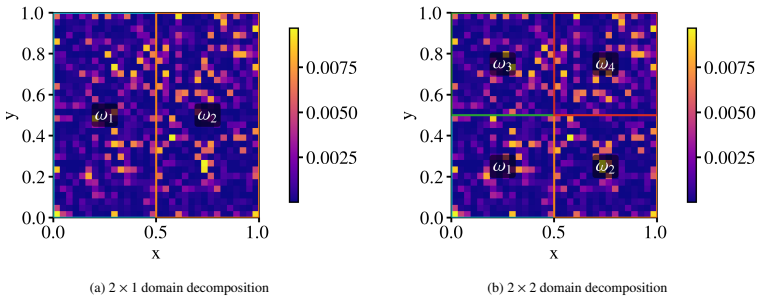


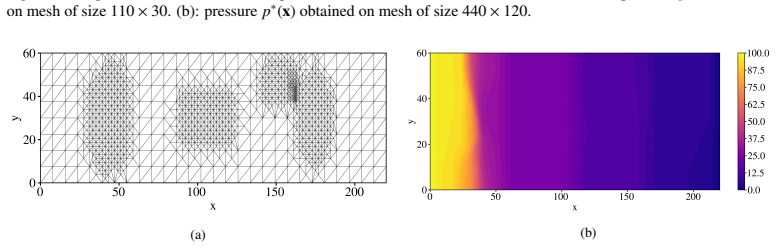
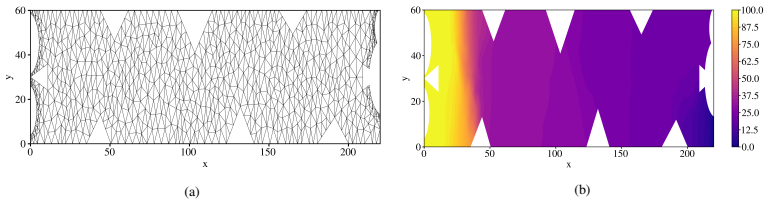

read the original abstract
Material properties such as permeability fields in heterogeneous porous media are often represented as discontinuous, piecewise constant data tied to a given spatial discretization. Such representations are inherently mesh-dependent, requiring interpolation or projection whenever they are transferred to a different discretization. In this work, we develop \emph{Parallel and Adaptive Mesh-Free Approximation (PAM)}, a mesh-independent framework that approximates discontinuous data by a continuous, closed-form function. The resulting approximation can be evaluated consistently across different geometries and numerical discretizations, while preserving sharp interface features. The proposed PAM framework employs radial basis functions (RBFs) to construct continuous approximations of discontinuous data. To accurately capture discontinuities, we incorporate Shepard-normalization, which stabilizes the approximation near sharp interfaces. The coefficients of the RBF expansion are determined via sparse regression, enabling automatic selection of the most relevant basis functions and promoting robust representations. In addition, we develop a novel adaptive refinement approach which further enriches the approximation in regions of rapid spatial variation. We provide a theoretical analysis showing that the proposed normalized RBF framework achieves arbitrarily small $L^1$ error in approximating discontinuous step functions. To enhance computational efficiency, the domain is partitioned into subdomains, and the reconstruction problem is solved independently on each subdomain in parallel. Numerical experiments demonstrate the accuracy, adaptivity, and scalability of the proposed method, including applications to challenging heterogeneous permeability fields.
Editorial analysis
A structured set of objections, weighed in public.
Referee Report
Summary. The manuscript introduces the Parallel and Adaptive Mesh-Free Approximation (PAM) method for representing discontinuous data such as permeability fields in heterogeneous porous media. It employs radial basis functions (RBFs) with Shepard normalization to stabilize approximations near sharp interfaces, determines coefficients via sparse regression, applies adaptive refinement in regions of rapid variation, and partitions the domain into subdomains for independent parallel solves. The central claim is a theoretical analysis establishing that the normalized RBF framework achieves arbitrarily small global L¹ error for discontinuous step functions, accompanied by numerical experiments on accuracy, adaptivity, and scalability.
Significance. If the global L¹ error bound holds and controls interface mismatches, the approach supplies a mesh-independent continuous representation of discontinuous fields that preserves sharp features while enabling consistent evaluation across different discretizations. The parallel subdomain strategy and adaptive enrichment address practical scalability needs in large heterogeneous porous-media simulations.
major comments (2)
- [Theoretical Analysis] Theoretical Analysis (abstract and main text): The manuscript asserts that the normalized RBF framework with Shepard normalization achieves arbitrarily small L¹ error for discontinuous step functions, yet supplies no derivation, assumptions, or proof steps. This omission is load-bearing because it leaves unverified whether the bound is global and accounts for potential discontinuities or mismatches at artificial subdomain interfaces created by the parallel partitioning.
- [Parallel Implementation] Parallel subdomain reconstruction (abstract and method description): The reconstruction is performed independently on each subdomain. Without an explicit uniform continuity, overlap, or interface-matching argument in the error analysis, it is unclear how local per-subdomain L¹ bounds combine into a global L¹ bound that can be made arbitrarily small, as required by the central claim.
minor comments (2)
- [Abstract] Abstract: the phrase 'continuous, closed-form function' is correct for the RBF expansion but would benefit from noting that the expansion is finite and its coefficients are obtained by sparse regression.
- [Numerical Experiments] Numerical experiments: the reported accuracy and scalability results would be strengthened by inclusion of error bars, explicit data-exclusion criteria, and quantitative measures of interface continuity across subdomains.
Simulated Author's Rebuttal
We thank the referee for their thorough review and valuable feedback on our manuscript. We address each major comment below and will incorporate revisions to clarify and strengthen the theoretical analysis and parallel error bounds.
read point-by-point responses
-
Referee: [Theoretical Analysis] Theoretical Analysis (abstract and main text): The manuscript asserts that the normalized RBF framework with Shepard normalization achieves arbitrarily small L¹ error for discontinuous step functions, yet supplies no derivation, assumptions, or proof steps. This omission is load-bearing because it leaves unverified whether the bound is global and accounts for potential discontinuities or mismatches at artificial subdomain interfaces created by the parallel partitioning.
Authors: We agree that a full derivation is needed to support the central claim. The manuscript currently states the result at a high level, relying on the stabilizing effect of Shepard normalization near discontinuities and the ability of adaptive RBF enrichment to reduce L1 error. In the revised version we will add an explicit proof sketch: first showing that normalized RBFs are dense in L1 for step functions on a single domain (under standard assumptions on the shape parameter and fill distance), then extending to the global case by controlling the measure of interface regions. We will also state the assumptions required for the bound to be global. revision: yes
-
Referee: [Parallel Implementation] Parallel subdomain reconstruction (abstract and method description): The reconstruction is performed independently on each subdomain. Without an explicit uniform continuity, overlap, or interface-matching argument in the error analysis, it is unclear how local per-subdomain L¹ bounds combine into a global L¹ bound that can be made arbitrarily small, as required by the central claim.
Authors: The referee correctly notes that independent subdomain solves require an interface argument. We will revise the error analysis section to include a decomposition of the global L1 norm into the sum of local subdomain errors plus a term measuring mismatches across artificial interfaces. By introducing a small overlap between subdomains and using the mesh-free evaluation property, the interface contribution can be bounded by the local approximation error, allowing the global L1 error to be driven arbitrarily small by increasing the number of basis functions and refinement levels per subdomain. Numerical results already show consistent global accuracy; we will add a supporting lemma and corresponding discussion. revision: yes
Circularity Check
No circularity: theoretical L1 bound derived independently of fitted parameters or self-citations
full rationale
The paper's central claim is a theoretical analysis establishing arbitrarily small global L1 error for the normalized RBF framework (with Shepard normalization, sparse regression, and adaptive refinement) when approximating discontinuous step functions. No quoted equations or self-citations reduce this bound to a tautological redefinition of the inputs, a fitted parameter renamed as a prediction, or a load-bearing uniqueness result imported from the authors' prior work. The subdomain partitioning is presented purely as a parallel implementation detail whose error control is asserted to follow from the same independent analysis rather than being presupposed by it. The derivation chain therefore remains self-contained against external benchmarks and does not exhibit any of the enumerated circular patterns.
Axiom & Free-Parameter Ledger
axioms (2)
- domain assumption Radial basis functions can approximate functions from scattered data in a mesh-free manner
- ad hoc to paper Shepard normalization stabilizes the approximation near sharp interfaces
Lean theorems connected to this paper
-
IndisputableMonolith/Cost/FunctionalEquation.leanwashburn_uniqueness_aczel unclear?
unclearRelation between the paper passage and the cited Recognition theorem.
We provide a theoretical analysis showing that the proposed normalized RBF framework achieves arbitrarily small L¹ error in approximating discontinuous step functions.
-
IndisputableMonolith/Foundation/AlphaCoordinateFixation.leancostAlphaLog_high_calibrated_iff unclear?
unclearRelation between the paper passage and the cited Recognition theorem.
K^*(x) = β₁ w₁(x) + β₂ w₂(x) with w_m the Shepard weights forming a partition of unity; error = (log 2) σ²/(c+b)
What do these tags mean?
- matches
- The paper's claim is directly supported by a theorem in the formal canon.
- supports
- The theorem supports part of the paper's argument, but the paper may add assumptions or extra steps.
- extends
- The paper goes beyond the formal theorem; the theorem is a base layer rather than the whole result.
- uses
- The paper appears to rely on the theorem as machinery.
- contradicts
- The paper's claim conflicts with a theorem or certificate in the canon.
- unclear
- Pith found a possible connection, but the passage is too broad, indirect, or ambiguous to say the theorem truly supports the claim.
Reference graph
Works this paper leans on
-
[1]
Bear, Dynamics of Fluids in Porous Media, Elsevier, 1972
J. Bear, Dynamics of Fluids in Porous Media, Elsevier, 1972
work page 1972
-
[2]
Dagan, Flow and Transport in Porous Formations, Springer, 1989
G. Dagan, Flow and Transport in Porous Formations, Springer, 1989
work page 1989
-
[3]
L. J. Durlofsky, Numerical calculation of equivalent grid block permeability tensors for heterogeneous porous media, Water Resources Research 27 (5) (1991) 699–708. 24
work page 1991
-
[4]
T. Y . Hou, X.-H. Wu, A multiscale finite element method for elliptic problems in composite materials and porous media, Journal of computational physics 134 (1) (1997) 169–189
work page 1997
-
[5]
Y . Efendiev, T. Y . Hou, Multiscale finite element methods: theory and applications, V ol. 4, Springer Science & Business Media, 2009
work page 2009
-
[6]
S. Lee, M. F. Wheeler, T. Wick, Pressure and fluid-driven fracture propagation in porous media using an adaptive finite element phase field model, Computer Methods in Applied Mechanics and Engineering 305 (2016) 111–132
work page 2016
-
[7]
J. Choo, S. Lee, Enriched galerkin finite elements for coupled poromechanics with local mass conservation, Computer Methods in Applied Mechanics and Engineering 341 (2018) 311–332
work page 2018
-
[8]
S. Lee, W. T. Leung, M. Vasilyeva, S.-Y . Yi, Generalized multiscale enriched galerkin method for flow in heterogeneous porous media, submitted for publication (2026)
work page 2026
-
[9]
M. J. D. Powell, Radial basis functions for multivariable interpolation: A review, in: J. C. Mason, M. G. Cox (Eds.), Algorithms for Approximation, Clarendon Press, Oxford, 1987, pp. 143–167
work page 1987
-
[10]
M. D. Buhmann, Radial Basis Functions: Theory and Implementations, V ol. 12 of Cam- bridge Monographs on Applied and Computational Mathematics, Cambridge University Press, Cambridge, UK, 2003.doi:10.1017/CBO9780511543241
-
[11]
Wendland, Scattered Data Approximation, Cambridge University Press, 2005
H. Wendland, Scattered Data Approximation, Cambridge University Press, 2005
work page 2005
-
[12]
C. A. Micchelli, Interpolation of scattered data: Distance matrices and conditionally pos- itive definite functions, Constructive Approximation 2 (1) (1986) 11–22.doi:10.1007/ BF01893414
work page 1986
-
[13]
J. Park, I. W. Sandberg, Universal approximation using radial-basis-function networks, Neural Computation 3 (2) (1991) 246–257
work page 1991
-
[14]
B. Fornberg, J. Zuev, The runge phenomenon and spatially variable shape parameters in rbf interpolation, Computers & Mathematics with Applications 54 (3) (2007) 379–398
work page 2007
-
[15]
Z. Majdisova, V . Skala, Big geo data surface approximation using radial basis functions: A comparative study, Computers & Geosciences 109 (2017) 51–68
work page 2017
-
[16]
M. A. Christie, M. J. Blunt, Tenth spe comparative solution project: A comparison of upscaling techniques, SPE Reservoir Evaluation & Engineering 4 (04) (2001) 308–317
work page 2001
-
[17]
H. Zou, T. Hastie, Regularization and variable selection via the elastic net, Journal of the Royal Statistical Society: Series B (Statistical Methodology) 67 (2) (2005) 301–320
work page 2005
-
[18]
D. Shepard, A two-dimensional interpolation function for irregularly spaced data, in: Pro- ceedings of the 23rd ACM National Conference, 1968, pp. 517–524.doi:10.1145/ 800186.810616
-
[19]
J. M. Melenk, I. Babuška, The partition of unity finite element method: Basic theory and applications, Computer Methods in Applied Mechanics and Engineering 139 (1–4) (1996) 289–314.doi:10.1016/S0045-7825(96)01087-0. 25
-
[20]
I. Babuška, J. M. Melenk, The partition of unity method, International Journal for Numerical Methods in Engineering 40 (4) (1997) 727–758.doi:10.1002/(SICI) 1097-0207(19970228)40:4<727::AID-NME86>3.0.CO;2-N
-
[21]
R. Tibshirani, Regression shrinkage and selection via the lasso, Journal of the Royal Statis- tical Society: Series B (Statistical Methodology) 58 (1) (1996) 267–288
work page 1996
-
[22]
A. E. Hoerl, R. W. Kennard, Ridge regression: Biased estimation for nonorthogonal prob- lems, Technometrics 12 (1) (1970) 55–67
work page 1970
-
[23]
J. Friedman, T. Hastie, R. Tibshirani, Regularization paths for generalized linear models via coordinate descent, Journal of Statistical Software 33 (1) (2010) 1–22
work page 2010
-
[24]
S. J. Wright, Coordinate descent algorithms, Mathematical Programming 151 (1) (2015) 3–34
work page 2015
-
[25]
A. Logg, K.-A. Mardal, G. N. Wells, Automated Solution of Differential Equations by the Finite Element Method: The FEniCS Book, Springer, 2012
work page 2012
-
[26]
M. S. Alnæs, J. Blechta, J. Hake, A. Johansson, B. Kehlet, A. Logg, C. Richardson, J. Ring, M. E. Rognes, G. N. Wells, The fenics project version 1.5, Archive of Numerical Software 3 (100) (2015)
work page 2015
-
[27]
B. Rivière, Discontinuous Galerkin methods for solving elliptic and parabolic equations: theory and implementation, SIAM, 2008
work page 2008
-
[28]
S. Lee, Y .-J. Lee, M. F. Wheeler, A locally conservative enriched galerkin approximation and efficient solver for elliptic and parabolic problems, SIAM Journal on Scientific Com- puting 38 (3) (2016) A1404–A1429
work page 2016
-
[29]
G. Scovazzi, M. F. Wheeler, A. Mikeli´c, S. Lee, Analytical and variational numerical meth- ods for unstable miscible displacement flows in porous media, Journal of Computational Physics 335 (2017) 444–496
work page 2017
-
[30]
T. Arbogast, Implementation of a locally conservative numerical subgrid upscaling scheme for two-phase darcy flow, Computational Geosciences 6 (3) (2002) 453–481
work page 2002
- [31]
discussion (0)
Sign in with ORCID, Apple, or X to comment. Anyone can read and Pith papers without signing in.