REVIEW 2 major objections 5 minor
Exact Signed-Distance Control Barrier Functions via Minkowski Operations for Safe Navigation among Polytopes
T0 review · 2 major / 5 minor · reviewed 2026-08-15 · deepseek-v4-flash
Pith's one-line read The exact signed distance between a polytopic robot and polytopic obstacles has a single analytical gradient across safe, contact, and penetrating states, computed in Minkowski-difference space and used to build nonsmooth control barrier…
desk verdict The exact SDF gradient formula is a genuine advance, but the implemented almost-active set leaves a real gap between the forward-invariance theorem and the controller actually run. read the letter →
The pith
A machine-rendered reading of the paper's core claim, the machinery that carries it, and where it could break.
The reading
What carries the argument
The central object is the signed distance function in Minkowski-difference space, whose geometric carrier is the configuration obstacle $O^c = O \oplus (-R)$. The argument runs on two companion convex programs: the dist-QP (16), which projects the origin onto the configuration obstacle, and the depth-LP (18), which measures penetration as the distance from the origin to the closest configuration-obstacle hyperplane. The load-bearing identity is the pseudo-QP mapping of Lemma 5, which rescales the depth-LP multiplier by $2s^*$ so that the penetrating branch obeys the same signed stationarity relation $z^* = -\frac{1}{2}\operatorname{sgn}(sd)\,(A^c_I)^\top \lambda^*_I$ as the separated branch; combined with the 2D Minkowski-sum property that every configuration-obstacle edge is a translated edge of either the robot or the obstacle, this single algebraic form yields the closed-form spatial and rotational gradients (35)--(36).
What would settle it
Compare the closed-form gradient (35)--(36) against central finite differences of the exact SDF obtained by solving (16) and (18) on a grid of SE(2) configurations that includes vertex-vertex contacts, skeleton states, and parallel-edge orientations; any mismatch on a set of positive measure would refute the claimed exactness. A separate check on the practical side: run the unicycle filter with a robot whose active-feature geometry satisfies the acute-angle condition $\beta < \pi/2$ and verify that the predicted geometric-kinematic-coupled local minimum actually traps the closed-loop system.
Extended reading notes
Core claim
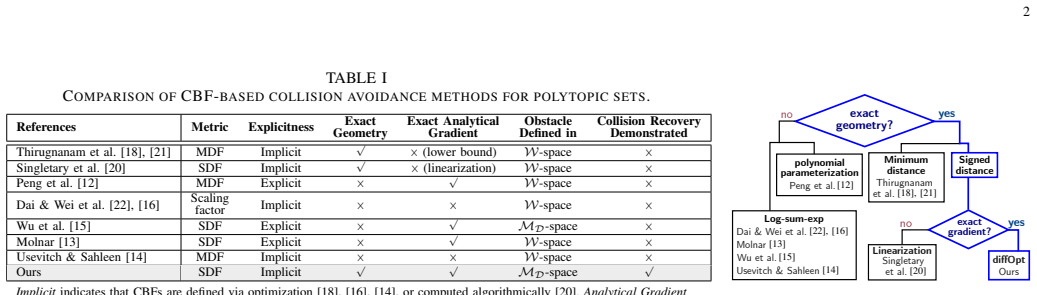
The central discovery is a unified exact gradient of the signed distance between a convex polygonal robot and convex polygonal obstacles, valid almost everywhere in the robot's SE(2) configuration. The signed distance is evaluated in Minkowski-difference space, where the robot is shrunk to the origin and the obstacle becomes a configuration obstacle; the separated branch is a quadratic program that projects the origin onto that polytope, and the penetrating branch is a linear program that computes the depth of the origin inside it. A 'pseudo-QP' mapping rescales the penetration LP's dual variable by twice the penetration depth, so the penetrating branch satisfies the same stationarity relation as the distance QP; consequently a single active-constraint gradient formula, obtained by sensitivity analysis of the KKT system, governs safe, contact, and penetration cases. The authors further show that the exact rotational part of this gradient uncovers a previously masked class of local minima in which the robot locks into a parallel-edge configuration because rotating away from the obstacle decreases the signed distance. The claim, if true, replaces conservative smooth-shape CBFs with exact-geometry CBFs at the cost of solving one small convex program per control step.
Load-bearing premise
The practical safety guarantee rests on the assumption that the finite set of nearby distance branches the controller checks (the 'almost-active' set in Remark 7) contains every direction in which the signed distance can become nonsmooth; if a dangerous branch is missed at a skeleton or parallel-edge state, the forward-invariance guarantee could fail even though the theoretical condition is satisfied.
Editorial extensions
If this is right
- A safety filter can be built from the exact polytope-pair signed distance instead of a sphere or ellipsoid surrogate, so trajectories can approach obstacles more closely without clipping them.
- The same unified gradient formula covers safe, contact, and penetration branches, so a controller that starts inside an obstacle can be steered back to the safe set without switching between different mathematical formulations.
- The exact rotational gradient exposes a new class of deadlocks—geometric-kinematic-coupled local minima—in which a nonholonomic robot locks into a parallel-edge configuration; shapes whose active normals form an acute angle with the heading are shown to be susceptible.
- Because the gradient is closed-form and only requires solving a small convex program, the filter runs at real-time control rates (200 Hz in the paper's simulations) and extends naturally to multiple obstacles by imposing one SD-NCBF constraint per obstacle pair.
Reading between the lines
- Inference: the same unified-gradient idea could be adapted to 3D, but the paper's Remark 6 indicates the 2D source-based derivation does not carry over directly, so a 3D version would need a different sensitivity decomposition that accounts for edges inherited from neither set.
- Inference: the almost-active-set implementation in Remark 7 is a gap between the theorem and the code; a testable extension would compute the full generalized gradient at skeleton states and check whether the almost-active constraint set is sufficient for forward invariance.
- Inference: the GKC local minima suggest that purely reactive safe filters should be paired with a global planner that avoids parallel-edge alignments, or the barrier function should be augmented with a penalty on rotational proximity to those critical angles.
- Inference: for moving obstacles, one could let the configuration obstacle depend on time and add an explicit time derivative to the sensitivity analysis, yielding a time-varying SD-NCBF for dynamic environments.
Signed reviews
Editorial analysis
A structured set of objections, weighed in public.
Referee Report
Summary. The paper proposes an exact Signed Distance Function (SDF) between a convex polytopic robot and convex polytopic obstacles, evaluated in Minkowski-difference (MD) space via two companion convex programs: a QP for minimum distance (16) in the safe case and an LP for penetration depth (18) in the collision case. The authors derive a unified analytical gradient formula (30) using sensitivity analysis, establish an algebraic correspondence between the two programs via a pseudo-QP mapping (Lemma 5), and integrate the SDF as a nonsmooth Control Barrier Function (SD-NCBF) within a CLF-NCBF-QP safety filter (38). They also identify a class of geometric-kinematic coupled (GKC) local minima revealed by the exact rotational gradient and demonstrate the framework in four simulations, including collision recovery and maze-like multi-obstacle navigation.
Significance. If the results hold, the paper makes a significant contribution by replacing conservative smooth-shape approximations with an exact polytopic geometry for CBF-based safety filters, and by providing closed-form analytical gradients of an implicitly defined SDF over SE(2). The unified treatment of safe, contact, and penetration branches through the pseudo-QP mapping is elegant, and the identification of GKC local minima is a useful insight that could inform future controller design. The derivations are careful and the paper provides detailed proofs, a clear computational pipeline, and comparisons with two baselines. However, the central safety guarantee for the implemented controller is not fully established because of a gap between the theoretical sufficient condition and the active-set strategy used in the implementation.
major comments (2)
- [Sec. V-C, Remark 7, Eq. (38)] The implemented CLF-NCBF-QP in (38) enforces the NCBF condition over the almost-active set \tilde{A}(x), whereas Corollary 2 requires the condition for every active branch in A(x). The manuscript does not establish that \tilde{A}(x) is a superset of A(x) at all states. At skeleton states x∈X_S, the depth-LP (18) has multiple active constraints; a standard LP/QP solver will return only a subset of the optimal face, so an active branch can be omitted from \tilde{A}(x). If the omitted branch's inequality in (37) is violated, the pointwise condition (7) of Theorem 1 can fail, and the forward-invariance guarantee of Corollary 2 does not apply to the implemented controller. This gap directly affects the paper's central safety claim and requires either a provably exhaustive active-set enumeration procedure or a modified sufficient condition that is robust to the active-subset selection used by the solver.
- [Sec. IV-E and Sec. V-B] The unified gradient formulas (30), (35)-(36) and Propositions 2-3 are derived under the assumptions x∉X_S and θ∉Θ*. At the degenerate configurations in X_S and Θ*, the generalized gradient is the convex hull of one-sided branch gradients, but the paper does not specify how these branch gradients are obtained in the implementation. In particular, the almost-active set \tilde{A}(x) described in Remark 7 requires identifying branches whose values are close to h(x), yet no algorithm is given for enumerating these branches in the presence of degeneracies, and the one-sided derivatives needed to compute their gradients are not defined. This is load-bearing because a trajectory can reach or approach these degenerate states and the theoretical guarantee in Theorem 1 covers all x∈X, including X_S. The manuscript should either provide an explicit construction of the generalized gradient at these states or restrict the safety guarantee to trajectories that avoid them, with a supporting argument.
minor comments (5)
- [Sec. VI] The GKC susceptibility condition (β(n_R)<π/2 and n_R^T n_O<0) is stated informally as a geometric observation; consider stating it as a formal proposition with precise assumptions and a proof sketch, since it is a claimed novel contribution.
- [Abstract and Sec. I] The abstract and introduction describe the gradient as 'exact' and 'analytical', but at the nondifferentiable states in X_S the gradient is set-valued and the implementation uses the almost-active heuristic; the paper should consistently qualify these claims as applying to the differentiable region and clearly distinguish the set-valued generalized gradient.
- [Sec. VII-A] The statement that the baseline [13] has 'almost half' the runtime would be more informative with a quantitative comparison, such as mean computation time per control loop on the same hardware.
- [Sec. V-A and Appendix A] Proposition 1 is stated without the safe-case assumption, but its proof in Appendix A considers only the safe branch; the proposition statement should explicitly note this, with the penetration branch handled by Theorem 3.
- [Abstract] There is a typo in the abstract: 'apolytopicrobot' should read 'a polytopic robot'.
Circularity Check
No circularity: SDF and gradient derivations are self-contained; the almost-active-set implementation gap is a soundness concern, not a circular reduction.
full rationale
No significant circularity. The exact-SDF construction is not an assumption of the conclusion: equation (16) is the standard projection QP for distance, equation (18) is the standard point-depth LP with closed form s* = min_i b_i^c / ||a_i^c||, and the unified gradient (30) is derived from the KKT sensitivity theorem (Theorem 2) rather than being imposed. Lemma 5's pseudo-QP multiplier is an algebraic reparameterization chosen to make the penetration branch match the dist-QP stationarity form; it is a construction, not a circular definition, because the depth-LP's own optimality conditions are used to establish the equality. The paper's self-citations to [24] are not load-bearing: the depth-LP is fully restated and proved here, and the earlier approximate rotational gradient is explicitly replaced by the exact expression (36). The GKC local-minima discussion is an interpretation of the exact rotational gradient, not an input to it; the paper even notes that a previous approximation masked the phenomenon, which is a falsifiable observation rather than a circular claim. The one implementation soundness gap I find is flagged by the paper itself: Corollary 2 requires (37) for every active branch a in A(x), while Sec. V-C and Remark 7 enforce the QP constraint (38) over the almost-active set ~A(x) = A(x) plus near-active branches, with no proof that ~A(x) always contains all branches needed for the generalized gradient. This is a correctness risk for the practical filter, not a circular reduction of the theoretical claim. Other stated limitations (3D extension in Remark 6, GKC deadlocks and hyperparameter sensitivity in Sec. VII-C) are honest scope statements. Score 1 reflects only a minor non-load-bearing self-citation; the central derivation is self-contained.
Assumptions & free parameters
free parameters (5)
- d_safe =
0 in all simulations
- gamma =
5, 1, 10 across scenarios
- kappa =
2, 1.5, 2 across scenarios
- p =
8, 1, 8, 10 across scenarios
- epsilon =
0 or 0.2
assumptions (5)
- domain assumption Robot and obstacles are compact convex polytopes with nonempty interior, minimal H-reps, and C1 state-parameterized H-rep functions (Assumptions 1-4, Sec III).
- standard math In 2D, every edge of the configuration obstacle is a translated edge from either the robot or the obstacle (Lemma 2).
- standard math KKT sensitivity analysis and value-function differentiation apply under LICQ, strict complementarity, and second-order conditions (Theorem 2, adapted from [37]).
- standard math The nonsmooth CBF forward-invariance condition (Theorem 1, from [30], [33]) is valid for locally Lipschitz barrier functions with Filippov solutions.
- ad hoc to paper The almost-active set ~A(x) used in the implementation suffices for enforcing the NCBF condition in QP (38).
Cite this review
Pith. "Pith review of Exact Signed-Distance Control Barrier Functions via Minkowski Operations for Safe Navigation among Polytopes." pith.science (2026). https://pith.science/paper/3NEMAWFD
@misc{pith2026260802886,
  author       = {Pith},
  title        = {Pith review of: Exact Signed-Distance Control Barrier Functions via Minkowski Operations for Safe Navigation among Polytopes},
  year         = {2026},
  howpublished = {\url{https://pith.science/paper/3NEMAWFD}},
  note         = {Machine review of arXiv:2608.02886}
}
read the original abstract
Safely navigating polytopic environments while respecting the dynamics, control, and exact geometry of the underlying system is a challenge in robotics. Control barrier functions (CBFs) synthesize safe control policies by rendering the safe set forward invariant, but many existing CBF-based methods approximate polytopes using conservative smooth shapes, such as spheres or ellipsoids, to obtain explicit differentiable distance functions. In this article, we propose an exact Signed Distance Function (SDF) formulation for a {\it polytopic} robot and {\it polytopic} obstacles and integrate it with nonsmooth CBFs. Leveraging Minkowski operations, the proposed method computes the exact SDF via companion convex programs in both the collision-free (positive-sign) and in-collision (negative-sign) cases. Furthermore, by exploiting the convenient geometric properties of 2D Minkowski operations and the optimality conditions of the two companion convex programs, we derive a unified analytical expression for the gradient of the exact SDF via sensitivity analysis. The exact rotational gradient further reveals a previously masked class of local minima induced by the coupling between geometry and nonholonomic kinematics. We demonstrate the effectiveness of the proposed framework through a pure-translation case and three scenarios with unicycle models involving recovery from an unsafe initialization and single- and multiple-obstacle avoidance. Comparisons with baseline methods highlight how the proposed framework enables non-conservative maneuvers and safety recovery.
Figures


Figures from the paper (9 more)


Reviewed August 15, 2026 · model on record in the stance chip above.
Discussion (0). Continue with ORCID to comment.