REVIEW 24 references
MIN: Co-Governing Multi-Identifier Network Architecture and its Prototype on Operator's Network
T0 review · reviewed 2026-08-14 · deepseek-v4-flash
Pith's one-line read A multi-identifier internet architecture with blockchain-based governance and a hash-prefix-tree forwarding table is proposed and prototyped, but scaling claims exceed the measured 20-node, 3.5-billion-entry tests.
The pith
A machine-rendered reading of the paper's core claim, the machinery that carries it, and where it could break.
The reading
The authors built a prototype and put it on real operator networks in mainland China, Hong Kong, and Macau. They report three technical pieces: a voting-based blockchain consensus called APoV, a forwarding table called HPT-FIB that mixes a hash table with a prefix tree to translate between identifier types, and a way to send ordinary IP packets through a content-centric network as a tunnel. They measured that their 20-node blockchain can handle more than 300,000 transactions per second, and that the forwarding table can store billions of names, though the largest experiment used 3.5 billion generated names. Video-on-demand ran through the network at 0.65 to 2.65 MB per second.
Extended reading notes
Core claim
The paper states in the Abstract that 'we deployed the prototype of MIN to the largest operators' network in Mainland China, Hongkong and Macao, and demonstrated that the network can register identifier under co-governing consensus algorithm, support VoD service very well.' On the data plane, it claims HPT-FIB 'can inter-translate different identifiers with tens of billions of entries' and that APoV 'can achieve a stable throughput of more than 300 thousand transactions per second.' If true, MIN is a workable post-IP architecture with decentralized management and large-scale multi-identifier forwarding.
Load-bearing premise
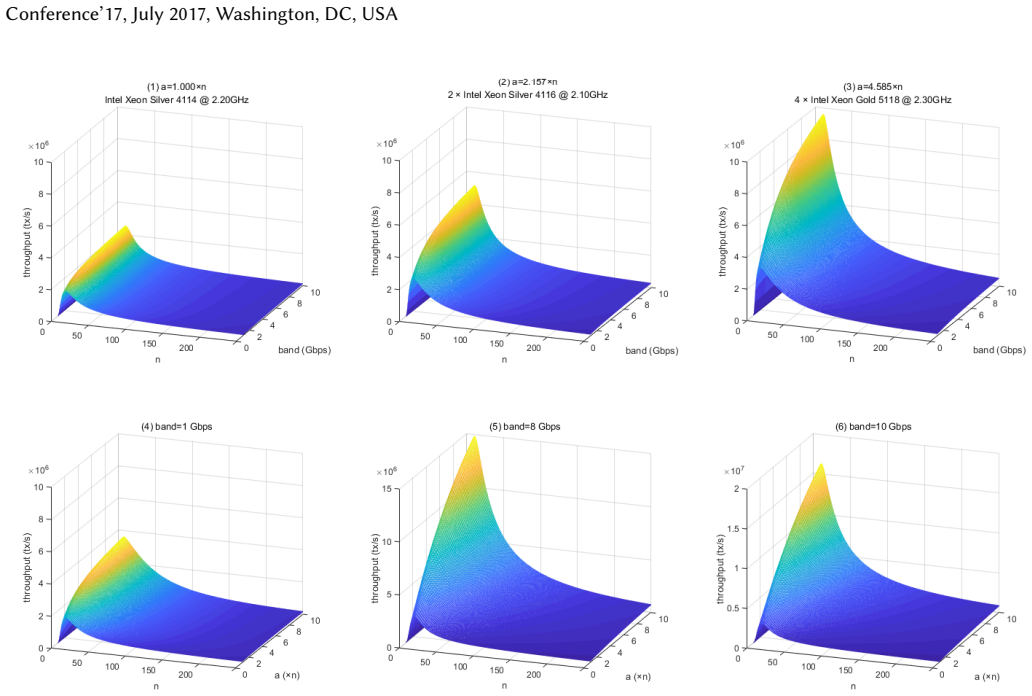
The load-bearing assumption is that the polynomial fits in Equations (6) and (7), measured on a prototype with 3-8 blockchain nodes and two servers, extrapolate to 'hundreds or thousands of nodes' and to 'tens of billions of entries.' The HPT-FIB experiments run only up to 3.5 billion synthetic names, and the lookup tests use 5 million entries. If the scaling laws break down, the throughput and capacity claims collapse even if the prototype itself works.
Signed reviews
Editorial analysis
A structured set of objections, weighed in public.
Assumptions & free parameters
free parameters (4)
- Equation (6) coefficients =
t1_comp=0.0041n+0.0174; t2_comp=0.0130n+0.0229; t3_comp=0.0012n^2-0.0082n+0.0415; t4_comp=0.0052n+0.0062
- Equation (7) consensus time coefficients =
0.0312 n^3 - 0.1920 n^2 + 2.0714 n + 11.2500 over 125
- URL-like name simulation parameters =
not given
- content-name length parameter rho(N;lambda-bar) =
M=4,5 in HIT tests
assumptions (4)
- domain assumption Consortium blockchain with voting consensus can manage identifiers at high throughput while remaining decentralized.
- ad hoc to paper The fitted polynomial equations generalize to arbitrary n and computing power a.
- domain assumption CCN can be deployed directly on Ethernet MAC and used to carry IP packets via a tunnel without IP.
- ad hoc to paper Self-generated URL-like names reproduce the statistical properties of real CCN content names.
invented entities (4)
-
MIN (Multi-Identifier Network) architecture
-
APoV (Advanced Proof of Vote) consensus
-
HPT-FIB with virtual and semi-virtual entries
-
IP-CCN-IP tunnel scheme
Cite this review
Pith. "Pith review of MIN: Co-Governing Multi-Identifier Network Architecture and its Prototype on Operator's Network." pith.science (2026). https://pith.science/paper/3OBBD5T6
@misc{pith2026190800418,
  author       = {Pith},
  title        = {Pith review of: MIN: Co-Governing Multi-Identifier Network Architecture and its Prototype on Operator's Network},
  year         = {2026},
  howpublished = {\url{https://pith.science/paper/3OBBD5T6}},
  note         = {Machine review of arXiv:1908.00418}
}
read the original abstract
IP protocol is the core of TCP/IP network layer. However, since IP address and its Domain Name are allocated and managed by a single agency, there are risks of centralization. The semantic overload of IP address also reduces its scalability and mobility, which further hinders the security. This paper proposes a co-governing Multi-Identifier Network (MIN) architecture that constructs a network layer with parallel coexistence of multiple identifiers, including identity, content, geographic information, and IP address. On the management plane, we develop an efficient management system using consortium blockchain with voting consensus, so the network can simultaneously manage and support by hundreds or thousands of nodes with high throughput. On the data plane, we propose an algorithm merging hash table and prefix tree (HTP) for FIB, which avoids the false-negative error and can inter-translate different identifiers with tens of billions of entries. Further, we propose a scheme to transport IP packets using CCN as a tunnel for supporting progressive deployment. We deployed the prototype of MIN to the largest operators' network in Mainland China, Hongkong and Macao, and demonstrated that the network can register identifier under co-governing consensus algorithm, support VoD service very well.
Figures


Figures from the paper (7 more)




Reference graph
Works this paper leans on
-
[1]
Muneeb Ali, Jude Nelson, Ryan Shea, and Michael J Freedman
-
[2]
Brendan Benshoof, Andrew Rosen, Anu G Bourgeois, and Robert W Harrison. 2016. Distributed decentralized domain name service. In IEEE International Parallel and Distributed Processing Symposium Work- shops (IPDPSW). 1279–1287
work page 2016
-
[3]
Christian Cachin. 2016. Architecture of the hyperledger blockchain fabric. In Workshop on distributed cryptocurrencies and consensus ledgers, Vol. 310. 4
work page 2016
-
[4]
Miguel Castro, Barbara Liskov, et al. 1999. Practical Byzantine fault tolerance. In OSDI, Vol. 99. 173–186
work page 1999
-
[5]
Weihua Cheng. 2015. A/t_tack Mode and Defense Strategy of DNS Cache Pollution. TELECOMMUNICATIONS INFORMATION 9 (2015), 16–21
work page 2015
-
[6]
Anastasius Gavras, Arto Karila, Serge Fdida, Martin May, and Martin Po/t_ts. 2007. Future internet research and experimentation: the FIRE initiative. ACM SIGCOMM Computer Communication Review (2007), 89–92
work page 2007
-
[7]
Van Jacobson, Diana K Sme/t_ters, James D /T_hornton, Michael F Plass, Nicholas H Briggs, and Rebecca L Braynard. 2009. Networking named content. In Proceedings of the 5th international conference on Emerging networking experiments and technologies . ACM, 1–12
work page 2009
-
[8]
Aggelos Kiayias, Alexander Russell, Bernardo David, and Roman Oliynykov. 2017. Ouroboros: A provably secure proof-of-stake blockchain protocol. In Annual International Cryptology Conference. Springer, 357–388
work page 2017
Show all 24 references
-
[9]
Sunny King and Sco/t_t Nadal. 2012. Ppcoin: Peer-to-peer crypto- currency with proof-of-stake. self-published paper, August 19 (2012)
2012
-
[10]
Hui Li, Kejiao Li, Yongle Chen, Jiawei Cai, Peng Yi, Zhihao Huang, Beini Zhou, Xin Li, and Jiyang Zhang. 2018. Determining consensus in a decentralized domain name system. US Patent App. 15/997,710. Conference’17, July 2017, Washington, DC, USA The Hong Kong Univ. of Science a...
2018
-
[11]
Hui Li, Xiangui Wang, Zhili Lin, Jiangxing Wu, Xueming Si, Kedan Li, Xin Yang, and Han Wang. 2019. Systems and methods for managing top-level domain names using consortium blockchain. US10178069B2
2019
-
[12]
Kejiao Li, Hui Li, Hanxu Hou, Kedan Li, and Yongle Chen. 2017. Proof of vote: A high-performance consensus protocol based on vote mech- anism & consortium blockchain. In IEEE 19th International Conference on High Performance Computing and Communications (HPCC) . 466– 473
2017
-
[13]
Andreas Loibl and J Naab. 2014. Namecoin. namecoin. info (2014). h/t_tps://Namecoin.info
2014
-
[14]
Satoshi Nakamoto et al. 2008. Bitcoin: A peer-to-peer electronic cash system. (2008). PKUSZ— 4 Servers China Telecom Nanshan 4 Servers node 9 node11 node10 node14 pkusz 3 IP IP China Telecom Shenzhen Backbone Network Environment node6 node8 node7CCN CCN Figure 10: /T_he Detail...
2008
-
[15]
Lily Hay Newman. 2016. What we know about Friday’s massive east coast internet outage. Wired Magazine 21 (2016)
2016
-
[16]
S Rosenbla/t_t. 2013. Fake turkish site certs create threat of bogus google sites. h/t_tp://cnet.co/2oArU6O
2013
-
[17]
David Schwartz, Noah Youngs, Arthur Bri/t_to, et al. 2014. /T_he ripple protocol consensus algorithm. Ripple Labs Inc White Paper 5 (2014), 8
2014
-
[18]
Ivan Seskar, Kiran Nagaraja, Sam Nelson, and Dipankar Raychaudhuri
-
[19]
2015./T_he /Q_uest for Scalable Blockchain Fabric: Proof- of-Work vs
Marko Vukoli/f_j. 2015./T_he /Q_uest for Scalable Blockchain Fabric: Proof- of-Work vs. BFT Replication. MIN: Co-Governing Multi-Identifier Network Architecture and Its Prototype on Operator’s Network Conference’17, July 2017, Washington, DC, USA Figure 11: /T_he Experimental ...
2015
-
[20]
Hequan Wu. 2019. Re/f_lections on the Reform of Network Architecture. ZTE TECHNOLOGY JOURNAL 25, 1 (2019)
2019
-
[21]
Lixia Zhang, Deborah Estrin, Jeffrey Burke, Van Jacobson, James D /T_hornton, Diana K Sme/t_ters, Beichuan Zhang, Gene Tsudik, Dan Massey, Christos Papadopoulos, et al. 2014. Named data networking (NDN). Acm Sigcomm Computer Communication Review 44 (2014), 66–73
2014
-
[22]
Nejc Zupan, Kaiwen Zhang, and Hans-Arno Jacobsen. 2017. Hyperpub- sub: a decentralized, permissioned, publish/subscribe service using blockchains. In Proceedings of the 18th ACM/IFIP/USENIX Middleware Conference: Posters and Demos . ACM, 15–16
2017
-
[2011]
InProceedings of the 7th Asian Internet Engineering Conference
Mobility/f_irst future internet architecture project. InProceedings of the 7th Asian Internet Engineering Conference . ACM, 1–3
-
[2016]
In USENIX Annual Technical Conference
Blockstack: A global naming and storage system secured by blockchains. In USENIX Annual Technical Conference. 181–194
Reviewed August 14, 2026 · model on record in the stance chip above.
Discussion (0). Continue with ORCID to comment.