Mitigating SAR-ADC Non-Idealities in Massive MU-MIMO Systems via Affine Models
Pith reviewed 2026-06-27 05:39 UTC · model grok-4.3
The pith
Two affine models capture SAR-ADC non-idealities and enable low-complexity mitigation in massive MU-MIMO systems.
A machine-rendered reading of the paper's core claim, the machinery that carries it, and where it could break.
Core claim
The paper claims that two affine models, one based on Bussgang's decomposition and one that maximizes the signal-to-distortion ratio, account for the most prominent non-idealities in successive approximation register ADCs, and that these models can be used to devise low-complexity methods that mitigate the non-idealities in massive multi-user MIMO wireless systems.
What carries the argument
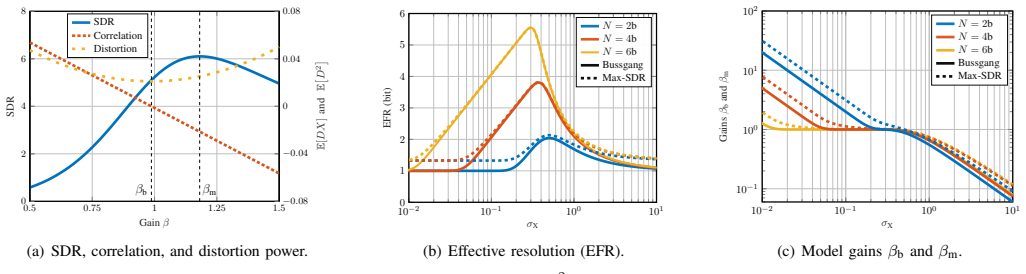
The two proposed affine models for SAR-ADC non-idealities, which represent the converter output as an affine function of the input plus a distortion term and are then applied to derive mitigation methods.
Load-bearing premise
The two affine models capture the dominant non-idealities of real SAR-ADCs well enough that mitigation methods based on them produce meaningful performance gains in actual hardware.
What would settle it
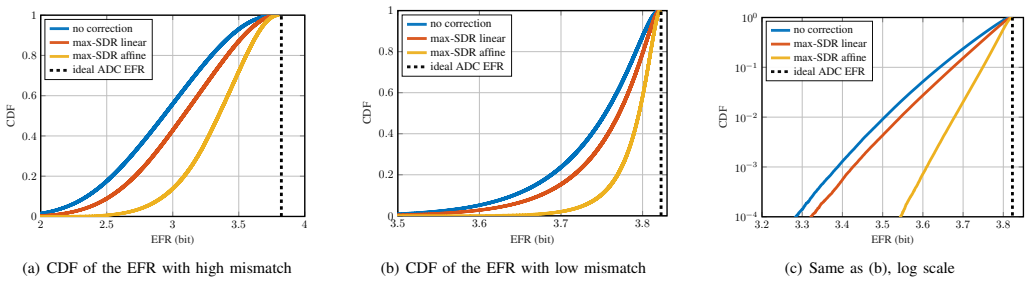
A side-by-side comparison of bit-error-rate or achievable-rate curves in a hardware testbed using real SAR-ADCs, with and without the proposed mitigation, would show whether the models deliver the expected improvement.
Figures
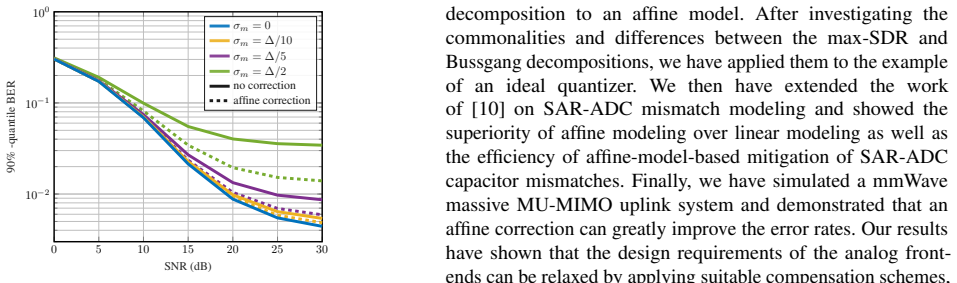
read the original abstract
Low-resolution data converters can significantly reduce the power consumption and silicon area of all-digital massive multi-user (MU) multiple-input multiple-output (MIMO) basestations. However, the existing literature almost exclusively focuses on idealistic quantization models, neglecting the inherent non-idealities present in real-world analog-to-digital converter (ADC) implementations. To overcome this limitation, we propose two affine models, one based on Bussgang's decomposition and one that maximizes the signal-to-distortion ratio (SDR), both accounting for the most prominent non-idealities in successive approximation register (SAR) ADCs. Subsequently, we utilize these models to devise low-complexity methods that mitigate SAR-ADC non-idealities in massive MU-MIMO wireless systems.
Editorial analysis
A structured set of objections, weighed in public.
Referee Report
Summary. The manuscript proposes two affine models for SAR-ADC non-idealities in massive MU-MIMO systems: a Bussgang-based model and an SDR-maximizing model. These are used to derive low-complexity mitigation algorithms that account for realistic ADC impairments beyond ideal quantization, with supporting derivations and simulation results.
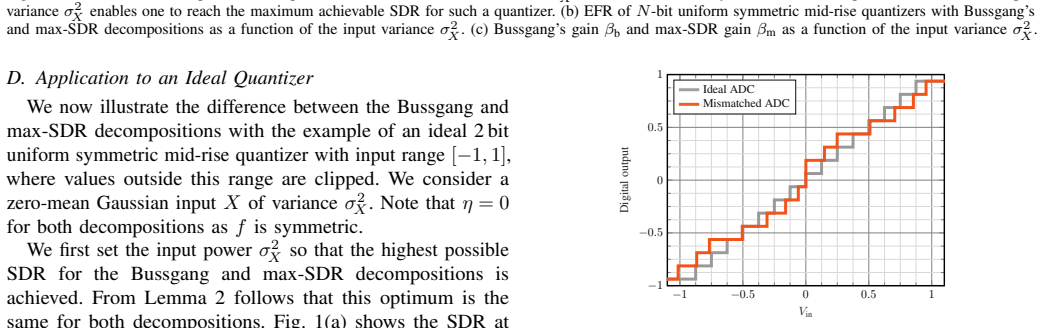
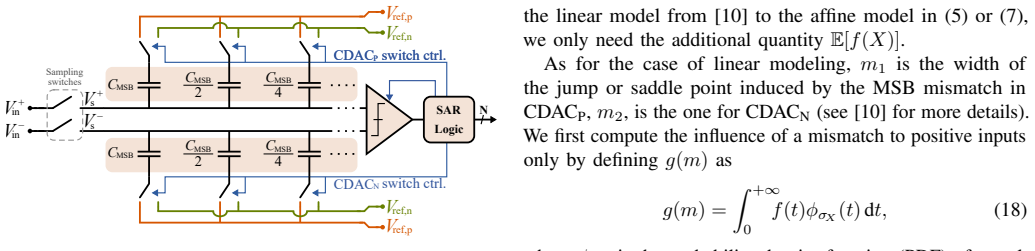
Significance. If the models hold, the work provides a practical bridge between idealized quantization analysis and hardware-aware design for power-efficient massive MIMO base stations. The emphasis on low-complexity mitigation methods and the explicit inclusion of prominent SAR-ADC effects (e.g., comparator offset, capacitor mismatch) are strengths; the simulation-based validation under the proposed models is internally consistent and directly supports the central claim.
minor comments (3)
- Abstract: the phrase 'accounting for the most prominent non-idealities' is repeated without naming them; a parenthetical list (e.g., comparator offset, gain error) would improve clarity for readers scanning the contribution.
- Notation: the definition of the affine parameters (gain and additive distortion term) should be stated once in a dedicated subsection or table rather than re-derived in each mitigation section to avoid repetition.
- Figure captions: several simulation figures lack explicit labels for the two proposed models versus the ideal-quantization baseline; adding a legend entry or caption sentence would aid reproducibility.
Simulated Author's Rebuttal
We thank the referee for the positive assessment of our work and the recommendation for minor revision. The report does not list any specific major comments requiring a point-by-point response.
Circularity Check
No significant circularity; derivations are self-contained
full rationale
The paper proposes two affine models (Bussgang-based and SDR-maximizing) for SAR-ADC non-idealities and derives low-complexity mitigation methods from them. No load-bearing step reduces by construction to a fitted parameter, self-citation chain, or renamed input; the models are defined from first principles on the non-idealities and the mitigation follows directly. The central claim remains independent of its own outputs.
Axiom & Free-Parameter Ledger
Reference graph
Works this paper leans on
-
[1]
Millimeter wave mobile communications for 5G cellular: It will work!
T. S. Rappaport, S. Sun, R. Mayzus, H. Zhao, Y . Azar, K. Wang, G. N. Wong, J. K. Schulz, M. Samimi, and F. Gutierrez, “Millimeter wave mobile communications for 5G cellular: It will work!”IEEE Access, vol. 1, pp. 335–349, May 2013
2013
-
[2]
Millimeter- wave massive MIMO: the next wireless revolution?
A. L. Swindlehurst, E. Ayanoglu, P. Heydari, and F. Capolino, “Millimeter- wave massive MIMO: the next wireless revolution?”IEEE Commun. Mag., vol. 52, no. 9, pp. 56–62, Sep. 2014
2014
-
[3]
An overview of massive MIMO: Benefits and challenges,
L. Lu, G. Y . Li, A. L. Swindlehurst, A. Ashikhmin, and R. Zhang, “An overview of massive MIMO: Benefits and challenges,”IEEE J. Sel. Topics Signal Process., vol. 8, no. 5, pp. 742–758, Apr. 2014
2014
-
[4]
Björnson, J
E. Björnson, J. Hoydis, and L. Sanguinetti,Massive MIMO Networks: Spectral, Energy, and Hardware Efficiency. Now Publishers, 2017, vol. 11, no. 3-4, ser. Fundations and Trends in Signal Processing
2017
-
[5]
Throughput analysis of massive MIMO uplink with low-resolution ADCs,
S. Jacobsson, G. Durisi, M. Coldrey, U. Gustavsson, and C. Studer, “Throughput analysis of massive MIMO uplink with low-resolution ADCs,” IEEE Trans. Wireless Commun., vol. 16, no. 6, pp. 4038–4051, Apr. 2017
2017
-
[6]
Uplink performance of wideband massive MIMO with one-bit ADCs,
C. Mollén, J. Choi, E. G. Larsson, and R. W. Heath, “Uplink performance of wideband massive MIMO with one-bit ADCs,”IEEE Trans. Wireless Commun., vol. 16, no. 1, pp. 87–100, Oct. 2017
2017
-
[7]
Finite-alphabet MMSE equalization for all-digital massive MU-MIMO mmWave communication,
O. Castañeda, S. Jacobsson, G. Durisi, T. Goldstein, and C. Studer, “Finite-alphabet MMSE equalization for all-digital massive MU-MIMO mmWave communication,”IEEE J. Sel. Areas Commun., vol. 38, no. 9, pp. 2128–2141, Jun. 2020
2020
-
[8]
Multiple parameter estimation with quantized channel output,
A. Mezghani, F. Antreich, and J. A. Nossek, “Multiple parameter estimation with quantized channel output,” inProc. Int. ITG Workshop Smart Antennas (WSA), Feb. 2010, pp. 143–150
2010
-
[9]
Mixed-ADC massive MIMO,
N. Liang and W. Zhang, “Mixed-ADC massive MIMO,”IEEE J. Sel. Areas Commun., vol. 34, no. 4, pp. 983–997, Mar. 2016
2016
-
[10]
The impact of SAR-ADC mismatch on quantized massive MU-MIMO systems,
J. Guichemerre and C. Studer, “The impact of SAR-ADC mismatch on quantized massive MU-MIMO systems,” inProc. 57th Asilomar Conf. Signals, Syst., Comput., Oct. 2023
2023
-
[11]
An all-MOS charge-redistribution A/D conversion technique,
R. Suarez, P. Gray, and D. Hodges, “An all-MOS charge-redistribution A/D conversion technique,” inIEEE Int. Solid-State Circuits Conf. (ISSCC), vol. XVII, Feb. 1974, pp. 194–195
1974
-
[12]
ADC Performance Survey 1997-2023,
B. Murmann, “ADC Performance Survey 1997-2023,” [Online]. Available: https://github.com/bmurmann/ADC-survey
1997
-
[13]
Crosscorrelation functions of amplitude-distorted Gaus- sian signals,
J. J. Bussgang, “Crosscorrelation functions of amplitude-distorted Gaus- sian signals,” Massachusetts Inst. Technol., Cambridge, MA, USA, Tech. Rep., Mar. 1952
1952
-
[14]
Estimation of the mean of a multivariate normal distribution,
C. M. Stein, “Estimation of the mean of a multivariate normal distribution,”Ann. Statist., vol. 9, no. 6, pp. 1135–1151, Nov. 1981. [Online]. Available: http://www.jstor.org/stable/2240405
-
[15]
Analog-to-digital converter survey and analysis,
R. Walden, “Analog-to-digital converter survey and analysis,”IEEE J. Sel. Areas Commun., vol. 17, no. 4, pp. 539–550, Apr. 1999
1999
-
[16]
Chan Carusone, D
T. Chan Carusone, D. Johns, and K. Martin,Analog Integrated Circuit Design, 2nd Edition. Wiley, 2011
2011
-
[17]
R. J. van der Plassche,Integrated Analog-To-Digital and Digital-To- Analog Converters. Kluwer Academic Publischers, 1994
1994
-
[18]
Matching properties of MOS transistors,
M. Pelgrom, A. Duinmaijer, and A. Welbers, “Matching properties of MOS transistors,”IEEE J. Solid-State Circuits, vol. 24, no. 5, pp. 1433– 1439, Oct. 1989
1989
-
[19]
QuaDRiGa - quasi deterministic radio channel generator, user manual and documentation,
S. Jaeckel, L. Raschkowski, K. Boerner, L. Thiele, F. Burkhardt, and E. Eberlein, “QuaDRiGa - quasi deterministic radio channel generator, user manual and documentation,” Fraunhofer Heinrich Hertz Inst., Tech. Rep. v2.2.0, Jun. 2019
2019
discussion (0)
Sign in with ORCID, Apple, or X to comment. Anyone can read and Pith papers without signing in.