A Census of the 200 Most Massive Galaxies Spectroscopically Observed with JWST at zspec sim3-15
Pith reviewed 2026-07-01 01:54 UTC · model grok-4.3
The pith
The 200 most massive galaxies at z~3-15 transition from normal star-forming systems at high redshift to more dusty and quiescent ones at lower redshift.
A machine-rendered reading of the paper's core claim, the machinery that carries it, and where it could break.
Core claim
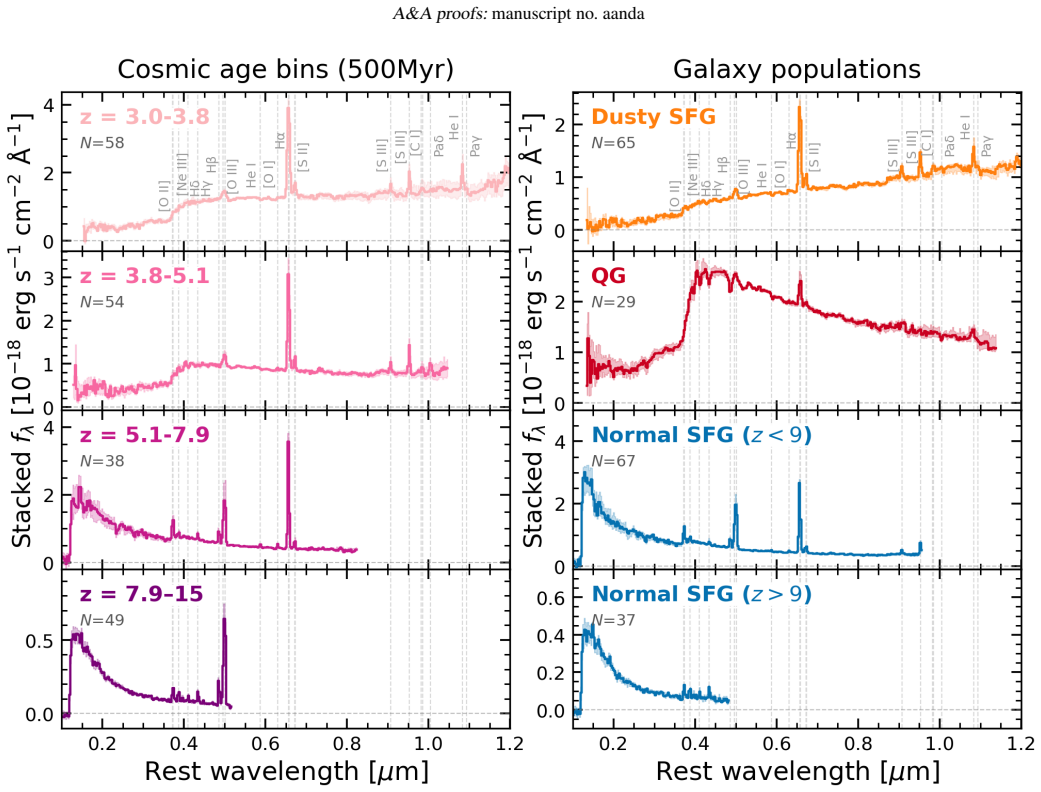
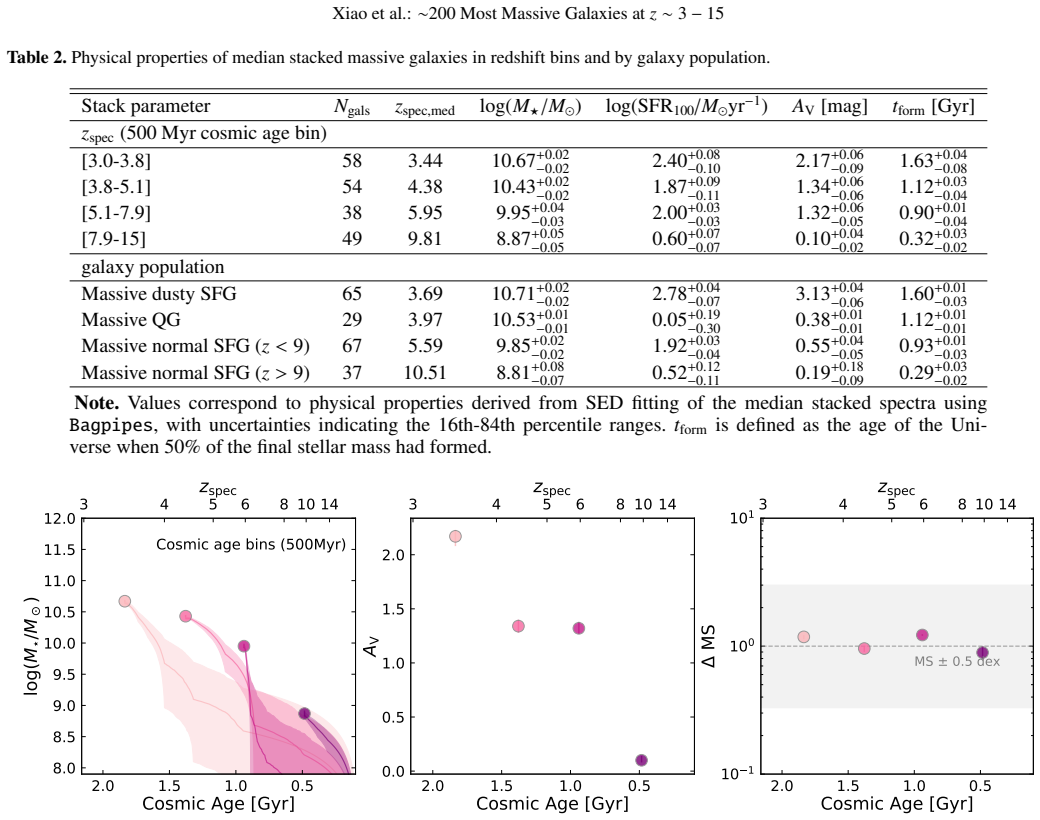
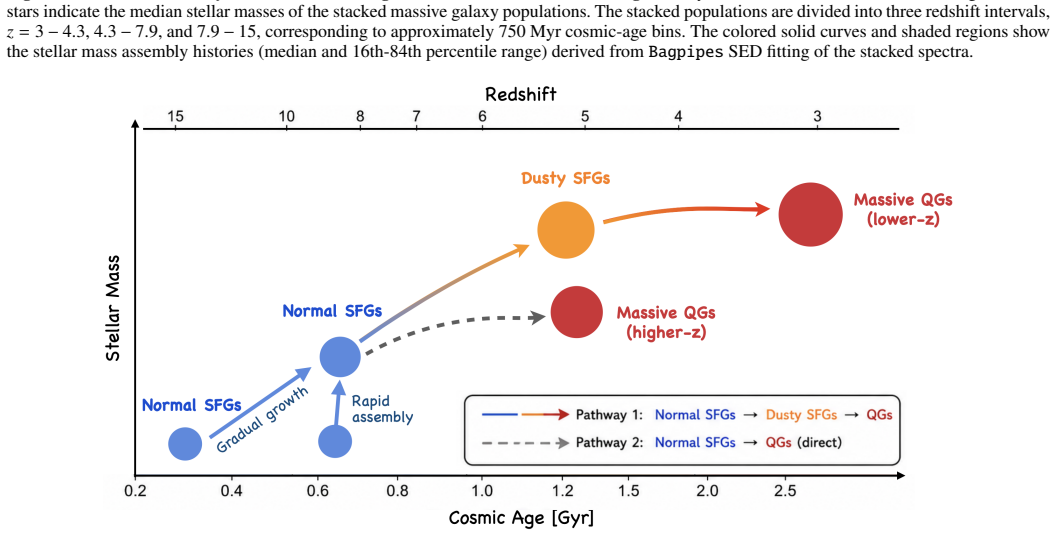
The massive galaxy population evolves strongly with redshift: normal SFGs (Av<1 mag) dominate at z>~6, while dusty SFGs (Av>1 mag) and QGs become more common toward lower redshift. Dust attenuation decreases systematically toward higher redshift. The authors identify 29 massive QGs, including recently quenched systems. The inferred formation histories suggest at least two pathways toward quiescence: a dust-enriched pathway linking normal SFGs, dusty SFGs, and QGs, and a more direct pathway connecting normal SFGs and QGs. Massive normal SFGs appear to grow through both relatively gradual and rapid assembly modes.
What carries the argument
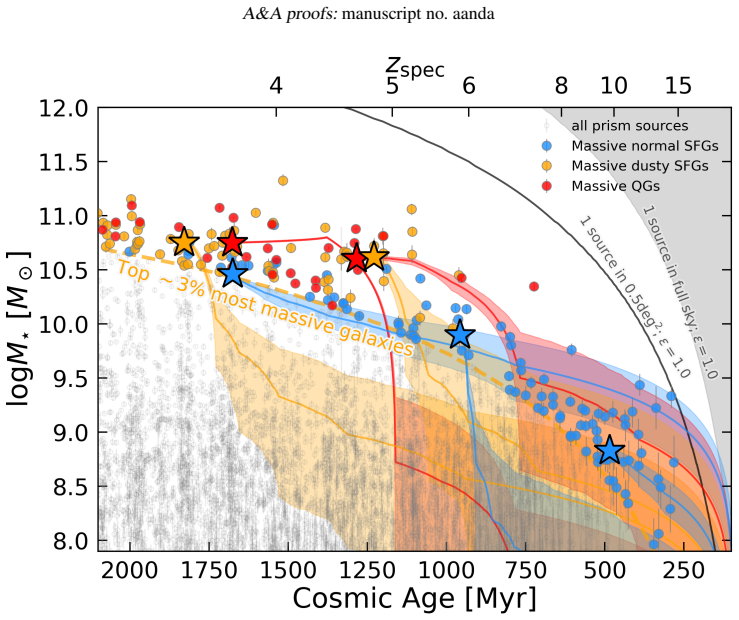
An evolving stellar-mass threshold anchored at log(Mstar)>10 at z~5 that selects the top 3% most massive systems from public prism observations, followed by joint SED fitting of spectroscopy and photometry after removal of LRD and broad-line AGN contaminants.
If this is right
- Normal SFGs dominate at z>~6 while dusty SFGs and QGs increase toward lower redshift.
- Dust attenuation decreases systematically with increasing redshift.
- 29 massive QGs exist, including systems quenched within the past ~100 Myr.
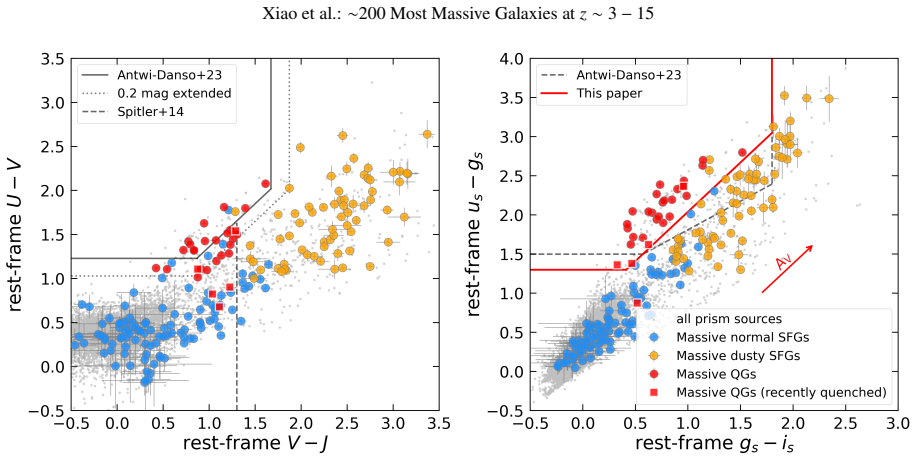
- Traditional UVJ and (ugi)s selections are inconsistent with the most massive galaxies at z>3, requiring a revised criterion.
- Massive normal SFGs grow through both gradual and rapid assembly modes, with at least two distinct quiescence pathways.
Where Pith is reading between the lines
- Galaxy formation models must accommodate early dust enrichment alongside multiple quenching channels to reproduce the observed demographics.
- The revised (ugi)s criterion calibrated on this spectroscopic sample could be tested for improved completeness in photometric selections of massive quiescent galaxies.
- Linking the inferred formation histories to halo assembly timelines could reveal whether the two quiescence pathways correspond to different merger or accretion regimes.
Load-bearing premise
The evolving stellar-mass threshold correctly isolates the top 3% most massive systems among available prism observations without significant selection bias from survey strategy.
What would settle it
A larger complete spectroscopic sample at these redshifts that shows no systematic rise in the fraction of dusty SFGs and QGs toward lower redshift, or that reveals many additional systems above the mass threshold outside the current selection, would falsify the reported evolutionary trends.
Figures
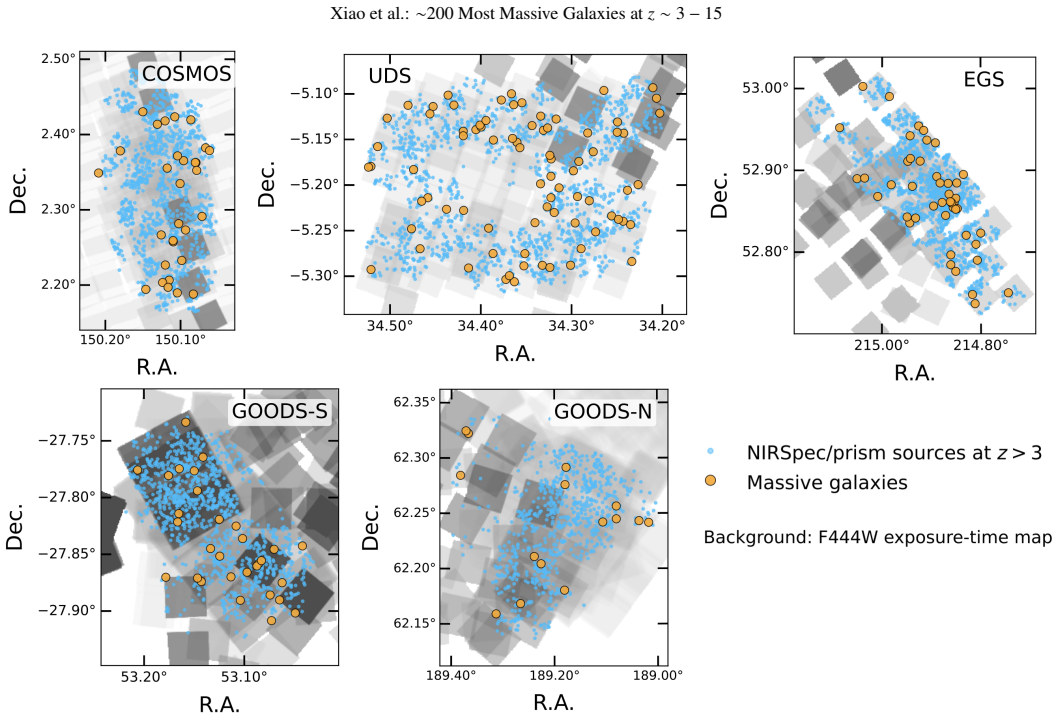
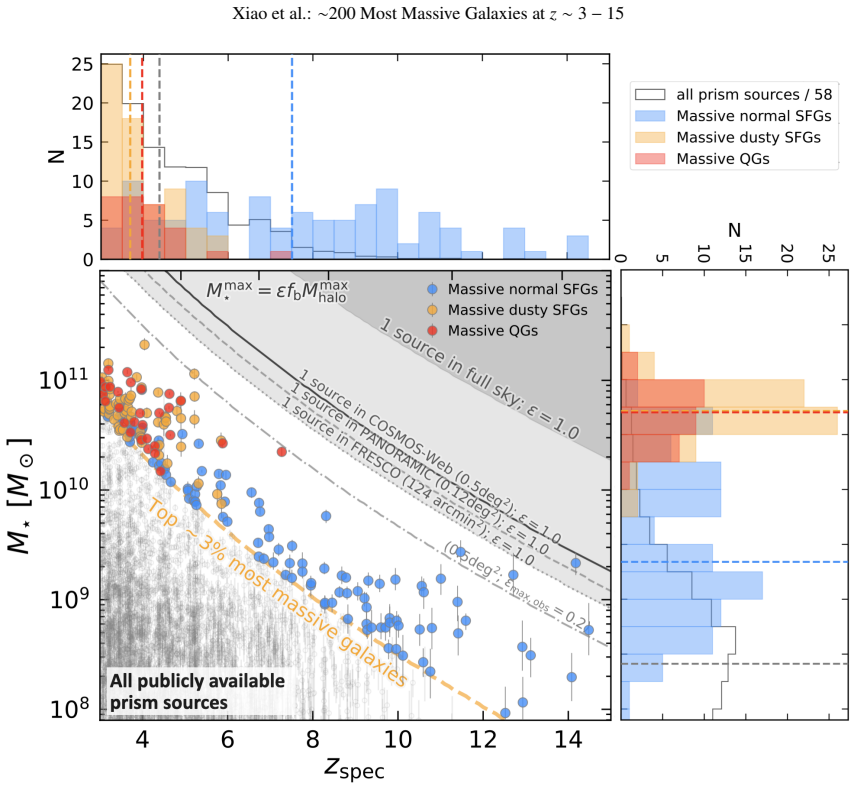
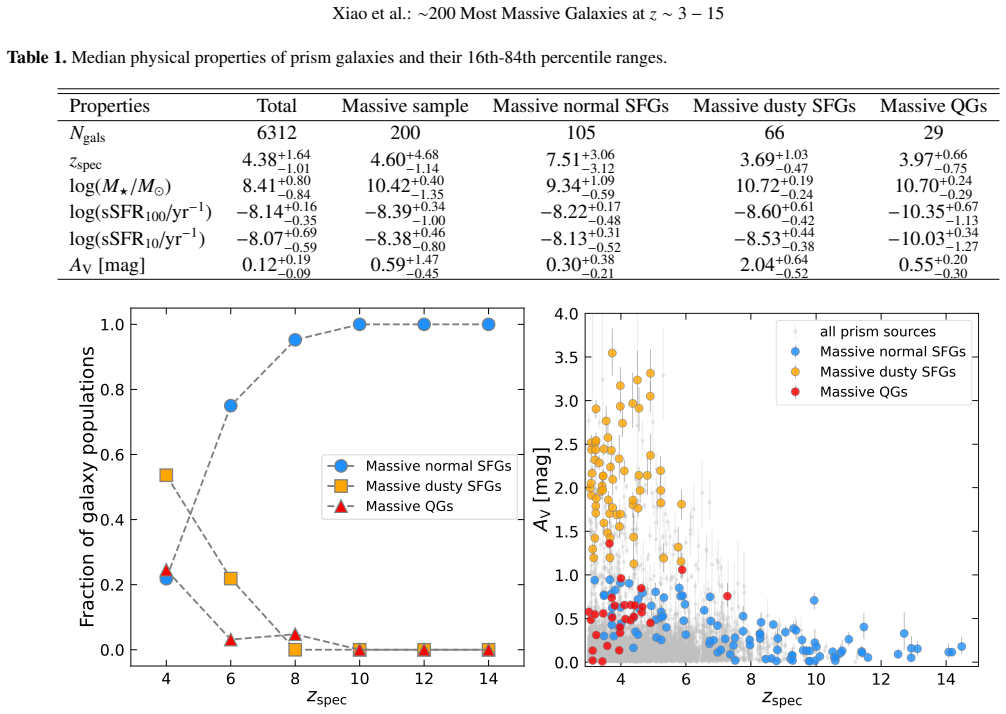
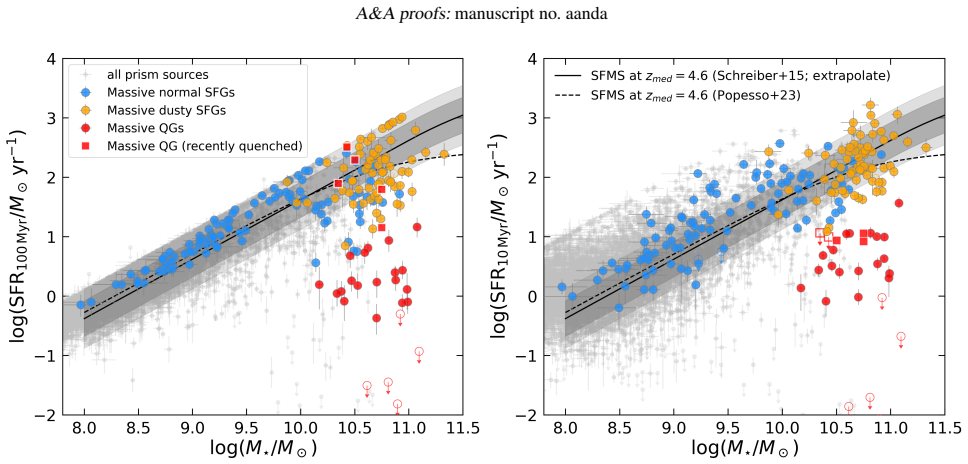
read the original abstract
Massive galaxies provide strong tests of galaxy formation models, yet a comprehensive spectroscopic view of their properties and demographics in the early Universe has remained elusive. Here we present a JWST spectroscopic census of the 200 most massive galaxies at zspec~3-15, selected using an evolving stellar-mass threshold motivated by the halo mass function and anchored at log(Mstar)>10 at z~5. These galaxies represent the top 3% most massive systems among all publicly available prism observations. We derive their physical properties through joint SED fitting of spectroscopy and photometry, and construct a clean massive galaxy sample after removing LRDs and broad-line AGN contaminants. We find that the massive galaxy population evolves strongly with redshift: normal SFGs (Av<1 mag) dominate at z>~6, while dusty SFGs (Av>1 mag) and QGs become more common toward lower redshift. Dust attenuation decreases systematically toward higher redshift. We identify 29 massive QGs, including a population of recently quenched systems whose star formation declined rapidly within the past ~100 Myr. We further show that both the traditional UVJ and recently proposed (ugi)s selections suffer substantial inconsistency with the most massive galaxies at z>3, motivating a revised (ugi)s criterion calibrated using our spectroscopic sample. The inferred formation histories suggest at least two pathways toward quiescence: a dust-enriched pathway linking normal SFGs, dusty SFGs, and QGs, and a more direct pathway connecting normal SFGs and QGs. Massive normal SFGs appear to grow through both relatively gradual and rapid assembly modes. Together, these results suggest that rapid stellar-mass assembly, dust enrichment, and quenching were already shaping the evolutionary pathways of the most massive galaxies within the first billion years after the Big Bang.
Editorial analysis
A structured set of objections, weighed in public.
Referee Report
Summary. The paper presents a JWST/NIRSpec prism spectroscopic census of the 200 most massive galaxies at z_spec ~3-15, selected from public data using an evolving stellar-mass threshold (anchored at log M_star >10 at z~5 and motivated by the halo mass function) that isolates the top ~3% of systems. Joint SED fitting of spectra and photometry is used to derive properties after removing LRDs and broad-line AGN; the authors report strong redshift evolution in demographics (normal SFGs with A_V<1 dominate at z>~6 while dusty SFGs and QGs rise at lower z), decreasing dust attenuation with redshift, 29 massive QGs including recently quenched systems, limitations of UVJ and (ugi)s selections, and two pathways to quiescence.
Significance. If the sample is shown to be free of redshift-dependent selection biases and the demographic trends are robust to completeness and validation checks, the results would supply key observational benchmarks for early massive-galaxy assembly, dust enrichment, and quenching within the first Gyr, directly testing formation models and motivating revised color selections.
major comments (3)
- [Sample selection] Sample selection (abstract and § on target selection): the claim that the evolving M_star threshold applied to public prism observations yields an unbiased representation of the top 3% most massive systems at each redshift is load-bearing for all demographic trends, yet no quantitative assessment is given of how pre-JWST photometric or emission-line targeting criteria (which favor UV-bright, low-A_V sources) correlate with the reported shift from normal SFGs at z>~6 to dusty SFGs/QGs at lower z.
- [Results on demographics] Physical properties and trends (abstract and results on demographics): the reported evolution in A_V, SFG/QG fractions, and formation histories rests on joint SED fitting, but the manuscript supplies no error budgets on derived M_star, A_V, or SFR values, no sample completeness estimates as a function of redshift or A_V, and no cross-checks against independent mass indicators, leaving the central evolutionary claims without quantified uncertainties.
- [QG identification] Quiescent galaxy sample (abstract and § on QG identification): the identification of 29 massive QGs and the distinction between 'recently quenched' systems (SF decline within ~100 Myr) and dusty SFGs is central to the two-pathway claim, but the specific SED-fitting criteria, sSFR thresholds, and handling of dust-star geometry degeneracies are not detailed enough to assess robustness against the noted UVJ/(ugi)s inconsistencies.
minor comments (2)
- [Color selection] Notation for the revised (ugi)s criterion is introduced without an explicit equation or table of coefficients calibrated on the spectroscopic sample.
- [Figures] Figure captions for demographic trends should explicitly state the redshift bins and number of galaxies per bin to allow direct comparison with the claimed fractions.
Simulated Author's Rebuttal
We thank the referee for their constructive and detailed report. We address each major comment below with the strongest honest responses possible based on the manuscript content. Where the comments correctly identify gaps, we agree to revise accordingly.
read point-by-point responses
-
Referee: [Sample selection] Sample selection (abstract and § on target selection): the claim that the evolving M_star threshold applied to public prism observations yields an unbiased representation of the top 3% most massive systems at each redshift is load-bearing for all demographic trends, yet no quantitative assessment is given of how pre-JWST photometric or emission-line targeting criteria (which favor UV-bright, low-A_V sources) correlate with the reported shift from normal SFGs at z>~6 to dusty SFGs/QGs at lower z.
Authors: The sample is defined exclusively from public prism data using the evolving mass threshold to isolate the top ~3% at each redshift. Pre-JWST targeting biases are inherent to the available observations and not under our control. We will add a quantitative discussion of available targeting metadata and its potential correlation with the demographic trends in a new subsection of the revised manuscript. revision: yes
-
Referee: [Results on demographics] Physical properties and trends (abstract and results on demographics): the reported evolution in A_V, SFG/QG fractions, and formation histories rests on joint SED fitting, but the manuscript supplies no error budgets on derived M_star, A_V, or SFR values, no sample completeness estimates as a function of redshift or A_V, and no cross-checks against independent mass indicators, leaving the central evolutionary claims without quantified uncertainties.
Authors: We agree that explicit error budgets, completeness estimates, and cross-checks strengthen the claims. The manuscript presents the trends from joint SED fitting but lacks these quantifications. We will add error propagation details, completeness as a function of redshift and A_V, and comparisons to independent mass indicators in the revised version. revision: yes
-
Referee: [QG identification] Quiescent galaxy sample (abstract and § on QG identification): the identification of 29 massive QGs and the distinction between 'recently quenched' systems (SF decline within ~100 Myr) and dusty SFGs is central to the two-pathway claim, but the specific SED-fitting criteria, sSFR thresholds, and handling of dust-star geometry degeneracies are not detailed enough to assess robustness against the noted UVJ/(ugi)s inconsistencies.
Authors: The QG identification uses sSFR thresholds and SED criteria detailed in the methods, with the two pathways inferred from formation histories. We acknowledge the description could be more explicit on thresholds and dust geometry handling. We will expand this section with precise criteria, additional degeneracy tests, and direct robustness checks against UVJ/(ugi)s selections. revision: yes
Circularity Check
No significant circularity; observational census with direct measurements
full rationale
The paper reports a spectroscopic census of 200 massive galaxies selected via an explicit evolving stellar-mass threshold applied to public prism data. All central claims (redshift evolution of normal vs. dusty SFGs and QGs, dust attenuation trends, two quiescence pathways) are presented as direct observational results from joint SED fitting and sample demographics, with no equations, fitted parameters renamed as predictions, or derivations that reduce to the inputs by construction. No load-bearing self-citations, uniqueness theorems, or ansatzes are invoked in the provided text. The selection is a definitional cut, not a derived quantity, making the work self-contained against external benchmarks.
Axiom & Free-Parameter Ledger
Reference graph
Works this paper leans on
-
[1]
Brammer, Gabriel , doi =
-
[2]
doi:10.1051/0004-6361/201425224 , Eid =. arXiv , Author =:1410.7389 , Journal =
work page internal anchor Pith review Pith/arXiv arXiv doi:10.1051/0004-6361/201425224
-
[3]
doi:10.1093/mnras/staa1211 , Eprint =
, Keywords =. doi:10.1093/mnras/staa1211 , Eprint =
-
[4]
doi:10.1093/mnras/sty1989 , Eprint =
, Keywords =. doi:10.1093/mnras/sty1989 , Eprint =
-
[5]
X-ray and Multiwavelength Insights into the Nature of Weak Emission-Line Quasars at Low Redshift
doi:10.1088/0004-637X/747/1/10 , Eid =. arXiv , Author =:1112.2228 , Journal =
work page internal anchor Pith review Pith/arXiv arXiv doi:10.1088/0004-637x/747/1/10
-
[6]
A Population of X-ray Weak Quasars: PHL 1811 Analogs at High Redshift
doi:10.1088/0004-637X/736/1/28 , Eid =. arXiv , Author =:1104.3861 , Journal =
work page internal anchor Pith review Pith/arXiv arXiv doi:10.1088/0004-637x/736/1/28
-
[7]
, Keywords =. doi:10.1086/500098 , Eprint =
-
[8]
arXiv , Author =:1908.07910 , Journal =
doi:10.3847/1538-4357/ab3c60 , Eid =. arXiv , Author =:1908.07910 , Journal =
-
[9]
arXiv , Author =:1811.01963 , Journal =
doi:10.3847/1538-4357/aaee7a , Eid =. arXiv , Author =:1811.01963 , Journal =
-
[10]
doi:10.1093/pasj/psx046 , Eid =. arXiv , Author =:1704.05854 , Journal =
work page internal anchor Pith review Pith/arXiv arXiv doi:10.1093/pasj/psx046
-
[11]
arXiv , Author =:2105.12133 , Journal =
-
[12]
arXiv , Author =:2109.06209 , Journal =
-
[13]
arXiv , Author =:2106.13719 , Journal =
-
[14]
doi:10.1093/mnras/stv3017 , Eprint =
, Keywords =. doi:10.1093/mnras/stv3017 , Eprint =
-
[15]
doi:10.1093/mnrasl/slaa160 , Eprint =
, Keywords =. doi:10.1093/mnrasl/slaa160 , Eprint =
-
[16]
doi:10.1088/0004-637X/785/2/154 , Eid =. arXiv , Author =:1402.5976 , Journal =
work page internal anchor Pith review Pith/arXiv arXiv doi:10.1088/0004-637x/785/2/154
-
[17]
The Ionized Gas in Nearby Galaxies as Traced by the [NII] 122 and 205 \mu m Transitions
doi:10.3847/0004-637X/826/2/175 , Eid =. arXiv , Author =:1605.03180 , Journal =
work page internal anchor Pith review Pith/arXiv arXiv doi:10.3847/0004-637x/826/2/175
-
[18]
doi:10.1038/s41550-020-01291-y , Eprint =
Nature Astronomy , Keywords =. doi:10.1038/s41550-020-01291-y , Eprint =
-
[19]
doi:10.1093/mnras/stw2749 , Eprint =
, Keywords =. doi:10.1093/mnras/stw2749 , Eprint =
-
[20]
arXiv , Author =:2109.01751 , Journal =
-
[21]
arXiv , Author =:2106.13246 , Journal =
-
[22]
arXiv , Author =:2009.04838 , Journal =
doi:10.3847/1538-4357/abd4d0 , Eid =. arXiv , Author =:2009.04838 , Journal =
-
[23]
Near-Infrared MOSFIRE Spectra of Dusty Star-Forming Galaxies at 0.2<z<4
doi:10.3847/1538-4357/aa6cb1 , Eid =. arXiv , Author =:1703.10168 , Journal =
work page internal anchor Pith review Pith/arXiv arXiv doi:10.3847/1538-4357/aa6cb1
-
[24]
arXiv , Author =:2102.09219 , Journal =
doi:10.3847/1538-4357/abe7ea , Eid =. arXiv , Author =:2102.09219 , Journal =
-
[25]
arXiv , Author =:2104.02177 , Journal =
doi:10.3847/1538-4357/abea15 , Eid =. arXiv , Author =:2104.02177 , Journal =
-
[26]
arXiv , Author =:2007.11600 , Journal =
doi:10.3847/1538-4357/abb8dd , Eid =. arXiv , Author =:2007.11600 , Journal =
-
[27]
doi:10.1093/pasj/psab047 , Eprint =
, Keywords =. doi:10.1093/pasj/psab047 , Eprint =
-
[28]
arXiv , Author =:2009.09784 , Journal =
doi:10.1051/0004-6361/202039462 , Eid =. arXiv , Author =:2009.09784 , Journal =
-
[29]
, Keywords =. doi:10.1146/annurev-astro-032620-021859 , Eprint =
-
[30]
doi:10.1093/mnras/stab191 , Eprint =
, Keywords =. doi:10.1093/mnras/stab191 , Eprint =
-
[31]
arXiv , Author =:2101.01937 , Journal =
doi:10.3847/1538-4357/abd7ec , Eid =. arXiv , Author =:2101.01937 , Journal =
-
[32]
doi:10.1093/mnras/stz1768 , Eprint =
, Keywords =. doi:10.1093/mnras/stz1768 , Eprint =
-
[33]
doi:10.1051/0004-6361/201833528 , Eid =. arXiv , Author =:1805.11621 , Journal =
work page internal anchor Pith review Pith/arXiv arXiv doi:10.1051/0004-6361/201833528
-
[34]
doi:10.1093/mnras/stx608 , Eprint =
, Keywords =. doi:10.1093/mnras/stx608 , Eprint =
-
[35]
doi:10.1093/mnras/stx3120 , Eprint =
, Keywords =. doi:10.1093/mnras/stx3120 , Eprint =
-
[36]
The spectral energy distribution of the hyperluminous, hot dust-obscured galaxy W2246$-$0526
doi:10.3847/1538-4357/aaaaae , Eid =. arXiv , Author =:1802.01865 , Journal =
work page internal anchor Pith review Pith/arXiv arXiv doi:10.3847/1538-4357/aaaaae
-
[37]
doi:10.1093/mnras/stw718 , Eprint =
, Keywords =. doi:10.1093/mnras/stw718 , Eprint =
-
[38]
doi:10.1093/mnras/stu1248 , Eprint =
, Keywords =. doi:10.1093/mnras/stu1248 , Eprint =
-
[39]
Spitzer Observations of Young Red Quasars
doi:10.1088/0004-637X/757/2/125 , Eid =. arXiv , Author =:1208.4585 , Journal =
work page internal anchor Pith review Pith/arXiv arXiv doi:10.1088/0004-637x/757/2/125
-
[40]
doi:10.1126/science.aap7605 , Eprint =
Science , Keywords =. doi:10.1126/science.aap7605 , Eprint =
-
[41]
Dust Reddened Quasars in FIRST and UKIDSS: Beyond the Tip of the Iceberg
doi:10.1088/0004-637X/778/2/127 , Eid =. arXiv , Author =:1309.6626 , Journal =
work page internal anchor Pith review Pith/arXiv arXiv doi:10.1088/0004-637x/778/2/127
-
[42]
, Keywords =. doi:10.1086/509617 , Eprint =
-
[43]
doi:10.1088/0004-637X/698/2/1095 , Eprint =
, Keywords =. doi:10.1088/0004-637X/698/2/1095 , Eprint =
-
[44]
, Keywords =. doi:10.1086/383305 , Eprint =
-
[45]
doi:10.1093/mnras/stw2387 , Eprint =
, Keywords =. doi:10.1093/mnras/stw2387 , Eprint =
-
[46]
A systematic study of Lyman-Alpha transfer through outflowing shells: Model parameter estimation
doi:10.1088/0004-637X/812/2/123 , Eid =. arXiv , Author =:1506.03836 , Journal =
work page internal anchor Pith review Pith/arXiv arXiv doi:10.1088/0004-637x/812/2/123
-
[47]
Gas Motion Study of Lya Emitters at z~2 Using UV and Optical Spectral Lines
doi:10.1088/0004-637X/765/1/70 , Eid =. arXiv , Author =:1206.2316 , Journal =
work page internal anchor Pith review Pith/arXiv arXiv doi:10.1088/0004-637x/765/1/70
-
[48]
, Keywords =. doi:10.1046/j.1365-8711.2001.04022.x , Eprint =
-
[49]
doi:10.1093/mnras/staa1220 , Eprint =
, Keywords =. doi:10.1093/mnras/staa1220 , Eprint =
-
[50]
doi:10.1093/mnras/stz1420 , Eprint =
, Keywords =. doi:10.1093/mnras/stz1420 , Eprint =
-
[51]
doi:10.1088/0004-637X/811/1/58 , Eid =. arXiv , Author =:1501.01240 , Journal =
work page internal anchor Pith review Pith/arXiv arXiv doi:10.1088/0004-637x/811/1/58
-
[52]
arXiv , Author =:2011.12458 , Journal =
doi:10.3847/1538-4357/abcc5e , Eid =. arXiv , Author =:2011.12458 , Journal =
-
[53]
HI4PI: A full-sky HI survey based on EBHIS and GASS
doi:10.1051/0004-6361/201629178 , Eid =. arXiv , Author =:1610.06175 , Journal =
work page internal anchor Pith review Pith/arXiv arXiv doi:10.1051/0004-6361/201629178
-
[54]
Chandra X-rays from the redshift 7.54 quasar ULAS J1342+0928
doi:10.3847/2041-8213/aab61e , Eid =. arXiv , Author =:1803.08105 , Journal =
work page internal anchor Pith review Pith/arXiv arXiv doi:10.3847/2041-8213/aab61e 2041
-
[55]
doi:10.1093/mnras/stz3275 , Eprint =
, Keywords =. doi:10.1093/mnras/stz3275 , Eprint =
-
[56]
arXiv , Author =:2103.06901 , Journal =
doi:10.1051/0004-6361/202140399 , Eid =. arXiv , Author =:2103.06901 , Journal =
-
[57]
, Keywords =. doi:10.1086/379758 , Eprint =
-
[58]
, Keywords =. doi:10.1086/510776 , Eprint =
-
[59]
, Keywords =. doi:10.1086/523959 , Eprint =
-
[60]
, Keywords =. doi:10.1086/377014 , Eprint =
-
[61]
, Keywords =. doi:10.1086/133630 , Eprint =
work page internal anchor Pith review doi:10.1086/133630
-
[62]
doi:10.1146/annurev.aa.31.090193.002353 , Journal =
-
[63]
doi:10.1093/mnras/stx1636 , Eprint =
, Keywords =. doi:10.1093/mnras/stx1636 , Eprint =
-
[64]
, Keywords =. doi:10.1086/528674 , Eprint =
-
[65]
doi:10.3847/1538-4357/aaecd2 , Eid =. arXiv , Author =:1810.12300 , Journal =
work page internal anchor Pith review Pith/arXiv arXiv doi:10.3847/1538-4357/aaecd2
-
[66]
arXiv , Author =:2101.04734 , Journal =
doi:10.3847/1538-4357/abdb27 , Eid =. arXiv , Author =:2101.04734 , Journal =
-
[67]
doi:10.1051/0004-6361/201732442e , Eid =
, Keywords =. doi:10.1051/0004-6361/201732442e , Eid =
-
[68]
doi:10.1051/0004-6361/201525780 , Eid =. arXiv , Author =:1502.00640 , Journal =
work page internal anchor Pith review Pith/arXiv arXiv doi:10.1051/0004-6361/201525780
-
[69]
ALMA Deep Field in SSA22: A concentration of dusty starbursts in a z=3.09 protocluster core
doi:10.1088/2041-8205/815/1/L8 , Eid =. arXiv , Author =:1510.08861 , Journal =
work page internal anchor Pith review Pith/arXiv arXiv doi:10.1088/2041-8205/815/1/l8 2041
-
[70]
ALMA Deep Field in SSA22: Source Catalog and Number Counts
doi:10.3847/1538-4357/835/1/98 , Eid =. arXiv , Author =:1611.09857 , Journal =
work page internal anchor Pith review Pith/arXiv arXiv doi:10.3847/1538-4357/835/1/98
-
[71]
Science , Keywords =. doi:10.1126/science.aaw5949 , Eprint =
-
[72]
arXiv , Author =:2007.09887 , Journal =
doi:10.1051/0004-6361/202038146 , Eid =. arXiv , Author =:2007.09887 , Journal =
-
[73]
doi:10.1093/mnras/staa1315 , Eprint =
, Keywords =. doi:10.1093/mnras/staa1315 , Eprint =
-
[74]
arXiv , Author =:2002.07199 , Journal =
doi:10.3847/1538-4357/ab765b , Eid =. arXiv , Author =:2002.07199 , Journal =
-
[75]
doi:10.1016/S0370-1573(02)00134-5 , Eprint =
, Keywords =. doi:10.1016/S0370-1573(02)00134-5 , Eprint =
-
[76]
arXiv , Author =:2102.05671 , Journal =
-
[77]
arXiv , Author =:2006.02447 , Journal =
doi:10.3847/1538-4357/abb943 , Eid =. arXiv , Author =:2006.02447 , Journal =
-
[78]
doi:10.1093/mnras/stz3248 , Eprint =
, Keywords =. doi:10.1093/mnras/stz3248 , Eprint =
-
[79]
doi:10.1093/pasj/psx017 , Eid =. arXiv , Author =:1605.03436 , Journal =
work page internal anchor Pith review Pith/arXiv arXiv doi:10.1093/pasj/psx017
-
[80]
doi:10.1088/0004-637X/785/2/153 , Eid =. arXiv , Author =:1402.0510 , Journal =
work page internal anchor Pith review Pith/arXiv arXiv doi:10.1088/0004-637x/785/2/153
discussion (0)
Sign in with ORCID, Apple, or X to comment. Anyone can read and Pith papers without signing in.