REVIEW 3 minor 49 references
EWOCS-VI: Probing the hidden intermediate-mass population of Westerlund 1
T0 review · 0 major / 3 minor · reviewed 2026-06-29 · grok-4.3
Pith's one-line read Near-infrared data and clustering reveal 1286 candidate members of Westerlund 1 spanning 1.5 to 20 solar masses.
desk verdict This paper gives a practical membership catalog for the intermediate-mass stars in Westerlund 1 using clustering on survey photometry. read the letter →
The pith
A machine-rendered reading of the paper's core claim, the machinery that carries it, and where it could break.
The reading
What carries the argument
HDBSCAN density-based clustering performed in a six-dimensional parameter space of sky position, near-infrared magnitudes and proper motions, with Monte Carlo simulations used to test separation of cluster members from field contaminants.
What would settle it
A radial-velocity or proper-motion survey of the 1286 candidates that finds most have velocities or motions inconsistent with membership at 4.23 kpc and 5-6 Myr age would falsify the membership list.
Extended reading notes
Core claim
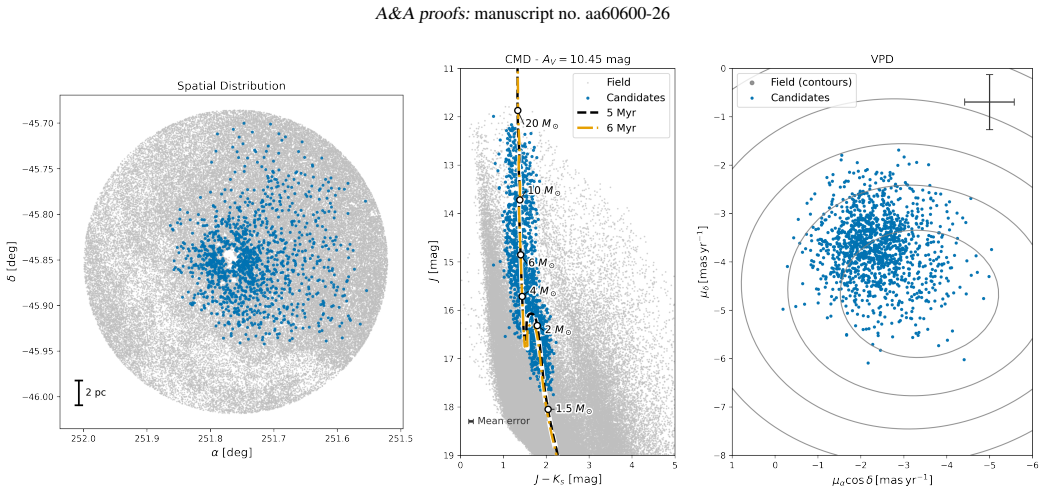
HDBSCAN clustering in a 6D space of position, photometry and astrometry, applied to VIRAC2 Ks-band data from the VVVX survey, isolates 1286 high-probability members with 12 < J < 18 that correspond to 1.5-20 solar masses under PARSEC 5 and 6 Myr isochrones at 4.23 kpc and A_Ks = 0.6 mag; 34 percent of these sources display statistically significant variability whose modes are analyzed parametrically for the first time.
Load-bearing premise
The HDBSCAN run in the selected 6D space correctly separates true cluster members from field stars with low contamination and incompleteness, and the chosen PARSEC isochrones with fixed age, distance and extinction accurately convert the observed magnitudes into the stated mass range.
Editorial extensions
If this is right
- The catalog supplies a ready sample for kinematic studies of the cluster's dynamics and extent.
- The 34 percent variability rate and its parametric description supply the first systematic view of Ks-band behavior among these intermediate-mass candidates.
- The spatial coverage extends membership information from the dense core into the cluster outskirts.
- The mass range closes the observational gap between Gaia high-mass stars and prior very-low-mass surveys of the same region.
Reading between the lines
- If the candidates prove to be genuine members, the spatial distribution could be used to test whether the cluster formed with a single burst or shows evidence of sequential star formation.
- The variability fraction may correlate with stellar rotation or accretion signatures that could be checked with multi-epoch spectroscopy.
- The same 6D clustering approach could be tested on other highly extincted young clusters where optical data are unavailable.
Editorial analysis
A structured set of objections, weighed in public.
Referee Report
Summary. The manuscript uses VIRAC2 NIR PSF photometry and astrometry from the VVVX survey to apply the HDBSCAN algorithm in 6D parameter space (position, photometry, astrometry) to Westerlund 1, identifying 1286 high-probability candidate members with 12 < J < 18 mag. These are mapped to a mass range of ~1.5--20 M_⊙ via PARSEC isochrones at 5 and 6 Myr with A_Ks=0.6 mag and d=4.23 kpc. Monte Carlo simulations assess robustness; 34% of candidates show statistically significant Ks-band variability, for which a parametric analysis of variability modes is presented, along with a membership catalog for future kinematic work.
Significance. If the clustering selection holds, the work fills the intermediate-mass gap between Gaia-traced high-mass stars and prior EWOCS low-mass studies, providing a more complete census of Wd1 in a starburst environment. Explicit strengths include reliance on public VIRAC2 catalogs, Monte Carlo robustness tests for the unsupervised membership assignment, and the first parametric Ks-band variability characterization for these candidates.
minor comments (3)
- [Abstract] Abstract and §3: the precise six features comprising the 6D input space to HDBSCAN (e.g., exact combination of RA/Dec, J/H/Ks magnitudes or colors, proper motions, and any parallax or other astrometric quantities) are not enumerated; an explicit list would aid reproducibility.
- Results section: the procedure for combining or selecting between the 5 Myr and 6 Myr PARSEC isochrones when assigning individual stellar masses is not described; it is unclear whether masses are taken from one isochrone, averaged, or assigned via a joint probability.
- Variability analysis: the exact statistical threshold and time-sampling criteria used to declare 'statistically significant flux variations' (and the subsequent parametric mode classification) should be stated with reference to the relevant equation or table.
Simulated Author's Rebuttal
We thank the referee for their positive assessment of the manuscript, including the recognition of its strengths in using public VIRAC2 data, Monte Carlo robustness tests, and providing the first parametric Ks-band variability analysis for Wd1 candidates. The recommendation for minor revision is noted. No specific major comments were raised in the report.
Circularity Check
No significant circularity identified
full rationale
The paper applies the unsupervised HDBSCAN algorithm to public VIRAC2 photometry and astrometry in a 6D space (position, photometry, astrometry), validates robustness with Monte Carlo simulations, and adopts fixed PARSEC isochrone parameters (5/6 Myr, A_Ks=0.6 mag, d=4.23 kpc) solely to convert observed J magnitudes into a mass range. The reported 1286 high-probability members and 34% variability fraction are computed directly from the clustering output and flux measurements without any fitted parameter being redefined as a prediction, without self-citation chains supporting the core claims, and without equations that reduce the results to quantities defined by the same inputs. The derivation is therefore self-contained against external data and algorithms.
Assumptions & free parameters
free parameters (3)
- Isochrone age =
5-6 Myr
- Extinction A_Ks =
0.6 mag
- Distance =
4.23 kpc
assumptions (2)
- domain assumption PARSEC isochrones accurately predict the mass-luminosity relation for stars in the 1.5-20 solar mass range at the adopted age and metallicity.
- domain assumption The 6D parameter space constructed from VIRAC2 astrometry and photometry permits reliable statistical separation of cluster members from field stars via HDBSCAN.
Cite this review
Pith. "Pith review of EWOCS-VI: Probing the hidden intermediate-mass population of Westerlund 1." pith.science (2026). https://pith.science/paper/3PXS72ZC
@misc{pith2026260627623,
  author       = {Pith},
  title        = {Pith review of: EWOCS-VI: Probing the hidden intermediate-mass population of Westerlund 1},
  year         = {2026},
  howpublished = {\url{https://pith.science/paper/3PXS72ZC}},
  note         = {Machine review of arXiv:2606.27623}
}
abstract
Context: Westerlund 1 (Wd1), the most massive young star cluster in the Milky Way, is an excellent laboratory for studying star formation and early stellar evolution in a starburst-like environment. However, high extinction restricts studies of its stellar content, and focus on high-mass stars limits our knowledge of the full spatial extent of the cluster. Aims: We characterize the near-infrared (NIR) variability of the stellar population of Wd1, filling the mass gap between massive stars traced by Gaia and very low-mass stars from previous Extended Westerlund 1 and 2 Open Clusters Survey (EWOCS) studies, to provide a more complete view of cluster membership across solar and super-solar masses.} Methods: We exploited data from the VISTA Variables of the V\'ia L\'actea survey and its extension (VVVX), using NIR point spread function (PSF) photometry and astrometric solutions from its latest data release, namely the VIRAC2 catalogs, mainly in the Ks band. Their large spatial coverage enables study of both the central regions and outskirts of the cluster. We applied HDBSCAN clustering algorithm in a 6D parameter space to differentiate cluster members from field contaminants, assessing robustness through Monte Carlo simulations. Variable sources along the line of sight were also identified and characterized. Results: We identify 1286 high-probability candidate members (12 < J < 18 mag) spanning $\sim 1.5$--$20\,M_{\odot}$, adopting both PARSEC 5 and 6 Myr isochrones ($A_{K_{\rm{s}}}=0.6\,\rm{mag}$, $d=4.23\,\rm{kpc}$). A considerable fraction (34%) shows statistically significant flux variations. We present, for the first time, a parametric analysis of variability modes of Wd1 candidate members in the Ks band, providing a membership catalog suitable for future kinematic studies.
Figures


Figures from the paper (11 more)


Reference graph
Works this paper leans on
-
[1]
G., Drake, J
Anastasopoulou, K., Guarcello, M. G., Drake, J. J., et al. 2025, A&A, 701, A138
2025
-
[2]
2017, A&A, 602, A22
Andersen, M., Gennaro, M., Brandner, W., et al. 2017, A&A, 602, A22
2017
-
[3]
Anderson, R. I. & Hunt, E. L. 2025, A&A, 700, L13
2025
-
[4]
H., et al
Balog, Z., Muzerolle, J., Rieke, G. H., et al. 2007, ApJ, 660, 1532
2007
-
[5]
R., Davies, B., Smith, N., Gehrz, R
Beasor, E. R., Davies, B., Smith, N., Gehrz, R. D., & Figer, D. F. 2021, ApJ, 912, 16
2021
-
[6]
Bessell, M. S. & Brett, J. M. 1988, PASP, 100, 1134
1988
-
[7]
Bonanos, A. Z. 2007, AJ, 133, 2696
2007
-
[8]
2023, ApJS, 265, 27
Bonito, R., Venuti, L., Ustamujic, S., et al. 2023, ApJS, 265, 27
2023
Show all 49 references
-
[9]
Campello, R. J. G. B., Moulavi, D., & Sander, J. 2013, in Advances in Knowl- edge Discovery and Data Mining, ed. J. Pei, V . S. Tseng, L. Cao, H. Motoda, & G. Xu (Berlin, Heidelberg: Springer Berlin Heidelberg), 160–172
2013
-
[10]
& Anders, F
Cantat-Gaudin, T. & Anders, F. 2020, A&A, 633, A99
2020
-
[11]
M., Hillenbrand, L
Carpenter, J. M., Hillenbrand, L. A., & Skrutskie, M. F. 2001, AJ, 121, 3160
2001
-
[12]
2026, A&A, 708, A209
Castellanos, R., Najarro, F., Garcia, M., et al. 2026, A&A, 708, A209
2026
-
[13]
S., Negueruela, I., Crowther, P
Clark, J. S., Negueruela, I., Crowther, P. A., & Goodwin, S. P. 2005, A&A, 434, 949
2005
-
[14]
S., Ritchie, B
Clark, J. S., Ritchie, B. W., & Negueruela, I. 2010, A&A, 514, A87
2010
-
[15]
S., Ritchie, B
Clark, J. S., Ritchie, B. W., & Negueruela, I. 2020, A&A, 635, A187
2020
-
[16]
M., Stauffer, J., Baglin, A., et al
Cody, A. M., Stauffer, J., Baglin, A., et al. 2014, AJ, 147, 82
2014
-
[17]
R., Andersen, M., & Espinoza, P
Cottaar, M., Meyer, M. R., Andersen, M., & Espinoza, P. 2012, A&A, 539, A5
2012
-
[18]
A., Blum, R
Damineli, A., Almeida, L. A., Blum, R. D., et al. 2016, MNRAS, 463, 2653
2016
-
[19]
S., Alessi, B
Dias, W. S., Alessi, B. S., Moitinho, A., & Lépine, J. R. D. 2002, A&A, 389, 871 Gaia Collaboration, Brown, A. G. A., Vallenari, A., et al. 2018, A&A, 616, A1 Gaia Collaboration, Vallenari, A., Brown, A. G. A., et al. 2023, A&A, 674, A1
2002
-
[20]
2011, MNRAS, 412, 2469
Gennaro, M., Brandner, W., Stolte, A., & Henning, T. 2011, MNRAS, 412, 2469
2011
-
[21]
P., Parker, R
Gennaro, M., Goodwin, S. P., Parker, R. J., Allison, R. J., & Brandner, W. 2017, MNRAS, 472, 1760
2017
-
[22]
G., Almendros-Abad, V ., Lovell, J
Guarcello, M. G., Almendros-Abad, V ., Lovell, J. B., et al. 2025, A&A, 693, A120
2025
-
[23]
G., Flaccomio, E., Albacete-Colombo, J
Guarcello, M. G., Flaccomio, E., Albacete-Colombo, J. F., et al. 2024, A&A, 682, A49
2024
-
[24]
W., Smith, L
Guo, Z., Lucas, P. W., Smith, L. C., et al. 2022, MNRAS, 513, 1015
2022
-
[25]
& Bonanos, A
Koumpia, E. & Bonanos, A. Z. 2012, A&A, 547, A30
2012
-
[26]
2012, ApJ, 750, L44
Kudryavtseva, N., Brandner, W., Gennaro, M., et al. 2012, ApJ, 750, L44
2012
-
[27]
2013, AJ, 145, 46
Lim, B., Chun, M.-Y ., Sung, H., et al. 2013, AJ, 145, 46
2013
-
[28]
Lomb, N. R. 1976, Ap&SS, 39, 447
1976
-
[29]
A., Whitworth, A
Marsh, K. A., Whitworth, A. P., Lomax, O., et al. 2017, MNRAS, 471, 2730
2017
-
[30]
2017, The Journal of Open Source Software, 2, 205
McInnes, L., Healy, J., & Astels, S. 2017, The Journal of Open Source Software, 2, 205
2017
-
[31]
R., Calvet, N., & Hillenbrand, L
Meyer, M. R., Calvet, N., & Hillenbrand, L. A. 1997, AJ, 114, 288
1997
-
[32]
Michel, A., van der Marel, N., & Matthews, B. C. 2021, ApJ, 921, 72
2021
-
[33]
W., Emerson, J
Minniti, D., Lucas, P. W., Emerson, J. P., et al. 2010, New A, 15, 433
2010
-
[34]
A., Sanders, J
Molnar, T. A., Sanders, J. L., Smith, L. C., et al. 2022, MNRAS, 509, 2566
2022
-
[35]
E., Rocha, D
Navarete, F., Damineli, A., Ramirez, A. E., Rocha, D. F., & Almeida, L. A. 2022, MNRAS, 516, 1289
2022
-
[36]
J., Dorda, R., et al
Negueruela, I., Alfaro, E. J., Dorda, R., et al. 2022, A&A, 664, A146
2022
-
[37]
S., & Ritchie, B
Negueruela, I., Clark, J. S., & Ritchie, B. W. 2010, A&A, 516, A78
2010
-
[38]
2022, MNRAS, 517, 6191
Ordenes-Huanca, C., Zoccali, M., Bayo, A., et al. 2022, MNRAS, 517, 6191
2022
-
[39]
2024, MNRAS, 533, 841
Ordenes-Huanca, C., Zoccali, M., Bayo, A., et al. 2024, MNRAS, 533, 841
2024
-
[40]
Pedregosa, F., Varoquaux, G., Gramfort, A., et al. 2011, J. Mach. Learn. Res., 12, 2825
2011
-
[41]
W., Clark, J
Ritchie, B. W., Clark, J. S., Negueruela, I., & Najarro, F. 2022, A&A, 660, A89
2022
-
[42]
K., Hempel, M., Alonso-García, J., et al
Saito, R. K., Hempel, M., Alonso-García, J., et al. 2024, A&A, 689, A148 Sánchez, N., Alfaro, E. J., & López-Martínez, F. 2020, MNRAS, 495, 2882 Sánchez, N., Vicente, B., & Alfaro, E. J. 2010, A&A, 510, A78
2024
-
[43]
& Gregorio-Hetem, J
Santos-Silva, T. & Gregorio-Hetem, J. 2012, A&A, 547, A107
2012
-
[44]
Scargle, J. D. 1982, ApJ, 263, 835
1982
-
[45]
C., Lucas, P
Smith, L. C., Lucas, P. W., Koposov, S. E., et al. 2025, MNRAS, 536, 3707
2025
-
[46]
M., Rebull, L., et al
Stauffer, J., Cody, A. M., Rebull, L., et al. 2016, AJ, 151, 60
2016
-
[47]
2022, A&A, 659, A59
Tarricq, Y ., Soubiran, C., Casamiquela, L., et al. 2022, A&A, 659, A59
2022
-
[48]
C., Lu, J
Wei, L., Boyle, P. C., Lu, J. R., et al. 2025, ApJ, 992, 213
2025
-
[49]
Yuk, H., Dai, X., Jayasinghe, T., et al. 2022, ApJ, 930, 110 Article number, page 12 of 17 Ordenes-Huanca et al.: EWOCS-VI Appendix A: Dipper variables Variability parameters of the members classifies as dippers and confirmed as this class by visual inspection. Table A.1 lists...
2022
Reviewed June 29, 2026 · model on record in the stance chip above.
Discussion (0). Sign in to comment.