REVIEW 2 major objections 6 minor 2 cited by
Decomposing zero-dimensional persistent homology over rooted tree quivers
T0 review · 2 major / 6 minor · reviewed 2026-08-12 · deepseek-v4-flash
Pith's one-line read Tree-indexed zero-dimensional persistence is classifiable
desk verdict Genuine new finite-type result for zero-dimensional persistence over rooted tree posets, with a quadratic decomposition algorithm; the main claims hold, but two proof details need expansion. read the letter →
The pith
A machine-rendered reading of the paper's core claim, the machinery that carries it, and where it could break.
The reading
What carries the argument
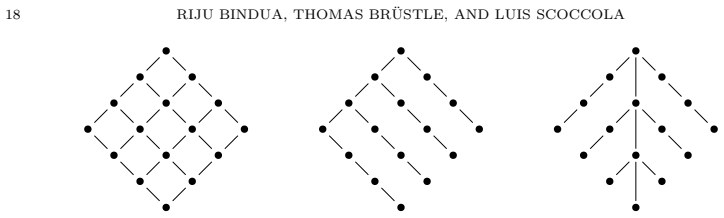
The load-bearing construction is the linearization of a rooted tree quiver over $Q$: a morphism $f: T \to Q$ is turned into a representation $k_T$ by pushing forward the constant representation of $T$, so each vertex of $T$ contributes a basis vector at its image in $Q$. The decomposition is controlled by the elder rule (Proposition 4.3): if two branches glued above the same vertex are comparable in the preorder on rooted tree quivers over $Q$, the smaller branch splits off as a direct summand. Reduced rooted tree quivers are those whose branches form antichains in this preorder; equivalently (Proposition 4.2) they are the ones admitting only the identity endomorphism, and their linearizations are the indecomposables. A gluing operation $G$ assembles rooted tree quivers by adjoining a new root, and representations and morphisms glue the same way.
What would settle it
Exhibit a finite rooted tree quiver $Q$ and a rooted tree module over $Q$ that is not isomorphic to a direct sum of reduced rooted tree modules, or an infinite family of pairwise non-isomorphic reduced rooted tree quivers over $Q$; either would directly contradict Corollary C.
Extended reading notes
Core claim
Let $Q$ be a finite rooted tree quiver, the quiver analogue of a rooted tree poset. The paper establishes two characterisations. First, the representations obtainable as zero-dimensional persistent homology $\mathrm{H}_0$ of a $Q$-indexed filtration are precisely the finite direct sums of linearized rooted tree quivers over $Q$ (Theorem A(1)). Second, the additive closure of this class is precisely the category of finite direct sums of rooted tree modules over $Q$ (Theorem A(2)). The main structural result (Theorem B) says every rooted tree module over a rooted tree quiver splits as a direct sum of reduced rooted tree modules, which are indecomposable; hence the additive closure is of finite type and its indecomposables are these reduced modules (Corollary C). The proof runs through an elder rule for the preorder on rooted tree quivers over $Q$, and the same rule yields algorithms that decompose a linearized tree in $O(|T|^2)$ time and the zero-dimensional persistent homology of a $Q$-filtered graph in $O(|G|^2)$ time (Theorem D).
Load-bearing premise
The classification rests on the claim that, for a fixed finite rooted tree quiver, there are only finitely many reduced rooted tree quivers over it up to isomorphism; the paper states this follows by induction but leaves the induction implicit.
Editorial extensions
If this is right
- Every zero-dimensional persistent homology module indexed by a rooted tree poset has a unique decomposition into reduced rooted tree modules, so the multiset of summands is a well-defined statistic of the filtration.
- The decomposition of a linearized rooted tree and of the $\mathrm{H}_0$ of a filtered graph can be computed in quadratic time, making the classification usable in practice.
- Each morphism between merge trees gives a representation of the target merge tree that decomposes by the same algorithm, providing an invariant of the morphism.
- Restricting a multi-parameter filtration to any rooted tree subposet yields a $\mathrm{H}_0$ module that can be fully decomposed, turning a generally wild problem into a tractable one on the restriction.
Reading between the lines
- Beyond the paper's statements, the multiset of reduced tree summands could serve as a feature vector for tree-indexed clusterings, since the decomposition is unique and computable in quadratic time.
- The elder-rule mechanism suggests a template for other posets: whenever a preorder makes linearized branches form antichains after pruning, the same finite-type conclusion may hold.
- Since the paper notes that higher-degree homology of a finite poset sees all representations, the finite-type phenomenon is specific to degree zero; this marks a boundary worth testing for other homology functors.
Signed reviews
Editorial analysis
A structured set of objections, weighed in public.
Referee Report
Summary. This paper studies the linear representations of a rooted tree quiver Q obtained by applying zero-dimensional persistent homology to Q-indexed filtrations of topological spaces (equivalently, set-valued functors). The main results are: Theorem A characterizes the essential image repH0(Q) as the finite direct sums of linearized rooted tree quivers over Q, and its additive closure as the finite direct sums of rooted tree modules; Theorem B shows every rooted tree module over Q decomposes as a direct sum of reduced rooted tree modules; Corollary C concludes that add(repH0(Q)) is of finite type, with indecomposables precisely the reduced rooted tree modules; and Theorem D provides quadratic-time algorithms for the decomposition. The proofs are built on an inductive description of rooted tree quivers over Q, a preorder ≼_Q, and an explicit elder rule (Proposition 4.3).
Significance. If the results hold, the paper makes a valuable contribution to both representation theory and persistence theory: it identifies a natural subcategory of representations of rooted tree quivers—those arising from zero-dimensional persistent homology—that is of finite type even though the ambient category rep(Q) is generally wild, and it provides a concrete quadratic-time decomposition algorithm. The paper redevelops rather than black-boxes Kinser's theory, proves the elder rule by an explicit isomorphism, and gives correctness proofs by invariant for the algorithms. The finite-type classification and the algorithmic results are concrete and falsifiable, and the connection to merge-tree morphisms in Section 6 indicates useful applications. The main caveats are two proof gaps identified below, both repairable.
major comments (2)
- [Proposition 4.1, proof of (3)⇒(1)] The proof as printed does not establish the implication: it shows only that for each branch i there exist j and n with φ_{i,j,n} nonzero at the root of Q_i, whereas Definition 2.14 requires, for every i and every j, the existence of some n with S^j_i ≼_{Q_i} T^n_i. The missing step is a column-sum argument at the edge σ_i→σ: since the structure maps from σ_i to σ are sums of identity maps, the compatibility condition forces every column of the root matrix of φ at σ_i to have sum equal to the nonzero root scalar λ, hence each column has a nonzero entry. With that argument, induction applies to every j. Because this implication is used in Proposition 4.3, Lemma 4.5, Theorem 4.6, and Theorem A(2), the proof must be corrected.
- [Corollary C] The finite-type conclusion depends on the assertion that there are finitely many isomorphism classes of reduced rooted tree quivers over a fixed Q, but the proof is a single sentence referring to Definition 2.15 and induction. Please spell out the induction: for each vertex x of Q, the fiber of a reduced T at x is, for each child Q_i of x, an antichain in the finite poset of reduced rooted tree quivers over Q_i (finite by induction), and the height of any T is bounded by |Q|; this gives the required finiteness. Without this step the 'finite type' claim in Corollary C is unsupported.
minor comments (6)
- [Lemma 2.3] The phrase 'join x∨y (i.e., greatest lower bound)' is incorrect: the join is the least upper bound; the greatest lower bound is the meet.
- [Definition 2.18] In the second bullet, the lists are denoted N•_1,...,N•_n, but Q has k branches Q_1,...,Q_k; the index should be k.
- [Proof of Theorem A(2)] The sentence 'where d∈N is such that, and note that, if succ^d(x) is the root of Q' is garbled; it should say 'where d is the unique integer such that succ^d(x) is the root of Q'.
- [Proposition 5.1, correctness proof] In the paragraph checking condition (2), the sentence 'If x has no predecessors, then this tree quiver is the trivial rooted tree quiver, and condition (1) is met' appears to refer to condition (2); please correct the cross-reference.
- [Proposition 5.1, invariant condition (3) proof] The reference to 'Definition 2.1' for the preorder ≼ should be to Definition 2.14.
- [Algorithm 3, lines 14–16] The set T^{ℓ+1}_0 is used at ℓ=maxℓ, where it is not defined; clarify that it is empty in that case or adjust the loop bounds.
Circularity Check
The paper's central derivation is self-contained and does not reduce to its own inputs.
full rationale
I traced the main results back along the paper's own proofs. Theorem A(1) is proved from the equivalences between set-valued functors, disjoint unions of rooted tree quivers, and their linearizations (Lemmas 3.5, 3.6, 3.8), not assumed from prior work. Section 4 reproves the needed representation-theoretic facts: Proposition 4.1 gives an inductive proof characterizing the preorder, Proposition 4.3 proves the elder rule with an explicit isomorphism, and Theorem 4.6 proves indecomposability via local endomorphism rings. Theorem B, Corollary C, and Theorem A(2) then follow from these internal results together with the already-proved Theorem A(1). The finiteness step in Corollary C is compressed into one sentence, but it is a finite induction over the inductive definition of rooted tree quivers over Q, using the antichain condition in Definition 2.15; it does not presuppose the conclusion. The proof of Proposition 4.1(3)⇒(1) is terse and arguably under-justified, but under-justification is a proof gap, not circularity, and the cited Kinser results are external and independently formulated rather than being a self-citation chain. Self-citations such as [25] appear only as contextual references for clustering and elder-rule variants and are not load-bearing. No fitted parameter is renamed as a prediction, and no definition is constructed in terms of the target result.
Assumptions & free parameters
assumptions (6)
- standard math Finite-dimensional representations of a finite quiver satisfy the Krull-Schmidt property (unique indecomposable decomposition).
- standard math H0(-;k) is naturally isomorphic to free composed with pi0 on the category of topological spaces with finitely many path components (Lemma 3.7).
- standard math Every functor Q -> set is isomorphic to pi0 of a functor Q -> top given by the discrete topology (Lemma 3.8).
- standard math The quiver representation category rep(Q) is equivalent to the category of functors from the path category of Q to vec (Section 2.3 and Definition 3.1).
- domain assumption Rooted tree quivers are finite, and all representations are finite-dimensional over a fixed field k.
- standard math An object with local endomorphism ring is indecomposable ([2, Corollary I.4.8(a)]).
Cite this review
Pith. "Pith review of Decomposing zero-dimensional persistent homology over rooted tree quivers." pith.science (2026). https://pith.science/paper/3PZQ62KX
@misc{pith2026241119319,
  author       = {Pith},
  title        = {Pith review of: Decomposing zero-dimensional persistent homology over rooted tree quivers},
  year         = {2026},
  howpublished = {\url{https://pith.science/paper/3PZQ62KX}},
  note         = {Machine review of arXiv:2411.19319}
}
read the original abstract
Given a functor from any category into the category of topological spaces, one obtains a linear representation of the category by post-composing the given functor with a homology functor with field coefficients. This construction is fundamental in persistence theory, where it is known as persistent homology, and where the category is typically a poset. Persistence theory is particularly successful when the poset is a finite linearly ordered set, owing to the fact that in this case its category of representations is of finite type. We show that when the poset is a rooted tree poset (a poset with a maximum and whose Hasse diagram is a tree) the additive closure of the category of representations obtainable as zero-dimensional persistent homology is of finite type, and give a quadratic-time algorithm for decomposition into indecomposables. In doing this, we give an algebraic characterization of the additive closure in terms of Ringel's tree modules, and show that its indecomposable objects are the reduced representations of Kinser.
Figures


Figures from the paper (1 more)
Forward citations
Cited by 2 Pith papers
-
Counts and end-curves in two-parameter persistence
In two-parameter persistence, the inclusion-exclusion formula dim(M) - dim(xM) - dim(yM) + dim(xyM) is a positive count equal to the number of birth-curves and death-curves, and it coincides with five prior signed-inv...
-
Rooted tree modules
A rooted tree module over a zero-relation algebra is indecomposable (char K not 2) exactly when the defining tree has no nontrivial idempotent self-map, giving checkable splitting and construction algorithms.
Reference graph
Works this paper leans on
-
[1]
Claire Amiot, Thomas Br¨ ustle, and Eric J. Hanson. Invar iants of persistence modules defined by order- embeddings, 2024
work page 2024
-
[2]
Elements of the representation theory of associative algebras
Ibrahim Assem, Daniel Simson, and Andrzej Skowro´ nski. Elements of the representation theory of associative algebras. Vol. 1 , volume 65 of London Mathematical Society Student Texts . Cambridge University Press, Cambridge, 2006. Techniques of represen tation theory
work page 2006
-
[3]
Botnan, Steffen Oppermann, and Jo han Steen
Ulrich Bauer, Magnus B. Botnan, Steffen Oppermann, and Jo han Steen. Cotorsion torsion triples and the representation theory of filtered hierarchical cluster ing. Advances in Mathematics, 369:107171, 2020
work page 2020
-
[4]
An introductio n to multiparameter persistence
Magnus Bakke Botnan and Michael Lesnick. An introductio n to multiparameter persistence. In Repre- sentations of algebras and related structures , EMS Ser. Congr. Rep., pages 77–150. EMS Press, Berlin, 2023. DECOMPOSING ZERO-DIMENSIONAL HOMOLOGY OVER ROOTED TREE QU IVERS 19
work page 2023
-
[5]
O n the complexity of zero-dimensional multi- parameter persistence, 2020
Jacek Brodzki, Matthew Burfitt, and Mariam Pirashvili. O n the complexity of zero-dimensional multi- parameter persistence, 2020
work page 2020
-
[6]
Coarse nodal count and topological persi stence
Lev Buhovsky, Jordan Payette, Iosif Polterovich, Leoni d Polterovich, Egor Shelukhin, and Vukaˇ sin Stojisavljevi´ c. Coarse nodal count and topological persi stence. J. Eur. Math. Soc. , 2024
work page 2024
-
[7]
Eld er-rule-staircodes for augmented metric spaces
Chen Cai, W oojin Kim, Facundo M´ emoli, and Yusu W ang. Eld er-rule-staircodes for augmented metric spaces. SIAM J. Appl. Algebra Geom. , 5(3):417–454, 2021
work page 2021
-
[8]
Fr´ ed´ eric Chazal, Leonidas J. Guibas, Steve Y. Oudot, and Primoz Skraba. Persistence-based clustering in Riemannian manifolds. J. ACM , 60(6):Art. 41, 38, 2013
work page 2013
Show all 27 references
-
[9]
An introduction to topological data analysis: Fundamental and practical aspects for data scientists
Fr´ ed´ eric Chazal and Bertrand Michel. An introduction to topological data analysis: Fundamental and practical aspects for data scientists. Frontiers in Artificial Intelligence , 4, 2021
2021
-
[10]
The fiber of the persistence map for functi ons on the interval
Justin Curry. The fiber of the persistence map for functi ons on the interval. J. Appl. Comput. Topol. , 2(3-4):301–321, 2018
2018
-
[11]
From trees to barcodes and back again II: Combinatorial and proba bilistic aspects of a topological inverse problem
Justin Curry, Jordan DeSha, Ad´ elie Garin, Kathryn Hes s, Lida Kanari, and Brendan Mallery. From trees to barcodes and back again II: Combinatorial and proba bilistic aspects of a topological inverse problem. Comput. Geom. , 116:Paper No. 102031, 28, 2024
2024
-
[12]
An introduction to quiver representations , volume 184 of Graduate Studies in Mathematics
Harm Derksen and Jerzy W eyman. An introduction to quiver representations , volume 184 of Graduate Studies in Mathematics . American Mathematical Society, Providence, RI, 2017
2017
-
[13]
Herbert Edelsbrunner and John L. Harer. Computational topology . American Mathematical Society, Providence, RI, 2010. An introduction
2010
-
[14]
Escolar and Yasuaki Hiraoka
Emerson G. Escolar and Yasuaki Hiraoka. Persistence mo dules on commutative ladders of finite type. Discrete Comput. Geom. , 55(1):100–157, 2016
2016
-
[15]
Barcodes: the persistent topology of da ta
Robert Ghrist. Barcodes: the persistent topology of da ta. Bull. Amer. Math. Soc. (N.S.) , 45(1):61–75, 2008
2008
-
[16]
A survey of topological machine learning methods
Felix Hensel, Michael Moor, and Bastian Rieck. A survey of topological machine learning methods. Frontiers in Artificial Intelligence , 4, 2021
2021
-
[17]
Reduced representatio ns of rooted trees
Valentin Katter and Nils Mahrt. Reduced representatio ns of rooted trees. J. Algebra , 413:41–49, 2014
2014
-
[18]
Rank functions on rooted tree quivers
Ryan Kinser. Rank functions on rooted tree quivers. Duke Math. J. , 152(1):27–92, 2010
2010
-
[19]
Computing minimal presentations and bigraded Betti numbers of 2-parameter persistent homology
Michael Lesnick and Matthew W right. Computing minimal presentations and bigraded Betti numbers of 2-parameter persistent homology. SIAM J. Appl. Algebra Geom. , 6(2):267–298, 2022
2022
-
[20]
Indecomposable representations of finite ordered sets
Mich` ele Loupias. Indecomposable representations of finite ordered sets. In Representations of algebras (Proc. Internat. Conf., Carleton Univ., Ottawa, Ont., 1974 ),, Lecture Notes in Math., Vol. 488,, pages 201–209. ,, 1975
1974
-
[21]
Steve Y. Oudot. Persistence theory: from quiver representations to data an alysis, volume 209 of Math- ematical Surveys and Monographs . American Mathematical Society, Providence, RI, 2015
2015
-
[22]
Topological persistence in geom- etry and analysis , volume 74 of University Lecture Series
Leonid Polterovich, Daniel Rosen, Karina Samvelyan, a nd Jun Zhang. Topological persistence in geom- etry and analysis , volume 74 of University Lecture Series . American Mathematical Society, Providence, RI, 2020
2020
-
[23]
Exceptional modules are tree mod ules
Claus Michael Ringel. Exceptional modules are tree mod ules. In Proceedings of the Sixth Conference of the International Linear Algebra Society (Chemnitz, 199 6), volume 275/276, pages 471–493, 1998
1998
-
[24]
Distinguished bases of exceptio nal modules
Claus Michael Ringel. Distinguished bases of exceptio nal modules. In Algebras, quivers and represen- tations, volume 8 of Abel Symp. , pages 253–274. Springer, Heidelberg, 2013
2013
-
[25]
Stable and consiste nt density-based clustering via multiparameter persistence
Alexander Rolle and Luis Scoccola. Stable and consiste nt density-based clustering via multiparameter persistence. Journal of Machine Learning Research , 25(258):1–74, 2024
2024
-
[26]
On the Hofer-Zehnder conjecture
Egor Shelukhin. On the Hofer-Zehnder conjecture. Ann. of Math. (2) , 195(3):775–839, 2022
2022
-
[27]
Data structures and network algorithms , volume 44 of CBMS-NSF Regional Conference Series in Applied Mathematics
Robert Endre Tarjan. Data structures and network algorithms , volume 44 of CBMS-NSF Regional Conference Series in Applied Mathematics . Society for Industrial and Applied Mathematics (SIAM), Philadelphia, PA, 1983. Indian Institute of Technology Delhi; New Delhi, India Bishop’...
1983
Reviewed August 12, 2026 · model on record in the stance chip above.
Discussion (0). Continue with ORCID to comment.