REVIEW 4 major objections 4 minor 28 references
Individual plasmonic helix for probing light chirality
T0 review · 4 major / 4 minor · reviewed 2026-08-14 · deepseek-v4-flash
Pith's one-line read One nanohelix on a tiny hole sorts left- and right-spinning light, with measured differential transmission above 0.96 across the telecom band.
desk verdict A strong measured chiral response from a single helix-on-aperture, but the 'background-free local probe' claim is not yet demonstrated. read the letter →
The pith
A machine-rendered reading of the paper's core claim, the machinery that carries it, and where it could break.
The reading
What carries the argument
The carrying object is the helical traveling-wave nanoantenna (HTN): a non-resonant carbon–gold core–shell helix that acts like a wound traveling-wave antenna at telecom wavelengths, engineered on a gold film with a small rectangular aperture at the helix pedestal. The aperture serves as a nanoscale linear polarization filter and local collection point; in collection mode the helix converts the handedness of the incoming circular polarization into a differential coupling through the aperture, while the surrounding opaque film suppresses background. Focused-ion-beam induced deposition and tilted rotating gold sputtering are the fabrication mechanisms that make the individual four-turn helix and the on-tip version possible.
What would settle it
Raster-scan the focused illumination spot across the sample in collection mode and record the transmitted signal as a function of position; measure the same quantity on a control sample that has the aperture but no helix, and on flat gold film. If a comparable signal appears when the beam is displaced from the helix pedestal by about a wavelength, or if the aperture-only control transmits a significant fraction of the power, then the claimed background-free localization is not established.
Extended reading notes
Core claim
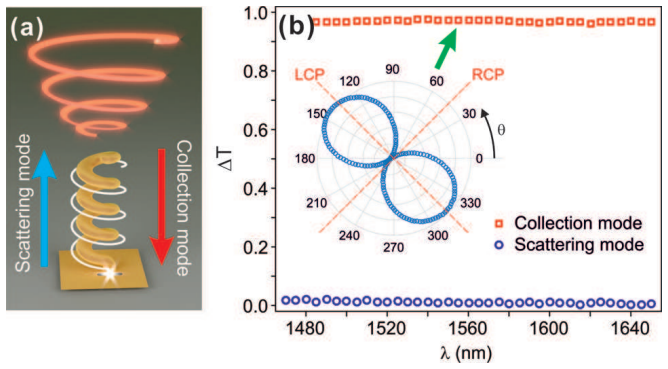
The paper's central claim is that an individual carbon–gold core–shell helix (105-nm carbon core, 25-nm gold coat, 505-nm outer diameter, 1.66-µm high, four turns) coupled to a 370-nm-by-40-nm aperture in a 100-nm gold film behaves as a chiral optical antenna in collection mode. Illuminated from the helix side with circular polarization matching the helix handedness, it transmits light through the aperture into the substrate; illumination with the opposite handedness is blocked. In the calculated response the differential transmission $\Delta T = (T_{\mathrm{LCP}} - T_{\mathrm{RCP}})/(T_{\mathrm{LCP}} + T_{\mathrm{RCP}})$ peaks at 1 near $\lambda = 1.57\,\mu\mathrm{m}$ and stays above 0.99 from 1.48 to 1.7 µm in simulation, while experiment maintains $\Delta T>0.96$ over the available 1.47–1.65 µm range. The paper further claims that the response is spatially localized and background-free, and demonstrates fabrication of the same helix on a near-field tip as a step toward a movable probe.
Load-bearing premise
The claim that the probe is localized and background-free rests on the untested assumption that all collected light passes through the 370-nm-by-40-nm aperture at the helix pedestal, with no contribution from the surrounding gold film or from direct illumination of the detector.
Editorial extensions
If this is right
- A single HTN can determine the handedness of a focused optical field from one subwavelength collection point, without ensemble averaging or additional polarization optics.
- The selectivity is broadband: measured differential transmission $\Delta T>0.96$ from 1.47 to 1.65 µm makes the probe compatible with tunable telecom lasers.
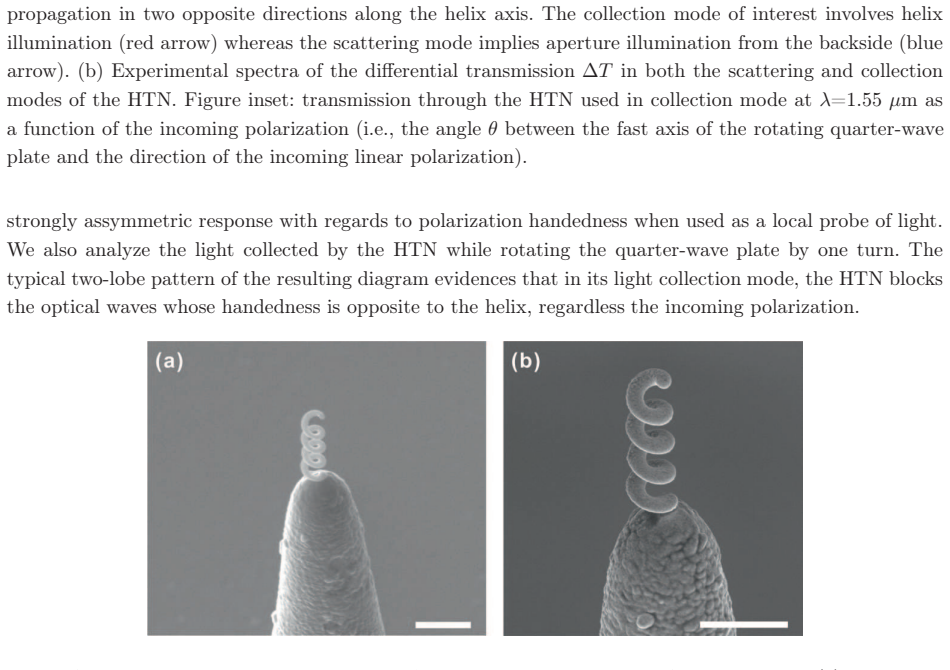
- The same helix can be grown at the apex of a near-field microscope tip, giving a moveable local probe for mapping chiral optical fields.
- Used in reverse (aperture illumination), the structure shows $\Delta T\approx 0$, so the handedness discrimination is tied to the helix–aperture collection process rather than the slot alone.
- The on-tip helix is positioned as a sensor for enantioselective optical forces, extending the probe from light detection to chiroptical mechanics.
Reading between the lines
- A raster-scan of the focused beam across the sample, currently not reported, would directly test the locality claim: if transmission drops to zero once the beam leaves the helix pedestal, the probe is confirmed as truly local.
- Fabricating the mirror-image right-handed helix and checking that $\Delta T$ flips sign would isolate the handedness mechanism from any aperture fabrication asymmetry.
- A resonant downscaled helix on a coaxial aperture, which supports a radially polarized TEM mode, is a concrete route to background-free superchiral-field probing, the resonant extension the paper sketches.
- Built directly onto a photodetector, the HTN could act as a single-pixel circular polarization analyzer, converting handedness into an electrical signal without waveplates or bulk optics.
Signed reviews
Editorial analysis
A structured set of objections, weighed in public.
Referee Report
Summary. The manuscript reports experiments and FDTD simulations on an individual carbon-gold core-shell plasmonic helix coupled to a subwavelength rectangular nanoaperture in a gold film (the 'HTN' configuration). The authors measure the differential transmission ΔT between left and right circularly polarized light in two operating modes: a 'collection mode' in which the helix is nominally illuminated from the top and light is collected through the aperture, and a 'scattering mode' in which the aperture is illuminated from the substrate side. They report ΔT > 0.96 over 1.47–1.65 μm in collection mode and near-zero ΔT in scattering mode, with supporting FDTD simulations predicting ΔT > 0.99 over a broad range. They also demonstrate fabrication of a similar helix on the apex of a scanning near-field microscopy tip. The central claims are that the HTN acts as a spatially localized, background-free, broadband probe of light chirality, and that on-tip integration is feasible.
Significance. If the central claims hold, this work would provide a practical, individual subwavelength element capable of reading out the handedness of circularly polarized light over a broad infrared band, with a path toward integration on a scanning probe tip. The paper's strengths include a direct experimental measurement of differential transmission that is not fitted to any free parameter, a useful negative control in the scattering mode, and a clear demonstration of on-tip fabrication. The measured ΔT > 0.96 in collection mode is an impressive raw result, and the FDTD prediction of a broad high-ΔT band is a falsifiable prediction that the experiment partially corroborates. However, the 'spatially localized' and 'background-free' performance, which is load-bearing for the proposed local-probe application, is not established by the reported measurements; the experimental geometry does not allow selective illumination of the subwavelength helix versus the adjacent aperture, and no background-control measurement is reported.
major comments (4)
- [HTN configuration and Fig. 3(a)] The claim that in collection mode 'the rectangle nano-aperture and the helix are selectively illuminated' cannot hold as stated. The illumination uses a 25X, 0.4 NA objective; at λ ≈ 1.55 μm the Airy diameter is ≈ 4.7 μm and the focal-spot FWHM is ≈ 2 μm, both much larger than the 370×40 nm aperture and the 505-nm-diameter helix, which lie within the same focal spot. Therefore the collection-mode measurement includes direct transmission through the aperture and the surrounding gold film, and no bare-aperture control, spatial scan, or background-leakage measurement is reported. This undermines the paper's central claim that the HTN achieves 'spatially localized, background-free' probing of light chirality.
- [FDTD simulations and Fig. 2] The simulation illuminates the entire HTN with a 2.3-μm-waist Gaussian beam and integrates transmitted power without specifying a collection angle or a spatial filtering procedure. It therefore cannot validate that the experimentally observed signal originates only from the helix–aperture near field rather than from direct aperture transmission. In addition, the simulated structure uses a uniform 25-nm gold coating, whereas the paper's own tomography (Figs. 1b and 1c) shows a non-uniform coating with a partially uncovered underside; the text acknowledges this shadowing effect may spectrally redshift the response. The close agreement between simulation and experiment in ΔT is thus not a validation of the assumed uniform-shell geometry.
- [Experimental methods, Fig. 3(b)] The reported differential transmission spectra ΔT > 0.96 are presented without error bars, replicate counts, or any statistical measure. At each wavelength, the transmission is measured for two QWP orientations only, and no analysis is given of the QWP retardance accuracy, the ellipticity of the generated polarization states, or the sensitivity of ΔT to alignment errors. Without this information, the reader cannot assess the robustness of the claimed bandwidth or the significance of the difference between the collection-mode and scattering-mode curves.
- [Conclusion and 'blocks the other' claim] The abstract and conclusion state that the HTN 'blocks' the opposite circular polarization, but the reported metric is the normalized differential transmission ΔT, which does not convey the absolute transmitted power. If T_LCP and T_RCP are both small, ΔT > 0.96 can coexist with very low overall transmission; the paper reports no absolute transmission efficiency or signal-to-background ratio. The 'background-free' claim in particular needs a quantitative definition and a direct measurement, not just an assertion based on the aperture geometry.
minor comments (4)
- [Throughout] The manuscript contains several typographical errors, including 'assymmetric', 'asymmetric' in the abstract, 'mat spectrally redshift' in the fabrication section, and 'we confirm' lacking a period in the experimental discussion.
- [FDTD simulation parameters] The simulation parameters are not given in the paper but are referred to a prior arXiv preprint [22]; since that preprint is not peer-reviewed or independently accessible in the same way, the key numerical settings (mesh size, boundary conditions, gold dielectric function, pulse details) should be restated in the main text or an appendix.
- [Fig. 3(b) inset] The inset showing transmission versus QWP angle is presented without a scale or numerical values; the 'typical two-lobe pattern' cannot be verified from the figure as reproduced.
- [On-tip integration, Fig. 4] The on-tip demonstration is purely structural (SEM images); no optical or chiroptical characterization of the tip-mounted helix is reported, so the claim that this opens 'the prospect of movable local probes' should be phrased as a fabrication milestone rather than a demonstrated functional probe.
Circularity Check
No significant circularity: the key differential transmission is a measured observable, and the self-cited HTN design is not used to fabricate the result.
full rationale
The central claim is experimental: the differential transmission is defined from measured transmitted intensities at two quarter-wave-plate settings, not from a parameter fitted to the target result. The FDTD simulations use geometrical parameters from the authors' own prior preprint [22], and the HTN concept is attributed to [22], but the paper's headline result of differential transmission larger than 0.96 over 1.47-1.65 micrometers is not derived from that citation; it is a direct measurement reported in Fig. 3(b) and only compared with the independent simulation. No equation reduces the input to the output, no fitted parameter is renamed as a prediction, and no uniqueness theorem is invoked. The 'spatially localized' and 'background-free' characterization is asserted from the subwavelength aperture geometry without a bare-aperture control, spatial scan, or background-leakage measurement; that is a missing experimental control rather than a circular derivation. The self-citation of [22] for the HTN geometry and simulation parameters is a minor, non-load-bearing reliance because the measured transmission asymmetry stands on its own as an experimental observation.
Assumptions & free parameters
assumptions (4)
- domain assumption FDTD solutions of Maxwell's equations with tabulated material permittivities adequately model the fabricated helix-on-aperture device.
- domain assumption The quarter-wave plate produces purely circularly polarized light with known handedness at every wavelength used.
- domain assumption The 370 nm by 40 nm aperture restricts detection to the near field of the helix, making the signal localized and background-free.
- domain assumption The scattering-mode control (ΔT approximately zero) implies the aperture has no handedness selectivity in collection mode.
Cite this review
Pith. "Pith review of Individual plasmonic helix for probing light chirality." pith.science (2026). https://pith.science/paper/3Q2MH2S2
@misc{pith2026190801157,
  author       = {Pith},
  title        = {Pith review of: Individual plasmonic helix for probing light chirality},
  year         = {2026},
  howpublished = {\url{https://pith.science/paper/3Q2MH2S2}},
  note         = {Machine review of arXiv:1908.01157}
}
read the original abstract
We investigate the plasmonic nanohelix as an individual subwavelength element for locally probing light chirality. We show that an hybrid nanoantenna combining a carbon-gold core-shell helix and a plasmonic nanoaperture transmits circularly polarized light with the same handedness as the helix and blocks the other. Such an assymmetric response is spatially localized, spectrally broadband and background-free. Finally, we demonstrate the possibility to engineer an individual plasmonic helix at the apex of a sharp tip typically used in scanning near-field microscopies, thus opening the prospect of moveable local probes for high resolution sensing and mapping of light chirality and chiroptical forces
Figures


Figures from the paper (1 more)
Reference graph
Works this paper leans on
-
[1]
Mario Hentschel, Martin Schäferling, Xiaoyang Duan, Har ald Giessen, and Na Liu. Chiral plasmonics. Sci. Advances, 3(5):e1602735, 2017
work page 2017
-
[2]
Tailoring enhanced optical chirality: design principles for chiral plasmonic nanostr uctures
Martin Schäferling, Daniel Dregely, Mario Hentschel, an d Harald Giessen. Tailoring enhanced optical chirality: design principles for chiral plasmonic nanostr uctures. Phys. Rev. X , 2(3):031010, 2012
work page 2012
-
[3]
Chiral light design and detection inspired by optical antenna theory
Lisa V Poulikakos, Prachi Thureja, Alexia Stollmann, Eva De Leo, and David J Norris. Chiral light design and detection inspired by optical antenna theory. Nano Lett. , 18(8):4633–4640, 2018
work page 2018
-
[4]
Probing t he chiral nature of electromagnetic fields surrounding plasmonic nanostructures
Nina Meinzer, Euan Hendry, and William L Barnes. Probing t he chiral nature of electromagnetic fields surrounding plasmonic nanostructures. Phys. Rev. B , 88(4):041407, 2013
work page 2013
-
[5]
T. Taminiau, R. Moerland, F. Segerink, L. Kuipers, and N. V an Hulst. λ/4 resonance of an optical monopole antenna probes by single molecule fluorescence. Nano Lett. , 7:28, 2007
work page 2007
-
[6]
M. Burresi, D. van Oosten, T. Kampfrath, H. Schoenmaker, R . Heideman, A. Leinse, and L. Kuipers. Probing the magnetic field of light at optical frequencies. Science, 326:550–553, 2009. 6
work page 2009
-
[7]
Mathieu Mivelle, Thomas S van Zanten, and Maria F Garcia-P arajo. Hybrid photonic antennas for subnanometer multicolor localization and nanoimaging of s ingle molecules. Nano Lett. , 14(8):4895– 4900, 2014
work page 2014
-
[8]
N. Murphy-DuBay, L. Wang, E. C. Kinzel, S. M. V. Uppuluri, a nd X. Xu. Nanopatterning using nsom probes integrated with high transmission nanoscale bowtie aperture. Opt. Express , 16(4):2584–2589, 2008
work page 2008
Show all 28 references
-
[9]
Grosjean, I
T. Grosjean, I. A. Ibrahim, M. A. Suarez, G. W. Burr, M. Mive lle, and D. Charraut. Full vectorial imaging of electromagneticlight at subwavelength scale. Opt. Express , 18(6):5809–5824, 2010
2010
-
[10]
Near-field probing of slow bloch modes on photonic crystals with a nanoantenna
Thanh-Phong Vo, M Mivelle, S Callard, A Rahmani, F Baida, D Charraut, A Belarouci, D Nedeljkovic, C Seassal, GW Burr, and T Grosjean. Near-field probing of slow bloch modes on photonic crystals with a nanoantenna. Opt. Express , 20(4):4124–4135, 2012
2012
-
[11]
Plas- monic nanofocusing with a metallic pyramid and an integrate d c-shaped aperture
Nathan C Lindquist, Timothy W Johnson, Prashant Nagpal, David J Norris, and Sang-Hyun Oh. Plas- monic nanofocusing with a metallic pyramid and an integrate d c-shaped aperture. Scientific reports , 3:1857, 2013
2013
-
[12]
Doubly resonant photonic antenna for single infrared quantum dot imaging at telecommunication wavelengths
Zhihua Xie, Yannick Lefier, Miguel Angel Suarez, Mathieu Mivelle, Roland Salut, Jean-Marc Merolla, and Thierry Grosjean. Doubly resonant photonic antenna for single infrared quantum dot imaging at telecommunication wavelengths. Nano Lett. , 17(4):2152–2158, 2017
2017
-
[13]
Optical and infrar ed helical metamaterials
Johannes Kaschke and Martin Wegener. Optical and infrar ed helical metamaterials. Nanophotonics, 5(4):510–523, 2016
2016
-
[14]
Plasmonic nano helix metamaterials with tailorable giant circular dichroism
JG Gibbs, AG Mark, S Eslami, and P Fischer. Plasmonic nano helix metamaterials with tailorable giant circular dichroism. Appl. Phys. Lett. , 103(21):213101, 2013
2013
-
[15]
Nanoscale 3d chiral plasmonic helices with circular dichroism at visible frequencies
Marco Esposito, Vittorianna Tasco, Massimo Cuscuna?, F rancesco Todisco, Alessio Benedetti, Iolena Tarantini, Milena De Giorgi, Daniele Sanvitto, and Adriana Passaseo. Nanoscale 3d chiral plasmonic helices with circular dichroism at visible frequencies. ACS Photon. , 2(1):105–...
2014
-
[16]
Triple-helical nanowires by tomographic rotatory growth for chiral photonics
Marco Esposito, Vittorianna Tasco, Francesco Todisco, Massimo Cuscunà, Alessio Benedetti, Daniele Sanvitto, and Adriana Passaseo. Triple-helical nanowires by tomographic rotatory growth for chiral photonics. Nat. Commun. , 6:6484, 2015
2015
-
[17]
Gold helix pho tonic metamaterial as broadband circular polarizer
Justyna K Gansel, Michael Thiel, Michael S Rill, Manuel D ecker, Klaus Bade, Volker Saile, Georg von Freymann, Stefan Linden, and Martin Wegener. Gold helix pho tonic metamaterial as broadband circular polarizer. Science, 325(5947):1513–1515, 2009
2009
-
[18]
Core– shell plasmonic nanohelices
Dolfine Kosters, Anouk De Hoogh, Hans Zeijlemaker, Hakkı Acar, Nir Rotenberg, and L Kuipers. Core– shell plasmonic nanohelices. ACS photon. , 4(7):1858–1863, 2017
2017
-
[19]
Helical plasmonic nanostructures as prototypical chiral near-field sources
Martin Schäferling, Xinghui Yin, Nader Engheta, and Har ald Giessen. Helical plasmonic nanostructures as prototypical chiral near-field sources. ACS Photon. , 1(6):530–537, 2014
2014
-
[20]
Chiroptical response of a single plasmonic na nohelix
Pawel Wozniak, Israel De Leon, Katja Hoeflich, Caspar Hav erkamp, Silke Christiansen, Gerd Leuchs, and Peter Banzer. Chiroptical response of a single plasmonic na nohelix. Opt. Express , 26(15):19275–19293, 2018
2018
-
[21]
Interaction of light carrying orbital angular momentum with a chiral dipolar sca tterer
Paweł Woźniak, Israel De León, Katja Höflich, Gerd Leuchs , and Peter Banzer. Interaction of light carrying orbital angular momentum with a chiral dipolar sca tterer. Optica, 6(8):961, 2019
2019
-
[22]
Controlling light polarization by swirling surface plasmo ns
Mengjia Wang, Roland Salut, Huihui Lu, Miguel-Angel Sua rez, Nicolas Martin, and Thierry Grosjean. Controlling light polarization by swirling surface plasmo ns. arXiv preprint arXiv:1812.06527 , 2018
2018 arXiv
-
[23]
Nanoscopic control a nd quantification of enantioselective optical forces
Yang Zhao, Amr AE Saleh, Marie Anne Van De Haar, Brian Baum , Justin A Briggs, Alice Lay, Olivia A Reyes-Becerra, and Jennifer A Dionne. Nanoscopic control a nd quantification of enantioselective optical forces. Nat. Nanotechnol., 12(11):1055, 2017. 7
2017
-
[24]
Programm able extreme chirality in the visible by helix-shaped metamaterial platform
Marco Esposito, Vittorianna Tasco, Francesco Todisco, Massimo CuscunÃă, Alessio Benedetti, Mario Scuderi, Giuseppe Nicotra, and Adriana Passaseo. Programm able extreme chirality in the visible by helix-shaped metamaterial platform. Nano Lett. , 16(9):5823–5828, 2016
2016
-
[25]
C.A. Balanis. Antenna theory: analysis and design . John Wiley & Sons, New-York, 1997
1997
-
[26]
Antennas and wave propagation
John D Kraus, Ronald J Marhefka, and Ahmad S Khan. Antennas and wave propagation . Tata McGraw- Hill Education, 2006
2006
-
[27]
Extraordinary transmis- sion through a single coaxial aperture in a thin metal film
Peter Banzer, Jochen Kindler, Susanne Quabis, Ulf Pesch el, and Gerd Leuchs. Extraordinary transmis- sion through a single coaxial aperture in a thin metal film. Opt. Express , 18(10):10896–10904, 2010
2010
-
[28]
Enhanced transmission through subwavelen gth metallic coaxial apertures by excitation of the TEM mode
Fadi I Baida. Enhanced transmission through subwavelen gth metallic coaxial apertures by excitation of the TEM mode. Appl. Phys. B , 89(2-3):145–149, 2007. 8
2007
Reviewed August 14, 2026 · model on record in the stance chip above.
Discussion (0). Continue with ORCID to comment.