Perpendicular rod-airfoil aeroacoustics: experiments and modelling of interaction noise
Pith reviewed 2026-05-22 02:02 UTC · model grok-4.3
The pith
The acoustic field from a perpendicular cylinder interacting with a downstream airfoil is produced by the three-dimensional cylinder wake.
A machine-rendered reading of the paper's core claim, the machinery that carries it, and where it could break.
Core claim
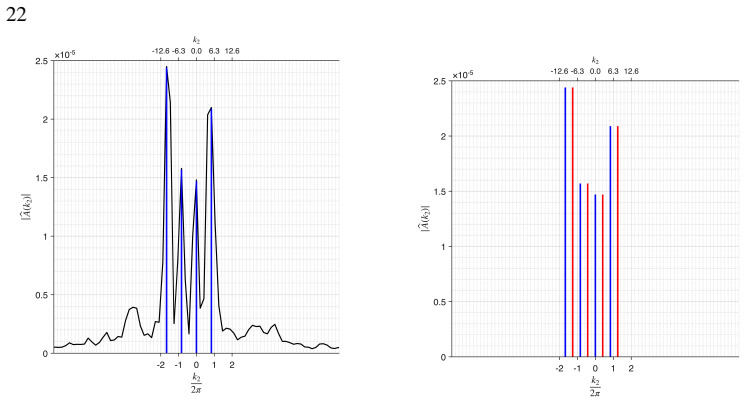
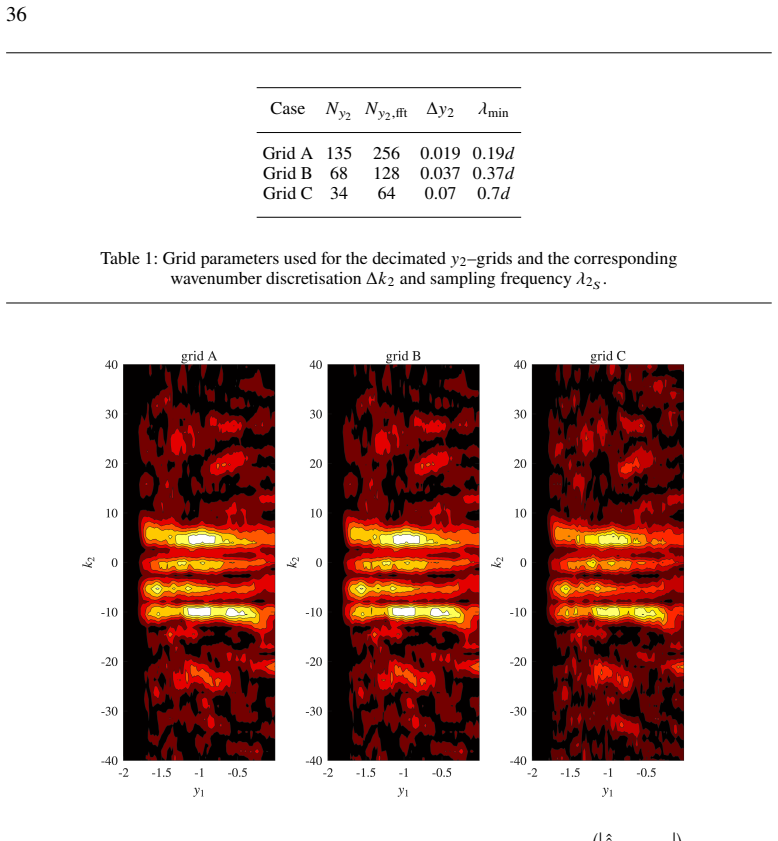
The measured acoustic field is an outcome of the three-dimensional cylinder-wake. Powell-Howe vortex-sound theory combined with an acoustically compact Green function for the NACA-0012 airfoil, supplied with a linearised source-term based on the analysed experimental velocity data, produces sound-field estimates that show reasonable agreement with the measurements. A semi-empirical source-model informed by the experimental data and based on Fourier modes in the cylinder's span direction is proposed to explore the mechanisms of sound generation.
What carries the argument
Linearised source-term derived from experimental velocity data, inserted into Powell-Howe vortex-sound theory with an acoustically compact Green function for the NACA-0012 airfoil.
If this is right
- Peak noise occurs at frequencies close to the cylinder drag-fluctuation Strouhal number of 0.38.
- The three-dimensional wake produces the dominant acoustic field rather than two-dimensional mechanisms.
- The linearised experimental source term can be used to identify acoustically important coherent structures in the flow.
- A Fourier-mode source model along the cylinder span offers a way to explore sound-generation mechanisms without full flow simulation.
Where Pith is reading between the lines
- The same experimental-modelling loop could be applied to other bluff-body and lifting-surface arrangements that produce interaction noise.
- Accounting for spanwise variation in the wake may be necessary in reduced-order models for aircraft high-lift noise.
- If the semi-empirical Fourier source model proves robust, it could support rapid parametric studies of geometry changes for noise control.
Load-bearing premise
The linearised source-term derived from the experimental velocity data is sufficient to capture the dominant sound-generation mechanisms when inserted into the compact Green function for the NACA-0012 airfoil.
What would settle it
A clear mismatch between the modelled and measured sound pressure levels at Strouhal number 0.38 for multiple observer locations would indicate that the linearised source term misses essential three-dimensional mechanisms.
Figures




read the original abstract
During the phase of landing, an important aircraft-noise source emanates from the interaction of the landing-gear wake with the deployed flap. In the present work we cast this problem in an academic framework, by studying a simplified configuration that consists of a cylinder placed upstream and perpendicularly to a symmetrical NACA-0012 airfoil. An experimental campaign is conducted, followed by modelling approaches to explore the flow phenomena associated with the acoustic field. Simultaneous acoustic and stereoscopic Time-Resolved Particle Image Velocimetry measurements are taken, to study the sound and flow-fields generated by the interaction of the cylinder-wake with the downstream airfoil, when the spans of the two objects are orthogonally aligned. The experimental data highlight the three-dimensional nature of the problem. The maximum sound pressure levels are obtained at frequencies close to $St \equiv f d/U = 0.38$ (cylinder's drag fluctuation frequency), where also the maximum linear coherence between the acoustic and cylinder-span-oriented fluctuation velocity is observed, demonstrating that the measured acoustic-field is an outcome of the three-dimensional cylinder-wake. Powell-Howe vortex-sound theory combined with an acoustically compact Green function for the NACA-0012 are employed for the aeroacoustic modelling. A linearised source-term based on the analysed experimental data is used as input to estimate the acoustic field and identify the acoustically important coherent structures of the flow-field. A reasonable agreement is obtained between the sound field estimations and the measurements. To further explore the mechanisms of sound generation, a semi-empirical source-model, informed by the experimental data, is proposed, based on Fourier modes in the cylinder's span direction.
Editorial analysis
A structured set of objections, weighed in public.
Referee Report
Summary. The paper investigates aeroacoustic noise generated by the interaction of a cylinder wake with a downstream perpendicular NACA-0012 airfoil, as a simplified model for landing-gear/flap noise. Simultaneous acoustic measurements and stereoscopic time-resolved PIV are performed to characterize the three-dimensional flow and sound fields. Powell-Howe vortex-sound theory is combined with an acoustically compact Green function for the airfoil; a linearised source term is extracted directly from the measured velocity fluctuations and a semi-empirical spanwise-Fourier-mode model informed by the same data is proposed. The authors report that maximum sound levels and coherence occur near St = 0.38 and that the modeled sound field shows reasonable agreement with measurements, thereby attributing the observed acoustics to the three-dimensional cylinder wake.
Significance. If the modeling assumptions can be placed on a firmer quantitative footing, the work supplies a useful experimental dataset and a practical route to predicting interaction noise in orthogonal rod-airfoil configurations. The simultaneous acoustic-PIV campaign and the identification of acoustically active coherent structures via the source term are clear strengths; the semi-empirical Fourier-mode model offers a compact way to explore parametric dependence once its predictive range is established.
major comments (3)
- [Abstract / Modelling section] Abstract and Modelling section: the statement that 'a reasonable agreement is obtained' is not supported by any quantitative error metric (RMS difference, dB deviation, or frequency-by-frequency correlation). Without these, it is impossible to judge whether residuals lie inside experimental uncertainty or indicate missing physics such as nonlinear wake-airfoil straining.
- [Modelling section] Modelling section: the linearised source term is constructed from the measured velocity fluctuations and inserted into the compact Green function. The manuscript does not demonstrate that nonlinear contributions (local straining at the airfoil leading edge or additional airfoil vortex shedding) remain negligible at St = 0.38; a direct comparison with a nonlinear formulation or a sensitivity test would be required to confirm that the linearised term captures the dominant mechanism.
- [Experimental / Modelling sections] Experimental and Modelling sections: the source term is derived from the identical PIV dataset that informs the semi-empirical Fourier-mode amplitudes. While the underlying Powell-Howe theory is external, the validation would be strengthened by an independent test case or cross-validation to reduce the circular dependence on the specific experimental realization.
minor comments (2)
- [Abstract] The Strouhal-number definition St ≡ f d/U should be accompanied by the numerical values of cylinder diameter d and free-stream velocity U employed throughout the campaign.
- [Throughout] Notation for spanwise Fourier modes and coherence functions should be introduced once and used consistently; a compact table of operating parameters (Re, Mach, cylinder-airfoil spacing) would aid readability.
Simulated Author's Rebuttal
We thank the referee for the thorough and constructive review of our manuscript. We address each major comment point by point below, indicating where revisions will be made to strengthen the paper.
read point-by-point responses
-
Referee: [Abstract / Modelling section] Abstract and Modelling section: the statement that 'a reasonable agreement is obtained' is not supported by any quantitative error metric (RMS difference, dB deviation, or frequency-by-frequency correlation). Without these, it is impossible to judge whether residuals lie inside experimental uncertainty or indicate missing physics such as nonlinear wake-airfoil straining.
Authors: We agree that quantitative error metrics would allow a more rigorous evaluation of the agreement. In the revised manuscript we will report the RMS difference between modeled and measured sound pressure levels, along with frequency-by-frequency correlation coefficients, and compare these values against estimated experimental uncertainties. revision: yes
-
Referee: [Modelling section] Modelling section: the linearised source term is constructed from the measured velocity fluctuations and inserted into the compact Green function. The manuscript does not demonstrate that nonlinear contributions (local straining at the airfoil leading edge or additional airfoil vortex shedding) remain negligible at St = 0.38; a direct comparison with a nonlinear formulation or a sensitivity test would be required to confirm that the linearised term captures the dominant mechanism.
Authors: The linearised Powell-Howe source term is adopted under the low-Mach-number approximation standard for this class of problems. The strong coherence observed between the acoustic pressure and the spanwise velocity fluctuations at St = 0.38 provides supporting evidence that the cylinder-wake structures dominate. In the revision we will add a quantitative estimate of the relative size of nonlinear straining terms using the measured velocity gradients to justify the linearisation. revision: partial
-
Referee: [Experimental / Modelling sections] Experimental and Modelling sections: the source term is derived from the identical PIV dataset that informs the semi-empirical Fourier-mode amplitudes. While the underlying Powell-Howe theory is external, the validation would be strengthened by an independent test case or cross-validation to reduce the circular dependence on the specific experimental realization.
Authors: While the source-term extraction and Fourier-mode amplitudes are derived from the same PIV fields, the acoustic validation is performed against microphone measurements acquired independently of the PIV system. This separation supplies an external check on the modeling. We will clarify this distinction in the revised text and acknowledge that additional independent datasets would further strengthen future work. revision: partial
Circularity Check
No circularity: modeling applies external theory to independent velocity data for validation against separate acoustic measurements
full rationale
The derivation applies Powell-Howe vortex-sound theory together with an acoustically compact Green function for the NACA-0012 to a linearised source term constructed from measured velocity fields; the resulting acoustic-field estimate is then compared with independently acquired acoustic measurements, producing only reasonable agreement. This is a standard validation exercise rather than a reduction by construction. Direct coherence between acoustic pressure and cylinder-span velocity fluctuations at St=0.38 is computed from the raw experimental time series and does not rely on the modeling step. The semi-empirical source model is proposed after the primary comparison and is not used to close the central claim. No self-citation chains, fitted parameters renamed as predictions, or ansatzes smuggled via prior work appear in the reported chain. The paper therefore remains self-contained against external benchmarks.
Axiom & Free-Parameter Ledger
free parameters (1)
- spanwise Fourier mode amplitudes
axioms (2)
- domain assumption Powell-Howe vortex-sound theory applies to the three-dimensional wake-airfoil interaction
- domain assumption NACA-0012 airfoil can be treated as acoustically compact
Lean theorems connected to this paper
-
IndisputableMonolith/Foundation/AlexanderDuality.leanalexander_duality_circle_linking unclear?
unclearRelation between the paper passage and the cited Recognition theorem.
The experimental data highlight the three-dimensional nature of the problem... maximum linear coherence between the acoustic and cylinder-span-oriented fluctuation velocity
-
IndisputableMonolith/Cost/FunctionalEquation.leanwashburn_uniqueness_aczel unclear?
unclearRelation between the paper passage and the cited Recognition theorem.
Powell-Howe vortex-sound theory combined with an acoustically compact Green function... linearised source-term based on the analysed experimental data
What do these tags mean?
- matches
- The paper's claim is directly supported by a theorem in the formal canon.
- supports
- The theorem supports part of the paper's argument, but the paper may add assumptions or extra steps.
- extends
- The paper goes beyond the formal theorem; the theorem is a base layer rather than the whole result.
- uses
- The paper appears to rely on the theorem as machinery.
- contradicts
- The paper's claim conflicts with a theorem or certificate in the canon.
- unclear
- Pith found a possible connection, but the passage is too broad, indirect, or ambiguous to say the theorem truly supports the claim.
Reference graph
Works this paper leans on
-
[1]
10th AIAA/CEAS Aeroacoustics Conference , pages=
An experimental study of gear wake/flap interaction noise , author=. 10th AIAA/CEAS Aeroacoustics Conference , pages=
-
[2]
Koschatzky, V. and Westerweel, J. and Boersma, B. J. , journal=. A study on the application of two different acoustic analogies to experimental. 2011 , publisher=
work page 2011
-
[3]
21st AIAA/CEAS Aeroacoustics Conference , pages=
A comparative study of simulated and measured gear-flap flow interaction , author=. 21st AIAA/CEAS Aeroacoustics Conference , pages=
-
[4]
Proceedings of the Royal Society of London
The influence of solid boundaries upon aerodynamic sound , author=. Proceedings of the Royal Society of London. Series A. Mathematical and Physical Sciences , volume=. 1955 , publisher=
work page 1955
-
[5]
Philosophical Transactions for the Royal Society of London
Sound generation by turbulence and surfaces in arbitrary motion , author=. Philosophical Transactions for the Royal Society of London. Series A, Mathematical and Physical Sciences , pages=. 1969 , publisher=
work page 1969
-
[6]
Journal of Fluid Mechanics , volume=
Contributions to the theory of aerodynamic sound, with application to excess jet noise and the theory of the flute , author=. Journal of Fluid Mechanics , volume=. 1975 , publisher=
work page 1975
-
[7]
Journal of Sound and Vibration , volume=
Noise due to turbulent flow past a trailing edge , author=. Journal of Sound and Vibration , volume=. 1976 , publisher=
work page 1976
-
[8]
Theoretical and Computational Fluid Dynamics , volume=
A new calculus for two-dimensional vortex dynamics , author=. Theoretical and Computational Fluid Dynamics , volume=. 2010 , publisher=
work page 2010
-
[9]
Numerical evaluation of the compact acoustic Green’s function for scattering problems , journal=. 2016 , issn=. doi:https://doi.org/10.1016/j.apm.2015.10.039 , url=
-
[10]
Table of integrals, series, and products , author=. 2014 , publisher=
work page 2014
-
[11]
Acoustics of fluid-structure interactions , author=. 1998 , publisher=
work page 1998
-
[12]
Journal of Fluid Mechanics , author=
The generation of sound by aerodynamic sources in an inhomogeneous steady flow , volume=. Journal of Fluid Mechanics , author=. 1975 , pages=. doi:10.1017/S0022112075000493 , number=
-
[13]
Fletcher, C. A. J. , year=. Computational techniques for fluid dynamics:
- [14]
-
[15]
8th Aeroacoustics Conference , pages=
Rotor-vortex interaction noise , author=. 8th Aeroacoustics Conference , pages=
-
[16]
An experimental investigation of blade-vortex interaction at normal incidence , author=. Journal of Aircraft , volume=
-
[17]
Casalino, D. and Jacob, M. and Roger, M. , journal=. Prediction of rod-airfoil interaction noise using the
-
[18]
Journal of Fluid Mechanics , volume=
Spectral proper orthogonal decomposition and its relationship to dynamic mode decomposition and resolvent analysis , author=. Journal of Fluid Mechanics , volume=. 2018 , publisher=
work page 2018
-
[19]
Abreu, L. I. and Tanarro, A. and Cavalieri, A. V. G. and Schlatter, P. and Vinuesa, R. and Hanifi, A. and Henningson, D. S. , year=. Spanwise-coherent hydrodynamic waves around flat plates and airfoils , volume=. doi:10.1017/jfm.2021.718 , journal=
-
[20]
Nekkanti, A. and Schmidt, O. T. , year=. Frequency–time analysis, low-rank reconstruction and denoising of turbulent flows using. doi:10.1017/jfm.2021.681 , journal=
-
[21]
Cylinder aeroacoustics: experimental study of the influence of cross-section shape on spanwise coherence length , author=. Acta Acustica , volume=. 2023 , publisher=
work page 2023
-
[22]
Barkley, D. and Henderson, R. D. , journal=. Three-dimensional. 1996 , publisher=
work page 1996
-
[23]
The existence of two stages in the transition to three-dimensionality of a cylinder wake , author=. Physics of Fluids , volume=
-
[24]
Williamson, C. H. K. , journal=. Mode. 1996 , publisher=
work page 1996
-
[25]
On secondary vortices in the cylinder wake , author=. Physics of Fluids , volume=. 1996 , publisher=
work page 1996
-
[26]
Margnat, F. and Gloerfelt, X. , journal=. On compressibility assumptions in aeroacoustic integrals:. 2014 , publisher=
work page 2014
-
[27]
Baddoo, P. J. and Ayton, L. J. , booktitle=. The compact
-
[28]
Boudet, J. and Grosjean, N. and Jacob, M. C. , journal=. Wake-airfoil interaction as broadband noise source:. 2005 , publisher=
work page 2005
-
[29]
Journal of Sound and Vibration , volume=
Airfoil gust response and the sound produced by airfoil-vortex interaction , author=. Journal of Sound and Vibration , volume=. 1986 , publisher=
work page 1986
-
[30]
Zehner, P. and Falissard, F. and Gloerfelt, X. , journal=. Aeroacoustic study of the interaction of a rotating blade with a. 2018 , publisher=
work page 2018
-
[31]
Proceedings of the Royal Society of London
Contributions to the theory of sound production by vortex-airfoil interaction, with application to vortices with finite axial velocity defect , author=. Proceedings of the Royal Society of London. A. Mathematical and Physical Sciences , volume=. 1988 , publisher=
work page 1988
-
[32]
A model problem for sound radiation by an installed jet , journal=. 2017 , issn=. doi:https://doi.org/10.1016/j.jsv.2016.12.015 , url=
-
[33]
Applied Mechanics Reviews , volume=
Wave-packet models for jet dynamics and sound radiation , author=. Applied Mechanics Reviews , volume=. 2019 , publisher=
work page 2019
-
[34]
Journal of Fluid Mechanics , volume=
Spanwise-coherent hydrodynamic waves around flat plates and airfoils , author=. Journal of Fluid Mechanics , volume=. 2021 , publisher=
work page 2021
-
[35]
Physical Review Fluids , volume=
Coherent pressure structures in turbulent channel flow , author=. Physical Review Fluids , volume=. 2024 , publisher=
work page 2024
-
[36]
Kaplan, O. and Jordan, P. and Cavalieri, A. V.G. and Brès, G. A. , year=. Nozzle dynamics and wavepackets in turbulent jets , volume=. doi:10.1017/jfm.2021.566 , journal=
- [37]
-
[38]
Demange, S. and Yuan, Z. and Jekosch, S. and Hanifi, A. and Cavalieri, A. V. G. and Sarradj, E. and Kaiser, T. L. and Oberleithner, K. , month = apr, year =. Resolvent model for aeroacoustics of trailing edge noise , volume =. doi:10.1007/s00162-024-00688-z , journal =
-
[39]
Journal of Sound and Vibration , volume=
On vortex--airfoil interaction noise including span-end effects, with application to open-rotor aeroacoustics , author=. Journal of Sound and Vibration , volume=. 2014 , publisher=
work page 2014
-
[40]
Quaglia, M. E. and Léonard, T. and Moreau, S. and Roger, M. , journal=. A 3. 2017 , publisher=
work page 2017
-
[41]
Journal of Fluid Mechanics , volume=
On unsteady surface forces, and sound produced by the normal chopping of a rectilinear vortex , author=. Journal of Fluid Mechanics , volume=. 1989 , publisher=
work page 1989
-
[42]
Prediction of sound generated by a rod–airfoil configuration using. Computers & Fluids , volume=. 2008 , note=. doi:https://doi.org/10.1016/j.compfluid.2007.02.013 , url=
-
[43]
16th AIAA/CEAS Aeroacoustics Conference , pages=
Numerical insight into sound sources of a rod-airfoil flow configuration using direct noise calculation , author=. 16th AIAA/CEAS Aeroacoustics Conference , pages=
-
[44]
17th AIAA/CEAS aeroacoustics conference (32nd AIAA aeroacoustics conference) , pages=
Numerical simulation of broadband noise from airfoil-wake interaction , author=. 17th AIAA/CEAS aeroacoustics conference (32nd AIAA aeroacoustics conference) , pages=
-
[45]
Giret, J.C. and Sengissen, A. and Moreau, S. and Sanjosé, M. and Jouhaud, J. C. , title=. AIAA Journal , volume=. 2015 , doi=
work page 2015
-
[46]
Jiang, Y. and Mao, M. L. and Deng, X. G. and Liu, H. Y. , year=. Numerical investigation on body-wake flow interaction over rod–airfoil configuration , volume=. doi:10.1017/jfm.2015.419 , journal=
-
[47]
Scattering of wavepackets by a flat plate in the vicinity of a turbulent jet , journal=. 2014 , issn=. doi:https://doi.org/10.1016/j.jsv.2014.07.029 , url=
-
[48]
Theoretical and Computational Fluid Dynamics , volume=
Experimentally informed, linear mean-field modelling of circular cylinder aeroacoustics , author=. Theoretical and Computational Fluid Dynamics , volume=. 2025 , publisher=
work page 2025
-
[49]
Physical Review Fluids , volume=
Trailing-edge noise from the scattering of spanwise-coherent structures , author=. Physical Review Fluids , volume=. 2019 , publisher=
work page 2019
-
[50]
Annual Review of Fluid Mechanics , volume=
Wave packets and turbulent jet noise , author=. Annual Review of Fluid Mechanics , volume=. 2013 , publisher=
work page 2013
-
[51]
C. Picard and J. Delville , keywords=. Pressure velocity coupling in a subsonic round jet , journal=. 2000 , issn=. doi:10.1016/S0142-727X(00)00021-7 , url=
-
[52]
Coherent structures driving broadband trailing-edge noise:. Phys. Rev. Fluids , author =. 2026 , pages =. doi:10.1103/kxbq-ynzd , number =
-
[53]
Guide to spectral proper orthogonal decomposition , author=. Aiaa journal , volume=. 2020 , publisher=
work page 2020
- [54]
-
[55]
Journal of Sound and Vibration , volume=
Acoustic radiation from an airfoil in a turbulent stream , author=. Journal of Sound and Vibration , volume=. 1975 , publisher=
work page 1975
-
[56]
Airfoil response to an incompressible skewed gust of small spanwise wave-number , author=. AIAA Journal , volume=
-
[57]
Roger, M. and Moreau, S. , journal=. Back-scattering correction and further extensions of Amiet's trailing-edge noise model. 2005 , publisher=
work page 2005
-
[58]
The Journal of the Acoustical Society of America , volume=
Theory of vortex sound , author=. The Journal of the Acoustical Society of America , volume=. 1964 , publisher=
work page 1964
-
[59]
Journal of Fluid Mechanics , author=
On vortex sound at low Mach number , volume=. Journal of Fluid Mechanics , author=. 1978 , pages=. doi:10.1017/S0022112078000865 , number=
-
[60]
Howe, M. S. , title=. The Quarterly Journal of Mechanics and Applied Mathematics , volume=. 2001 , month=. doi:10.1093/qjmam/54.1.139 , url=
-
[61]
W.Y. Liu , keywords=. A review on wind turbine noise mechanism and de-noising techniques , journal=. 2017 , issn=. doi:https://doi.org/10.1016/j.renene.2017.02.034 , url=
-
[62]
Wang, J. and Wang, K. and Wang, M. , year=. Computational prediction and analysis of rotor noise generation in a turbulent wake , volume=. doi:10.1017/jfm.2020.783 , journal=
-
[63]
Raposo, H. and Azarpeyvand, M. , year=. Turbulence ingestion noise generation in rotating blades , volume=. doi:10.1017/jfm.2024.7 , journal=
-
[64]
Hales, Alistair D.G. and Ayton, L.J. and Jiang, C. and Mahgoub, A. and Kisler, R. and Dixon, R. and de Silva, C. and Moreau, D. and Doolan, C. , year=. A mathematical model for the interaction of anisotropic turbulence with a rigid leading edge , volume=. doi:10.1017/jfm.2023.630 , journal=
-
[65]
Theoretical and Computational Fluid Dynamics , volume=
A rod-airfoil experiment as a benchmark for broadband noise modeling , author=. Theoretical and Computational Fluid Dynamics , volume=. 2005 , publisher=
work page 2005
-
[66]
23rd AIAA/CEAS Aeroacoustics Conference , pages=
A Study on Landing Gear Wake-Flap Interaction Noise , author=. 23rd AIAA/CEAS Aeroacoustics Conference , pages=
-
[67]
Roger, M. and Moreau, S. , year=. Extensions and limitations of analytical airfoil broadband noise models , volume=. International Journal of Aeroacoustics , doi=
-
[68]
Vortex noise of isolated airfoils , author=. Journal of Aircraft , volume=
-
[69]
Journal of Fluid Mechanics , volume=
Sound generation by a two-dimensional circular cylinder in a uniform flow , author=. Journal of Fluid Mechanics , volume=. 2002 , publisher=
work page 2002
-
[70]
Revisiting the frozen gust assumption through the aeroacoustic scattering of wavepackets by a semi-infinite plate , journal =. 2024 , issn =. doi:https://doi.org/10.1016/j.jsv.2023.117989 , url =
- [71]
-
[72]
Perpendicular rod wake/aerofoil interaction: microphone array and. Exp Fluids , author =. 2025 , pages =. doi:10.1007/s00348-025-04149-z , number =
-
[73]
Journal of Fluid Mechanics , volume=
Acoustic wave emitted by a vortex ring passing near the edge of a half-plane , author=. Journal of Fluid Mechanics , volume=. 1985 , publisher=
work page 1985
-
[74]
Aeroacoustics of vortex–wedge interaction , volume =. J. Fluid Mech. , author =. 2025 , pages =. doi:10.1017/jfm.2025.10580 , urldate =
-
[75]
Abreu, L. I. , Tanarro, A. , Cavalieri, A. V. G. , Schlatter, P. , Vinuesa, R. , Hanifi, A. & Henningson, D. S. 2021 Spanwise-coherent hydrodynamic waves around flat plates and airfoils . Journal of Fluid Mechanics 927 , A1
work page 2021
-
[76]
Ahmadi, A. R. 1986 An experimental investigation of blade-vortex interaction at normal incidence . Journal of Aircraft 23 (1), 47--55
work page 1986
-
[77]
Amaral, F. R. , Spiropoulos, M. I. , Margnat, F. , Marx, D. , Valeau, V. & Jordan, P. 2025 Perpendicular rod wake/aerofoil interaction: microphone array and TR - PIV insights via SPOD and beamforming analysis . Exp Fluids 66 (12), 217
work page 2025
-
[78]
1986 Airfoil gust response and the sound produced by airfoil-vortex interaction
Amiet, R.K. 1986 Airfoil gust response and the sound produced by airfoil-vortex interaction . Journal of Sound and Vibration 107 (3), 487--506
work page 1986
-
[79]
Amiet, R. K. 1975 Acoustic radiation from an airfoil in a turbulent stream . Journal of Sound and Vibration 41 (4), 407--420
work page 1975
-
[80]
2011 Fundamentals of Aerodynamics\/
Anderson, J. 2011 Fundamentals of Aerodynamics\/ . McGraw Hill
work page 2011
discussion (0)
Sign in with ORCID, Apple, or X to comment. Anyone can read and Pith papers without signing in.