REVIEW 2 major objections 15 references
Physics Equivariance for Robust Generalization in Wireless Foundation Model
T0 review · 2 major / 0 minor · reviewed 2026-06-30 · grok-4.3
Pith's one-line read Embedding wave equivariance into wireless foundation models improves robustness and generalization under distribution shifts.
desk verdict Wave equivariance as an inductive bias for wireless foundation models is a reasonable direction, but the abstract gives no data to show it delivers the claimed gains. read the letter →
The pith
A machine-rendered reading of the paper's core claim, the machinery that carries it, and where it could break.
The reading
What carries the argument
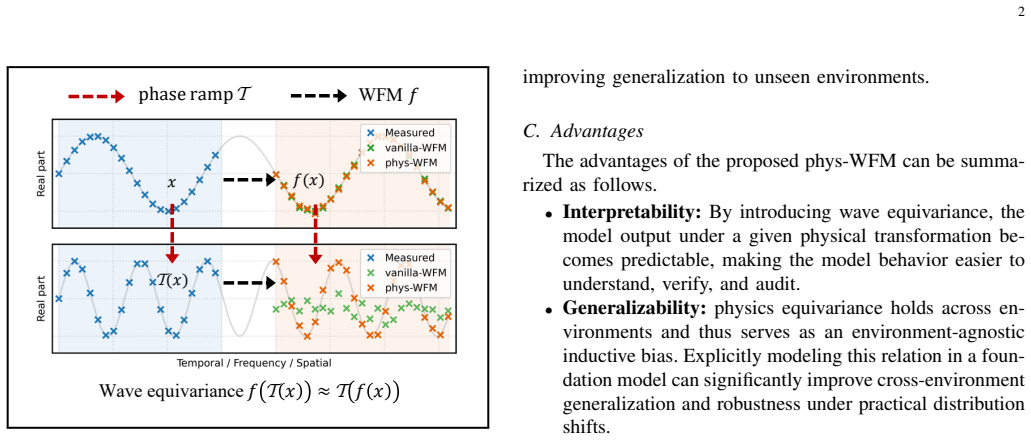
Wave equivariance: the property that when the input CSI is modulated along time-frequency-space dimensions, the output channel response must exhibit the corresponding transformation; it serves as the explicit inductive bias that aligns model behavior with interpretable wave propagation structure.
What would settle it
A controlled comparison in which a model lacking explicit wave-equivariance alignment matches or exceeds the generalization performance of phys-WFM on held-out real-world environments would falsify the claim that the alignment is necessary for the observed robustness gains.
Extended reading notes
Core claim
The central claim is that wave equivariance, defined as the requirement that modulated input CSI produces correspondingly transformed output channel responses, can be explicitly aligned in the model architecture to produce a physics-intrinsic WFM (phys-WFM) that reliably captures electromagnetic propagation structure and thereby improves robustness and generalization to unseen environments under distribution shift, in contrast to vanilla WFMs that do not acquire this property reliably.
Load-bearing premise
Wave equivariance can be explicitly aligned in the model architecture in a way that is both feasible and sufficient to overcome the sim-to-real gap and limited data scale.
Editorial extensions
If this is right
- Vanilla WFMs fail to acquire wave equivariance reliably even with large numbers of parameters and training samples.
- Explicit alignment with wave propagation structure produces measurable gains in robustness to distribution shift between simulated and real environments.
- The resulting models offer a physics-grounded route toward more explainable wireless foundation models.
Reading between the lines
- The same explicit-alignment strategy might be applied to other electromagnetic symmetries such as reciprocity or far-field approximations to further constrain wireless models.
- If wave equivariance proves sufficient, future work could test whether similar physics priors reduce the volume of real-world CSI data needed for acceptable performance.
Editorial analysis
A structured set of objections, weighed in public.
Referee Report
Summary. The paper claims that vanilla wireless foundation models (WFMs) fail to reliably acquire wave equivariance (where input CSI modulated in time-frequency-space yields corresponding output transformations) even at large scale, due to limited data, simulation-dominated training, and the sim-to-real gap. It proposes a physics-intrinsic WFM (phys-WFM) that explicitly aligns model behavior with this electromagnetic propagation property as an inductive bias, asserting that the design captures equivariance and substantially improves robustness and generalization to unseen environments under distribution shift.
Significance. If the empirical claims hold with rigorous validation, the work would be significant for introducing an explainable, physics-grounded inductive bias into WFMs, potentially offering a testable route to better generalization beyond parameter scaling in wireless CSI tasks.
major comments (2)
- [Abstract] Abstract: the central empirical claims—that vanilla-WFM fails to acquire wave equivariance even with large parameters and samples, while phys-WFM substantially improves generalization—are asserted without any metrics, datasets, baselines, or experimental details, making the claims impossible to evaluate.
- [Abstract] Abstract: the assumption that explicit wave-equivariance alignment is both feasible and sufficient to overcome the sim-to-real gap is load-bearing for the main claim, yet the manuscript provides no analysis or evidence addressing whether non-propagation effects (e.g., hardware impairments or measurement noise) dominate the distribution shift.
Simulated Author's Rebuttal
We thank the referee for the thoughtful comments on our manuscript. We address each major comment point-by-point below, with revisions where appropriate to strengthen the presentation.
read point-by-point responses
-
Referee: [Abstract] Abstract: the central empirical claims—that vanilla-WFM fails to acquire wave equivariance even with large parameters and samples, while phys-WFM substantially improves generalization—are asserted without any metrics, datasets, baselines, or experimental details, making the claims impossible to evaluate.
Authors: We agree that the abstract, being a high-level summary, does not include quantitative metrics or experimental details. The full manuscript (Sections 3–5) provides these: equivariance violation metrics (e.g., normalized L2 error under time-frequency-space modulations), datasets (ray-tracing simulations and over-the-air CSI traces from multiple environments), baselines (standard transformer WFMs of varying scales), and generalization results under distribution shift. To make the abstract more self-contained while remaining concise, we will revise it to report key quantitative outcomes, such as the reduction in equivariance error and accuracy gains on unseen environments. revision: yes
-
Referee: [Abstract] Abstract: the assumption that explicit wave-equivariance alignment is both feasible and sufficient to overcome the sim-to-real gap is load-bearing for the main claim, yet the manuscript provides no analysis or evidence addressing whether non-propagation effects (e.g., hardware impairments or measurement noise) dominate the distribution shift.
Authors: The manuscript positions wave equivariance as a fundamental electromagnetic property and demonstrates through controlled experiments that enforcing it as an inductive bias yields measurable gains in robustness to environment shifts. We acknowledge that the current analysis does not isolate the relative contribution of non-propagation effects such as hardware impairments. In the revision we will add a dedicated limitations paragraph discussing these factors and noting that our empirical improvements hold under the evaluated distribution shifts even when such effects are present in the real traces. revision: partial
Circularity Check
No circularity in derivation chain
full rationale
The provided abstract and description contain no equations, parameter-fitting steps presented as predictions, self-citation load-bearing arguments, or ansatzes that reduce claims to inputs by construction. The central proposal (phys-WFM with explicit wave equivariance alignment) is framed as an architectural inductive bias whose effectiveness is asserted via empirical studies, without any visible mathematical reduction or renaming of known results. Absent a derivation chain in the text, the paper is self-contained against the circularity criteria.
Assumptions & free parameters
assumptions (1)
- domain assumption Wave equivariance is a universal propagation property for electromagnetic waves that should be explicitly aligned in the model.
Cite this review
Pith. "Pith review of Physics Equivariance for Robust Generalization in Wireless Foundation Model." pith.science (2026). https://pith.science/paper/3QKIJTIA
@misc{pith2026260628847,
  author       = {Pith},
  title        = {Pith review of: Physics Equivariance for Robust Generalization in Wireless Foundation Model},
  year         = {2026},
  howpublished = {\url{https://pith.science/paper/3QKIJTIA}},
  note         = {Machine review of arXiv:2606.28847}
}
read the original abstract
Wireless foundation models (WFMs) have recently emerged as a promising paradigm for learning multiple channel state information (CSI) acquisition tasks. However, unlike natural language tokens governed by statistical co-occurrence, wireless channels are generated by electromagnetic propagation laws, and current WFM training is constrained by limited data scale, narrow distribution coverage dominated by simulations, and a pronounced sim-to-real gap. As a result, simply scaling model parameters and CSI samples does not necessarily yield robust and generalizable models. In this paper, we advocate enabling physics equivariance as a principled and explainable inductive bias for WFMs. Specifically, we focus on a universal propagation property for electromagnetic waves, termed wave equivariance: when the input CSI is modulated along time-frequency-space dimensions, the output channel response should exhibit the corresponding transformation. Empirical studies show that the vanilla-WFM fails to reliably acquire such equivariance even with a large number of model parameters and training samples. To address this, we design the physics-intrinsic WFM (phys-WFM) with wave equivariance, which explicitly aligns model behaviors with an interpretable wave propagation structure. Results demonstrate that the proposed design effectively captures wave equivariance and substantially improves robustness and generalization to unseen environments under distribution shift, offering a physics-grounded and testable route toward explainable wireless foundation models.
Figures


Figures from the paper (1 more)

Reference graph
Works this paper leans on
-
[1]
A vision of 6G wireless systems: Applications, trends, technologies, and open research problems,
W. Saad, M. Bennis, and M. Chen, “A vision of 6G wireless systems: Applications, trends, technologies, and open research problems,”IEEE Netw., vol. 34, no. 3, pp. 134–142, 2019
work page 2019
-
[2]
Z. Zhang, J. Zhang, Y . Zhang, L. Yu, and G. Liu, “AI-based time-, frequency-, and space-domain channel extrapolation for 6G: Opportuni- ties and challenges,”IEEE V eh. Technol. Mag., vol. 18, no. 1, pp. 29–39, 2023
work page 2023
-
[3]
Scaling Laws for Neural Language Models
J. Kaplan, S. McCandlish, T. Henighan, T. B. Brown, B. Chess, R. Child, S. Gray, A. Radford, J. Wu, and D. Amodei, “Scaling laws for neural language models,”arXiv preprint arXiv:2001.08361, 2020
work page Pith review arXiv 2001
-
[4]
WiFo: Wireless foundation model for channel prediction,
B. Liu, S. Gao, X. Liu, X. Cheng, and L. Yang, “WiFo: Wireless foundation model for channel prediction,”Sci. China Inf. Sci., vol. 68, no. 6, p. 162302, 2025
work page 2025
-
[5]
C. Zhang, X. Lyu, C. Ren, S. Liu, Q. Cui, and X. Tao, “HeterCSI: Channel-adaptive heterogeneous CSI pretraining framework for gener- alized wireless foundation models,”arXiv preprint arXiv:2601.18200, 2026
-
[6]
J. G. Proakis,Digital Signal Processing: Principles, Algorithms, and Applications, 4th ed. Pearson Education India, 2007
work page 2007
-
[7]
Large language models for wireless communications: From adaptation to autonomy,
L. Liang, H. Ye, Y . Sheng, O. Wang, J. Wang, S. Jin, and G. Y . Li, “Large language models for wireless communications: From adaptation to autonomy,”IEEE Commun. Mag., 2026
work page 2026
-
[8]
Study on channel model for frequencies from 0.5 to 100 GHz,
3GPP, “Study on channel model for frequencies from 0.5 to 100 GHz,” 3rd Generation Partnership Project, 3GPP TR 38.901, V17.0.0, 2022
work page 2022
Show all 15 references
-
[9]
Qwen3 technical report,
A. Yang, A. Li, B. Yang, B. Zhang, B. Hui, B. Zheng, B. Yu, C. Gao, C. Huang, C. Lvet al., “Qwen3 technical report,”arXiv preprint arXiv:2505.09388, 2025
2025 arXiv
-
[10]
Attention is all you need,
A. Vaswani, N. Shazeer, N. Parmar, J. Uszkoreit, L. Jones, A. N. Gomez, Ł. Kaiser, and I. Polosukhin, “Attention is all you need,”Adv. Neural Inf. Process. Syst., vol. 30, 2017
2017
-
[11]
Deep learning for fading channel prediction,
W. Jiang and H. D. Schotten, “Deep learning for fading channel prediction,”IEEE Open J. Commun. Soc., vol. 1, pp. 320–332, 2020
2020
-
[12]
Informer: Beyond efficient transformer for long sequence time-series forecasting,
H. Zhou, S. Zhang, J. Peng, S. Zhang, J. Li, H. Xiong, and W. Zhang, “Informer: Beyond efficient transformer for long sequence time-series forecasting,” inProc. AAAI Conf. Artif. Intell., vol. 35, no. 12, 2021, pp. 11 106–11 115
2021
-
[13]
W AIR-D: Wireless AI research dataset,
Y . Huangfu, J. Wang, S. Dai, R. Li, J. Wang, C. Huang, and Z. Zhang, “W AIR-D: Wireless AI research dataset,”arXiv preprint arXiv:2212.02159, 2022
2022
-
[14]
DeepMIMO: A generic deep learning dataset for millimeter wave and massive MIMO applications,
A. Alkhateeb, “DeepMIMO: A generic deep learning dataset for millimeter wave and massive MIMO applications,”arXiv preprint arXiv:1902.06435, 2019
1902 arXiv
-
[15]
Massive MIMO channels with inter-user angle correlation: Open-access dataset, analysis and measurement-based validation,
X. Du and A. Sabharwal, “Massive MIMO channels with inter-user angle correlation: Open-access dataset, analysis and measurement-based validation,”IEEE Trans. V eh. Technol., vol. 71, no. 2, pp. 1602–1616, 2021. Haoyu Wang[S] (wanghy22@mails.tsinghua.edu.cn) received his B.S. d...
2021
Reviewed June 30, 2026 · model on record in the stance chip above.
Discussion (0). Sign in to comment.