REVIEW 3 major objections 4 minor 48 references
The Geometry of Extended Kalman Filters on Manifolds with Affine Connection
T0 review · 3 major / 4 minor · reviewed 2026-08-07 · deepseek-v4-flash
Pith's one-line read The classical EKF on a curved state space is missing two Jacobian corrections, and adding them reduces position and velocity error by 40-60 percent in inertial navigation simulations.
desk verdict Strong geometric filtering theory with a central sign error in the displayed update formulas that contradicts the paper's own simulations; the flaw looks corrigible and the paper deserves peer review. read the letter →
The pith
A machine-rendered reading of the paper's core claim, the machinery that carries it, and where it could break.
The reading
What carries the argument
The machinery is the normal-coordinate system generated by geodesics of the affine connection, together with the two partial pushforwards of the exponential map: $J_2$ differentiates the exponential with respect to the tangent vector and $J_1$ differentiates it with respect to the base point. $J_2$ carries the covariance transformation in Lemma 3.2 and in the reset step, while $J_1$ and $J_2$ together convert the measurement noise covariance into the state chart in the update step. The appendix supplies computable approximations of these transcendental maps using Jacobi field theory: $J_2(\xi_1,\xi_2)[w] = P^{0,1}_\gamma(w + \tfrac{1}{6}R(v,w)v) + o(|v|^3)$ and $J_1(\xi_1,\xi_2)[w] = P^{0,1}_\gamma(w - \tfrac{1}{2}R(v,w)v) + o(|v|^3)$, where $P$ is parallel transport along the connecting geodesic and $R$ is the curvature tensor. This turns the geometric corrections into implementable linear-algebra operations.
What would settle it
Re-run the $\mathrm{SE}_2(3)$ Monte-Carlo benchmark with initial covariance scaled up by one or two orders of magnitude and check whether the geometric EKF keeps its ANEES advantage over the classical EKF in the first seconds; if the advantage shrinks or reverses, the filter is operating outside the regime where Lemma 3.2 is proven. A complementary test is to replace the approximate $J_1,J_2$ expressions with Jacobians obtained by numerically integrating the Jacobi equation, and ask whether the reported gains persist.
Extended reading notes
Core claim
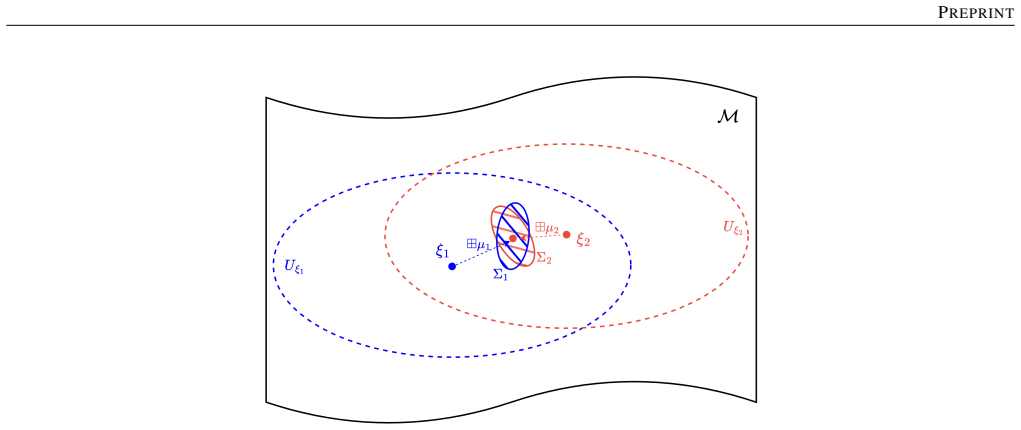
The paper's central claim is that a concentrated Gaussian information state is not invariant under a change of normal coordinate chart in the way the classical EKF implicitly assumes. Moving the reference point from $\xi_1$ to $\xi_2$ while keeping the same underlying distribution over the manifold changes the covariance parameter to $\Sigma_2 = J_2^{-1}(\xi_2,\xi_\diamond)\, J_2(\xi_1,\xi_\diamond)\, \Sigma_1\, J_2^\top(\xi_1,\xi_\diamond)\, J_2^{-\top}(\xi_2,\xi_\diamond)$, and Lemma 3.2 proves this is the concentrated Gaussian closest to the original in Kullback-Leibler divergence up to $\mathcal{O}(\mathrm{tr}(\Sigma_1^2))$. The paper applies the same Jacobian reasoning to the update step, expressing the measurement noise covariance $R_k$ in the normal coordinates of the state estimate, and to the reset step, recentring the posterior covariance at the updated state estimate. In the $\mathrm{SE}_2(3)$ inertial navigation benchmark, the resulting geometric EKF reduces position and velocity RMSE by roughly 40--60 percent relative to the classical EKF, improves the ANEES consistency measure by roughly halving transient overconfidence, and, per the ablation study, only delivers the full gain when update and reset corrections are combined.
Load-bearing premise
The load-bearing premise is that the truncated, second-order coordinate-change formulas of Lemma 3.2 remain accurate when errors and covariances are large, because the paper's largest performance gains occur during the initial transient rather than in the asymptotic regime where the $\mathcal{O}(\mathrm{tr}(\Sigma_1^2))$ error term is small.
Editorial extensions
If this is right
- Any error-state or boxplus EKF that ignores the covariance change under recentring will be overconfident; the geometric corrections directly address that, so the consistency gain is a general consequence of the theory rather than a tuning artifact.
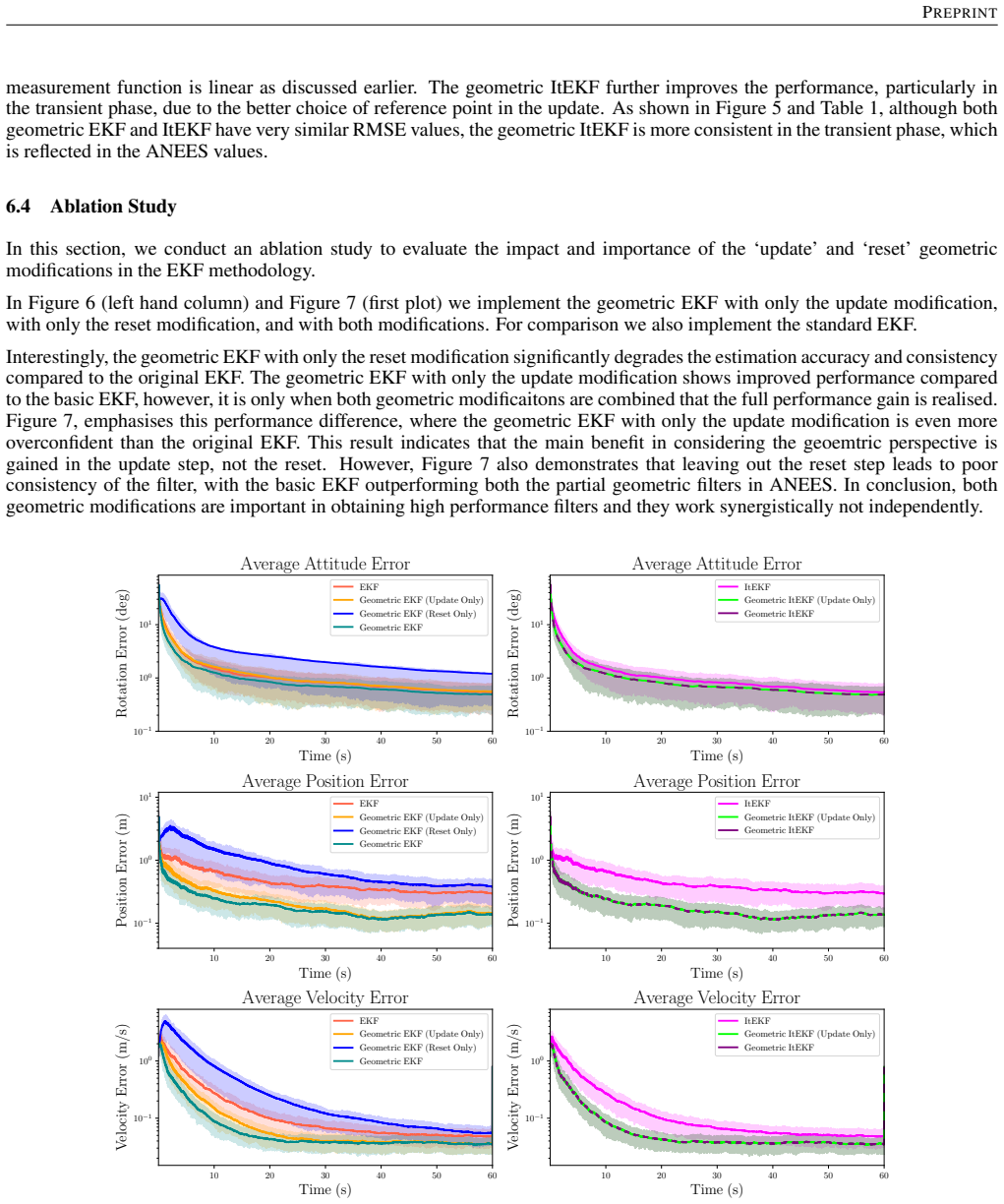
- In the benchmark problem the full geometric EKF reduces transient position RMSE from $0.7226\,\mathrm{m}$ to $0.4168\,\mathrm{m}$ and velocity RMSE from $0.6271\,\mathrm{m/s}$ to $0.3602\,\mathrm{m/s}$ relative to the classical EKF, with smaller but persistent gains in the asymptotic phase.
- The update-step modification alone is beneficial, but the reset-step modification alone is harmful; the two corrections work together, which the paper suggests explains why reset-only schemes in the existing literature have not been adopted by the filter community.
- For the iterated filter, the geometric update correction supplies nearly all the benefit; the full geometric iterated EKF and an update-only geometric iterated EKF perform almost identically, because the iterated update already ends at the best linearisation point and the reset then does little.
- The measurement correction matters even when the output function is linear, because the measurement noise is defined in coordinates around the true output rather than the predicted output; this is why the position and velocity errors, emphasised by the inhomogeneous measurement noise, improve substantially.
Reading between the lines
- An implication the paper leaves implicit is that any boxplus-style error-state filter on a Lie group or homogeneous space carries the same coordinate-dependence, so applying the $J_2$ reset and the $J_1,J_2$ measurement correction could cure known overconfidence of multiplicative and error-state filters even when the prediction model is unchanged.
- The propagation step still approximates the process noise covariance by leaving $Q_{k+1}$ unchanged because the noiseless intermediate state $\xi^\diamond_{k+1}$ is unavailable; a testable extension is to estimate or marginalise over that state and use the full $J_2^{-1}(\hat{\xi}_{k+1|k},\xi^\diamond_{k+1}) Q_{k+1} J_2^{-\top}(\cdot)$ transform, which may give further gains under large process no
- Since Lemma 3.2 is proved only to second order in the covariance, the theory predicts that at sufficiently large initial errors the Jacobian-only corrections should eventually stop helping; if that happens, a second-order or sigma-point variant would be the natural next step rather than a contradiction of the paper's asymptotic claim.
- The coordinate-change formula is a statement about concentrated Gaussian distributions themselves, so the same $J_2$ transformation should transfer to smoothing and information-form estimators on manifolds, not only to filtering.
Editorial analysis
A structured set of objections, weighed in public.
Referee Report
Summary. The paper develops a framework for extended Kalman filtering on smooth manifolds equipped with an affine connection. It defines concentrated Gaussian distributions in normal coordinates, derives a coordinate-change formula (Lemma 3.2) with Jacobian corrections involving the exponential map, and proposes geometric modifications to the propagation, update, and reset steps of the EKF. An iterated variant is also presented. The method is benchmarked on an SE2(3) inertial navigation example with direct pose measurements, reporting improved RMSE and ANEES relative to classical EKF and iterated EKF, with an ablation study separating the contributions of the update and reset modifications. The central formal contribution is the covariance transformation (14) and the associated Jacobian approximations in the appendix.
Significance. If the proposed update and reset formulas were correct, the paper would make a useful contribution to intrinsic state estimation on manifolds. The coordinate-change Lemma 3.2 is a clean and potentially reusable result, and the ablation study is a strength because it isolates the effect of each geometric correction. The paper is also transparent in admitting that the proposed propagation correction is not implementable in its current form. However, the central algorithmic formulas for the update mean appear internally inconsistent: the displayed equations would diverge in a simple Euclidean limit, and the simulations therefore cannot be trusted as evidence for the claimed performance unless the implementation uses different formulas. Because the load-bearing algorithmic claim is affected, the manuscript needs a substantive technical revision before its conclusions can be accepted.
major comments (3)
- [Section 4.4, Eqs. (35)-(37), and Algorithm 1] The posterior-mean formula has the wrong sign and is applied to the wrong innovation. In the Euclidean identity-output limit M = N = R^m, h = identity, one has J1 = J2 = C = I and R-dagger = R; Eq. (35) gives eta(epsilon) = r - epsilon with r = phi_haty(y). Minimizing the quadratic objective (33), (Sigma^{-1} + R^{-1}) epsilon = R^{-1} r, yields epsilon* = K r with K = Sigma (Sigma + R)^{-1}. Equation (37) instead states mu^+ = -K r, which moves the estimate away from the measurement and would cause the filter to diverge. The same sign error appears in Eq. (44) and in the pseudocode of Algorithms 1 and 2. In addition, Eq. (37) applies K to the raw innovation r, whereas consistency with the R-dagger covariance in Eq. (36) requires the transformed innovation J1^{-1}J2 r; the mean and covariance updates therefore do not solve the same quadratic minimization. Since the simulations report good performance, the implementation must differ from the displayed formulas; without code or a corrected derivation, the central algorithmic claim is not verifiable.
- [Section 4.3, Eqs. (30)-(32)] The claimed propagation modification is not actually part of the proposed filter. The corrected process-noise covariance Q-diamond in Eq. (30) depends on the virtual noise-free state xi_diamond_{k+1} = F(xi_k, u_{k+1}), which is unknown at the time of propagation. The text states that the authors do not have a way to overcome this difficulty and that the best approximation is to set Q_{k+1} to approximate Q-diamond_{k+1}; Eq. (32) then uses Q_{k+1} unmodified, and Algorithm 1 contains no propagation correction. The abstract's claim of "novel geometric modifications to the propagation" is therefore not supported by the presented algorithm. The paper should either restrict its contribution claims to the update and reset steps or provide an implementable, error-bounded approximation to Q-diamond rather than abandoning the modification.
- [Lemma 3.2 and Section 6] The central coordinate-change formula (14) is proved only to second order in the covariance, O(tr(Sigma_1^2)), yet the reported performance gains are largest in the initial transient (Table 1 and Figures 4-5), where the covariance and linearization errors are large. The paper provides no bound or numerical evidence that the truncated formula remains accurate outside its asymptotic regime. This is a load-bearing concern because the update and reset steps rely on Eq. (14); the ablation study in Section 6.4 shows that the reset-only variant, which applies the coordinate change without the update correction, degrades performance dramatically. A discussion of the domain of validity of the approximation, or a simulation with a smaller initial covariance, would be needed to support the transient-phase claims.
minor comments (4)
- [Section 5, Eq. (44)] Independently of the sign error, the information term in Eq. (44) appears to use J2^T where the derivation from Eq. (42) and the transformed innovation require J2^{-T}; please verify the matrix transposes and show the intermediate steps.
- [Appendix A and Section 6.2] The implementation of the Jacobians J1 and J2 in the simulation is not described: it is unclear whether exact algebraic formulas for SE(3)/SE2(3) are used or the o(|v|^3) approximations of Lemmas A.1 and A.3. Providing the exact formulas used would substantially improve reproducibility.
- [Section 6.3] The text says the output function (46) is "linear in the state" and hence the geometric ItEKF terminates on the first iteration, but the projection from SE2(3) to SE(3) is not linear in the exponential coordinates used for the error state; please clarify what is meant by linearity here.
- [Throughout] There are several typographical errors and minor inconsistencies, including "Substitude" (Eq. 28), "consistancy" (conclusion), "implmentation" (Section 6.4), and the use of both Q^+ and Q_diamond for the same quantity in Section 4.3; a careful proofreading pass is recommended.
Circularity Check
No significant circularity: the core coordinate-change and EKF update/reset derivations are self-contained and are benchmarked against external algorithms.
full rationale
The central derivation chain is self-contained. Lemma 3.2 derives the transformed concentrated Gaussian parameters (13)--(14) by minimizing the KL divergence of a Gaussian ansatz in the target normal coordinates; the proof computes the actual stationary conditions and uses Theorem 3.1 for covariance propagation, so the result is not assumed by definition. The update formulas (36)--(37) and reset formula (39) are obtained by applying this coordinate-change machinery and standard Gaussian fusion, not by fitting parameters to the simulation outputs. The reset formula is also explicitly attributed to prior external literature (Markley [21], Muller et al. [33,34]) and is a special case of the paper's own Lemma 3.2, so the self-citations [29,32,42] for reset geometry and parallel-transport computation are not load-bearing for the central claim. The benchmark against a classical EKF and an iterated EKF [44] provides external comparison, and the ablation study compares variants of the proposed filter rather than importing the paper's own prior results as evidence. Section 4.3 candidly states that the propagation-side geometric covariance correction is not implemented because the required Jacobian at the virtual state is unavailable ('At the moment, the authors do not have a way to overcome this difficulty'), which is a limitation of the proposed algorithm but not a circular step. A possible algebraic sign inconsistency in Eq. (37) (and mirrored in Eq. (44)) is a correctness concern, not a circularity concern, because it does not make the derivation equivalent to its inputs. Overall, the paper's self-citations are normal background references and the principal derivation stands independently.
Assumptions & free parameters
assumptions (5)
- domain assumption State and output spaces admit affine connections and normal coordinate charts covering the relevant sets.
- domain assumption The information state is well approximated by concentrated Gaussian distributions with small enough covariance for second-order truncations.
- domain assumption Process and measurement noise are zero-mean concentrated Gaussians with known covariances in normal coordinates.
- domain assumption The affine connection is symmetric for the Jacobi-field approximations in Appendix A.
- standard math Standard differential geometry results on geodesics, parallel transport, and Jacobi fields.
invented entities (1)
-
Virtual noise-free propagated state xi^diamond_{k+1} = F(xihat_{k|k}, u_{k+1})
Cite this review
Pith. "Pith review of The Geometry of Extended Kalman Filters on Manifolds with Affine Connection." pith.science (2026). https://pith.science/paper/3QXQKSSC
@misc{pith2026250605728,
  author       = {Pith},
  title        = {Pith review of: The Geometry of Extended Kalman Filters on Manifolds with Affine Connection},
  year         = {2026},
  howpublished = {\url{https://pith.science/paper/3QXQKSSC}},
  note         = {Machine review of arXiv:2506.05728}
}
read the original abstract
The extended Kalman filter (EKF) has been the industry standard for state estimation problems over the past sixty years. The classical formulation of the EKF is posed for nonlinear systems defined on global Euclidean spaces. The design methodology is regularly applied to systems on smooth manifolds by choosing local coordinates, however, it is well known that this approach is not intrinsic to the manifold and performance depends heavily on choosing 'good' coordinates. In this paper, we propose an extended Kalman filter that is adapted to the specific geometry of the manifold in question. We show that an affine connection and the concepts of parallel transport, torsion, and curvature are the key geometric structures that allow the formulation of a suitable family of intrinsic Gaussian-like distributions and provide the tools to understand how to propagate state estimates and fuse measurements. This leads us to propose novel geometric modifications to the propagation and update steps of the EKF and revisit recent work on the geometry of the reset step. The relative performance of the proposed geometric modifications are benchmarked against classical EKF and iterated EKF algorithms on a simplified inertial navigation system with direct pose measurements and no bias.
Figures


Figures from the paper (4 more)



Reference graph
Works this paper leans on
-
[1]
P. S. Maybeck,Stochastic models, estimation, and control. Academic press, 1982
work page 1982
-
[2]
B. D. O. Anderson and J. B. Moore,Optimal Filtering. Dover Publications, May 2012
work page 2012
-
[3]
T. D. Barfoot,State estimation for robotics. Cambridge University Press, 2017
work page 2017
-
[4]
A new approach to linear filtering and prediction problems,
R. E. Kalman, “A new approach to linear filtering and prediction problems,” 1960
1960
-
[5]
G. L. Smith, S. F. Schmidt, and L. A. McGee,Application of statistical filter theory to the optimal estimation of position and velocity on board a circumlunar vehicle. National Aeronautics and Space Administration, 1962
work page 1962
-
[6]
L. A. McGee,Discovery of the Kalman filter as a practical tool for aerospace and industry. National Aeronautics and Space Administration, 1985, vol. 86847
work page 1985
-
[7]
Gelbet al.,Applied optimal estimation
A. Gelbet al.,Applied optimal estimation. MIT press, 1974
1974
-
[8]
A. H. Jazwinski,Stochastic processes and filtering theory. Courier Corporation, 2007
2007
Show all 48 references
-
[9]
Robust extended kalman filtering,
G. A. Einicke and L. B. White, “Robust extended kalman filtering,”IEEE transactions on signal processing, vol. 47, no. 9, pp. 2596–2599, 1999
1999
-
[10]
Unscented filtering and nonlinear estimation,
S. J. Julier and J. K. Uhlmann, “Unscented filtering and nonlinear estimation,”Proceedings of the IEEE, vol. 92, no. 3, pp. 401–422, 2004
2004
-
[11]
Some filtering results in riemann manifolds,
T. E. Duncan, “Some filtering results in riemann manifolds,”Information and Control, vol. 35, no. 3, pp. 182–195, 1977
1977
-
[12]
Kalman filtering for spacecraft attitude estimation,
E. J. Lefferts, F. L. Markley, and M. D. Shuster, “Kalman filtering for spacecraft attitude estimation,”Journal of Guidance, Control, and Dynamics, vol. 5, no. 5, pp. 417–429, 1982. 22 PREPRINT
1982
-
[13]
Nonlinear filtering in riemannian manifolds,
S. Ng and P. Caines, “Nonlinear filtering in riemannian manifolds,”IMA journal of mathematical control and information, vol. 2, no. 1, pp. 25–36, 1985
1985
-
[14]
Integrating generic sensor fusion algorithms with sound state representations through encapsulation of manifolds,
C. Hertzberg, R. Wagner, U. Frese, and L. Schr ¨oder, “Integrating generic sensor fusion algorithms with sound state representations through encapsulation of manifolds,”Information Fusion, vol. 14, no. 1, pp. 57–77, 2013
2013
-
[15]
Extended kalman filter with manifold state representation for navigating a maneuverable melting probe,
J. Clemens and K. Schill, “Extended kalman filter with manifold state representation for navigating a maneuverable melting probe,” in2016 19Th International Conference On Information Fusion (FUSION). IEEE, 2016, pp. 1789–1796
2016
-
[16]
The invariant extended kalman filter as a stable observer,
A. Barrau and S. Bonnabel, “The invariant extended kalman filter as a stable observer,”IEEE Transactions on Automatic Control, vol. 62, no. 4, pp. 1797–1812, 2017
2017
-
[17]
Unscented kalman filtering on riemannian manifolds,
S. Hauberg, F. Lauze, and K. S. Pedersen, “Unscented kalman filtering on riemannian manifolds,”Journal of mathematical imaging and vision, vol. 46, pp. 103–120, 2013
2013
-
[18]
Iterated extended kalman filter based visual-inertial odom- etry using direct photometric feedback,
M. Bloesch, M. Burri, S. Omari, M. Hutter, and R. Siegwart, “Iterated extended kalman filter based visual-inertial odom- etry using direct photometric feedback,”The International Journal of Robotics Research, vol. 36, no. 10, pp. 1053–1072, 2017
2017
-
[19]
On filtering with observation in a manifold: Reduction to a classical filtering problem,
S. Said and J. H. Manton, “On filtering with observation in a manifold: Reduction to a classical filtering problem,”SIAM Journal on Control and Optimization, vol. 51, no. 1, pp. 767–783, 2013
2013
-
[20]
Invariant affine connections on homogeneous spaces,
K. Nomizu, “Invariant affine connections on homogeneous spaces,”American Journal of Mathematics, vol. 76, no. 1, pp. 33–65, 1954
1954
-
[21]
Attitude error representations for kalman filtering,
F. L. Markley, “Attitude error representations for kalman filtering,”Journal of guidance, control, and dynamics, vol. 26, no. 2, pp. 311–317, 2003
2003
-
[22]
Circumventing dynamic modeling: Evaluation of the error-state kalman filter applied to mobile robot localization,
S. Roumeliotis, G. Sukhatme, and G. Bekey, “Circumventing dynamic modeling: Evaluation of the error-state kalman filter applied to mobile robot localization,” inIn Proceedings IEEE International Conference on Robotics and Automation (ICRA1999), vol. 2. IEEE, 1999, pp. 1656–1663
1999
-
[23]
Error propagation on the euclidean group with applications to manipulator kinematics,
Y . Wang and G. S. Chirikjian, “Error propagation on the euclidean group with applications to manipulator kinematics,” IEEE Transactions on Robotics, vol. 22, no. 4, pp. 591–602, 2006
2006
-
[24]
The banana distribution is gaussian: A localization study with exponential coordinates,
A. W. Long, K. C. Wolfe, M. J. Mashner, G. S. Chirikjianet al., “The banana distribution is gaussian: A localization study with exponential coordinates,”Robotics: Science and Systems VIII, vol. 265, 2013
2013
-
[25]
Left-invariant extended kalman filter and attitude estimation,
S. Bonnabel, “Left-invariant extended kalman filter and attitude estimation,” in2007 46th IEEE Conference on Decision and Control, 2007, pp. 1027–1032
2007
-
[26]
Invariant extended kalman filter: theory and application to a velocity-aided attitude estimation problem,
S. Bonnable, P. Martin, and E. Sala¨un, “Invariant extended kalman filter: theory and application to a velocity-aided attitude estimation problem,” inProceedings of the 48h IEEE Conference on Decision and Control (CDC) held jointly with 2009 28th Chinese Control Conference, 20...
2009
-
[27]
Equivariant systems theory and observer design,
R. Mahony, T. Hamel, and J. Trumpf, “Equivariant systems theory and observer design,”arXiv preprint arXiv:2006.08276, 2020
2006 arXiv
-
[28]
Equivariant filter (eqf),
P. van Goor, T. Hamel, and R. Mahony, “Equivariant filter (eqf),”IEEE Transactions on Automatic Control, 2022
2022
-
[29]
Equivariant filter design for discrete-time systems,
Y . Ge, P. van Goor, and R. Mahony, “Equivariant filter design for discrete-time systems,” in2022 IEEE 61st Conference on Decision and Control (CDC). IEEE, 2022, pp. 1243–1250
2022
-
[30]
Bayesian fusion on lie groups,
K. C. Wolfe and M. Mashner, “Bayesian fusion on lie groups,”Journal of Algebraic Statistics, vol. 2, no. 1, 2011
2011
-
[31]
Continuous-discrete extended kalman filter on matrix lie groups using concentrated gaussian distributions,
G. Bourmaud, R. M ´egret, M. Arnaudon, and A. Giremus, “Continuous-discrete extended kalman filter on matrix lie groups using concentrated gaussian distributions,”Journal of Mathematical Imaging and Vision, vol. 51, no. 1, pp. 209–228, Jan 2015
2015
-
[32]
A geometric perspective on fusing gaussian distributions on lie groups,
Y . Ge, P. van Goor, and R. Mahony, “A geometric perspective on fusing gaussian distributions on lie groups,”IEEE Control Systems Letters, vol. 8, pp. 844–849, 2024
2024
-
[33]
Covariance correction step for kalman filtering with an attitude,
M. W. Mueller, M. Hehn, and R. D’Andrea, “Covariance correction step for kalman filtering with an attitude,”Journal of Guidance, Control, and Dynamics, vol. 40, no. 9, pp. 2301–2306, 2017
2017
-
[34]
Full-order solution to the attitude reset problem for kalman filtering of atti- tudes,
R. Gill, M. W. Mueller, and R. D’Andrea, “Full-order solution to the attitude reset problem for kalman filtering of atti- tudes,”Journal of Guidance, Control, and Dynamics, vol. 43, no. 7, pp. 1232–1246, 2020
2020
-
[35]
J. M. Lee and J. M. Lee,Smooth manifolds. Springer, 2012
2012
-
[36]
J. M. Lee,Introduction to Riemannian manifolds. Springer, 2018, vol. 2
2018
-
[37]
G. S. Chirikjian,Stochastic Models, Information Theory, and Lie Groups, Volume 2: Analytic Methods and Modern Applications. Springer, 2011
2011
-
[38]
Lang,Fundamentals of differential geometry
S. Lang,Fundamentals of differential geometry. Springer Science & Business Media, 2012, vol. 191
2012
-
[39]
A framework for sparse, non-linear least squares problems on manifolds
A. auf Mannigfaltigkeiten and C. Hertzberg, “A framework for sparse, non-linear least squares problems on manifolds.” 23 PREPRINT
-
[40]
A closed formula for the riemann normal coordinate expansion,
U. M ¨uller, C. Schubert, and A. van de Ven, “A closed formula for the riemann normal coordinate expansion,”arXiv preprint gr-qc/9712092, 1997
1997 arXiv
-
[41]
Quaternion kinematics for the error-state kalman filter,
J. Sola, “Quaternion kinematics for the error-state kalman filter,”arXiv preprint arXiv:1711.02508, 2017
2017 arXiv
-
[42]
Observer design for nonlinear systems with equivariance,
R. Mahony, P. van Goor, and T. Hamel, “Observer design for nonlinear systems with equivariance,”Annual Review of Control, Robotics, and Autonomous Systems, vol. 5, no. 1, p. null, 2022. [Online]. Available: https://doi.org/10.1146/annurev-control-061520-010324
2022 doi
-
[43]
Convergence and consistency analysis for extended kalman filter based slam,
S. Huang and G. Dissanayake, “Convergence and consistency analysis for extended kalman filter based slam,”IEEE Transactions on robotics, vol. 23, no. 5, pp. 1036–1049, 2007
2007
-
[44]
The iterated kalman filter update as a gauss-newton method,
B. M. Bell and F. W. Cathey, “The iterated kalman filter update as a gauss-newton method,”IEEE Transactions on Automatic Control, vol. 38, no. 2, pp. 294–297, 1993
1993
-
[45]
A note on the extended kalman filter on a manifold,
Y . Ge, P. Van Goor, and R. Mahony, “A note on the extended kalman filter on a manifold,” in2023 62nd IEEE Conference on Decision and Control (CDC). IEEE, 2023, pp. 7687–7694
2023
-
[46]
Evaluation of estimation algorithms: Credibility tests,
X. R. Li, Z. Zhao, and X.-B. Li, “Evaluation of estimation algorithms: Credibility tests,”IEEE Transactions on Systems, Man, and Cybernetics-Part A: Systems and Humans, vol. 42, no. 1, pp. 147–163, 2011
2011
-
[47]
Helgason,Differential geometry, Lie groups, and symmetric spaces
S. Helgason,Differential geometry, Lie groups, and symmetric spaces. Academic press, 1979
1979
-
[48]
Geometric wave equations,
S. Waldmann, “Geometric wave equations,”arXiv preprint arXiv:1208.4706, 2012. 24
2012 arXiv
Reviewed August 7, 2026 · model on record in the stance chip above.
Discussion (0). Sign in to comment.