REVIEW 2 major objections 5 minor 14 references
On the number of gaps of sequences with Poissonian Pair Correlations
T0 review · 2 major / 5 minor · reviewed 2026-08-14 · deepseek-v4-flash
Pith's one-line read The paper proves two gap-statistics theorems for Poissonian pair-correlation sequences: the maximal gap multiplicity is $o(n)$, and for every $f(n)\to\infty$ a Poissonian sequence with at most $f(n)$ distinct gap lengths exists.
desk verdict Strong new results; proof gaps in Claim 2 and Claim 4 are repairable but must be fixed. read the letter →
The pith
A machine-rendered reading of the paper's core claim, the machinery that carries it, and where it could break.
The reading
What carries the argument
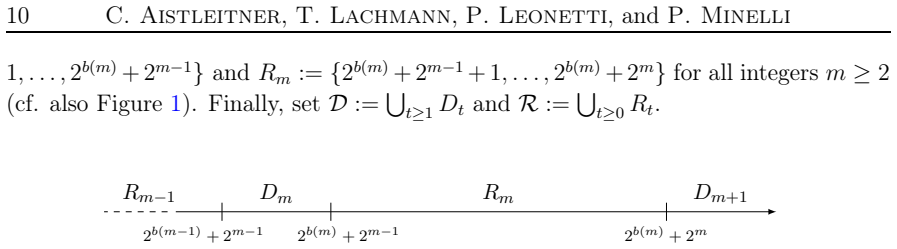
The central mechanism is a two-scale dyadic-grid construction. Random blocks $(X_i)$ are independent uniform draws from the grids $A_m=\{j/2^{m+a(m)}\}$, and deterministic blocks $(Y_{m,j})$ are the new points $C_m=B_m\setminus B_{m-1}$ of the coarser dyadic grids $B_m=\{j/2^{b(m)}\}$, inserted between random blocks. The random blocks supply Poissonian pair correlations through expectation and variance estimates followed by a standard almost-sure convergence lemma; the deterministic blocks control the gap count through the sandwich $B_{m-1}\subseteq\{Z_1,\ldots,Z_n\}\subseteq A_m$, which bounds the number of gap lengths by a power of two governed by the prescribed gap function $h(n)=\lfloor\log_2 q(n)\rfloor$.
What would settle it
A direct refutation of Theorem 1.2 would be a Poissonian sequence with a subsequence on which some single gap length occurs at least $cn$ times for a fixed $c>0$; no such sequence can exist if the theorem is right. For the construction, computing the true covariance between pair indicators that share an index would decide whether the claimed concentration genuinely holds.
Extended reading notes
Core claim
The central discovery is that Poissonian pair correlations impose a very mild constraint on gap-length statistics. Theorem 1.2 shows that if a sequence has Poissonian pair correlations, then $\max_{i\le g(n)}\phi_{n,i}=o(n)$; since at least one gap length must occur at least $n/g(n)$ times, the total number of distinct gap lengths $g(n)$ tends to infinity. Theorem 1.4 shows this is essentially the only constraint: for any function $f(n)\to\infty$ one can construct a sequence $(x_n)$ with Poissonian pair correlations and $g(n)\le f(n)$ for all sufficiently large $n$. The construction interleaves deterministic dyadic grid points, which keep the gap set small, with random dyadic grid points, which force the Poissonian pair-correlation statistics. The second theorem answers the open question negatively, while the first shows the limitation is real: the gap count must still tend to infinity.
Load-bearing premise
The proof needs the random blocks' pair counts to sit very close to their averages for almost every outcome; the written variance estimate treats every pair of indicators as independent even when the pairs share an index, and without that concentration the almost-sure Poissonian step collapses.
Editorial extensions
If this is right
- For every sequence with Poissonian pair correlations, the maximum multiplicity of a neighboring gap length is $o(n)$; since $g(n)\ge n/\max_{i\le g(n)}\phi_{n,i}$, the number of distinct gap lengths tends to infinity.
- Combined with the Three Gap Theorem, this implies that no sequence of the form $(\{n\alpha\})$ has Poissonian pair correlations, because such a sequence has at most three gap lengths and therefore a gap multiplicity at least $n/3$.
- There is no universal slowly growing lower bound on $g(n)$: for every $f(n)\to\infty$ there is a Poissonian sequence with $g(n)\le f(n)$ for all large $n$, answering the open question negatively.
- The constructed sequences show that the typical behavior of almost all sequences, which have all $n$ adjacent gaps distinct, is not a necessary feature of Poissonian pair correlations.
Reading between the lines
- Beyond the paper, a natural next step is to make the construction explicit: the proof is probabilistic and yields almost-sure existence, so a deterministic version of the dyadic-block construction would turn the existence result into a concrete sequence.
- The two-scale grid suggests a quantitative tradeoff between the prescribed gap bound and the denominator growth of the random blocks; one could ask how fast $a(m)$ and $b(m)$ must grow as a function of $f$.
- The proof of $\max \phi_{n,i}=o(n)$ is by contradiction and gives no rate; extracting a quantitative rate would connect these gap statistics to discrepancy-type estimates for Poissonian sequences.
Signed reviews
Editorial analysis
A structured set of objections, weighed in public.
Referee Report
Summary. The paper studies the number of distinct gap lengths between neighboring elements of the first N terms of a sequence on the torus, under the assumption that the sequence has Poissonian pair correlations (PPC). The authors prove two main results. Theorem 1.2 improves a previous result by showing that the maximum multiplicity among neighboring gap lengths is o(n) for every PPC sequence. Theorem 1.4 answers a question of Larcher negatively: for every function f with f(n) -> infinity, there exists a sequence with PPC such that the number of distinct gap lengths g(n) is at most f(n) for all sufficiently large n. The proof of Theorem 1.4 constructs a random sequence consisting of independent random variables supported on dyadic grids, interleaved with deterministic blocks, and shows that almost surely the combined sequence has PPC while having few distinct gap lengths.
Significance. If both theorems are correct, the paper settles Larcher's Question 1.3 in the negative and provides a sharp necessary condition (max multiplicity o(n)) for PPC. The construction is original and the deterministic-block/random-block technique is a natural and potentially reusable tool. The proof of Theorem 1.2 is clean and self-contained. The main probabilistic construction in Theorem 1.4 is conceptually sound, and the overall structure of the estimates is plausible. However, as written, the proof of Theorem 1.4 contains two load-bearing gaps: the variance bound in Claim 2 rests on a false independence assertion, and the interpolation in Claim 4 fails for N near M^2. Both appear repairable, but the current manuscript does not establish Theorem 1.4 as written.
major comments (2)
- [Section 3, Claim 2] The proof asserts that the indicator random variables 1_{[-s/y_N,s/y_N]}(X_{i1}-X_{j1}) and 1_{[-s/y_N,s/y_N]}(X_{i2}-X_{j2}) are independent for all distinct pairs (i1,j1) and (i2,j2), citing [6, Corollary 272L]. This is false when the two pairs share an index, e.g., h(X_1-X_2) and h(X_1-X_3) are both functions of X_1 and are not independent. Consequently, the displayed identity Var[Ftilde_{X,y,N}(s)] = (4/N^2) Var(sum ...) does not reduce to the sum of individual variances; covariance terms are omitted. The claimed bound Var[Ftilde_{X,y,N}(s)] << 1/N is therefore not established. This bound is exactly what Claim 3 uses via Chebyshev's inequality and Borel-Cantelli to obtain almost sure PPC along square indices, so the central probabilistic input for Theorem 1.4 is missing as written. A covariance or Hoeffding-type decomposition is needed.
- [Section 3, Claim 4] The interpolation step from square-index PPC to full PPC contains an invalid inequality for N between M^2 and w_{(M+1)^2} = (M+1)^2 - (M+1) = M^2+M. In the displayed chain, the upper bound uses Ftilde_{X,w,(M+1)^2}(s) = (1/(M+1)^2) #{ |Xi-Xj| <= s/w_{(M+1)^2} }. For N in [M^2+1, M^2+M], we have w_{(M+1)^2} > N, so s/w_{(M+1)^2} < s/N and the count with the smaller threshold is not an upper bound for F_{X,N}(s). Thus the right-hand inequality in Claim 4 fails for such N. The passage from the almost sure limits at square indices to the full limit F_{X,N}(s) -> 2s is therefore not established as written. This is a separate but also load-bearing gap; the argument needs a different comparison, for example using two-sided bounds with both v and w at appropriately chosen indices.
minor comments (5)
- [Abstract] The phrase 'gap len gths' contains a typo and should read 'gap lengths'.
- [Section 3, Claim 2] In the sentence 'the last O(1) comes the fact that ...', the word 'from' is missing; it should read 'comes from the fact that'.
- [Section 3, Claim 6] The name 'Cauchy–Schwartz' should be 'Cauchy–Schwarz'.
- [Section 3, Claim 7] The inclusion B_{m-1} \subseteq {Z_1(ω), ..., Z_n(ω)} \subseteq A_m is asserted without proof; a one-sentence justification that the deterministic blocks up to m are contained in B_m and that B_m \subseteq A_m under the chosen a and b would improve readability.
- [Section 2, proof of Theorem 1.2] In the sentence 'there would exist t \in N+ such that ...', the expression 'there would exist t' should be 'there would exist a t' or 'there exists t' for grammatical correctness.
Circularity Check
No significant circularity: the construction and estimates are self-contained.
full rationale
The paper proves Theorem 1.2 by contradiction from the PPC definition, and Theorem 1.4 by an explicit random/deterministic construction. The expected-value and variance estimates are derived from the stated probabilistic model; the gap bound comes from explicit inclusions B_{m-1} subset {Z_1,...,Z_n} subset A_m with known grid spacings. No parameter is fitted to the target conclusions, no target-defining normalization is imported, and the few citations to prior work (e.g., Fremlin's measure theory, Larcher-Stockinger's earlier results) are background or standard external facts rather than substitutes for the derivation. The reader's-flag concerns about the pairwise-independence assertion in Claim 2 and the interpolation step in Claim 4 are proof-correctness gaps, not circularity: even if those estimates fail as written, the construction is not defined in terms of the desired PPC or gap bounds, so the claimed results do not reduce to their own inputs.
Assumptions & free parameters
free parameters (2)
- a(m) =
ceil(h(m)/2)
- b(m) =
m+1 - floor(h(m+1)/2)
assumptions (4)
- domain assumption A countably additive probability space supports the jointly independent random variables X_i with uniform distributions on the grids A_m.
- standard math Chebyshev's inequality and the first Borel-Cantelli lemma apply to the sequence Z_N = Ftilde_{X,N^2}(s)-2s.
- standard math Fremlin Corollary 272L, as cited, gives independence of functions of independent random variables with disjoint index sets.
- standard math For a fixed N and sequence x, the function s -> F_{x,N}(s) is non-decreasing, so convergence on a dense set of s suffices.
Cite this review
Pith. "Pith review of On the number of gaps of sequences with Poissonian Pair Correlations." pith.science (2026). https://pith.science/paper/3R75ZOC2
@misc{pith2026190806292,
  author       = {Pith},
  title        = {Pith review of: On the number of gaps of sequences with Poissonian Pair Correlations},
  year         = {2026},
  howpublished = {\url{https://pith.science/paper/3R75ZOC2}},
  note         = {Machine review of arXiv:1908.06292}
}
abstract
A sequence $(x_n)$ on the torus is said to have Poissonian pair correlations if $\# \{1\le i\neq j\le N: |x_i-x_j| \le s/N\}=2sN(1+o(1))$ for all reals $s>0$, as $N\to \infty$. It is known that, if $(x_n)$ has Poissonian pair correlations, then the number $g(n)$ of different gap lengths between neighboring elements of $\{x_1,\ldots,x_n\}$ cannot be bounded along every index subsequence $(n_t)$. First, we improve this by showing that the maximum among the multiplicities of the neighboring gap lengths of $\{x_1,\ldots,x_n\}$ is $o(n)$, as $n\to \infty$. Furthermore, we show that, for every function $f: \mathbf{N}^+\to \mathbf{N}^+$ with $\lim_n f(n)=\infty$, there exists a sequence $(x_n)$ with Poissonian pair correlations and such that $g(n) \le f(n)$ for all sufficiently large $n$. This answers negatively a question posed by G. Larcher.
Figures
Reference graph
Works this paper leans on
-
[1]
I. Aichinger, C. Aistleitner, and G. Larcher, On quasi-energy-spectra, pair correlations of sequences and additive combinatorics , Contemporary computational mathematics—a celebration of the 80th birthday of Ian Sloan. Vol. 1, 2, Springer, Cham, 2018, pp. 1– 16
work page 2018
-
[2]
C. Aistleitner, T. Lachmann, and F. Pausinger, Pair correlations and equidistribution , J. Number Theory 182 (2018), 206–220
work page 2018
-
[3]
C. Aistleitner, G. Larcher, and M. Lewko, Additive energy and the Hausdorff dimension of the exceptional set in metric pair correlation problems , Israel J. Math. 222 (2017), no. 1, 463–485, With an appendix by Jean Bourgain
work page 2017
- [4]
-
[5]
, The two-point correlation function of the fractional parts of √n is Poisson , Proc. Amer. Math. Soc. 143 (2015), no. 7, 2815–2828
work page 2015
-
[6]
D. H. Fremlin, Measure theory. Vol. 2 , Torres Fremlin, Colchester, 2003, Broad foundations, Corrected second printing of the 2001 original. Gaps and Poissonian Pair Correlations 13
work page 2003
-
[7]
S. Grepstad and G. Larcher, On pair correlation and discrepancy , Arch. Math. (Basel) 109 (2017), no. 2, 143–149
work page 2017
-
[9]
G. Larcher and W. Stockinger, On pair correlation of sequences , preprint ( arXiv:1903.09978)
arXiv 1903
Show all 14 references
-
[10]
, Pair correlation of sequences ({anα })n∈ N with maximal order of additive energy , Math. Proc. Cambridge Philos. Soc., to appear ( doi.org/10.1017/S030500411800066X)
-
[11]
, Some negative results related to Poissonian pair correlatio n problems , Discrete Math., to appear ( arXiv:1803.05236)
-
[12]
Marklof, Pair correlation and equidistribution on manifolds , Monatsh
J. Marklof, Pair correlation and equidistribution on manifolds , Monatsh. Math., to appear (doi.org/10.1007/s00605–019–01308–3 )
-
[13]
Marklof and A
J. Marklof and A. Strömbergsson, The three gap theorem and the space of lattices , Amer. Math. Monthly 124 (2017), no. 8, 741–745
2017
-
[14]
Steinerberger, Poissonian pair correlation in higher dimension , J
S. Steinerberger, Poissonian pair correlation in higher dimension , J. Number Theory, to appear (arXiv:1812.10458)
-
[15]
180 (2017), no
, Localized quantitative criteria for equidistribution, Acta Arith. 180 (2017), no. 2, 183–199. Institute of Analysis and Number Theory, Graz University of Tec hnology | Kopernikusgasse 24/II, 8010 Graz, Austria E-mail address : aistleitner@math.tugraz.at Institute of Analysis...
2017
Reviewed August 14, 2026 · model on record in the stance chip above.
Discussion (0). Continue with ORCID to comment.