REVIEW 4 major objections 5 minor
SPURS: Massive Stars, Dense Gas, and Ly$\alpha$ Escape in GN-z11 at $z = 10.6$
T0 review · 4 major / 5 minor · reviewed 2026-08-16 · deepseek-v4-flash
Pith's one-line read Ultra-deep JWST spectroscopy of GN-z11 finds stellar-wind features that require very massive stars (>100 solar masses) at low metallicity and ≤3 Myr age, pointing to the first directly probed very-massive-star population at z>10.
desk verdict Deep SPURS data deliver genuinely new empirical results on GN-z11, but the headline very-massive-star claim rides on an assumed IGM bubble size and stellar metallicity; the paper is transparent about this, so it deserves serious refereeing rather than desk rejection. read the letter →
The pith
A machine-rendered reading of the paper's core claim, the machinery that carries it, and where it could break.
The reading
What carries the argument
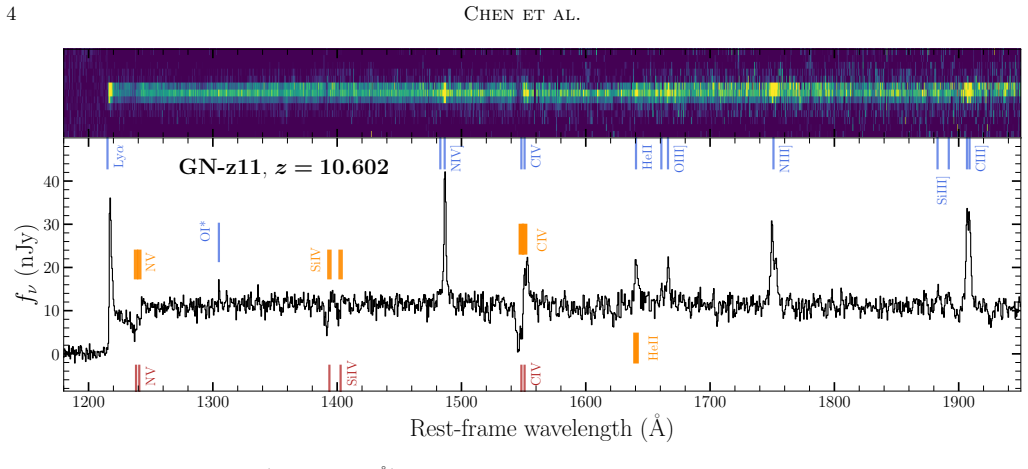
The load-bearing objects are the stellar-wind P-Cygni features ($\mathrm{N\,V}\,\lambda\lambda1238,1242$; $\mathrm{Si\,IV}\,\lambda\lambda1393,1402$; $\mathrm{C\,IV}\,\lambda\lambda1548,1550$) and broad $\mathrm{He\,II}\,\lambda1640$, fitted with the FiCUS continuum-fitting code as linear combinations of simple stellar populations from two model families that include very massive stars (the CB19 and M25 grids). These features are sharply age-, metallicity-, and IMF-sensitive: $\mathrm{N\,V}$ appears only in populations younger than about 3 Myr, $\mathrm{Si\,IV}$ and $\mathrm{C\,IV}$ track metallicity, and the P-Cygni troughs plus $\mathrm{He\,II}$ strengthen considerably when the IMF is extended from $100\,M_\odot$ to $300\,M_\odot$. The IGM damping-wing correction, computed assuming fully neutral gas beginning $0.5$ pMpc from the galaxy, sets the intrinsic $\mathrm{N\,V}$ profile that the models must reproduce.
What would settle it
Measure the size of GN-z11's ionized bubble—for example with a higher-resolution Ly$\alpha$ profile and independent IGM damping-wing modeling—and show that the neutral gas begins more than about $2$ Mpc away; the paper's own grids then no longer require stars above $100\,M_\odot$. A second decisive check is a deeper spectrum around $\mathrm{N\,IV}\,\lambda1719$: a broad detection would rule out the proposed dense WN/LBV origin of the broad $\mathrm{N\,IV]}$ component.
Extended reading notes
Core claim
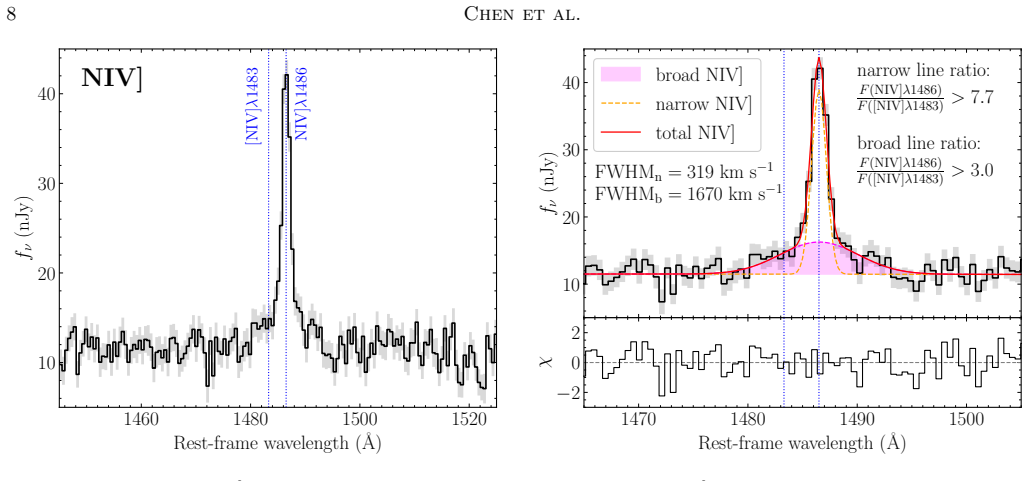
The paper's central claim is that the rest-UV spectrum of GN-z11 is a stellar-wind spectrum: the strong $\mathrm{N\,V}$ P-Cygni profile survives IGM damping-wing correction, and the joint fit of $\mathrm{N\,V}$, $\mathrm{Si\,IV}$, $\mathrm{C\,IV}$, and $\mathrm{He\,II}$ succeeds with two independent stellar-population model families only when the IMF extends to $300\,M_\odot$, the stellar metallicity is near $0.04\,Z_\odot$, and a substantial fraction of the UV light comes from $2$–$3$ Myr old populations. Models capped at $100\,M_\odot$ underproduce the P-Cygni emission at the fiducial distance to the neutral IGM ($0.5$ pMpc); they match only if that distance exceeds about $2$ pMpc, which the paper argues is unlikely given reionization-era Ly$\alpha$ constraints. The broad $\mathrm{N\,IV]}$ component, with no accompanying broad $\mathrm{N\,IV}\,\lambda1719$, is reproduced by adding a dense, relatively cool WN atmosphere or an LBV-outburst spectrum at roughly 13–35% of the UV continuum, suggesting N-rich outflows from a very-massive-star population in a dense cluster environment, though an AGN-driven wind cannot be excluded.
Load-bearing premise
The load-bearing premise is that GN-z11 sits in a small ionized bubble (neutral intergalactic gas starting about $0.5$ Mpc away) and has very low stellar metallicity; if the neutral gas starts more than about $2$ Mpc away, the paper's own fiducial models without very massive stars can fit the spectrum, and the VMS conclusion collapses.
Editorial extensions
If this is right
- If GN-z11 does host very massive stars, its super-solar N/O ratio (3.9× solar) can be explained by CNO-cycle winds and LBV-like eruptions from these stars within the first few million years, rather than by an AGN.
- Lyα visibility at z>10 does not require a very large ionized bubble: GN-z11's red wing, carrying 44% of the Lyα flux at >500 km/s, encounters 16–32% IGM transmission versus 0.3–7% at line center.
- The combination of O I* λ1304 fluorescence with weak low-ionization absorption implies that dense neutral gas is confined to a compact nuclear region, with the bulk of the UV continuum emerging from surrounding star-forming clusters.
- The failure of 100 M⊙-truncated IMF models at the fiducial IGM parameters identifies R~2700 spectroscopy as the next test, since it can separate stellar-wind and nebular contributions to He II and N V and distinguish between VMS wind prescriptions.
- If very massive stars assemble through runaway collisions in dense, low-metallicity clusters, their collapse after ~2.5–5 Myr would seed intermediate-mass black holes, linking GN-z11's starburst to black-hole formation in the early universe.
Reading between the lines
- A natural extension, not carried out in this paper, is to search the same broad N IV] component in the full sample of known z>8 nitrogen emitters; if it is common, dense WN/LBV winds may be a standard phase of early massive-star formation rather than a peculiarity of GN-z11.
- Because the VMS inference is degenerate with the assumed ionized-bubble size, independent reionization constraints at z≈10.6 (from Lyα damping wings of other galaxies or 21-cm observations) could either strengthen or overturn the stellar-population conclusion without changing the spectrum.
- If the paper's WN/LBV interpretation is right, population-synthesis models that omit eruptive mass loss may misclassify similar UV spectra in other high-redshift sources as AGN, since a dense, N-rich outflow can mimic the broad-line signatures of an active nucleus.
Signed reviews
Editorial analysis
A structured set of objections, weighed in public.
Referee Report
Summary. The paper presents ultra-deep JWST/NIRSpec medium-resolution spectroscopy of the z=10.6 galaxy GN-z11 from the SPURS program, combined with JADES data. The authors measure a suite of rest-UV and rest-optical emission lines, resolve the Lyα profile, detect interstellar absorption lines, and infer gas densities, temperatures, and abundances. They then fit the rest-UV continuum with stellar population synthesis models and claim that the P-Cygni wind features (NV, SiIV, CIV) and broad HeII require very massive stars (>100 M_sun) at low metallicity (0.04 Z_sun) and young ages (<=3 Myr), after correcting for IGM damping-wing attenuation assuming a small ionized bubble (Db=0.5 pMpc). The paper also reports a broad component to NIV] lambda1486, seen in several nitrogen emitters, and proposes dense WN winds or LBV-like outbursts as a possible origin, while acknowledging that an AGN wind cannot be excluded.
Significance. If the VMS interpretation is correct, this is the first direct spectroscopic probe of very massive stars at z>10, with implications for stellar evolution, nitrogen enrichment, and the seeding of intermediate-mass black holes. The empirical measurements are carefully executed: line fluxes and widths are derived with resampling uncertainties, model selection uses BIC, and the paper is transparent about caveats. The rest-UV absorption-line results (fast highly ionized outflow, weak low-ionization covering fraction) and the resolved Lyα profile (broad red wing, low escape fraction) are robust and valuable regardless of the stellar population modeling. However, the headline VMS conclusion is conditional on the assumed IGM bubble size and stellar metallicity, and the paper's own analysis shows that non-VMS models can fit the data for larger bubbles or higher metallicities. The manuscript would be greatly strengthened by a quantitative treatment of these degeneracies.
major comments (4)
- [§6.3–6.4] The central claim that very massive stars (VMS) are required to reproduce the rest-UV wind features is not robust to the assumed distance to the nearest neutral IGM, Db. The paper adopts Db=0.5 pMpc but states in §6.4 that non-VMS models (Mup=100 M_sun) can reproduce the spectrum for Db>2 pMpc, and labels such bubbles 'unlikely' on the basis of reionization simulations rather than a quantitative posterior from the combined Lyα and NV data. Because the IGM damping-wing correction directly shapes the NV profile used to infer the stellar population, the authors should either provide a joint constraint on Db from the observed Lyα profile and NV profile under a physical prior on the IGM neutral fraction, or explicitly present the VMS result as conditional on Db and temper the abstract and summary accordingly.
- [§6.2 and §6.4] The adopted stellar metallicity Z*=0.04 Z_sun is an assumption derived from the gas-phase oxygen abundance (0.18 Z_sun) and an assumed alpha-enhancement factor of about 5, and the VMS inference is conditional on this value. The paper shows that at Db=0.1 pMpc the VMS models at Z*=0.04 fail to match the NV emission, requiring higher metallicity, and that at Db=0.5 pMpc the VMS models with Z*=0.1–0.2 Z_sun fit comparably well. A formal sensitivity analysis or joint fit over Z* and Db is needed to establish whether the data actually require low-metallicity VMS, or whether the conclusion is an artifact of the adopted priors.
- [§7.2] The proposed origin of the broad NIV] component in dense WN winds or LBV-like outbursts is supported by a single PoWR atmosphere and the HD 5980 spectrum that were selected specifically to match the observed line strengths, with no exploration of the parameter space or statistical comparison to alternative models. The paper states that this is a 'simple experiment' with future work planned, but the abstract presents the WN/LBV interpretation as a plausible finding. The authors should clearly label this part of the analysis as an illustrative hypothesis and either provide a quantitative exploration of the WN parameter space or soften the abstract's claim.
- [§6.4] The paper asserts that without VMS the fits to the wind lines are 'considerably worse' at the fiducial Db=0.5 pMpc and Z*=0.04 Z_sun, but does not report the goodness-of-fit statistics for the non-VMS models or a formal model comparison (e.g., BIC or AIC) that accounts for the number of free parameters. Given the degeneracies with Db and Z*, a quantitative comparison of VMS and non-VMS models over the allowed parameter space is necessary to support the claim that VMS are 'very important' to the fit.
minor comments (5)
- [§6.3] There is a typo in the sentence 'The weak low-ionization absorption lines (§4) imply either the total HI column density in front of the UV continuum is lowWe also consider damped Lyα absorption...'; the text appears to be missing a period or conjunction.
- [Figure 10] The caption contains a typo: 'T oppanel' should read 'Top panel'.
- [§2.2] The factor 1.3 applied to the in-flight line spread function should be justified with a reference or a brief explanation of its origin.
- [§6.3] The choice of Db=0.5 pMpc as the fiducial value is the upper end of the 68% range from Lu et al. (2024); the paper should explain why the median value of 0.3 pMpc was not adopted for the fiducial model.
- [§2 and §8] The paper mentions that an independent analysis of the SPURS spectrum is presented by Nakane et al. (2026) but does not compare its conclusions; a brief discussion of any differences or agreements would help the reader evaluate potential systematic effects.
Circularity Check
No significant circularity; the VMS claim is parameter-dependent but explicitly stated and the key additions are acknowledged as fits rather than predictions.
full rationale
The paper's empirical measurements (line fluxes, equivalent widths, velocity profiles, and non-detections) are model-independent and serve as the primary data. The central inference that very massive stars are present is drawn from a stellar-population model comparison (Section 6.4) using the CB19, M25, and BPASS models, including explicit non-VMS (Mup=100 Msun) alternatives; the failure of the non-VMS models depends on the adopted low stellar metallicity (Z*=0.04 Zsun) and small IGM ionized bubble (Db=0.5 pMpc), and the paper transparently shows that non-VMS models can fit if Db>2 pMpc. This is an assumption-sensitivity analysis rather than a circular reduction: the bubble size is set from external reionization simulations and the Ly-alpha EW, not derived from the stellar wind features. The broad N IV] component is first identified as an unexplained spectral feature; the later addition of a PoWR WN atmosphere (Section 7.2) is explicitly described as 'a simple experiment' and the atmosphere is 'chosen from the PoWR grids specifically as a visually close approximation of the observed line strengths,' so it is a fit used to illustrate a possible origin, not a prediction claimed to be derived from first principles. Self-citations appear (e.g., Lu et al. 2024 for bubble sizes, Plat et al. 2019 for CB19 models, Tang et al. 2024a for IGM neutrality) but these are external published simulations and models, not a chain that forces the conclusion by definition. No equation or fitted parameter is shown to reduce to its own input. The paper is therefore not circular, though the VMS conclusion is conditional on the small-bubble and low-metallicity assumptions, which are stated explicitly and tested for sensitivity.
Assumptions & free parameters
free parameters (5)
- Stellar metallicity Z* =
0.04 Zsun (fiducial)
- Distance to nearest neutral IGM Db =
0.5 pMpc (fiducial)
- SSP age light fractions =
dominated by 2-3 Myr SSPs
- Ionization parameter log U =
-1.82
- V-band dust optical depth tau_V =
0.01
assumptions (6)
- domain assumption CB19 and M25 stellar population models with VMS up to 300 Msun, and their wind and mass-loss prescriptions, describe real low-metallicity massive stars.
- domain assumption The IGM is fully neutral beyond a spherical ionized bubble, and the damping-wing transmission follows the adopted Mason and Gronke model with z_reion=5.5.
- domain assumption Gas-phase oxygen abundance maps to stellar metallicity with roughly a factor of 5 alpha/Fe enhancement.
- domain assumption The stellar IMF is a Chabrier IMF with mass limits 0.1-300 Msun, or a Salpeter-like slope above 0.5 Msun for the M25 models.
- domain assumption Case B recombination ratios apply to the Balmer lines and Ly alpha/H gamma relation.
- standard math PyNeb atomic data and transition probabilities used for density and temperature diagnostics are accurate.
Cite this review
Pith. "Pith review of SPURS: Massive Stars, Dense Gas, and Ly$\alpha$ Escape in GN-z11 at $z = 10.6$." pith.science (2026). https://pith.science/paper/3REAR2KC
@misc{pith2026260812699,
  author       = {Pith},
  title        = {Pith review of: SPURS: Massive Stars, Dense Gas, and Ly$\alpha$ Escape in GN-z11 at $z = 10.6$},
  year         = {2026},
  howpublished = {\url{https://pith.science/paper/3REAR2KC}},
  note         = {Machine review of arXiv:2608.12699}
}
abstract
We present ultra-deep {\it JWST} spectroscopy of GN-z11 ($z=10.6$) obtained through the SPURS Cycle 4 Large Program, providing the deepest rest-UV view yet obtained of a galaxy at $z>10$. GN-z11 was previously found to be nitrogen-enhanced with detectable Ly$\alpha$. The SPURS spectrum reveals P-Cygni stellar wind features and broad He II emission that are jointly reproduced by stellar population models incorporating very massive stars (VMS; $>100\,M_\odot$) at low metallicity and young ages ($\lesssim3$ Myr). We also detect a broad ($\rm FWHM=1670$ km s$^{-1}$) component to N IV] $\lambda1486$, now seen in several nitrogen emitters, potentially arising from dense WN-like winds or LBV-like outbursts associated with a population of VMS in a dense environment, though an AGN-driven wind cannot be excluded. In either scenario, this broad component may trace the gas producing GN-z11's nitrogen enhancement. Rest-UV absorption lines reveal a fast ($\sim500$~km~s$^{-1}$), highly ionized outflow and a negligible neutral gas covering fraction. We resolve the weak Ly$\alpha$ emission (EW=5.6 \AA, $f_{\rm esc,Ly\alpha}=2.7$\%), finding a broad red wing (44\% of flux at $>500$ km s$^{-1}$) that should experience reduced IGM damping wing suppression and help explain Ly$\alpha$ visibility at $z>10$. Fine-structure O I* $\lambda1304$ emission indicates dense neutral gas near a subset of the ionizing sources, which may also scatter Ly$\alpha$ to the large observed velocities. The weak low-ionization absorption favors a picture in which this dense neutral gas is confined to a compact nuclear region. Together, these results are consistent with a rapid burst of star formation building up the dense nuclear regions and surrounding clusters in GN-z11.
Figures


Figures from the paper (17 more)


Reviewed August 16, 2026 · model on record in the stance chip above.
Discussion (0). Continue with ORCID to comment.