BASIIS: Bistatic Angular Sampling and Interpolation for ISAC Setups
Pith reviewed 2026-06-26 23:17 UTC · model grok-4.3
The pith
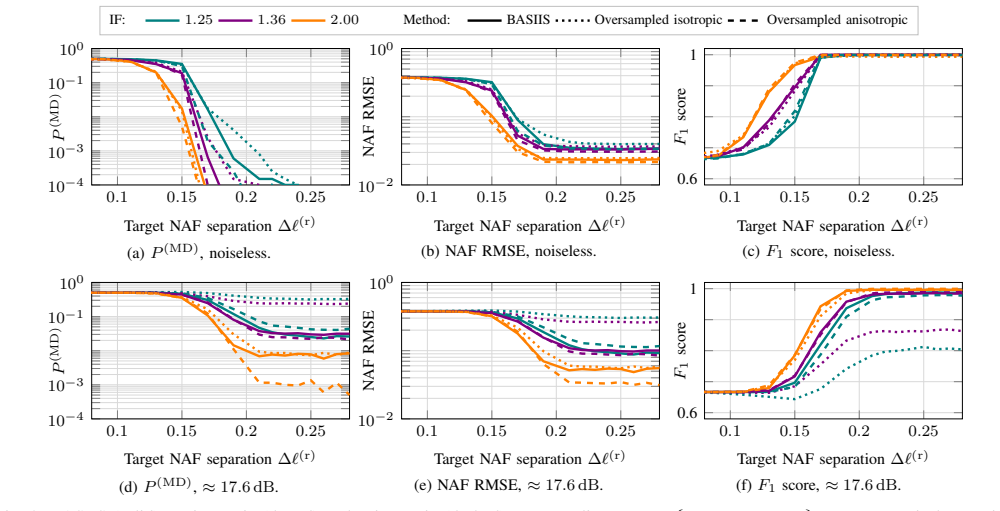
Bistatic ISAC sensing reduces TX-RX angle pairs by 3-5 times via a minimal sampling scheme based on the ortho-baseline coarray while matching dense imaging detection accuracy.
A machine-rendered reading of the paper's core claim, the machinery that carries it, and where it could break.
Core claim
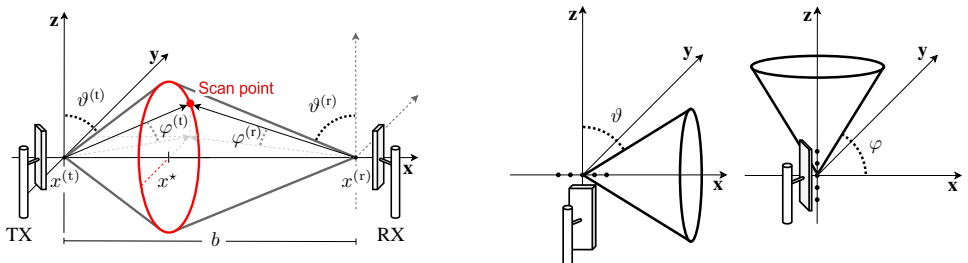
In bistatic ISAC the elevation angles at transmitter and receiver are coupled by geometry; the ortho-baseline coarray captures the resulting joint elevation aperture as a virtual array. A minimal DFT-based sampling pattern on this coarray, together with interpolation, produces near-lossless reconstruction of the four-dimensional angular response. This scheme works for arbitrary beamforming architectures and reduces the number of required TX-RX direction pairs by a factor of three to five while preserving detection accuracy equivalent to dense oversampling.
What carries the argument
The ortho-baseline coarray, a virtual array that encodes the coupled elevation aperture of a bistatic TX-RX pair.
If this is right
- Bistatic ISAC operations become feasible with three- to five-fold lower radio-resource overhead.
- The scheme extends DFT-optimal sampling from one-dimensional to full four-dimensional azimuth-elevation domains.
- Any beamforming architecture can realize the pattern without custom hardware.
- The same coarray-derived interpolation restores the full angular image after minimal acquisition.
Where Pith is reading between the lines
- Lower acquisition counts could translate directly into higher update rates or more simultaneous users in a 6G cell.
- The coupling model may extend to other non-ortho baselines or multi-static geometries with analogous virtual arrays.
- Resource savings might allow ISAC to coexist with higher data-rate communications without additional spectrum allocation.
Load-bearing premise
The ortho-baseline coarray representation fully captures the joint elevation aperture arising from bistatic geometry without introducing unaccounted losses or requiring additional constraints.
What would settle it
A Monte Carlo or hardware measurement in which detection probability or angle estimation error for the minimal sampling scheme falls measurably below that of dense oversampling under identical SNR and target conditions.
Figures
read the original abstract
Integrated Sensing and Communications (ISAC) is a defining feature of 6G, extending cellular networks with radar-like sensing at limited additional overhead. In bistatic deployments, sensing requires coordinating the transmitter (TX) and receiver (RX) arrays to scan the Cartesian product of angle of departure and arrival, resulting in a four-dimensional sampling problem in the angular domain. This work establishes a complete angular sampling framework for bistatic ISAC, extending the DFT-based optimal-sampling methodology to the full azimuth and elevation domains of both arrays. We show that the bistatic geometry couples the TX and RX elevation angles, and represent this coupling through the ortho-baseline coarray, a virtual array that captures the joint elevation aperture of the array pair. From the coarray we derive a minimal sampling and interpolation scheme, near-lossless and realizable with any beamforming architecture. Monte Carlo simulations confirm the proposed minimal acquisition essentially equalizes the detection accuracy of dense oversampled imaging while acquiring 3 to 5 times fewer TX-RX direction pairs. This allows having bistatic operations with drastically reduced overhead on the radio resource usage of ISAC systems.
Editorial analysis
A structured set of objections, weighed in public.
Referee Report
Summary. The paper proposes BASIIS, a complete angular sampling framework for bistatic ISAC that extends DFT-based optimal sampling to azimuth and elevation domains. It models the coupling between TX and RX elevation angles via an ortho-baseline coarray virtual array, derives a minimal near-lossless sampling and interpolation scheme realizable with standard beamforming, and reports Monte Carlo results showing equivalent detection accuracy to dense oversampling while using 3-5 times fewer TX-RX direction pairs.
Significance. If the ortho-baseline coarray representation is shown to be near-lossless for general bistatic geometries, the work would enable substantial reduction in radio resource overhead for bistatic sensing in 6G ISAC systems without sacrificing performance, addressing a key scalability issue in multi-array deployments.
major comments (2)
- [Section introducing the ortho-baseline coarray and coupling representation] The central claim that the minimal acquisition scheme is near-lossless rests on the ortho-baseline coarray exactly capturing the joint elevation aperture. The manuscript provides no explicit mapping from bistatic geometry to coarray elements, no bounds on approximation error relative to full 4D sampling, and no verification against the complete Cartesian product of angles, leaving the Monte Carlo performance results dependent on an unverified modeling assumption.
- [Simulation results section] Monte Carlo simulations are invoked to confirm equalization of detection accuracy, yet the manuscript supplies no details on array configurations (element counts, spacing, orientations), noise models, target scenarios, statistical significance testing, or the precise definition of 'dense oversampled imaging' baseline, preventing assessment of whether the reported 3-5x reduction is robust or geometry-specific.
minor comments (1)
- Notation for the four-dimensional angular domain (azimuth/elevation at TX/RX) should be introduced with a clear table or diagram early in the paper to aid readability of subsequent derivations.
Simulated Author's Rebuttal
We thank the referee for the constructive feedback on our manuscript. The comments identify areas where additional detail will improve clarity and verifiability. We address each major comment below and will revise the manuscript accordingly.
read point-by-point responses
-
Referee: [Section introducing the ortho-baseline coarray and coupling representation] The central claim that the minimal acquisition scheme is near-lossless rests on the ortho-baseline coarray exactly capturing the joint elevation aperture. The manuscript provides no explicit mapping from bistatic geometry to coarray elements, no bounds on approximation error relative to full 4D sampling, and no verification against the complete Cartesian product of angles, leaving the Monte Carlo performance results dependent on an unverified modeling assumption.
Authors: We agree that an explicit derivation and error analysis would strengthen the central claim. In the revised manuscript we will add a dedicated subsection that maps bistatic geometry parameters (baseline vector, array positions, and orientations) to the ortho-baseline coarray elements. We will also derive and present analytic bounds on the approximation error relative to full 4D Cartesian sampling and include a direct numerical verification comparing coarray-based reconstruction against the complete angle product. These additions will make the near-lossless property explicit rather than implicit. revision: yes
-
Referee: [Simulation results section] Monte Carlo simulations are invoked to confirm equalization of detection accuracy, yet the manuscript supplies no details on array configurations (element counts, spacing, orientations), noise models, target scenarios, statistical significance testing, or the precise definition of 'dense oversampled imaging' baseline, preventing assessment of whether the reported 3-5x reduction is robust or geometry-specific.
Authors: We acknowledge that the current simulation description lacks the requested reproducibility details. The revised manuscript will expand the simulation section to specify array configurations (element counts, inter-element spacing, and orientations), the noise model (AWGN with explicit SNR ranges), target scenarios (single and multi-target cases with angle distributions), the number of Monte Carlo trials together with statistical significance measures (e.g., confidence intervals), and the precise definition of the dense oversampled baseline (uniform sampling at twice the Nyquist rate in all four angular dimensions). Additional geometry sweeps will also be included to demonstrate that the 3-5x reduction is not limited to the reported cases. revision: yes
Circularity Check
No significant circularity in derivation chain
full rationale
The paper presents a geometric derivation: bistatic elevation coupling is represented via the ortho-baseline coarray, from which a minimal sampling scheme is obtained and validated by Monte Carlo simulations showing equivalent detection accuracy with fewer pairs. No equations or steps reduce a claimed prediction or result to a fitted parameter, self-definition, or self-citation chain by construction. The framework extends prior DFT-based sampling to bistatic geometry without evidence of the central claim being equivalent to its inputs; external simulation results supply independent content.
Axiom & Free-Parameter Ledger
invented entities (1)
-
ortho-baseline coarray
no independent evidence
Reference graph
Works this paper leans on
-
[1]
Study on 6G use cases and service requirements,
3rd Generation Partnership Project (3GPP), “Study on 6G use cases and service requirements,” TR 22.870, 2026, version 20.0.0
2026
-
[2]
A unified future: Integrated sensing and communication (isac) in 6g,
A. Ghoshet al., “A unified future: Integrated sensing and communication (isac) in 6g,”IEEE Journal of Selected Topics in Electromagnetics, Antennas and Propagation, 2025
2025
-
[3]
Wavefield Networked Sensing: Principles, Algo- rithms, and Applications,
M. Manzoniet al., “Wavefield Networked Sensing: Principles, Algo- rithms, and Applications,”IEEE Open J. Commun. Soc., vol. 6, pp. 181–197, 2025
2025
-
[4]
Analog beamforming for active imaging using sparse arrays,
R. Rajam ¨aki, S. P. Chepuri, and V . Koivunen, “Analog beamforming for active imaging using sparse arrays,” in2019 53rd Asilomar Conf. Signals, Syst., Comput., 2019, pp. 1202–1206
2019
-
[5]
Hybrid beamforming for active sensing using sparse arrays,
——, “Hybrid beamforming for active sensing using sparse arrays,” IEEE Trans. Signal Process., vol. 68, pp. 6402–6417, 2020
2020
-
[6]
Sampling and reconstructing angular domains with uniform arrays,
S. Mandelli, M. Henninger, and J. Du, “Sampling and reconstructing angular domains with uniform arrays,”IEEE Trans. Wireless Commun., 2022
2022
-
[7]
H. L. V . Trees,Optimum Array Process.: Part IV of Detection, Estima- tion, and Modulation Theory. John Wiley & Sons
-
[8]
Optimal Azimuth Sampling and Interpolation for Bistatic ISAC Setups,
A. Felix, S. Mandelli, M. Henninger, and S. Ten Brink, “Optimal Azimuth Sampling and Interpolation for Bistatic ISAC Setups,” in2025 28th Int. Workshop Smart Antennas (WSA), 2025, pp. 241–246
2025
-
[9]
System concept and demonstration of bistatic MIMO- OFDM-based ISAC,
L. Girotoet al., “System concept and demonstration of bistatic MIMO- OFDM-based ISAC,”arXiv:2504.07600 [eess.SP], 2025
arXiv 2025
-
[10]
Cherniakov,Bistatic radar: Principles and practice
M. Cherniakov,Bistatic radar: Principles and practice. Wiley, 2007
2007
-
[11]
Skolnik,Introduction to radar systems, 3rd ed
M. Skolnik,Introduction to radar systems, 3rd ed. McGraw-Hill Education, 2002
2002
-
[12]
N. J. Willis,Bistatic radar, 2nd ed. SciTech Publishing Inc, 2005
2005
-
[13]
The unifying role of the coarray in aperture synthesis for coherent and incoherent imaging,
R. T. Hoctor and S. A. Kassam, “The unifying role of the coarray in aperture synthesis for coherent and incoherent imaging,”Proc. IEEE, vol. 78, no. 4, pp. 735–752, 1990
1990
-
[14]
The Dolph–Chebyshev window: A simple optimal filter,
P. Lynch, “The Dolph–Chebyshev window: A simple optimal filter,” Mon. Weather Rev., vol. 125, no. 4, pp. 655–660, 1997
1997
discussion (0)
Sign in with ORCID, Apple, or X to comment. Anyone can read and Pith papers without signing in.