A Sieve for Twin Primes
Pith reviewed 2026-05-25 18:29 UTC · model grok-4.3
The pith
A sieve like Eratosthenes generates twin primes and a novel heuristic counts them with a simpler correction factor.
A machine-rendered reading of the paper's core claim, the machinery that carries it, and where it could break.
Core claim
The authors construct a sieve that produces the list of twin primes and introduce a novel heuristic method for counting them that arrives at the same asymptotic formula as prior work but with a simpler correction factor.
What carries the argument
The twin-prime sieve construction together with the novel heuristic correction factor used in the second counting argument.
If this is right
- The sieve algorithm produces all twin primes below a given bound.
- Both heuristic methods recover the same asymptotic formula for the count of twin primes.
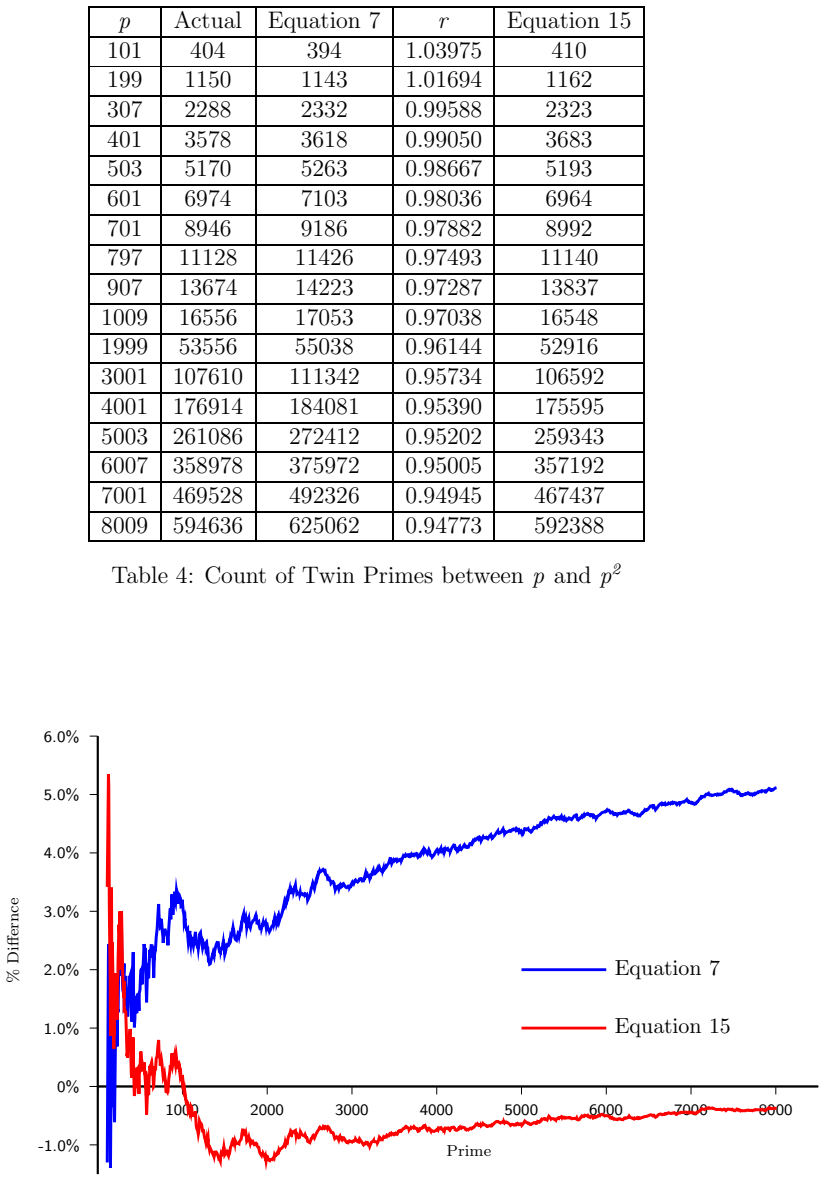
- The new method's simpler correction factor produces estimates close to actual counts up to 8009.
- The estimates remain close to observed counts both with and without the correction factor.
Where Pith is reading between the lines
- The sieve construction could be extended to generate other prime pairs or constellations with minor adjustments to the sieving steps.
- The simpler correction factor may reduce computational overhead when estimating twin prime counts for very large bounds.
- If the heuristics continue to track actual counts at larger scales, they could serve as practical tools for testing distribution conjectures even in the absence of a full proof.
Load-bearing premise
The heuristic arguments produce reliable estimates of twin-prime counts despite the explicit statement that no supporting theory exists for their accuracy.
What would settle it
A significant divergence between the heuristic estimates and the actual number of twin primes found by exhaustive search beyond 8009 would falsify the reliability of these counting methods.
Figures
read the original abstract
We present an algorithm analogous to the sieve of Eratosthenes that produces the list of twin primes. Next, we count the number of twin primes resulting from the construction with two different heuristic arguments. The first method is essentially the same as the one in Hardy and Wright. However, the second method is novel. It results in the same asymptotic formula but it uses a simpler correction factor than theirs. Though we have no theory for the accuracy of our estimates, we compute them both without and with the correction factor and they turn out to be close to the actual counts up to 8009.
Editorial analysis
A structured set of objections, weighed in public.
Referee Report
Summary. The manuscript presents an Eratosthenes-like sieve algorithm that generates twin primes and then applies two heuristic counting arguments to estimate their density. The first heuristic is essentially that of Hardy and Wright; the second is claimed to be novel, to produce the identical asymptotic formula, and to employ a simpler correction factor. Numerical values of both estimates (with and without the correction) are compared to direct counts up to 8009, although the authors explicitly state that no theory exists for the accuracy of these estimates.
Significance. If the second heuristic could be placed on a rigorous footing, it would offer a simpler route to the standard twin-prime asymptotic; however, the manuscript itself acknowledges the absence of any supporting analytic justification or error bound, so the work remains at the level of an unproven computational observation rather than a substantiated advance.
major comments (3)
- [Abstract] Abstract: the central claim that the second method 'results in the same asymptotic formula' but with a 'simpler correction factor' rests entirely on the internal construction of the heuristic; the manuscript provides no derivation showing how the simpler factor is obtained or why it must reproduce the Hardy-Wright leading term.
- [Abstract] Abstract: the statement 'we have no theory for the accuracy of our estimates' directly undermines the assertion that the second heuristic supplies a valid simpler correction factor; numerical agreement up to 8009 is offered without error bounds, convergence analysis, or comparison to the known error terms in the twin-prime conjecture.
- [Numerical comparison paragraph] The finite-range comparison to actual counts up to 8009 cannot substantiate an asymptotic statement; any heuristic that matches the count at a fixed upper limit can still deviate in the leading coefficient or lower-order terms for larger x, and no such test is performed.
minor comments (1)
- [Abstract] The explicit form of the asymptotic formula (including the constant and the integral) should be written out once, so that readers can see precisely what both heuristics are asserted to recover.
Simulated Author's Rebuttal
We thank the referee for the careful review. Our work is explicitly heuristic and computational, as stated in the abstract, and we address each major comment below without claiming rigor beyond what is presented.
read point-by-point responses
-
Referee: [Abstract] the central claim that the second method 'results in the same asymptotic formula' but with a 'simpler correction factor' rests entirely on the internal construction of the heuristic; the manuscript provides no derivation showing how the simpler factor is obtained or why it must reproduce the Hardy-Wright leading term.
Authors: The body of the paper constructs the second heuristic by directly counting the positions remaining after the twin-prime sieve steps, yielding the factor 2C_2 / log^2 x where C_2 is the twin-prime constant; this matches the Hardy-Wright leading term by explicit product evaluation over the same primes. The abstract summarizes this outcome. We will add one sentence in the abstract and a short remark in the counting section to highlight the direct equivalence. revision: partial
-
Referee: [Abstract] the statement 'we have no theory for the accuracy of our estimates' directly undermines the assertion that the second heuristic supplies a valid simpler correction factor; numerical agreement up to 8009 is offered without error bounds, convergence analysis, or comparison to the known error terms in the twin-prime conjecture.
Authors: The explicit disclaimer already appears in the abstract precisely to avoid any implication of rigor. The numerical checks are presented only as consistency checks for the heuristics, not as validation of the correction factor. No change is required because the manuscript does not assert validity beyond the heuristic level. revision: no
-
Referee: [Numerical comparison paragraph] The finite-range comparison to actual counts up to 8009 cannot substantiate an asymptotic statement; any heuristic that matches the count at a fixed upper limit can still deviate in the leading coefficient or lower-order terms for larger x, and no such test is performed.
Authors: We agree that agreement at a single finite limit does not establish the asymptotic. The comparisons are offered only for illustration of the heuristics' practical behavior. We will insert a clarifying sentence stating that the numerical agreement is illustrative and does not constitute evidence for the asymptotic formula or its error terms. revision: yes
- Providing a rigorous analytic derivation or error bounds that would place the second heuristic on a firm footing, as the manuscript already states that no such theory is available.
Circularity Check
No circularity detected; heuristics are explicitly non-theoretical and externally compared to counts.
full rationale
The paper presents a sieve construction followed by two heuristic counting arguments. It states outright that 'we have no theory for the accuracy of our estimates' and validates only by direct numerical comparison to twin-prime counts up to 8009. The second heuristic is described as yielding the same asymptotic as Hardy-Wright with a simpler factor, but this is an observed outcome of applying the heuristic, not a claimed first-principles derivation that reduces to its own inputs. No self-definitional equations, fitted parameters renamed as predictions, or load-bearing self-citations appear in the provided text. The approach is self-contained as heuristic estimation with external numerical checks.
Axiom & Free-Parameter Ledger
Lean theorems connected to this paper
-
IndisputableMonolith/Cost/FunctionalEquation.leanwashburn_uniqueness_aczel unclear?
unclearRelation between the paper passage and the cited Recognition theorem.
The second method is novel. It results in the same asymptotic formula but it uses a simpler correction factor than theirs.
-
IndisputableMonolith/Foundation/RealityFromDistinction.leanreality_from_one_distinction unclear?
unclearRelation between the paper passage and the cited Recognition theorem.
we have no theory for the accuracy of our estimates
What do these tags mean?
- matches
- The paper's claim is directly supported by a theorem in the formal canon.
- supports
- The theorem supports part of the paper's argument, but the paper may add assumptions or extra steps.
- extends
- The paper goes beyond the formal theorem; the theorem is a base layer rather than the whole result.
- uses
- The paper appears to rely on the theorem as machinery.
- contradicts
- The paper's claim conflicts with a theorem or certificate in the canon.
- unclear
- Pith found a possible connection, but the passage is too broad, indirect, or ambiguous to say the theorem truly supports the claim.
Reference graph
Works this paper leans on
-
[1]
[HW] G.H. Hardy and E.M. Wright, An Introduction to the Theory of Nu m- bers, 4th ed. Oxford. [P] George P´ olya, Am. Math. Monthly 66 (1959), 375-84. [A] Tom M. Apostol, Introduction to Analytic Number Theory, Spring er- Verlag, Berlin,
work page 1959
-
[2]
11 13 17 19 29 31 41 43 59 61 71 73 101 103 107 109 137 139 149 151 167 169 179 181 191 193 197 199 209 211 221 223 227 229 239 241 251 253 269 271 281 283 311 313 317 319 347 349 359 361 377 379 389 391 401 403 407 409 419 421 431 433 437 439 449 451 461 463 479 481 491 493 521 523 527 529 557 559 569 571 587 589 599 601 611 613 617 619 629 631 641 643 6...
work page 1901
-
[3]
8 p Actual Equation 7 r Equation 15 101 404 394 1.03975 410 199 1150 1143 1.01694 1162 307 2288 2332 0.99588 2323 401 3578 3618 0.99050 3683 503 5170 5263 0.98667 5193 601 6974 7103 0.98036 6964 701 8946 9186 0.97882 8992 797 11128 11426 0.97493 11140 907 13674 14223 0.97287 13837 1009 16556 17053 0.97038 16548 1999 53556 55038 0.96144 52916 3001 107610 1...
work page 1999
discussion (0)
Sign in with ORCID, Apple, or X to comment. Anyone can read and Pith papers without signing in.