REVIEW 1 major objections 3 minor 133 references
Belief Identification in Populations
T0 review · 1 major / 3 minor · reviewed 2026-08-01 · deepseek-v4-flash
Pith's one-line read A population's distribution of Bayesian beliefs is generically recoverable from anonymous event-by-event reports exactly when the graph induced by the observed events is nonseparable; when it is separable, non-identification is generic.
desk verdict Clean, genuinely new graph-theoretic dichotomy for when anonymous belief data recover belief heterogeneity; main theorem is right, but Theorem 4's proof has a fillable gap. read the letter →
The pith
A machine-rendered reading of the paper's core claim, the machinery that carries it, and where it could break.
The reading
What carries the argument
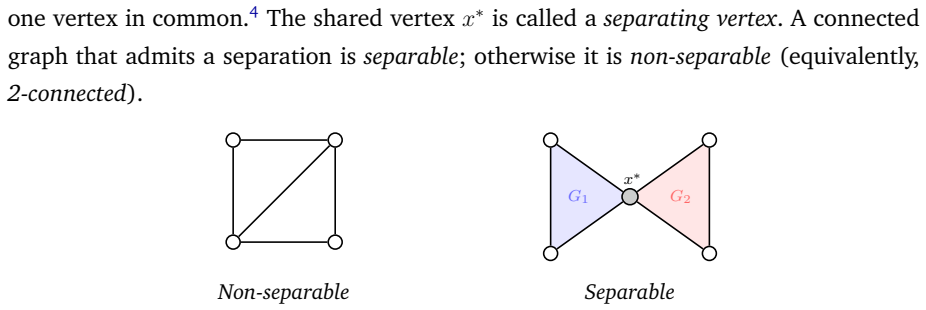
The pivot is the induced graph (X,∼), where x∼y whenever some observed event E contains both states; the graph discards event sizes and counts and keeps only pairwise co-occurrence. Two tools carry the argument. Lemma 4.1 is a cycle-product criterion: a collection {p_E} of conditionals is probabilistically consistent iff the product of likelihood ratios around every setwise cycle equals 1, a potential-function argument in the style of ratio-consistency results. In the separable case, a splicing operation p_{X_1}q recombines p's beliefs on one side of a separating vertex with q's beliefs on the other, preserving all observable conditionals while producing a genuinely different population dist
What would settle it
Exhibit a nonseparable event family Σ and n≥2 for which the non-identified n-agent distributions contain a nonempty open set (for example, an open neighborhood of the six-belief configuration of Example 4 in which every distribution is non-identified). That would contradict Theorem 2's claim that the identified set is generic, which requires an open dense identified set; equivalently, find a single nonempty open ball inside the complement of the identified set.
Extended reading notes
Core claim
The central claim is that separability of the induced graph (X,∼), not connectedness, is the criterion for population-level identification from anonymous belief data. For n≥2, Theorem 2 states that when (X,∼) is nonseparable, the set of n-agent distributions identified by Σ is generic, and when (X,∼) is separable, the set not identified by Σ is generic. Theorem 1 shows that if the full state space X is absent from Σ, there always exist distinct uniform n-agent distributions that induce identical observables, even when Σ contains every proper subset of X. The paper further shows that on the larger domain of all finitely-supported distributions, nonseparability makes both the identified and no
Load-bearing premise
Every result assumes all priors assign strictly positive probability to every state; if zero-probability states are allowed, the cycle-product and splicing arguments break down, and the separability/nonseparability dichotomy is not established.
Editorial extensions
If this is right
- With a nonseparable event graph, non-identification is topologically negligible for finite-type populations: a generic n-agent distribution is uniquely recoverable from anonymous event-by-event belief distributions.
- With a separable graph, adding more events inside the existing components does not help generically; defeating non-identification requires adding events that create cycles across components.
- Omitting the grand event X always leaves at least one uniform population distribution unidentified, even when all proper subsets of states are observed.
- The generic degree of non-identification is (n!)^{m−1}, where m is the number of maximal nonseparable components; tree-shaped event graphs are generically the worst.
- Under a stochastic-choice interpretation of the same mathematics, connectedness of the menu graph is not enough to recover a population's mixing measure over choice weights from anonymous menu-by-menu distributions; nonseparability is required generically.
Reading between the lines
- The full-support restriction is load-bearing: cycle products and the splicing operation require strictly positive probabilities, so admitting zero-probability states would likely require a complete induced graph and a different theorem; the boundary case is an open problem.
- The (n!)^{m−1} formula suggests a practical survey-design metric: minimize the number of maximal nonseparable components of the induced graph to reduce the worst-case number of observationally equivalent populations.
- The six-belief configuration of Example 4 implies the generic result is not universal: nonseparable graphs admit structured, non-identified distributions, so robustness conclusions for finite n rely on the open-dense notion and may not survive passage to large or continuous populations without further assumptions.
- The paper leaves open the testable-content question—which collections of per-event distributions are rationalizable by some population distribution—and notes a possible route through a marginal-preservation theorem after a log transformation.
Editorial analysis
A structured set of objections, weighed in public.
Referee Report
Summary. The paper studies the identification of a population distribution of Bayesian priors from anonymous, event-by-event distributions of posterior beliefs. The analyst observes, for each event E in a family Σ, the cross-sectional distribution of Bayesian updates p(·|E), but cannot link an individual's reports across events. The main question is when the map from the distribution π over full-support priors to these aggregate conditionals is injective. The authors show first (Theorem 1) that if the grand set X is not observed, then there always exists a uniform n-agent distribution that is not identified, even when Σ contains all proper subsets. Their central result (Theorem 2) is a graph-theoretic dichotomy for n-agent distributions: if the induced graph (X,∼) is nonseparable, the set of identified distributions is generic (contains an open dense set); if the graph is separable, the set of non-identified distributions is generic. The extension to all finitely supported distributions (Section 5) shows that nonseparability no longer yields generic identification: identified and non-identified distributions are both dense, while separability still makes non-identification open and dense. The proofs use a cycle-product characterization of probabilistic consistency (Lemma 4.1), a topological transfer from profiles to empirical distributions (Lemma 4.2 and Proposition 2), and a splicing operation in the separable case.
Significance. If the results hold, the paper provides a clean and economically meaningful criterion for when belief heterogeneity can be recovered from anonymous aggregate data: the answer is governed by separability of the induced graph, not by the number or size of observed events. This is a genuine contribution to the literature on belief elicitation and identification in populations. The paper is self-contained: Lemma 4.1 gives a parameter-free potential-function characterization, Proposition 2 cleanly transfers genericity from belief profiles to n-agent distributions, and the Pappus example (Example 4) usefully illustrates why nonseparability can still allow knife-edge non-identification. The main theorems are proved from stated assumptions, and the authors are transparent about the full-support restriction (footnote 2). The only serious issue I find is an incomplete proof of Theorem 4, which is an extension result rather than the central n-agent dichotomy.
major comments (1)
- [Section 5, Theorem 4] The proof of Theorem 4 defines the set S of distributions having two support points p,q with p(·|X1)≠q(·|X1) and p(·|X2)≠q(·|X2), shows S is open and dense, and shows every element of S is not identified. This proves that the set T of non-identified distributions contains an open dense subset (hence T is dense), but it does not prove that T is open, as the theorem states. To prove openness of T one must show T⊆S, i.e., every non-identified distribution has such a pair of support points. In the separable case this equivalence is true: the observable data are equivalent to the pair of marginal distributions of (p(·|X1), p(·|X2)), and a joint distribution is uniquely determined by its marginals iff its support lies in a single fiber of one of the two coordinates. But this characterization is neither stated nor proved, so the proof of Theorem 4 is incomplete as written.
minor comments (3)
- [Section 4, Lemma 4.1] The 'Extension to generalized cycles' paragraph is terse. The inductive replacement of a minimal repeated segment by 1 should be written more carefully; as it stands, it is not fully formal that unit products along setwise cycles imply unit products along all generalized cycles.
- [Section 5, Theorem 3] The proof asserts 'Clearly ∪_n X_n is dense in Δ_S(Δ++(X))' without argument. Since X_n consists of empirical distributions of n agents, a brief explanation of why every finitely supported distribution can be approximated by such empirical distributions would be useful.
- [Section 4, Example 4] There is a typo in the sentence beginning 'Finally, Hence,'. Also, the figure labels in Figures 2 and 5 are very small and may be hard to read in print.
Circularity Check
The paper's derivations are self-contained; no circular reliance on definitions, fits, or self-citations.
full rationale
All central claims (Theorems 1–4) are proven directly from stated definitions using constructive arguments and standard external theorems. Theorem 1 constructs distinct π and π' and verifies equality of every observable conditional distribution by explicit binomial counting; no fitted parameter or prior result is assumed. Theorem 2 is proven from Lemma 4.1 (a conditional-consistency cycle-product characterization, cited to Luce/Afriat/Rockafellar as standard background), Lemma 4.2/Corollary 1 (a homeomorphism between n-tuples of beliefs and n-agent empirical distributions), and Proposition 2 (denseness/openness transfer). The nonseparable and separable cases each construct explicit open dense sets on which identification or non-identification is proven by construction, not assumed. The self-citations (e.g., Chambers and Turansick on RUM non-identification, Chambers and Hayashi on prior-by-prior updating) are used only to distinguish the present phenomenon from related literature, not to prove any identification result. The Pappus example, while a crafted counterexample, is explicitly used to motivate genericity rather than to define generic behavior. A possible proof gap in Theorem 4 (the openness argument covers a constructed subset S rather than the entire non-identified set directly) is a correctness/incompleteness concern, not circularity: it does not assume what it claims to prove. Overall, no step in the derivation reduces to its own inputs by construction.
Assumptions & free parameters
assumptions (7)
- domain assumption Finite state space X with |X| ≥ 3 and fixed known population size n ≥ 2.
- domain assumption Full-support priors: all beliefs lie in Δ++(X), i.e. every state has positive probability.
- domain assumption Bayesian updating: p(·|E) = p(·∩E)/p(E) for E∈Σ.
- domain assumption The induced graph (X,∼) is connected.
- domain assumption The analyst observes, for each event E, the full population distribution of posterior beliefs, anonymously and without tracking individuals across events.
- standard math Whitney's theorem (in a 2-connected graph any two edges lie on a common cycle) and Bondy & Murty Theorem 5.2; Urysohn lemma; standard quotient-topology facts.
- standard math Existence of potential functions from cycle conditions (Luce/Afriat/Rockafellar), proven in the paper as Lemma 4.1.
Cite this review
Pith. "Pith review of Belief Identification in Populations." pith.science (2026). https://pith.science/paper/3S2MGPXN
@misc{pith2026260716952,
  author       = {Pith},
  title        = {Pith review of: Belief Identification in Populations},
  year         = {2026},
  howpublished = {\url{https://pith.science/paper/3S2MGPXN}},
  note         = {Machine review of arXiv:2607.16952}
}
abstract
We study the identification of belief distributions in a population of Bayesian agents from anonymous aggregate belief data. While a single Bayesian agent's full belief can be recovered from beliefs over a suitable collection of binary events, this principle need not extend to populations: event-by-event distributions of beliefs may fail to identify the underlying distribution of priors. We study when this failure is generic and when it is exceptional. Identification is governed by the graph-theoretic structure induced by the observed family of events on the state space. Among $n$-agent distributions, identification is generic if the induced graph is nonseparable, while non-identification is generic if the graph is separable. The results establish both limits and design principles for recovering belief heterogeneity from aggregate belief data.
Figures


Figures from the paper (3 more)


Reference graph
Works this paper leans on
-
[1]
2025 , publisher=
Stochastic choice theory , author=. 2025 , publisher=
2025
-
[2]
The Annals of Mathematical Statistics , volume=
The existence of probability measures with given marginals , author=. The Annals of Mathematical Statistics , volume=. 1965 , publisher=
1965
-
[3]
1987 , publisher=
Projective geometry , author=. 1987 , publisher=
1987
-
[4]
Theoretical Economics , volume=
Dynamic objective and subjective rationality , author=. Theoretical Economics , volume=. 2019 , publisher=
2019
-
[5]
Journal of mathematical economics , volume=
Maxmin expected utility with non-unique prior , author=. Journal of mathematical economics , volume=. 1989 , publisher=
1989
-
[6]
Journal of Economic Theory , volume=
Bayesian consistent belief selection , author=. Journal of Economic Theory , volume=. 2010 , publisher=
2010
-
[7]
Journal of Economic Theory , volume=
Recursive multiple-priors , author=. Journal of Economic Theory , volume=. 2003 , publisher=
2003
-
[8]
Theory and Decision , volume=
A rule for updating ambiguous beliefs , author=. Theory and Decision , volume=. 2002 , publisher=
2002
Show all 133 references
-
[9]
The American Mathematical Monthly , volume=
An elementary theorem on graphs , author=. The American Mathematical Monthly , volume=
-
[10]
Journal of the American Statistical Association , volume=
Elicitation of personal probabilities and expectations , author=. Journal of the American Statistical Association , volume=. 1971 , publisher=
1971
-
[11]
Review of Economic Studies , volume=
The binarized scoring rule , author=. Review of Economic Studies , volume=. 2013 , publisher=
2013
-
[12]
2018 , publisher=
A crisis of beliefs: Investor psychology and financial fragility , author=. 2018 , publisher=
2018
-
[13]
, title =
Manski, Charles F. , title =. Econometrica , volume =
-
[14]
2021 , author =
Experimental methods: Eliciting beliefs , journal =. 2021 , author =
2021
-
[15]
Manski , title =
Charles F. Manski , title =. NBER Macroeconomics Annual , volume =. 2018 , doi =
2018
-
[16]
arXiv preprint arXiv:2603.27868 , year=
A Revealed Preference Framework for AI Alignment , author=. arXiv preprint arXiv:2603.27868 , year=
-
[17]
Pacific Journal of Mathematics , volume=
Characterization of the subdifferentials of convex functions , author=. Pacific Journal of Mathematics , volume=. 1966 , publisher=
1966
-
[18]
2006 , publisher=
Infinite dimensional analysis: a hitchhiker's guide , author=. 2006 , publisher=
2006
-
[19]
1970 , publisher=
General topology , author=. 1970 , publisher=
1970
-
[20]
The system of inequalities a_
Afriat, Sydney N , journal=. The system of inequalities a_. 1963 , organization=
1963
-
[21]
2008 , publisher=
Graph theory , author=. 2008 , publisher=
2008
-
[22]
Transactions of the American Mathematical Society , volume=
Non-separable and planar graphs , author=. Transactions of the American Mathematical Society , volume=
-
[23]
Bulletin of the American Mathematical Society , volume=
An identity in arithmetic , author=. Bulletin of the American Mathematical Society , volume=
-
[24]
Contributions to Probability and Statistics , pages=
Random Orderings and Stochastic Theories of Responses , author=. Contributions to Probability and Statistics , pages=
-
[25]
Proceedings of the American Mathematical Society , volume=
On ``an identity in arithmetic'' , author=. Proceedings of the American Mathematical Society , volume=
-
[26]
Random Choice as Behavioral Optimization , volume =
Gul, Faruk and Natenzon, Paulo and Pesendorfer, Wolfgang , date-added =. Random Choice as Behavioral Optimization , volume =. Econometrica , number =
-
[27]
Random Choice and Learning , volume =
Natenzon, Paulo , date-added =. Random Choice and Learning , volume =. Journal of Political Economy , number =
-
[28]
Stochastic semi-orders , volume =
Horan, Sean , date-added =. Stochastic semi-orders , volume =. Journal of Economic Theory , pages =
-
[29]
Journal of Political Economy , title =
Filiz-Ozbay, Emel and Masatlioglu, Yusufcan , date-added =. Journal of Political Economy , title =
-
[30]
Gradual pairwise comparison and stochastic choice , volume =
Dutta, Rohan , date-added =. Gradual pairwise comparison and stochastic choice , volume =. Theoretical Economics , number =
-
[31]
American Economic Journal: Microeconomics , year=
A Random Reference Model , author=. American Economic Journal: Microeconomics , year=
-
[32]
and Ma, Xinwei and Masatlioglu, Yusufcan and Suleymanov, Elchin , date-added =
Cattaneo, Matias D. and Ma, Xinwei and Masatlioglu, Yusufcan and Suleymanov, Elchin , date-added =. A Random Attention Model , volume =. Journal of Political Economy , number =
-
[33]
A law of comparative judgement , volume =
Thurstone, LL , date-added =. A law of comparative judgement , volume =. Psychological Review , pages =
-
[34]
A behavioral characterization of the drift diffusion model and its multialternative extension for choice under time pressure , volume =
Baldassi, Carlo and Cerreia-Vioglio, Simone and Maccheroni, Fabio and Marinacci, Massimo and Pirazzini, Marco , date-added =. A behavioral characterization of the drift diffusion model and its multialternative extension for choice under time pressure , volume =. Management Sci...
-
[35]
Falmagne and the Rationalizability of Stochastic Choices in Terms of Random Orderings , volume =
Barber. Falmagne and the Rationalizability of Stochastic Choices in Terms of Random Orderings , volume =. Econometrica , number =
-
[36]
Random Ambiguity , volume =
Lu, Jay , journal =. Random Ambiguity , volume =
-
[37]
Maximal Flow Through a Network , volume =
Ford, Lester Randolph and Fulkerson, Delbert R , journal =. Maximal Flow Through a Network , volume =
-
[38]
Random Orderings and Stochastic Theories of Response , year =
Block, Henry David and Marschak, Jacob , institution =. Random Orderings and Stochastic Theories of Response , year =
-
[39]
Optimal Replacement of GMC Bus Engines: An Empirical Model of Harold Zurcher , volume =
Rust, John , journal =. Optimal Replacement of GMC Bus Engines: An Empirical Model of Harold Zurcher , volume =
-
[40]
Individual Choice Behavior: A Theoretical Analysis , year =
Luce, R Duncan , publisher =. Individual Choice Behavior: A Theoretical Analysis , year =
-
[41]
Intertemporal Discrete Choice , volume =
Pennesi, Daniele , journal =. Intertemporal Discrete Choice , volume =
-
[42]
Dynamic Logit with Choice Aversion , volume =
Fudenberg, Drew and Strzalecki, Tomasz , journal =. Dynamic Logit with Choice Aversion , volume =
-
[43]
Dynamic Random Utility , volume =
Frick, Mira and Iijima, Ryota and Strzalecki, Tomasz , journal =. Dynamic Random Utility , volume =
-
[44]
Random Intertemporal Choice , volume =
Lu, Jay and Saito, Kota , journal =. Random Intertemporal Choice , volume =
-
[45]
Journal of the European Economic Association , volume=
Behavioral influence , author=. Journal of the European Economic Association , volume=. 2023 , publisher=
2023
-
[46]
A Definition of Subjective Probability , volume =
Anscombe, Francis J and Aumann, Robert J and others , journal =. A Definition of Subjective Probability , volume =
-
[47]
The Foundations of Statistics , year =
Savage, Leonard J , publisher =. The Foundations of Statistics , year =
-
[48]
A Representation Theorem for Finite Random Scale Systems , volume =
Falmagne, Jean-Claude , journal =. A Representation Theorem for Finite Random Scale Systems , volume =
-
[49]
On Systems of Linear Inequalities , year =
Fan, Ky , booktitle =. On Systems of Linear Inequalities , year =
-
[50]
A Short Proof of a Theorem of Falmagne , volume =
Fiorini, Samuel , journal =. A Short Proof of a Theorem of Falmagne , volume =
-
[51]
arXiv preprint arXiv:1904.06742 , year=
Peer effects in random consideration sets , author=. arXiv preprint arXiv:1904.06742 , year=
1904 arXiv
-
[52]
Stochastic Utility , year =
Fishburn, Peter C , booktitle =. Stochastic Utility , year =
-
[53]
arXiv preprint arXiv:2408.06547 , year=
Identifying Restrictions on the Random Utility Model , author=. arXiv preprint arXiv:2408.06547 , year=
-
[54]
Random Utility with Unobservable Alternatives , author=
-
[55]
A Game-Theoretic Approach to the Binary Stochastic Choice Problem , volume =
Gilboa, Itzhak and Monderer, Dov , journal =. A Game-Theoretic Approach to the Binary Stochastic Choice Problem , volume =
-
[56]
Discrete Choice and Stochastic Utility Maximization , volume =
Koning, Ruud H and Ridder, Geert , journal =. Discrete Choice and Stochastic Utility Maximization , volume =
-
[57]
On the Extension of a Set Function on a Set of Events to a Probability on the Generated Boolean -algebra , year =
McFadden, D and Richter, MK , journal =. On the Extension of a Set Function on a Set of Events to a Probability on the Generated Boolean -algebra , year =
-
[58]
Tchebyscheff Bounds for the Space of Agent Characteristics , volume =
McFadden, Daniel and others , journal =. Tchebyscheff Bounds for the Space of Agent Characteristics , volume =
-
[59]
Stochastic Rationality and Revealed Stochastic Preference , year =
McFadden, Daniel and Richter, Marcel K , journal =. Stochastic Rationality and Revealed Stochastic Preference , year =
-
[60]
Revealed Stochastic Preference: A Synthesis , volume =
McFadden, Daniel L , journal =. Revealed Stochastic Preference: A Synthesis , volume =
-
[61]
The Stochastic Choice Problem: A Game-Theoretic Approach , volume =
Monderer, Dov , journal =. The Stochastic Choice Problem: A Game-Theoretic Approach , volume =
-
[62]
A Characterization Theorem for Random Utility Variables , volume =
Robertson, CA and Strauss, DJ , journal =. A Characterization Theorem for Random Utility Variables , volume =
-
[63]
On the Foundations of Combinatorial Theory I
Rota, Gian-Carlo , journal =. On the Foundations of Combinatorial Theory I. Theory of M
-
[64]
Some Results on Random Utility Models , volume =
Strauss, David , journal =. Some Results on Random Utility Models , volume =
-
[65]
Random choice as behavioral optimization , volume =
Gul, Faruk and Natenzon, Paulo and Pesendorfer, Wolfgang , journal =. Random choice as behavioral optimization , volume =
-
[66]
Random expected utility , volume =
Gul, Faruk and Pesendorfer, Wolfgang , journal =. Random expected utility , volume =
-
[67]
Single-Crossing Random Utility Models , volume =
Apesteguia, Jose and Ballester, Miguel A and Lu, Jay , journal =. Single-Crossing Random Utility Models , volume =
-
[68]
Random choice and private information , volume =
Lu, Jay , journal =. Random choice and private information , volume =
-
[69]
Rational inattention, optimal consideration sets, and stochastic choice , volume =
Caplin, Andrew and Dean, Mark and Leahy, John , journal =. Rational inattention, optimal consideration sets, and stochastic choice , volume =
-
[70]
Stochastic choice and revealed perturbed utility , volume =
Fudenberg, Drew and Iijima, Ryota and Strzalecki, Tomasz , journal =. Stochastic choice and revealed perturbed utility , volume =
-
[71]
Random choice and learning , volume =
Natenzon, Paulo , journal =. Random choice and learning , volume =
-
[72]
A random attention model , volume =
Cattaneo, Matias D and Ma, Xinwei and Masatlioglu, Yusufcan and Suleymanov, Elchin , journal =. A random attention model , volume =
-
[73]
Menu-dependent stochastic feasibility , volume =
Brady, Richard L and Rehbeck, John , journal =. Menu-dependent stochastic feasibility , volume =
-
[74]
General Luce Model , volume =
Echenique, Federico and Saito, Kota , journal =. General Luce Model , volume =
-
[75]
Satisficing and stochastic choice , volume =
Aguiar, Victor H and Boccardi, Mar. Satisficing and stochastic choice , volume =. Journal of Economic Theory , pages =
-
[76]
Rational Inattention to Discrete Choices: A New Foundation for the Multinomial Logit Model , volume =
Mat. Rational Inattention to Discrete Choices: A New Foundation for the Multinomial Logit Model , volume =. American Economic Review , number =
-
[77]
Rational Inattention Dynamics: Inertia and Delay in Decision-Making , volume =
Steiner, Jakub and Stewart, Colin and Mat. Rational Inattention Dynamics: Inertia and Delay in Decision-Making , volume =. Econometrica , number =
-
[78]
arXiv , author =:1808.00296 , note =
Dynamic Random Subjective Expected Utility , year =. arXiv , author =:1808.00296 , note =
-
[79]
Identification of Endogenous Social Effects: The Reflection Problem , volume =
Manski, Charles F , journal =. Identification of Endogenous Social Effects: The Reflection Problem , volume =
-
[80]
Social Interactions, Local Spillovers and Unemployment , volume =
Topa, Giorgio , journal =. Social Interactions, Local Spillovers and Unemployment , volume =
-
[81]
Peer Effects and Social Networks in Education , volume =
Calv. Peer Effects and Social Networks in Education , volume =. The Review of Economic Studies , number =
-
[82]
Peers at Work , volume =
Mas, Alexandre and Moretti, Enrico , journal =. Peers at Work , volume =
-
[83]
Identification of Peer Effects Through Social Networks , volume =
Bramoull. Identification of Peer Effects Through Social Networks , volume =. Journal of Econometrics , number =
-
[84]
Identification of Social Interactions , volume =
Blume, Lawrence E and Brock, William A and Durlauf, Steven N and Ioannides, Yannis M , booktitle =. Identification of Social Interactions , volume =
-
[85]
Linear Social Interactions Models , volume =
Blume, Lawrence E and Brock, William A and Durlauf, Steven N and Jayaraman, Rajshri , journal =. Linear Social Interactions Models , volume =
-
[86]
Econometrics of Network Models , volume =
De Paula, Aureo , booktitle =. Econometrics of Network Models , volume =
-
[87]
Choosing on Influence , volume =
Cuhadaroglu, Tugce , journal =. Choosing on Influence , volume =
-
[88]
Choice via Social Influence , year =
Borah, Abhinash and Kops, Christopher and others , note =. Choice via Social Influence , year =
-
[89]
Stochastic Choice Functions Generated From Deterministic Preferences Over Lotteries , volume =
Machina, Mark J , journal =. Stochastic Choice Functions Generated From Deterministic Preferences Over Lotteries , volume =
-
[90]
Deliberately Stochastic , volume =
Cerreia-Vioglio, Simone and Dillenberger, David and Ortoleva, Pietro and Riella, Gil , journal =. Deliberately Stochastic , volume =
-
[91]
Stochastic Choice and Consideration Sets , volume =
Manzini, Paola and Mariotti, Marco , journal =. Stochastic Choice and Consideration Sets , volume =
-
[92]
Revealed Statistical Consumer Theory , year =
Allen, Roy and Dziewulski, Pawe. Revealed Statistical Consumer Theory , year =
-
[93]
Subjective Causality in Choice , year =
Ellis, Andrew and Thysen, Heidi Christina , note =. Subjective Causality in Choice , year =
-
[94]
Introductory notes on stochastic rationality , year =
Border, K , note =. Introductory notes on stochastic rationality , year =
-
[95]
Revealed Preference and the Utility Function , volume =
Houthakker, Hendrik S , journal =. Revealed Preference and the Utility Function , volume =
-
[96]
Nonparametric Analysis of Random Utility Models , volume =
Kitamura, Yuichi and Stoye, J. Nonparametric Analysis of Random Utility Models , volume =. Econometrica , number =
-
[97]
Nonparametric Analysis of Random Utility Models: Computational Tools for Statistical Testing , volume =
Smeulders, Bart and Cherchye, Laurens and De Rock, Bram , journal =. Nonparametric Analysis of Random Utility Models: Computational Tools for Statistical Testing , volume =
-
[98]
What Do Twins Studies Reveal About the Economic Returns to Education? A Comparison of Australian and US Findings , volume =
Miller, Paul and Mulvey, Charles and Martin, Nick , journal =. What Do Twins Studies Reveal About the Economic Returns to Education? A Comparison of Australian and US Findings , volume =
-
[99]
Estimates of the Economic Return to Schooling from a New Sample of Twins , year =
Ashenfelter, Orley and Krueger, Alan , journal =. Estimates of the Economic Return to Schooling from a New Sample of Twins , year =
-
[100]
Peer Effects and Alcohol Use among College Students , volume =
Kremer, Michael and Levy, Dan , journal =. Peer Effects and Alcohol Use among College Students , volume =
-
[101]
Peer Effects and Multiple Equilibria in the Risky Behavior of Friends , volume =
Card, David and Giuliano, Laura , journal =. Peer Effects and Multiple Equilibria in the Risky Behavior of Friends , volume =
-
[102]
Peer Effects with Random Assignment: Results for Dartmouth Roommates , volume =
Sacerdote, Bruce , journal =. Peer Effects with Random Assignment: Results for Dartmouth Roommates , volume =
-
[103]
On the Testable Implications of Collective Choice Theories , volume =
Sprumont, Yves , journal =. On the Testable Implications of Collective Choice Theories , volume =
-
[104]
Game Theory via Revealed Preferences , volume =
Ray, Indrajit and Zhou, Lin , journal =. Game Theory via Revealed Preferences , volume =
-
[105]
The Testable Implications of Zero-sum Games , volume =
Lee, SangMok , journal =. The Testable Implications of Zero-sum Games , volume =
-
[106]
Revealed Preference Tests of the Cournot Model , volume =
Carvajal, Andres and Deb, Rahul and Fenske, James and Quah, John K-H , journal =. Revealed Preference Tests of the Cournot Model , volume =
-
[107]
Coherent Combination of Experts' Opinions , volume =
Dawid, AP and DeGroot, MH and Mortera, J and Cooke, Roger and French, S and Genest, C and Schervish, MJ and Lindley, DV and McConway, KJ and Winkler, RL , journal =. Coherent Combination of Experts' Opinions , volume =
-
[108]
Feasible Joint Posterior Beliefs , volume =
Arieli, Itai and Babichenko, Yakov and Sandomirskiy, Fedor and Tamuz, Omer , journal =. Feasible Joint Posterior Beliefs , volume =
-
[109]
On Information Design in Games , volume =
Mathevet, Laurent and Perego, Jacopo and Taneva, Ina , journal =. On Information Design in Games , volume =
-
[110]
Random Utility Maximization with Indifference , year =
Gul, Faruk and Pesendorfer, Wolfgang , institution =. Random Utility Maximization with Indifference , year =
-
[111]
Bottleneck Extrema , volume =
Edmonds, Jack and Fulkerson, Delbert Ray , journal =. Bottleneck Extrema , volume =
-
[112]
Games and Economic Behavior , volume=
The limits of identification in discrete choice , author=. Games and Economic Behavior , volume=. 2025 , publisher=
2025
-
[113]
Identification in the Random Utility Model , year =
Turansick, Christopher , journal =. Identification in the Random Utility Model , year =
-
[114]
Dynamic Random Choice , year =
Li, Ricky , note =. Dynamic Random Choice , year =
-
[115]
Mixture Choice Data: Revealing Preferences and Cognition , year =
Dardanoni, Valentino and Manzini, Paola and Mariotti, Marco and Petri, Henrik and Tyson, Christopher , journal =. Mixture Choice Data: Revealing Preferences and Cognition , year =
-
[116]
Preference for Flexibility and Random Choice , volume =
Ahn, David S and Sarver, Todd , journal =. Preference for Flexibility and Random Choice , volume =
-
[117]
Nonparametric Analysis of Dynamic Random Utility Models , year =
Kashaev, Nail and Aguiar, Victor H , journal =. Nonparametric Analysis of Dynamic Random Utility Models , year =
-
[118]
The Random Utility Model with an Infinite Choice Space , volume =
Clark, Stephen A , journal =. The Random Utility Model with an Infinite Choice Space , volume =
-
[119]
Adjacencies on Random Ordering Polytopes and Flow Polytopes , year =
Doignon, Jean-Paul and Saito, Kota , journal =. Adjacencies on Random Ordering Polytopes and Flow Polytopes , year =
-
[120]
Operations Research , year=
Every choice function is pro-con rationalizable , author=. Operations Research , year=
-
[121]
2018 , publisher=
Axiomatization of the Mixed Logit Model , author=. 2018 , publisher=
2018
-
[122]
Journal of Applied Econometrics , volume =
McFadden, Daniel and Train, Kenneth , title =. Journal of Applied Econometrics , volume =
-
[123]
Journal of Political Economy , volume =
Kovach, Matthew and Tserenjigmid, Gerelt , title =. Journal of Political Economy , volume =
-
[124]
American Economic Journal: Microeconomics , volume =
Kovach, Matthew and Tserenjigmid, Gerelt , title =. American Economic Journal: Microeconomics , volume =
-
[125]
Mathematical Social Sciences , volume =
Echenique, Federico and Saito, Kota and Tserenjigmid, Gerelt , title =. Mathematical Social Sciences , volume =
-
[126]
Econometrica , volume =
Fudenberg, Drew and Iijima, Ryota and Strzalecki, Tomasz , title =. Econometrica , volume =
-
[127]
Review of Economic Studies , volume =
Cerreia-Vioglio, Simone and Maccheroni, Fabio and Marinacci, Massimo and Rustichini, Aldo , title =. Review of Economic Studies , volume =
-
[128]
Theoretical Economics , volume =
Azrieli, Yaron and Rehbeck, John , title =. Theoretical Economics , volume =
-
[129]
, title =
Dardanoni, Valentino and Manzini, Paola and Mariotti, Marco and Tyson, Christopher J. , title =. Econometrica , volume =
-
[130]
Chang, Haoge and Narita, Yusuke and Saito, Kota , title =
-
[131]
Saito, Kota , title =
-
[132]
Lu, Jay and Saito, Kota , title =
-
[133]
, title =
Dardanoni, Valentino and Manzini, Paola and Mariotti, Marco and Petri, Henrik and Tyson, Christopher J. , title =. Journal of Political Economy , volume =
Reviewed August 1, 2026 · model on record in the stance chip above.
Discussion (0). Continue with ORCID to comment.