REVIEW 2 major objections 5 minor 39 references
Hybrid High-Order formulations with turbulence modelling capabilities for incompressible flow problems
T0 review · 2 major / 5 minor · reviewed 2026-08-07 · deepseek-v4-flash
Pith's one-line read The paper claims that a hybrid velocity-pressure HHO discretization combined with ESDIRK time stepping reproduces DNS-level kinetic energy and enstrophy for the Taylor-Green vortex at Re=1600 on coarse tetrahedral meshes.
desk verdict Solid numerical validation of an ESDIRK-HHO scheme, but the Taylor-Green turbulence claim is not yet demonstrated because the runs used an older code without the proposed convective L2 projections. read the letter →
The pith
A machine-rendered reading of the paper's core claim, the machinery that carries it, and where it could break.
The reading
What carries the argument
The central mechanism is full hybridization: the velocity space $V_h^k$ uses $P^{k+1}$ polynomials in cells and $P^k$ on faces, while the pressure space $Q_h^{k+1}$ uses $P^k$ in cells and $P^{k+1}$ on faces, with gradient reconstruction operators $G_T^k$ and $g_T^{k+1}$ tying the two. This structure allows static condensation of both cell velocity and cell pressure, so the global algebraic system contains only face unknowns, and p-multilevel preconditioners operate on this condensed system. The convective term uses upwind fluxes with $L^2$ projections of test functions to retain Reynolds semi-robustness, a time-derivative stabilization term handles the vanishing-viscosity limit, and embedded ESDIRK error estimators drive local time-step adaptation.
What would settle it
Rerun the Taylor-Green vortex at Reynolds 1600 on the finer $24\times 8^3$ tetrahedral mesh at polynomial degree 8 using the current code that includes the $L^2$ projections in the convective term, and compare the relative enstrophy $E/E_0$ and kinetic energy $K/K_0$ against the DNS reference; if the discrepancies grow beyond the reported 3% kinetic-energy error at peak dissipation, the marginal-impact assumption fails.
Extended reading notes
Core claim
The paper's central claim is that its ESDIRK-HHO formulation—hybrid velocity and pressure spaces, an upwind-stabilized convective term with $L^2$ projections of test functions, and high-order ESDIRK time stepping with local time-step adaptation—delivers pressure-robust, pointwise divergence-free solutions with controlled numerical dissipation up to the inviscid limit. In the Taylor-Green vortex at Reynolds 1600 this combination reproduces the DNS reference evolution of kinetic energy and enstrophy on coarse tetrahedral meshes using polynomial degrees 1 through 9 (up to 8 on the finer mesh), with numerical dissipation decreasing systematically as the polynomial degree and mesh resolution increase. The authors note that the TGV computations were carried out with an older code version that omits the $L^2$ projections in the convective term, and they assert that the impact of this omission is marginal at high polynomial degree.
Load-bearing premise
The Taylor-Green vortex results were produced with an older version of the code that omits the $L^2$ projections of test functions in the convective term, and the paper assumes, without demonstrating, that this omission has only a marginal effect at high polynomial degree.
Editorial extensions
If this is right
- The method offers an implicit, fully discrete high-order approach to under-resolved turbulence simulation on coarse meshes, with memory cost dominated by face unknowns rather than cell unknowns.
- Cell-by-cell mass conservation to machine precision removes the pressure-velocity coupling errors that typically limit long-time incompressible simulations.
- Pressure-robustness means large irrotational body forces affect only the pressure field and do not contaminate the velocity approximation, which matters for buoyancy and rotating flows.
- Robustness in the inviscid limit together with measurable, decreasing numerical dissipation makes the scheme usable at very high Reynolds numbers without added artificial viscosity.
- Local time-step adaptation with embedded error estimators automatically controls temporal accuracy even when the required step size varies by two orders of magnitude over a simulation.
Reading between the lines
- If the marginal-impact assumption about the older TGV code holds, then the updated scheme with $L^2$ projections should gain half an order of convergence in the convection-dominated regime, so the reported TGV results are likely conservative rather than optimistic.
- The same hybrid framework could be carried to wall-bounded and non-periodic turbulent flows; the planar-face requirement for static condensation favors tetrahedral meshes, suggesting skeleton-based adaptive mesh refinement as a natural extension.
- The systematic reduction of numerical dissipation with polynomial degree suggests that p-refinement alone, without mesh refinement, may be sufficient to resolve the dissipation peak for canonical flows, a trend that runs beyond degree 9 on finer meshes could test directly.
- Hybridizing the pressure opens a route to skeleton-based a posteriori error estimation and goal-oriented time-step control that the paper does not explore.
Editorial analysis
A structured set of objections, weighed in public.
Referee Report
Summary. The paper proposes an ESDIRK-in-time Hybrid High-Order (HHO) discretization of the incompressible Navier–Stokes equations, based on hybrid velocity and pressure spaces, L2 projections of test functions in the convective term, upwind stabilization, static condensation, p-multilevel preconditioning, and adaptive time stepping. The method is validated on manufactured and analytical solutions (travelling waves, Ethier–Steinmann, LLMS pressure-robustness), on the inviscid double shear layer, and then applied to the Taylor–Green vortex at Re=1600 on tetrahedral meshes with polynomial degrees up to k=9. The main claim is that the formulation can reach DNS-like precision in relevant flow features (kinetic energy and enstrophy) on coarse meshes. The manuscript explicitly states that all TGV computations were performed with an older version of the code that omits the L2 projections in the convective term, and argues that the impact is marginal at high polynomial degree.
Significance. If the claims are substantiated, the paper would make a useful contribution: it combines several attractive properties (pressure-robustness, cellwise mass conservation, Reynolds-semi-robust convergence, high-order implicit time stepping, static condensation) into one HHO framework and provides extensive convergence and robustness evidence. The manufactured-solution tests in Section 4 are broad and mostly match the theoretical rates of [8,9]; the pressure-robustness study and the numerical-dissipation quantification for the double shear layer are valuable. The central limitation is that the turbulence-capability claim rests on TGV runs made with an older code lacking the proposed convective L2 projections, so the DNS-like-precision conclusion is not yet demonstrated for the formulation as presented. No reproducibility package or data archive is mentioned.
major comments (2)
- [Section 5, paragraph after Fig. 6; Section 3.4, Eq. (2)] The TGV results at Re=1600, which carry the paper's central turbulence claim, were produced with an older code that omits the L2 projections of test functions in the convective term (Eq. (2)), while Section 3.4 states that omitting these projections costs a full order of convergence in the convection-dominated regime; Section 5 instead describes the loss as only 'half an order'. This internal inconsistency, combined with the absence of any quantitative estimate of the projection omission's effect on enstrophy or kinetic energy at high k, makes the assertion that the impact is 'marginal' unsupported. Since TGV at Re=1600 is convection-dominated and the reported numerical dissipation (E_h - E) is exactly the quantity most likely to be affected by the modified convective term, the curves in Figures 6 and 7 cannot be taken as evidence for the proposed formulation until either the key high-k runs are repeated with the updated code or a quantitative sensitivity study (e.g., comparing both variants on a coarse grid at moderate k) is provided.
- [Section 5, Figs. 6 and 7; Section 6] The evidence presented does not fully support the conclusion that the method 'reaches DNS-like precision in the relevant flow features' on the two tetrahedral grids. Only two grid resolutions are shown, with no error bars or repeated runs; on the coarser grid even the k=9 total-dissipation curve is shifted left relative to DNS, and on the finer grid the kinetic energy still deviates in the enstrophy-decreasing phase. The text itself notes that the maximum relative numerical dissipation below unity implies a 3% discrepancy in kinetic energy relative to a fully resolved computation. The manuscript should state a quantitative accuracy target for 'DNS-like precision' and either demonstrate that this target is met or soften the claim to agreement in trend rather than DNS-like precision.
minor comments (5)
- [Section 3.4, Eq. (2)] The phrase 'would endow losing a full order of convergence' should be corrected to 'would lead to losing' or similar.
- [Section 5, Figs. 6 and 7 captions and text] The captions use 'entrophy' instead of 'enstrophy' in several places; please correct the spelling.
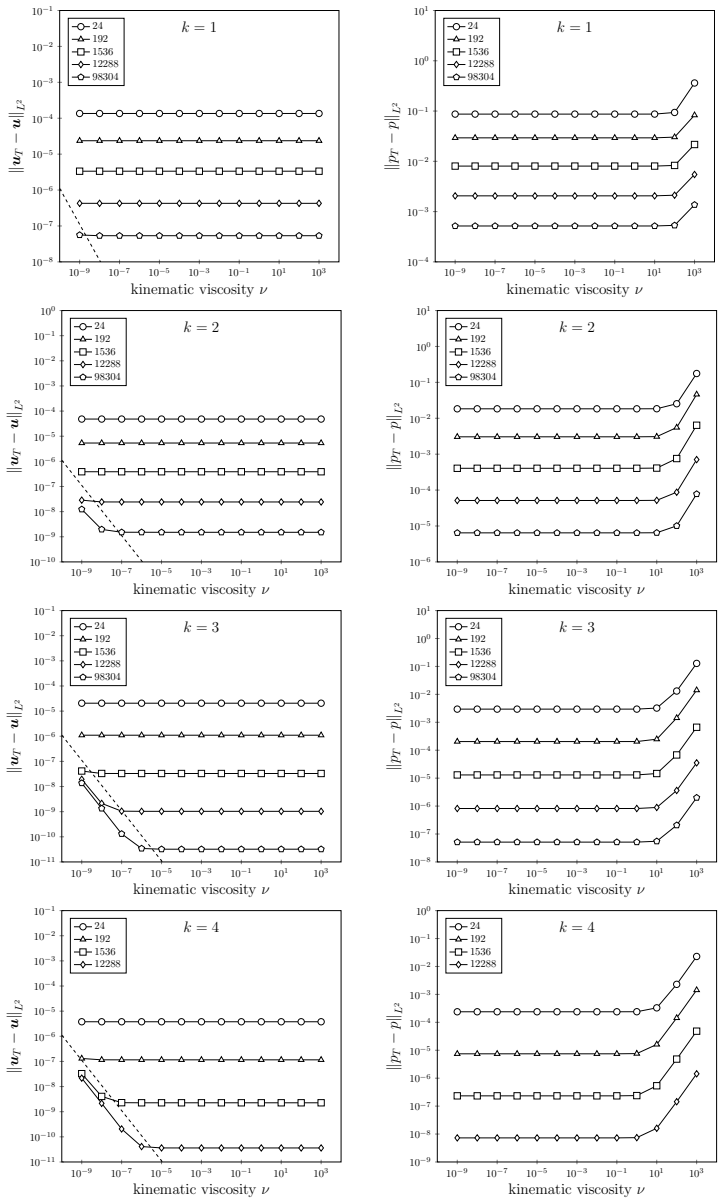
- [Section 4.1, Table 1] The pressure error in L2 stagnates around 1e-9 for the finest time steps; a brief explanation (e.g., round-off or spatial-error floor) would avoid the appearance of an unexplained saturation.
- [Section 3.7, Eq. (15)] The safety factor mu is introduced and set to sqrt(10), but its influence on the tolerance criterion is not discussed; a sentence clarifying why this value is chosen would help.
- [Section 4.1, Tables 2-6] For the smallest viscosities and some k values, the observed convergence rates in the convection-dominated regime are noticeably below the claimed k+3/2 (e.g., several k=0 rows in Table 2); a comment on whether this reflects pre-asymptotic behavior or a limitation of the manufactured solution would strengthen the validation.
Circularity Check
No circular derivation: the TGV benchmark is an external forward simulation, and the acknowledged older-code gap is a validation limitation, not a construction-level circularity.
full rationale
The paper's central method properties are cited from the authors' own analyses ([8] for pressure-robustness, [9] for Reynolds semi-robustness and for the L2-projected convective term), but these properties are independently exercised in Section 4 against analytical solutions (travelling waves, Ethier-Steinman, LLMS), and the Taylor-Green vortex result is benchmarked against the external DNS of van Rees et al. [39]. No fitted parameter is renamed as a prediction: the ESDIRK-HHO scheme is fixed by the formulation in Eqs. (2)-(12), and the TGV comparison is a forward simulation. The only load-bearing caveat is explicitly stated in Section 5: 'All the TGV computations have been performed with an older version of the code whose implementation omits L2 projections of test functions in the convective term formulation, see paragraph 3.4... it has not been possible to rerun all tests with the updated code implementation.' This means the DNS-like-precision claim is not yet demonstrated for the exact analyzed scheme, but that is a correctness and validation gap, not a circularity: the omitted projections are not fitted to the DNS data, and the claim does not reduce by construction to the paper's inputs. The self-citations to [8] and [9] are supported by independent numerical reproduction of the predicted convergence rates in Tables 2-6. Score 2 reflects the minor self-citation load and the explicit old-code limitation, not a circular derivation.
Assumptions & free parameters
free parameters (3)
- Double shear layer parameters =
xi = 1/30, delta = 1/20
- Time-step adaptation tolerance tola =
1e-4 to 1e-11 depending on test
- Safety factor mu =
sqrt(10)
assumptions (5)
- domain assumption Mesh shape and contact regularity
- standard math Cited stability and pressure-robustness theorems from [8] and [9]
- ad hoc to paper The discrete solution on coarse high-order meshes is a valid implicit LES representation
- standard math Newton's method converges to the discrete solution
- domain assumption Manufactured solutions are exact and sufficiently regular
Cite this review
Pith. "Pith review of Hybrid High-Order formulations with turbulence modelling capabilities for incompressible flow problems." pith.science (2026). https://pith.science/paper/3SL3D5CR
@misc{pith2026250522480,
  author       = {Pith},
  title        = {Pith review of: Hybrid High-Order formulations with turbulence modelling capabilities for incompressible flow problems},
  year         = {2026},
  howpublished = {\url{https://pith.science/paper/3SL3D5CR}},
  note         = {Machine review of arXiv:2505.22480}
}
abstract
We propose a Hybrid High-Order (HHO) formulation of the incompressible Navier--Stokes equations, that is well suited to be employed for the simulation of turbulent flows. The spatial discretization relies on hybrid velocity and pressure spaces and the temporal discretization is based on Explicit Singly Diagonal Implicit Runge-Kutta (ESDIRK) methods. The formulation possesses some attractive features that can be fruitfully exploited when high-fidelity computations are required, namely: pressure-robustness, conservation of mass enforced cell-by-cell up to machine precision, robustness in the inviscid limit, implicit high-order accurate time stepping with local time step adaptation, reduced memory footprint thanks to static condensation of both velocity and pressure, possibility to exploit inherited $p$-multilevel solution strategies to improve performance of iterative solvers. After demonstrating the relevant properties of the scheme in practice, performing challenging 2D and 3D test cases, we consider the simulation of the Taylor--Green Vortex flow problem at Reynolds 1600.
Figures


Figures from the paper (4 more)


Reference graph
Works this paper leans on
-
[1]
B. Cockburn, D. A. Di Pietro, A. Ern, Bridging the Hybrid High-Order and Hybridizable Discontinuous Galerkin methods, ESAIM: M2AN 50 (3) (2016) 635–650. doi:10.1051/m2an/2015051
arXiv 2016
-
[2]
D. A. Di Pietro, J. Droniou, A. Ern, A discontinuous-skeletal method for advection-diffusion-reaction on general meshes, SIAM J. Numer. Anal. 53 (5) (2015) 2135–2157. doi:10.1137/140993971
-
[3]
L. Botti, F. C. Massa, Hho methods for the incompressible navier-stokes and the incompressible euler equations, Journal of Scientific Computing 92 (28) (2022) 397–434. doi:10.1007/s10915-022-01864-1 . URL https://doi.org/10.1007/s10915-022-01864-1 20
-
[4]
J. Aghili, S. Boyaval, D. A. Di Pietro, Hybridization of mixed high-order methods on general meshes and application to the Stokes equations, Comput. Meth. Appl. Mat. 15 (2) (2015) 111–134. doi:10.1515/cmam-2015-0004
-
[5]
D. A. Di Pietro, A. Ern, A. Linke, F. Schieweck, A discontinuous skeletal method for the viscosity-dependent Stokes problem, Comput. Meth. Appl. Mech. Engrg. 306 (2016) 175–195. doi:10.1016/j.cma.2016.03.033
-
[6]
D. A. Di Pietro, S. Krell, A Hybrid High-Order method for the steady incompressible Navier–Stokes problem, J. Sci. Comput. 74 (3) (2018) 1677–1705. doi:10.1007/s10915-017-0512-x
-
[7]
L. Botti, D. A. Di Pietro, J. Droniou, A Hybrid High-Order method for the incompressible Navier–Stokes equations based on Temam’s device, J. Comput. Phys. 376 (2019) 786–816. doi:10.1016/j.jcp.2018.10.014
-
[8]
L. Botti, M. Botti, D. A. Di Pietro, F. C. Massa, Stability, convergence, and pressure-robustness of numerical schemes for incompressible flows with hybrid velocity and pressure, Math. Comp. (01 2025). arXiv:https://www.ams.org/ journals/mcom/0000-000-00/S0025-5718-2025-04049-3/ , doi:https://doi.org/10.1090/mcom/4049
Show all 39 references
-
[9]
Beir˜ ao da Veiga, D
L. Beir˜ ao da Veiga, D. A. Di Pietro, J. Droniou, K. B. Haile, T. J. Radley, A Reynolds-semi-robust method with hybrid velocity and pressure for the unsteady incompressible Navier–Stokes equations (2 2025). arXiv:2502.15293
2025
-
[10]
Linke, On the role of the Helmholtz decomposition in mixed methods for incompressible flows and a new variational crime, Comput
A. Linke, On the role of the Helmholtz decomposition in mixed methods for incompressible flows and a new variational crime, Comput. Methods Appl. Mech. Engrg. 268 (2014) 782–800. doi:10.1016/j.cma.2013.10.011
2014 doi
-
[11]
Rhebergen, G
S. Rhebergen, G. N. Wells, A hybridizable discontinuous Galerkin method for the Navier-Stokes equations with pointwise divergence-free velocity field, J. Sci. Comput. 76 (3) (2018) 1484–1501. doi:10.1007/s10915-018-0671-4
2018 doi
-
[12]
K. L. A. Kirk, S. Rhebergen, Analysis of a Pressure-Robust Hybridized Discontinuous Galerkin Method for the Stationary Navier–Stokes Equations, J. Sci. Comput. 81 (2) (2019) 881–897. doi:10.1007/s10915-019-01040-y
2019 doi
-
[13]
Castanon Quiroz, D
D. Castanon Quiroz, D. A. Di Pietro, A hybrid high-order method for the incompressible navier–stokes problem robust for large irrotational body forces, Computers & Mathematics with Applications 79 (9) (2020) 2655–2677. doi:https://doi.org/10.1016/j.camwa.2019.12.005. URL https...
2020 doi
-
[14]
Castanon Quiroz, D
D. Castanon Quiroz, D. A. Di Pietro, A pressure-robust hho method for the solution of the incompressible navier–stokes equations on general meshes, IMA Journal of Numerical Analysis 44 (1) (2023) 397–434. arXiv:https: //academic.oup.com/imajna/article-pdf/44/1/397/56532105/dra...
2023 doi
-
[15]
D. C. Quiroz, D. A. Di Pietro, A reynolds-semi-robust and pressure-robust hybrid high-order method for the time dependent incompressible navier–stokes equations on general meshes, Computer Methods in Applied Mechanics and Engineering 436 (2025) 117660. doi:https://doi.org/10.1...
2025
-
[16]
Lehrenfeld, J
C. Lehrenfeld, J. Sch¨ oberl, High order exactly divergence-free hybrid discontinuous galerkin methods for unsteady incompressible flows, Computer Methods in Applied Mechanics and Engineering 307 (2016) 339–361. doi:https: //doi.org/10.1016/j.cma.2016.04.025. URL https://www.s...
2016 doi
-
[17]
W. Qiu, L. Zhao, H(div)-conforming HDG methods for the stress-velocity formulation of the Stokes equations and the Navier–Stokes equations, Numerische Mathematik 156 (2024) 1639–1678. doi:10.1007/s00211-024-01419-6 . URL https://doi.org/10.1007/s00211-024-01419-6
2024 doi
-
[19]
C. R. Ethier, D. A. Steinman, Exact fully 3d navier–stokes solutions for benchmarking, International Journal for Numerical Methods in Fluids 19 (5) (1994) 369–375.arXiv:https://onlinelibrary.wiley.com/doi/pdf/10.1002/ fld.1650190502, doi:https://doi.org/10.1002/fld.1650190502....
1994 doi
-
[20]
P. L. Lederer, A. Linke, C. Merdon, J. Sch¨ oberl, Divergence-free Reconstruction Operators for Pressure-Robust Stokes Discretizations with Continuous Pressure Finite Elements, SIAM J. Numer. Anal. 55 (3) (2017) 1291–1314. doi:10.1137/16M1089964. 21
2017 doi
-
[21]
G. I. Taylor, A. E. Green, Mechanism of the production of small eddies from large ones, Proceedings of the Royal Society of London. Series A - Mathematical and Physical Sciences 158 (895) (1937) 499–521. arXiv:https:// royalsocietypublishing.org/doi/pdf/10.1098/rspa.1937.0036,...
1937
-
[22]
D. A. Di Pietro, J. Droniou, The Hybrid High-Order method for polytopal meshes, no. 19 in Modeling, Simulation and Application, Springer, Cham, 2020. doi:10.1007/978-3-030-37203-3
2020 doi
-
[23]
Lehrenfeld, Hybrid discontinuous galerkin methods for solving incompressible flow problems, Ph.D
C. Lehrenfeld, Hybrid discontinuous galerkin methods for solving incompressible flow problems, Ph.D. thesis, Rheinisch-Westf¨ alischen Technischen Hochschule Aachen (2010)
2010
-
[24]
C. A. Kennedy, M. H. Carpenter, Additive Runge–Kutta schemes for convection–diffusion–reaction equations, Applied Numerical Mathematics 44 (1) (2003) 139–181. doi:10.1016/S0168-9274(02)00138-1
2003 doi
-
[25]
C. A. Kennedy, M. H. Carpenter, Diagonally Implicit Runge-Kutta Methods for Ordinary Differential Equations. A Review, Tech. Rep. NASA/TM-2016-219173, NASA Langley Research Center (2016). URL https://ntrs.nasa.gov/citations/20160005923
2016
-
[26]
Botti, D
L. Botti, D. A. D. Pietro, p-Multilevel Preconditioners for HHO Discretizations of the Stokes Equations with Static Condensation, Commun. Appl. Math. Comput. 4 (2022) 783–822. doi:10.1007/s42967-021-00142-5 . URL https://doi.org/10.1007/s42967-021-00142-5
2022 doi
-
[27]
Soderlind, Digital filters in adaptive time-stepping, ACM Trans
G. Soderlind, Digital filters in adaptive time-stepping, ACM Trans. Math. Softw. 29 (1) (2003) 1–26
2003
-
[28]
Soderlind, L
G. Soderlind, L. Wang, Adaptive time-stepping and computational stability, Journal of Computational and Ap- plied Mathematics 185 (2) (2006) 225 – 243, special Issue: International Workshop on the Technological Aspects of Mathematics
2006
-
[29]
Hairer, G
E. Hairer, G. Wanner, Solving Ordinary Differential Equations II, Springer Series in Computational Mathematics, 1996
1996
-
[30]
J. Lang, D. Teleaga, Towards a fully space-time adaptive FEM for magnetoquasistatics, Magnetics, IEEE Transactions on 44 (6) (2008) 1238–1241
2008
-
[31]
Noventa, F
G. Noventa, F. Massa, S. Rebay, F. Bassi, A. Ghidoni, Robustness and efficiency of an implicit time-adaptive dis- continuous galerkin solver for unsteady flows, Computers & Fluids 204 (2020) 104529. doi:10.1016/j.compfluid. 2020.104529
2020
-
[32]
Ghidoni, F
A. Ghidoni, F. Massa, G. Noventa, S. Rebay, Assessment of an adaptive time integration strategy for a high-order discretization of the unsteady RANS equations, International Journal for Numerical Methods in Fluids 94 (12) (2022) 1923–1963. doi:10.1002/fld.5131
2022 doi
-
[33]
Botti, D
L. Botti, D. A. Di Pietro, Numerical assessment of Hybrid High-Order methods on curved meshes and comparison with discontinuous Galerkin methods, J. Comput. Phys. 370 (2018) 58–84. doi:10.1016/j.jcp.2018.05.017
2018 doi
-
[34]
Bassi, L
F. Bassi, L. Botti, A. Colombo, D. A. Di Pietro, P. Tesini, On the flexibility of agglomeration based physical space discontinuous Galerkin discretizations, J. Comput. Phys. 231 (1) (2012) 45–65. doi:10.1016/j.jcp.2011.08.018
2012 doi
-
[35]
Balay, S
S. Balay, S. Abhyankar, M. F. Adams, J. Brown, P. Brune, K. Buschelman, L. Dalcin, V. Eijkhout, W. D. Gropp, D. Kaushik, M. G. Knepley, L. C. McInnes, K. Rupp, B. F. Smith, S. Zampini, H. Zhang, PETSc users manual, Tech. Rep. ANL-95/11 - Revision 3.6, Argonne National Laborato...
2015
-
[36]
J. B. Bell, P. Colella, H. M. Glaz, A Second-Order Projection Method for the Incompressible Navier–Stokes Equations, J. Comput. Phys. 85 (1989) 257–283. doi:10.1007/s10494-018-0005-5
1989 doi
-
[37]
N. Fehn, M. Kronbichler, C. Lehrenfeld, G. Lube, P. W. Schroeder, High-order dg solvers for underresolved turbulent incompressible flows: A comparison of l2 and h(div) methods, International Journal for Numerical Methods in Fluids 91 (11) (2019) 533–556. arXiv:https://onlineli...
2019 doi
-
[38]
N. Fehn, W. A. Wall, M. Kronbichler, Robust and efficient discontinuous galerkin methods for under-resolved turbulent incompressible flows, Journal of Computational Physics 372 (2018) 667–693.doi:https://doi.org/10.1016/j.jcp. 2018.06.037. URL https://www.sciencedirect.com/sci...
2018 doi
-
[39]
W. M. van Rees, A. Leonard, D. Pullin, P. Koumoutsakos, A comparison of vortex and pseudo-spectral methods for the simulation of periodic vortical flows at high reynolds numbers, Journal of Computational Physics 230 (8) (2011) 2794–2805. doi:https://doi.org/10.1016/j.jcp.2010....
2011 doi
-
[40]
Yemm, A new approach to handle curved meshes in the Hybrid High-Order method, Foundations of Computational Mathematics 24 (2024) 1049–1076
L. Yemm, A new approach to handle curved meshes in the Hybrid High-Order method, Foundations of Computational Mathematics 24 (2024) 1049–1076. doi:10.1007/s10208-023-09615-w . URL https://doi.org/10.1007/s10208-023-09615-w 23
2024 doi
Reviewed August 7, 2026 · model on record in the stance chip above.
Discussion (0). Sign in to comment.