REVIEW 4 major objections 7 minor 186 references
A Comprehensive Analysis of Rovibrational CO in the Era of JWST
T0 review · 4 major / 7 minor · reviewed 2026-08-06 · deepseek-v4-flash
Pith's one-line read This paper argues that the CO-emitting region in the inner few AU of planet-forming disks is a ring of variable width whose outer edge is set by disk structure, not by a single temperature cutoff.
desk verdict A valuable reference survey with a central geometry claim that outruns the flagged degeneracies in its own retrievals. read the letter →
The pith
A machine-rendered reading of the paper's core claim, the machinery that carries it, and where it could break.
The reading
What carries the argument
The load-bearing tool is the single-temperature slab model, which treats the CO gas as a uniform slab with three free parameters—column density, temperature, and solid angle—and fits each source's rotation diagram (the curve of line flux against excitation energy) by MCMC retrieval. The solid angle is converted to an emitting area using each source's distance, and to a deprojected radius using the disk inclination, with 45 degrees adopted when no inclination is available. The geometric test compares the retrieved area with an independent inner radius derived from Keplerian line broadening, $R_{\mathrm{CO}} = GM\,(\sin i/(1.7\times\mathrm{HWHM}))^2$, and with an experimental outer radius $R_{\mathrm{out}}$ computed by assuming the area is a ring with inner radius $R_{\mathrm{CO}}$.
What would settle it
Directly resolve the CO-emitting region with spectro-astrometry or long-baseline infrared interferometry for a sample of these 67 disks. If the resolved emission is consistent with a single thin ring of constant width across stellar luminosity, or if the outer edge tracks the temperature cutoff expected from stellar luminosity, the structure-driven ring claim is refuted. A cheaper check is to refit the highest-S/N sources with a two-component narrow-plus-broad model and test whether the area-radius dispersion in Figure 17 collapses.
Extended reading notes
Core claim
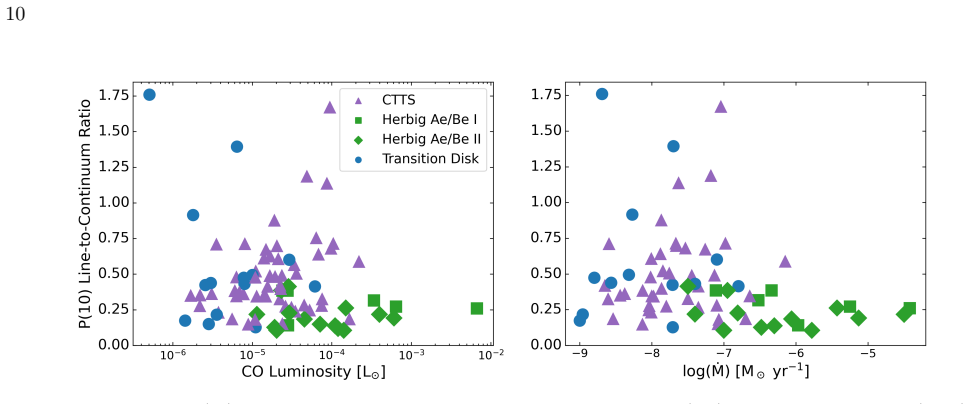
The paper's central discovery is that, across 67 disks with successful slab retrievals, the CO rovibrational emitting area cannot be reproduced by a thin ring of constant width: plotting the deprojected emitting area against the Keplerian inner radius $R_{\mathrm{CO}}$ shows a positive but highly dispersed trend, with outer-to-inner radius ratios spanning roughly 1 to 50 and no tight relation of the form $A = 2\pi R\,\Delta R$ for any single width $\Delta R$. The outer radius of the CO emission shows no dependence on stellar luminosity or on the temperature cutoff that stellar heating would produce, so the paper concludes that the emitting region is a ring whose size is set by structure in the disk, such as a gap or cavity, rather than by a universal temperature boundary. The paper also reports that Herbig Ae/Be disks have cooler and larger CO-emitting regions than T Tauri disks, that CO luminosity correlates with accretion rate across the sample, and that no weak-line T Tauri star in the sample shows CO rovibrational emission.
Load-bearing premise
The conclusion rests on assuming that the area recovered from line fluxes by a single-temperature slab model is the true physical area of the CO-emitting gas, once the assumed disk inclination and ring geometry are used to convert that area into a radius.
Editorial extensions
If this is right
- The 67-source slab retrieval catalog provides a reference set of inner-disk CO temperatures, column densities, and emitting areas for T Tauri, Herbig, and transition disks.
- Classical T Tauri stars are the better JWST targets for rovibrational CO because their line-to-continuum ratios are higher; Herbig non-detections should not be read as absence of CO.
- Combining ground-based high-resolution spectra with JWST-MIRI data changes the retrieved temperature substantially, so joint fits are needed for accurate inner-disk temperatures.
- The lack of a temperature-cutoff trend implies the outer edge of CO emission can mark a structural boundary, making CO emitting radii a useful diagnostic in searches for inner-disk gaps or planets.
Reading between the lines
- If the variable ring size is genuinely set by disk substructure, time-domain monitoring of CO line widths and areas could reveal inner-disk gaps or clearing events as they evolve, a testable extension the paper does not pursue.
- The single-slab assumption and the 45-degree inclination fallback are the most fragile links in the geometry argument; refitting the highest-S/N sources with a two-component model could either strengthen or dissolve the 'no thin ring' conclusion.
- Matching the CO outer radii against ALMA mm-dust substructure for the same sources would directly test whether the CO outer edge coincides with a particular dust gap or ring, since the paper has no spatially resolved inner-disk imaging.
- The Table 5 line-to-continuum predictions for JWST assume the slab parameters hold at JWST resolution; verifying them with a handful of already-observed JWST targets would quickly test that assumption.
Editorial analysis
A structured set of objections, weighed in public.
Referee Report
Summary. The paper compiles two decades of Keck-NIRSPEC M-band spectra of 183 pre-main-sequence objects, detects CO rovibrational emission in 96, presents detection statistics by disk/stellar subtype, models 67 detected sources with single-slab MCMC retrievals, and reports retrieved temperatures, column densities, and emitting areas. It argues that Herbig Ae/Be disks have cooler and larger CO-emitting regions than T Tauri disks, and that the CO emitting area is not a thin ring of constant width but a ring whose size is set by disk substructure. It closes with empirical guidance and integration-time estimates for detecting CO rovibrational lines with JWST.
Significance. If its central claim holds, the paper provides a valuable reference: a homogeneous, decades-long Keck-NIRSPEC sample with public spectra, machine-readable line fluxes, a 67-object slab retrieval catalog, and an explicit link between ground-based high-resolution data and JWST observability. The CO luminosity-accretion rate correlation and the sharp WTTS/Class III non-detections are useful empirical results that will inform JWST disk programs. The paper is also commendable for making reduced spectra publicly available and for being transparent about retrieval degeneracies in Table 3. However, the headline geometry conclusion depends on retrieved emitting areas that the paper itself flags as degenerate in many sources; the strength of the claim currently exceeds what those data support.
major comments (4)
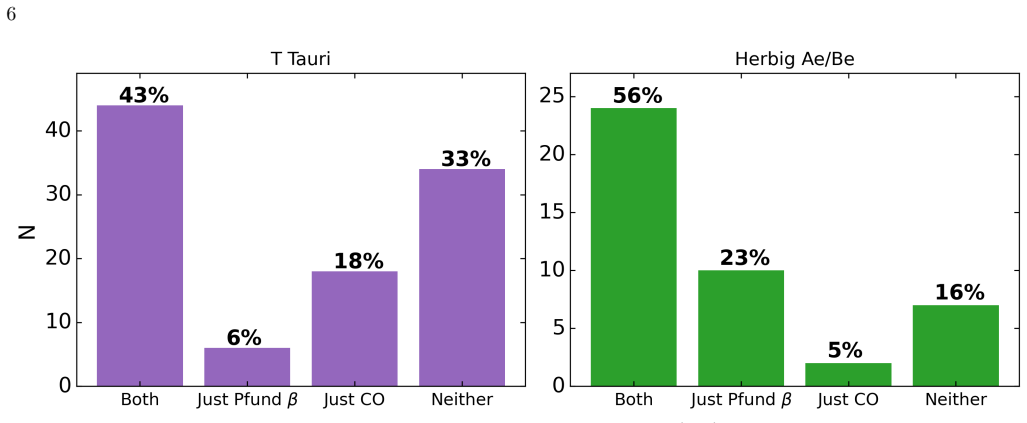
- [Abstract and §3.1] The detection statistics are internally inconsistent. The abstract reports 82% for transition disks, 61% for Herbigs, and 77% for CTTSs, while §3.1 first says that 78 confirmed Class II objects are '82% of the objects with CO emission lines detected,' then gives TTS 72% and Herbig 62%, and later gives TTS 61% and Herbig 60%. In addition, 13 of 17 transition disks is 76%, not 82%. Because the detection-rate summary is a headline quantitative result, please reconcile all numbers and state the denominators for every rate.
- [§4.1 and Table 2] No uncertainties are quoted for the line fluxes in Table 2, even though these fluxes feed the rotation diagrams, slab retrievals, and all subsequent correlations. The text describes Gaussian and numerically integrated fluxes but does not report a noise budget, telluric-residual error, continuum-placement error, or variability term, nor does it describe how such uncertainties were propagated into the MCMC credible intervals in Table 3. Please provide flux uncertainties and demonstrate that the retrieval results are robust to them.
- [§4.3, Table 3, Figures 15–17] The central 'not a thin ring' conclusion depends on retrieved emitting areas that Section 4.3 explicitly states are degenerate with column density in optically thin cases, flagged as F or T in Table 3. Several of the largest-area points are effectively unconstrained: HD 37806 (area 58 +250/-48 au^2, F), LkHA 224 (508 +760/-430 au^2), DG Tau (46.5 +240/-39 au^2), HD 244604 (45 +210/-40 au^2), and GI Tau (4.87 +140/-4.7 au^2). These points are marked with plus signs in Figure 17; if they dominate the scatter, the rejection of a thin ring and the inference of disk-substructure-dependent emission do not follow. Please repeat the geometry analysis using only sources without F/T flags, or with a model that breaks the degeneracy (e.g., including 13CO or CO 2-1 lines), and report how the conclusion changes.
- [§5.4 and Figure 16] The conclusion that R_out does not correlate with stellar luminosity, which is used to exclude a temperature-cutoff scenario, relies on R_out = sqrt(A/pi + R_CO^2). This quantity inherits the area degeneracy discussed above and also depends on assumed inclinations, with many sources using the 45-degree fallback marked in Table 4. Without propagating the retrieval and inclination uncertainties, the absence of a trend may be noise rather than evidence against a temperature boundary. Please provide confidence intervals on R_out and check whether the conclusion survives when degenerate sources and sources with assumed inclinations are excluded.
minor comments (7)
- [§2.2] The text says 151 objects have confirmed SED disk classifications, but the listed categories (120 Class II + 12 Class III + 12 debris + 17 transition) sum to 161; please correct either the total or the category counts.
- [Abstract] The abstract states that 53% of the sample has CO emission; 96/183 is 52.5%, so please specify the rounding convention or quote 96/183.
- [Figure 5 caption] The caption says 'six objects' are presented, while the text describes five example types; please align the number and the list of objects.
- [Table 1 references] The reference list has duplicate numbered entries, for example (17) and (24) both cite Cieza et al. 2007; please renumber and deduplicate so that citation numbers are unique.
- [Equation 3 and §6] Equation (3) defines t = A L^b, but the normalization A is only described as dependent on the desired S/N squared; please specify its units, how it was anchored to real data, and the exact meaning of L (continuum flux at which wavelength).
- [§6] The manuscript uses 'JWST-NIRSpec,' 'JWST-NIRSPEC,' and 'Keck-NIRSPEC' in ways that can confuse readers; standardize the instrument names throughout.
- [§4.3] The 'hot CO' TTS subtype is introduced but not defined quantitatively; please state the temperature threshold or fitting criterion used to assign this label.
Circularity Check
No significant circularity: the geometry claim compares independent reductions (slab-fit areas vs. line-width radii), and the JWST estimates are forward sample statistics, not derived predictions.
full rationale
The paper's central geometry claim (Sec. 5.4, Fig. 17) compares slab-retrieved emitting areas with R_CO derived from line FWHMs. These are different reductions of the same spectra: the area comes from line-flux ratios in a three-parameter slab fit, while R_CO comes from Keplerian broadening of stacked line profiles. No equation in the paper defines the area in terms of R_CO (or vice versa); the ring conversions A = pi(R_out^2 - R_in^2) and A = 2*pi*R*DeltaR are geometric scalings applied after the retrieval, not identities that force the conclusion. The flagged F/T degeneracies in Sec. 4.3 and Table 3 are statistical robustness concerns about how well the areas are constrained, not circular construction. The JWST 'predictions' (Table 5, Eq. 3) are sample statistics and empirically anchored scaling relations for future observations, not first-principles forecasts whose outputs equal their inputs. Self-citations (e.g., Salyk et al. 2011 for the 1.7xHWHM calibration, spectools_ir for the slab code) are present, but they are external empirical calibrations and code, not a uniqueness theorem or an assumption of the conclusion. Therefore no step reduces by construction; the derivation chain is self-contained.
Assumptions & free parameters
free parameters (6)
- Slab gas temperature T =
450 to 3000 K across sample (Table 3)
- Slab column density N =
10^14.9 to 10^19.8 cm^-2 (Table 3)
- Slab solid angle / emitting area =
0.004 to 508 au^2 (Table 3)
- Temperature prior upper limit =
1750 K, raised to 3000 K for some TTS
- Assumed inclination =
45 degrees for sources without literature values
- Integration time normalization A =
not specified; depends on desired S/N squared
assumptions (6)
- domain assumption CO rovibrational emission can be modeled as a single isothermal slab with constant column density and area.
- domain assumption Line broadening is dominated by Keplerian rotation, so R_CO = GM (sin i / (1.7 HWHM))^2.
- domain assumption The emitting area converts to radius as a circle projected by inclination, and to an outer radius via a ring A = pi(R_out^2 - R_in^2).
- domain assumption Literature distances, stellar masses, accretion rates, and inclinations in Table 1 are accurate.
- domain assumption Detection statistics are not dominated by selection biases, despite sample incompleteness below 0.3 Msun and at Dec < -40.
- ad hoc to paper The MCMC priors do not bias the retrieved parameters.
Cite this review
Pith. "Pith review of A Comprehensive Analysis of Rovibrational CO in the Era of JWST." pith.science (2026). https://pith.science/paper/3STFVYZ2
@misc{pith2026250716127,
  author       = {Pith},
  title        = {Pith review of: A Comprehensive Analysis of Rovibrational CO in the Era of JWST},
  year         = {2026},
  howpublished = {\url{https://pith.science/paper/3STFVYZ2}},
  note         = {Machine review of arXiv:2507.16127}
}
read the original abstract
We present an analysis of CO rovibrational emission lines in the 183 infrared spectra of nearby Class II objects obtained with the NIRSPEC instrument on the Keck II telescope over the past two decades. The sample includes a broad range of stellar mass (both T Tauri and Herbig Ae/Be) and disk evolutionary states (from full to debris disks). We find that 53% of the sample has CO rovibrational emission lines present in their spectrum with disk/stellar subtype detection rates of 82% for transition disks, 61% for Herbigs, and 77% for CTTSs. Although there is no discernible difference between T Tauri and Herbig Ae/Be star CO detection rates, the detection of accretion and of CO are statistically correlated in T Tauri stars but not in Herbig Ae/Be objects. Within the sample of T Tauri stars, we find that no weak-line T Tauri stars have CO rovibrational emission lines. We use slab modeling to analyze the density, temperature, and emitting area of the sample. The retrieval results imply that Herbig Ae/Be objects tend to have cooler and larger CO emitting regions than T Tauri stars. We find that the CO emitting area is not a thin ring as defined by temperature, but a ring of varying size likely dependent on the structure of the disk. We also present guidelines on how to approach CO rovibrational emission lines in JWST spectra and present methods for linking ground-based observations with JWST spectra. This includes line-to-continuum ratio estimates based on stellar mass and accretion rate.
Figures


Figures from the paper (17 more)




Reference graph
Works this paper leans on
-
[1]
, " * write output.state after.block = add.period write newline
ENTRY address archivePrefix author booktitle chapter doi edition editor eprint howpublished institution journal key month number organization pages publisher school series title misctitle type volume year version url label extra.label sort.label short.list INTEGERS output.state before.all mid.sentence after.sentence after.block FUNCTION init.state.consts ...
-
[2]
write newline
" write newline "" before.all 'output.state := FUNCTION format.url url empty "" new.block "" url * "" * if FUNCTION format.eprint eprint empty "" archivePrefix empty "" archivePrefix "arXiv" = new.block " " eprint * " " * new.block " " eprint * " " * if if if FUNCTION format.doi doi empty "" " " doi * " " * if FUNCTION format.pid doi empty eprint empty ur...
-
[3]
"֬Y =\ر#
thebibliography [1] 20pt to REFERENCES 6pt =0pt \@twocolumntrue 12pt -12pt 10pt plus 3pt =0pt =0pt =1pt plus 1pt =0pt =0pt -12pt =13pt plus 1pt =20pt =13pt plus 1pt \@M =10000 =-1.0em =0pt =0pt 0pt =0pt =1.0em @enumiv\@empty 10000 10000 `\.\@m \@noitemerr \@latex@warning Empty `thebibliography' environment \@ifnextchar \@reference \@latexerr Missing key o...
2017
-
[4]
Adkins , S. M., McLean , I. S., Fitzgerald , M. P., et al. 2016, in Society of Photo-Optical Instrumentation Engineers (SPIE) Conference Series, Vol. 9908, Ground-based and Airborne Instrumentation for Astronomy VI, ed. C. J. Evans , L. Simard , & H. Takami , 990805, 10.1117/12.2233759
-
[5]
Alcal \'a , J. M., Natta , A., Manara , C. F., et al. 2014, , 561, A2, 10.1051/0004-6361/201322254
-
[6]
Alcal \'a , J. M., Manara , C. F., Natta , A., et al. 2017, , 600, A20, 10.1051/0004-6361/201629929
-
[7]
M., Gangi , M., Biazzo , K., et al
Alcal \'a , J. M., Gangi , M., Biazzo , K., et al. 2021, , 652, A72, 10.1051/0004-6361/202140918
-
[8]
Andrews , S. M. 2020, , 58, 483, 10.1146/annurev-astro-031220-010302
Show all 186 references
- [9]
-
[10]
2016, , 585, A61, 10.1051/0004-6361/201526787
Antonellini , S., Kamp , I., Lahuis , F., et al. 2016, , 585, A61, 10.1051/0004-6361/201526787
2016 doi
-
[11]
Bailer-Jones , C. A. L., Rybizki , J., Fouesneau , M., Demleitner , M., & Andrae , R. 2021, , 161, 147, 10.3847/1538-3881/abd806
2021 doi
-
[12]
P., & Eisner , J
Ballering , N. P., & Eisner , J. A. 2019, , 157, 144, 10.3847/1538-3881/ab0a56
2019 doi
-
[13]
2018, , 609, L2, 10.1051/0004-6361/201732034
Banzatti , A., Garufi , A., Kama , M., et al. 2018, , 609, L2, 10.1051/0004-6361/201732034
2018 doi
-
[14]
M., Brittain , S., et al
Banzatti , A., Abernathy , K. M., Brittain , S., et al. 2022, , 163, 174, 10.3847/1538-3881/ac52f0
2022 doi
- [15]
-
[16]
E., Brown , J
Bast , J. E., Brown , J. M., Herczeg , G. J., van Dishoeck , E. F., & Pontoppidan , K. M. 2011, , 527, A119, 10.1051/0004-6361/201015225
2011 doi
-
[17]
2023, in Astronomical Society of the Pacific Conference Series, Vol
Benisty , M., Dominik , C., Follette , K., et al. 2023, in Astronomical Society of the Pacific Conference Series, Vol. 534, Protostars and Planets VII, ed. S. Inutsuka , Y. Aikawa , T. Muto , K. Tomida , & M. Tamura , 605, 10.48550/arXiv.2203.09991
-
[18]
K., Follette , K
Betti , S. K., Follette , K. B., Ward-Duong , K., et al. 2023, , 166, 262, 10.3847/1538-3881/ad06b8
2023 doi
-
[19]
A., Richter , M
Bitner , M. A., Richter , M. J., Lacy , J. H., et al. 2008, , 688, 1326, 10.1086/592317
2008 doi
- [20]
-
[21]
J., Benisty , M., Perraut , K., et al
Bohn , A. J., Benisty , M., Perraut , K., et al. 2022, , 658, A183, 10.1051/0004-6361/202142070
2022 doi
-
[22]
D., Banzatti , A., Bruderer , S., et al
Bosman , A. D., Banzatti , A., Bruderer , S., et al. 2019, , 631, A133, 10.1051/0004-6361/201935910
2019 doi
-
[23]
1992, , 92, 481
Bouvier , J., & Appenzeller , I. 1992, , 92, 481
1992
-
[24]
Bouvier , J., Alecian , E., Alencar , S. H. P., et al. 2020, , 643, A99, 10.1051/0004-6361/202038892
2020 doi
-
[25]
D., Najita , J
Brittain , S. D., Najita , J. R., & Carr , J. S. 2009, , 702, 85, 10.1088/0004-637X/702/1/85
2009 doi
-
[26]
M., Pontoppidan , K
Brown , J. M., Pontoppidan , K. M., van Dishoeck , E. F., et al. 2013, , 770, 94, 10.1088/0004-637X/770/2/94
2013 doi
-
[27]
2013, , 554, A66, 10.1051/0004-6361/201321418
Caratti o Garatti , A., Garcia Lopez , R., Weigelt , G., et al. 2013, , 554, A66, 10.1051/0004-6361/201321418
2013 doi
-
[28]
M., Esplin , T
Carpenter , J. M., Esplin , T. L., Luhman , K. L., Mamajek , E. E., & Andrews , S. M. 2025, , 978, 117, 10.3847/1538-4357/ad8ebc
2025 doi
-
[29]
S., Mathieu , R
Carr , J. S., Mathieu , R. D., & Najita , J. R. 2001, , 551, 454, 10.1086/320071
2001 doi
-
[30]
M., & Eiroa , C
Casali , M. M., & Eiroa , C. 1996, , 306, 427
1996
-
[31]
M., Perez , S., et al
Casassus , S., van der Plas , G. M., Perez , S., et al. 2013, , 493, 191, 10.1038/nature11769
2013 doi
-
[32]
2021, , 507, 3789, 10.1093/mnras/stab2359
Casassus , S., Christiaens , V., C \'a rcamo , M., et al. 2021, , 507, 3789, 10.1093/mnras/stab2359
2021 doi
-
[33]
H., Mittal , T., Kuchner , M., et al
Chen , C. H., Mittal , T., Kuchner , M., et al. 2014, , 211, 25, 10.1088/0067-0049/211/2/25
2014 doi
- [34]
-
[35]
L., Stapelfeldt , K
Cieza , L., Padgett , D. L., Stapelfeldt , K. R., et al. 2007, , 667, 308, 10.1086/520698
2007 doi
- [36]
-
[37]
Cohen , M., & Kuhi , L. V. 1979, , 41, 743, 10.1086/190641
1979 doi
-
[38]
2012, , 427, 1344, 10.1111/j.1365-2966.2012.22008.x
Costigan , G., Scholz , A., Stelzer , B., et al. 2012, , 427, 1344, 10.1111/j.1365-2966.2012.22008.x
2012
-
[39]
M., & Walther , D
Coulson , I. M., & Walther , D. M. 1995, , 274, 977, 10.1093/mnras/274.4.977
1995 doi
-
[40]
A., & Russo , G
Covino , E., Terranegra , L., Vittone , A. A., & Russo , G. 1984, , 89, 1868, 10.1086/113697
1984 doi
-
[41]
1969, , 74, 375, 10.1086/110819
Cowley , A., Cowley , C., Jaschek , M., & Jaschek , C. 1969, , 74, 375, 10.1086/110819
1969 doi
-
[42]
D., Launhardt , R., et al
Cugno , G., Pearce , T. D., Launhardt , R., et al. 2023, , 669, A145, 10.1051/0004-6361/202244891
2023 doi
-
[43]
2021, , 912, 6, 10.3847/1538-4357/abebe3
Czekala , I., Ribas , \'A ., Cuello , N., et al. 2021, , 912, 6, 10.3847/1538-4357/abebe3
2021 doi
- [44]
-
[45]
E., Busfield , G., Hoare , M
Drew , J. E., Busfield , G., Hoare , M. G., et al. 1997, , 286, 538, 10.1093/mnras/286.3.538
1997 doi
-
[46]
2010, , 712, 112, 10.1088/0004-637X/712/1/112
Duch \^e ne , G., McCabe , C., Pinte , C., et al. 2010, , 712, 112, 10.1088/0004-637X/712/1/112
2010 doi
-
[47]
P., Dominik , C., & Natta , A
Dullemond , C. P., Dominik , C., & Natta , A. 2001, , 560, 957, 10.1086/323057
2001 doi
-
[48]
K., Barlow , M
Dunkin , S. K., Barlow , M. J., & Ryan , S. G. 1997, , 286, 604, 10.1093/mnras/286.3.604
1997 doi
-
[49]
1997, ESA Special Publication, Vol
ESA , ed. 1997, ESA Special Publication, Vol. 1200, The HIPPARCOS and TYCHO catalogues. Astrometric and photometric star catalogues derived from the ESA HIPPARCOS Space Astrometry Mission
1997
-
[50]
L., & Luhman , K
Esplin , T. L., & Luhman , K. L. 2020, , 159, 282, 10.3847/1538-3881/ab8dbd
2020 doi
-
[51]
L., Luhman , K
Esplin , T. L., Luhman , K. L., Miller , E. B., & Mamajek , E. E. 2018, , 156, 75, 10.3847/1538-3881/aacce0
2018 doi
-
[52]
E., Blake , G
Evans , Neal J., I., Allen , L. E., Blake , G. A., et al. 2003, , 115, 965, 10.1086/376697
2003 doi
-
[53]
J., Dunham , M
Evans , II, N. J., Dunham , M. M., J rgensen , J. K., et al. 2009, , 181, 321, 10.1088/0067-0049/181/2/321
2009 doi
-
[54]
2020, , 639, A121, 10.1051/0004-6361/202038027
Facchini , S., Benisty , M., Bae , J., et al. 2020, , 639, A121, 10.1051/0004-6361/202038027
2020 doi
-
[55]
R., Oudmaijer , R
Fairlamb , J. R., Oudmaijer , R. D., Mendigut \' a , I., Ilee , J. D., & van den Ancker , M. E. 2015, , 453, 976, 10.1093/mnras/stv1576
2015 doi
- [56]
- [57]
-
[58]
Fernandez , M., Ortiz , E., Eiroa , C., & Miranda , L. F. 1995, , 114, 439
1995
-
[59]
A., & Gabbasov , R
Fern \'a ndez-L \'o pez , M., Zapata , L. A., & Gabbasov , R. 2017, , 845, 10, 10.3847/1538-4357/aa7d51
2017 doi
-
[60]
1997, , 318, 783
Figueiredo , J. 1997, , 318, 783
1997
-
[61]
F., Nisini , B., et al
Fiorellino , E., Manara , C. F., Nisini , B., et al. 2021, , 650, A43, 10.1051/0004-6361/202039264
2021 doi
-
[62]
2020, , 892, 111, 10.3847/1538-4357/ab7b63
Francis , L., & van der Marel , N. 2020, , 892, 111, 10.3847/1538-4357/ab7b63
2020 doi
-
[63]
2006, , 165, 568, 10.1086/505468
Furlan , E., Hartmann , L., Calvet , N., et al. 2006, , 165, 568, 10.1086/505468
2006 doi
-
[64]
L., Espaillat , C., et al
Furlan , E., Luhman , K. L., Espaillat , C., et al. 2011, , 195, 3, 10.1088/0067-0049/195/1/3
2011 doi
-
[65]
Gaia Collaboration , Vallenari , A., Brown , A. G. A., et al. 2023, , 674, A1, 10.1051/0004-6361/202243940
2023 doi
-
[66]
Galli , P. A. B., Loinard , L., Ortiz-L \'e on , G. N., et al. 2018, , 859, 33, 10.3847/1538-4357/aabf91
2018 doi
-
[67]
F., Folha , D
Gameiro , J. F., Folha , D. F. M., & Costa , V. M. 2002, , 388, 504, 10.1051/0004-6361:20020413
2002 doi
-
[68]
2006, , 459, 837, 10.1051/0004-6361:20065575
Garcia Lopez , R., Natta , A., Testi , L., & Habart , E. 2006, , 459, 837, 10.1051/0004-6361:20065575
2006 doi
-
[69]
M., Brasseur , C
Ginsburg , A., Sip o cz , B. M., Brasseur , C. E., et al. 2019, , 157, 98, 10.3847/1538-3881/aafc33
2019 doi
-
[71]
2022 b , , 277, 107949, 10.1016/j.jqsrt.2021.107949
---. 2022 b , , 277, 107949, 10.1016/j.jqsrt.2021.107949
2022
-
[72]
N., Bouvier , J., Herbst , W., & Melnikov , S
Grankin , K. N., Bouvier , J., Herbst , W., & Melnikov , S. Y. 2008, , 479, 827, 10.1051/0004-6361:20078476
2008 doi
-
[73]
L., Espaillat , C
Grant , S. L., Espaillat , C. C., Brittain , S., Scott-Joseph , C., & Calvet , N. 2022, , 926, 229, 10.3847/1538-4357/ac450a
2022 doi
-
[74]
2019, , 632, A53, 10.1051/0004-6361/201936403
GRAVITY Collaboration , Perraut , K., Labadie , L., et al. 2019, , 632, A53, 10.1051/0004-6361/201936403
2019 doi
-
[75]
2021, , 655, A73, 10.1051/0004-6361/202141624
---. 2021, , 655, A73, 10.1051/0004-6361/202141624
2021 doi
-
[76]
O., Riggs , Q
Gray , R. O., Riggs , Q. S., Koen , C., et al. 2017, , 154, 31, 10.3847/1538-3881/aa6d5e
2017 doi
-
[77]
1999, , 348, 570
Guilloteau , S., Dutrey , A., & Simon , M. 1999, , 348, 570
1999
-
[78]
2021, , 650, A182, 10.1051/0004-6361/202039519
Guzm \'a n-D \' az , J., Mendigut \' a , I., Montesinos , B., et al. 2021, , 650, A182, 10.1051/0004-6361/202039519
2021 doi
-
[79]
M., Shipman , R
Heras , A. M., Shipman , R. F., Price , S. D., et al. 2002, , 394, 539, 10.1051/0004-6361:20021124
2002 doi
-
[80]
Herbig , G. H. 1977 a , , 214, 747, 10.1086/155304
1977 doi
- [81]
-
[82]
H., & Bell , K
Herbig , G. H., & Bell , K. R. 1988, Third Catalog of Emission-Line Stars of the Orion Population : 3 : 1988
1988
-
[83]
H., & Kameswara Rao , N
Herbig , G. H., & Kameswara Rao , N. 1972, , 174, 401, 10.1086/151500
1972 doi
-
[84]
H., Vrba , F
Herbig , G. H., Vrba , F. J., & Rydgren , A. E. 1986, , 91, 575, 10.1086/114039
1986 doi
-
[85]
P., Warner , J
Herbst , W., Miller , D. P., Warner , J. W., & Herzog , A. 1982, , 87, 98, 10.1086/113085
1982 doi
-
[86]
Herbst , W., & Shevchenko , V. S. 1999, , 118, 1043, 10.1086/300966
1999 doi
-
[87]
J., Brown , J
Herczeg , G. J., Brown , J. M., van Dishoeck , E. F., & Pontoppidan , K. M. 2011, , 533, A112, 10.1051/0004-6361/201016246
2011 doi
-
[88]
J., & Hillenbrand , L
Herczeg , G. J., & Hillenbrand , L. A. 2014, , 786, 97, 10.1088/0004-637X/786/2/97
2014 doi
-
[89]
2004, , 127, 1682, 10.1086/381908
Hern \'a ndez , J., Calvet , N., Brice \ n o , C., Hartmann , L., & Berlind , P. 2004, , 127, 1682, 10.1086/381908
2004 doi
-
[90]
A., Carpenter , J
Hillenbrand , L. A., Carpenter , J. M., Kim , J. S., et al. 2008, , 677, 630, 10.1086/529027
2008 doi
-
[91]
1982, Michigan Catalogue of Two-dimensional Spectral Types for the HD stars
Houk , N. 1982, Michigan Catalogue of Two-dimensional Spectral Types for the HD stars. Volume\_3. Declinations -40\_ 0 to -26\_ 0
1982
-
[92]
1988, Michigan Catalogue of Two-dimensional Spectral Types for the HD Stars
Houk , N., & Smith-Moore , M. 1988, Michigan Catalogue of Two-dimensional Spectral Types for the HD Stars. Volume 4, Declinations -26 .0 to -12 .0
1988
-
[93]
1999, Michigan Spectral Survey, 5, 0
Houk , N., & Swift , C. 1999, Michigan Spectral Survey, 5, 0
1999
-
[94]
M., Cleeves , L
Huang , J., Andrews , S. M., Cleeves , L. I., et al. 2018 a , , 852, 122, 10.3847/1538-4357/aaa1e7
2018 doi
-
[95]
M., Dullemond , C
Huang , J., Andrews , S. M., Dullemond , C. P., et al. 2018 b , , 869, L42, 10.3847/2041-8213/aaf740
2018 doi
-
[96]
M., Lieman-Sifry , J., Flaherty , K
Hughes , A. M., Lieman-Sifry , J., Flaherty , K. M., et al. 2017, , 839, 86, 10.3847/1538-4357/aa6b04
2017 doi
-
[97]
D., Oudmaijer , R
Ilee , J. D., Oudmaijer , R. D., Wheelwright , H. E., & Pomohaci , R. 2018, , 477, 3360, 10.1093/mnras/sty863
2018 doi
-
[98]
M., & Testi , L
Isella , A., Natta , A., Wilner , D., Carpenter , J. M., & Testi , L. 2010, , 725, 1735, 10.1088/0004-637X/725/2/1735
2010 doi
-
[99]
2022, , 661, A80, 10.1051/0004-6361/202142663
Jakobsen , P., Ferruit , P., Alves de Oliveira , C., et al. 2022, , 661, A80, 10.1051/0004-6361/202142663
2022 doi
-
[100]
D., Najita , J
Jensen , Stanley K., J., Brittain , S. D., Najita , J. R., & Carr , J. S. 2021, , 133, 104402, 10.1088/1538-3873/ac21a2
2021 doi
-
[101]
2004, in Society of Photo-Optical Instrumentation Engineers (SPIE) Conference Series, Vol
Kaeufl , H.-U., Ballester , P., Biereichel , P., et al. 2004, in Society of Photo-Optical Instrumentation Engineers (SPIE) Conference Series, Vol. 5492, Ground-based Instrumentation for Astronomy, ed. A. F. M. Moorwood & M. Iye , 1218--1227, 10.1117/12.551480
2004 doi
-
[102]
Kamp , I., & Dullemond , C. P. 2004, , 615, 991, 10.1086/424703
2004 doi
- [103]
-
[104]
2017, , 844, 168, 10.3847/1538-4357/aa7c60
Kellogg , K., Prato , L., Torres , G., et al. 2017, , 844, 168, 10.3847/1538-4357/aa7c60
2017 doi
-
[105]
P., Malbet , F., et al
Kluska , J., Berger , J. P., Malbet , F., et al. 2020, , 636, A116, 10.1051/0004-6361/201833774
2020 doi
-
[106]
L., Herczeg , G
Kraus , A. L., Herczeg , G. J., Rizzuto , A. C., et al. 2017, , 838, 150, 10.3847/1538-4357/aa62a0
2017 doi
-
[107]
T., P \'e rez , L
Kurtovic , N. T., P \'e rez , L. M., Benisty , M., et al. 2018, , 869, L44, 10.3847/2041-8213/aaf746
2018 doi
-
[108]
L., et al
Labdon , A., Kraus , S., Davies , C. L., et al. 2019, , 627, A36, 10.1051/0004-6361/201935331
2019 doi
-
[109]
P., Kluska , J., et al
Lazareff , B., Berger , J. P., Kluska , J., et al. 2017, , 599, A85, 10.1051/0004-6361/201629305
2017 doi
-
[110]
Levreault , R. M. 1983, , 265, 855, 10.1086/160731
1983 doi
-
[111]
C., Graham , J
Liu , M. C., Graham , J. R., Ghez , A. M., et al. 1996, , 461, 334, 10.1086/177060
1996 doi
-
[112]
J., Harsono , D., et al
Long , F., Herczeg , G. J., Harsono , D., et al. 2019, , 882, 49, 10.3847/1538-4357/ab2d2d
2019 doi
-
[113]
Luhman , K. L. 2007, , 173, 104, 10.1086/520114
2007 doi
-
[114]
L., Allen , P
Luhman , K. L., Allen , P. R., Espaillat , C., Hartmann , L., & Calvet , N. 2010, , 186, 111, 10.1088/0067-0049/186/1/111
2010 doi
-
[115]
L., & Esplin , T
Luhman , K. L., & Esplin , T. L. 2020, , 160, 44, 10.3847/1538-3881/ab9599
2020 doi
-
[116]
L., Esplin , T
Luhman , K. L., Esplin , T. L., & Loutrel , N. P. 2016, , 827, 52, 10.3847/0004-637X/827/1/52
2016 doi
- [117]
-
[118]
L., Stauffer , J
Luhman , K. L., Stauffer , J. R., Muench , A. A., et al. 2003, , 593, 1093, 10.1086/376594
2003 doi
-
[119]
Y., & Movsesian , T
Magakian , T. Y., & Movsesian , T. A. 2001, Astrophysics, 44, 419, 10.1023/A:1014238719048
2001 doi
-
[120]
Maheswar , G., Manoj , P., & Bhatt , H. C. 2003, , 402, 963, 10.1051/0004-6361:20030315
2003 doi
- [121]
-
[122]
F., Testi , L., Natta , A., et al
Manara , C. F., Testi , L., Natta , A., et al. 2014, , 568, A18, 10.1051/0004-6361/201323318
2014 doi
-
[123]
F., Natta , A., Rosotti , G
Manara , C. F., Natta , A., Rosotti , G. P., et al. 2020, , 639, A58, 10.1051/0004-6361/202037949
2020 doi
-
[124]
C., Maheswar , G., & Muneer , S
Manoj , P., Bhatt , H. C., Maheswar , G., & Muneer , S. 2006, , 653, 657, 10.1086/508764
2006 doi
-
[125]
C., et al
Marino , S., Carpenter , J., Wyatt , M. C., et al. 2018, , 479, 5423, 10.1093/mnras/sty1790
2018 doi
-
[126]
Mart \' n , E. L. 1998, , 115, 351, 10.1086/300168
1998 doi
-
[127]
K., Furlan , E., Manoj , P., et al
McClure , M. K., Furlan , E., Manoj , P., et al. 2010, , 188, 75, 10.1088/0067-0049/188/1/75
2010 doi
-
[128]
McGinnis , P., Dougados , C., Alencar , S. H. P., Bouvier , J., & Cabrit , S. 2018, , 620, A87, 10.1051/0004-6361/201731629
2018 doi
-
[130]
S., Becklin , E
McLean , I. S., Becklin , E. E., Bendiksen , O., et al. 1998 b , in Society of Photo-Optical Instrumentation Engineers (SPIE) Conference Series, Vol. 3354, Infrared Astronomical Instrumentation, ed. A. M. Fowler , 566--578, 10.1117/12.317283
1998 doi
-
[131]
Meeus , G., Waters , L. B. F. M., Bouwman , J., et al. 2001, , 365, 476, 10.1051/0004-6361:20000144
2001 doi
-
[132]
2013, , 771, 110, 10.1088/0004-637X/771/2/110
Mooley , K., Hillenbrand , L., Rebull , L., Padgett , D., & Knapp , G. 2013, , 771, 110, 10.1088/0004-637X/771/2/110
2013 doi
-
[133]
2006, , 644, 525, 10.1086/503381
Mo \'o r , A., \'A brah \'a m , P., Derekas , A., et al. 2006, , 644, 525, 10.1086/503381
2006 doi
-
[134]
2001, , 378, 116, 10.1051/0004-6361:20011098
Mora , A., Mer \' n , B., Solano , E., et al. 2001, , 378, 116, 10.1051/0004-6361:20011098
2001 doi
-
[135]
J., Gray , R
Murphy , S. J., Gray , R. O., Corbally , C. J., et al. 2020, , 499, 2701, 10.1093/mnras/staa2347
2020 doi
-
[136]
S., & Mathieu , R
Najita , J., Carr , J. S., & Mathieu , R. D. 2003, , 589, 931, 10.1086/374809
2003 doi
-
[137]
R., Andrews , S
Najita , J. R., Andrews , S. M., & Muzerolle , J. 2015, , 450, 3559, 10.1093/mnras/stv839
2015 doi
-
[138]
V., Kuzmin , A
Nesterov , V. V., Kuzmin , A. V., Ashimbaeva , N. T., et al. 1995, , 110, 367
1995
-
[139]
F., Schmitt , J
Neuhaeuser , R., Sterzik , M. F., Schmitt , J. H. M. M., Wichmann , R., & Krautter , J. 1995, , 297, 391
1995
-
[140]
H., & Azatyan , N
Nikoghosyan , E. H., & Azatyan , N. M. 2019, , 36, e039, 10.1017/pasa.2019.32
2019 doi
-
[141]
J., Ramsey , L., Welty , A
Patterer , R. J., Ramsey , L., Welty , A. D., & Huenemoerder , D. P. 1993, , 105, 1519, 10.1086/116531
1993 doi
-
[142]
J., & Mamajek , E
Pecaut , M. J., & Mamajek , E. E. 2016, , 461, 794, 10.1093/mnras/stw1300
2016 doi
-
[143]
R., McCollum , B., van den Ancker , M
P \'e rez , M. R., McCollum , B., van den Ancker , M. E., & Joner , M. D. 2008, , 486, 533, 10.1051/0004-6361:200809933
2008 doi
-
[144]
B., et al
P \'e rez , S., Hales , A., Liu , H. B., et al. 2020, , 889, 59, 10.3847/1538-4357/ab5c1b
2020 doi
-
[145]
D., Duch \^e ne , G., Kalas , P., & Graham , J
Perrin , M. D., Duch \^e ne , G., Kalas , P., & Graham , J. R. 2006, , 645, 1272, 10.1086/504510
2006 doi
-
[146]
P., Kurosawa , R., Romanova , M
Petrov , P. P., Kurosawa , R., Romanova , M. M., et al. 2014, , 442, 3643, 10.1093/mnras/stu1131
2014 doi
-
[147]
2018, , 859, 32, 10.3847/1538-4357/aabf94
Pinilla , P., Tazzari , M., Pascucci , I., et al. 2018, , 859, 32, 10.3847/1538-4357/aabf94
2018 doi
-
[148]
M., Blake , G
Pontoppidan , K. M., Blake , G. A., & Smette , A. 2011, , 733, 84, 10.1088/0004-637X/733/2/84
2011 doi
-
[149]
M., Salyk , C., Bergin , E
Pontoppidan , K. M., Salyk , C., Bergin , E. A., et al. 2014, in Protostars and Planets VI, ed. H. Beuther , R. S. Klessen , C. P. Dullemond , & T. Henning , 363--385, 10.2458/azu_uapress_9780816531240-ch016
2014 doi
-
[150]
M., Salyk , C., Blake , G
Pontoppidan , K. M., Salyk , C., Blake , G. A., et al. 2010, , 720, 887, 10.1088/0004-637X/720/1/887
2010 doi
-
[151]
M., Salyk , C., Banzatti , A., et al
Pontoppidan , K. M., Salyk , C., Banzatti , A., et al. 2024, , 963, 158, 10.3847/1538-4357/ad20f0
2024 doi
-
[152]
2016, in Society of Photo-Optical Instrumentation Engineers (SPIE) Conference Series, Vol
Rayner , J., Tokunaga , A., Jaffe , D., et al. 2016, in Society of Photo-Optical Instrumentation Engineers (SPIE) Conference Series, Vol. 9908, Ground-based and Airborne Instrumentation for Astronomy VI, ed. C. J. Evans , L. Simard , & H. Takami , 990884, 10.1117/12.2232064
2016 doi
-
[153]
Rei , A. C. S., Petrov , P. P., & Gameiro , J. F. 2018, , 610, A40, 10.1051/0004-6361/201731444
2018 doi
-
[154]
Ricci , L., Testi , L., Natta , A., & Brooks , K. J. 2010, , 521, A66, 10.1051/0004-6361/201015039
2010 doi
-
[155]
F., et al
Riviere-Marichalar , P., M \'e nard , F., Thi , W. F., et al. 2012, , 538, L3, 10.1051/0004-6361/201118448
2012 doi
-
[156]
A., Williams , J
Ru \' z-Rodr \' guez , D., Cieza , L. A., Williams , J. P., et al. 2018, , 478, 3674, 10.1093/mnras/sty1351
2018 doi
-
[157]
Rydgren , A. E. 1980, , 85, 438, 10.1086/112693
1980 doi
-
[158]
2022, csalyk/spectools\_ir: First release, v1.0.0, Zenodo, 10.5281/zenodo.5818682
Salyk, C. 2022, csalyk/spectools\_ir: First release, v1.0.0, Zenodo, 10.5281/zenodo.5818682
2022 doi
-
[159]
A., Boogert , A
Salyk , C., Blake , G. A., Boogert , A. C. A., & Brown , J. M. 2007, , 655, L105, 10.1086/512012
2007 doi
-
[160]
2009, , 699, 330, 10.1088/0004-637X/699/1/330
---. 2009, , 699, 330, 10.1088/0004-637X/699/1/330
2009 doi
-
[161]
2011, , 743, 112, 10.1088/0004-637X/743/2/112
---. 2011, , 743, 112, 10.1088/0004-637X/743/2/112
2011 doi
-
[162]
J., Brown , J
Salyk , C., Herczeg , G. J., Brown , J. M., et al. 2013, , 769, 21, 10.1088/0004-637X/769/1/21
2013 doi
-
[163]
2008, , 487, 965, 10.1051/0004-6361:200810081
Sestito , P., Palla , F., & Randich , S. 2008, , 487, 965, 10.1051/0004-6361:200810081
2008 doi
-
[164]
2020, , 641, A35, 10.1051/0004-6361/202037511
Siebenmorgen , R., Kre owski , J., Smoker , J., Galazutdinov , G., & Bagnulo , S. 2020, , 641, A35, 10.1051/0004-6361/202037511
2020 doi
-
[165]
1949, , 109, 92, 10.1086/145107
Struve , O., & Rudkj bing , M. 1949, , 109, 92, 10.1086/145107
1949 doi
-
[166]
W., Guilloteau , S., Pi \'e tu , V., et al
Tang , Y. W., Guilloteau , S., Pi \'e tu , V., et al. 2012, , 547, A84, 10.1051/0004-6361/201219414
2012 doi
-
[167]
F., Grant , S
Temmink , M., van Dishoeck , E. F., Grant , S. L., et al. 2024, , 686, A117, 10.1051/0004-6361/202348911
2024 doi
-
[168]
F., et al
Testi , L., Natta , A., Manara , C. F., et al. 2022, , 663, A98, 10.1051/0004-6361/202141380
2022 doi
-
[169]
F., Kamp , I., Woitke , P., et al
Thi , W. F., Kamp , I., Woitke , P., et al. 2013, , 551, A49, 10.1051/0004-6361/201219210
2013 doi
-
[170]
C., Welch , D
Tisserand , P., Clayton , G. C., Welch , D. L., et al. 2013, , 551, A77, 10.1051/0004-6361/201220713
2013 doi
-
[171]
Torres , C. A. O., Quast , G. R., da Silva , L., et al. 2006, , 460, 695, 10.1051/0004-6361:20065602
2006 doi
-
[172]
G., Miotello , A., Facchini , S., et al
Ubeira Gabellini , M. G., Miotello , A., Facchini , S., et al. 2019, , 486, 4638, 10.1093/mnras/stz1138
2019 doi
-
[173]
2018, , 156, 63, 10.3847/1538-3881/aacbd1
Uyama , T., Hashimoto , J., Muto , T., et al. 2018, , 156, 63, 10.3847/1538-3881/aacbd1
2018 doi
-
[174]
2023, European Physical Journal Plus, 138, 225, 10.1140/epjp/s13360-022-03628-0
van der Marel , N. 2023, European Physical Journal Plus, 138, 225, 10.1140/epjp/s13360-022-03628-0
2023 doi
-
[175]
W., van Terwisga , S., et al
van der Marel , N., Verhaar , B. W., van Terwisga , S., et al. 2016, , 592, A126, 10.1051/0004-6361/201628075
2016 doi
-
[176]
Vieira , S. L. A., Corradi , W. J. B., Alencar , S. H. P., et al. 2003, , 126, 2971, 10.1086/379553
2003 doi
-
[177]
D., Baines , D., Mendigut \' a , I., & P \'e rez-Mart \' nez , R
Vioque , M., Oudmaijer , R. D., Baines , D., Mendigut \' a , I., & P \'e rez-Mart \' nez , R. 2018, , 620, A128, 10.1051/0004-6361/201832870
2018 doi
-
[178]
2023, , 166, 183, 10.3847/1538-3881/acf75f
Vioque , M., Cavieres , M., Pantaleoni Gonz \'a lez , M., et al. 2023, , 166, 183, 10.3847/1538-3881/acf75f
2023 doi
-
[179]
M., Vrba , F
Walter , F. M., Vrba , F. J., Mathieu , R. D., Brown , A., & Myers , P. C. 1994, , 107, 692, 10.1086/116889
1994 doi
-
[180]
A., Zuckerman , B., Platais , I., et al
Webb , R. A., Zuckerman , B., Platais , I., et al. 1999, , 512, L63, 10.1086/311856
1999 doi
-
[181]
W., Glasse , A., et al
Wells , M., Pel , J. W., Glasse , A., et al. 2015, , 127, 646, 10.1086/682281
2015 doi
-
[182]
R., & Banzatti , A
Wheeler III , C., Hinkel , N. R., & Banzatti , A. 2024, arXiv e-prints, arXiv:2411.13308. 2411.13308
2024 arXiv
- [183]
-
[184]
D., Fairlamb , J
Wichittanakom , C., Oudmaijer , R. D., Fairlamb , J. R., et al. 2020, , 493, 234, 10.1093/mnras/staa169
2020 doi
-
[185]
Wichmann , R., Krautter , J., Schmitt , J. H. M. M., et al. 1996, , 312, 439
1996
-
[186]
A., Meyer , M
Wilking , B. A., Meyer , M. R., Robinson , J. G., & Greene , T. P. 2005, , 130, 1733, 10.1086/432758
2005 doi
-
[187]
2023, , 267, 7, 10.3847/1538-4365/acd84b
Zhang , J., Zhang , Y., Kang , Z., Li , C., & Zhao , Y. 2023, , 267, 7, 10.3847/1538-4365/acd84b
2023 doi
-
[188]
2012, , 758, 77, 10.1088/0004-637X/758/2/77
Zuckerman , B., & Song , I. 2012, , 758, 77, 10.1088/0004-637X/758/2/77
2012 doi
Reviewed August 6, 2026 · model on record in the stance chip above.
Discussion (0). Sign in to comment.