REVIEW 3 major objections 5 minor 112 references
Correcting for the effects of the point spread function in intra-halo light measurements and application to deep Hyper Suprime-Cam data
T0 review · 3 major / 5 minor · reviewed 2026-08-07 · deepseek-v4-flash
Pith's one-line read Removing telescope-scattered light first shrinks a 100-fold error in faint galaxy light to under 10%.
desk verdict Useful PSF-correction pipeline for IHL work, but the mock validation omits PSF convolution of the injected IHL, so the real-galaxy fractions are less certain than the abstract implies. read the letter →
The pith
A machine-rendered reading of the paper's core claim, the machinery that carries it, and where it could break.
The reading
What carries the argument
The machinery is a two-stage image-processing pipeline. Stage one estimates the intrinsic flux of every detected source by comparing its observed flux with the flux remaining inside its segmentation map after a PSF convolution, rescales each source by the ratio of those fluxes, then convolves the rescaled image with the PSF model and subtracts it from the original image outside the source segments — this yields an image whose diffuse background is nominally free of scattered light. Stage two masks all detected sources and fits the remaining light with ProFit's circular exponential Sérsic template (n = 1, axial ratio 1, position angle 0), leaving only magnitude and effective radius as free parameters, optimised with the Highlander genetic/MCMC algorithm. The same template is used to inject mock IHL components, whose effective radii are tied to halo mass via the r_IHL–M200 relation from Proctor et al. 2024. The comparison between injected and fitted magnitude and effective radius across 5440 mocks, with and without stage one, is what carries the argument.
What would settle it
Take a set of galaxy-group mocks like those used here but inject an elliptical or substructured IHL (e.g., axial ratio 0.5 with a tidal stream), run the full PSF-correction-plus-exponential-fit pipeline, and check whether the recovered flux and radius deviate from the injected values by more than the paper's quoted ~10%/12% biases at f_IHL = 0.01; any substantially larger deviation would falsify the claim that the method gives unbiased IHL measurements for realistic morphologies.
Extended reading notes
Core claim
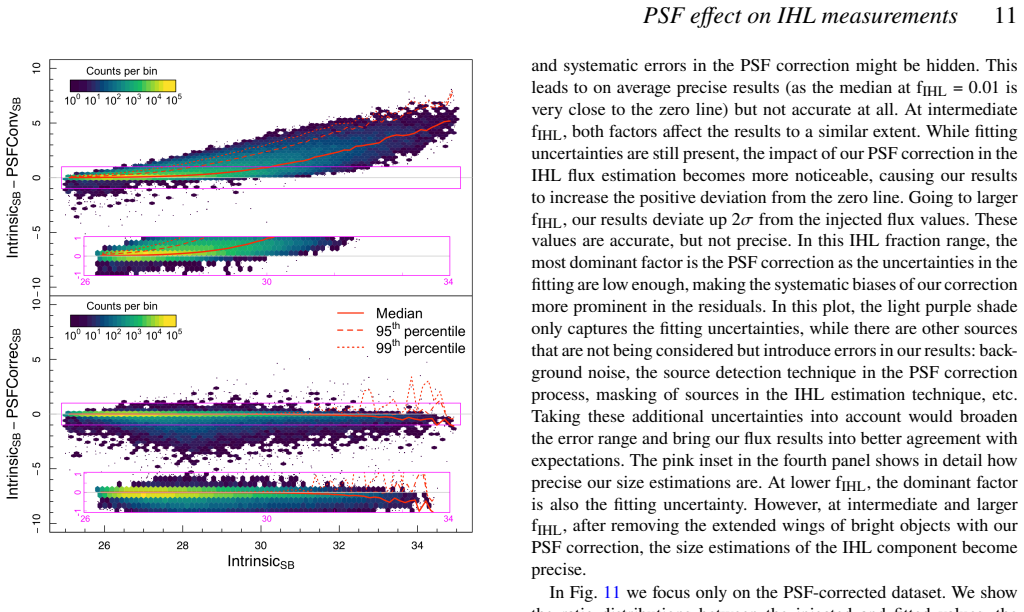
The paper's central claim is that removing the PSF-scattered flux before fitting an exponential model is not optional for IHL measurements — it is the step that turns order-of-magnitude errors into near-percent-level ones. In the authors' mock suite, without PSF correction the fitted IHL flux at an injected fraction f_IHL = 0.01 is on average ~100 times larger than the injected value and the effective radius ~10 times larger; after applying their PSF-correction pipeline, the same mock fits come in 9.6% low in flux and 12.2% low in radius at f_IHL = 0.01, with the bias shrinking to 3.5% and 0.28% at f_IHL = 0.5. The authors interpret the remaining small deficits as a known oversubtraction caused by the correction itself. For the real group G400138, using the same PSF-corrected pipeline, they report median intra-halo light fractions of f_g,IHL ~ 0.19, f_r,IHL ~ 0.08, and f_i,IHL ~ 0.06, which lie in the range of previous measurements and reproduce the trend of lower IHL fractions at redder wavelengths.
Load-bearing premise
The mock validation assumes real intra-halo light is a smooth circular exponential disc whose size is set by the simulation-based r_IHL–M200 relation, and that the same functional form is the one used for fitting; if real IHL has different shapes or substructure, the quoted recovery biases and the G400138 fractions would not transfer directly.
Editorial extensions
If this is right
- IHL fractions measured from survey images without PSF subtraction are systematically overestimated, with the largest errors at the faintest IHL fractions, so previously published IHL fractions based on PSF-uncorrected images may need revision.
- With the correction in place, automated exponential fits recover the injected IHL flux and size to within about 10% at f_IHL = 0.01 and to within a few percent at higher fractions, making the pipeline suitable for large survey samples and stacked IHL analysis.
- For the real group G400138, the reported fractions (fg ~ 0.19, fr ~ 0.08, fi ~ 0.06) imply that roughly one-fifth of the g-band light but only about 6% of the i-band light is diffuse intra-halo light, a colour trend consistent with the idea that IHL is built from tidally stripped stellar populations.
- The PSF-removal technique is not specific to IHL; it can be applied to any low-surface-brightness measurement in astronomical images, and the mock suite doubles as a calibration of the residual biases.
Reading between the lines
- Inference: because the mocks inject exactly the functional form the fitter assumes, the quoted 9.6% and 12.2% biases are best-case; real IHL with ellipticity or tidal substructure will recover less accurately, as the paper's own elliptical-mock test shows roughly half the flux missed at f_IHL = 0.5.
- Inference: the pipeline's remaining bias is a systematic flux deficit, so a simple empirical correction factor derived from the mock suite could produce unbiased f_IHL values in real applications, at the cost of added scatter.
- Inference: the r_IHL–M200 relation used to set mock sizes is simulation-based; the same pipeline applied to a large real sample with independent mass estimates could test that relation observationally.
- Inference: applied to upcoming deep surveys, the method could measure IHL fractions for thousands of groups, but the single-exponential assumption should be diagnosed with residual maps to avoid mistaking unmodelled substructure for background noise.
Editorial analysis
A structured set of objections, weighed in public.
Referee Report
Summary. The paper presents two techniques for measuring intra-halo light in galaxy groups and clusters: a ProFound-based routine that rescales source fluxes and subtracts PSF-scattered flux outside source segments (Sec. 2), and a ProFit-based MCMC fit of a circular exponential (Sérsic n=1) IHL model to the masked, PSF-corrected image (Sec. 3). The methods are tested on 5440 HSC-SSP PDR3 mock images of GAMA groups with injected circular exponential IHL components at fractions f_IHL = 0.01-0.5. The mocks show that without PSF correction the fitted IHL flux can be ~100 times too high and the effective radius ~10 times too large at f_IHL=0.01, while after correction the bias is reduced to ~9.6% in flux and ~12.2% in Reff at f_IHL=0.01 (Sec. 5.2). The pipeline is then applied to the real GAMA group G400138 in HSC-UD g,r,i, yielding median PSF-corrected fractions f_g,IHL~0.19, f_r,IHL~0.08, f_i,IHL~0.06 (Sec. 6).
Significance. If the central claim holds, the proposed combination of PSF-scattered-light removal and single-component exponential fitting offers a computationally efficient, automatable route to IHL measurements in large deep surveys, and the 5440-mock controlled test is a useful resource. The paper is transparent about several caveats, including the up to 4% oversubtraction of intrinsic source flux in Sec. 2.3, unreliable recovery at f_IHL=0.01-0.05 in Sec. 5.2, and the limitations of a circular exponential model in Sec. 5.3. The use of publicly available software (ProFound, ProFit) and a detailed mock-generation recipe supports reproducibility. However, the external validity of the recovery biases and of the real G400138 measurement is limited by two modelling gaps identified in the major comments.
major comments (3)
- [Sec. 4 / Sec. 3 Step v] The mock validation does not include the PSF convolution of the target IHL. In Sec. 4, the construction sequence is: convolve the HSC cutouts (with galaxy segments and injected point sources) with the extended PSF model, add Gaussian noise, and only then 'inject the corresponding IHL component into each mock group'. In Sec. 3 Step v, ProFit fits an unconvolved circular Sérsic n=1 template and is not given a PSF image. The mocks therefore test recovery of a sharp, unconvolved IHL that is contaminated by PSF-scattered source flux, not the PSF-convolved IHL that is present in real HSC data. The quoted recovery biases in Sec. 5.2 (9.6% low flux and 12.2% low Reff at f_IHL=0.01) and the G400138 fractions in Sec. 6 are thus not directly transferable to real data, because the target component is misspecified there. I recommend adding a mock variant in which the IHL is injected before the PSF convolution (and/or fitting with a PSF-convolved ProFit model) and rerunning the recovery and G400138 analyses.
- [Sec. 3 / Sec. 5.3 / Appendix B] The recovery test is internally consistent but does not validate the exponential model: the injected IHL is a circular exponential (Sec. 4, 'we select a circular exponential model') and the fitting template is the same functional form (Sec. 3 Step v). The one morphological robustness test in Sec. 5.3 varies only ellipticity (Arat=0.5, theta=45 deg) while keeping an exponential radial profile. Appendix B claims 'supporting evidence' for an exponential model by fitting an exponential to the SB-limit IHL of G400138 and extrapolating that same fit into the core; this is not an independent test. The real-data f_IHL values in Sec. 6 should therefore be presented as conditional on the exponential-profile assumption, or the authors should add tests with Sérsic n != 1, substructure, or a realistic simulated IHL morphology to quantify the resulting bias.
- [Sec. 6 / Table 2] The uncertainties quoted for the real G400138 fractions are fitting uncertainties only; the three methods (ProFit fixed, ProFit free, SB-extrapolated) share the same PSF-correction pipeline and the same exponential-model assumption, so their spread does not encompass the dominant systematics discussed in Secs. 2.3 and 5.3. The reported medians f_g,IHL~0.19, f_r,IHL~0.08, f_i,IHL~0.06 and their asymmetric ranges would be more robust with an explicit systematic error term from the PSF oversubtraction (up to 4% source flux) and from the model-choice sensitivity.
minor comments (5)
- [Sec. 2.3] There is a typo: 'profile profile' should be 'profile'.
- [Sec. 4] The chronological order of noise addition and IHL injection is described ambiguously: 'Finally, we add image noise...' appears before the paragraph describing the IHL injection. Please clarify whether the noise is added before or after the IHL injection, since this matters for interpreting the mock construction and the PSF-convolution issue raised above.
- [Sec. 5.2] The conversions from log-ratios to percentages (9.6% low flux and 12.2% low Reff at f_IHL=0.01) are not exactly consistent with the displayed log values; please verify the arithmetic or the quoted log values.
- [Sec. 5.2 / Fig. 10] There are typos: 'uncertanties' should be 'uncertainties' and 'accross' should be 'across'.
- [Software / References] In the software section, 'Robotham 023a' should be 'Robotham 2023a'.
Circularity Check
No significant circularity: the mock recovery is a forward-model self-consistency test, the exponential-profile choice is a stated ansatz supported by external simulations, and no derivation reduces to its own input by construction.
full rationale
The central validation in Sec. 5.2 is a standard injected-recovery experiment: mocks are built with a known circular exponential IHL (Sec. 4) and the same functional form is fitted in Sec. 3 Steps v–vi. This does not make the recovery circular, because the fitted parameters are not fixed to the injected values; they are optimized by Highlander and compared with the truth only to quantify PSF-contamination bias. The equality of template shape is an explicit assumption, acknowledged in Sec. 3 ('the main disadvantage of our technique is the lack of flexibility to model non-circular and non-exponential IHL distributions'), and the paper tests an elliptical alternative in Sec. 5.3. Equations (1) and (2) are inverse algebraic definitions of fIHL; using the same definition for injection and estimation is a convention, not a derivation. Appendix B justifies the exponential choice by an empirical fit to the G400138 SB profile; this is weak evidence but not a reduction to the fitted model, because the fit is to measured unmasked SB points, not to the desired fIHL value. The PSF model taken from Garate-Nuñez et al. 2024 is a self-citation, but it is an external calibration product used as an input; the mock test that uses it is an internal-consistency check of the correction algorithm, not a proof of the PSF model, and the cited prior work does not contain the target IHL result. The omission of PSF convolution of the injected IHL component (Sec. 4) is a modeling limitation and a correctness risk for the real-data numbers, but it is not circularity: the paper's claim that source-scattered flux biases IHL fits is tested by adding source PSF wings before injection. Overall, no load-bearing step reduces by construction to its own input.
Assumptions & free parameters
free parameters (5)
- Injected IHL effective radius (Reff) =
derived from r_IHL(M200) relation of Proctor et al. 2024 for each group
- Injected IHL fraction grid =
0.01, 0.02, 0.03, 0.04, 0.05, 0.1, 0.2, 0.3, 0.4, 0.5
- Surface brightness threshold for SB method =
mu_V = 26.5 mag arcsec^-2
- Integration radius for SB method =
R = 275 kpc
- Extrapolated group light factor =
Fgroup,extrap = 1.48 * Fgroup
assumptions (5)
- domain assumption The IHL component of groups and clusters can be described by a circular or elliptical exponential (Sérsic n=1) profile.
- domain assumption The extended HSC-SSP PDR3 PSF model from Garate-Nuñez et al. 2024 accurately represents scattered light in these images.
- domain assumption ProFound segmentation maps enclose essentially all intrinsic light of each source, and WAVES segments used to build mocks are faithful proxies.
- domain assumption The r_IHL(M200) relation of Proctor et al. 2024, used to set injected effective radii, applies to the GAMA groups at z~0.2.
- domain assumption Background noise in mocks is Gaussian with the HSC Wide median sky RMS.
Cite this review
Pith. "Pith review of Correcting for the effects of the point spread function in intra-halo light measurements and application to deep Hyper Suprime-Cam data." pith.science (2026). https://pith.science/paper/3T7GO4S6
@misc{pith2026250524395,
  author       = {Pith},
  title        = {Pith review of: Correcting for the effects of the point spread function in intra-halo light measurements and application to deep Hyper Suprime-Cam data},
  year         = {2026},
  howpublished = {\url{https://pith.science/paper/3T7GO4S6}},
  note         = {Machine review of arXiv:2505.24395}
}
abstract
The intra-halo light (IHL) is the diffuse stellar component that surrounds galaxies, groups, and clusters. Its formation is intimately linked to the hierarchical assembly of the system, making it a key tracer of galaxy evolution. However, the low surface brightness (LSB) of the IHL makes it challenging to detect and also to distinguish from the point spread function (PSF) effect of the telescope. In this paper, we present two independent techniques that, when combined, provide a statistically robust estimation of the IHL component in galaxy groups and clusters. The first technique corrects for the PSF-scattering effect to obtain unbiased LSB measurements, while the second fits an exponential model to the IHL component using a Markov Chain Monte Carlo (MCMC) optimiser algorithm. To test our methodology, we build a set of 5440 Hyper Suprime-Cam Subaru Strategic Program Public Data Release 3 (HSC-SSP PDR3) mock observations of Galaxy And Mass Assembly (GAMA) groups, each containing an IHL component with a flux fraction ($\mathrm{f_{IHL}}$) ranging from 0.01 to 0.5. Our results demonstrate the importance of properly removing the PSF-scattered flux, especially at lower $\mathrm{f_{IHL}}$. Without the PSF correction, our IHL model overestimates the true flux by up to a factor of 100, and the effective radius by up to a factor of 10. Finally, we apply our methodology to real observations and estimate the $\mathrm{f_{IHL}}$ of the GAMA group G400138 using HSC-PDR3 UD data in the $\textit{g,r}$ and $\textit{i}$-bands, finding median IHL fractions of: $\mathrm{f_{g,IHL}}$ $\sim$ 0.19$^{+0.09}_{-0.01}$, $\mathrm{f_{r,IHL}}$ $\sim$ 0.08$^{+0.06}_{-0.02}$ and $\mathrm{f_{i,IHL}}$ $\sim$ 0.06$^{+0.04}_{-0.02}$.
Figures


Figures from the paper (10 more)




Reference graph
Works this paper leans on
-
[1]
write newline
" write newline "" before.all 'output.state := FUNCTION fin.entry write newline FUNCTION new.block output.state before.all = 'skip after.block 'output.state := if FUNCTION new.sentence output.state after.block = 'skip output.state before.all = 'skip after.sentence 'output.state := if if FUNCTION not #0 #1 if FUNCTION and 'skip pop #0 if FUNCTION or pop #1...
-
[2]
write newline
" write newline "" before.all 'output.state := FUNCTION fin.entry write newline FUNCTION new.block output.state before.all = 'skip after.block 'output.state := if FUNCTION new.sentence output.state after.block = 'skip output.state before.all = 'skip after.sentence 'output.state := if if FUNCTION not #0 #1 if FUNCTION and 'skip pop #0 if FUNCTION or pop #1...
-
[3]
Abraham R. G., van Dokkum P. G., 2014, @doi [ ] 10.1086/674875 , https://ui.adsabs.harvard.edu/abs/2014PASP..126...55A 126, 55
doi:10.1086/674875 2014
-
[4]
Ahad S. L., Bah \'e Y. M., Hoekstra H., 2023, @doi [ ] 10.1093/mnras/stac3357 , https://ui.adsabs.harvard.edu/abs/2023MNRAS.518.3685A 518, 3685
-
[5]
Aihara H., et al., 2018, @doi [ ] 10.1093/pasj/psx081 , https://ui.adsabs.harvard.edu/abs/2018PASJ...70S...8A 70, S8
-
[6]
Aihara H., et al., 2022, @doi [ ] 10.1093/pasj/psab122 , https://ui.adsabs.harvard.edu/abs/2022PASJ...74..247A 74, 247
-
[7]
Alonso Asensio I., Dalla Vecchia C., Bah \'e Y. M., Barnes D. J., Kay S. T., 2020, @doi [ ] 10.1093/mnras/staa861 , https://ui.adsabs.harvard.edu/abs/2020MNRAS.494.1859A 494, 1859
-
[8]
Bah \'e Y. M., et al., 2017, @doi [ ] 10.1093/mnras/stx1403 , https://ui.adsabs.harvard.edu/abs/2017MNRAS.470.4186B 470, 4186
Show all 112 references
-
[9]
K., et al., 2018, @doi [ ] 10.1093/mnras/stx3042 , https://ui.adsabs.harvard.edu/abs/2018MNRAS.474.3875B 474, 3875
Baldry I. K., et al., 2018, @doi [ ] 10.1093/mnras/stx3042 , https://ui.adsabs.harvard.edu/abs/2018MNRAS.474.3875B 474, 3875
2018 doi
-
[10]
Bellstedt S., et al., 2020, @doi [ ] 10.1093/mnras/staa1466 , https://ui.adsabs.harvard.edu/abs/2020MNRAS.496.3235B 496, 3235
2020 doi
-
[11]
A., 2007, @doi [ ] 10.1086/519824 , https://ui.adsabs.harvard.edu/abs/2007ApJ...666..663B 666, 663
Bernstein R. A., 2007, @doi [ ] 10.1086/519824 , https://ui.adsabs.harvard.edu/abs/2007ApJ...666..663B 666, 663
2007 doi
-
[12]
G., Tal T., Marchesini D., Kriek M., Franx M., Coppi P., 2009, @doi [ ] 10.1088/0004-637X/697/2/1290 , https://ui.adsabs.harvard.edu/abs/2009ApJ...697.1290B 697, 1290
Bezanson R., van Dokkum P. G., Tal T., Marchesini D., Kriek M., Franx M., Coppi P., 2009, @doi [ ] 10.1088/0004-637X/697/2/1290 , https://ui.adsabs.harvard.edu/abs/2009ApJ...697.1290B 697, 1290
2009 doi
-
[13]
Cambridge University Press; 7th edition
Born M., Wolf E., 1999, Principles of Optics . Cambridge University Press; 7th edition
1999
- [14]
-
[15]
Brough S., et al., 2024, @doi [ ] 10.1093/mnras/stad3810 , https://ui.adsabs.harvard.edu/abs/2024MNRAS.528..771B 528, 771
2024 doi
-
[16]
Burke C., Hilton M., Collins C., 2015, @doi [ ] 10.1093/mnras/stv450 , https://ui.adsabs.harvard.edu/abs/2015MNRAS.449.2353B 449, 2353
2015 doi
-
[17]
A., Pearce F., Brough S., Dubois Y., 2025, @doi [ ] 10.1093/mnras/staf615 , https://ui.adsabs.harvard.edu/abs/2025MNRAS.539.2279B 539, 2279
Butler J., Martin G., Hatch N. A., Pearce F., Brough S., Dubois Y., 2025, @doi [ ] 10.1093/mnras/staf615 , https://ui.adsabs.harvard.edu/abs/2025MNRAS.539.2279B 539, 2279
2025 doi
-
[18]
Ca \ n as R., Lagos C. d. P., Elahi P. J., Power C., Welker C., Dubois Y., Pichon C., 2020, @doi [ ] 10.1093/mnras/staa1027 , https://ui.adsabs.harvard.edu/abs/2020MNRAS.494.4314C 494, 4314
2020 doi
-
[19]
Canepa L., Brough S., Lanusse F., Montes M., Hatch N., 2025, @doi [ ] 10.3847/1538-4357/adabc7 , https://ui.adsabs.harvard.edu/abs/2025ApJ...980..245C 980, 245
2025 doi
-
[20]
Casura S., et al., 2022, @doi [ ] 10.1093/mnras/stac2267 , https://ui.adsabs.harvard.edu/abs/2022MNRAS.516..942C 516, 942
2022 doi
-
[21]
Chun K., Shin J., Ko J., Smith R., Yoo J., 2024, @doi [ ] 10.3847/1538-4357/ad4a52 , https://ui.adsabs.harvard.edu/abs/2024ApJ...969..142C 969, 142
2024 doi
-
[22]
Contini E., 2021, @doi [Galaxies] 10.3390/galaxies9030060 , https://ui.adsabs.harvard.edu/abs/2021Galax...9...60C 9, 60
2021 doi
-
[23]
Contini E., De Lucia G., Villalobos \'A ., Borgani S., 2014, @doi [ ] 10.1093/mnras/stt2174 , https://ui.adsabs.harvard.edu/abs/2014MNRAS.437.3787C 437, 3787
2014 doi
-
[24]
K., 2023, @doi [ ] 10.3847/1538-4357/acfd25 , https://ui.adsabs.harvard.edu/abs/2023ApJ...958...72C 958, 72
Contini E., Jeon S., Rhee J., Han S., Yi S. K., 2023, @doi [ ] 10.3847/1538-4357/acfd25 , https://ui.adsabs.harvard.edu/abs/2023ApJ...958...72C 958, 72
2023 doi
-
[25]
K., 2024, @doi [ ] 10.3847/1538-3881/ad0894 , https://ui.adsabs.harvard.edu/abs/2024AJ....167....7C 167, 7
Contini E., Rhee J., Han S., Jeon S., Yi S. K., 2024, @doi [ ] 10.3847/1538-3881/ad0894 , https://ui.adsabs.harvard.edu/abs/2024AJ....167....7C 167, 7
2024 doi
-
[26]
Contreras-Santos A., et al., 2024, @doi [ ] 10.1051/0004-6361/202348474 , https://ui.adsabs.harvard.edu/abs/2024A&A...683A..59C 683, A59
2024 doi
-
[27]
Cook R. H. W., Cortese L., Catinella B., Robotham A., 2019, @doi [ ] 10.1093/mnras/stz2789 , https://ui.adsabs.harvard.edu/abs/2019MNRAS.490.4060C 490, 4060
2019 doi
-
[28]
P., Gao L., Guo Q., Frenk C
Cooper A. P., Gao L., Guo Q., Frenk C. S., Jenkins A., Springel V., White S. D. M., 2015, @doi [ ] 10.1093/mnras/stv1042 , https://ui.adsabs.harvard.edu/abs/2015MNRAS.451.2703C 451, 2703
2015 doi
-
[29]
D'Souza R., Kauffman G., Wang J., Vegetti S., 2014, @doi [ ] 10.1093/mnras/stu1194 , https://ui.adsabs.harvard.edu/abs/2014MNRAS.443.1433D 443, 1433
2014 doi
-
[32]
Davies L. J. M., et al., 2021, @doi [ ] 10.1093/mnras/stab1601 , https://ui.adsabs.harvard.edu/abs/2021MNRAS.506..256D 506, 256
2021 doi
-
[33]
De Lucia G., Blaizot J., 2007, @doi [ ] 10.1111/j.1365-2966.2006.11287.x , https://ui.adsabs.harvard.edu/abs/2007MNRAS.375....2D 375, 2
2007
-
[34]
J., et al., 2021, @doi [ ] 10.1093/mnras/staa3590 , https://ui.adsabs.harvard.edu/abs/2021MNRAS.500.4181D 500, 4181
Deason A. J., et al., 2021, @doi [ ] 10.1093/mnras/staa3590 , https://ui.adsabs.harvard.edu/abs/2021MNRAS.500.4181D 500, 4181
2021 doi
-
[36]
Dolag K., Mevius E., Remus R.-S., 2017, @doi [Galaxies] 10.3390/galaxies5030035 , https://ui.adsabs.harvard.edu/abs/2017Galax...5...35D 5, 35
2017 doi
-
[37]
P., et al., 2011, @doi [ ] 10.1111/j.1365-2966.2010.18188.x , https://ui.adsabs.harvard.edu/abs/2011MNRAS.413..971D 413, 971
Driver S. P., et al., 2011, @doi [ ] 10.1111/j.1365-2966.2010.18188.x , https://ui.adsabs.harvard.edu/abs/2011MNRAS.413..971D 413, 971
2011
-
[38]
P., et al., 2019, @doi [The Messenger] 10.18727/0722-6691/5126 , https://ui.adsabs.harvard.edu/abs/2019Msngr.175...46D 175, 46
Driver S. P., et al., 2019, @doi [The Messenger] 10.18727/0722-6691/5126 , https://ui.adsabs.harvard.edu/abs/2019Msngr.175...46D 175, 46
2019 doi
-
[39]
Dubois Y., Peirani S., Pichon C., Devriendt J., Gavazzi R., Welker C., Volonteri M., 2016, @doi [ ] 10.1093/mnras/stw2265 , https://ui.adsabs.harvard.edu/abs/2016MNRAS.463.3948D 463, 3948
2016 doi
-
[40]
Erwin P., 2015, @doi [ ] 10.1088/0004-637X/799/2/226 , https://ui.adsabs.harvard.edu/abs/2015ApJ...799..226E 799, 226
2015 doi
-
[41]
Euclid Collaboration et al., 2022, @doi [ ] 10.1051/0004-6361/202141938 , https://ui.adsabs.harvard.edu/abs/2022A&A...662A.112E 662, A112
2022 doi
-
[42]
J., Mihos J
Feldmeier J. J., Mihos J. C., Morrison H. L., Rodney S. A., Harding P., 2002, @doi [ ] 10.1086/341472 , https://ui.adsabs.harvard.edu/abs/2002ApJ...575..779F 575, 779
2002 doi
-
[43]
J., Mihos J
Feldmeier J. J., Mihos J. C., Morrison H. L., Harding P., Kaib N., Dubinski J., 2004, @doi [ ] 10.1086/421313 , https://ui.adsabs.harvard.edu/abs/2004ApJ...609..617F 609, 617
2004 doi
-
[44]
E., et al., 2021, @doi [ ] 10.1093/mnras/stab065 , https://ui.adsabs.harvard.edu/abs/2021MNRAS.502.2419F 502, 2419
Furnell K. E., et al., 2021, @doi [ ] 10.1093/mnras/stab065 , https://ui.adsabs.harvard.edu/abs/2021MNRAS.502.2419F 502, 2419
2021 doi
-
[45]
P., Robotham A
Garate-Nu \ n ez L. P., Robotham A. S. G., Bellstedt S., Davies L. J. M., Mart \' nez-Lombilla C., 2024, @doi [ ] 10.1093/mnras/stae1292 , https://ui.adsabs.harvard.edu/abs/2024MNRAS.531.2517G 531, 2517
2024 doi
-
[46]
Giallongo E., et al., 2014, @doi [ ] 10.1088/0004-637X/781/1/24 , https://ui.adsabs.harvard.edu/abs/2014ApJ...781...24G 781, 24
2014 doi
-
[47]
B., et al., 2023, @doi [ ] 10.1093/mnras/stad469 , https://ui.adsabs.harvard.edu/abs/2023MNRAS.521..478G 521, 478
Golden-Marx J. B., et al., 2023, @doi [ ] 10.1093/mnras/stad469 , https://ui.adsabs.harvard.edu/abs/2023MNRAS.521..478G 521, 478
2023 doi
-
[48]
B., et al., 2025, @doi [ ] 10.1093/mnras/staf277 , https://ui.adsabs.harvard.edu/abs/2025MNRAS.538..622G 538, 622
Golden-Marx J. B., et al., 2025, @doi [ ] 10.1093/mnras/staf277 , https://ui.adsabs.harvard.edu/abs/2025MNRAS.538..622G 538, 622
2025 doi
-
[49]
H., Zabludoff A
Gonzalez A. H., Zabludoff A. I., Zaritsky D., Dalcanton J. J., 2000, @doi [ ] 10.1086/308985 , https://ui.adsabs.harvard.edu/abs/2000ApJ...536..561G 536, 561
2000 doi
-
[50]
H., Zabludoff A
Gonzalez A. H., Zabludoff A. I., Zaritsky D., 2005, @doi [ ] 10.1086/425896 , https://ui.adsabs.harvard.edu/abs/2005ApJ...618..195G 618, 195
2005 doi
-
[51]
Ivezi \'c Z ., et al., 2019, @doi [ ] 10.3847/1538-4357/ab042c , https://ui.adsabs.harvard.edu/abs/2019ApJ...873..111I 873, 111
2019 doi
-
[52]
Jim \'e nez-Teja Y., et al., 2018, @doi [ ] 10.3847/1538-4357/aab70f , https://ui.adsabs.harvard.edu/abs/2018ApJ...857...79J 857, 79
2018 doi
- [53]
-
[54]
Kluge M., et al., 2020, @doi [ ] 10.3847/1538-4365/ab733b , https://ui.adsabs.harvard.edu/abs/2020ApJS..247...43K 247, 43
2020 doi
-
[55]
Kluge M., Bender R., Riffeser A., Goessl C., Hopp U., Schmidt M., Ries C., 2021, @doi [ ] 10.3847/1538-4365/abcda6 , https://ui.adsabs.harvard.edu/abs/2021ApJS..252...27K 252, 27
2021 doi
- [56]
-
[57]
Kolmogorov A., 1941, Akademiia Nauk SSSR Doklady, https://ui.adsabs.harvard.edu/abs/1941DoSSR..30..301K 30, 301
1941
- [58]
-
[59]
J., 2004, @doi [ ] 10.1086/425412 , https://ui.adsabs.harvard.edu/abs/2004ApJ...617..879L 617, 879
Lin Y.-T., Mohr J. J., 2004, @doi [ ] 10.1086/425412 , https://ui.adsabs.harvard.edu/abs/2004ApJ...617..879L 617, 879
2004 doi
-
[60]
Liu Q., et al., 2023, @doi [ ] 10.3847/1538-4357/acdee3 , https://ui.adsabs.harvard.edu/abs/2023ApJ...953....7L 953, 7
2023 doi
-
[62]
J., Trujillo I., Majewski S
Mart \' nez-Delgado D., Pe \ n arrubia J., Gabany R. J., Trujillo I., Majewski S. R., Pohlen M., 2008, @doi [ ] 10.1086/592555 , https://ui.adsabs.harvard.edu/abs/2008ApJ...689..184M 689, 184
2008 doi
-
[63]
H., 2019, @doi [ ] 10.1051/0004-6361/201935464 , https://ui.adsabs.harvard.edu/abs/2019A&A...629A..12M 629, A12
Mart \' nez-Lombilla C., Knapen J. H., 2019, @doi [ ] 10.1051/0004-6361/201935464 , https://ui.adsabs.harvard.edu/abs/2019A&A...629A..12M 629, A12
2019 doi
-
[64]
Mart \' nez-Lombilla C., et al., 2023, @doi [ ] 10.1093/mnras/stac3119 , https://ui.adsabs.harvard.edu/abs/2023MNRAS.518.1195M 518, 1195
2023 doi
-
[65]
Merritt D., 1984, @doi [ ] 10.1086/161590 , https://ui.adsabs.harvard.edu/abs/1984ApJ...276...26M 276, 26
1984 doi
-
[66]
Merritt A., van Dokkum P., Abraham R., Zhang J., 2016, @doi [ ] 10.3847/0004-637X/830/2/62 , https://ui.adsabs.harvard.edu/abs/2016ApJ...830...62M 830, 62
2016 doi
-
[67]
C., Harding P., Feldmeier J., Morrison H., 2005, @doi [ ] 10.1086/497030 , https://ui.adsabs.harvard.edu/abs/2005ApJ...631L..41M 631, L41
Mihos J. C., Harding P., Feldmeier J., Morrison H., 2005, @doi [ ] 10.1086/497030 , https://ui.adsabs.harvard.edu/abs/2005ApJ...631L..41M 631, L41
2005 doi
-
[68]
Moffat A. F. J., 1969, , https://ui.adsabs.harvard.edu/abs/1969A&A.....3..455M 3, 455
1969
-
[69]
Monaco P., Murante G., Borgani S., Fontanot F., 2006, @doi [ ] 10.1086/510236 , https://ui.adsabs.harvard.edu/abs/2006ApJ...652L..89M 652, L89
2006 doi
-
[70]
Montes M., 2022, @doi [Nature Astronomy] 10.1038/s41550-022-01616-z , https://ui.adsabs.harvard.edu/abs/2022NatAs...6..308M 6, 308
2022 doi
-
[71]
Montes M., Trujillo I., 2018, @doi [ ] 10.1093/mnras/stx2847 , https://ui.adsabs.harvard.edu/abs/2018MNRAS.474..917M 474, 917
2018 doi
-
[72]
Montes M., Trujillo I., 2022, @doi [ ] 10.3847/2041-8213/ac98c5 , https://ui.adsabs.harvard.edu/abs/2022ApJ...940L..51M 940, L51
2022 doi
-
[73]
S., Santucci G., 2021, @doi [ ] 10.3847/1538-4357/abddb6 , https://ui.adsabs.harvard.edu/abs/2021ApJ...910...45M 910, 45
Montes M., Brough S., Owers M. S., Santucci G., 2021, @doi [ ] 10.3847/1538-4357/abddb6 , https://ui.adsabs.harvard.edu/abs/2021ApJ...910...45M 910, 45
2021 doi
- [74]
-
[75]
E., Treu T., Schmidt K
Morishita T., Abramson L. E., Treu T., Schmidt K. B., Vulcani B., Wang X., 2017, @doi [ ] 10.3847/1538-4357/aa8403 , https://ui.adsabs.harvard.edu/abs/2017ApJ...846..139M 846, 139
2017 doi
-
[76]
Murante G., Giovalli M., Gerhard O., Arnaboldi M., Borgani S., Dolag K., 2007, @doi [ ] 10.1111/j.1365-2966.2007.11568.x , https://ui.adsabs.harvard.edu/abs/2007MNRAS.377....2M 377, 2
2007
-
[77]
H., Ostriker J
Naab T., Johansson P. H., Ostriker J. P., 2009, @doi [ ] 10.1088/0004-637X/699/2/L178 , https://ui.adsabs.harvard.edu/abs/2009ApJ...699L.178N 699, L178
2009 doi
-
[78]
Nelson D., et al., 2019, @doi [Computational Astrophysics and Cosmology] 10.1186/s40668-019-0028-x , https://ui.adsabs.harvard.edu/abs/2019ComAC...6....2N 6, 2
2019 doi
-
[79]
Pillepich A., et al., 2018, @doi [ ] 10.1093/mnras/stx3112 , https://ui.adsabs.harvard.edu/abs/2018MNRAS.475..648P 475, 648
2018 doi
-
[80]
Postman M., et al., 2012, @doi [ ] 10.1088/0067-0049/199/2/25 , https://ui.adsabs.harvard.edu/abs/2012ApJS..199...25P 199, 25
2012 doi
-
[81]
L., Lagos C
Proctor K. L., Lagos C. d. P., Ludlow A. D., Robotham A. S. G., 2024, @doi [ ] 10.1093/mnras/stad3341 , https://ui.adsabs.harvard.edu/abs/2024MNRAS.527.2624P 527, 2624
2024 doi
-
[82]
W., Bullock J
Purcell C. W., Bullock J. S., Zentner A. R., 2007, @doi [ ] 10.1086/519787 , https://ui.adsabs.harvard.edu/abs/2007ApJ...666...20P 666, 20
2007 doi
-
[83]
R Foundation for Statistical Computing, Vienna, Austria, https://www.R-project.org/
R Core Team 2023, R: A Language and Environment for Statistical Computing . R Foundation for Statistical Computing, Vienna, Austria, https://www.R-project.org/
2023
-
[84]
Racine R., 1996, @doi [ ] 10.1086/133788 , https://ui.adsabs.harvard.edu/abs/1996PASP..108..699R 108, 699
1996 doi
-
[85]
Ragusa R., et al., 2023, @doi [ ] 10.1051/0004-6361/202245530 , https://ui.adsabs.harvard.edu/abs/2023A&A...670L..20R 670, L20
2023 doi
-
[86]
L., 2017, @doi [Galaxies] 10.3390/galaxies5030049 , https://ui.adsabs.harvard.edu/abs/2017Galax...5...49R 5, 49
Remus R.-S., Dolag K., Hoffmann T. L., 2017, @doi [Galaxies] 10.3390/galaxies5030049 , https://ui.adsabs.harvard.edu/abs/2017Galax...5...49R 5, 49
2017 doi
-
[87]
Robotham A. S. G., 2016a, Celestial: Common astronomical conversion routines and functions , Astrophysics Source Code Library, record ascl:1602.011 ( @eprint ascl 1602.011 )
-
[88]
Robotham A. S. G., 2016b, magicaxis: Pretty scientific plotting with minor-tick and log minor-tick support , Astrophysics Source Code Library, record ascl:1604.004 ( @eprint ascl 1604.004 )
-
[89]
Robotham A. S. G., 2023a, https://doi.org/10.5281/zenodo.10059903
-
[90]
Robotham A. S. G., Obreschkow D., 2015, @doi [ ] 10.1017/pasa.2015.33 , https://ui.adsabs.harvard.edu/abs/2015PASA...32...33R 32, e033
2015 doi
-
[91]
Robotham A. S. G., et al., 2011, @doi [ ] 10.1111/j.1365-2966.2011.19217.x , https://ui.adsabs.harvard.edu/abs/2011MNRAS.416.2640R 416, 2640
2011
-
[92]
Robotham A. S. G., Taranu D. S., Tobar R., Moffett A., Driver S. P., 2017, @doi [ ] 10.1093/mnras/stw3039 , https://ui.adsabs.harvard.edu/abs/2017MNRAS.466.1513R 466, 1513
2017 doi
-
[93]
Robotham A. S. G., Davies L. J. M., Driver S. P., Koushan S., Taranu D. S., Casura S., Liske J., 2018, @doi [ ] 10.1093/mnras/sty440 , https://ui.adsabs.harvard.edu/abs/2018MNRAS.476.3137R 476, 3137
2018 doi
-
[94]
Robotham A. S. G., et al., 2024, @doi [ ] 10.1093/mnras/stae349 , https://ui.adsabs.harvard.edu/abs/2024MNRAS.528.5046R 528, 5046
2024 doi
-
[95]
S., Mihos J
Rudick C. S., Mihos J. C., McBride C., 2006, @doi [ ] 10.1086/506176 , https://ui.adsabs.harvard.edu/abs/2006ApJ...648..936R 648, 936
2006 doi
-
[96]
S., Mihos J
Rudick C. S., Mihos J. C., McBride C. K., 2011, @doi [ ] 10.1088/0004-637X/732/1/48 , https://ui.adsabs.harvard.edu/abs/2011ApJ...732...48R 732, 48
2011 doi
-
[97]
Sandin C., 2014, @doi [ ] 10.1051/0004-6361/201423429 , https://ui.adsabs.harvard.edu/abs/2014A&A...567A..97S 567, A97
2014 doi
-
[98]
Sandin C., 2015, @doi [ ] 10.1051/0004-6361/201425168 , https://ui.adsabs.harvard.edu/abs/2015A&A...577A.106S 577, A106
2015 doi
-
[99]
L., 1963, Boletin de la Asociacion Argentina de Astronomia La Plata Argentina, https://ui.adsabs.harvard.edu/abs/1963BAAA....6...41S 6, 41
S \'e rsic J. L., 1963, Boletin de la Asociacion Argentina de Astronomia La Plata Argentina, https://ui.adsabs.harvard.edu/abs/1963BAAA....6...41S 6, 41
1963
-
[100]
T., Harding P., Mihos J
Slater C. T., Harding P., Mihos J. C., 2009, @doi [ ] 10.1086/648457 , https://ui.adsabs.harvard.edu/abs/2009PASP..121.1267S 121, 1267
2009 doi
-
[101]
Spavone M., et al., 2017, @doi [ ] 10.1051/0004-6361/201629111 , https://ui.adsabs.harvard.edu/abs/2017A&A...603A..38S 603, A38
2017 doi
-
[102]
Spavone M., et al., 2020, @doi [ ] 10.1051/0004-6361/202038015 , https://ui.adsabs.harvard.edu/abs/2020A&A...639A..14S 639, A14
2020 doi
-
[103]
Spavone M., et al., 2024, @doi [ ] 10.1051/0004-6361/202451346 , https://ui.adsabs.harvard.edu/abs/2024A&A...689A.306S 689, A306
2024 doi
- [104]
-
[105]
E., et al., 2021, @doi [ ] 10.1093/mnras/stab1294 , https://ui.adsabs.harvard.edu/abs/2021MNRAS.505..540T 505, 540
Thorne J. E., et al., 2021, @doi [ ] 10.1093/mnras/stab1294 , https://ui.adsabs.harvard.edu/abs/2021MNRAS.505..540T 505, 540
2021 doi
-
[106]
C., 1930, @doi [Proceedings of the National Academy of Science] 10.1073/pnas.16.7.511 , https://ui.adsabs.harvard.edu/abs/1930PNAS...16..511T 16, 511
Tolman R. C., 1930, @doi [Proceedings of the National Academy of Science] 10.1073/pnas.16.7.511 , https://ui.adsabs.harvard.edu/abs/1930PNAS...16..511T 16, 511
1930 doi
-
[107]
C., 1934, Relativity, Thermodynamics, and Cosmology
Tolman R. C., 1934, Relativity, Thermodynamics, and Cosmology
1934
-
[108]
Trujillo I., Fliri J., 2016, @doi [ ] 10.3847/0004-637X/823/2/123 , https://ui.adsabs.harvard.edu/abs/2016ApJ...823..123T 823, 123
2016 doi
-
[109]
M., Boughn S
Uson J. M., Boughn S. P., Kuhn J. R., 1991, @doi [ ] 10.1086/169737 , https://ui.adsabs.harvard.edu/abs/1991ApJ...369...46U 369, 46
1991 doi
-
[110]
E., Mihos J
Watkins A. E., Mihos J. C., Harding P., 2015, @doi [ ] 10.1088/2041-8205/800/1/L3 , https://ui.adsabs.harvard.edu/abs/2015ApJ...800L...3W 800, L3
2015 doi
-
[111]
Yoo J., et al., 2024, @doi [ ] 10.3847/1538-4357/ad2df8 , https://ui.adsabs.harvard.edu/abs/2024ApJ...965..145Y 965, 145
2024 doi
-
[112]
Zhang Y., et al., 2019, @doi [ ] 10.3847/1538-4357/ab0dfd , https://ui.adsabs.harvard.edu/abs/2019ApJ...874..165Z 874, 165
2019 doi
-
[113]
Zibetti S., White S. D. M., Schneider D. P., Brinkmann J., 2005, @doi [ ] 10.1111/j.1365-2966.2005.08817.x , https://ui.adsabs.harvard.edu/abs/2005MNRAS.358..949Z 358, 949
2005
-
[114]
Zwicky F., 1937, @doi [ ] 10.1086/143864 , https://ui.adsabs.harvard.edu/abs/1937ApJ....86..217Z 86, 217
1937 doi
-
[115]
S., 2008, @doi [ ] 10.1111/j.1365-2966.2008.13505.x , https://ui.adsabs.harvard.edu/abs/2008MNRAS.388.1521D 388, 1521
de Jong R. S., 2008, @doi [ ] 10.1111/j.1365-2966.2008.13505.x , https://ui.adsabs.harvard.edu/abs/2008MNRAS.388.1521D 388, 1521
2008
-
[116]
G., Conroy C., 2010, @doi [ ] 10.1038/nature09578 , https://ui.adsabs.harvard.edu/abs/2010Natur.468..940V 468, 940
van Dokkum P. G., Conroy C., 2010, @doi [ ] 10.1038/nature09578 , https://ui.adsabs.harvard.edu/abs/2010Natur.468..940V 468, 940
2010 doi
Reviewed August 7, 2026 · model on record in the stance chip above.
Discussion (0). Sign in to comment.