REVIEW 3 major objections 7 minor 31 references
Modelling birdsong transmission with methods from molecular sequence analysis
T0 review · 3 major / 7 minor · reviewed 2026-08-05 · deepseek-v4-flash
Pith's one-line read This paper adapts DNA sequence-evolution mathematics to birdsong, fitting a Markov transmission matrix to Java sparrow note sequences that assigns birds to their social lineage about 55% of the time, though it cannot name individual tutors.
desk verdict Real novelty and honest negatives, but the 55% lineage claim is in-sample and post-hoc; the evaluation needs fixing, the math appendix is solid. read the letter →
The pith
A machine-rendered reading of the paper's core claim, the machinery that carries it, and where it could break.
The reading
What carries the argument
The transmission matrix T is the central object: a stochastic d×d matrix with T_rs = P(pupil sings note r | tutor sang note s), joined to the data by q_j = T p_j at each aligned position j, where p_j and q_j are latent multinomial note-usage vectors. Estimation rests on count matrices cut from profile-HMM alignments; the Interacting Particle Langevin Algorithm, a diffusion-based gradient ascent on the marginal likelihood run in logit-stick-breaking coordinates so probabilities stay in the simplex; and bridge sampling with HMC to compute per-site log evidence for every candidate pair. The paper proves the negative log-posterior has Lipschitz gradients but is not strongly convex, so the algori
What would settle it
Generate synthetic songs from a known transmission matrix T together with motif structure (repeated 'ACACAC' blocks) so the independent-sites aligner is misspecified, run the full pipeline—alignment, counting, IPLA fit, bridge-sampling evidence—and check whether T is recovered and whether the true tutor wins the evidence comparison; the paper's own explanation predicts accuracy rises with song length, so a null result on long, motif-rich songs would undercut the analogy as a practical tool.
Extended reading notes
Core claim
Birdsong transmission can be modelled position-wise like DNA: with p_j the tutor's note-probability vector and q_j the pupil's, q_j = T p_j for one shared transmission matrix T, where T_rs is the chance a pupil sings note r when the tutor sang note s. Fitted by the Interacting Particle Langevin Algorithm, the matrix is near-identity for the six most common notes, while rare classes drift toward common ones. The paper proves the convexity guarantee fails, yet synthetic runs recover a known T. Evidence scores miss individual tutors (2/57) and transmission direction, but assign lineages at 55% versus 21% naive; the paper reads the limits as data-driven—short songs, faithful learning, and an ind
Load-bearing premise
The load-bearing premise is that the profile-HMM alignments from which the note-count matrices are built are trustworthy, including their treatment of each aligned position as independent; the paper itself concedes that songs contain repeated motifs ('ACACAC') that break this assumption, and incorrect alignments would corrupt the transmission matrix and the evidence scores built on the counts.
Editorial extensions
If this is right
- Song-learning fidelity becomes a quantitative object: a fitted column-stochastic matrix per note class, comparable across species, tutors, and social contexts.
- Lineage membership can be inferred from songs alone—about 55% accuracy versus 21% naive—even when the true tutor and the direction of teaching are unknowable.
- The near-identity matrix for common notes implies that almost all transmission signal sits in rare note classes and in alignment positions where notes differ, so future datasets should oversample rare notes and longer songs.
- Because the failures (2/57 pairwise hits, undetectable direction) are attributed by the paper to short songs and faithful copying, the model's predictions are testable: accuracy should rise with song length and with datasets that violate the independent-sites assumption less.
- The paper's own check on motifs ('ACACAC') flags that the independent-sites alignment assumption is broken exactly where transmission is interesting, pointing to joint alignment-and-transmission models as the next step.
Reading between the lines
- The evidence matrix's symmetry suggests the scores track overall song similarity rather than any causal teaching direction; the lineage signal may survive even if the Markov transmission structure is wrong, because same-lineage birds simply share more notes.
- A test the paper does not run: simulate songs with explicit motif structure and let the independent-sites aligner be misspecified, then check whether the IPLA estimate of a known T is biased toward the identity—a positive result would make the near-diagonal fit partly an artifact of alignment rather than of learning.
- The machinery transfers to other culturally transmitted discrete sequences—whale song syllables, human vocalisations, tokenised cultural items—and the paper's reported null results effectively calibrate how much data such transfers will need.
Editorial analysis
A structured set of objections, weighed in public.
Referee Report
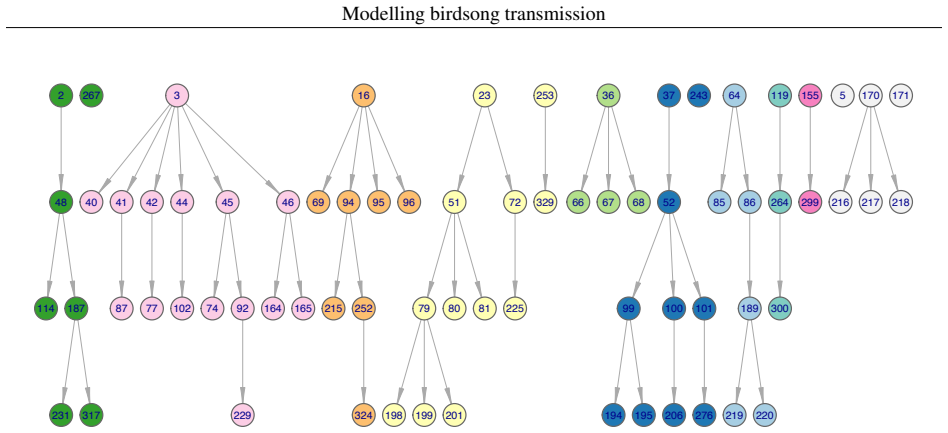
Summary. This paper introduces a Markov model for birdsong transmission in which a pupil’s note-usage distribution at an aligned position is q_j = T p_j, directly analogous to nucleotide substitution models. The transmission matrix and latent profiles are fitted by maximum marginal likelihood via the Interacting Particle Langevin Algorithm (IPLA). The authors show that the required strong-convexity assumption is violated, but synthetic experiments recover T with no evidence of multimodality. Applied to Java sparrow recordings, the estimated T is near-identity for common notes. The fitted T* is then plugged into bridge-sampling evidence calculations for all putative tutor–pupil pairs. Pairwise tutor identification and direction-of-transmission tests fail, but a lineage-assignment procedure based on mean log evidence obtains 55% accuracy (39/70) after dropping two ‘Dark Pink’ birds, against a 21% naive baseline.
Significance. If the lineage signal were validated, this would be a useful contribution: it is a first alignment-based generative model of cultural song transmission, with careful treatment of simplex constraints and a transparent account of failed convergence assumptions. The appendix’s Lipschitz and bounded-moment proofs are detailed, and the synthetic experiments (dip test, 200 initializations) are a good sanity check. The paper is also admirably honest about three negative results: pairwise identification, direction of transmission, and generation-depth discrimination. However, the one positive result—lineage prediction—rests on an in-sample evaluation: the evidence values are computed with T* fitted on the same full dataset, and the two most influential birds are removed post hoc. The significance of the 55% figure is therefore not yet established.
major comments (3)
- [§4.4 / Eq. (26)] The lineage-prediction evaluation is in-sample and circular. T* is estimated on the entire dataset (§4.3) and then used as a fixed plug-in in Eq. (26) to compute E_ab for every pair, including the pairs that contributed to the estimate. The 55% accuracy (39/70 after removing JS299 and JS155) is therefore not a predictive accuracy; it may reflect overfitting of T* or simply the fact that within-lineage birds share similar note repertoires, independent of the transmission model. No cross-validation, held-out data, or permutation control is provided. Please re-estimate T on training data before scoring held-out pairs, add a permutation/null test for lineage assignment, and report the result with all 72 birds included, stating whether the removal of JS299/JS155 was pre-specified.
- [§5 / Eqs. (3)–(7)] The count matrices and hence T* and E_ab depend entirely on profile-HMM alignments from Kwong et al. (2025, in preparation). The paper itself concedes in §5 that the independent-sites assumption is violated by motifs such as ‘ACACAC’. Because the alignments are not publicly described beyond the unpublished reference, the core data-processing step is not reproducible, and alignment artefacts (e.g., of rare notes) can propagate directly into the estimated transmission matrix and evidence. I request a detailed description or release of the alignment pipeline, and a sensitivity analysis (e.g., fitting T on subsets of aligned columns or on data simulated with motif structure) to show that the lineage-level evidence is robust to this acknowledged violation.
- [§4.1 / §5] The synthetic validation is not calibrated to the real-data regime. The simulations use d=5, n=500 aligned positions, m=8 recordings, and a uniform-Dirichlet T, while the real application has d=9 and, as stated in §5, a median of only 18 aligned positions per pair, with T near the identity. Recovery of T in Figure 6 and the unimodality dip tests therefore do not establish that the MMLE and bridge-sampling evidence are well-behaved at the actual data sparsity. Please add simulations with n≈18, d=9, and a near-identity T to verify identifiability and to characterize the sampling variability of E_ab in the regime used for lineage prediction.
minor comments (7)
- [§2.3.2 / Eq. (14)] The notation T⋆i denotes the i-th column while T⋆ denotes the MMLE; this is confusing. Use T_i or T_{·i} for columns.
- [§1.2 / §4.4] The paper states 58 pupil-tutor pairs in §1.2 but 57 known pairs in §4.4. Please reconcile.
- [§3 / Appendix] ‘Akylidiz’ should be ‘Akyildiz’ in several theorem statements; also Reference [1] is dated 2025 although the arXiv preprint is 2023.
- [Figure 6] The caption lists N=1025 among the values; this is likely a typo for 1024.
- [§4.4] The sentence beginning ‘Thus our model made modestly accurate predictions…’ is duplicated almost verbatim a few lines later.
- [Appendix A.4] The conclusion that U is not strongly convex because each summand is not strongly convex is not valid in general. Please give a direct proof for the sum, e.g., by exhibiting a single direction that makes the gradient-difference inner product arbitrarily small for the whole U.
- [Availability] No data/code availability statement is included. Given the dependence on unpublished alignments, a repository with the alignments and fitting code would materially aid reproducibility.
Circularity Check
Reported lineage-prediction accuracy is an in-sample score: E_ab is computed with T* fitted to the same pairs being classified, so the 55% figure is not an independent prediction.
-
fitted input called prediction
[Section 4.4, Eq. (26) and the lineage-classification paragraph (Section 4.4, final two paragraphs)]
"For each potential (pupil, tutor) pair (a, b), we aligned the birds' songs and then estimated E_ab = ∏_j ∫ P(x_j | p_j)P(y_j | p_j, T⋆)P(p_j) dp_j = ∏_j ∫ Mult(x_j | p_j) Mult(y_j | T⋆ p_j) Dir(p_j | α_p) dp_j"
T⋆ is the MMLE produced in Section 4.3 from the full set of aligned positions over all pupil-tutor pairs, i.e. from the same x_j, y_j counts that are plugged into Eq. (26) for each pair. There is no train/test split: the evidence for a pair is the marginal likelihood of that pair's own counts evaluated at a transmission matrix fitted to those very counts. The subsequent assignment ('We then assigned the bird to the lineage whose pairs had the highest mean log evidence') and the reported 'predictive accuracy of ≈ 55%' therefore describe how well the model fits the fitting data, not how well it predicts new lineages. The pairwise tutor-identification and direction tests are also computed with the same T*, so the only quantitative positive claim is in-sample.
full rationale
The model itself q_j = T p_j and the MMLE/IPLA estimation are not circular: the transmission model is a genuine analogy to substitution models, the IPLA convergence assumptions are checked (and one is disproved) rather than assumed, and the synthetic-data recovery experiment in Section 4.1 provides an independent check of the estimator. The circularity is confined to the evaluation of the model's predictive claims. Eq. (26) defines the pair evidence using T⋆ obtained by fitting the same data (Section 4.3); no held-out pairs, cross-validation, or permutation control are used. Thus the lineage-classification accuracy and the evidence comparisons are in-sample statistics. They may indicate fit or similarity, but they cannot support the paper's 'modestly accurate predictions' claim on their own. The citation to the authors' in-preparation profile-HMM alignment work (Kwong et al., 2025) is a reproducibility concern but not load-bearing circularity: the alignments are input data, not derived from the model's conclusions. Overall, the derivation chain is independent; the predictive evaluation is partially circular/in-sample, giving score 6.
Assumptions & free parameters
free parameters (6)
- Transmission matrix T =
d x d matrix with column sums 1 (9x9 in real data)
- Dirichlet prior shape alpha_p =
0.5 (d-dimensional)
- Dirichlet prior shape alpha_T =
1.1 (d-dimensional)
- Alignment position inclusion threshold =
at least 50% songs have a note at the position
- Number of note classes after amalgamation =
9 (8 most common + other)
- Initialization epsilon for T =
0.1
assumptions (5)
- domain assumption Pupil's note usage probabilities at an aligned position are q_j = T p_j for a fixed transmission matrix T shared across all positions
- domain assumption Aligned positions are independent and identically distributed
- ad hoc to paper Profile HMM alignments from Kwong et al. (2025, in preparation) are correct
- ad hoc to paper IPLA converges to the MMLE despite the lack of strong convexity
- domain assumption The number of recordings per bird (up to 10) is sufficient to estimate multinomial counts at each position
Cite this review
Pith. "Pith review of Modelling birdsong transmission with methods from molecular sequence analysis." pith.science (2026). https://pith.science/paper/3TIEYTGR
@misc{pith2026250820833,
  author       = {Pith},
  title        = {Pith review of: Modelling birdsong transmission with methods from molecular sequence analysis},
  year         = {2026},
  howpublished = {\url{https://pith.science/paper/3TIEYTGR}},
  note         = {Machine review of arXiv:2508.20833}
}
read the original abstract
In many species of songbirds, juvenile males learn their songs from adult male tutors. In this paper we formulate a novel Markov model for birdsong transmission developed by analogy with models used in biological sequence analysis. We fit the model using the recently developed Interacting Particle Langevin Algorithm (IPLA) of Akyildiz et al. (arXiv:2303.13429) and analyse a collection of songs from Java sparrows (Lonchura oryzivora) originally recorded and studied by Masayo Soma and her collaborators. The model proves to have limited predictive power for a number of natural problems associated with song transmission in Java sparrows and we propose reasons for this, including the well-established faithfulness of song-learning and the comparative brevity of Java sparrow songs.
Figures


Figures from the paper (8 more)


Reference graph
Works this paper leans on
-
[1]
Ö. Deniz Akyildiz et al. Interacting Particle Langevin Algorithm for Maximum Marginal Likelihood Estimation
-
[2]
Cruising the simplex: Hamiltonian Monte Carlo and the Dirichlet distribution
Michael Betancourt. “Cruising the simplex: Hamiltonian Monte Carlo and the Dirichlet distribution”. In: American Institute of Physics Conference Series. Ed. by Philip Goyal et al. V ol. 1443. American Institute of Physics Conference Series. May 2012, pp. 157–164. DOI: 10.1063/1.3703631
-
[3]
Stan: A Probabilistic Programming Language
Bob Carpenter et al. “Stan: A Probabilistic Programming Language”. In: Journal of Statistical Software 76.1 (2017), pp. 1–32. DOI: 10.18637/jss.v076.i01
-
[4]
Automated annotation of birdsong with a neural network that segments spectrograms
Yarden Cohen et al. “Automated annotation of birdsong with a neural network that segments spectrograms”. In: eLife 11 (Jan. 2022), e63853. ISSN : 2050-084X. DOI: 10.7554/eLife.63853
-
[5]
Cambridge, UK: Cambridge University Press, 1998
Richard Durbin et al.Biological sequence analysis: probabilistic models of proteins and nucleic acids. Cambridge, UK: Cambridge University Press, 1998. DOI: 10.1017/CBO9780511790492
-
[6]
Rcpp: Seamless R and C++ Integration
Dirk Eddelbuettel and Romain François. “Rcpp: Seamless R and C++ Integration”. In: Journal of Statistical Software 40.8 (2011), pp. 1–18. DOI: 10.18637/jss.v040.i08
-
[7]
Rcpp: Seamless R and C++ Integration
Dirk Eddelbuettel, Romain François, et al. Rcpp: Seamless R and C++ Integration. R package version 1.1.0
-
[8]
Yukio Fukuzawa et al. “Koe: Web-based software to classify acoustic units and analyse sequence structure in animal vocalizations”. In: Methods in Ecology and Evolution 11.3 (2020), pp. 431–441. DOI: 10.1111/2041- 210X.13336
doi:10.1111/2041- 2020
Show all 31 references
-
[9]
URL: https://CRAN.R-project.org/package=Rcpp
-
[10]
A tutorial on bridge sampling
Quentin F. Gronau, Alexandra Sarafoglou, et al. “A tutorial on bridge sampling”. In: Journal of Mathematical Psychology 81 (2017), pp. 80–97. DOI: 10.1016/j.jmp.2017.09.005
2017 doi
-
[11]
Simulating normalizing constants: from importance sampling to bridge sampling to path sampling
Andrew Gelman and Xiao-Li Meng. “Simulating normalizing constants: from importance sampling to bridge sampling to path sampling”. In: Statistical Science 13.2 (May 1998), pp. 163–185. DOI: 10 . 1214 / ss / 1028905934
1998
-
[12]
The Dip Test of Unimodality
J. A. Hartigan and P. M. Hartigan. “The Dip Test of Unimodality”. In: The Annals of Statistics 13.1 (1985), pp. 70–84. DOI: 10.1214/aos/1176346577
1985
-
[13]
bridgesampling: An R Package for Estimating Normalizing Constants
Quentin F. Gronau, Henrik Singmann, et al. “bridgesampling: An R Package for Estimating Normalizing Constants”. In: Journal of Statistical Software 92.10 (2020), pp. 1–29. DOI: 10.18637/jss.v092.i10
2020 doi
-
[14]
Particle algorithms for maximum likelihood training of latent variable models
Juan Kuntz et al. “Particle algorithms for maximum likelihood training of latent variable models”. In:Proceedings of The 26th International Conference on Artificial Intelligence and Statistics. V ol. 206. Proceedings of Machine Learning Research. 2023, pp. 5134–5180. URL: http...
2023
-
[15]
Song performance and elaboration as potential indicators of male quality in Java sparrows
Hiroko Kagawa and Masayo Soma. “Song performance and elaboration as potential indicators of male quality in Java sparrows”. In: Behavioural processes 99 (2013), pp. 138–144. DOI: 10.1016/j.beproc.2013.07.012
2013 doi
-
[16]
Inheritance of temporal song features in Java sparrows
Rebecca N Lewis, Anthony Kwong, et al. “Inheritance of temporal song features in Java sparrows”. In: Animal Behaviour 206 (2023), pp. 61–74. DOI: 10.1016/j.anbehav.2023.09.012
2023 doi
-
[17]
Mathematical models for song evolution using Java sparrows
Anthony Kwong et al. Mathematical models for song evolution using Java sparrows. 2025
2025
-
[18]
A View of the EM Algorithm that Justifies Incremental, Sparse, and other Variants
Radford M. Neal and Geoffrey E. Hinton. “A View of the EM Algorithm that Justifies Incremental, Sparse, and other Variants”. In: Learning in Graphical Models. Ed. by Michael I. Jordan. V ol. 89. NATO Science Series D. Springer Dordrecht, 1998. DOI: 10.1007/978-94-011-5014-9_12
1998 doi
-
[19]
Like Father Like Son: Cultural and Genetic Contributions to Song Inheritance in an Estrildid Finch
Rebecca N. Lewis, Masayo Soma, et al. “Like Father Like Son: Cultural and Genetic Contributions to Song Inheritance in an Estrildid Finch”. In: Frontiers in Psychology12 (2021). DOI: 10.3389/fpsyg.2021.654198
2021
-
[20]
R Foundation for Statistical Computing
R Core Team.R: A Language and Environment for Statistical Computing. R Foundation for Statistical Computing. Vienna, Austria, 2025. URL: https://www.R-project.org/
2025
-
[21]
Springer Optimization and Its Applications
Yurii Nesterov.Lectures on Convex Optimization. Springer Optimization and Its Applications. Springer Cham,
-
[22]
Computational methods for Bayesian model choice
C. P. Robert and D. Wraith. “Computational methods for Bayesian model choice”. In: 29th International Workshop on Bayesian Inference and Maximum Entropy Methods in Science and Engineering. Ed. by Paul M. Goggans and Chung-Yong Chan. V ol. 1193. AIP conference Proceedings 1. Am...
2009 doi
-
[23]
The mutation rate in human evolution and demographic inference
Aylwyn Scally. “The mutation rate in human evolution and demographic inference”. In: Current Opinion in Genetics & Development 41 (2016), pp. 36–43. DOI: 10.1016/j.gde.2016.07.008
2016 doi
-
[24]
Use of profile hidden Markov models in viral discovery: current insights
Alejandro Reyes et al. “Use of profile hidden Markov models in viral discovery: current insights”. In: Advances in Genomics and Genetics 7 (2017), pp. 29–45. DOI: 10.2147/AGG.S136574
2017 doi
-
[25]
Profile hidden Markov models for the detection of viruses within metagenomic sequence data
Peter Skewes-Cox et al. “Profile hidden Markov models for the detection of viruses within metagenomic sequence data”. In: PLOS ONE 9.8 (2014), e105067. DOI: 10.1371/journal.pone.0105067
2014 doi
-
[26]
Social factors in song learning: a review of Estrildid finch research
Masayo Soma. “Social factors in song learning: a review of Estrildid finch research”. In: Ornithological Science 10.2 (2011), pp. 89–100. DOI: 10.2326/osj.10.89
2011 doi
-
[27]
A Short Guide to the Human Genome
Stewart Scherer. A Short Guide to the Human Genome. Cold Spring Harbor Laboratory Press, 2008. 32 Modelling birdsong transmission
2008
-
[28]
On the Fenchel Duality between Strong Convexity and Lipschitz Continuous Gradient
Xingyu Zhou. On the Fenchel Duality between Strong Convexity and Lipschitz Continuous Gradient. 2018. DOI: 10.48550/arXiv.1803.06573. 33 Modelling birdsong transmission Supplementary Material 0.0 0.2 0.4 0.6 0.8 1.0 0.0 0.2 0.4 0.6 0.8 1.0 Simplex p1 p2 0.0 0.2 0.4 0.6 0.8 1.0...
-
[30]
Nonasymptotic Estimates for Stochastic Gradient Langevin Dynamics Under Local Conditions in Nonconvex Optimization
Ying Zhang et al. “Nonasymptotic Estimates for Stochastic Gradient Langevin Dynamics Under Local Conditions in Nonconvex Optimization”. In: Applied Mathematics and Optimization 87.2 (2023), p. 25. DOI: 10.1007/ s00245-022-09932-6
2023
- [2018]
- [2025]
Reviewed August 5, 2026 · model on record in the stance chip above.
Discussion (0). Continue with ORCID to comment.